|
(11) | EP 0 014 322 A1 |

| (12) | EUROPEAN PATENT APPLICATION |
|
|
|
|
|||||||||||||||||||||||||||
| (54) | Polycarbonate composition containing a metal salt of an aromatic sulfonamide as an ignition depressant |
| (57) A composition comprising a carbonate polymer having dispersed therein an additive
which retards combustion when the composition is exposed to a low temperature ignition
source; the additive is a metal salt of an aromatic sulfonamide. |
[0001] This invention relates to polycarbonate compositions containing additives which inhibit combustion upon exposure of the polycarbonates to low temperature ignition sources.
[0002] Polycarbonates derived from reactions of dihydroxyorganic compounds, particularly the dihydric phenols, and carbonic acid derivatives such as phosgene have found extensive commercial application because of their excellent physical properties. These thermoplastic polymers appear to be particularly suitable for the manufacture of molded parts wherein impact strength, rigidity, toughness, heat resistance and excellent electrical properties are required.
[0003] Unfortunately, however, these polymers exhibit a brief but definite burning time when contacted with an open flame or comparable low temperature ignition source. More importantly, as is often the case, the polycarbonates contain stabilizers and other additives which are often more combustible than the unmodified polycarbonate. As a result, the modified polycarbonate frequently exhibits substantially poorer resistance to combustion than does the unmodified polycarbonate.
[0004] In attempts to increase the combustion resistance of polycarbonates including modified forms thereof, it has been a common practice to employ monomeric phosphites, phosphoric acid esters, thiophosphoric acid esters containing halogenated alkyl radicals and halogenated.organic compounds into the polycarbonate. However, in order to obtain any noticeable improvement in combustion resistance, these additives have been employed in such large quantities that they often adversely affect many of the desirable physical and mechanical properties of the polycarbonate.
[0005] More recently, for example as taught in U.S. Patent No. 3,919,167, various organo sulfonate salts have been employed as fire retardant additives for the polycarbonates. While these materials do not have a substantial deleterious effect on the physical properties of the polycarbonate, they generally must be employed in concentrations of at least one weight percent based on the polycarbonate in order to obtain a material that does not exhibit flaming drips upon combustion.
[0006] In view of the deficiencies of conventional fire retardant polycarbonate compositions, it would be highly desirable to provide a polycarbonate composition having improved resistance to burning when exposed to a low temperature ignition source.
[0007] The present invention is a polycarbonate composition comprising a carbonate polymer having dispersed therein an additive which retards combustion when the composition is exposed to a low temperature ignition source, characterized in that the additive is a metal salt of an aromatic sulfonamide. Hereinafter, such composition shall be referred to as a fire retardant polycarbonate. The aromatic sulfonamide employed in the fire retardant polycarbonate advantageously has at least one sulfonamide moiety represented by the formula:
wherein Ar is an aromatic group, M is a cation and n is a number corresponding to the valence of M. The fire retardant polycarbonate of the present invention exhibits surprisingly high resistance to combustion and physical properties comparable to the carbonate polymer containing no sulfonamide additive or the carbonate polymer containing a non-salt sulfonamide.
[0008] The fire retardant polycarbonate of the present invention is suitably employed in most applications which polycarbonates have been previously utilized. Applications of particular interest for the utilization of the fire retardant polycarbonates of this invention are as follows: automobile parts, e.g., air filters, fan housings, exterior components; housings for electrical motors, appliances, business and office equipment, and photographic equipment, lighting and aircraft applications.
[0009] In general, such fire retardant polycarbonates are particularly useful in applications wherein the polycarbonate part is likely to be exposed to low temperature ignition sources.
[0010] The carbonate polymers employed in the present invention are advantageously aromatic carbonate polymers such as the trityl diol carbonates described in U.S. Patent Nos. 3,036,036; 3,036,037; 3,036,038 and 3,036,039; polycarbonates of bis(ar-hydroxyphenyl)-alkylidenes (often called bisphenol-A type diols) including their aromatically and aliphatically substituted derivatives such as disclosed in U.S. Patent Ncs. 2,999,835; 3,038,365 and 3,334,154; and carbonate polymers derived from other aromatic diols such as described in U.S. Patent No. 3,169,121.
[0011] It is understood, of course, that the carbonate polymer may be derived from two or more different dihydric phenols or a copolymer of a dihydric phenol with a glycol or with a hydroxy cr acid terminated polyester or with a dibasic acid in the event of a carbonate copolymer or interpolymer rather than a homopolymer is desired. Also suitable for the practice of this invention are blends of any one of the above carbonate polymers. Also included in the term "carbonate polymer" are the ester carbonate copolymers of the types described in U.S. Patent Nos. 3,169,121 and 4,105,633. Of the aforementioned carbonate polymers, the polycarbonates of bisphenol-A and derivatives, including copolycarbonates of bisphenol-A, are preferred. Methods for preparing carbonate polymers for use in the practice of this invention are well known, for example, several suitable methods are disclosed in the aforementioned patents.
[0012] The salt form of aromatic sulfonamides preferably employed is represented by the formula:
wherein Ar, taken singularly, is a monovalent carbocyclic aromatic moiety, R is a monovalent organic moiety, especially one containing a sulfonyl or carbonyl which is bonded to the anionic nitrogen, or, taken collectively, Ar and R are a divalent aromatic moiety, especially one containing sulfonyl or carbonyl, wherein both valencies are bonded to the anionic nitrogen, and M is a monovalent cation. Representative preferred sulfonamide salts are those in which Ar is phenyl, aromatically substituted phenyl, phenylene or aromatically substituted phenylene wherein the substituent(s) are halo, alkyl, aryl, amino including N-alkyl amino and N,N-dialkyl amino, alkyl carbonyl, alkaryl or aralkyi; R is carbonyl, aryl carbonyl such as benzoyl, aryl aminocarbonyl, such as benzylamino- carbonyl, aryl sulfonyl, such as tolylsulfonyl, thiazolyl including alkylthiazolyl, pyrimidinyl including alkyl pyrimidinyl, quinolinyl and pyrrolidinyl, thiadiazolyl including alkyl thiadiazolyl and comparable monovalent organic moieties that are inert to the sulfonamide moiety; and M is ammonium or an alkali metal cation. Alternatively, M is a divalent cation, preferably derived from the alkaline earth metals, such as calcium or magnesium, or a multivalent cation obtained from iron, copper or zinc.
[0013] Especially preferred aromatic sulfonamide salts include the heterocyclic sulfonamide salts wherein Ar and R taken collectively are phenylenecarbonyl
and ar-substituted phenylenecarbonyl such as ar-methyl- phenylenecarbonyl
and ar-chlorophenylenecarbonyl and M is sodium.
[0014] Specific examples of preferred and other suitable sulfonamides include the salt forms (especially the sodium salt forms) of the following sulfonamides: (N-benzoyl)sulfanilamide, N-(2-thiazolyl)-sulfanilamide, N-(2-(4-methylpyrimidinyl))sulfanilamide, N-(5-methyl-1,3,4-thiadiazol-2-yl)sulfanilamide, N-(6--methoxy-2-methyl-4-pyrimidinyl)sulfanilamide, N-(5-methyl--3-isoxazolyl)sulfanilamide, N-(6-methoxy-3-pyridazinyl)-sulfanilamide, N-(2-quinoxalinyl)sulfanilamide, N-(5--chloro-2-pyrazinyl)sulfanilamide, saccharin
5-methylsaccharin
and 6-chlorosaccharin
with the saccharin and substituted saccharin being preferred. While saccharin and other similar compounds having the sulfonamide moiety,
embodied in a heterocyclic ring are technically sulfi- mides, they are included within the term "aromatic sulfonamide" for the purposes of this invention.
[0015] Methods for preparing the aromatic sulfonamides to be employed in the practice of this invention are described in Kirk-Othmer, Encvclopedia of Chemical Technology, 2nd Edition, Vol. 19, Wiley & Sons Inc., New York (1969) at pp 257-258 and Kharasch, Organic Sulfur Compounds, Percamon Press Inc., New York (1961) at pp 561-562.
[0016] The fire retardant polycarbonate of the present invention is suitably prepared by combining the carbonate polymer with an effective amount of sulfonamide using any one of a variety of blending procedures conventionally employed for incorporating additives into carbonate polymer resins. For example, dry particulates of the carbonate polymer and the sulfonamide may be dry blended and the resulting dry blend extruded into the desired shape.
[0017] While any amount of sulfonamide that imparts to the polycarbonate an improved resistance to ignition and/or combustion is suitable, preferred amounts of the sulfonamide are in the range from about 0.001 to about 2, especially from about 0.01 to about 0.5, weight percent based on the weight of the polycarbonate.
[0018] In addition to the aforementioned sulfonamide, other additives may be included in the fire retardant polycarbonate of the present invention such as fillers, pigments, dyes, antioxidants, stabilizers, ultraviolet light absorbers, mold release agents and other additives commonly employed in polycarbonate resin formulations.
[0019] The following examples are given to further illustrate the invention and should not be construed as limiting its scope. In the following examples, all parts and percentages are by weight unless otherwise indicated.
Examples 1 through 27 and Comparative Runs A through F
[0020] For each of Examples 1 through 27 and Comparative Runs C, D and E, a composition was prepared by blending a suitable quantity of a fire retardant additive with 3000 g of a commercially available homopolycarbonate of bisphenol-A. The two components were dry blenced and then dried at 250°F (121°C) for four hours. The resultant blend was extruded and repelletized in a single screw extruder operating at 500°F (260°C). The extruded pellets were redried at 250°F (121°C) for up to four hours. These redried pellets were molded into test bars 12.7 cm x 1.27 cm x 0.32 cm using a screw type injection molding unit wherein the molding temperature was 55C°F (288°C). For Comparative Runs A, B, and F, injection molded test bars were prepared from the commercially available polycarbonates containing no fire retardant additives. The injection molded bars were tested for oxygen index according to ASTM D-2863-70 and for fire retardance according to Underwriters Laboratories Standard Test UL-94.
[0021] For Comparative Run A and Examples 1 through 16, the bisphenol-A homopolycarbonate had a weight average molecular weight of 32,000 as determined by gel permeation chromatography and was commercially available from Mobay Chemical Company under the tradename of Merlon M50F-1000. For Examples 1, 2 and 3, the compositions contained the sodium salt of N-(p-tolylsulfonyl)-p-toluenesulfonamide, designated as NaTS. For Example 4, the composition contained the sodium salt of N-(N'-benzylaminocarbonyl)-sulfanilamide, designated as NaUBS. For Examples 5, 6 and 7, the compositions contained the sodium salt of N-(2-thiazolyl)-sulfarilamide, designated as NaSTZ. For Examples 8, 9 and 10, the compositions contained the sodium salt of N-(2-(4-methylpyrimidinyl))sulfanilamide, designated as NaSMZ. For Examples 11, 12 and 13, the compositions contained the sodium salt of N-(phenylcarbonyl)sulfanilamide, designated as NaSBZ. For Examples 14, 15 and 16, the compositions contained the sodium salt of N-(5-chloro-2-pyrazinyl)sulfanilamide, designated as NaSCP. For Comparative Run B and Examples 17 through 24, the bisphenol-A homopolycarbonate was commercially available from the Mobay Chemical Company as Merlon M50F-1000 containing a tint package. For Examples 17 through 24, the compositions contained the sodium salt of saccharin, designated as NaS.
[0022] For Comparative Runs B, C, D and E and Examples 4, 5 and 6, the bisphenol-A homopolycarbonate was commercially available from General Electric as Lexan 101-111. For Comparative Runs C, D and E, the compositions contained N-(p-tolylsulfonyl)-p-toluenesulfonamide, designated as TS. For Examples 4, 5 and 6, the compositions contained the sodium salt of N-(2-pyrimidinyl)sulfanilamide, designated as SDZ.
1. A polycarbonate composition comprising a carbonate polymer having dispersed therein
an additive which retards combustion when the composition is exposed to a low temperature
ignition source, characterized in that the additive is a metal salt of an aromatic
sulfonamide.
2. The composition of Claim 1 characterized in that the sulfonamide has at least one
sulfonamide moiety represented by the formula:
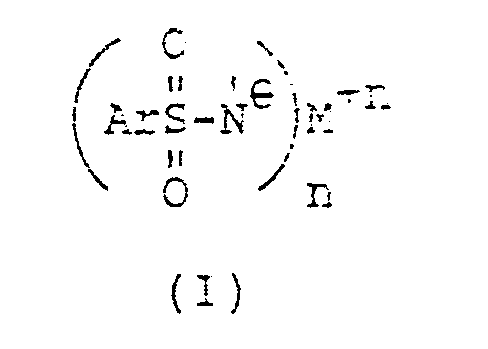
wherein Ar is an aromatic group, M is a metal cation and n is a number corresponding to the valence of M.
wherein Ar is an aromatic group, M is a metal cation and n is a number corresponding to the valence of M.
3. The composition of Claim 1 characterised in that the sulfonamide is represented
by the formula:
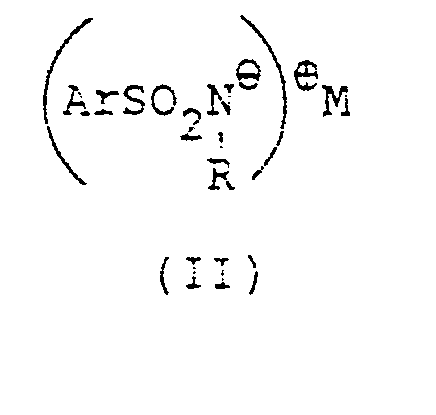
wherein Ar taken singularly is a monovalent carbocyclic aromatic moiety and R is a monovalent organic moiety or taken collectively Ar and R are a divalent aromatic moiety wherein both valencies are bonded to the -Nθ- and M⊕ is a monovalent cation.
wherein Ar taken singularly is a monovalent carbocyclic aromatic moiety and R is a monovalent organic moiety or taken collectively Ar and R are a divalent aromatic moiety wherein both valencies are bonded to the -Nθ- and M⊕ is a monovalent cation.
4. The composition of Claim 3 characterized in that the monovalent cation is sodium,
Ar is phenyl, aromatically substituted phenyl, phenylene or aromatically substituted
phenylene wherein the substituent(s) is halo, alkyl, aryl, amino, alkyl carbonyl,
alkaryl or aralkyl; R is carbonyl, aryl carbonyl, aryl aminocarbonyl, aryl sulfonyl,
thiazolyl, alkyl thiazolyl, pyrimidinyl, alkyl pyrimidinyl, quinolinyl or pyrrolidinyl.
5. The composition of Claim 4 characterized in that the sulfonamide is represented
by the formula:
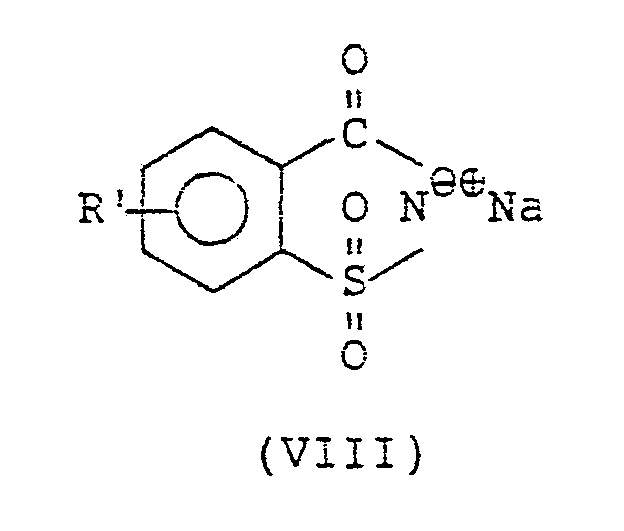
wherein R' is halo, hydrogen or alkyl.
wherein R' is halo, hydrogen or alkyl.
6. The composition of Claim 4 characterized in that the sulfonamide is represented
by the formula:
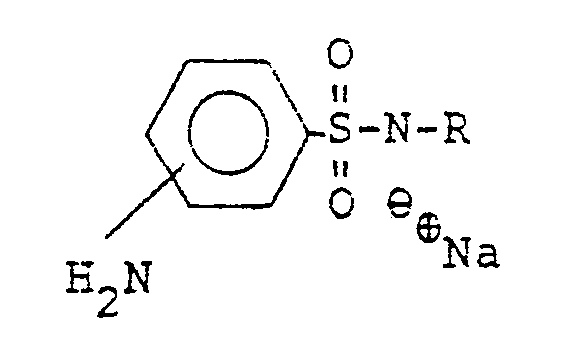
wherein R is aryl carbonyl, aryl amino carbonyl, aryl sulfonyl, thiazolyl, alkyl thiazolyl, pyrimidinyl, alkyl pyrimidinyl, quinolinyl or pyrrolidinyl.
wherein R is aryl carbonyl, aryl amino carbonyl, aryl sulfonyl, thiazolyl, alkyl thiazolyl, pyrimidinyl, alkyl pyrimidinyl, quinolinyl or pyrrolidinyl.