| (19) |
 |
|
(11) |
EP 0 015 035 B1 |
| (12) |
EUROPEAN PATENT SPECIFICATION |
| (45) |
Mention of the grant of the patent: |
|
16.02.1983 Bulletin 1983/07 |
| (22) |
Date of filing: 15.02.1980 |
|
|
| (54) |
Coating composition having a water-dilutable maleinized oil base, process for the
application and baking thereof and coated substrates thus obtained
Bekleidungszusammensetzung auf der Basis wasserverdünnbaren maleinisierten Öls, Verfahren
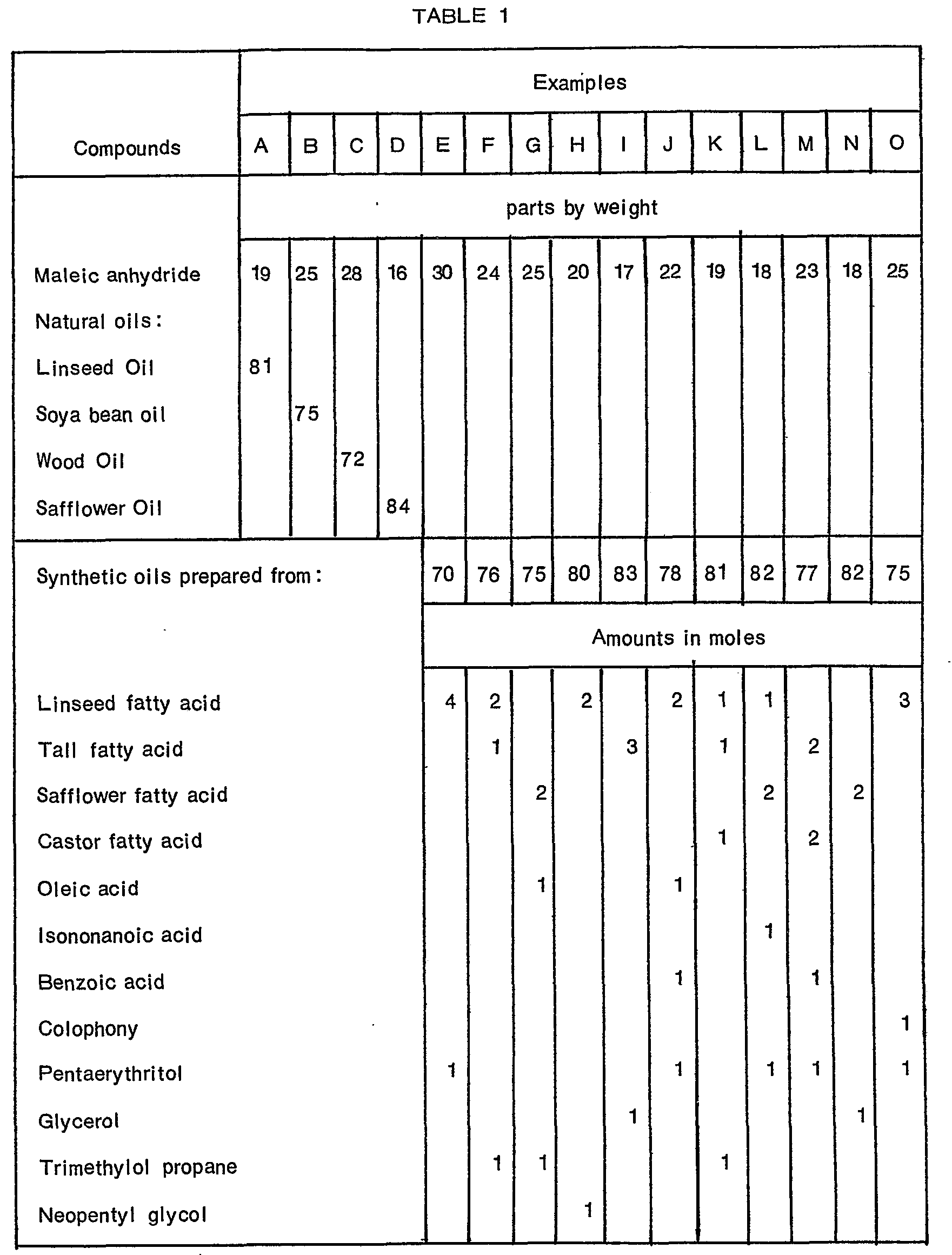
zur Anwendung und zum Backen und durch dieses Verfahren bekleidete Substrate
Composition de revêtement à base d'une huile maléinisée diluable à l'eau, procédé
pour son application ainsi que pour sa cuisson et substrats revêtus selon ce procédé
|
| (84) |
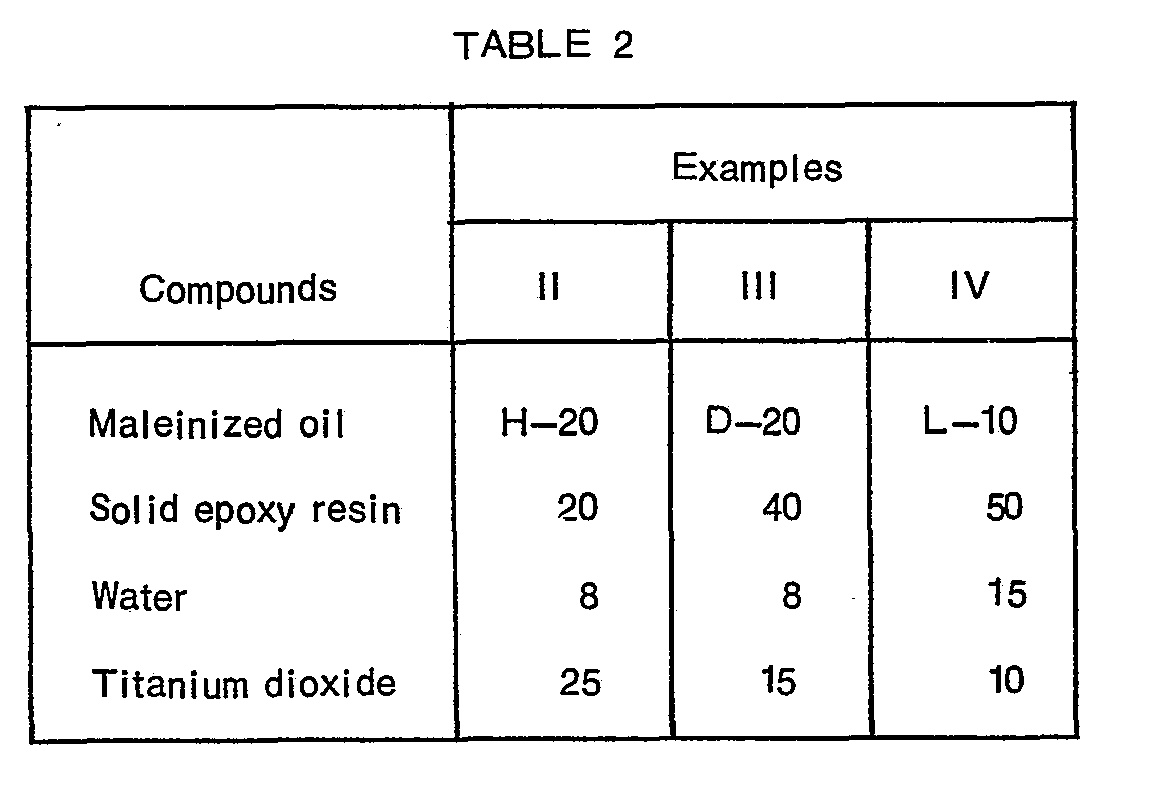
Designated Contracting States: |
|
AT BE DE FR GB IT NL SE |
| (30) |
Priority: |
17.02.1979 NL 7901275
|
| (43) |
Date of publication of application: |
|
03.09.1980 Bulletin 1980/18 |
| (71) |
Applicant: AKZO N.V. |
|
NL-6824 BM Arnhem (NL) |
|
| (72) |
Inventors: |
|
- Guenter, Gerhard
D-7505 Ettlingen (DE)
- Haeufler, Hartmut
D-7141 Aldingen (DE)
|
| (74) |
Representative: Sieders, René et al |
|
AKZO NOBEL N.V.
Patent Department (Dept. CO)
P.O. Box 9300
6800 SB Arnhem
6800 SB Arnhem (NL) |
|
| |
|
| Note: Within nine months from the publication of the mention of the grant of the European
patent, any person may give notice to the European Patent Office of opposition to
the European patent
granted. Notice of opposition shall be filed in a written reasoned statement. It shall
not be deemed to
have been filed until the opposition fee has been paid. (Art. 99(1) European Patent
Convention).
|
[0001] This invention relates to a coating composition based on a water-dilutable maleinized
oil. A water-dilutable maleinized oil of the type contemplated herein is a water-soluble
product obtained by the addition of an œ,,13-ethylenically unsaturated dicarboxylic
acid, for instance maleic acid or fumaric acid, or an anhydride thereof, to a product
which substantially consists of an ethylenically unsaturated monocarboxylic acid and
an alcohol containing 2 to 6 hydroxyl groups, for instance a trivalent or tetravalent
alcohol such as glycerol, trimethylol propane or pentaerythritol. Instead of or besides
said alcohols other hydroxyl compounds may be used, for instance low-molecular reaction
products of epichlorohydrin and bisphenol-A or copolymers from styrene and allyl alcohol.
[0002] Any suitable ethylenically unsaturated monocarboxylic acid which contains one or
more carbon to carbon double bonds may be used, such as, for example oleic acid, ricinoleic
acid, linoleic acid, linolenic acid, sorbic acid, eleostearic acid and licanic acid,
or mixtures thereof.
[0003] Any suitable ester of an ethylenically unsaturated monocarboxylic acid and a polyhydric
alcohol may be used, such as, for example, natural oils, such as linseed oil, soya
bean oil, sunflower oil, safflower oil, rape seed oil, cotton seed oil, wood oil,
fish oil and castor oil, or synthetic oils prepared from a fatty acid and a polyhydric
alcohol such as trimethylol propane or pentaerythritol. The ethylenically unsaturated
monocarboxylic acid or the polyol-ester thereof generally has an iodine value between
80 and 370, and preferably within the range of from 130 to 200.
[0004] In the maleinized oil still other compounds may be bonded, for instance: monocarboxylic
acids, such as palmitic acid, benzoic acid, p-tert-butyl benzoic acid, dicarboxylic
acids, and compounds such as colophony or dimerized, oxidized or hydrogenated colophony.
Further, the oil may be modified with, for instance, styrene, vinyl toluene or cyclopentadiene.
[0005] The maleinized oil contains 10 to 40 per cent by weight, and preferably 18 to 25
per cent by weight of the α,β-ethylenically unsaturated dicarboxylic acid and the
oil has an acid number in the range of 115 to 475, and preferably of 210 to 290.
[0006] To render the maleinized oil dilutable with water the oil is entirely or partly neutralized
in a known manner with an alkaline compound. Suitable alkaline compounds are inorganic
hydroxides, such as ammonia or lithium hydroxide, or primary, secondary or tertiary
amines, for instance, monoethylamine, monobutylamine, dimethylamine, diethylamine,
triethylamine, diethanolamine or triethanolamine.
[0007] The maleinized oil may be prepared in a known manner, for instance by reaction of
the α,ß- ethylenically unsaturated dicarboxylic acid with the ethylenically unsaturated
monocarboxylic acid or the polyol ester thereof, at a temperature generally within
the range of from 150° to 260°C, optionally in the presence of a catalyst.
[0008] The afore-described water-dilutable maleinized oils find application as film-forming
constituent in coating compositions such as varnishes and paints. Such coating compositions,
however, have a number of disadvantages. Particularly at a solids content of more
than 35%, only water being used as a solvent for the maleinized oil, the viscosity
is very high. Consequently, in order that these systems may be satisfactorily workable,
they must be thinned to such a degree that the solids content becomes too low, so
that a sufficiently thick coating can be obtained only be repeatedly applying the
coating composition to the substrate. Such a procedure, however, is very uneconomical.
Up till now it has been tried to somewhat remedy this disadvantage by adding an organic
solvent to the coating composition. During their handling and drying, however, the
compositions thus obtained present drawbacks as far as safety and environmental hygiene
are concerned.
[0009] An object of the invention is to provide a coating composition which is suitable
for industrial use, and more particularly for application in the automobile industry,
for instance as a coating of motor car bodies, and does not show the above-mentioned
drawbacks. The coating composition is little viscous in spite of its high solids content,
dries quickly and does not give any air pollution as a result of organic solvents
being absent in the composition since there is no longer any need for them and because
they generally may tend to give rise to solvating or swelling of the epoxy resin particles
and accordingly cause agglomeration thereof.
[0010] Besides, the coating composition is easy to apply and makes it possible to obtain
smooth surfaces without irregularities. Another advantage is that dried up rests of
the coating composition can for a long time, for instance a few days, still be washed
off with water.
[0011] The coating composition according to the invention is characterized in that it contains
a binder made up of 30-95% by weight of the water-dilutable maleinized oil and 5-70%
by weight of a solid particulate epoxy group-containing compound having a number average
molecular weight of at least 1000 and an epoxy equivalent weight in the range of 450
to 7500, the percentages by weight being calculated on the sum of the two solvent-free
components and said solid particulate epoxy group-containing resin having an average
particle size of 0,5 to 35 ,um. It is preferred that the binder should be made up
of 45-75% by weight of the maleinized oil and 25-55% by weight of the solid epoxy-group
containing compound, the percentages by weight being based on the sum of the two solvent-free
components. More preferably, the binder is made up of 52-75% by weight of the maleinized
oil and 25-48% by weight of the solid epoxy group-containing compound, the percentages
by weight being based on the two solvent-free components.
[0012] U.S. Patent Specification 4 042 478 discloses an aqueous electro-coating composition
containing as filmforming constituents:
a) a reaction product of maleinized oil and the esterification product of an epoxy
hydroxy polyether resin and a drying oil fatty acid, and
b) a water-dispersible cross-linking agent. Japanese Patent Application 64-25281 describes
an aqueous solution of maleinized oil and a liquid epoxy resin having a molecular
weight of less than 1000, the weight ratio of the epoxy resin to the maleinized oil
being in the range of 95:5 to 50:50. To promote the solubility of the epoxy resin
in the aqueous system it is preferred that an organic solvent, such as a monoalcohol,
for instance ethanol, or a glycol derivative, for instance ethylene glycol monoethyl
ether, should be added. From Japanese Patent Application 77-125535 it is known that
as colourant coloured powders of a thermoplastic synthetic resin and having a particle
size of 50 to 1200 ,um are added to an aqueous solution of maleinized oil to obtain
a multicoloured pattern. Representative examples of the powdered thermoplastic resin
are alkyd resins and (co)polymers of vinyl chloride. If the resulting coating composition
is dried at elevated temperature, then this temperature must be below the melting
point of the powdered thermoplastic resin used as colourant. It should be added that
Japanese Patent Application 64-25283 reveals a coating composition which is obtained
by dispersing a powdered thermoplastic resin, such as polyacrylate, polyvinyl chloride,
polyamide, polyethylene or polystyrene in an aqueous solution of a specific thermosetting
resin which upon heating becomes insoluble in water. The powdered thermoplastic resin,
which must have a particle size of 44-150 pm, will melt upon the applied layer of
the coating composition being heated, the resin particles adhering to each other to
form a continuous and uniform coating layer. The specific, water-soluble resin then
serves as a dispersing medium for the powdered thermoplastic resin. Representative
examples of the dispersing medium are copolymers of maleic anhydride and one or more
alkyl acrylates, coconut-modified polyester resins and melamine-formaldehyde resins.
[0013] The solid epoxy group-containing compound generally contains at least 1, but by preference
2 or more epoxy groups per molecule. For the sake of brevity the epoxy-group containing
compound will be referred to hereinafter as epoxy resin. As examples of suitable solid
epoxy resins may be mentioned: glycidyl-groups containing resins such as polyacryl
resins, polyesters, polyethers or polyurethanes which all contain one or more glycidyl
groups per molecule. It is preferred that the epoxy resin should be a compound of
the following general formula:

wherein R represents an aliphatic, cycloaliphatic or aromatic group and n is a number
within the range of from 0 to 150, preferably between 0 and 60. As examples of such
epoxy resins may be mentioned the glycidyl ethers of ethylene glycol, diethylene glycol,
triethylene glycol, 1,2-propylene glycol, 1,3-propylene glycol, 1,5-pentane diol,
bis-(4-hydroxycyclohexyl)-2,2-propane, 4,4'-dihydroxybenzophenone, bis-(4-hydroxyphenyl)-methane,
bis-(4-hydroxypheny))-1,1-ethane, bis-(4-hydroxyphenyl)-1,1-isobutane and 1,5-dihydroxynaphthalene.
Optionally, use may be made of poly- glycidyl ethers of compounds such as glycerol
or 1,2,6-hexane triol. More particularly, preference is given to the use of a diglycidyl
ether based on bis-(4-hydroxyphenyl)-2,2-propane. Also mixtures of epoxy resins may
be employed. The epoxy equivalent weight of the epoxy resin(s) is by preference 600-2000,
more particularly 800-1500. Preferably, the solid particulate epoxy resin has a number
average molecular weight in the range of 1000 to 1500. The solid particulate epoxy
resin has a melting point which is generally between 40°C and the baking temperature,
which is usually at 150° to 180°C; the melting point is preferably in the range of
70° to 130°C. The average particle size of the solid particulate epoxy resin is in
the range of 0,5 to 35 ,um, and is preferably in the range of 2 to 25 ,um.
[0014] The water-dilutable maleinized oil and the solid epoxy resin may be combined in a
simple manner, for instance by intermixing the solid epoxy resin and the maleinized
oil and subsequently grinding the epoxy resin in the presence of the maleinized oil.
Alternatively, however, the epoxy resin may be pulverized before it is mixed with
the oil. Of advantage is that with either method of mixing no surface active compounds
or protective colloids need be added.
[0015] The coating composition may contain the usual additives, for instance: pigments,
fillers and levelling agents. If desired, also additional cross-linking agents, for
instance melamine resins and melamine urea resins, may be used. The coating composition
may optionally also contain a liquid or solid cross-linking agent for the solid particulate
epoxy resin, such as:
a) a polyanhydride: for instance: pyrometallitic anhydride, copolymers of maleic anhydride
and styrene, ethylene and/or acrylate compounds, and adducts of maleic anhydride and
ethylenically unsaturated compounds such as unsaturated fatty acids and polybutadiene
compounds;
b) polyamino amides having an amino number of 80-400;
c) polyamines; for instance: ethylene diamine, diethylene triamine, triethylene tetramine,
iso- phoron diamine and xylene diamine;
d) anhydrides; for instance: phthalic anhydride, hexahydrophthalic anhydride and methyl
hexahydrophthalic anhydride;
e) polycarboxylic compounds; for instance: phthalic acid, trimellitic acid, copolymers
of (meth)acrylic acid and acrylate compounds and/or styrene and polyester resins having
an acid number generally of 50-430, but preferably of 100-200;
f) blocked polyisocyanates; for instance: hexamethylene diisocyanate blocked with
caprolactam or with a methylethyl ketoxime; and
g) compounds such as dicyandiamide. The cross-linking agents referred to above are
generally known (see for instance Lee and Neville, Handbook of Epoxy Resins, McGraw
Hill, New York) and need not be further described here. The cross-linking agent or
a mixture thereof is usually employed in an amount of 0,1 to 5% by weight, calculated
on the solid epoxy resin. Optionally, the cross-linking agent may previously be mixed
with the epoxy resin or be added to the aqueous composition or to some component thereof.
[0016] The coating composition may be applied to a substrate in any convenient way; for
instance by roller coating, spraying, brushing, sprinkling, flow coating or dipping.
It is preferred, however, that the coating composition be applied to the substrate
by electrostatic spraying. The coating composition applied is baked and cross-linked
at a temperature which is above the melting point of the solid epoxy resin. The temperatures
applied are in the range of 80° to 200°C, and preferably between 130° and 170°C.
[0017] The substrate may be of a pretreated or non-pretreated metal or synthetic material.
As examples of suitable metals may be mentioned iron, steel, zinc and aluminium.
[0018] The properties of the baked coating composition according to the invention at least
compare with those of the usual baking enamels.
Examples A-0
[0019] For the preparation of the maleinized oil first of all the synthetic oils to be used
were made, which was done by esterification of the various compounds mentioned in
Table 1 in the amounts given in it (expressed in moles). The esterification was carried
out in a reactor fitted with a stirrer, a thermometer, a water outlet, a cooler and
an inlet tube for an inert gas such as nitrogen or helium. All starting materials
were charged into the reactor in the order indicated, followed by adding 4% by weight
of xylene. The reaction mixture was melted and heated to boiling temperature (230°-240°C)
with stirring, and passing through a stream of inert gas, and in the presence of an
esterification catalyst (tin octoate). The water evolved during the esterification
was removed azeotropically by the xylene, the xylene being fed back into the reactor.
During the esterification, which may last up to 24 hours, the reaction process was
followed while determining the acid number. The reaction was allowed to proceed until
the acid number was below 10 and remained at this value upon continued heating of
the reaction mixture to 230°-240°C. Then the xylene was removed in vacuo.
[0020] Next, the resulting synthetic oils or the natural oils were reacted with maleic anhydride
in the amount given in Table 1 (parts by weight). The reaction was carried out in
a reactor equipped with a stirrer, a thermometer and a reflux condenser. The starting
materials were brought into the reactor in the order indicated, after which the reaction
mixture was kept at a temperature of 195°-220°C. After 3 hours the reaction mixture
no longer contained any free maleic anhydride and the reaction was stopped. The maleinized
oil was cooled to a temperature below 95°C asnd subsequently mixed with water and
triethylamine, in amounts such that an aqueous 40% solution having a pH of 7,5 was
obtained.
Example I
[0021] 49 parts by weight of each of the 40% aqueous solutions of the maleinized oils obtained
in accordance with the Examples A-0 were mixed with 11 parts by weight of a solid
epoxy resin consisting of a diglycidyl ether of bis-(4-hydroxyphenyl)-2,2-propane
having an epoxy equivalent weight of 900-1000 and a melting point of 96°-104°C. To
this mixture there were subsequently added 41 parts by weight of titanium dioxide
as pigment, after which the mixture was ground to a particle size of 25 µm. By adding
5-7% by weight of water the viscosity was set to 18 seconds (measured in conformity
with DIN 53211).
[0022] Of the resulting coating composition according to the invention 1 cross-coat was
applied to flat sheet metal to a thickness of 25‾200 µm and baked for 30 minutes at
170°C. The baked coatings showed indentation values of 1,3-2,5 (measured in accordance
with DIN 53156), hardness values of 100-150 (measured in accordance with DIN 53157),
gloss values of 30-50% (measured in accordance with Gardner 60
0), and elongation values of 5-12 mm (measured in conformity with ASTM D522-60). The
coatings obtained showed good to very good sanding properties both in the wet and
in the dry state.
[0023] For comparison the experiments were repeated, but in such a way that the solid particulate
epoxy resin was omitted. After the coating layers had been cured, they could be dissolved
by washing with alkaline water. The baked coatings were very soft and not resistant
to organic solvents. It can be concluded that maleinized oil cannot be considered
to be a thermosetting product. For, upon baking it would form a hard, insoluble and
solvent resistant coating layer which cannot be dissolved by washing with alkaline
water.
Examples II-IV
[0024] A 40% aqueous solution of a maleinized oil obtained in accordance with one of the
Examples H, D and L was mixed with a diglycidyl ether of bis-(4-hydroxyphenyl)-2,2-propane
respectively having an epoxy equivalent weight of 450-500 and a melting point of 64°-74°C
(Example II), an equivalent weight of 1700-2000 and a melting point of 125°-132° (Example
III) and an equivalent weight of 2500-4000 and a melting point of 140°-154°C (Example
IV). The composition of the maleinized oil is designated in Table 2 by the letter
of the Example in which the oil was prepared. The amounts of the two components mentioned
and those of the water and titanium dioxide still added are also mentioned in Table
2. subsequently, the mixture was ground to a particle size of less than 35 µm. Finally,
dimethylethanolamine was added to bring the pH of the coating composition to a value
of 7,8.
[0025] The coating composition was tested in exactly the same way as in the preceding examples.
The indentation values, hardness values, gloss values and elongation values were found
to be 1,2-2,5, 90‾160, 30-50% and 5-16 mm respectively. The coatings obtained show
good to very good sanding properties both in the wet and in the dry state.
Claims for the following Contracting State(s) : BE DE FR GB IT NL SE
1. A coating composition based on a water-dilutable maleinized oil, characterized
in that it contains a binder made up of 30-95% by weight of the water-dilutable maleinized
oil and 5-70% by weight of a solid particulate epoxy group-containing compound having
a number average molecular weight of at least 1000 and an epoxy equivalent weight
in the range of 450 to 7500, the percentages by weight being calculated on the sum
of the two solvent-free components, and said solid particulate epoxy group-containing
resin having an average particle size of 0,5 to 35 ,um.
2. The coating composition of claim 1, wherein the binder is made up of 45-75% by
weight of the maleinized oil and 25-55% by weight of the solid particulate epoxy group-containing
compound, the percentages by weight being based on the sum of the two solvent-free
components.
3. The coating composition of claim 1, wherein the binder is made up of 52-75% by
weight of the maleinized oil and 25-48% by weight of the solid particulate epoxy group-containing
compound, the percentages by weight being based on the sum of the two solvent-free
components.
4. The coating composition of claim 1, wherein the solid particulate epoxy group-containing
compound has an epoxy equivalent weight in the range of 600 to 2000.
5. The coating composition of claim 1, wherein the solid particulate epoxy group-containing
compound has an epoxy equivalent weight in the range of 800 to 1500.
6. The coating composition of claim 1, wherein the solid particulate epoxy group-containing
? compound has the aeneral formula:

wherein R is an aliphatic, cycloaliphatic or aromatic group and n is a number within
the range of from 0 to 150.
7. The coating composition of claim 1, wherein the solid particulate epoxy group-containing
compound is a diglycidyl ether based on bis-(4-hydroxyphenyl)-2,2-propane,
8. The coating composition of claim 1, wherein the average particle size of the solid
particulate epoxy group-containing compound is in the range of 2 to 25 pm.
9. The coating composition of claim 1, wherein the solid particulate epoxy group-containing
compound has a melting point in the range of 40° and a baking temperature of 150°
to 180°C.
10. The coating composition of claim 1, wherein the solid particulate epoxy group-containing
compound has a melting point in the range of 70 to 130°C.
11. The coating composition of claim 1, wherein the solid particulate epoxy group-containing
compound has a number average molecular weight in the range of 1000 to 15000.
12. A process for applying an aqueous coating composition to a substrate which comprises
applying the coating composition of claim 1 to the substrate by electrostatic spraying.
13. A process for coating a substrate which comprises applying the composition of
claim 1 to the substrate and baking the resulting coating at a temperature above the
melting point of the solid particulate epoxy group-containing compound.
14. The process of claim 13, wherein the resulting coating is baked at a temperature
of 150° to 180°C.
15. The coated substrate obtained by the process of one of the claims 12 to 14.
Claims for the following Contracting State(s) : AT
1. A process for preparing a coating composition based on a water-dilutable maleinized
oil, characterized in that it contains a binder made up of 30‾95% by weight of the
water-dilutable maleinized oil and 5-70% by weight of a solid particulate epoxy group-containing
compound having a number average molecular weight of at least 1000 and an epoxy equivalent
weight in the range of 450 to 7500, the percentages by weight being calculated on
the sum of the two solvent-free components, and said solid particulate epoxy group-containing
resin having an average particle size of 0,5 to 35 µm.
2. The process of claim 1, wherein the binder is made up of 45-75% by weight of the
maleinized oil and 25-55% by weight of the solid particulate epoxy group-containing
compound, the percentages by weight being based on the sum of the two solvent-free
components.
3. The process of claim 1, wherein the binder is made up of 52-75% by weight of the
maleinized oil and 25-48% by weight of the solid particulate epoxy group-containing
compound, the percentages by weight being based on the sum of the two solvent-free
components.
4. The process of claim 1, wherein the solid particulate epoxy group-containing compound
has an epoxy equivalent weight in the range of 600 to 2000.
5. The process of claim 1, wherein the solid particulate epoxy group-containing compound
has an epoxy equivalent weight in the range of 800 to 1500.
6. The process of claim 1, wherein the solid particulate epoxy group-containing compound
has the general formula:

wherein R is an aliphatic, cycloaliphatic or aromatic group and n is a number within
the range of from 0 to 150.
7. The process of claim 1, wherein the solid particulate epoxy group-containing compound
is a diglycidyl ether based on bis-(4-hydroxyphenyl)-2,2-propane.
8. The process of claim 1, wherein the average particle size of the solid particulate
epoxy group-containing compound is in the range of 2 to 25µm.
9. The process of claim 1, wherein the solid particulate epoxy group-containing compound
has a melting point in the range of 40° and a baking temperature of 150° to 180°C.
10. The process of claim 1, wherein the solid particulate epoxy group-containing compound
has a melting point in the range of 70 to 130°C.
11. The process of claim 1, wherein the solid particulate epoxy group-containing compound
has a number average molecular weight in the range of 1000 to 15000.
12. A process for coating a substrate which comprises applying a coating composition
that contains a binder made up of 30-95% by weight of a water-dilutable maleinized
oil and 5-70% by weight of a solid particulate epoxy group-containing compound having
a number average molecular weight of at least 1000 and an epoxy equivalent weight
in the range of 450 to 7500, the percentages . by weight being calculated on the sum
of the two solvent-free components, and said solid particulate epoxy group-containing
resin having an average particle size of 0,5 to 35µm, to the substrate and baking
the resulting coating at a temperature above the melting point of the solid particulate
epoxy group-containing compound.
13. A process for applying an aqueous coating composition to a substrate which comprises
applying a coating composition that contains a binder made up of 30-95% by weight
of the water-dilutable maleinized oil and 5-70% by weight of a solid particulate epoxy
group-containing compound having a number average molecular weight of at least 1000
and an epoxy equivalent weight in the range of 450 to 7500, the percentages by weight
being calculated on the sum of the two solvent-free components, and said solid particulate
epoxy group-containing resin having an average particle size of 0,5 to 35 pm, to the
substrate by electrostatic spraying.
14. The process of claim 12, wherein the resulting coating is baked at a temperature
of 150° to 180°C.
Revendications pour l'(les) Etat(s) contractant(s) suivant(s) : BE DE FR GB IT NL
SE
1. Composition de revêtement à base d'une huile maléinisée diluable à l'eau caractérisée
en ce qu'elle contient un liant constitué de 30 à 95% en poids de l'huile maléinisée
diluable à l'eau et de 5 à 70% en poids d'un composé solide en particules contenant
un radical époxy ayant une moyenne numérique du poids moléculaire d'au moins 1.000
et un poids équivalent en époxyde compris dans la gamme de 450 à 7.500, les pourcentages
en poids étant calculés pour la somme des deux composants sans solvants, et ladite
résine solide en particules contenant un radical époxy ayant une taille moyenne des
particules de 0,5 à 35,um.
2. Composition de revêtement selon la revendication 1, dans laquelle le liant est
constitué de 45 à 75% en poids de l'huile maléinisée et de 25 à 55% en poids du composé
solide en particules contenant un radical époxy, les pourcentages en poids étant exprimés
par rapport à la somme des deux composants sans solvants.
3. Composition de revêtement selon la revendication 1, dans laquelle le liant est
constitué de 52 à 75% en poids de l'huile maléinisée et de 25 à 48% en poids du composé
solide en particules contenant un radical époxy, les pourcentages en poids étant exprimés
par rapport à la somme des deux composants sans solvants.
4. Composition de revêtement selon la revendication 1, dans laquelle le composé solide
en particules contenant un radical époxy a un poids équivalent en époxyde compris
dans la gamme de 600 à 2000.
5. Composition de revêtement selon la revendication 1 dans laquelle le composé solide
en particules contenant un radical époxy a un poids équivalent en époxyde compris
dans la gamme de 800 à 1.500.
6. Composition de revêtement selon la revendication 1 dans laquelle le composé solide
en particules contenant un radical époxy répond à la formule générale:

dans laquelle R représente un radical aliphatique, cycloaliphatique ou aromatique
et n est un nombre compris dans la gamme de 0 à 150.
7. Composition de revêtement selon la revendication 1, dans laquelle le composé solide
en particules contenant un radical époxy est un éther diglycidylique à base de bis-(hydroxy-4
phényl)-2,2 propane.
8. Composition de revêtement selon la revendication 1 dans laquelle la taille moyenne
des particules du composé solide en particules contenant un radical époxy est comprise
dans la gamme de 2 à 25 !lm.
9. Composition de revêtement selon la revendication 1 dans laquelle le composé solide
en particules contenant un radical époxy a un point de fusion compris entre 40°C et
la température de cuisson de 150 à 180°C.
10. Composition de revêtement selon la revendication 1 dans laquelle le composé solide
en particules contenant un radical époxy a un point de fusion compris dans la gamme
de 70 à 130°C.
11. Composition de revêtement selon la revendication 1 dans laquelle le composé solide
en particules contenant un radical époxy a une moyenne numérique du poids moléculaire
comprise dans la gamme de 1.000 à 15.000.
12. Procédé pour appliquer une composition de revêtement aqueuse à un substrat qui
comprend l'application de la composition de revêtement selon la revendication 1 au
substrat par pulvérisation électrostatique.
13. Procédé pour revêtir un substrat qui comprend l'application de la composition
de la revendication 1 au substrat et la cuisson du revêtement obtenu à une température
supérieure au point de fusion du composé solide en particules contenant un radical
époxy.
14. Procédé selon la revendication 13 dans lequel le revêtement obtenu est cuit à une
température de 150 à 180°C.
15. Substrat revêtu obtenu selon le procédé de l'une quelconque des revendications
12 à 14.
Revendications pour l'(les) Etat(s) contractant(s) suivant(s) : AT
1. Procédé pour préparer une composition de revêtement à base d'une huile maléinisée
diluable à l'eau caractérisée en ce qu'elle contient un liant constitué de 30 à 95%
en poids de l'huile maléinisée diluable à l'eau et de 5 à 70% en poids d'un composé
solide en particules contenant un radical époxy ayant une moyenne numérique du poids
moléculaire d'au moins 1.000 et un poids équivalent en époxyde compris dans la gamme
de 450 à 7.500, les pourcentages en poids étant calculés pour la somme des deux composants
sans solvants, et ladite résine solide en particules contenant un radical époxy ayant
une taille moyenne des particules de 0,5 à 35 ,um.
2. Procédé selon la revendication 1, dans laquel le liant est constitué de 45 à 75%
en poids de l'huile maléinisée et de 25 à 55% en poids du composé solide en particules
contenant un radical époxy, les pourcentages en poids étant exprimés par rapport à
la somme des deux composants sans solvants.
3. Procédé selon la revendication 1, dans lequel le liant est constitué de 52 à 75%
en poids de l'huile maléinisée et de 25 à 48% en poids du composé solide en particules
contenant un radical époxy, les pourcentages en poids étant exprimés par rapport à
la somme des deux composants sans solvants.
4. Procédé selon la revendication 1, dans lequel le composé solide en particules contenant
un radical époxy a un poids équivalent en époxyde compris dans la gamme de 600 à 2000.
5. Procédé selon la revendication 1 dans lequel le composé solide en particules contenant
un radical époxy a un poids équivalent en époxyde compris dans la gamme de 800 à 1.500.
6. Procédé selon la revendication 1 dans lequel le composé solide en particules contenant
un radical époxy répond à la formule générale:

dans laquelle
R représente un radical aliphatique, cycloaliphatique ou aromatique et n est un nombre
compris dans la gamme de 0 à 150.
7. Procédé selon la revendication 1, dans lequel le composé solide en particules contenant
un radical époxy est un éther diglycidylique à base de bis-(hydroxy-4 phényl)-2,2
propane.
8. Procédé selon la revendication 1 dans lequel la taille moyenne des particules du
composé solide en particules contenant un radical époxy est comprise dans la gamme
de 2 à 25 ,um.
9. Procédé selon la revendication 1 dans lequel le composé solide en particules contenant
un radical époxy a un point de fusion compris entre 40°C et la température de cuisson
de 150 à 180°C.
10. Procédé selon la revendication 1 dans lequel le composé solide en particules contenant
un radical époxy a un point de fusion compris dans la gamme de 70 à 130°C.
11. Procédé selon la revendication 1 dans lequel le composé solide en particules contenant
un radical époxy a une moyenne numérique du poids moléculaire comprise dans la gamme
de 1.000 à 15.000.
12. Procédé pour revêtir un substrat qui comprend l'application d'une composition
de revêtement contenant un liant constitué de 30 à 95% en poids de l'huile maléinisée
diluable à l'eau et de 5 à 70% poids d'un composé solide en particules contenant un
radical époxy ayant un moyenne numérique du poids moléculaire d'au moins 1.000 et
un poids équivalent en époxyde compris dans la gamme de 450 à 7.500, les pourcentages
en poids étant calculés pour la somme des deux composants sans solvants, et ladite
résine solide en particules contenant un radical époxy ayant une taille moyenne des
particules de 0,5 à 35,um, au substrat et la cuisson du revêtement obtenu à une température
supérieure au point de fusion du composé solide en particules contenant un radical
époxy.
13. Procédé pour appliquer une composition de revêtement aqueuse à un substrat qui
comprend l'application d'une composition de revêtement contenant un liant constitué
de 30 à 95% en poids de l'huile maléinisee diluable à l'eau et de 5 à 70% poids d'un
composé solide en particules contenant un radical époxy ayant une moyenne numérique
du poids moléculaire d'au moins 1.000 et un poids équivalent en époxyde compris dans
la gamme de 450 à 7.500, les pourcentages en poids étant calculés pour la somme deux
composants sans solvants, et ladite résine solide en particules contenant un radical
époxy ayant une taille moyenne des particules de 0,5 à 35 ,um, au substrat par pulvérisation
électrostatique.
14. Procédé selon la revendication 12, dans lequel le revêtement obtenu est cuit à
une température de 150 à 180°C.
Patentansprüche für folgende(n) Vertragsstaat(en) : BE DE FR GB IT NL SE
1. Überzugzusammensetzung auf der Basis eines wasserverdünnbaren mafginisigrten Öfs, dadurch gekennzeichnet, dass sie einen Binder, hergestellt aus 30-95 Gew.-%
des wasserverdünnbaren maleinisierten Öls und 5-70 Gew.-% einer festen, feinteiligen,
Epoxygruppen enthaltenden Verbindung mit einem Zahlenmittel-Molekulargewicht von mindestens
1000 und einem Epoxy-Äquivalentgewicht im Bereich von 450 bis 7500 enthält, wobei
die Gewichtsprozentsätze auf die Summe der beiden lösungsmittelfreien Komponenten
berechnet sind und das feste, feinteilige, epoxygruppen enthaltende Harz eine durchschnittliche
Teilchengrösse von 0,5 bis 35 µm aufweist.
2. Zusammensetzung nach Anspruch 1, dadurch gekennzeichnet, dass der Binder aus 45-75
Gew.-% meleinisierten Öl und 25-55 Gew.-% der festen, feinteiligen, Epoxygruppen enthaltenden
Verbindung, bezogen auf die Summe der beiden lösungsmittelfreien Komponenten, hergestellt
ist.
3. Zusammensetzung nach Anspruch 1, dadurch gekennzeichnet, dass der Binder aus 52-75
Gew.-% maleinisiertem Öl und 25-48 Gew.-% der festen, feinteiligen, Epoxygruppen enthaltenden
Verbindung, bezogen auf die Summe der beiden lösungsmittelfreien Komponenten, hergestellt
ist.
4. Zusammensetzung nach Anspruch 1, dadurch gekennzeichnet, dass die feste, feinteilige,
Epoxygruppen enthaltende Verbindung ein Epoxy-Aquivalentgewicht im Bereich von 600
bis 2000 hat.
5. Zusammenzetzung nach Anspruch 1, dadurch gekennzeichnet, dass die feste, feinteilige,
Epoxygruppen enthaltende Verbindung ein Epoxy-Äquivalentgewicht im Bereich von 800
bis 1500 hat.
6. Zusammensetzung nach Anspruch 1, dadurch gekennzeichnet, dass die feste, feinteilige,
Epoxygruppen enthaltende Verbindung die allgemeine Formel

hat, worin R eine aliphatische, cycloaliphatische oder aromatische Gruppe, und n eine
Zahl im Bereich von 0 bis 150 ist.
7. Zusammensetzung nach Anspruch 1, dadurch gekennzeichnet, dass die feste, feinteilige,
Epoxygruppen enthaltende Verbindung ein Diglycidyläther auf der Basis von Bis(4-hydroxyphenyl)-2,2-propan
ist.
8. Zusammentsetzung nach Anspruch 1, dadurch gekennzeichnet, dass die durchschnittliche
Teilchengrösse der festen, feinteiligen, Epoxygruppen enthaltenden Verbindung im Bereich
von 2 bis 25 ,um liegt.
9. Zusammensetzung nach Anspruch 1, dadurch gekennzeichnet, dass die feste, feinteilige,
Epoxygruppen enthaltende Verbindung einen Schmelzpunkt im Bereich von 40° bis eine
Einbrenntemperatur von 150 bis 180°C hat.
10. Zusammensetzung nach Anspruch 1, dadurch gekennzeichnet, dass die feste, feinteilige,
Epoxygruppen enthaltende Verbindung einen Schmelzpunkt im Bereich von 70 bis 130°C
hat.
11. Zusammensetzung nach Anspruch 1, dadurch gekennzeichnet, dass die feste, feinteilige,
Epoxygruppen enthaltende Verbindung ein Zahlenmittel-Molekulargewicht im Bereich von
1000 bis 15000 hat.
12. Verfahren zum Aufbringen einer wässrigen Öberzugszusammensetzung auf ein Substrat,
dadurch gekennzeichnet, dass die Öberzugszusammensetzung gemäss Anspruch 1 durch elektrostatisches
Aufsprühen auf das Substrat aufgebracht wird.
13. Verfahren zum Öberziehen eines Substrats, dadurch gekennzeichnet, dass die Zusammensetzung
gemäss Anspruch 1 auf das Substrat aufgebracht und der resultierende Oberzug bei einer
über dem Schmelzpunkt der festen, feinteiligen, Epoxygruppen enthaltenden Verbindung
liegenden Temperatur eingebrannt wird.
14. Verfahren nach Anspruch 13, dadurch gekennzeichnet, dass der resultierende Öberzug
bei einer Temperatur von 150 bis 180°C eingebrannt wird.
15. Das überzogene Substrat, erhalten nach dem Verfahren gemäss einem der Ansprüche
12 bis 14.
Patentansprüche für folgende(n) Vertragsstaat(en) : AT
1. Verfahren zur Herstellung einer Überzugszusammensetzung auf der Basis eines wasserverdünnbaren
maleinisierten Öls, dadurch gekennzeichnet, dass sie einen Binder, hergestellt aus
30-95 Gew.-% des wasserverdünnbaren maleinisierten Öls und 5-70 Gew.-% einer festen,
feinteiligen, Epoxygruppen enthaltenden Verbindung mit einem Zahlenmittel-Molekulargewicht
von mindestens 1000 und einem Epoxy-Äquivalentgewicht im Bereich von 450 bis 7500
enthält, wobei die Gewichtsprozentsätze auf die Summe der beiden lösungsmittelfreien
Komponenten berechnet sind und das feste, feinteilige, epoxygruppen enthaltende Harz
eine durchschnittliche Teilchengrösse von 0,5 bis 35 µm aufweist.
2. Verfahren nach Anspruch 1, dadurch gekennzeichnet, dass der Binder aus 45-75 Gew.-%
maleinisiertem Öl und 25-55 Gew.-% der festen, feinteiligen, Epoxygruppen enthaltenden
Verbindung, bezogen auf die Summe der beiden lösungsmittelfreien Komponenten, hergestellt
ist.
3. Verfahren nach Anspruch 1, dadurch gekennzeichnet, dass der Binder aus 52-75 Gew.-%
maleinisierten Öl und 25-28 Gew.-% der festen, feinteiligen, Epoxygruppen enthaltenden
Verbindung, bezogen auf die Summe der beiden lösungsmittelfreien Komponenten, hergestellt
ist.
4. Verfahren nach Anspruch 1, dadurch gekennzeichnet, dass die feste, feinteilige,
Epoxygruppen enthaltende Verbindung ein Epoxy-Äquivalentgewicht im Bereich von 600
bis 2000 hat.
5. Verfahren nach Anspruch 1, dadurch qekennzeichnet, dass die feste, feinteilige,
Epoxygruppen enthaltende Verbindung ein Epoxy-Äquivalentgewicht im Bereich von 800
bis 1500 hat.
6. Verfahren nach Anspruch 1, dadurch gekennzeichnet, dass die feste, feinteilige,
Epoxygruppen enthaltende Verbindung die allgemeine Formel

hat, worin R eine aliphatische, cycloaliphatische oder aromatische Gruppe, und n eine
Zahlm im Bereich von 0 bis 150 ist.
7. Verfahren nach Anspruch 1, dadurch gekennzeichnet, dass die feste, feinteilige,
Epoxygruppen enthaltende Verbindung ein Diglycidyläther auf der Basis von Bis(4-hydroxyphenyl)-2,2-propan
ist.
8. Verfahren nach Anspruch 1, dadurch gekennzeichnet, dass die durchschnittliche Teilchengrösse
der festen, feinteiligen, Epoxygruppen enthaltenden Verbindung im Bereich von 2 bis
25 ,um liegt.
9. Verfahren nach Anspruch 1, dadurch gekennzeichnet, dass die feste, feinteilige,
Epoxygruppen enthaltende Verbindung einen Schmelzpunkt im Bereich von 40° bis eine
Einbrenntemperatur von 150 bis 180°C hat.
10. Verfahren nach Anspruch 1, dadurch gekennzeichnet, dass die feste, feinteilige,
Epoxygruppen enthaltende Verbindung einen Schmelzpunkt im Bereich von 70° bis 130°C
hat.
11. Verfahren nach Anspruch 1, dadurch gekennzeichnet, dass die feste, feinteilige,
Epoxygruppen enthaltende Verbindung ein Zahlenmittel-Molekulargewicht im Bereich von
1000 bis 15000 hat.
12. Verfahren zum Überziehen eines Substrats, dadurch gekennzeichnet, dass eine Überzugszusammensetzung
die einen Binder, hergestellt aus 30-95 Gew.-% eines wasserverdünnbaren maleinisierten
Ols und 5-70 Gew.-% einer festen, feinteiligen, Epoxygruppen enthaltenden Verbindung
mit einem Zahlenmittel-Molekulargewicht von mindestens 1000 und einem Epoxy-Äquivalentgewicht
im Bereich von 450 bis 7500 enthält, wobei die Gewichtspronzentsätze auf die Summe
der beiden lösungsmittelfreien Komponenten berechnet sind und das feste, feinteilige,
epoxygruppen enthaltende Harz eine durchschnittliche Teilchengrösse von 0,5 bis 35
µm aufweist, auf das Substrat aufgebracht und der resultierende Uberzug bei einer
über dem Schmelzpunkt der festen, feinteiligen, Epoxygruppen enthaltenden Verbindung
liegenden Temperatur eingebrannt wird.
13. Verfahren zum Aufbringen einer wässerigen Überzugszusammensetzung auf ein Substrat,
dadurch gekennzeichnet, dass eine Überzugszusammensetzung die einen Binder, hergestellt
aus 30-95 Gew.-% eines wasserverdünnbaren maleinisierten Öls und 5-70 Gew.-% einer
festen, feinteiligen, Epoxygruppen enthaltenden Verbindung mit einem Zahlenmittel-Molekulargewicht
von mindestens 1000 und einem Epoxy-Aquivalentgewicht im Bereich von 450 bis 7500
enthält, wobei die Gewichtspronzentsätze auf die Summe der beiden lösungsmittelfreien
Komponenten berechnet sind und das feste, feinteilige, epoxygruppen enthaltende Harz
eine durchschnittliche Teilchengrösse von 0,5 bis 35 ,um aufweist, durch elektrostatisches
aufsprühen auf das Substrat aufgebracht wird.
14. Verfahren nach Anspruch 12, dadurch gekennzeichnet, dass der resultierende Überzug
bei einer Temperatur von 150 bis 180°C eingebrannt wird.