|
(11) | EP 0 017 466 B1 |

| (12) | EUROPEAN PATENT SPECIFICATION |
|
|
| (54) |
A write and read objective lens Schreib- und Leseobjektiv Objectif pour l'enregistrement et la lecture |
|
|
|||||||||||||||||||||||||||||||
| Note: Within nine months from the publication of the mention of the grant of the European patent, any person may give notice to the European Patent Office of opposition to the European patent granted. Notice of opposition shall be filed in a written reasoned statement. It shall not be deemed to have been filed until the opposition fee has been paid. (Art. 99(1) European Patent Convention). |
[0001] The present invention relates to a write and read objective lens for encoding and recovery of information upon a storage member and, more particularly, to a write and read objective lens both for the encoding of high-density information upon a storage member, and for the recovery of high-density information which is optically encoded on a storage member.
[0002] A write and read objective lens for encoding and recovering of information upon a storage member must be utilisable with a plurality of wavelengths of light. This is required due to the use of the write and read objective lens as both the encoding objective lens and further as a reproducing lens for the recovery of the encoded information; the specific requirements for encoding and recovery differ greatly. A write objective lens must be of a high numerical aperture to provide a minimum spot size at the object; this provides for a high signal to noise ratio of the recorded information and a high storage density of information upon the storage member.
[0003] To provide the maximum available power through the objective lens for use in encoding information, the objective lens mst be as transparent as possible at the wavelength of light provided for the encoding of information (A=4420 nm). This can be accomplished by providing a multi-layer, anti-reflection coating on the lens surfaces. For an objective lens to be used in reproducing video signals from a video disc, it is required to guarantee a resolving power of at least 1µ due to the fact that the objective lens must recover the very small signals recorded at a high density. Moreover, the information recovered from the disc, which rotates at high speed, provides information for directing the objective lens to follow the recorded track and information for automatic focusing in addition to the stored video information. To ensure that the objective lens recovers those kinds of information correctly, the flatness of field focussed by the objective lens should be high. To prevent the objective lens from contacting the storage member which would result in the destruction of the storage member and the objective lens, the working distance of the objective lens should be long.
[0004] Further, to accomplish automatic focussing, the objective lens should be compact and light in weight. As the light source provided for generation of light provided to the objective lens for recovery of information is generally of the monochromatic type (A=6328 nm), it is effective for increasing the signal to noise ratio of the recovered signal as amplified after recovery by a photo detector that the objective lens be as highly transparent to light of this wavelength as possible. Therefore, to increase the transparency, it is possible to provide a multi-layer, anti-reflection coating on the lens surfaces and the number of lenses constituting the objective lens should be minimized.
[0005] It is, therefore, a primary objective of the present invention to provide a write and read objective lens for encoding and recovery of information upon a storage member which is utilizable at a plurality of wavelengths of light and further to provide a large working distance and high flatness of field and resolving power.
[0006] As shown in Figure 1, the write and read objective lens for encoding and recovery of information is a lens system comprising a first, second, third and fourth lens, said first lens being a positive meniscus lens with its concave surface positioned toward the object side, said second lens being a positive achromatic doublet, said third lens being a negative meniscus lens with its convex surface positioned toward the object side and said fourth lens being a positive lens. The write and read objective lens satisfies the following conditions. Reference symbol f represents the focal length of the lens system as a whole. Reference symbol f3 represents the focal length of the third lens, reference symbol f4 represents the focal length of the fourth lens, reference symbol r. represents the radius of curvature of the surface on the image side of the second lens, reference symbol r, represents the radius of curvature of surface on the object side of the third lens, reference symbol d1 represents the thickness of the first lens and reference symbol d5 represents the thickness of the positive lens part of the second lens.
[0008] When in the lens system of the above-mentioned configuration, re/f becomes larger than the upper limit of the condition (1), i.e., r6/f>1.24, distortion will increase and spherical aberration in the zonal and marginal portions will be overcorrected. When, on the contrary, r6/f becomes smaller than the lower limit, i.e., re/f<1.17, astigmation will be undercorrected. When d/f in the condition (2) becomes d/f>.46, the working distance becomes short and it becomes impossible to attain the object of the present invention. Moreover spherical aberration will be undercorrected and the astigmatic difference becomes large. When, on the contrary, it becomes d1/f<.37, coma and spherical aberration in the marginal portion will become unfavorable though the working distance becomes large. It is this condition which corrects additional spherical aberrations introduced by subsequent elements interposed in the long conjugate of the objective lens. If |r6|/ |r7| >.27, in the condition (3), spherical aberration and coma will be overcorrected. If | r6 |/|r7 | <.21, coma will be somewhat undercorrected. If, |f3|/| f4|> 1.20 in the condition (4), coma and spherical aberration in the marginal portion will become large. If, |f3| /| |f4| < 1.00, symmetry of coma will become unfavorable. Moreover, astigmatism will be undercorrected and will increase in a negative direction toward the marginal portion. If, in the condition (5), d5/f>.45 spherical aberration will be somewhat overcorrected and, at the same time, the astigmatic difference becomes large. If, on the contrary, d5/f<.40, coma will be somewhat overcorrected.
Brief description of the drawings
Embodiment I
[0009] Figure 1 shows a sectional view of the objective lens according to the present invention; and
[0010] Figure 2A, 2B, 2C, 2D, 2E, 2F, 2G, 2H, 21, 2J, 2K, and 2L, respectively, show graphs illustrating aberration curves of the present invention.
[0011] One embodiment of the write and read objective lens for use with a wavelength of light (A=4420 nm) suitable for the encoding of information upon a storage member is as follows:-
Embodiment 2
[0013] That write and read objective lens when used with a wavelength of light λ,=6328 nm suitable for the recovery of high density information upon a storage member has characterising as follows:―
[0014]
In the above-mentioned embodiments, reference symbols r1 through r1o' respectively, represent radii of curvature of respective lens surface. Reference symbols d1 through dg respectively, represent thicknesses of respective lenses and air spaces between respective lenses. Reference symbols n1 through n5, respectively, represent refractive indices of respective lenses. Reference symbols ν1 through ν5, respectively, represent Abbe's numbers of respective lenses. Reference symbol f represents the focal length of the lens system as a whole. Reference symbol f3 represents the focal length of the third lens. Reference symbol f4 represents the focal length of the fourth lens and reference symbol I represents the working distance of the lens system. As explained in the above, the lens system according to the present invention fully satisfies the requirements for a reproducing objective lens for videodiscs. This is also evident from the favorably corrected aberrations shown in respective graphs of aberration curves.
1. A write and read objective lens for encoding and recovery of information upon a
storage member comprising a first, second, third and fourth lens, said first lens
being a positive meniscus lens with its concave surface positioned toward the object
side, said second lens being a positive achromatic doublet, said third lens being
a negative meniscus lens with its convex surface positioned toward the object side,
and said fourth lens being a positive lens, said write and read objective lens being
utilizable with a plurality of wavelengths of light and satisfying the following conditions:
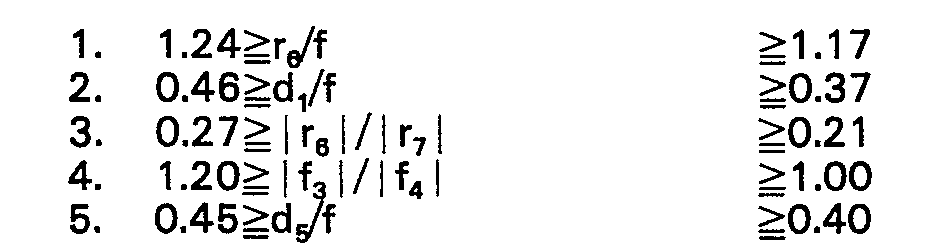
wherein f represents the focal length of the lens system as a whole, f3 represents the focal length of the third lens, f4 represents the focal length of the fourth lens, r6 represents the radius of curvature of the surface on the image side of the second lens, r7 represents the radius of curvature of surface on the object side of the third lens, d1 represents the thickness of the first lens and d5 represents the thickness of the positive lens part of the second lens.
wherein f represents the focal length of the lens system as a whole, f3 represents the focal length of the third lens, f4 represents the focal length of the fourth lens, r6 represents the radius of curvature of the surface on the image side of the second lens, r7 represents the radius of curvature of surface on the object side of the third lens, d1 represents the thickness of the first lens and d5 represents the thickness of the positive lens part of the second lens.
2. A write and read objective lens for encoding and recovery of information upon a
storage member as claimed in Claim 1, having the following numerical data:
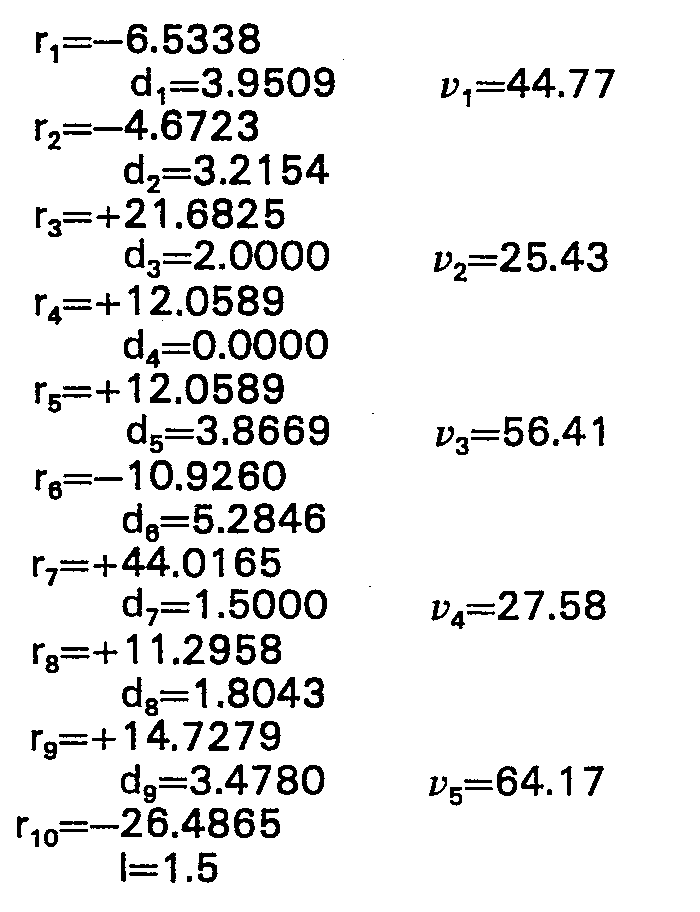
wherein r, through r10 respectively represent radii of curvature of respective lens surfaces, d1 through dg respectively, represent thickness of respective lenses and airspaces between respective lenses, ν1 through ν5 respectively, represents Abbe's numbers of respective lenses.
wherein r, through r10 respectively represent radii of curvature of respective lens surfaces, d1 through dg respectively, represent thickness of respective lenses and airspaces between respective lenses, ν1 through ν5 respectively, represents Abbe's numbers of respective lenses.
3. A write and read objective lens for encoding and recovery of information upon a
storage member as claimed in Claim 1 or Claim 2 in which said write and read objective
lens for encoding and recovery of information upon a storage member when used at a
wavelength of light A=6328 nm has the following numerical data:
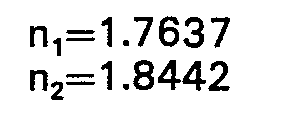
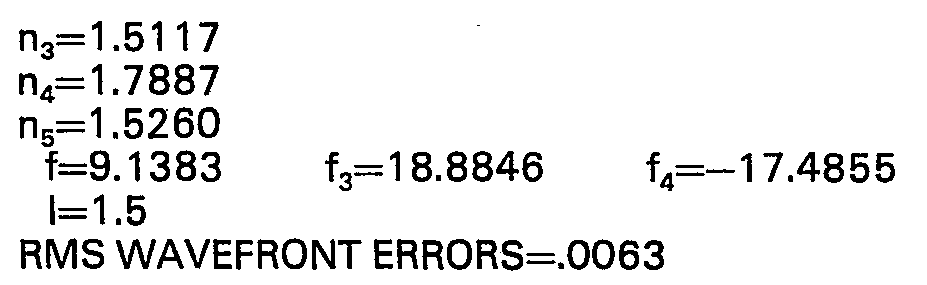
wherein n1 through n5, respectively, represent refractive indices of respective lenses, f represents the focal length of the lens system as a whole, f3 represents the focal length of the third lens, f4 represents the focal length of the fourth lens and I represents the working distance of the lens system.
wherein n1 through n5, respectively, represent refractive indices of respective lenses, f represents the focal length of the lens system as a whole, f3 represents the focal length of the third lens, f4 represents the focal length of the fourth lens and I represents the working distance of the lens system.
4. A write and read objective lens for encoding and recovery of information upon a
storage member as claimed in Claim 1 or Claim 2 in which said write and read objective
lens for encoding and recovery of information upon a storage member when used at a
wavelength of light A=4420 nm has the following numerical data:
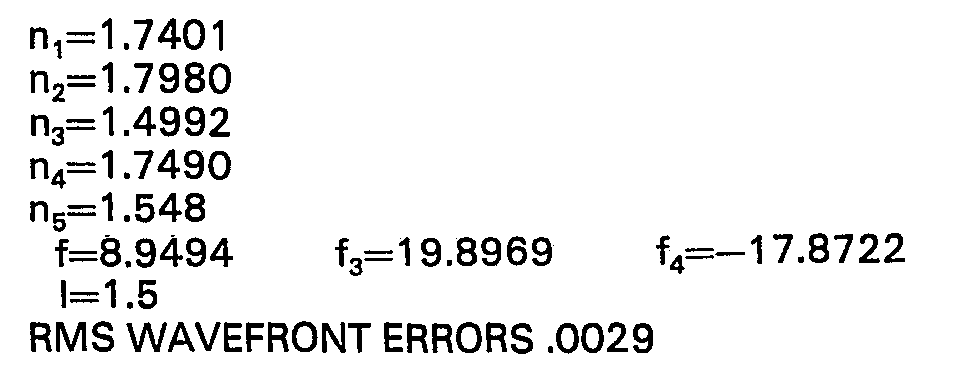
wherein n, through n5 respectively, represents refractive indices of respective lenses, f represents the focal length of the lens system as a whole, f3 represents the focal length of the third lens, f4 represents the focal length of the fourth lens and I represents the working distance of the lens system.
wherein n, through n5 respectively, represents refractive indices of respective lenses, f represents the focal length of the lens system as a whole, f3 represents the focal length of the third lens, f4 represents the focal length of the fourth lens and I represents the working distance of the lens system.
1. Schreib- und Leseobjektiv zum Einschreiben und Rückgewinnen von Informationen in
ein und aus einem Speicherelement, gekennzeichnet durch ein erstes, zweites, drittes
und viertes Glied, wobei das erste Glied ein sammelnder Meniskus mit dem Objekt zugewandter
Konkavfläche, das zweite Glied ein sammelndes achromatisches Doublet, das dritte Glied
ein zerstreuender Meniskus mit dem Objekt zugewandter Konvexfläche und das vierte
Glied ein Sammelglied ist, wobei ferner das genannte Schreibund Leseobjektiv bei einer
Mehrzahl von Lichtwellenlängen verwendbar ist und die folgenden Bedingungen erfüllt:
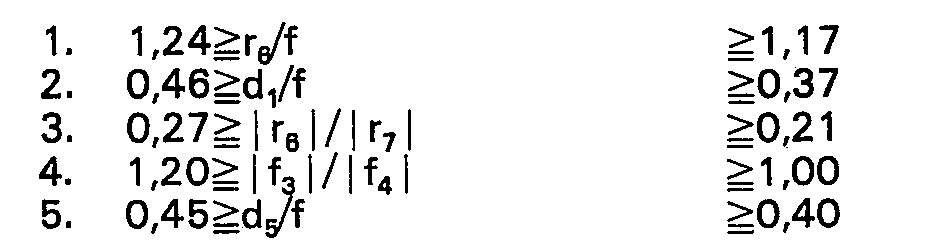
worin f die Brennweite des Gesamtlinsensystems bedeutet, f3 die Brennweite des dritten Gliedes, f4 die Brennweite des vierten Gliedes, r6 den Krümmungsradius der bildseitigen Fläche des zweiten Gliedes, r7 den Krümmungsradius der objektseitigen Fläche des dritten Gliedes, d1 die Dicke des ersten Gliedes und d5 die Dicke des sammelnden Teils des zweiten Gliedes.
worin f die Brennweite des Gesamtlinsensystems bedeutet, f3 die Brennweite des dritten Gliedes, f4 die Brennweite des vierten Gliedes, r6 den Krümmungsradius der bildseitigen Fläche des zweiten Gliedes, r7 den Krümmungsradius der objektseitigen Fläche des dritten Gliedes, d1 die Dicke des ersten Gliedes und d5 die Dicke des sammelnden Teils des zweiten Gliedes.
2. Schreib- und Leseobjektiv zum Einschreiben und Rückgewinnen von Informationen in
ein und aus einem Speicherelement, nach Anspruch 1, gekennzeichnet durch folgende
Konstruktionsdaten:
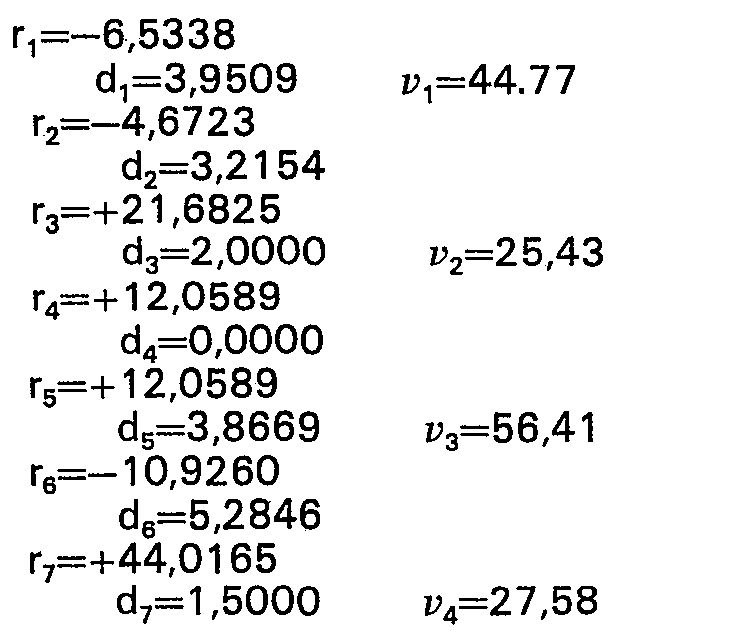
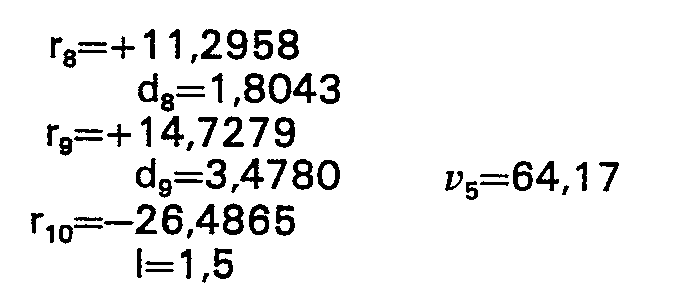
worin r1 bis r10 Krümmungsradien von zugeordneten Linsenflächen sind, d1 bis dg Dicken zugeordneter Linsen und Luftabstände, ν1 bis ν5 die Abbe'schen Zahlen der zugeordneten Linsen.
worin r1 bis r10 Krümmungsradien von zugeordneten Linsenflächen sind, d1 bis dg Dicken zugeordneter Linsen und Luftabstände, ν1 bis ν5 die Abbe'schen Zahlen der zugeordneten Linsen.
3. Schreib- und Leseobjektiv zum Einschreiben und Rückgewinnen von Informationen in
ein und aus einem Speicherelement, nach Anspruch 1 oder 2, dadurch gekennzeichnet,
daß das Schreib- und Leseobjektiv zum Einschreiben und Rückgewinnen von Informationen
in ein und aus einem Speicherelement bei der Anwendung einer Lichtwellenlänge von
λ=6328 nm die folgenden Konstruktionsdaten hat:
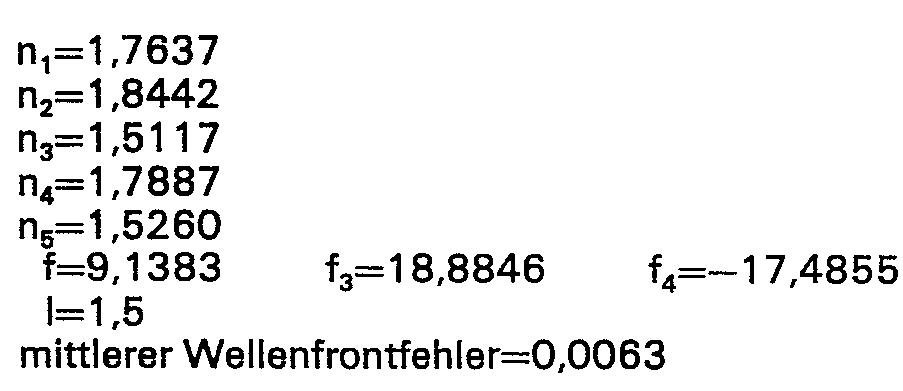
worin n1 bis n5 die Brechungsindizes der zugeordneten Linsen bedeuten, f die Brennweite des Gesamtlinsensystems, f3 die Brennweite des dritten Gliedes, f4 die Brennweite des vierten Gliedes und 1 den Arbeitsabstand des Linsensystems.
worin n1 bis n5 die Brechungsindizes der zugeordneten Linsen bedeuten, f die Brennweite des Gesamtlinsensystems, f3 die Brennweite des dritten Gliedes, f4 die Brennweite des vierten Gliedes und 1 den Arbeitsabstand des Linsensystems.
4. Schreib- und Leseobjektiv zum Einschreiben und Rückgewinnen von Informationen in
ein und aus einem Speicherelement, nach Anspruch 1 oder 2, dadurch gekennzeichnet,
daß das Schreib- und Leseobjektiv zum Einschreiben und Rückgewinnen von Informationen
in ein und aus einem Speicherelement bei der Anwendung einer Lichtwellenlänge von
λ=4420 nm die folgenden Konstruktionsdaten hat:
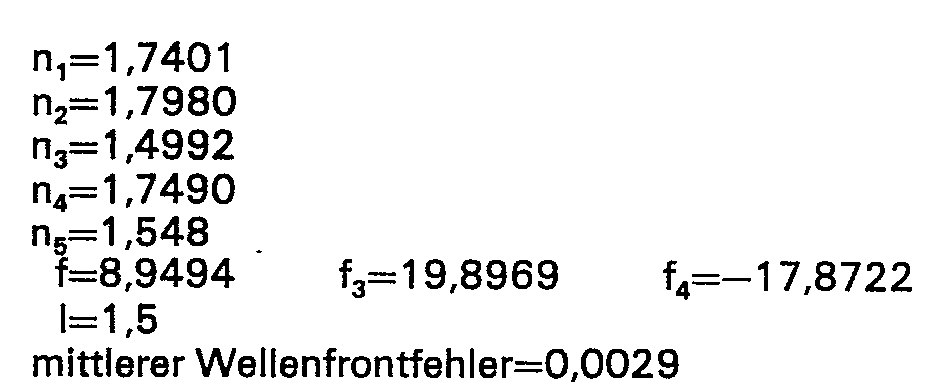
worin n, bis ns die Brechungsindizes der zugeordneten Linsen bedeuten, f die Brennweite des Gesamtlinsensystems, f3 die Brennweite des dritten Gliedes, f4 die Brennweite des vierten Gliedes und 1 den Arbeitsabstand des Linsensystems.
worin n, bis ns die Brechungsindizes der zugeordneten Linsen bedeuten, f die Brennweite des Gesamtlinsensystems, f3 die Brennweite des dritten Gliedes, f4 die Brennweite des vierten Gliedes und 1 den Arbeitsabstand des Linsensystems.
1. Objectif pour l'enregistrement et la lecture pour le codage et la restitution d'une
information sur un organe de stockage comprenant des première, seconde, troisième
et quatrième lentilles, ladite première lentille étant une lentille à ménisque positif
avec sa surface concave placée vers le côté objet, ladite seconde lentille étant un
doublet achromatique positif, ladite troisième lentille étant une lentille à ménisque
négatif avec sa surface convexe placée vers le côté objet, et ladite quatrième lentille
étant une lentille positive, ledit objectif pour l'enregistrement et la lecture étant
utilisable avec un certain nombre de longueurs d'onde de lumière et répondant aux
conditions qui suivent:
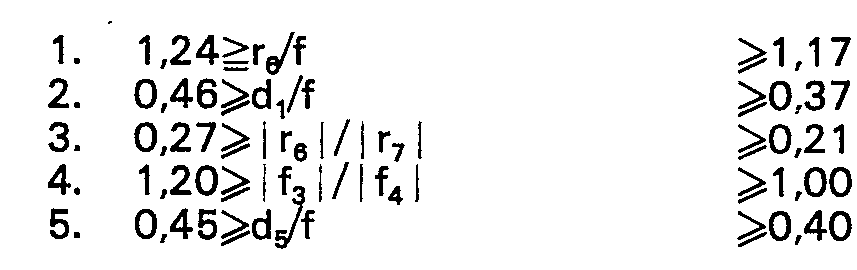
où f représente la longueur focale du système de lentilles dans son ensemble, f3 représente la longueur focale de la troisième lentille, f4 représente la longueur focale de la quatrième lentille, r6 représente le rayon de courbure de la surface du côté image de la seconde lentille, r7 représente le rayon de courbure de la surface du côté objet de la troisième lentille, d1 représente l'épaisseur de la première lentille et d5 représente l'épaisseur de la partie de lentille positive de la seconde lentille.
où f représente la longueur focale du système de lentilles dans son ensemble, f3 représente la longueur focale de la troisième lentille, f4 représente la longueur focale de la quatrième lentille, r6 représente le rayon de courbure de la surface du côté image de la seconde lentille, r7 représente le rayon de courbure de la surface du côté objet de la troisième lentille, d1 représente l'épaisseur de la première lentille et d5 représente l'épaisseur de la partie de lentille positive de la seconde lentille.
2. Objectif pour l'enregistrement et la lecture pour le codage et la restitution d'une
information sur un organe de stockage selon la revendication 1 ayant les données numériques
qui suivent:
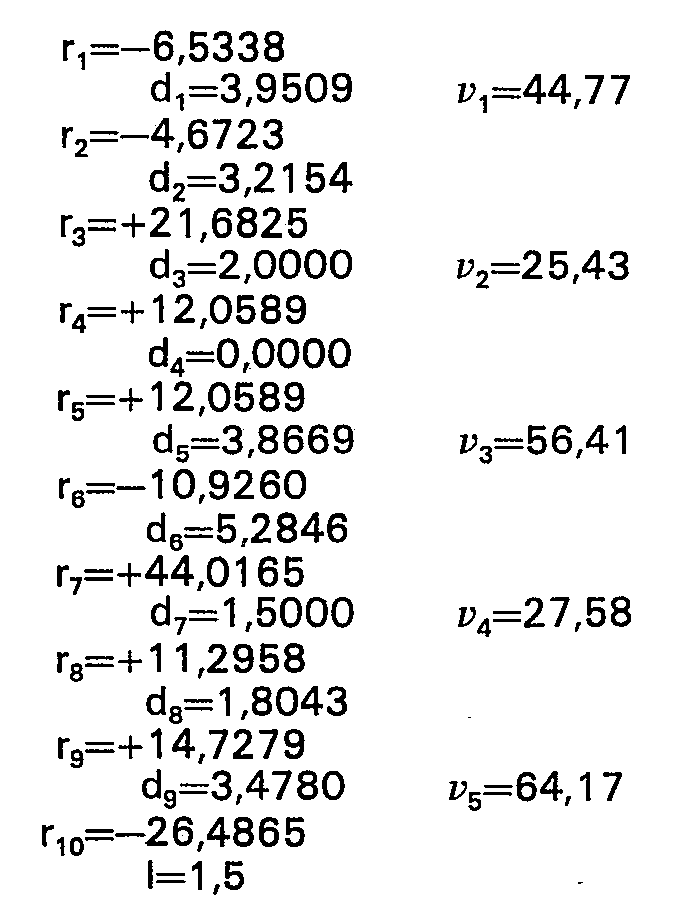
où r1 à r10 représentent respectivement les rayons de courbure des surfaces respectives des lentilles, d1 à d9 respectivement représentent l'épaisseur des lentilles respectives et les espaces d'air entre les lentilles respectives, ν1 à ν5 respectivement représentent les nombres d'Abbe des lentilles respectives.
où r1 à r10 représentent respectivement les rayons de courbure des surfaces respectives des lentilles, d1 à d9 respectivement représentent l'épaisseur des lentilles respectives et les espaces d'air entre les lentilles respectives, ν1 à ν5 respectivement représentent les nombres d'Abbe des lentilles respectives.
3. Objectif pour l'enregistrement et la lecture pour le codage et la restitution d'une
information sur un organe de stockage selon la revendication 1 ou la revendication
2, où ledit objectif pour l'enregistrement et la lecture pour le codage et la restitution
d'une information sur un organe de stockage quand on l'utilise à une longueur d'onde
de la lumière A=6328 nm a les données numériques qui suivent:
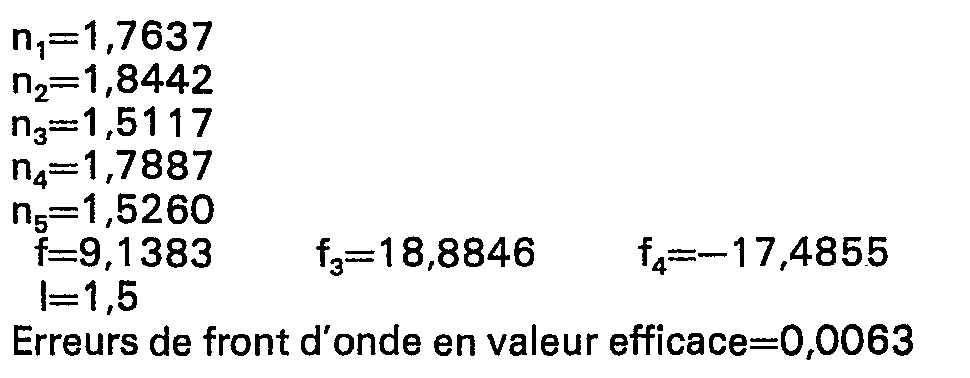
où n1 à n5 respectivement, représentent les indices de réfraction des lentilles respectives, f représente la longueur focale du système de lentilles dans son ensemble, f3 représente la longueur focale de la troisième lentille, f4 représente la longueur focale de la quatrième lentille et 1 représente la distance de travail du système de lentilles.
où n1 à n5 respectivement, représentent les indices de réfraction des lentilles respectives, f représente la longueur focale du système de lentilles dans son ensemble, f3 représente la longueur focale de la troisième lentille, f4 représente la longueur focale de la quatrième lentille et 1 représente la distance de travail du système de lentilles.
4. Objectif pour l'enregistrement et la lecture pour le codage et la restitution d'une
information sur un organe de stockage selon la revendication 1 ou la revendication
2, où ledit objectif pour l'enregistrement et la lecture pour le codage et la restitution
d'une information sur un organe de stockage quand on l'utilise à une longueur d'onde
de la lumière λ=4420 nm, a les données numériques qui suivent:
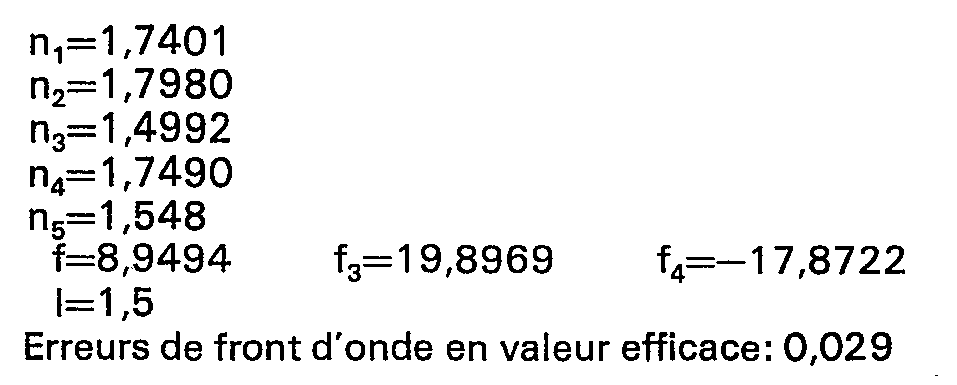
où n1 à n5 respectivement représentent les indices de réfraction des lentilles respectives, f représente la longueur focale du système de lentilles dans son ensemble, f3 représente la longueur focale de la troisème lentille, f4 représente la longueur focale de la quatrième lentille et l représente la distance de travail du système de lentilles.
où n1 à n5 respectivement représentent les indices de réfraction des lentilles respectives, f représente la longueur focale du système de lentilles dans son ensemble, f3 représente la longueur focale de la troisème lentille, f4 représente la longueur focale de la quatrième lentille et l représente la distance de travail du système de lentilles.