|
(11) | EP 0 017 478 A1 |

| (12) | EUROPEAN PATENT APPLICATION |
|
|
|
|
|||||||||||||||||||||||||||
| (54) | Dialkoxy- and dioxacycloalkyl-alkyltheobromines, pharmaceutical compositions containing them and their preparation |
| (57) Pharmaceutical compositions containing a compound of the formula (II):
wherein R, is a lower alkyl group and R2 is a lower alkyl group optionally linked to R, so that the OR1 and OR2 moieties and the carbon atom to which they are attached form a 1,3-dioxacyclohexa-2,2-diyl, 1,3-dioxacyclopenta-2,2-diyl or 1,3-dioxacyclohepta-2,2-diyl diradical, and a process for their preparation. |
[0001] The compound of the formula (I) :
was disclosed in DDR Patentschrift 129911 as being a chemical intermediate but no pharmacological activity was ascribed to it. It has now been found that the compound of the formula (I) and certain related compounds have similar pharmacological properties to pentoxyphilline and so may be used to promote blood flow through skeletal muscles which is desirable for the treatment of inter- mittant claudication.
[0002] The present invention provides a pharmaceutical composition containing a compound of the formula (II) :
wherein R1 is a lower alkyl group and R2 is a lower alkyl group optionally linked to R1 so that the OR and OR2 moieties and the carbon atom to which they are attached form a 1,3-dioxacyclohexa-2,2-diyl, 1,3-dioxacyclo- penta-2,2-diyl or 1,3-dioxacyclohepta-2,2-diyl diradical.
[0004] Most suitably R1 and R2 both represent the same lower alkyl group or alternatively are linked.
[0005] A particularly suitable acyclic value for R1 is the ethyl group. A particularly suitable acyclic value for R2 is the ethyl group.
[0006] A preferred compound of the formula (II) is that wherein R1 and R2 are linked so that the C(OR1)(OR2) moiety is a 1,3-dioxacyclopenta-2,2-diyl diradical.
[0007] The compounds of this invention may be used to treat vascular disorders in the same manner as pentoxyphilline is used. Thus for example they may be formulated into orally administrable unit dose forms that contain 100-500 mg of the compound of the formula (II). Such unit dose forms may be administered 1-4 times daily in such a manner that the daily dose for a 70 kg adult will usually be in the range 300-1500 mg per day.
[0008] Particuarly suitable unit dose forms are tablets and capsules. These forms will contain excipients in normal manner, for example lubricants such as magnesium stearate, disintegrants such as microcrystalline cellulose or sodium starch glycollate or the like.
[0009] The present invention also provides a process for the preparation of the compositions containing a compound of the formula (II), which process comprises bringing a compound of the formula (II) into association with a pharmaceutically acceptable carrier.
[0010] The compositions of this invention may be fabricated by conventional methods of blending, compressing, filling and the like, for example those methods known as suitable for pentoxyphilline.
[0011] The compounds of the formula (II) may be prepared by the method described in DDR Patentschrift 129911. Thus suitable methods comprise ketalising pentoxyfilline in conventional manner or reacting a salt of the 3,7-dimethylxanthine with CH3·C(OR1)·(CH2)·Cl or the like.
[0012] Ketalisation of pentoxyphilline may be brought about by reaction with a diol in benzene in the presence of p-toluene sulphonic and in conditions under which the water produced is removed. After about 1 day the benzene layer may be washed to remove excess diol and the benzene evaporated.
[0013] Acyclic ketals may be prepared by the reaction with an orthoester at ambient temperature. In this form of the process a large excess of the orthoester may be used so that the orthoester also acts as solvent. A catalyst such as Amberlyst 15 may also be employed (see Patwardhan et al., Synthesis, 1974, page 340).
[0014] Purifications of the initially produced product may be effected in conventional manner, for example by crystallisation from petroleum ether or the like.
[0015] Compounds of the formula (II) other than the compound of t1 formula (I) and are novel, and as such form an aspect of t1 present invention.
[0016] The compound of the formula (I) as a medicament for the promotion of blood flow through skeletal muscle is novel, and as such also forms an aspect of the present invention.
[0017] The following Examples illustrate the preparation of the pharmaceutical compositions and the compounds of the present invention.
Example 1
Tablet Composition
[0018] 2-Methyl-2-(theobrominyl-butyl-4)-1,3-dioxalane, magnesium stearate and microcrystalline cellulose may be blended together and passed through a 40 mesh sieve (UK). The mixture may be tabletted on a conventional rotary machine to produce a batch of 5000 tablets of the following composition :
Example 2
Capsule Composition
[0019] 2-Methyl-2-(theobrominyl-butyl-4)-1,3-dioxalane and magnesium stearate may be blended together and passed through a 40 mesh sieve (UK). The resulting mixture may be filled into two-part hard gelatin capsules to produce a batch of 5000 of the following composition :
Demonstration of Preparation
[0020] 1-(5-Oxohexyl)-3,7-dimethylxanthine (10.2 g), benzene (180 ml) and 1, 2-ethandiol (5.1 ml) were refluxed with p-toluenesulphonic acid (10 mg) . After three hours the reaction was complete. The reaction water had been collected in a water separator. The reaction mixture was washed several times with a solution of sodium carbonate and water and then dried over sodium sulphate, filtered and evaporated to dryness under reduced pressure. The residue was recrystallized from ethyl acetate to give 2-methyl-2-(theobrominylbutyl-4)-1,3 dioxalane (5.9 g) in the form of a white powder, melting point 93°C.
Illustration of Pharmacological Effectiveness
Methodology
[0022] Cats of either sex were anaesthetized by i.p. injection of urethane/chloralosc (120/60 mg/kg). The intraduodenal (i.d.) administration of compounds was conducted by means of a plastic.catheter which was inserted into the duodenum following midline incision at the abdominal cavity.
i) pO2-measurements
[0023] Measurement of muscle surface p02. The skin above the measuring site (3-4 mm in diameter) was removed and one multiwire-surface electrode (Eschweiler, Kiel) was placed on the gastrocnemius muscle of each hindlimb. The femoral artery in one hindlimb was ligated in order to induce ischaemia. Muscle temperature was controlled by means of a thermocouple (Ellab, Copenhagen). The electrode current was measured every 6 to 8 s and collected for periods of 4 min (Hewlett-Packard programmable data logger system 3051 A). After each period, mean value and standard deviation was calculated.
ii) Skeletal muscle contractility
[0024] After dissection of the skin of the calf muscles, the sciatic nerve was cut about 3 cm proximal to the knee. The tendon of the calf muscles was cut and connected with an isometric force transducer (SMEMA, SG 3). In order to maintain constant differences and a resting tension of 100 p in cats and 25 p in rats, the hindlimb was fixed at the tibia by means of a clamp. Direct stimulation of the muscles consisted of square wave pulses of 4 msec duration at a frequency of 2 Hz and at a voltage 50 V in cats. In order to keep the muscles wet. and at a normal temperature, the muscles were continuously superfused with 0.9% w/v NaCl solution (38°C). Femoral blood flow was restricted by a graded occlusion of the artery leading to a reduction of contractility by ca. 30 %. After having reached a constant level of the contraction force, the appropriate vehicle (NaCl or Methocel) was injected, followed by the test substance.
Results obtained with 2-Methyl-2-(theobrominyl-butyl-4)-1,3-dioxalane
i) pO2-msasurements
ii) skeletal muscle contractility
[0026]
n = number of animals
Cs = significance coefficient = number of measuring sites with significant p02 increase per total number of measuring sites
ΔpO2 = mean pO2 increase in experiments with significant pO2 increase (Torr E = efficiency-index = Cs x ΔpO2 (Torr)
Control values: E = between 0.1 and 1.2 Torr
i.d.* = intraduodenal administration of a suspension in Methocel°.
No toxic effects were observed at the above test dosages.
1. A pharmaceutical composition characterised by containing a compound of the formula
(II):
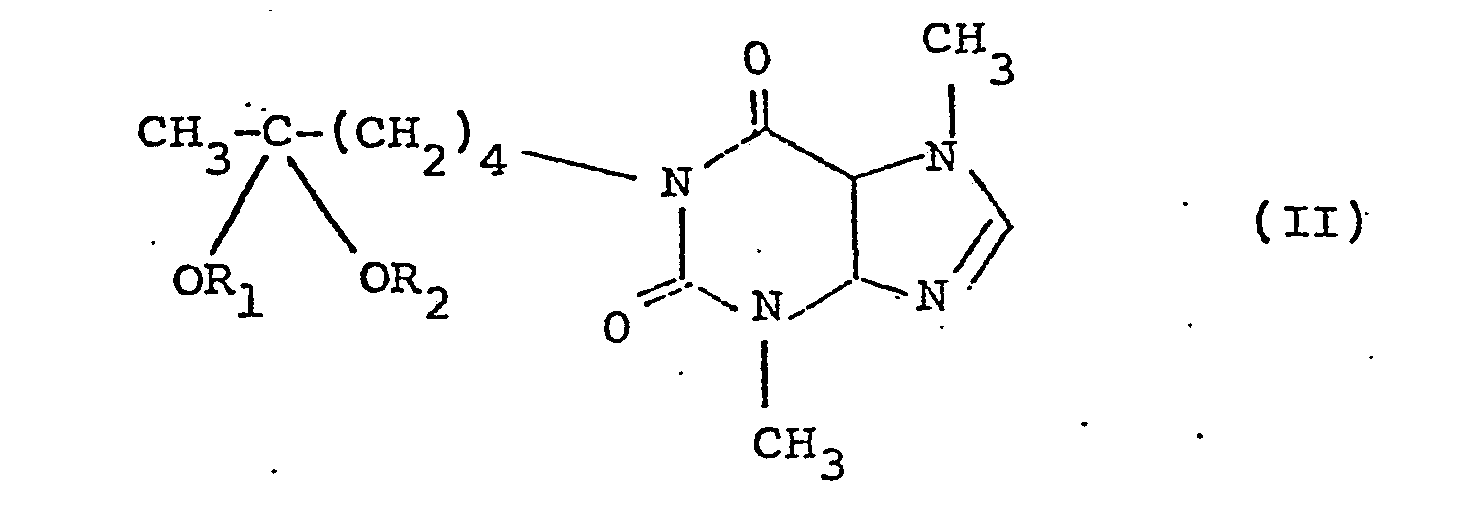
wherein R1is a lower alkyl group and R2 is a lower alkyl group optionally linked to Ri so that the OR1 and OR2 moieties and the carbon atom to which they are attached form a 1,3-dioxacyclohexa-2,2-diyl, 1,3-dioxacyclopenta-2,2-diyl or 1,3-dioxacyclohepta-2,2-diyl diradical.
wherein R1is a lower alkyl group and R2 is a lower alkyl group optionally linked to Ri so that the OR1 and OR2 moieties and the carbon atom to which they are attached form a 1,3-dioxacyclohexa-2,2-diyl, 1,3-dioxacyclopenta-2,2-diyl or 1,3-dioxacyclohepta-2,2-diyl diradical.
2. A pharmaceutical composition according to claim 1 characterised by containing a
compound of the formula (II), wherein R1 and R2 are the same lower alkyl group.
3. A pharmaceutical compoisition according to claim 1 characterised by containing
a compound of the formula (II), wherein the OR1 and OR2 moieties and the carbon atom to which they are attached form a 1,3-dioxacyclohexa-2,2-diyl,
1,3-dioxacyclopenta-2,2-diyl or 1,3-dioxacyclohepta-2,2-diyl diradical.
4. A pharmaceutical composition according to claim 3 characterised by containing 2-methyl-2-(4-theobrominylbutyl)-1,3-dioxalane.
5. A pharmaceutical composition according to any one of claims 1 to 4 which is a tablet.
6. A pharmaceutical composition according to any one of claims 1 to 4 which is a capsule.
7. A process for the preparation of a pharmaceutical composition according to claim
1 characterised by bringing a compound of the formula (II) into association with a
pharmaceutically acceptable carrier.
8. A process according to claim 7, characterised by blending the compound of the formula
(II) with the carrier and optionally thereafter compressing the resultant blend into
a tablet or filling the resultant blend into a capsule.
9. A compound of the formula (II) as defined in claim 1, other than 2-methyl- 2-(4-theobrominyl-butyl)-1,3-dioxalane.
10. 2-methyl- 2-(4-theobrominyl-butyl)-1,3-dioxalane for the promotion of blood flow
through skeletal muscle.