|
(11) | EP 0 018 415 A1 |

| (12) | EUROPEAN PATENT APPLICATION |
| published in accordance with Art. 158(3) EPC |
|
|
|
|
|||||||||||||||||||||||||||
| (54) | Process for producing alkyl 4-(alkoxy methyl phosphinoyl)butyrates and alkyl-(2-amino-4-(alkoxy methyl phosphinoyl)) butyrates |
| (57) Dialkyl 4-methylphosphinobutyrates represented by the following general formula;
(wherein R, represents hydrogen atom or acylamino group, and R2 and Rs each represents C1-C5 alkyl group) are intermediates for D,L-2-amino-4-methylphosphinobutyric acid useful as a herbicide, and are prepared by reacting a corresponding vinylacetic acid ester with methylphosphorous acid monoalkyl ester at 100-200"C in the presence of a radical-generating agent or under irradiation with ultraviolet rays. |
Scope of the invention
[0001] The present invention relates to 4-methylphosphinobutyric acid dialkyl esters and 2-substituted amino derivatives thereof which are intermediates useful for synthesis of herbicidal and anti-microbial DL-2-amino-4-methylphosphinobutyric acid, and to a process of producing the same.
Background of the invention
[0002] Several processes of producing DL-2-amino-4-methylphosphinobutyric acid have already been proposed. The examples of these processes include a process of producing said compound through β-chloroethyl-methyl-phosphinic acid β-chloroethyl ester, described by H. Gross et al (J. Pract. Chem. 318, p. 157, 1976), a process of producing the same from dialkyl methylphosphonite and 3-halopropanal dialkylacetal, by P. Mastalerz et al (Rocz. Chem. 49, p. 2127, 1975).
[0003] Furthermore, the present inventors have also proposed a process using a reaction between a 2-haloethyl-methyl-phosphinic acid ester and acetamidomalonic acid ester (Japanese Preliminary Patent Publication No. 48-91019).
Disclosure of the invention
[0004] The present inventors have made extensive research for estab -lishing a method to economically produce DL-2-amino-4-methylphosphinobutyric acid through intermediates different from and more advantageous than that of the above mentioned prior arts because of cheaper materials.
[0005] As a result of the research, it has been found that 4-methylphosphinobutyric acid dialkyl ester and 2-substituted amino-4-methyl- pbosphinobutyric acid dialkyl ester which are derived from vinyia- cetic acid ester and α-substituted amino-vinylacetic acid ester respectively by phosphorylation with methylphosphorous monoalkyl ester, and that said dialkyl esters can be effectively used for synthesis of DL-2-amino-4-methylphosphinobutyric acid by way of subsequent two independent pathways.
[0006] The present invention is advantageous industrially in that vinylacetic acid ester as the material for 4-methylphosphinobutyric acid dialkyl ester is inexpensive and that through 2-substituted -amino-4-methylphosphinobutyric acid dialkyl ester, the consumption of expensive phosphorous agent is limited to a minimum.
[0008] As a starting material, there is used vinylacetic acid ester or an α-substituted-amino-vinylacetic acid ester represented by the general formula
(1)
wherein R1 represents hydrogen atom, an acylamino group expressed by R3CONH-(Where R3is a C1-C5 lower alkyl group, trifluoromethyl group, trichloromethyl group, monochloromethyl group or phenyl group), a phthalimino group, or an N-acyl-N-benzylamino group expressed by
(where R4 is an acetyl group, trifluoroacetyl group or benzoyl group), and R2 represents a Cl-C5 lower alkyl group (straight or branched).
[0009] The ester of N-acyl-vinylglycine which is one of the representatives of α-substituted amino-vinylacetic acid esters of the formula (1) in which R1 is not hydrogen is obtained by treating vinylglycine (J.E. Baldwin et al, J. Org. Chem. 42, 1239, 1977) with an acid anhydride such as acetic anhydride, propionic anhydride or trifluoroacetic anhydride, or with an acid chloride such as acetyl chloride or benzoyl chloride and esterifying the N-acyl compound obtained.
[0010] The ester of N-benzyl-N-acyl-vinylglycine is obtained by reacting an α-bromo-vinylacetic acid ester with benzylamino in an organic solvent such as dimethylformamide, benzene, toluene, or dimethylsulfoxide and subjecting the resulting N-benzyl-vinylglycine ester to N-acylation with acetic anhydride or trifluoroacetic anhydride.
[0011] N-phthaloyl-vinylglycine ester is obtained by reacting x-bromo -vinylacetic acid ester with potassium phtalimide in a solvent such as dimethylformamide or dimethylsulfoxide.
[0012] The thus obtained vinylacetic acid ester or α-substituted -amino-vinylacetic acid ester is reacted with a methylphosphorous monoalkyl ester of the general formula (2)
wherein R5 represents a C1-C5 lower alkyl group (straight or branched), in the presence of a free radical-generating agent such as di-t-butyl peroxide, dibenzoyl peroxide, t-butyl peroxide, t-butyl hydroperoxide or acetylbenzoyl peroxide, or under ultraviolet-irradiating condition, usually in a solvent-free condition at a tenpera- ture ranging from 100 to 200°C for a reaction time of 1 to 8 hours.
[0014] By this reaction, there is obtained a 4-methylphosphinobutyric acid dialkyl ester or a 2-substituted-amino-4-methylphosphinobutyric acid dialkyl ester as a product of this invention, each expressed by the general formula (3)
wherein R1, R2 and R5 have each the same meaning as defined above.
[0015] The herbicidal DL-2-amino-4-methylphosphinobutyric acid can be prepared by subsequent different processes corresponding to the substituent Rl, as described below.
[0016] The resulting 4-methylphosphinobutyric acid dialkyl ester of the formula (3) in which the R1 is hydrogen is subjected to a hydrolysis reaction under an appropriate condition with an acid such as hydrochloric acid, sulfuric acid, hydrobromic acid or trifluoroacetic acid or an alkaline solution such as of sodium hydroxide, potassium hydroxide or barium hydroxide, to effect deesterification of the carboxylic ester, thereby giving 4-methylphosphinobutyric acid or 4-methylphosphinobutyric acid monoester of the general formula (4)
wherein R5 represents hydrogen atom or a lower alkyl of C1-C5 atoms (straight or branched).
[0017] For instance, when 4-methylphosphinobutyric acid dialkyl ester is heated in 0.1 to 2 N sodium hydroxide solution in water, aqueous ethyl alcohol or aqueous acetone, at 40 to 80°C for 1 to 5 hours, there is obtained 4-methylphosphinobutyric acid. When 4-methylphosphinobutyric acid dialkyl ester is heated in aueous 0.5 to IN hydrochloric acid at a temperature of 50 to 700C for 1 to 2 hours, the carboxylic acid ester alone is deesterified, there is obtained 4-methylphosphinobutyric acid monoester. Particularly, in the case of t-butyl ester of the carboxylic acid, the selective deesterification proceeds easily even at a room temperature.
[0018] The compound of the general formula (4) is converted to 2-halo- genocarboxylic acid of the general formula (5)
wherein R5 has the same meaning as defined above, and X represents a halogen atom, by the use of the halogenation reaction at the α-position of the carboxylic acid, as described below.
[0019] For example, the halogenation reaction is easily conducted either by subjecting the compound of the formula (4) to a bromination with bromine or a chlorination with sulfuryl chloride in the presence of a compound such as phosphorus trichloride, phosphorus tribromide or red phosphorus, or by converting the compound of the formula (4) to its acid chloride by treating with thionyl chloride, followed by chlorination by the reaction with chlorins gas in the presence of iodine, red phosphorus or an organic peroxide under ultraviolet-irradiating conditions.
[0020] Some of the reagents mentioned may induce not only the halogenation, but also conversion of the carboxylic acid moiety into the acid halode. In such a case, however, the treatment with cold water is sufficient to convert the acid halode to the original free carboxylic acid.
[0021] The thus obtained α-halide of the general formula (5) is then treated with a usually employable aminating agent such as concentrated aqueous ammonia or liquid ammonia to obtain DL-2-amino-4-methylphosphinobutyric acid as the final compound.
[0022] Alternatively, the compound of the general formula (5) may be reacted with sodium nitride or hydrazine to form an α-azide compound or an α-hydrazine compound which is subsequently reduced in a known manner to obtain the DL-2-amino-4-methylphosphinobutyric acid.
[0023] 2-substituted-amino-4-methylphosphinobutyric acid dialkyl ester of the formula (3) in which the R1 is other than hydrogen atom is hydrolyzed by the use of an inorganic acid such as hydrochloric acid, sulfuric acid or hydrobromic acid or of an alkaline solution containing sodium hydroxide, potassium hydroxide or barium hydroxide to obtain an intended compound of DL-2-amino-4-methylphosphinobutyric acid
[0024] The final compound can be separated from the reaction solution advantageously by an ion exchange chromatographic technique or a crystallization technique, by which pure DL-2-amino-4-methylphosphinobutyric acid can readily be obtained.
Preferred embodiments of the invention.
[0025] The present invention is now illustrated with reference to the following Examples to which the present invention is not limited in any way.
Example 1
[0026] 4.08g of methyl phosphorous monoisobutyl ester was placed in a 20ml flask, into which 3.42g of vinylacetic acid ethyl ester containing O.lg of t-butyl peroxide was dropped over 3 hours while agitating at 145 to 150 C. After reaction for further 1 hour at the temperature, the reaction product was dissolved in 20ml of chloroform, and charged into a silica gel column with a volume of 70ml, followed by eluting it with a mixed solvent of chloroform and methanol (20:1). The resulting eluate was concentrated to obtain 7.1g of an oily substance of 4-(0-isobutyl-methylphosphino)butyric acid ethyl ester.
Elementary analysis
Example 2
[0029] 6.0g of 4-(O-isobutyl-methylphosphino)butyric acid ethyl ester obtained in the Example 1 was dissolved in 40ml of aqueous IN sodium hydroxide solution and heated for 3 hours at 80°C.
[0030] The resulting reaction product was adjusted to pH 2.0 by addition of an aqueous 5N hydrochloric acid solution, and concentrated and evaporated to dryness as it is. The thus obtained residue was extracted with 30ml of ethanol and the extract was evaporated to dryness to obtain 3.4g of a syrup of 4-methylphosphinobutyric acid.
Elementary analysis
[0032] Calculated for C5H11O4P: C 36.14, H 6.63, 0 38.55, P 18.67% To 3.3g of the thus obtained 4-methylphosphinobutyric acid, was added 1.76g of bromine, to which was further 0.04ml of phosphorus trichloride, followed by reacting at 70°C for 15 hours under agitation.
[0033] The reaction product was evaporated to dryness to obtain 4.2g of a crude syrup of 4-methylphosphino-2-bromo-butyric acid.
[0034] The thus obtained substance was then dissolved, without purification, in 30ml of 28% aqueous ammonia and allowed to stand at room temperature for 6 days. The reaction product was evaporated to dryness to remove excess ammonia therefrom and then dissolved in 5ml of water. The solution was adjusted to pH 2 with aqueous 5N hydrochloric acid solution and evaporated to dryness. The residue was extracted with 20ml of ethanol and the extract was subjected to distillation to remove ethanol therefrom. The residue was subjected to column chromatography with 50ml of Dowex 1 x 2 (acetic acid type) which was developed with an aqueous 3N acetic acid solution, to collect a ninhydrin positive fraction, followed by concentrating and evaporating to dryness to obtain 1.4g of DL-2-amino-4-methylphosphinobutyric acid.
Example 3
[0035] 5.5g of the 4-(O-isobutyl-methylphosphino)butyric acid ethyl ester obtained according to Example 1 was suspended in 80ml of an aqueous 1N hydrochloric acid solution and heated at 70°C for 2 hours under agitation.
[0036] The reaction solution was evaporated to dryness and dried over sodium hydroxide in high vacuum to obtain 4.6g of 4-(O-isobutyl- methylphosphino)butyric acid.
[0037] This substance was found from the NMR spectrum that only the absorptions of 4-(O-isobutyl- methylphosphino)butyric acid ethyl ester at 1.25 (t) and 4.18(g) ppm disappeared.
Elementary analysis
[0040] Then, 20ml of thionyl chloride was added to 4.45g of the substance for reaction at 5G to 60°C for 2 hours with agitation. To the thionyl chloride solution of the acid chloride obtained was added 0.25g of iodine, followed by violently agitating at 85 to 90°C under ultraviolet irradiation while passing chlorine gas. The reaction time was 6 hours. The thionyl chloride was removed from the reaction solution by distillation and 10ml of iced water was added to the residue to decompose the acid chloride. The solution was again evaporated to dryness, followed by drying over sodium hydroxide in high vacuum to obtain 4.72g of a syrup of 2-chloro-4-(O-isobutyl-1-methylphino)butyric acid. 300 mg of the resulting syrup was dissolved in 0.5ml of methanol and was subjected to a silica gel column (40ml) which was then eluted with CHC13 -CH30H (5:1) to obtain 180mg of sample for analysis.
[0044] The remainder of the syrup was dissolved in 40ml of 28% aqueous ammonia and allowed to stand for 7 days at room temperature, and heated for 4 hours at 60 C.
[0045] The reaction solution was evaporated to dryness and then treated in the same procedue as in example 2 to obtain l.lg of DL-2-amino-4-methylphosphinobutyric acid.
Example 4
[0046] 1.2g of vinylglycine was dissolved in 10ml of trifluoroacetic acid, to which was added 2.4ml of trifluoroacetic anhydride at 0°C. After being agitated for 30 minutes, the solution was allowed to stand for 3 hours. The reaction solution was evaporated to dryness and the residue was dissolved in 10ml of methanol, to which was added 50ml of an ether solution of diazomethane at 0 to 5°C, followed by allowing to stand at 5°C for 1 hour.
[0047] The reaction solution was evaporated to dryness to obtain 2.3g of an oily substance of methyl N-trifluoroacetyl-vinylglycinate.
[0048] Then, 1.36g of methylphosphorous monoisobutyl ester was added to 2.1g of the oily substance obtained, followed by agitating at 150°C for 5 hours, while di-t-butyl peroxide, divided into 10 portions, was added portion by portion in a total amount of 0.2g. The reaction solution was evaporated to dryness and 3.43g of the product containing 4-(O-isobutyl-methylphosphino)-2-trifluoro-acetyl-aminobutyric acid methyl ester was obtained. 200mg of the product was dissolved in 0.5ml of chloroform and subjected to a silica gel column (30ml) which was then eluted with chloroform-methanol (40:1) to obtain 85mg oily sample to be analyzed.
Elementary analysis.
[0051] The remainder of the product was dissolved in 20ml of an aqueous 5N hydrochloric acid and hydrolyzed at 100°C for 4 hours. The hydrolyzed solution was evaporated to dryness and the residue was dissolved in 10ml of water and discolored with use of carbon powder, after which it was adjusted to pH 3 with aqueous 3N sodium hydroxide solution. The thus pH adjusted solution was concernt- rated to about 3ml, to which was added 8ml of ethanol, followed by allowing to stand at low temperature so as to effect crystalli- zation. The crystals were collected by filtration to obtain 1.35g of white crystals of DL-2-amino-4-methylphosphinobutyric acid.
[0052] This substance was found to exhibit the same melting point as the control substance without showing any depression of melting point.
Example 5
[0053] 1.8g of vinylglycine was dissolved in 9ml of water, into which was dropped 6ml of acetic anhydride under ice-cooloing over 2 hours with agitation.
[0054] The solution was agitated at 5 to 100C for further 5 hours and then evaporated to dryness, thereby obtaining crystals. The crystals were suspended in 5ml of acetone and then separated by filtration to obtain 2.1g of white crystals of N-acetylvinylglycine having a melting point of 118 to 119°C.
[0055] 2.0g of the crystals were dissolved in 80ml of methanol to which was added 0.3ml of concentrated sulfuric acid, followed by refluxing for 4 hours under heating conditions.
[0056] The reaction solution was allowed to cool, neutralized with sodium hydrogen carbonate, and evaporated to dryness. The residue was dissolved in 50ml of chloroform and washed 10ml of a saturated saline solution. The chloroform layer was dehydrated with anhydrous sodium sulfate and evaporated to dryness to give 2.2g of an oily substance of methylN-acetyl-vinylglycinate.
[0057] To 1.6g of the thus obtained methyl-N-acetyl-vinylglycinate was added 1.35g of methyl phosphorous monoisobutyl ester, to which was further added portion by portion 0.15g of di-t-butyl poroxide, divided into ten portions, while agitating at 160°C for 4 hours.
[0058] The reaction solution was evaporated to dryness to obtain 2.68g of the product containing 4-(0-isobutyl) methylphosphino-2-N-acetylbutyric acid methyl ester.
[0059] To the product was added 25ml of aqueous 6N hydrochloric acid solution to hydrolyze at 110°C for 20 hours. Then, the procedure of Example 4 was repeated to obtain 1.12g of crystals of DL-2-amino -4-methylphosphinobutyric acid.
Example 6
[0060] 2.5g of ethyl a-bromo-vinylacetate was dissolved in 10ml of dimethyl formamide, to which was added 2.38g of patassium phthalimide, followed by agitating at room temperature for 6 hours.
[0061] The reaction solution was diluted by addetion of 100ml of chloroform and the insoluble matter was removed by filtration. The resulting filtrate was washed twice with 30ml of a saturated saline solution. The chloroform layer was treated with anhydrous sodium salfate to remove water therefrom, concentrated to about 5ml, and allowed to stand at a low temperature, whereupon crystals precipitated in small amount. The crystals were removed by filtration and the filtrate was evaporated to dryness to obtain an oily substance. This substance was dissolved in 10ml of ethyl ether. When the solution was allowed to stand at a low temperature, crystals appeared. The crystals were collected by filtration to obtain 3.5g of white crystals of ethyl N-phthaloyl-vinylglycinate with a melting point of 95 to 97°C. To 1.29g of the crystals of ethyl N-phthaloyl-vinylglycinate was added 0.68g of methylphosphorous monoisobutyl ester and diluted with 3ml of xylene.
O.lg of di-t-butyl peroxide which had been divided into ten portions was added portion by portion to the mixture at 140°C over 6 hours under agitation.
[0062] The reaction solution was evaporated to obtain 1.46g of dried product containing 4-(O-isobutyl-methylphosphino)-2-N-phthalimido- butyric acid ethyl ester.
[0063] The product was dissolved in 5ml of aqueous 40% sulfuric acid and refluxed for 4 hours to effect hydrolysis. The reaction solution was decolorized with activated carbon powder and allowed to stand at low temperature, followed by separating precipitated crystals of phthalic acid by filtration.
1. 4-methylphosphinobutyric acid dialkyl ester of 2- substituted amino-4-methylphosphinobutyric
acid dialkyl ester represented by the general formula:
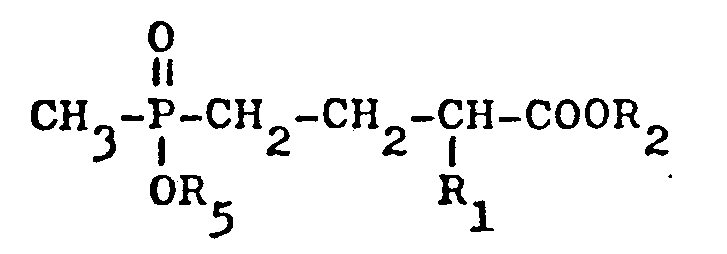
wherein R1 represents hydrogen atom, an acylamino group expressed by R3CONH-(wherein R3 is a C1-C5 lower alkyl group trifluoromethyl group, monochloromethyl group or phenyl group) a phthalimino group, or an N-acyl-N-benzylamino group expressed by

wherein R4 is an acetyl group, trifluoroacetyl group or benzoyl group), and R2 represents a C1-C5 lower alkyl group.
wherein R1 represents hydrogen atom, an acylamino group expressed by R3CONH-(wherein R3 is a C1-C5 lower alkyl group trifluoromethyl group, monochloromethyl group or phenyl group) a phthalimino group, or an N-acyl-N-benzylamino group expressed by
wherein R4 is an acetyl group, trifluoroacetyl group or benzoyl group), and R2 represents a C1-C5 lower alkyl group.
2. A process for production of 4-methylphosphinobutyric acid dialkyl ester of 2-substituted
amino-4-methylphosphinobutyric acid dialkyl ester represented by the general formula:
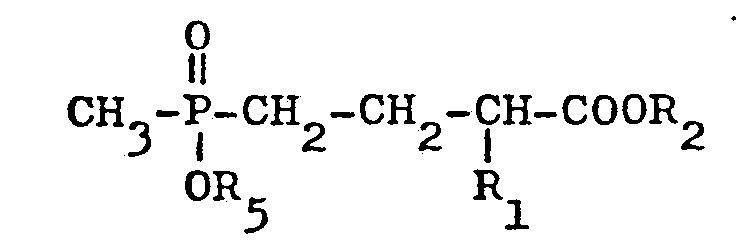
wherein R1 represents hydrogen atom, an acylamino group expressed by R3CONH-(wherein R3 is a C1-C5 lower alkyl group, trifluoromethyl group, trichloromethyl group, monochloromethyl group or phenyl group) a phthalimino group, or an N-acyl-N-benzylamino group expressed by

(wherein R4 is an acetyl group, trifluoroacetyl group or benzoyl group), and R2 represents a C1-C5 lower alkyl group, which comprises reacting vinylacetic acid ester or α-substituted amino-vinylacetic acid ester of the general formula:
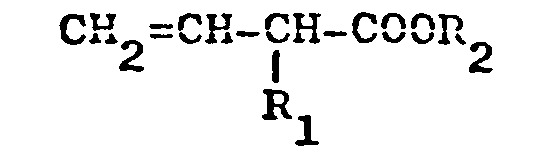
wherein R1 and R2 have each the same meaning as defined above, with a methylphosphorous monoalkyl ester of the general formula:
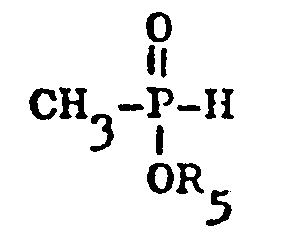
wherein R5 has the same meaning as defined above, in the presence of a free radical-generating agent or under ultraviolet-irradiating condition, at a temperature from 100 to 200°C.
wherein R1 represents hydrogen atom, an acylamino group expressed by R3CONH-(wherein R3 is a C1-C5 lower alkyl group, trifluoromethyl group, trichloromethyl group, monochloromethyl group or phenyl group) a phthalimino group, or an N-acyl-N-benzylamino group expressed by
(wherein R4 is an acetyl group, trifluoroacetyl group or benzoyl group), and R2 represents a C1-C5 lower alkyl group, which comprises reacting vinylacetic acid ester or α-substituted amino-vinylacetic acid ester of the general formula:
wherein R1 and R2 have each the same meaning as defined above, with a methylphosphorous monoalkyl ester of the general formula:
wherein R5 has the same meaning as defined above, in the presence of a free radical-generating agent or under ultraviolet-irradiating condition, at a temperature from 100 to 200°C.