|
(11) | EP 0 018 751 B1 |

| (12) | EUROPEAN PATENT SPECIFICATION |
|
|
| (54) |
Compositions comprising blends of polynorbornene and polyolefin resin and a process for making them Zusammensetzungen, die Gemische aus Polynorbornen und Polyolefinharz enthalten, und Verfahren zu deren Herstellung Compositions contenant des mélanges de polynorbornène et de résine polyoléfinique et procédé pour leur fabrication |
|
|
|||||||||||||||||||||||||||||||
| Note: Within nine months from the publication of the mention of the grant of the European patent, any person may give notice to the European Patent Office of opposition to the European patent granted. Notice of opposition shall be filed in a written reasoned statement. It shall not be deemed to have been filed until the opposition fee has been paid. (Art. 99(1) European Patent Convention). |
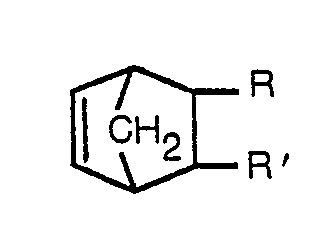
[0001] This invention relates to compositions comprising blends of polyolefin resin and polynorbornene. In this description of the invention and claims, "Polynorbornene" means a substantially amorphous homopolymer of bicyclo [2.2. 1] ] heptene-2 or of a substituted derivative of the formula
wherein R is H, CH3, COZCH3 or OCOCH3, and R' is H or COZCH3 with the condition that when R' is C02CH3 then R is also C02CH3, a substantially amorphous copolymer of bicyclo 12.2.1 J heptene-2 with one of its substituted derivatives of the above formula or a substantially amorphous copolymer of two of said substituted derivatives with each other.
[0002] High molecular weight polymers are generally incompatible with each other. When two different polymers are mixed, the blend exhibits poor mechanical properties, e.g., tensile strength or ultimate elongation. A pair of polymers is seldom sufficiently compatible to give a blend exhibiting mechanical properties as good as the weakest polymer. However, when two polymers are compatible the resulting blend can exhibit a valuable combination of properties, i.e., in addition to good mechanical properties, the blends may also exhibit favourable characteristics, such as temperature and solvent resistance of the individual polymers.
Summary of the Invention.
[0003] It has been discovered that compositions, comprising blends of thermoplastic crystalline polyolefin resin, polynorbornene, and sufficient polynorbornene plasticizer to lower the glass transition temperature (Tg) of the polynorbomene to within the rubbery range exhibit desirable properties. Generally, compositions comprising 1-99, and in particular 10-90, parts by weight of crystalline polyolefin resin and correspondingly 99-1, and in particular 90-10, parts weight of polynorbornene per 100 total parts by weight of resin and polynorbornene and enough plasticizer to reduce the Tg to below 10°C, typically between 30-400 parts by weight of polynorbornene and enough plasticizer to reduce the Tg to below 10°C, typically between 30-400 parts by weight of polynorbornene plasticizer per 100 parts by weight of polynorbornene, are moldable thermoplastic compositions exhibiting improved strength, greater toughness or impact resistance. Compositions comprising more than 80 parts by weight of crystalline polyolefin resin per 100 parts by weight of polyolefin resin and polynorbornene combined are thermoplastic compositions exhibiting improved impact resistance. Compositions comprising less than 80 parts by weight of crystalline polyolefin resin are elastoplastic, i.e., they exhibit elastomeric properties yet are processable as thermoplastics.
[0004] Preferred compositions of the invention comprise a blend of about 75 to 10 parts by weight of polyolefin resin, about 25 to 90 parts by weight of polynorbornene and sufficient plasticizer for the polynorbomene to make it rubbery at room temperature or below. Preferred amounts of plasticizer are generally between 50-200 parts by weight of plasticizer per 100 parts by weight of polynorbornene. More preferred elastomeric compositions comprise blends of about 20 to about 60 parts by weight of polyolefin resin and about 80 to about 40 parts by weight of polynorbornene per 100 parts by weight of crystalline polyolefin resin and polynorbornene combined. In the molten state, a portion of the polynorbomene plasticizer can be part of the thermoplastic molten polyolefin phase, said polyolefin normally being crystalline at room temperature. After cooling, the plasticizer will be substantially removed from the crystalline polyolefin phase to become a part of the polynorbornene phase. Thus, because of the plasticizer, the relative volume of the molten polyolefin phase can be much larger than the relative volume of the crystalline polyolefin phase. Hence, the plasticizer can improve fabricability or thermoplasticity of the composition. Also, the amount of plasticizer affects thermoplasticity. Less of the normally crystalline polyolefin may be required for thermoplasticity when larger amounts of plasticizer are used.
[0005] One embodiment of the invention consists of compositions comprising about 10-90 parts by weight of crystalline polyolefin resin and correspondingly about 90-10 parts by weight of cross-linked polynorbomene in the form of small particles (below about 50 microns number average) per 100 total parts by weight of polyolefin resin and polynorbornene, and plasticizer wherein the cross-linked polynorbomene is dispersed throughout the polyolefin resin as discrete particles. The size of the cross-linked plasticized polynorbornene particles is generally 50 microns number average or below and preferably is below 10 microns number average and more preferably below 0.1-2 microns number average. The particle size may be readily determined by diluting the cross-linked particles in a transparent matrix media and measuring and counting the particles under a microscope.
[0006] An improved balance of properties is obtained by cross-linking the polynorbornene. Cross-linking the polynorbornene increases the tensile strength of the composition. Substantially greater increases in tensile strength are obtained in compositions in which the polynorbornene/polyolefin resin ratio is greater than one. In addition, cross-linking improves the solvent resistance and the high temperature properties of the blend. The properties of the composition improve as the extent of cross-linking of the polynorbornene increases. In preferred compositions, the polynorbornene is cross-linked to the extent that no more than 20 weight percent, preferably no more than 10 weight percent, and more preferably no more than 5 weight percent of the polynorbornene is extractable in a solvent in which the noncross-linked polynorbornene is essentially completely soluble. A preferred solvent for determining the extent of cross-linking is a solvent in which the polyolefin resin is soluble so that the polynorbornene is completely exposed to the solvent, for example, boiling xylene. However, the polynorbornene should not be too highly cross-linked, i.e., the cross-link density should not be so high so as to reduce the elasticity to the extent that it is no longer rubbery. Likewise, extensive cross-linking of the polyolefin resin should be avoided so that thermoplasticity of the composition is maintained. However, it should not be assumed that the curative does not react with the polyolefin resin or that there is no reaction between the polyolefin resin and polynorbornene. There may be highly significant reactions involved but of limited extent. However, the fact that a large proportion of the polyolefin resin can be dissolved by extraction with a solvent for the polyolefin resin such as boiling xylene indicates that no extensive cross-linking of the polyolefin resin has occurred.
[0007] Another embodiment of the invention which consists of thermoset composition comprising a blend of polyolefin, plasticizer, and cross-linked polynorbornene in the form of a continuous network rather than being in particulate form. Thermoset compositions of the invention are prepared by first blending polyolefin resin, polynorbornene and plasticizer at a temperature sufficient to melt the polyolefin resin using a conventional masticating equipment. The composition is then transferred to a mill where curatives are incorporated therein at a temperature below the activation temperature of the curative system. The curable composition is then sheeted by passage through a roll mill or a shaped specimen is prepared. The sheet or shaped specimen is then cured by conventional means, typically by heating under pressure. The specimens may be cured either above or below the melting point of the polyolefin resin. When a specimen is cured below the melting point of the polyolefin resin, the physical properties of the cured specimen are dependent upon the direction of measurement because of orientation of resin particles. The degree of anistropy of any particular specimen depends upon the proportions of resin in the blend and the degree of orientation. Orientation of the resin particles can be conveniently achieved by passing a sheeted material one or more times through the rolls of an even speed mill.
[0008] Thermoplastic compositions of the invention in which the polynorbornene is cross-linked are preferably prepared by dynamic vulcanization, a process which comprises blending a mixture of polynorbornene, plasticizer, polyolefin resin and curvatives in amounts sufficient to cross-link the polynorbornene, then masticating the blend at a temperature sufficient to affect cross-linked formation, using conventional masticating equipment, for example, a Banbury mixer, a Brabender mixer, or a mixing extruder. An intimate mixture of polyolefin resin, polynorbornene, and polynorbornene plasticizer are mixed at a temperature sufficient to melt the polyolefin resin. After the polyolefin resin is melted, curative is added. Heating and masticating at vulcanization temperatures are generally adequate to complete the cross-link formation in a few minutes or less, but if shorter times are desired, higher temperatures may be used. A suitable range of temperatures for cross-link formation is from about the melting temperature of the polyolefin resin to the decomposition temperature of the polynorbornene which range commonly is from about 110°C to 250°C. Typically, the range is from about 130°C to 220°C. A preferred range of temperatures is from about 140°C to about 210°C. Blends are treated with curatives in amounts and under time and temperature conditions known to give cured products of plasticized polynorbornene alone. This can be determined from studies of static cures of polynorbornene in molds, in the absence of polyolefin resin. Thermosets are avoided in the compositions of the invention by simultaneously masticating and curing the blends. To obtain thermoplastic compositions, it may be important that mixing continues without interruption until cross-linking occurs. Sometimes, when appreciable cross-linking is allowed after mixing has stopped, a thermoset unprocessable composition may be obtained. However, this material may be converted to a thermoplastic by cold milling or by remixing in a mixer until the cross-linked polynorbornene is reduced to a particle size of 50 microns or below. A few simple experiments within the skill of the art utilizing available curative systems will suffice to determine their applicability for the preparation of the products of this invention.
[0009] Methods other than the dynamic vulcanization can be utilized to prepare compositions of the invention. For example, plasticized polynorbornene can be fully vulcanized in the absence of the polyolefin resin, comminuted, and mixed with the polyolefin resin at a temperature above the melting or softening point of the polyolefin resin. Provided that the cross-linked polynorbornene particles are small, well dispersed and in an appropriate concentration, compositions within the invention are easily obtained by blending cross-linked polynorbornene and polyolefin resin. In addition, thermoplastic compositions may be prepared by masticating a blend of polyolefin resin and plasticized polynorbornene, incorporating curatives and then curing under static conditions, such as, in a mold.
[0010] Thermoplastic compositions of the invention are all processable in an internal mixer, to products which, upon transferring at temperatures above the softening or crystallizing points of the polyolefin resin, to the rotating rolls of a rubber mill, from continuous sheets. The sheets are re-processable in the intemal mixer, after reaching temperatures above the softening or melting points of the polyolefin resin. The material is again transformed to the plastic state (molten state of the polyolefin resin) but upon passing the molten product through the rolls of the rubber mill a continuous sheet again forms. In addition, a sheet of thermoplastic composition of this invention can lie cut into pieces and compression molded to give a single smooth sheet with complete knitting or fusion between the pieces. It is in the foregoing sense that "thermoplastic" will be herein understood. In addition, elastoplastic compositions of the invention are further processable to the extent that articles may be formed by extrusion, injection molding or calendering.
[0011] Polynorbomenes satisfactory for the practice of the invention are substantially amorphous polymers or copolymers of bicyclo [2.2.1] heptene-2 and its substituted derivatives as described in U.S. Patent 3,676,390 issued July 11, 1972. Polynorbornene may be prepared as described in the reference patent. As indicated in the reference patent, it is necessary to use a low volatity liquid material in combination with the polynorbomene in order to convert the polynorbornene into its rubber form. For convenience, materials which lower the glass transistion temperature of polynorbornene to within the rubbery range are called plasticizers, more precisely polynorbornene plasticizers. Those substances described in the reference patent, Col. 2, lines 45-60 are satisfactory for the practice of this invention. Hydrocarbon oils typically used in rubber compounding and referred to as extender oils are suitable for the practice of this invention.
[0012] Any curing system suitable for vulcanizing diene rubber is suitable for cross-linking polynorbomene and may be used in the practice of this invention. Satisfactory rubber curatives are based on sulfur-, peroxide, azide, maleimido, quinoid, urethane, or phenolic resin vulcanization agents, ordinarily used in conjunction with vulcanization activators or accelerators. Examples of satisfactory curing system components are zinc oxide, sulfur, organic peroxide, magnesium oxide, benzothiazole sulfenamide accelerator, benzothiazyl disulfide, phenolic (phenol/formaldehyde) curing resin, stannous chloride, m-phenylene bis-maleimide, benzoquinone dioxime, thiuram disulfide, lead peroxide and dipentamethylene thiuram hexasulfide. Efficient or semi-efficient sulfur curing systems comprising high accelerator to sulfur ratios are especially preferred. Sufficient quantities of curatives are used to cross-link the polynorbornene to the extent necessary to achieve the desired extent of cure. High energy radiation is also utilizable as the curative means. Large amounts of organic peroxides should be avoided with branched polyolefin resins (e.g. polypropylene) and coagents should be used.
[0013] Suitable thermoplastic polyolefin resins comprise crystalline, high molecular weight solid products from the polymerization of one or more monoolefins by either high pressure or low pressure processes. Examples of such resins are the isotactic and syndiotactic monoolefin polymer resins, representative members of which are commercially available. Examples of satisfactory olefins are ethylene, propylene, 1-butene, 1-pentene, 1-hexene, 2-methyl-1-propene, 3-methyl-1-pentene, 4-methyl-1-pentene, 5-methyl-1-hexene and mixtures thereof. Commercially available thermoplastic polyolefin resins (or blends thereof), and preferably polyethylene or polypropylene, may be advantageously used in the practice of the invention with polypropylene being preferred.
[0014] The properties of the compositions of this invention may be modified by addition of ingredients which are conventional in the compounding of rubber, polyolefin resin and blends thereof. Additions can be before or after vulcanization. Examples of such ingredients include carbon black, silica, titanium dioxide, magnesia, colored pigments, clay, silanes, titanates or other coupling agents, stabilizers, antidegradants, processing aids, adhesives, tackifiers, wax, and discontinuous fibers such as wood cellulose or glass fibers, etc. The addition of particulate filler, preferably prior to dynamic vulcanization, is particularly recommended. Preferably, the particulate filler and plasticizer are masterbatched with the polynorbornene and the masterbatch is then mixed with the polyolefin resin. Particulate fillers such as carbon black or silane-treated clay, improve the tensile stength. Clay also can improve the ultimate elongation of the elastoplastic composition. Typical additions of particulate fillers or reinforcement fillers such as carbon black comprise about 20-150 parts by weight of filler per 100 parts by weight of polynorbornene and usually about 10-100 parts by weight filler per 100 parts total weight of polynorbomene and plasticizer. The amount of particulate filler which can be used depends, at least in part, upon the type of filler and the amount of plasticizer to be used.
[0015] Thermoplastic compositions of the invention are useful for making a variety of articles such as tires, hoses, belts, gaskets, moldings and molded parts. They are particularly useful for making articles by extrusion, injection molding and compression molding techniques. Compositions of the invention also are useful for blending with thermoplastics in particular, polyolefin resin. The compositions of the invention are blended with thermoplastics using conventional mixing equipment. The properties of the blend depend upon the proportions. Generally, the amount is such that the blend contains sufficient cross-linked polynorbornene to obtain the desired effect.
[0016] Tensile properties of the compositions are determined by ASTM procedure D-1 708-66. Specimens are pulled with an tensile tester at one inch per minute up to 30% elongation and then 10 inches per minute to failure. The term "elastomeric" as used herein and in the claims means a composition which possess the property of forcibly retracting within ten minutes to less than 160% of its original length after being stretched at room temperature to twice its unstressed length and held for ten minutes before release. Especially preferred compositions of the invention are rubbery compositions having tension set values of about 50% or less which compositions approximate the definition for rubber as defined by ASTM Standards, V. 28, page 756 (D1566). More preferred compositions are compositions having a Shore D hardness of 50 or below or a 100% modulus between 3-15 MPa (megapascals) or a Young's modulus below 100 MPa.
Description of the Preferred Embodiments.
[0017] When the dynamic vulcanization process is used, it is important that the polyolefin resin and plasticized polynorbornene are intimately mixed prior to vulcanization. A technique for assuring a homogenous polymer blend comprises first masticating the polymers at a temperature above the melting temperature of the polyolefin resin, next masticating the mixture at a temperature below the melting temperature of the polyolefin resin, and lastly masticating the mixture at a temperature above the melting temperature of the polyolefin resin. The duration of any of the three mastication steps can be, for example from 0.5 to 10 minutes. The aforesaid procedure gives a homogenous blend of polyolefin resin and polynorbornene in the form of well-dispersed small particles of fairly uniform size. Curatives are then added and mastication is continued until the plasticized polynorbornene is cross-linked.
[0018] Compositions of the invention are illustrated in Tables 1-7. Unless indicated otherwise, the compositions are prepared as follows: A masterbatch comprising in the indicated proportions polynorbornene, particulate filler (carbon black or clay), polynorbornene plasticizer (hydrocarbon extender oil), zinc oxide and stearic acid is first prepared by conventional means. The masterbatch and polyolefin resin are charged to a Brabender mixer at 180°C and a mixing speed of 100 rpm. Mastication is continued for about 5 minutes after the polyolefin resin is melted. The mixture is removed from the mixer and milled for about one minute on a roll mill at a temperature below the crystallization temperature of the resin. The mixture is then returned to the Brabender mixer and again melt mixed giving a homogenous thermoplastic blend. In the case of blends containing cross-linked polynorbornene, curatives are added at this time and mastication is continued until the polynorbornene is cross-linked (about 4 minutes). In the case of sulfur curative systems, the sulfur is added about 1/2 minutes after the accelerators. The composition is removed, sheeted on a mill, and then remixed in the Brabender mixer at 180°C for 2 minutes. Test specimens are prepared by compression molding at 220°C and then evaluated.
[0019] The effect of varying the proportions of polynorbornene and polypropylene is shown in Table 1. The polynorbornene is purchased under the tradename Norsorex (Registered Trade Mark). It is a polymer of bicyclo [2.2.11 ] heptene-2 having a molecular weight over 2,000,000, compounded density of 0.96 g/cm3, and a softening point about +35°C in the absence of plasticizer. The polypropylene is a low flow, general purpose polypropylene specific gravity 0.902 and 11 % yield elongation. The extender oil is purchased under the tradename Sunthene 4240 and is a naphthenic extender oil. The relative (to polynorbornene) proportions of extender oil and carbon black are kept constant. The amounts are 150 parts by weight extender oil and 100 parts by weight carbon black per 100 parts by weight of polynorbornene. The data in parenthesis are for compositions without curative.
[0020] The data show that hardness, tensile strength, 100% modulus, and Young's modulus E, increase with increasing proportions of polypropylene. The data show that cross-linking the polynorbornene results in substantial increases in tensile strength and 100% modulus and improves tension set. The improvement in tensile strength due to cross-linking is greater in compositions comprising 50 parts by weight or more polynorbornene per 100 total parts by weight of polypropylene and polynorbornene. Cross-linking reduces ultimate elongation except in compositions containing 80 parts by weight or more of polypropylene which compositions exhibit a yield point. All compositions are processable as thermoplastics.
[0021] Compositions of the invention comprising polyethylene, polybutene-1 and mixtures of polyolefin resins are illustrated in Table 2. The polyethylene is ASTM D- 1248-72, Type IV, having a melt index 0.6 and density of 0.960 g/cm3. The polybutene is purchased under the tradename Witron 1200.
The data in parenthesis are for blends prepared in a similar manner but without curatives. The data indicates that the effect of varying the proportions of polyethylene and polynorbornene (stocks 1-4) are similar to those obtained with polypropylene but that the improvement in properties due to cross-linking is not as great. However, polyethylene gives better compositions than those obtained with polybutene-1. A comparison of compositions containing a mixture of two polyolefin resins (stocks 6 and 7) shows that compositions comprising polypropylene and polybutene-1 are superior to compositions comprising polyethylene and polypropylene. This is surprising since, when polybutene-1 is the sole polyolefin resin, a weaker composition is obtained with substantially less improvement due to cure.
[0022] The effect of extender oil is illustrated in Table 3. The odd numbered stocks are controls containing no curative. A naphthenic extender oil is used. The data show a substantial improvement in properties results from cross-linking the polynorbornene. All compositions are processable as thermoplastics. Stocks 1 and 2 indicate that 25 parts by weight extender oil per 100 parts by weight of polynorbornene are insufficient to lower the glass transition temperature of the polynorbornene to within the rubbery range but that with increasing amounts of extender oil the compositions become more rubbery.
[0023] A study of the effect of different extender oils is shown in Table 4. The data show that compositions containing aromatic or naphthenic extender oils are superior to compositions containing paraffinic extender oil.
[0024] Compositions containing different particulate fillers are illustrated in Table 5. Silane A-172 (vinyl-tris-betamethoxy ethoxy silane) is a silane coupling agent for clays. The procedure for preparing the compositions is different than before. The step of mixing on a roll mill is omitted.
and the curatives are added to the Brabender mixer at 182°C after a homogenous mixture is obtained as shown by a smooth uniform appearance of the blend. Otherwise the procedure is the same. The data indicates that the properties of the compositions are essentially the same except the composition containing kaolin clay (Dixie clay) has superior utlimate elongation.
[0025] Compositions prepared with different curatives are illustrated in Table 6. The preparation procedure is the same as in Table 5 for stocks 1-5 and the same as in Table 1 for stock 6. Santocure@ accelerator is N-cyclohexyl-2-benzothiazolesulfenamide. Santocure@ NS accelerator is N-tert-butyl-2-benzothiazole sulfenamide. Sulfasan@ vulcanizing agent is 4-4' dithiodimorpholine. TMTD is tetramethylthiuram disulfide. TMTM is tetramethythiuram monosulfide. ZMDC is zinc dimethyldithiocarbamate. Novor 924 is an urethane type curative. SP1056 is brominated dimethylol-p-octyl phenol resin. The data show that satisfactory thermoplastic elastomeric compositions are obtained with all of the curvatives.
[0026] Compositions of the invention prepared by static curing are illustrated in Table 7. A masterbatch comprising in the indicated proportions polynorbornene, carbon black, extender oil, zinc oxide and stearic acid is prepared by conventional means. The masterbatch and polypropylene are charged to a Brabender mixer at 180°C and a mixing speed of 100 rpm before the polypropylene melts and 60-80 rpm thereafter. Mastification is continued for about 5 minutes after the polypropylene is melted. The
® Registered Trade Mark.
mixture is removed, cooled, milled for about one minute on a roll mill, then returned to the Brabender mixture and again melt mixed for about 5 minutes. The composition is then removed and cooled. A portion of the composition is compression molded at 220°C which comprises stock 1. Stock 2 is prepared by incorporating curatives into another portion of the composition by milling on a cool roll mill. The vulcanizable composition thus prepared is then cured in a press at 200°C for 10 minutes. The cured composition of Stock 2 is cut into small pieces and the pieces compression molded at 200°C to obtain stock 3. The molding has knit lines, however, there is no cracking when the specimen is bent. The cured composition of Stock 2 is milled at 60°C on a roll mill, then compression molded at 200°C to obtain stock 4. A smooth molding is obtained. Stock 5 is obtained by mixing the cured composition of Stock 2 in a Brabender mixer at 180°C for 5 minutes, removing, cooling and then compression molding the material at 200°C.The data show that stronger compositions are obtained by static curing and that the static cured product is processable as a thermoplastic. For purposes of comparison, Stock 6 of Table 1 represents a similar composition prepared by dynamic vulcanization. The comparison indicates that static cured compositions upon remolding have properties similar to the properties of dynamically cured compositions.
1. A composition comprising a blend of 1-99 parts by weight of thermoplastic crystalline
polyolefin resin, 99-1 parts by weight of polynorbornene per 100 total parts by weight
of polyolefin resin and polynorbomene, and sufficient plasticizer to lower the glass
transition temperature of the polynorbomene to below 10°C., the polynorbornene being
a substantially amorphous homopolymer of bicyclo [2.2.1] heptene-2 or of a substituted
derivative of the formula
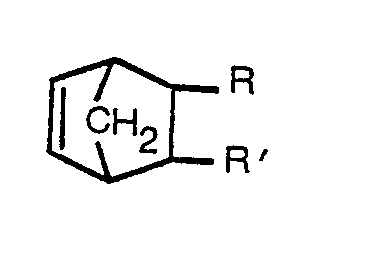
wherein R is H, CH3, CO2CH3 or OCOCH3, and R' is H or CO2CH3 with the condition that when R' is C02CH3 then R is also C02CH3, a substantially amorphous copolymer of bicyclo [2.2.1] heptene-2 with one of its substituted derivatives of the above formula or a substantially amorphous copolymer of two of said substituted derivatives with each other.
wherein R is H, CH3, CO2CH3 or OCOCH3, and R' is H or CO2CH3 with the condition that when R' is C02CH3 then R is also C02CH3, a substantially amorphous copolymer of bicyclo [2.2.1] heptene-2 with one of its substituted derivatives of the above formula or a substantially amorphous copolymer of two of said substituted derivatives with each other.
2. A composition of Claim 1 comprising 30-400 parts by weight of polynorbornene plasticizer
per 100 parts by weight of polynorbornene.
3. A composition of Claim 2 comprising 50-200 parts by weight of plasticizer per 100
parts by weight of polybornene.
4. The composition of any of Claims 1 to 3 comprising 10-90 parts by weight of polyolefin
resin and correspondingly 90-10 parts by weight of polynorbornene.
5. A composition of Claim 4 in which the polynorbornene is cross-linked.
6. A composition of Claim 5 that is a thermoplastic composition in which the cross-linked
plasticized polynorbornene is in the form of small dispersed particles of such a size
that the composition is processable as a thermoplastic.
7. A composition of Claim 6 which is an elastoplastic composition comprising a blend
of 10-75 parts by weight of polyolefin resin and 90-25 parts by weight of cross-linked
polynorbornene per 100 total parts by weight of polyolefin resin and polynorbornene.
8. A composition of Claim 7 comprising a blend of 20-60 parts by weight of polyolefin
resin and 80--40 parts by weight of cross-linked polynorbornene per 100 total parts
by weight of polyolefin resin and polynorbornene.
9. A composition of any of Claims 6 to 8 in which the particle size is 50 microns
number average or less.
10. A composition of Claim 9 in which the particle size is 10 microns number average
or less.
11. A composition of Claim 10 in which the particle size is 0.1-2 microns number average.
12. A composition of any of Claims 5 to 11 in which the polynorbornene is cross-linked
to the extent that no more than twenty weight percent of it is extractable in a solvent
in which noncross-linked polynorbornene is essentially completely soluble.
13. A composition of Claim 12 in which the polynorbornene is cross-linked to the extent
that no more than ten weight percent of it is extractable in a solvent in which noncross-linked
polynorbornene is essentially completely soluble.
14. A composition of any of Claims 5 to 13 prepared by masticating the appropriate
blend of polyolefin resin, polynorbornene and polynorbornene plasticizer with rubber
curative at cross-linking temperature until the polynorbornene is cross-linked.
15. A composition of any of Claims 1 to 14 in which the polynorbornene plasticizer
is an aromatic or naphthenic extender oil.
16. A composition of any of Claims 1 to 15 in which the polyolefin resin is polyethylene
or polypropylene.
17. A process for making a homogenous polymer blend, which comprises first masticating
a blend of 10 to 90 parts by weight of thermoplastic crystalline polyolefin resin,
90 to 10 parts by weight of polynorbornene per 100 total parts by weight of polyolefin
resin and polynorbornene, and sufficient plasticizer to lower the glass transition
temperature of the polynorbornene to below 10°C at a temperature and for a time sufficient
to melt the polyolefin resin, next masticating the mixture at a temperature below
the melting temperature of the polyolefin resin, and lastly masticating the mixture
at a temperature above the melting temperature of the polyolefin resin, the polynorbornene
being a substantially amorphous homopolymer of bicyclo [2.2.1] ] heptene-2 or of a
substituted derivative of the formula
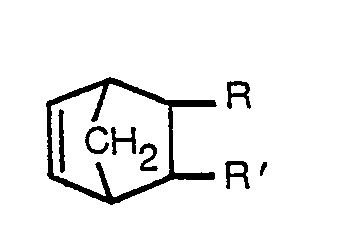
wherein R is H, CH3, C02CH3 or OCOCH3, and R' is H or C02CH3 with the condition that when R' is C02CH3 then R is also C02CH3, a substantially amorphous copolymer of bicyclo [2.2.1] ] heptene-2 with one of its substituted derivatives of the above formula or a substantially amorphous copolymer of two of said substituted derivatives with each other.
wherein R is H, CH3, C02CH3 or OCOCH3, and R' is H or C02CH3 with the condition that when R' is C02CH3 then R is also C02CH3, a substantially amorphous copolymer of bicyclo [2.2.1] ] heptene-2 with one of its substituted derivatives of the above formula or a substantially amorphous copolymer of two of said substituted derivatives with each other.
18. A process of Claim 17 in which the mixture comprises 30-40 parts by weight of
polynorbornene plasticizer per 100 parts by weight of polynorbornene.
19. A process of either of Claims 17 and 18 in which the mastication time of any of
the three mastication steps is 0.5 to 10 minutes.
20. A process of any of Claims 17 to 19 which comprises cross-linking the polynorbornene
during the last mastication step.
1. Composition comprenant un mélange de 1-99 parties en poids de résine de polyoléfine
cristalline thermoplastique, de 99-1 parties en poids de polynorbornène pour 100 parties
en poids au total de résine de polyoléfine et de polynorbornène et de suffisamment
de plastifiant pour abaisser la température de transition à l'état vitreux du polynorbornène
jusqu'à moins de 10°C, le polynorbornène étant un homopolymère sensiblement amorphe
de bicyclo [2.2.1] heptène-2 ou d'un dérivé substitué ayant la formule:
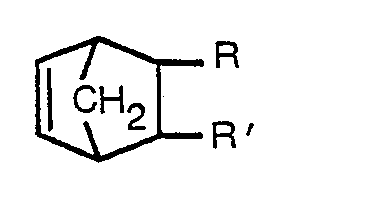
où R est H, CH3, C02CH3 ou OCOCH3, et R' est H ou C02CH3, en prévoyant que, quand R' est CO2CH3, R est aussi COZCH3, un copolymère sensiblement amorphe de bicyclo [2.2.1] heptène-2 avec un de ses dérivés substitués ayant la formule ci-dessus ou un copolymère sensiblement amorphe de deux de ces dérivés substitués, l'un avec l'autre.
où R est H, CH3, C02CH3 ou OCOCH3, et R' est H ou C02CH3, en prévoyant que, quand R' est CO2CH3, R est aussi COZCH3, un copolymère sensiblement amorphe de bicyclo [2.2.1] heptène-2 avec un de ses dérivés substitués ayant la formule ci-dessus ou un copolymère sensiblement amorphe de deux de ces dérivés substitués, l'un avec l'autre.
2. Composition selon la revendication 1, comprenant 30-400 parties en poids de plastifiant
de polynorbornène pour 100 parties en poids de polynorbornène.
3. Composition selon la revendication 2, comprenant 50-200 parties en poids de plastifiant
pour 100 parties en poids de polynorbornène.
4. Composition selon l'une quelconque des revendications 1 à 3, comprenant 10-90 parties
en poids de résine de polyoléfine et, de manière correspondante, 90-10 parties en
poids de polynorbornène.
5. Composition selon la revendication 4, dans laquelle le polynorbornène est réticulé.
6. Composition selon la revendication 5, qui est une composition thermoplastique dans
laquelle le polynorbomène plastifié réticulé est sous la forme de petites particles
dispersées à dimension telle que la composition peut être traitée sous forme d'un
produit thermoplastique.
7. Composition selon la revendication 6 qui est une composition élastoplastique comprenant
un mélange de 10-75 parties en poids de résine de polyoléfine de de 90-25 parties
en poids de polynorbomène réticulé pour 100 parties en poids au total de résine de
polyoléfine et de polynorbomène.
8. Composition selon la revendication 7, comprenant un mélange de 20-60 parties en
poids de résine de polyoléfine et de 80-40 parties en poids de polynorbornène réticulé
pour 100 parties en poids au total de résine de polyoléfine et de polynorbornène.
9. Composition selon l'une quelconque des revendications 6 à 8, dans laquelle la dimension
de particules est à moyenne en nombre de 50 microns ou moins.
10. Composition selon la revendication 9 dans laquelle la dimension de particules
est à moyenne en nombre de 10 microns ou moins.
11. Composition selon la revendication 10, dans laquelle la dimension de particules
est à moyenne en nombre de 0,1-2 microns.
12. Composition selon l'une quelconque des revendications 5 à 11, dans laquelle le
polynorbomène est réticulé jusqu'à un point tel que pas plus de 20% en poids du polynorbornène
puissent être extraits dans un solvant où le polynorbornène non réticulé est essentiellement
complètement soluble.
13. Composition selon la revendication 12 dans laquelle le polynorbornène est réticulé
jusqu'à un point tel que pas plus de 10% en poids de polynorbornène puissent être
extraits dans un solvant où le polynorbornène non réticulé est essentiellement complètement
soluble.
14. Composition selon l'une quelconque des revendications 5 à 13, préparée en mastiquant
le mélange approprié de résine de polyoléfine, de polynorbornène et de plastifiant
de polynorbornène avec un produit de cuisson de caoutchouc à une température de réticulation
jusqu'a ce que le polynorbomène soit réticulé.
15. Composition selon l'une quelconque des revendications 1 à 14, dans laquelle le
plastifiant de polynorbomène est une huile de dilution aromatique ou naphténique.
16. Composition selon l'une quelconque des revendications 1 à 15, dans laquelle le
résine de polyoléfine est le polyéthyléne ou le polypropyléne.
17. Procédé pour fabriquer un mélange de polymères homogène, qui consiste d'abord
à mastiquer un mélange de 10 à 90 parties en poids de résine de polyoléfine cristalline
thermoplastique, de 90 à 10 parties en poids de polynorbornène pour 100 parties en
poids au total de résine de polyoléfine et de polynorbornène, et de suffisamment de
plastifiant pour abaisser la température de transition à l'état vitreux de polynorbornène
jusqu'à moins de 10°C, à une température et pendant un temps suffisants pour faire
fondre la résine de polyoléfine, à mastiquer ensuite le mélange à une température
en-dessous de la température de fusion de la résine de polyoléfine, et finalement
à mastiquer le mélange à une température au-dessus de la température de fusion de
la résine de polyoléfine, le polynorbomène étant un homopolymère sensiblement amorphe
de bicyclo [2.2.11 heptène-2 ou d'un dérivé substitué ayant la formule:
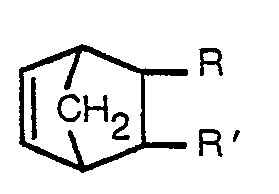
où R est H, CH3, C02CH3 ou OCOCH3, et R' est H ou C02CH3, en prévoyant que, quand R' est COZCH3, R est aussi C02CH3, un copolymère sensiblement amorphe de bicyclo [2.2.1] heptène-2 avec l'un de ses dérivés substitués ayant la formule ci-dessus ou un copolymère sensiblement amorphe de deux de ces dérivés substitués, l'une avec l'autre.
où R est H, CH3, C02CH3 ou OCOCH3, et R' est H ou C02CH3, en prévoyant que, quand R' est COZCH3, R est aussi C02CH3, un copolymère sensiblement amorphe de bicyclo [2.2.1] heptène-2 avec l'un de ses dérivés substitués ayant la formule ci-dessus ou un copolymère sensiblement amorphe de deux de ces dérivés substitués, l'une avec l'autre.
18. Procédé selon la revendication 17 dans lequel le mélange comprend 30-400 parties
en poids de plastifiant de polynorbornène pour 100 parties en poids de polynorbornène.
19. Procédé selon l'une ou l'autre des revendications 17 et 18 dans lequel le temps
de mastication de l'une quelconque des trois étapes de mastication est 0,5 à 10 minutes.
20. Procédé selon l'une quelconque des revendications 17 à 19, qui consiste à réticuler
le polynorbornène durant la dernière étape de mastication.
1. Zusammensetzung aus einer Mischung von 1 bis 99 Gew.-Teilen eines thermoplastischen
kristallinen Polyolefinharzes, 99 bis 1 Gew.-Teilen Polynorbornen auf 100 Gesamtgewichtsteile
aus Polyolefinharz und Polynorbornen und genügend Weichmacher zur Herabsetzung der
Glasumwandlungstemperatur des Polynorbornens auf unter 10°C, wobei es sich bei dem
Polynorbornen um ein im wesentlichen amorphes Homopolymeres von Bicyclo [2.2.1]-hepten-2
oder eines substituierten Derivats der Formel handelt
worin R H, CH3, C02CH3 oder OCOCH3 und R' H oder C02CH3 darstellen, mit der Maßgabe, daß dann, wenn R' COzCH3 bedeutet, R ebenfalls COZCH3 darstellt, einem im wesentlichen amorphen Copolymeren von Bicyclo [2.2.1]-hepten-2 mit einem seiner substituierten Derivate der oben angegebenen Formel oder einem im wesentlichen amorphen Copolymeren von zwei dieser substituierten Derivate miteinander.
worin R H, CH3, C02CH3 oder OCOCH3 und R' H oder C02CH3 darstellen, mit der Maßgabe, daß dann, wenn R' COzCH3 bedeutet, R ebenfalls COZCH3 darstellt, einem im wesentlichen amorphen Copolymeren von Bicyclo [2.2.1]-hepten-2 mit einem seiner substituierten Derivate der oben angegebenen Formel oder einem im wesentlichen amorphen Copolymeren von zwei dieser substituierten Derivate miteinander.
2. Zusammensetzung nach Anspruch 1, die auf 100 Gew.-Teile Polynorbornen 30 bis 400
Gew.-Teile Polynorbornen-Weichmacher enthält.
3. Zusammensetzung nach Anspruch 2, die auf 100 Gew.-Teile Polynorbornen 50 bis 200
Gew.-Teile Weichmacher enthält.
4. Zusammensetzung nach einem der Ansprüche 1 bis 3, die 10 bis 90 Gew.-Teile Polyolefinharz
und entsprechend 90 bis 10 Gew.-Teile Polynorbornen enthält.
5. Zusammensetzung nach Anspruch 4, in der das Polynorbornen vernetzt ist.
6. Zusammensetzung nach Anspruch 5, bei der es sich um eine thermoplastische Zusammensetzung
handelt, in welcher das vernetzte weichgemachte Polynorbornen in Form von kleinen
dispergierten Teilchen einer solchen Größe vorliegt, daß die Zusammensetzung wie ein
Thermoplast ver- bzw. bearbeitbar ist.
7. Zusammensetzung nach Anspruch 6, bei der es sich um eine elastoplastische Zusammensetzung
aus einer Mischung von 10 bis 75 Gew.-Teilen Polyolefinharz und 90 bis 25 Gew.-Teilen
vernetztem Polynorbornen auf 100 Gesamtgewichtsteile von Polyolefinharz und Polynorbornen
handelt.
8. Zusammensetzung nach Anspruch 7 aus einer Mischung aus 20 bis 60 Gew.-Teilen Polyolefinharz
und 80 bis 40 Gew.-Teilen vernetztem Polynorbornen auf 100 Gesamtgewichtsteile Polyolefinharz
und Polynorbornen.
9. Zusammensetzung nach einem der Ansprüche 6 bis 8, in der die Teilchengröße 50 Mikron
im Zahlendurchschnitt oder weniger beträgt.
10. Zusammensetzung nach Anspruch 9, in der die Teilchengröbe 10 Mikron im Zahlendurchschnitt
oder weniger beträgt.
11. Zusammensetzung nach Anspruch 10, in der die Teilchengröße 0,1 bis 2 Mikron im
Zahlendurchschnitt beträgt.
12. Zusammensetzung nach einem der Ansprüche 5 bis 11, in der das Polynorbornen bis
zu einem solchen Ausmaß vernetzt ist, daß nicht mehr als 20 Gew.-% desselben in einem
Lösungsmittel extrahierbar sind, in dem unvernetztes Polynorbornen im wesentlichen
vollständig löslich ist.
13. Zusammensetzung nach Anspruch 12, in der das Polynorbornen in einem solchen Ausmaß
vernetzt ist, daß nicht mehr als 10 Gew.-% desselben in einem Lösungsmittel extrahierbar
sind, in dem unvernetztes Polynorbornen im wesentlichen vollständig löslich ist.
14. Zusammensetzung nach einem der Ansprüche 5 bis 13, die hergestellt wurde durch
Durchkneten der geeigneten Mischung aus Polyolefinharz, Polynorbornen und Polynorbornen-Weichmacher
mit einem Kautschukhärter bei Vernetzungstemperatur, bis das Polynorbornen vernetzt
ist.
15. Zusammensetzung nach einem der Ansprüche 1 bis 14, in der der Polynorbornen-Weichmacher
ein aromatisches oder naphthenisches Strecköl darstellt.
16. Zusammensetzung nach einem der Ansprüche 1 bis 15, in der es sich bei dem Polyolefinharz
um Polyethylen oder Polypropylen handelt.
17. Verfahren zur Herstellung einer homogenen Polymermischung, bei dem man zuerst
eine Mi-. schung von 10 bis 90 Gew.-Teilen eines thermoplastischen kristallinen Polyolefinharzes,
90 bis 10 Gew.-Teilen Norbornen auf 100 Gesamtgewichtsteile Polyolefinharz und Polynorbornen
und genügend Weichmacher zur Herabsetzung der Glasumwandlungstemperatur des Polynorbornens
auf unter 10°C bei einer Temperatur und für eine Zeitspanne, die zum Schmelzen des
Polyolefinharzes ausreicht, durchknetet, danach die Mischung bei einer Temperatur
unterhalb der Schmeltztemperatur des Polyolefinharzes durchknetet und schließlich
die Mischung bei einer Temperatur oberhalb der Schmelztemperatur des Polyolefinharzes
durchknetet, wobei es sich bei dem Polynorbornen handelt um ein im wesentlichen amorphes
Homopolymeres von Bicyclo [2.2.1]-hepten-2 oder eines substituierten Derivats der
Formel
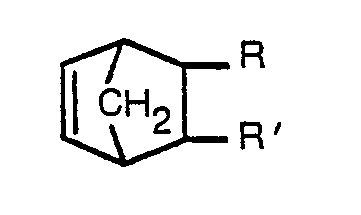
worin R H, CH3, COZCH3 oder OCOCH3 und R' H oder C02CH3 darstellen, mit der Maßgabe, daß dann, wenn R' CO2CH3 bedeutet, R ebenfalls CO2CH3 darstellt, ein im wesentlichen amorphes Copolymeres von Bicyclo [2.2.1]-hepten-2 mit einem seiner substituierten Derivate der oben angegebenen Formel oder ein im wesentlichen amorphes Copolymeres von zwei dieser substituierten Derivate miteinander.
worin R H, CH3, COZCH3 oder OCOCH3 und R' H oder C02CH3 darstellen, mit der Maßgabe, daß dann, wenn R' CO2CH3 bedeutet, R ebenfalls CO2CH3 darstellt, ein im wesentlichen amorphes Copolymeres von Bicyclo [2.2.1]-hepten-2 mit einem seiner substituierten Derivate der oben angegebenen Formel oder ein im wesentlichen amorphes Copolymeres von zwei dieser substituierten Derivate miteinander.
18. Verfahren nach Anspruch 17, in dem die Mischung auf 100 Gew.-Teile Polynorbornen
30 bis 400 Gew.-Teile Polynorbomen-Weichmacher enthält.
19. Verfahren nach Anspruch 17 oder 18, bei dem die Durchknetungsdauer jeder der drei
Durchknetungsstufen 0,5 bis 10 Minuten beträgt.
20. Verfahren nach einem der Ansprüche 17 bis 19, bei dem das Polynorbornen während
der letzten Durchknetungsstufe vernetzt wird.