|
(11) | EP 0 021 502 A1 |

| (12) | EUROPEAN PATENT APPLICATION |
|
|
|
|
|||||||||||||||||||||||||||
| (54) | Colour display tube |
| (57) Colour display tube comprising in an evacuated envelope means to generate a number
of electron beams (3,4,5), a display screen (6) comprising a large number of areas
(16) luminescing in different colours, and colour selection means (7) which assign
each electron beam (3,4,5) to luminescent areas (16) of one colour, which colour selection
means (7) comprise a metal plate (11) which is provided with rows of apertures (9)
and which forms a first set of electrodes against which, between said rows, spherical
or rod-shaped carriers (13) of insulating material are fixed by means of an adhesive,
to which carriers (13) elongate conductors (14) are connected which form a second
system of electrodes between which systems a potential difference is applied in which
grooves (12,15) are present both in the metal plate (11) between the rows of apertures
(9) and in the elongate conductors (14) in the longitudinal direction of said conductors
(24), in which grooves (12,15) the carriers (13) are centred unambiguously and are
secured in that there are per carrier (13) only two points or lines of contact (17,18,19,20)
in each groove (12,15) and in that the carriers (13) are secured to the system (14)
having the lower potential by means of an electrically conductive adhesive (21) in
the grooves (15), and substantially no flash-overs occur between the systems of electrodes. |
[0001] The invention relates to a colour display tube comprising in an evacuated envelope means to generate a number of electron beams, a display screen comprising a large number of areas luminescing in different colours, and colour selection means which assign each electron beam to luminescent areas of one colour, which colour selection means comprise a metal plate which is provided with rows of apertures and which forms a first set of electrodes against which, between said rows, spherical or rod-shaped carriers of insulation material are fixed by means of an adhesive, to which carriers elongate conductors are secured which constitute a second set of electrodes, between which sets a potential difference is applied.
[0002] Such a colour display tube is disclosed in Netherlands Patent Application 7600420 laid open to public inspection. By applying a potential difference between the elongate conductors and the metal plate, electrostatic quadrupole lenses are formed in the apertures, the electric field of which lenses is perpendicular or substantially perpendicular to the electron beams passing through the apertures. The electron beams are focused in one direction and defocused in the direction extending at right angles thereto by said lenses. The colour selection takes place in the same manner as in colour display tubes without post-focusing. As a result of the focusing effect, however, the apertures may be much larger than in colour display tubes without post-focusing, so that a much larger quantity of electrons impinges on the display screen. As a result of this a much brighter picture can be obtained or a picture having a better picture sharpness because with a smaller electron beam current a sufficiently bright picture is nevertheless obtained. In fact, with a smaller beam current a small spot is possible substantially without a haze surrounding the spot. Such a colour display tube is described elaborately in United States Patent Specification 4,059,781 which is considered to be incorporated by way of reference.
[0003] The above-mentioned Netherlands Patent Application 7600420 laid open to public inspection discloses a colour display tube in which the metal plate at least between the rows of apertures is provided with a layer of adhesive material, for example, consisting of the polyamide of 4-4' diaminodiphenylether and 1-2-4-5 benzenetetracarboxylic acid dianhydride, of methylmethacrylate resin or of sealing glasses or polymers. On their side facing the plate the elongate conductors are also covered with such a layer of adhesive material. The elongate conductors are kept at a defined distance from the plate by grains of an electrically insulating material, which grains on the one hand are sunk partly in the layer of adhesive material present on the plate and on the other hand are sunk partly in the layer of adhesive material present on the elongate conductors. A disadvantage of such a construction is that in the case of colour selection means of large dimensions (having a diagonal exceeding 35 cm) it is difficult to position the elongate conductors accurately between the rows of apertures in the plate so that colour defects arise in the picture.
[0004] United States Patent Specification 2,916,649 describes a construction for the accurate positioning of a number of electrodes relative to each other in travelling wave guides. The electrodes comprise pits, holes or channels obtained by deep drawing in which spacing elements of insulation material are placed. In colour selection means for colour display tubes as described above such a construction cannot be used. 300,000 holes or pits would have to be provided in the colour selection means. Moreover, such a positioning of two electrodes relative to each other by means of holes or pits is not unambiguous. The spacer elements will always engage in the holes or pits in a different manner. Providing channels by means of deep drawing is not desired either since this makes the colour selection means much less rigid in one direction. Moreover, sharp edges are formed in such channels which might give rise to flash-over between the elongate conductors and the plate when they would be used in the said colour selection means. The distance between the conductors and the apertured metal plate in such colour selection means is in fact 100/um and the potential difference is approximately 2000 Volts.
[0005] In Netherlands Patent Application 7600422 laid open to public inspection a colour display tube is described in which the elongate conductors are positioned between the rows of apertures in the metal plate and are each kept at a defined place by at least one insulating member consisting of a core which determines the distance between the elongate conductors and the plate, and a jacket which is adhered directly to the elongate conductors and the plate. The core consists of a material having a higher melting point than the material of the jacket. The core consists, for example, of a glass fibre surrounded by a jacket of a glass having a lower melting point than the glass of the fibre. This construction also has the disadvantage that in colour selection means of large dimensions it is difficult to position theelongate conductors accurately between the rows of apertures in the metal plate. A very accurate positioning is necessary in such colour selection means to as to obtain a pure picture.
[0006] It is therefore an object of the invention to provide a construction in which the elongate conductors can be positioned very accurately in a simple manner between the rows of apertures in the metal plate without flash-overs occuring between the elongate conductors and the metal plate when a high voltage is applied.
[0007] According to the invention a colour display tube of the kind mentioned in the opening paragraph is characterized in that grooves are present both in the metal plate between the rows of apertures and in the elongate conductors, in the longitudinal direction of said conductors in which grooves the carriers are unambiguously centred and secured in that per carrier only two points or lines of contact are present in each groove and in that the carriers are secured in the grooves to the system having the lower potential by means of an electrically conductive adhesive.
[0008] When the carriers of insulation material are spheres, for example glass beads having accurately identical diameters, the grooves should be such that said spheres engage in the grooves in only two points. If the carriers are rods, for example pieces of glass fibre, there are two contact lines per groove. As a result of this the carriers are positioned very accurately between the rows of apertures in the grooves in the metal.-plate. The elongate conductors are accurately positioned on the carriers. By providing grooves in the metal plate and the elongate conductors, sharp edges are formed which, as a result of both the high voltage between the metal plate and the elongate conductors (approximately 2000 Volts) and the small distance between the elongate, conductors and the metal plate (approximately 100/um), give rise to flash-overs along the carriers. These flash-overs can be avoided entirely by fixing the carriers at-least in the grooves of the system having the lower potential with an electrically conductive adhesive. Surface charge present on the carriers is dissipated to the elongate conductors and/or the metal plate by the adhesive so that flash-overs no longer occur. In addition, the sharp edges are more or less covered and rounded off by the adhesive.
[0009] The elongate conductors can be manufactured in a simple manner by connecting two wires together, for example by spot welding. It is also possible to manufacture said conductors by rolling or etching a groove in a strip. The electrically conductive adhesive may be a solder or an electrically conductive glue. The electrically conductive adhesive is preferably an electrically conductive enamel, preferably an enamel which is composed of one or more metal oxides and/or one or more metal oxidic compounds having a reacting or non-reacting oxidic binder, which enamel consists of oxidic particles as a carrier material on the surface of which a layer is present in a thickness of 0.5-100 nm of a dried soluble metal compound which after heating can be converted into a resistance - determining oxide or an oxidic compound or a layer of the oxide or the oxidic compound itself. The resistance-determining oxide is preferably ruthenium oxide (Ru 02). Such elee- trically conductive enamels are known per se from Netherlands Patent Application 7800355 not yet laid open to public inspection (US serial number 974,643 PHN 9016), in which these enamels are described as resistive materials, which Patent Application is to be considered as being incorporated by reference. The carriers may be manufactured from aluminium oxide or glass. However, the carriers are preferably manufactured from a glass having a resistivity of ) 1016 ohm cm at 80°C.
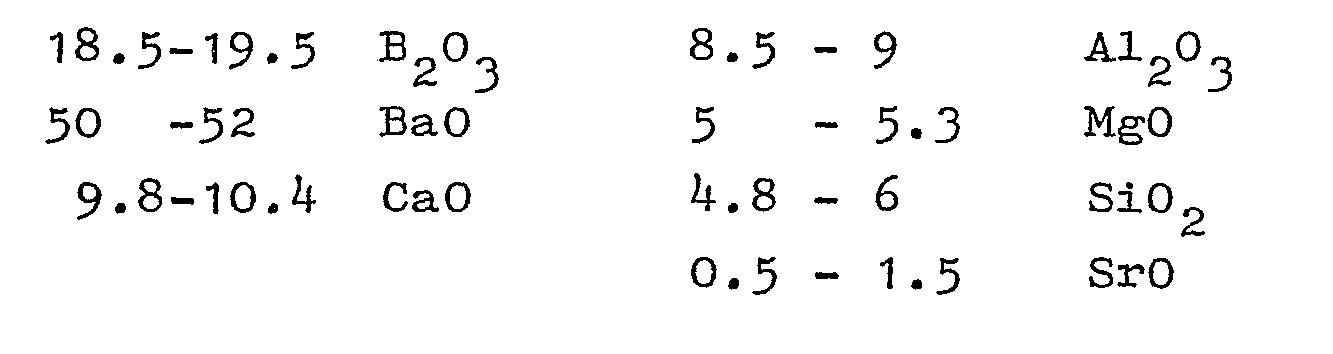
[0010] A particularly suitable glass for the manufacture of the carriers has approximately the following composition in per cent by weight:
The advantages of this glass are: 1) a low mobility of ions in the glass, 2) very smooth beads can be manufactured with it, 3) a suitable viscosity characteristic (high viscosity at 5500C and low viscosity at 1000-1200°C, 4) a coefficient of expansion adapted to the material of the colour selection means, and 5) stability under electron bombardment.
[0011] The invention will now be described in greater detail, by way of example, with reference to the accompanying drawings, in which
Figure 1 is a sectional-view of a colour display tube having colour selection means consisting of elongate conductors which are connected to an apertured metal plate,
Figure 2 illustrates the principle of the post-focusing effect of a quadrupole lens,
Figures 3a and 3b are exploded viewed of an embodiment of colour selection means,
Figure 4 shows a composed embodiment of colour selection means,
Figure 5 is an elevation of a detail of the colour selection means shown in Figure 4,
Figure 6 is a sectional view of a detail of this embodiment of the colour selection means, and
Figure 7 is a sectional view of a detail of another embodiment_of the colour selection means.
[0012] The tube shown in Figure 1 comprises a glass envelope 1, means 2 to generate three electron beams 3, 4 and 5, a display screen 6, colour selection means 7 and deflection coils 8. The electron beams 3, 4 and 5 are generated in one plane, the plane of drawing of Figure 1, and are deflected over the display screen 6 by means of the deflection coils 8. The display screen 6 consists of a large number of phosphor strips luminescing in red, green and blue and the longitudinal direction of which is perpendicular to the plane of the drawing of Figure 1. During normal operation of thetube the phosphor strips are vertical and Figure 1 thus represents a horizontal sectional view of the tube. The colour selection means 7 which will be described with reference to Figures 3, 4, 5 and 6, comprise a large number of apertures 9 which are denoted diagrammatically only in Figure 1. The three electron beams 3, 4 and 5 pass through the apertures 9 at a small angle with each other and consequently each impinge only on phosphor strips of one colour. The apertures 9 in the colour selection means 7 are thus very accurately positioned relative to the phosphor strips of a display screen 6.
[0013] In the generally used shadow mask tube without post-focusing the electron beams 3, 4 and 5 are not focused when passing through the apertures 9. United States Patent Specification 3,398,309 discloses a display tube in which unipotential lenses to focus the electron beams are formed in the apertures 9. It has also been suggested to use post-focusing by means of a potential difference between the colour selection means 7 and the display screen 6, in which, however, much hindrance is experienced from secondary electron.
[0014] In a colour display tube in accordance with the invention, a quadrupole lens is formed in each aperture 9. Figure 2 shows diagrammatically such a quadrupole lens. Shown is a part of the colour selection means 7 and one of the apertures 9. The potential variation along the edge of the aperture 9 is denoted by +, -, +, - in such manner that a quadrupole field is formed. The electron beam which passes through the aperture 9 is focused in the horizontally drawn plane and defocused in the vertically drawn plate so that, when the display screen is exactly in the horizontal focal point, the electron spot 10 is formed. As will be explained hereinafter it is recommended not to focus exactly on the display screen 6 so that a slightly wider electron spot is obtained. It is only of minor influence on the focusing when the electron beam passes through the aperture 9 at a small angle; as a result of this the colour selection of the three electron beams 3, 4 and 5 takes place in a manner quite analogous to that in the known shadow mask tube. However, due to the strong focusing the aperture 9 can be muchlarger than in the known shadow mask tube so that many more electrons impinge on the display screen 6 and a brighter and/or sharper picture is obtained. The defocusing in the vertical direction need not be a disadvantage when phosphor strips are used which are parallel to the longitudinal direction of the spot 10.
[0015] Figures 3a and 3b show a perspective exploded view of an embodiment of colour selection means 7 used in a colour display tube in accordance with the invention. They consist of an approximately 150/um thick metal plate 11 which is provided with rows of apertures 9 between which V or U-shaped grooves 12 are provided. For example, these grooves may be etched in the plate or be obtained by means of spark erosion and they are, for example, 110/um wide and 50/um deep. Glass beads 13 having a diameter of 150/um are provided in said grooves and constitute the carriers for the elongate conductors 14, which conductors are approximately 220/um wide and approximately 110/um thick. A very suitable glass from which the beads can be manufactured with a high resistivity and a number of other good properties has already been described hereinbefore. These elongate conductors 14 are also provided with V or U-shaped grooves 15 so that they are centred unambiguously on the beads 13, as is shown in Figure 4. The beads 13. are fixed in the grooves 12 and 15 by means of a conductive enamel. Said conductive.enamel should be used at least for the adhesion of the beads to the set of electrodes having the lower potential, in this case the elongate conductors 14. The beads 1-3 may first be secured to the plate. However, it is also possible to provide the elongate conductors with glass beads at regular distances and then to fix them against the plate.
[0016] Figure 5 is an elevation of a detail of Figure 4. The dimensions of the apertures 9 in the centre of the colour selection means are 475 x 570/um and their horizontal and vertical pitches are 775/um so that the transmis- si-on-of the colour selection means is approximately 45%. At the edge of the colour selection means there is a departure from these values. At a potential on the display screen 6 of 25 kV, a potential of the metal plate 11 of likewise 25 kV and a potential of the elongate conductors 14 of 23 kV the focal distance of the quadrupole lenses is approximately 17 mm with a perpendicular incidence in the centre of the display screen. The distance between display screen 6 and the colour selection means 7 is 9 mm in the centre of the display screen. The electron spots in the centre of the display screen are then approximately 210/um and in the corners approximately 160/um and no focusing is visible on the display screen. The width of the phosphor strips R, G, B is approximately 220/um. The remainder of the display screen may or may not be provided with a ligh absorbing material. The display screen 6 and the metal plate 11 are connected electrically and receive their voltage of 25 kV from an external voltage source. The voltage of 23 kV which is supplied to the elongate conductors 14 which mutually are electrically interconnected also originates from an external voltage source. For reasons of clarity of the Figure, the elongate conductors are shown on the side of the plate 11 remote from the display screen 6. Preferably, however, these conductors are provided on the display screen side so that an entirely field-free space is formed between the electron gun and the colour selection means. Only a few rays of the central electron beam 4 which form an electron spot 10 on the phosphor strip 16 are shown in the Figure. The apertures 9 in the metal plate 11 are shown to be square. However, it is also possible to use circular or oval apertures or square apertures with rounded corners.
[0017] Figure 6 is a sectional view of a detail of Figure 4. The elongate conductors 14 are positioned very accurately between the apertures 9 in the plane 11 because the glass beads 13 are positioned unambiguously in the U-shaped groove 12 and the V-shaped groove 15. This unambiguous positioning takes place in that there are two points of contacts 17 and 18 of the bead in the groove 1 and also two points of contact 19 and 20 in the groove 15 which is provided in the elongate conductors. The glass beads 13 are fixed to the set of electrodes having the lower potential, in this case the elongate conductors 14, by means of an electrically conductive enamel 21. However, this enamel may also be used for fixing the glass beads in the grooves 12 in the plate 15. The conductive enamel prevents flash-overs over the surface of the glass beads and covers the sharp edges of the grooves 12 and 15 near the glass beads 13. Suitable conductive enamels are described in Netherlands Patent Application 7800355 (PHN 9016) which has not yet been laid open to public inspection which are described in this Patent Application as a resistive material. These enamels comprise a few tenths of per cent by weight of ruthenium oxide (RuO2). A suitable enamel is composed, for example, as follows. A potassium ruthenate solution containing 35 mg of Ru in 5 ml of water is added to a suspension of 1 g of glass powder having a particle size of approximately 1/um and approximately the following composition in per cent by weight:
and then 10 ml of ethanol. The suspension is stirred thoroughly, filtered, and the filter residue is dried. A paste is made from the material thus prepared by means of benzyl benzoate. Said paste is converted into the enamel by firing for 1/3 second at 7500C in air. The sheet resistance of a 12/um thick enamel layer manufactured from said paste was approximately 0.5-1 M Ω. By melting glass beads 13 with such an enamel on the metal plates 11 and/or the elongate conductors 14, no flash-overs occur between the plate and the conductors up to 5000 to 7000 Volts. When a non-conductive enamel is used, for example the above-mentioned enamel without Ru02, a voltage of 2000 to 4000 Volts as a result of flash-overs proved to give large problems already.
[0018] It is possible to replace the glass beads 13 by pieces of glass fibre. Instead of points of contact 17, 18, 19 and 20, lines of contact are then formed of the pieces of glass fibre with the walls of the grooves.
[0019] Figure 7 is a sectional view of another embodiment of colour selection means. In this case the elongage conductors are composed of two parallel wires 22 and 23 welded to each other. This is a very simple manner to obtain elongate conductors with a groove. The wires may be secured together by means of solder or by means of spot welding, for example by means of a laser beam or an electron beam.
[0020] A display screen for a tube in accordance with the invention can be manufactured by means of a known exposure method in which the colour selection means are displayed on a photosensitive layer on a window portion of the tube. In connection with the large transmission of the colour selection means used in the tube in accordance with the invention, the exposure method used should be suitable to display the apertures 9 in a strongly narrowed manner. An exposure method suitable for this purpose uses two or more light sources at some distance from each other,as described in German Patent Application 2,248,878, laid open to public inspection. Of course, a tube in accordance with the invention is also excellently suitable for so- called electronic exposure in which the sensitive layer on the window portion is "exposed" by means of an electron beam.
1. A colour display tube comprising in an evacuated envelope means to generate a number
of electron beams, a display screen comprising a large number of areas luminescing
in different colours, and colour selection means which assign each electron beam to
luminescent areas of one colour, which colour selection means comprise a metal plate
provided with rows of apertures which forms a first set of electrodes against which,
between said rows, spherical or rod-shaped carriers of insulating or resistive material
are fixed by means of adhesive, to which carriers alongate conductors are secured
which form a second set of electrodes between which sets a potential difference is
applied, characterized in that grooves are present both in the metal plate between
the rows of apertures and in the elongate conductors in the longitudinal direction
of said conductors, in which grooves the carriers are centred unambiguously and secured
in that per carrier in each groove there are only two points or lines of contact and
in that the carriers are secured in the grooves to the system having the lower potential
by means of an electrically conductive adhesive.
2. A colour display tube as claimed in Claim 1, characterized in that the elongate
conductors consist of two parallel wires connected together.
3. A colour display tube as claimed in Claim 2, characterized in that the parallel
wires are secured together by means of welding at a number of discrete points.
4. A colour display tube as claimed in Claim 1, characterized in that the elongate
conductors consist of strips having a groove which is rolled or etched therein.
5. A colour display tube as claimed in any of the Claims 1, 2, 3 or 4, characterized
in that the electrically conductive adhesive is of electrically conductive enamel.
6. A colour display tube as claimed in Claim 5, characterized in that the electrically
conductive enamel is composed of one or more metal oxides and/or one or more metal
oxidic compounds having a reacting or non-reacting oxidic binder, which enamel consists
of oxidic particles as a carrier material on the surface of which a layer of 0.5-100
nm thickness is present of a dried soluble metal compound which after heating can
be converted into a resistance-determining oxide or an oxidic compound, or a layer
of the oxide or the oxidic compound itself.
7. A colour display tube as claimed in Claim 6, characterized in that the resistance-determining
oxide is ruthenium oxide (RuO2).
8. A colour display tube as claimed in any of the preceding Claims, characterized
in that the carriers are manufactured from a glass which has a resistivity of ≥ 1016 Ω cm at 80°C.
9. A colour display tube as claimed in Claim 8, characterized in that the carriers
consist of a glass having approximately the following composition in per cent by weight: