|
(11) | EP 0 021 520 B1 |

| (12) | EUROPEAN PATENT SPECIFICATION |
|
|
| (54) |
(Cycloalkyl)alkoxyimino-substituted cyclopropanecarboxylate esters, process for their manufacture, pesticidal compositions containing them, and their use as pesticides (Cycloalkyl)alkoxyimino-substituierte Cyclopropancarbonsäure-Ester, Verfahren zu ihrer Herstellung, sie enthaltende pestizide Zusammensetzungen und ihre Verwendung als Pestizide Dérivés d'esters cyclopropane carboxyliques (cycloalkyl)alkoxyimino-substitués, procédé pour leur préparation, compositions pesticides les contenant et leur application |
|
|
|||||||||||||||||||||||||||||||
|
||||||||||||||||||||||||||||||||
| Note: Within nine months from the publication of the mention of the grant of the European patent, any person may give notice to the European Patent Office of opposition to the European patent granted. Notice of opposition shall be filed in a written reasoned statement. It shall not be deemed to have been filed until the opposition fee has been paid. (Art. 99(1) European Patent Convention). |
[0001] This invention relates to (cycloalkyl)alkoxyimino-substituted cyclopropanecarboxylate esters, to a process for their manufacture, to compositions containing the esters, and to their use as pesticides.
[0002] U.S. Patent 3,922,269 discloses a class of 2,2-dimethyl-3-(oxyiminomethyl)cyclopropanecarboxylic acid esters useful as insecticides. In the case of esters of alpha-substituted asymmetric alcohols, three asymmetric centres and one oxime double bond are present and therefore a total of sixteen stereoisomers are possible; eight stereoisomers are possible when there is no asymmetric centre in the alcohol moiety.
[0003] It has now been found that certain (cycloalkyl)alkoxyimino-substitued cyclopropanecarboxylate esters in the (1R, cis) form are useful pesticides (insecticides and acaricides).
[0004] The invention provides a (cycloalkyl)alkoxyimino-substituted-cyclopropanecarboxylate ester in the (1 R, cis) form characterised in that it has the general formula A:-
wherein R' represents a (cycloalkyl)alkyl group containing 3 to 7 ring carbon atoms, a total of 4 to 9 carbon atoms and optionally ring-substituted by one or more halogen atoms, each R2 independently represents a fluorine, chlorine or bromine atom and n is an integer 1 to 5. Suitable halogen atom substituents are chlorine, fluorine or bromine.
[0005] The oxime substituent group of the compounds of the invention gives rise to geometric isomerism by virtue of the presence of an asymmetrically-substituted double bond. These isomers are usually described as follows:
A useful subclass of the invention comprises esters in which the oxime substituent is in the Z-isomer form as such isomers can be several times more pesticidally-active than when the oxime substituent is in the E-isomer form or is a mixture of the E- and Z-isomer forms.
[0006] Because of their pesticidal utility in agricultural and domestic locations preferred esters according to the invention are those wherein (R2)n is pentachloro, 2,6-dichloro, 2,6-difluoro or 2-chloro-6-fluoro, and R1 is a (cycloalkyl)alkyl group containing 3 to 6 ring carbon atoms, a total of 4 to 8 carbon atoms and optionally ring-substituted by 1 to 4 chlorine, fluorine and/or bromine atoms. Particular examples of the group R1 are cyclopropyl-methyl, 1-(cyclopropyl)ethyl, cyclohexylmethyl and cyclobutylmethyl.
[0007] Because of their pesticidal activity and ease of preparation, one preferred class of the compounds according to the invention are those esters wherein (R 2) is 2,6-dichloro or pentachloro and R1 is a (cycloalkyl)alkyl group containing 4 to 5 carbon atoms. Examples of some highly active compounds of this class of the invention are: 2,6-dichlorobenzyl (1R, cis)-2,2-dimethyl-3-((cyclopropylmethoxy- imino)methyl)cyclopropanecarboxylate and pentachlorobenzyl (1R, cis)-2,2-dimethyl-3-((cyclopropyl- methoxyimino)methyl)cyclopropanecarboxylate.
[0008] It has been generally observed that esters wherein the oxime substituent is in the Z-isomer form, are the most pesticidally active. Therefore, the Z-isomer (or mixtures of isomers in which the Z-isomer predominates) form another preferred subclass of the esters according to the invention. That the Z-isomer form is more pesticidally-active contrasts with another class of oxime pesticides disclosed in U.S. patent 4,079,149, in which the E-isomer form is said to be the more pesticidally-active of the oxime geometric isomer forms.
[0009] The pesticidal esters according to the present invention may be prepared by an esterification reaction involving the reaction of an alcohol or derivative thereof of formula:
with a cyclopropane carboxylic acid or derivative thereof of general formula VII
where Q and P are functional groups or atoms which will react to form an ester linkage and R', R2 and n are as defined above.
[0010] It is usually convenient in practice either to treat the acid or acid halide with the alcohol (P=OH or -halide and Q=OH) or to treat a halogeno compound (Q=halide) with a salt of the carboxylic acid (P=O-M where M is, for example, a silver or triethylammonium cation).
[0011] Transesterification is not always practical and, it is useful to prepare the intermediate alkyl ester as tert-butyl ester (R=tert-butyl) which can be selectively converted (under acid conditions) to give the free acid, which can, after conversion to the acid halide by methods known in the art, be esterified to a pesticidal ester.
[0012] The compounds of the present invention can also be prepared by treating an ester of caronaldehyde of formula XIII
where R2 and n are as defined above with hydroxylamine or a 0-substituted hydroxylamine of formula RIONH2 where R1 is as defined above, and in the case where hydroxylamine is reacted, subsequently reacting the resulting oxime with a halide of formula R'-halide in which R1 has the meaning specified above. Oxime formation can take place by treating substantially equimolar amounts of aldehyde and hydroxylamine or hydrocarboyloxyamine in a polar solvent such as an alkanol e.g. ethanol or dioxane. When the aldehyde is converted into the oxime by reaction with hydroxylamine the resulting oxime is converted into an alkylated derivative using procedures customarily used for the alkylation of phenols. Thus, the oxime may be treated in a polar solvent, such as ethanol, with an alkyl halide, typically the bromide, in the presence of a hydrogen halide acceptor and the mixture heated until reaction is complete.
[0013] Oxime formation is normally carried out using an acid addition salt of hydroxylamine or the 0- substituted hydroxylamine, e.g. the hydrochloride. In the cases where R' represents a large group it is usually more convenient to form the oxime first and subsequently to react the oxime with a halide of the formula R'-halide.
[0014] Since it has been discovered that the esters of the invention in which the oxime substituent is in the Z-isomer form are pesticidally more active than when the oxime substituent is in either the E-isomer form or is a mixture of E- and Z-isomer forms, it can be desirable to convert the esters in both the E- and Z-isomer forms. Such conversion is accomplished by the addition of a minor amount of an organic or inorganic acidic material. Any inorganic or organic acid or acidic acting material can be used, including acidic clays such as acidic silicates and aluminates or synthetic acidified clays, mineral acids such as hydrochloric or sulfuric acid, sulfonic acids such as toluenesulfonic acid, or organic acids, including lower alkanonic acids such as acetic, propionic or butyric acids. The acid can be used in a solid or liquid form. While the precise amount of acid used to convert the E-isomer or Z-isomer into the E- and Z-isomer mixture can vary depending on the particular oxyimino-substituted ester, from 0.001 to 5% by weight of acid based on the E-isomer or Z-isomer is generally sufficient. Preferably, from 0.01 to 5% by weight of acid is used.
[0015] The invention includes, within its scope, pesticidal compositions comprising an agriculturally- acceptable adjuvant - that is, at least one carrier or a surface-active agent - and, as active ingredient, a pesticidally-effective amount of at least one pesticidally-active ester of this invention. Likewise, the invention includes also a method of comating insect, acarine or other arthropod pests at a locus which comprises applying to the pests or to the locus a pesticidally effective amount of at least one ester according to the invention or a composition containing it.
[0016] With respect to the spectrum of pesticidal activity, the compounds of this invention exhibit a selective or non-selective activity on such orders as Coleoptera, Lepidoptera (especially larvae), Diptera, Orthoptera, Hemiptera, Homoptera and Acarina depending upon a specific combination of acid and an alcohol according to the present invention. The compositions according to the present invention are very useful for controlling disease carrying insects such as mosquitoes, flies and cockroaches, grain insects such as rice weevil (Sitophilus oryzae) and mites as well as agricultural noxious insects such as planthoppers, green rice leafhopper (Nephotettix bipuntatus cinticeps Uhler), diamond-back moths (Plutella maculipennis Curtis), imported cabbage worm (Pieris rapae Linne), rice stem borers (Chilo suppressalis Walker), corn earworm larvae (Heliothis zea Boddie), aphids, tortrixes, leaf-miners and the like.
[0017] The esters are used for harvested crops, horticultural application, forests, cultures in green house, packaging materials for foodstuffs, in household applications and as ectoparasiticides.
[0018] The term "carrier" as used herein means a material, that may be inorganic or organic and of synthetic or natural origin with which the active compound is mixed or formulated to facilitate its application to the plant, seed, soil and other object to be treated, or its storage, transport or handling. The carrier may be a solid or a liquid.
[0019] Suitable solid carriers may be natural and synthetic clays and silicates, for example, natural silicas such as diatomaceous earths; magnesium silicates, for example, talcs; magnesium aluminum silicates, for example, attapulgites and vermiculites; aluminum silicates, for example, kaolinites, montmorillon- ites and micas; calcium carbonate; calcium sulfate; synthetic hydrated silicon oxides and synthetic calcium or aluminum silicates; elements such as for example, carbon and sulfur; natural and synthetic resins such as, for example, coumarone resins, polyvinyl chloride and styrene polymer and copolymers; solid polychlorophenols; bitumen, waxes such as beeswax, paraffin wax, and chlorinated mineral waxes; degradable organic solids, such as ground corn cobs and walnut shells; and solid fertilizers, for example superphosphates.
[0020] Suitable liquid carriers include solvents for the compounds of this invention and liquids in which the toxicant is insoluble or only slightly soluble.
[0021] Examples of such solvents and liquid carriers, generally, are water, alcohols, for example, isopropyl alcohol, ketones, such as acetone, methyl ethyl ketone, methyl isobutyl ketone and cyclohexanone; ethers; aromatic hydrocarbons such as benzene, toluene and xylene; petroleum fractions, such as kerosene, light mineral oils, chlorinated hydrocarbons, such as methylene chloride, perchloroethylene, trichloroethane, including liquified normally vaporous gaseous compounds. Mixtures of different liquids are often suitable.
[0022] If used, the surface-active agent may be an emulsifying agent or a dispersing agent or a wetting agent. It may be nonionic, ionic or preferably, mixtures of both. Surface-active agents usually applied in formulating pesticides may be used. Examples of such surface-active agents are the sodium or calcium salts of polyacrylic acids and lignin sulfonic acids; the condensation products of fatty acids or aliphatic amines or amides containing at least 12 carbon atoms in the molecule with ethylene oxide and/or propylene oxide; fatty acid esters of glycerol, sorbitan, sucrose or pentaerythritol; fatty acids salts of low molecular weight, mono-, di- and trialkyl-amines; condensates of these with ethylene oxide and/or propylene oxide; condensation products of fatty alcohols or alkyl phenols, for example, p-octylphenol or p-octylcresol, with ethylene oxide and/or propylene oxide; sulfates or sulfonates of these condensation products; alkali or alkaline earth metal salts, preferably sodium salts of sulfonated caster oil, and sodium alkylaryl sulfonates such as sodium dodecylbenzene sulfonate; and polymers of ethylene oxide and copolymers of ethylene oxide and propylene oxide.
[0023] The compositions of the invention may be formulated as wettable powders, dusts, granules, solutions, emulsifiable concentrates, emulsions, suspension concentrates or aerosols. Encapsulated formulations and controlled release formulations are also contemplated, as are bait formulations. Wettable powders are usually compounded to contain 25, 50 or 75%w of toxicant and usually contain, in addition to solid carrier, 3-10%w of stabilizer(s) and/or other additives such as penetrants or stickers. Dusts are usually formulated as a dust concentrate having a similar composition to that of a wettable powder but without a dispersant, and are diluted in the field with further solid carrier to give a composition usually containing 1/2-1 O%w of toxicant. Granules may be manufactured by extrusion of plastics, agglomeration or impregnation techniques. Generally, granules will contain 1/2-25%w toxicant and 0-10%w of additives such as stabilizers, slow release modifiers and binding agents. Emulsifiable concentrates usually contain, in addition to the solvent, and when necessary, cosolvent, 10-50%w/v toxicant, 2-20w/v emulsifiers and 0-20%w/v of appropriate additives such as stabilizers, penetrants and corrosion inhibitors. Suspension concentrates are compounded so as to obtain a stable, nonsedimenting, flowable product and usually contain 10-75%w toxicant, 0-5%w of dispersing agents, 0.1-10%w of suspending agents such as protective colloids and thixotropic agents, 0-10%w of appropriate additives such as defoamers, corrosion inhibitors, stabilizers, penetrants and stickers, and as carrier, water or an organic liquid in which the toxicant is substantially insoluble; certain organic additives or inorganic salts may be dissolved in the carrier to assist in preventing sedimentation or as antifreeze agents for water.
[0024] Aqueous dispersions and emulsions, for example, compositions obtained by diluting a wettable powder or an emulsifiable concentrate according to the invention with water, also lie within the scope of the present invention.
[0025] The compositions of the invention can also contain other ingredients, for example, other compounds possessing pesticidal, herbicidal or fungicidal properties, or attractants, such as pheromones, attractive food ingredients, and the like, for use in baits and trap formulations.
[0026] Particularly useful compositions can be obtained by using a mixture of two or more kinds of the present compounds, or by the use of synergists, such as those known for use with the general class of "pyrethroid" compounds, especially alpha-[2-(2-butoxyethoxy)-ethoxy]-4,5-methylenedioxy-2-propyltoluene also known as piperonyl butoxide, 1,2-methylenedioxy-4-[2-(octylsufinyl)propyllbenzene, 4-(3,4-methylenedioxyphenyl)-5-methyl-1,3-dioxane also known as safroxane, N-(2-ethyhexyl)bicyclo-[2,2,1 ]hept-5-ene-2,3-dicarboximide, octachlorodipropyl ether, isobornyl thiocyanoacetate, and other synergists used for allethrin and pyrethrin. Useful compositions can be prepared with other biological chemicals incuding other cyclopropanecarboxylates, organic phosphate type insecticides and carbamate type insecticides.
[0027] The compositions of the invention are applied in sufficient amount to supply the effective dosage of toxicant at the locus to be protected. This dosage is dependent upon many factors, including the carrier employed, the method and conditions of application, whether the formulation is present at the locus in the form of an aerosol, or as a film, or as discrete particles, the thickness of film or size of particles, the insects or acarine species to be controlled and the like, proper consideration and resolution of these factors to provide the necessary dosage of active material at the locus being within the skill of these versed in the art. In general, however, the effective dosage of toxicants of this invention at the locus to be protected - i.e. the applied dosage is of the order of 0.01 % to 0.5% based on the total weight of the formulation, though under some circumstances the effective concentration will be as little as 0.001% or as much as 2%, in the same basis.
[0028] The invention is illustrated by the following examples which describe the preparation and biological testing of typical species of the invention with respect to representative insects. The identity of the products was confirmed by elemental, infrared and nuclear magnetic resonance spectral (NMR) analyses as necessary.
Example 1
Pentachlorobenzyl (1 R, cis)-2,2-dimethyl-3-((cyclobutylmethoxyimino)methyl)cyclopropanecarboxylate
[0029] To solution of 0.4 g potassium carbonate, 0.05 g tetrabutyl-ammonium sulfate and 0.05 g benzyltriethylammonium chloride in 6 ml of water was added 1.30 g of (1 R, cis)-2,2-dimethyl-3-((cyclobutyl- methoxyimino)methyl)cyclopropanecarboxylic acid in 10 ml toluene and then 1.64 g of pentachlorobenzyl chloride. The resulting mixture was heated at 60-800C with vigorous stirring for several days.
[0030] The toluene phase was separated, washed successively with water, sodium bicarbonate solution and saturated sodium chloride solution, dried over magnesium sulfate and stripped to yield an oil. The product was chromatographed using petane:ether (4:1) as the eluent to give an amber oil which crystallized on standing. This product was recrystallized from pentane to yield 1.4 g of solid; m.p. 78-86°C;
(CHCl2) 0.02 g/cc.
Examples 2-4
[0031] Following procedures similar to-Example 1, the additional (1R, cis)-3-(oxyimino)methylcyclo- propanecarboxylates were prepared as set forth in Table 1.
Example 5
Pesticidal Activity
[0032] As an example, the activity of the compounds according to the invention with respect to pests was determined by using standardized test methods to test the toxicity of the compounds as follows:
[0033] Corn earworm larvae (Heliothis zea Boddie) were tested by spraying a broad bean plant with dilutions of acetone solution of test compound into water containing an emulsifier. Immediately after spraying, 5 larvae were transferred to the plant and held for 44-46 hours, at which time the dead and moribund larvae were counted. The tests that were conducted employed several different dosage rates for each test compound.
[0034] In each instance, the toxicity of the compound of the invention was compared to that of a standard pesticide (Parathion), its relative toxicity then being expressed in terms of the relationship between the amount of compound of the invention and the amount of the mortality in the test insects or acarine. Assigning the standard pesticide an arbitrary rating of 100, the toxicities of the compounds of the invention were expressed in terms of the toxicity indices, which compares the toxicity of the compounds of the invention with that of the standard pesticide. That is to say, a test compound having a Toxicity Index of 200 would be twice as active as the standard pesticide.
1. A (cycloalkyl)alkoxyimino-substituted-cyclopropanecarboxylate ester in the (1 R,
cis) form characterised in that it has the general formula A:-
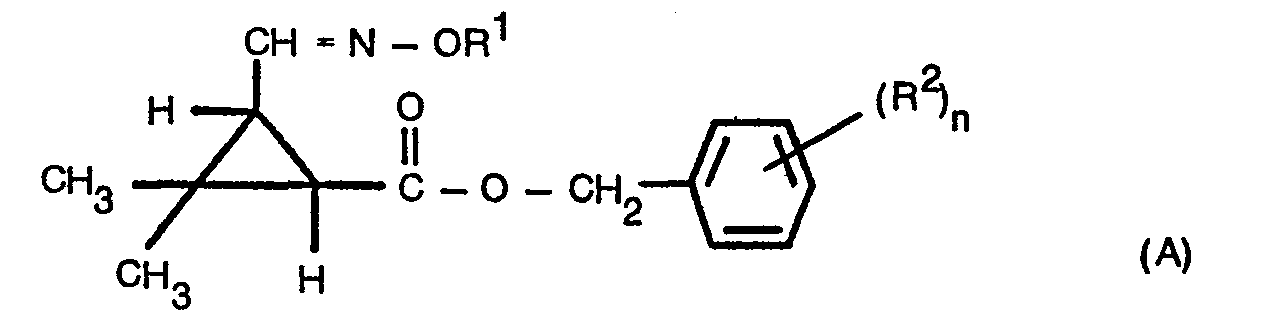
wherein R1 represents a (cycloalkyl)alkyl group containing 3 to 7 ring carbon atoms, a total of 4 to 9 carbon atoms and optionally ring-substituted by one or more halogen atoms, each R2 independently represents a fluorine, chlorine, or bromine atom and n is an integer of 1 to 5.
wherein R1 represents a (cycloalkyl)alkyl group containing 3 to 7 ring carbon atoms, a total of 4 to 9 carbon atoms and optionally ring-substituted by one or more halogen atoms, each R2 independently represents a fluorine, chlorine, or bromine atom and n is an integer of 1 to 5.
2. An ester according to claim 1 characterised in that (R2)n represents pentachloro, 2,6-dichloro, 2,6-difluoro or 2-chloro-6-fluoro and R1 is a (cycloalkyl)alkyl group containing 3 to 6 ring carbon atoms, a total of 4 to
8 carbon atoms and optionally ring-substituted by 1 to 4 chlorine, fluorine and/or
bromine atoms.
3. An ester according to claims 1 or 2 characterised in that (R 2)n is pentachloro or 2,6-dichloro and R1 is a (cycloalkyl)alkyl group containing 4 to 5 carbon atoms.
4. A process for the preparation of an ester of the general formula A characterised
in that an alcohol or derivative thereof of formula:
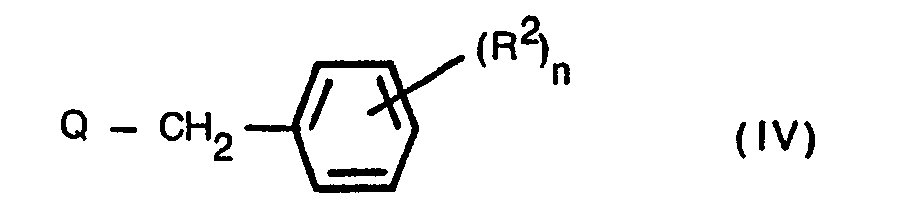
in which R2 and n have the meanings defined in claim 1 and Q is a functional group is reacted with a cyclopropane carboxylic acid or derivative thereof of general formula VII:-
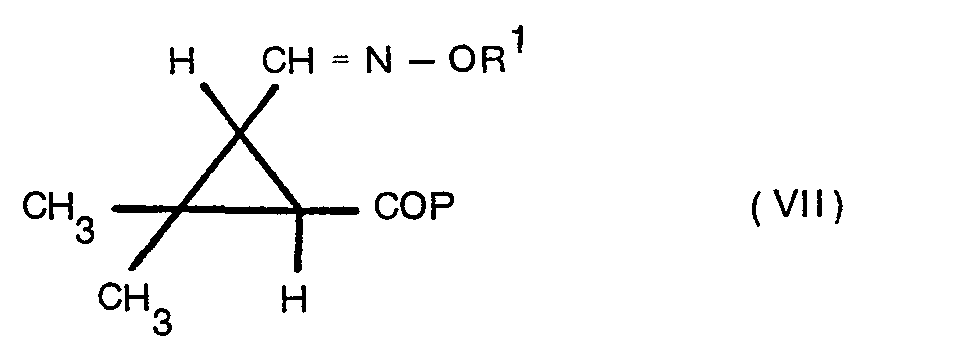
in which R1 has the meaning specified in claim 1 and P is a functional group, and wherein the groups P and Q are capable of reacting together to form an ester linkage.
in which R2 and n have the meanings defined in claim 1 and Q is a functional group is reacted with a cyclopropane carboxylic acid or derivative thereof of general formula VII:-
in which R1 has the meaning specified in claim 1 and P is a functional group, and wherein the groups P and Q are capable of reacting together to form an ester linkage.
5. A process for the preparation of an ester of the general formula A characterised
in that an ester of caronaldehyde of general formula XIII:-
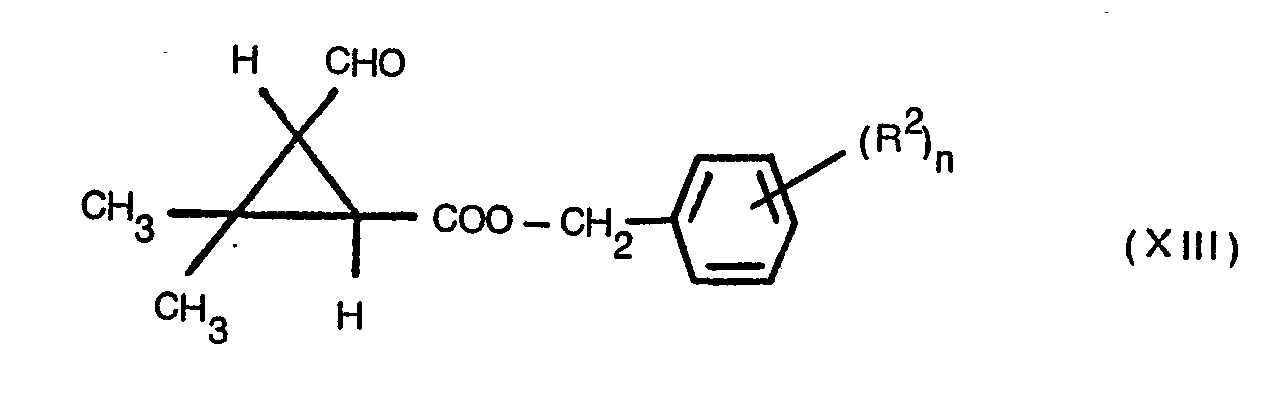
in which R2 and n have the meanings specified in claim 1 is reacted with hydroxylamine or an 0- substituted hydroxylamine of formula R1ONH2 where R1 has the meaning specified in claim 1, and in the case where hydroxylamine is reacted, subsequently reacting the resulting oxime with a halide of formula R'-halide.
in which R2 and n have the meanings specified in claim 1 is reacted with hydroxylamine or an 0- substituted hydroxylamine of formula R1ONH2 where R1 has the meaning specified in claim 1, and in the case where hydroxylamine is reacted, subsequently reacting the resulting oxime with a halide of formula R'-halide.
6. A pesticidal composition characterised in that it contains a pesticidally-effective
amount of an ester according to any one of claims 1 to 3.
7. A method of controlling pests at a locus characterised in that a pesticidally effective
amount of an ester according to any one of claims 1 to 3 or a composition containing
it is applied to the pests or to the locus.
1. Un ester cyclopropanecarboxylique (cycloalcoyl)alcoxyimino-substitué dans la forme
(1R, cis) caractérisé en ce qu'il a la formule générale A:
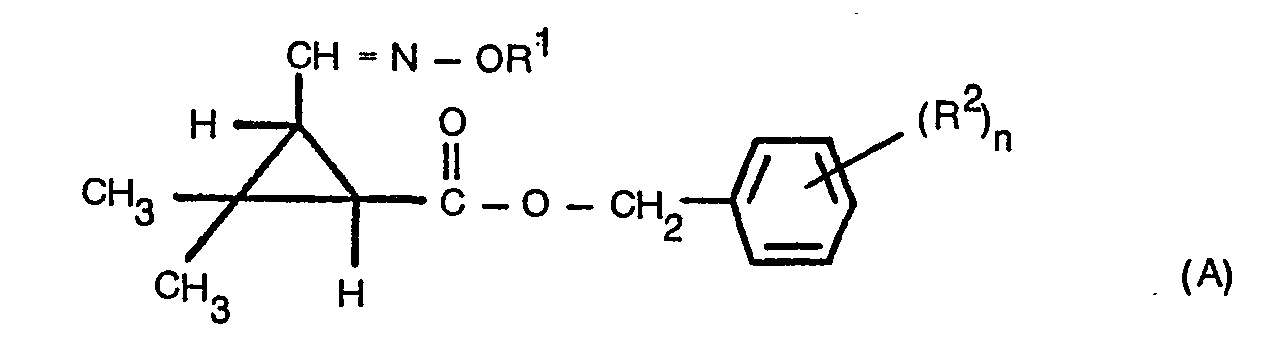
dans laquelle R' représente un groupe (cycloalcoyl)alcoyle contenant de 3 à 7 atomes de carbone dans le cycle, un total de 4 à 9 atomes de carbone et éventuellement substitué au noyau par un ou plusieurs atomes d'halogènes, chaque R2 indépendamment représente un atome de fluor, de chlore ou de brome et n est un nombre entier de 1 à 5.
dans laquelle R' représente un groupe (cycloalcoyl)alcoyle contenant de 3 à 7 atomes de carbone dans le cycle, un total de 4 à 9 atomes de carbone et éventuellement substitué au noyau par un ou plusieurs atomes d'halogènes, chaque R2 indépendamment représente un atome de fluor, de chlore ou de brome et n est un nombre entier de 1 à 5.
2. Un ester selon la revendication 1, caractérisé en ce que (R2)n représente une substitution pentachloro, 2,6-dichloro, 2,6-difluoro ou 2-chloro-6-fluoro
et R1 est un groupe (cycloalcoyl)alcoyle contenant de 3 à 6 atomes de carbone dans le cycle,
un total de 4 à 8 atomes de carbone et éventuellement substitué au noyau par 1 à 4
atomes de chlore, de fluor et/ou de brome.
3. Un ester selon les revendications 1 ou 2, caractérisé en ce que (R2)n représente une substitution 2,6-dichloro et R' est un groupe (cycloalcoyl)alcoyle
contenant 4 ou 5 atomes de carbone.
4. Un procédé pour la préparation d'un ester de la formule générale A, caractérisé
en ce qu'un alcool ou dérivé d'alcool de formule:
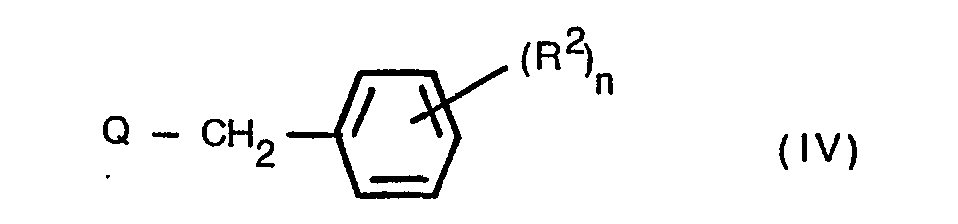
dans laquelle R2 et n ont les significations définies dans la revendication 1 et Q est un groupe fonctionnel est mis à réagir avec un acide cyclopropane carboxylique ou un dérivé d'un tel acide de formule générale VII:
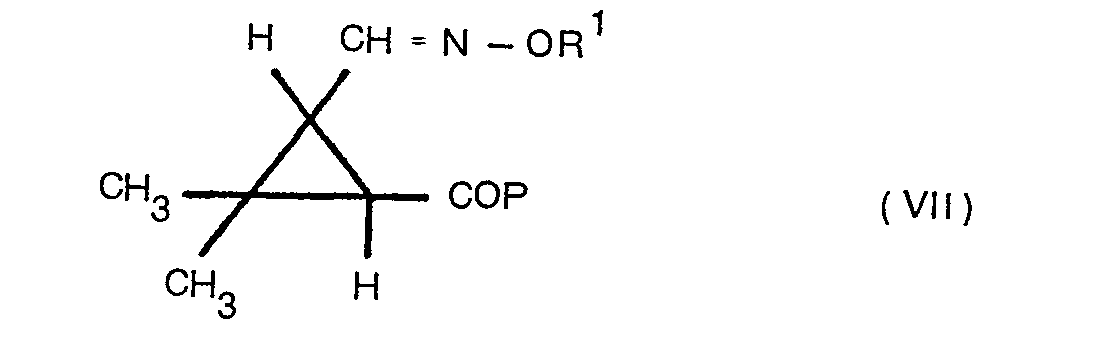
dans laquelle RI a la signification spécifiée dans la revendication 1 et P est un groupe fonctionnel, et les groupes P et Q sont capables de réagir ensemble pour former une liaison ester.
dans laquelle R2 et n ont les significations définies dans la revendication 1 et Q est un groupe fonctionnel est mis à réagir avec un acide cyclopropane carboxylique ou un dérivé d'un tel acide de formule générale VII:
dans laquelle RI a la signification spécifiée dans la revendication 1 et P est un groupe fonctionnel, et les groupes P et Q sont capables de réagir ensemble pour former une liaison ester.
5. Un procédé pour la préparation d'un ester de la formule générale A, caractérisé
en ce qu'un ester de caronaldéhyde de formule générale XIII:
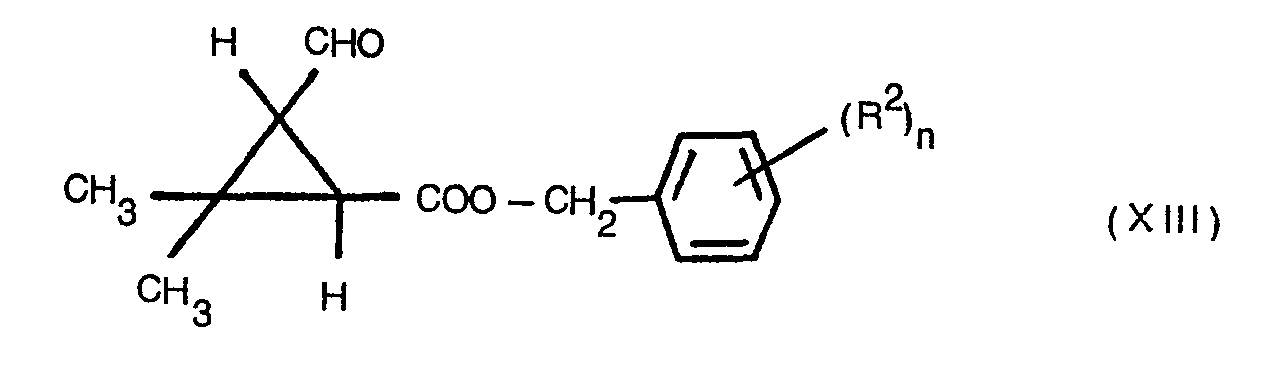
dans laquelle R2 et n ont les significations spécifiées dans la revendication 1 est mis à réagir avec l'hydroxylamine ou une hydroxylamine O-substituée de formule R1ONH2 dans laquelle R1 a la signification spécifiée dans la revendication 1 et, dans le cas où on fait réagir l'hydroxylamine, on fait réagir ensuite l'oxime résultante avec un halogénure de formule R1-halogénure.
dans laquelle R2 et n ont les significations spécifiées dans la revendication 1 est mis à réagir avec l'hydroxylamine ou une hydroxylamine O-substituée de formule R1ONH2 dans laquelle R1 a la signification spécifiée dans la revendication 1 et, dans le cas où on fait réagir l'hydroxylamine, on fait réagir ensuite l'oxime résultante avec un halogénure de formule R1-halogénure.
6. Une composition pesticide caractérisée en ce qu'elle contient une quantité efficace
du point de vue pesticide d'un ester selon l'une quelconque des revendications 1 à
3.
7. Un procédé pour lutter contre des organismes nuisibles en un lieu, caractérisé
en ce qu'on applique aux organismes nuisibles ou au lieu concerné une quantité efficace
du point de vue pesticide d'un ester selon t'une quelconque des revendications 1 à
3 ou d'une composition le contenant.
1. (Cycloalkyl)alkoxyimin-substituierte Cyclopropancarboxylat-ester in (1 R, cis)
Form, gekennzeichnet durch die allgemeine Formel A
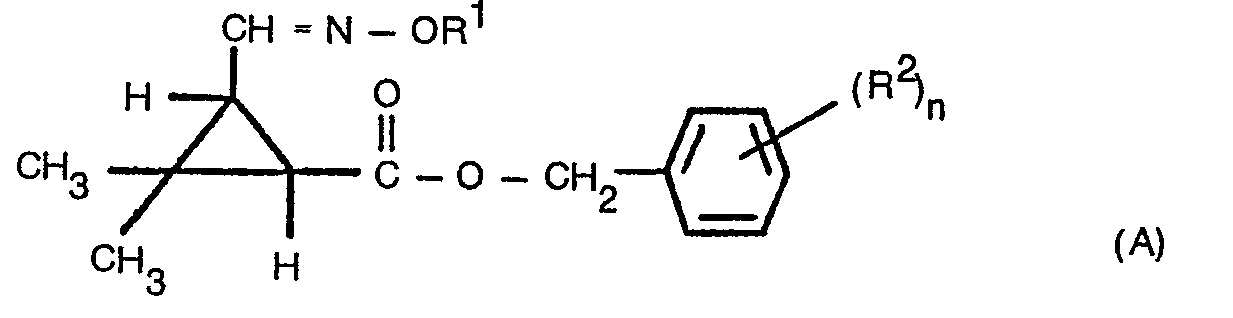
in der R1 eine (Cycloalkyl)alkylgruppe mit 3 bis 7 Ring-Kohlenstoffatomen und insgesamt 4 bis 6 Kohlenstoffatomen, die gegebenenfalls am Ring durch ein oder mehrere Halogenatome substituiert ist, R2 jeweils ein Fluor-, Chlor- oder Bromatom und n eine ganze Zahl von 1 bis 5 bedeutet.
in der R1 eine (Cycloalkyl)alkylgruppe mit 3 bis 7 Ring-Kohlenstoffatomen und insgesamt 4 bis 6 Kohlenstoffatomen, die gegebenenfalls am Ring durch ein oder mehrere Halogenatome substituiert ist, R2 jeweils ein Fluor-, Chlor- oder Bromatom und n eine ganze Zahl von 1 bis 5 bedeutet.
2. Ester nach Anspruch 1, dadurch gekennzeichnet, daß (R2)n Pentachlor, 2,6-Dichlor, 2,6-Difluor oder 2-Chlor-6-fluor und R1 eine (Cycloalkyl)alkylgruppe mit 3 bis 6 Ring-Kohlenstoffatomen und insgesamt 4 bis
8 Kohlenstoffatomen, die gegebenenfalls am Ring durch 1 bis 4 Chlor-, Fluor- und/oder
Bromatome substituiert ist, bedeutet.
3. Ester nach Anspruch 1 oder 2, dadurch gekennzeichnet, daß (R2)n Pentachlor oder 2,6-Dichlor und R1 eine (Cycloalkyl)alkylgruppe mit 4 bis 5 Kohlenstoffatomen bedeutet.
4. Verfahren zur Herstellung eines Esters der allgemeinen Formel A, dadurch gekennzeichnet,
daß ein Alkohol oder ein Derivat davon der Formel
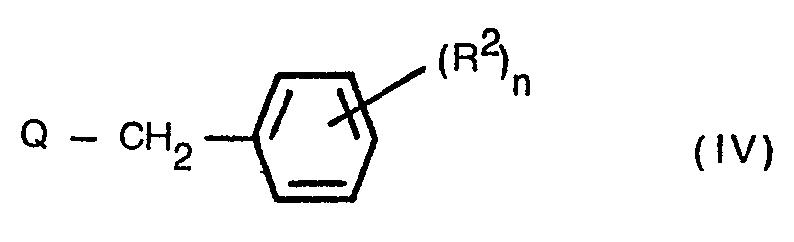
in der R2 und n, die in Anspruch 1 angegebene Bedeutung haben und Q eine funktionelle Gruppe ist, umgesetzt wird mit einer Cyclopropancarbonsäure oder einem Derivat davon der allgemeinen Formel VII
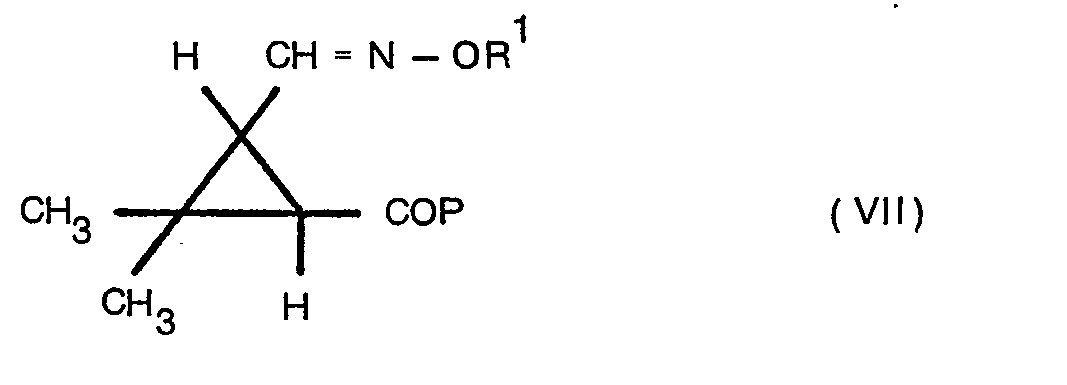
in der R1 die in Anspruch 1 angegebene Bedeutung hat und P eine funktionelle Gruppe ist, und wobei die Gruppen P und Q imstande sind, unter Bildung einer Esterbindung miteinander zu reagieren.
in der R2 und n, die in Anspruch 1 angegebene Bedeutung haben und Q eine funktionelle Gruppe ist, umgesetzt wird mit einer Cyclopropancarbonsäure oder einem Derivat davon der allgemeinen Formel VII
in der R1 die in Anspruch 1 angegebene Bedeutung hat und P eine funktionelle Gruppe ist, und wobei die Gruppen P und Q imstande sind, unter Bildung einer Esterbindung miteinander zu reagieren.
5. Verfahren zur Herstellung eines Esters der allgemeinen Formel A, dadurch gekennzeichnet,
daß ein Ester von Caronaldehyd der allgemeinen Formel XIII
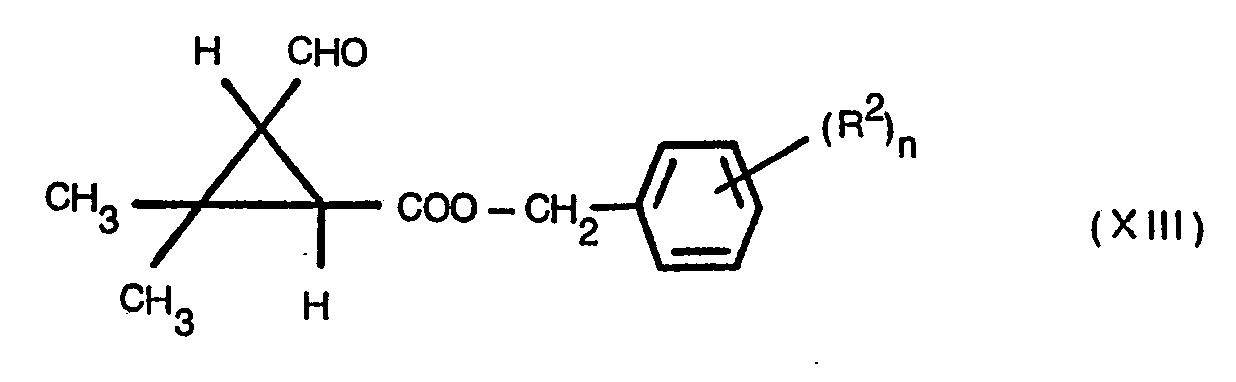
in der R2 und n, die in Anspruch 1 angegebene Bedeutung haben, umgesetzt wird mit Hydroxylamin oder einem 0-substituierten Hydroxylamin der Formel R1ONH2, wobei R1 die in Anspruch 1 angegebene Bedeutung hat, und, wenn Hydroxylamin umgesetzt wird, das erhaltene Oxim anschließend mit einem Halogenid der Formel R'-Halogenid umgesetzt wird.
in der R2 und n, die in Anspruch 1 angegebene Bedeutung haben, umgesetzt wird mit Hydroxylamin oder einem 0-substituierten Hydroxylamin der Formel R1ONH2, wobei R1 die in Anspruch 1 angegebene Bedeutung hat, und, wenn Hydroxylamin umgesetzt wird, das erhaltene Oxim anschließend mit einem Halogenid der Formel R'-Halogenid umgesetzt wird.
6. Pestizides Mittel, dadurch gekennzeichnet, daß es eine pestizid wirksame Menge
eines Esters nach einem der Ansprüche 1 bis 3 enthält.
7. Verfahren zur Bekämpfung von Schädlingen an einer Stelle, dadurch gekennzeichnet,
daß eine pestizid wirksame Menge eines Esters nach einem der Ansprüche 1 bis 3 oder
eines Mittels, enthaltend einen solchen Ester, auf die Schädlinge oder auf die Stelle
aufgebracht wird.