|
(11) | EP 0 021 625 A1 |

| (12) | EUROPEAN PATENT APPLICATION |
|
|
|
|
|||||||||||||||||||||||||||
| (54) | Electrolytic membrane cell |
| (57) A electrolytic cell comprises two or more units wherein each unit comprises a gas-and
liquid-permeable anode (2) in close contact with one surface of a cation exchange
membrane (1) and a gas-and liquid-permeable cathode (3) which is in close contact
with the other surface of the membrane; a gas-and liquid-permeable current collector
(4) which is in close contact with a back surface of said naode (2) and a gas-and
liquid permeable current collector (5) which is in close contact with a back surface
of said cathode. A partition wall made of a cathode side conductor (6) and an anode
side conductor (7) is interposed between the two units, said cathode side conductor
(6) being in contact with a current collector (5) which in turn is in contact with
a cathode (3) and said anode side conductor (7) being in contact with a current collector
(4) which is in contact with an anode (2). An electrolyte solution is fed into said
current collector(4) in contact with said anode and an electrolyzed solution is discharged
from said current collector (5) in contact with said cathode. |
[0001] The present invention relates to an electrolytic cell. More particularly, it relates to an electrolytic cell having a novel structure using a cation exchange membrane for producing an alkali metal hydroxide.
[0002] In producing an alkali metal hydroxide by electrolysis of an aqueous solution of an alkali metal chloride, cation exchange membrane processes have been increasingly employed instead of the conventional mercury process, in order to reduce pollution.
[0003] Various processes have been proposed for producing an alkali metal hydroxide having high concentration and high purity using a cation exchange membrane instead of the process using asbestos.
[0004] In addition, processes operating at lower cell voltages have become desirable in view of the energy saving.
[0005] In seeking ways of lowering the cell voltage, various substances, composition and configurations for the anode and cathode have been studied. Moreover, various compositions for the cation exchange membrane and types of ion exchange group have been studied.
[0006] Most of the proposed processes however have relatively low limits for the maximum concentration of the alkali metal hydroxide. When the concentration of the alkali metal hydroxide goes above the limit for the process, the cell voltage is suddenly increased and the current efficiency is lowered. Moreover, the required low cell voltage is not maintained.
[0007] Recently, it has been proposed to carry out an electrolysis process using a cell wherein a gas-and liquid-permeable anode is brought into contact with one surface of a fluorinated cation exchange membrane and a gas-and liquid-permeable cathode is brought into contact with the opposite surface of the membrane. This process is effective for electrolysis at a lower cell voltage because the electrical resistance of the electrolyte solution and the resistance caused by bubbles of hydrogen or chlorine gas can be remarkably reduced.
[0008] Such proposals, however, are still theoretical and no suitable electrolytic cell has hitherto been designed for the industrial application of this process.
[0009] The present invention provides an electrolytic cell which comprises two or more units, each comprising a gas-and liquid-permeable anode which is brought into close contact with one surface of a cation exchange membrane and a gas-and liquid-permeable cathode which is brought into close contact with the opposite surface of the said membrane; a first gas-and liquid-permeable current colleator which is brought into close contact with a back surface of said anode and a second gas-and liquid-permeable current collector which is brought into close contact with a back surface of said cathode, characterized in that a partition wall made of a cathode side conductor and an anode side conductor is interposed between the units, said cathode side conductor being in contact with a current collector which in turn is in contact with a cathode and said anode side conductor being in contact with a current collector which in turn is in contact with an anode,means being provided for feeding an electrolyte solution into the current collector in contact with said anode and for discharging an electrolyzed solution from said current collector in conta with said cathode.
[0010] It is possible by means of the present invention to provide an electrolytic cell for the process described above which requires only small floor space and has a compact structure, even with large scale apparatus.
[0011] The gas-and liquid-permeable anode is preferably made of a mixture of ruthenium oxide and an oxide of at least one metal selected from Sr, La, Ge, Sn, Pb, Ti, Zr, Sb, Bi, Nb, Ta, Mn, Fe, Co or Ni. The gas-and liquid-permeable anode can also be made of a pyrochlore-type complex oxide having the formula A2Ru2O7-x
[0012] (A is Pb, Bi, T1 or a rare earth element and 0≦x≦1), a perovskite-type complex oxide having the formulz BRuO3 (B is Ca, Sr, Ba or La) or a pyrochlore-type complex oxide having the formula
(x = 0.3 - 1.5)
[0013] The accompanying drawing is a schematic view of an electrolytic cell of the present invention.
[0014] The structure of the electrolytic cell of the present invention will be briefly described with reference to the drawing before the detailed description of the structure.
[0015] The reference numeral (1) designates a cation exchange membrane. A gas-and liquid-permeable anode (2) is brought into contact with one surface of the membrane and a gas-and liquid-permeable cathode (3) is brought into contact with the other surface of the membrane. A gas-and liquid-peremable collector (4) is brought into contact with the back surface of the anode (2) opposite to the side in contact with the membrane and a gas-and liquid-permeable collector (5) is brought into contact with the back surface of the cathode (3) opposite to the side in contact with the membrane to form one unit.
[0016] The reference numeral (6) designates a cathode side conductor and (7) designates an anode side conductor which is electrically connected to the cathode side conductor. The conductors (6), (7) to form a one- piece partition wall.
[0017] In the drawing, two units are shown. The current collector (5) in contact with the cathode (3) in one unit is brought into contact with the cathode side conductor (6) and the current collector (4) in contact with the anode (2) in the other unit is brought into contact with the anode side conductor (7) to form a single piece. The units are respectively connected through their partition walls to form an electrolytic cell having the desired number of chambers.
[0018] An aqueous solution of an alkali metal chloride is fed into the current collector (4) in contact with the anode (2). The plus terminal of a DC power source is connected to an anode terminal (not shown) at one end of the cell and the minus terminal is connected to a cathode terminal (not shown) at the other end of the cell as in the case of a conventional bipolar cell. Water is usually fed into the current collector (5) contacting the- cathode (3) to carry out the electrolysis whereby an electrolyzed solution is produced in the current collector (5).
[0019] Gas and liquid permeate into the current collectors (4), (5), whereby the gas formed at each electrode, the electrolyzed solution and the electrolyte solution can all move freely.
[0020] The gas-and liquid-permeable electrodes used in the present invention, both the cathode and the anode, can be porous. The physical properties of the cathode and the anode preferably include an average pore diameter of 0.01 to 1000 p a porosity of 20 to 95% and an air permeable coefficient of 1 x 10⁻⁵ to 1 mole/cm2. min. cmHg.
[0021] When the average pore diameter, the porosity and the air permeable coefficient are belowthe said ranges, hydrogen and chlorine gas formed by the electrolysis are not easily removed from the electrodes but remain to cause high electric resistance. When they are above said ranges, the effective electrode area is small which increases the contact resistance between the membrane and the electrode.
[0022] It is preferable to have an average pore diameter of 0.05 to 500u; a porosity of 30 to 90% and an air permeability coefficient of 1 x 10⁻⁴ to 1 x 10⁻¹ mole/ cm2.min.cmHg. The gas will then be easy to remove from the electrode, allowing stable continuous operation for a long time.
[0023] In the electrolytic cell of the present invention, the electrodes are brought into contact with the cation exchange membrane, whereby more anticorrosive electrodes are required in comparison with conventional electrolysis processes. The anode in particular will be in contact with an alkali metal chloride, chlorine and an alkali metal hydroxide during the electrolysis, the alkali metal hydroxide being produced in the cation exchange membrane at relatively high temperature and reacting a highly corrosive atmosphere.
[0024] In order to reduce the cell voltage in the electrolysis of an aqueous solution of an alkali metal chloride, electrodes having high chlorine resistance and high alkali resistance are required. It has been found that electrodes. especially anodes, made of the following substances are particularly suitable:
(1) A mixture of ruthenium oxide and an oxide of at least one metal selected from Sr, La, Ge, Sn, Pb, Ti, Zr, Sb, Bi, Nb, Ta, Mn, Fe, Co and Ni.
(2) A pyrochlore-type complex oxide having the formula
(A is Pb or Bi, Tℓ or rare earth elements and O x 1).
(3) A perovskite type complex oxide having the formula BRu03 (B is Ca, Sr, Ba or La)
(4) A pyrochlore type complex oxide having the formula
(x = 0.3 - 1.5).
[0026] In type (1), the content of the oxide of the other metal is dependent upon the kind of oxide and is usually in a range of 1 to 70 mole% to ruthenium oxide. When it is below this range, the corrosion resistance is not satisfactory whereas when it is above this range, the effect of the low cell voltage of ruthenium oxide is reduced, resulting in a high overall cell voltage.
[0027] When the content of the other metal oxide is in a range of 5 to 60 mole%, it imparts satisfactory corrosion resistance without substantially increasing the cell voltage. When the oxide of Ge, Pb, Ti, Zr, Bi, Nb, T1, Mn, Co or Ni is used, excellent corrosion resistance is obtained without reducing the effect of the low cell voltage of ruthenium oxide.
[0028] (2) The pyrochlore-type complex oxides (A2RuzO7-x) have a special crystalline structure and X-ray refraction pattern as described in Mat. Res. Bull. 6, 669 (1971) by R.J. Bouchard. The oxides impart excellent properties to the anode for electrolysis of an alkali metal chloride and also have the high alkali resistance and high chlorine resistance required in electrode-contact type elec-rolysis.
[0029] (3) The perovskite-type complex oxides are described in Mat. Res. Bull. Vol. 10 page 837 (1975) by H.S. Gandhi et. al. When the perovskite type complex oxide . is used, the anode overvoltage is low and the anode has' the high alkali resistance and high chlorine resistance required for contact-type electrolysis.
[0031] The method used for the preparation of an anode made of one of these oxides is not critical but is preferably as follows.
[0032] Powder or grains of 200 to 500 mesh of said oxide are prepared and admixed with a binder made of a fluorinated polymer such as polytetrafluoroethylene with a surfactant to obtain a paste. The paste is coated onto a soluble sheet such as aluminium foil, the coated layer is bonded to a cation exchange membrane at high temperature under pressure and the aluminium foil is dissolved with an alkali metal hydroxide. In the preparation of the anode, it is possible to coat a suspension or a paste of said powder or grains of said complex oxide onto a net or a porous substrate made of Ti, Ta or Nb.
[0033] In the preparation of the electrolytic cell of the present invention, the anode is brought into close contact with one surface of the cation exchange membrane and a gas-and liquid-permeable cathode is brought into close contact with the other surface of the membrane. Preferably; nets made of a platinum group metal or an iron group metal are brought into close contact with each of the anode and the cathode. The cathode is prepared in a similar way to the anode, using a material which can for example be a platinum group metal such as Pt, Ru or Rh or an alloy thereof, graphite, nickel, or stainless steel. A porous plate can be formed by the powder by a net or by superposed layers or a plate having many through holes can be used.
[0034] When the anode or the cathode is brought into close contact with the cation exchange membrane, the electrode can be heat-pressed onto the membrane.
[0035] The current collector brought into contact with the anode or the cathode can be in the form of a plurality of nets or rods assembled so as to be gas-and liquid-permeable or it can be a porous plate.
[0036] When the net or the porous plate is used, it is suitable to have an average pore diameter of 100p to 5mm and a porosity of 50 to 98%. When the rods are used it is preferable to arrange them so as to give similar physical properties.
[0037] The current collector should be gas-and liquid-permeable and act as a conductor for the electrode.
[0038] The substrate for the current collector on the anode side can be made of Ti, Zr, Nb or Ta and the substrate for the current collector on the cathode side can be made of Ni or stainless steel.
[0039] In the partition wall made of the anode side conductor and the cathode side conductor, the former can suitably be made of Ti, Zr, Nb or Ta and the latter of Ni, stainless steel or Fe. These conductors are electrically connected, for example by a welding process such as explosion welding.
[0040] The partition walls preferably have deep protrusions or many vertical grooves to facilitate an electrolyte solution through the current collectors. The partition can be prepared by explosion welding of two kinds of metal plate or coating an alkali-resistant metal on a metal substrate.
[0041] The cation exchange membrane used in the present invention can be made of a polymer having cation-exchange groups such as carboxylic acid groups, sulfonic acid groups, phosphoric acids groups and phenolic hydroxy groups. Suitable polymers include copolymers of a vinyl monomer such as tetrafluoroethylene and chlorotrifluoroethylene and a perfluorovinyl monomer having an ion-exchange group such as a sulfonic acid group, a carboxylic acid group or a phosphoric acid group or a reactive group which can be converted into the ion-exchange group. It is also possible to use a membrane of a polymer of trifluoroethylene into which ion-exchange groups such as sulfonic acid groups are introduced.
[0042] It is especially preferable to use monomers which form the following units (a) and (b) in the copolymer.
wherein X represents fluorine, chlorine or hydrogen atom or -CF3; X' represents X or CF3(CF2)̵m ; m represents an integer of 1 to 5 and Y represents -A, -φ-A, -p-A or -O-(CF2)̵n(P,Q,R)̵-A; P represents (̵CF2)̵a(̵CXX')̵b(̵CF2)̵c; Q represents-(CF2-O-CXX)̵d, and R represents-(̵CXX'-O-CF2)̵e , (P,Q,R) represents at least one of P, Q and R arranged in a desired order; φ represents phenylene group; X and X' are defined above; n is 0 to 1 and a, b, c, d and e are respectively 0 to 6; A represents -COOH, -CN, -COF, -COOR1, -COOM, -CONR2R3 or a reactive group which can be converted into -COOH by a hydrolysis or neutralization; R represents a C1 - C20 alkyl group; M represents an alkali metal or quaternary ammonium group; R2 and R3 represent H or a C1 - C10 alkyl group.
[0043] The typical examples of Y have the structures bonding A to a fluorocarbon group such as
and
x, y and z respectively represent an integer of 1 to 10; Z and Rf represent -F or a C1 - C10 perfluoroalkyl group; and A is defined above.
[0044] When a fluorinated cation exchange membrane having a carboxylic acid group content of 0. 5 to 2. 0 meq/g. dry resin which is made of said copolymer is used, the desired object of the present invention is especially satisfactorily attained.
[0045] When such a membrane is used, the current efficiency can be increased to higher than 90% even when the concentration of sodium hydroxide is more than 40%.
[0046] When the carboxylic acid group content is in a range of 1.12 to 1.7 meq/g. dry resin, the membrane is very stable and has excellent durability and long life.
[0047] In order to impart such an ion-exchange capacity, the ratio of the units (b) in the copolymer of the units (a) and the units (b) is preferably in a range of 1 to 40 mole% and especially 3 to 25 mole%.
[0048] The ion-exchange resin membrane used for the cell of the present invention is preferably made of a non- crosslinked copolymer of a fluorinated olefin monomer and a monomer having a carboxylic acid group or a functional group which can be converted into a carboxylic acid group. The molecular weight of the copolymer is preferably in a range of 100,000 to 2,000,000, especially 150,000 to 1,000,000.
[0049] In the preparation of this copolymer, one or more of the above-mentioned monomers can be used with a third monomer so as to improve the membrane. For example, flexibility can be imparted to the membrane by incorporating CF2 = CFORf (Rf is a C1 - C10 perfluoroalkyl group), or the mechanical strength of the membrane can be improved by crosslinking the copolymer with a divinyl monomer such as CF2=CF-CF=CF2 or CF2 = CFO(CF2)1-3CF-CF2.
[0050] The copolymerization of the fluorinated olefin monomer with the monomer having the carboxylic acid group or the convertible functional group can be carried out by a desired conventional process. The polymerization can be carried out, if necessary, with a solvent such as a halohydrocarbon by catalytic polymerization, thermal polymerization or radiation-induced polymerization. The method of fabrication of the ion-exchange membrane from the resulting copolymer is not critical, and it can for example be a known method such as press-molding, roll-molding extrusion-molding, solution spreading, dispersion molding and powder molding.
[0052] When the functional groups of the fluorinated cation exchange membrane are groups which can be converted to carboxylic acid groups, the conversion to carboxylic acid groups (COOM) can be carried out by any suitable treatment, depending upon the particular functional groups, before the membrane is used in electrolysis and preferably after the fabrication.
[0053] When the functional groups are -CN, -COF, -COOR1, -COOM or -CONF2R3 (M, R1 to R3 are defined above), they can be converted to carboxylic acid groups (COOM) by hydrolysis or neutralization with an acid or an alcoholic aqueous solution of a base.
[0054] When the functional groups comprise double bonds, they can be converted into carboxylic acid groups by reacting them with COF2.
[0055] The cation exchange membrane used in the present invention can be fabricated by blending a polyolefin such as polyethylene, polypropylene, preferably a fluorinated polymer such as polytetrafluoroethylene and a copolymer of ethylene and tetrafluoroethylene.
[0056] A cloth, net, nonwoven fabric or porous film made of such polymer can be used as a supporter or wires, net or porous sheet made of a metal can be used as a supporter to reinforce the membrane.
[0057] The cation exchange membrane, the electrodes and the current collectors can be brought into close contact with each other for example by fastening them with frames and bolts as a filter-press structure or by heat-pressing or my mutually pressing with springs.
[0058] These elements can be connected to the partition walls by fastening or welding as mentioned above.
[0059] The electrolyte solution can be fed into the current collectors through branched pipes for the corresponding current collectors (the branched pipes are branched from one main pipe). The electrolyzed solution can be discharged through the similar branched pipes having the similar structure.
[0060] A gas-liquid separation can be carried out by placing a gas-liquid separator above the electrolytic cell. A gas-liquid separation can be also attained out of the electrolytic cell.
[0061] The electrolyte solution can be an aqueous solution of an alkali metal halide such as sodium chloride, potassium chloride or
[0063] The present invention will be further illustrated by certain examples and references which are provided for purposes of illustration only and are not intended to be limiting the present invention.
EXAMPLE 1:
[0064] Into 20 ml. of water, 2. 08 g. of ruthenium chloride was dissolved and 0. 54 g. of germanium tetrachloride was added and the mixture was heated with stirring and concentrated to dryness. The resulting solid was pulverized and calcined at 500°C for 1 hour. The resulting product is a mixture of oxides of Ru and Ge at an atomic ratio of Ru : Ge of 1 : 0. 25. Then, 50 mg. of the oxides was admixed with 2. 5 mg. of polytetrafluoroethylene dispersion (Teflon 30 J made by E.I. DuPont) and the mixture was coated on an aluminum foil and calcined at 360°C for 2 hours. The aluminum foil was dissolved to obtain a plate having an area of 10 cm2. This was used as an anode. The anode had an average pore diameter of 1µ and a porosity of 65%.
[0065] In accordance with the process for the preparation of the anode except using 50 mg. of Raney nickel, a cathode was prepared. The cathode had an average pore diameter of 3µ, a porosity of 70%. The anode and the cathode were bonded on different surfaces of a cation exchange membrane made of a copolymer of C2F4 and CF2=CFO(CF2)3COOCH3 having an ion exchange capacity of 1.45 meq/ g. dry resin and a thickness of 250µ, at 160°C under a pressure of 30 kg/cm2. The product was dipped in an aqueous solution of sodium hydroxide (25 wt. %) at 90°C for 16 hours to hydrolyze the cation exchange membrane. Each platinum net as the current collector was brought into contact with each of the cathode and the anode under a pressure. A partition was made by explosion welding of a stainless steel plate and a titanium plate and each outer surface of said plates had deep protrusion. One current collector of one unit was welded on the wall of the stainless steel plate of the partition and the other current collector of said unit was welded on the wall of the titanium plate of the other partition so as to form a serial connection of ten pairs of the units and the partitions. 5N aqueous solution of NaC1 was fed into the anode compartment and water was fed into the cathode compartment to carry out the electrolysis under maintaining a concentration of sodium hydroxide of the catholyte at 35 wt. %. The results are as follows.
EXAMPLES 2 to 20:
[0066] In accordance with the process of Example 1 except using zirconium chloride, titanium chloride, tantalum chloride, niobium chloride, stannous chloride, antimony chloride, manganese nitrate, ferric nitrate, cobalt nitrate, nickel nitrate, lead nitrate or bismuth nitrate or a mixture thereof, to give each mixture of oxides having atomic ratio shown in Table, each anode was prepared by using said mixture of oxides and each electrolytic cell was prepared and each electrolysis was carried out at 20 A/dm2. The cell voltages (each unit) are as follows. The cathode was the same with that of Example 1. The anodes had an average pore diameter of 1. 1 to 8. 3µ and a porosity of 40 to 85%.
[0067] As a reference, the anode was prepared by using only ruthenium oxide and the electrolysis was carried out. The initial cell voltage (each unit) was 2.95V but the cell voltage (each unit) was gradually increased to cause a dissolution of the anode to change the catholyte in blue color.
EXAMPLE 21:
[0068] Into 50 ml. of water, 73 mg. of Pb2Ru206. 5 powder (325 mesh) was dispersed and the polytetrafluoroethylene dispersion (Teflon 30 J) was admixed to give a content of polytetrafluoroethylene of 7. 3 mg. and one drop of a surfactant was added and the mixture was cooled with ice and mixed by an ultrasonic mixer. The mixture was deposited on a porous polytetrafluoroethylene membrane by a suction filtration to support Pb2Ru2O6.5 at a rate of 5 mg/cm2 as an anode thin layer on the porous polytetrafluoroethylene membrane.
[0069] A cathode thin layer was also formed on a porous polytetrafluoroethylene membrane by depositing Raney nickel at a rate of 7 mg/cm2.z
[0070] These two thin layers were plied on each surface of the cation exchange membrane of Example 1 at 150°C under 25 kg/cm2 to contact the electrode layers with the cation exchange membrane and then, the porous polytetrafluoroethylene membranes were peeled off. The cation exchange membrane having the cathode and the anode was dipped in an aqueous solution of sodium hydroxide (25 wt. %) at 90°C for 16 hours to hydrolyze the cation exchange membrane. Nickel and platinum nets as the current collectors were plied on the cathode and the anode under a pressure. A partition was made by explosion welding of a stainless steel plate and a titanium plate and each outer surface of said plates had many vertical grooves. One current collector of one unit was welded on the wall of the stainless steel plate of the partition and the other current collector of said unit was welded on the wall of the titanium plate of the other partition so as to form a serial connection of ten pairs of the units and the partitions. 4N aqueous solution of NaCi was fed into the anode compartment and water was fed into the cathode compartment to carry out the electrolysis under maintaining a concentration of sodium hydroxide of the catholyte at 35wt. %. The results are as follows.
[0071] The current efficiency at the current density of 20 A/dm" was 94%. When the electrolysis was continued for 100 days at 20 A/dm2, the cell voltage (each unit) was 2. 87 V.
EXAMPLE 22:
[0072] In accordance with the process of Example 21 except using Bi2RU2O7 as the oxide for the anode, 10 of the unit of the anode, the cathode, the cation exchange membrane, the current colleciors and the partition wall were prepared and the electrolysis of NaCℓ was carried out at a current density of 20 A/dm2. The cell voltage (each unit) was 2.83 Volt and the current efficiency was 93%.
EXAMPLE 23:
[0073] In accordance with the process of Example 21 except using Tℓ2Ru2O7 (325 mesh) as the oxide for the anode, 10 of the units of the anode, the cathode, the cation exchange membrane, the current collectors and the partition wall were prepared and the electrolysis of NaCℓ was carried out. The results are as follows.
[0074] The current efficiency at the current density of 20 A/dm2 was 96%. When the electrolysis was continued for 100 days at 20 A/dm2, the cell voltage (each unit) was 2.82 V.
EXAMPLES 24 to 27:
[0075] In accordance with the process of Example 21 except using each pyrochlore complex oxide of Lu2Ru2O7, Nd2Ru2O7, Eu2Ru2O7 or Nd0.8Bo1.2Ru2O7 as the oxide for the anode, the preparation of the anode and the electrolytic cell and the electrolysis were carried out at a current density of 20 A/dm2. The results are as follows.
EXAMPLE 28:
[0076] In accordance with the process of Example 21 except using perovskite complex oxide of SrRuO3 as the oxide for the anode, the preparation of the anode and the electrolytic cell and the electrolysis were carried out. The results are as follows.
[0077] The current efficiency at the current density of 20 A/dm2 was 95%. When the electrolysis was continued for 100 days at 20 A/dm2, the cell voltage (each unit) was 2. 84 V.
EXAMPLE 29 to 31:
[0078] In accordance with the process of Example 21 except using each perovskite complex oxide of CaRuO3, BaRuO3 or LaRuO3, as the oxide for the anode, the preparation of the anode and the electrolytic cell and the electrolysis were carried out at a current density of 20 A/dm2. The results are as follows.
EXAMPLE 32:
1. An electrolytic cell which comprises two or more units, each comprising a gas-and
liquid-permeable anode (2) which is brought into close contact with one surface of
a cation exchange membrane (1) and a gas-and liquid-permeable cathode (3) which is
brought into close contact with the opposite surface of the said membrane; a first
gas-and liquid-permeable current collector (4) which is brought into close contact
with a back surface of said anode (2) and a second gas-and liquid-permeable current
collector (5) which is brought into close contact with a back surface of said cathode
(3), characterized in that a partition wall made of a cathode side conductor (6) and
an anode side conductor (7) is interposed between the units, said cathode side conductor
(6) being in contact with a current collector (5) which in turn is in contact with
a cathode (3) and said anode side conductor (7) being in contact with a current collector
(4) which in turn is in contact with an anode (2), means being provided for feeding
an electrolyte solution into the current collector (4) in contact with said anode
and for discharging an electrolyzed solution from said current collector (5) in contact
with said cathode.
2. An electrolytic cell according to claim 1 characterised in that said anode side
conductor (7) of the partition wall is made of Ti, Zr, Nb or Ta and said cathode side
conductor (6) of the partition wall is made of Ni, stainless steel or iron.
3. An electrolytic cell according to claim 1 or claim 2 characterised in that said
anode is made of a mixture of ruthenium oxide and an oxide of at least one metal or
semi-metal selected from Sr, La, Ge, Sn, Pb, Ti, Zr, Sb, Bi, Nb, Ta, Mn, Fe, Co or
Ni.
4. An electrolytic cell according to claim 1 or claim 2 characterised in that said
anode is made of a pyrochlore type complex oxide having the formula

wherein A is Pb, Bi, Tℓ or a rare earth element and O<x<l.
wherein A is Pb, Bi, Tℓ or a rare earth element and O<x<l.
5. An electrolytic cell according to claim 1 or claim 2 characterised in that said
anode is made of a perovskite type complex oxide having the formula
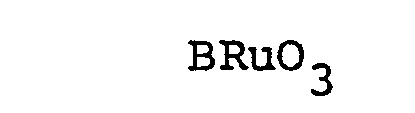
wherein B is Ca, Sr, Ba or La.
wherein B is Ca, Sr, Ba or La.
6. An electrolytic cell according to claim 1 or claim 2 characterised in that said
anode is made of a pyrochlore-type complex oxide having the formula

wherein x is 0.3 to 1.5.
wherein x is 0.3 to 1.5.
7. An electrolytic cell according to any preceding claim characterised in that said
anode has an average pore diameter of 0.01 to 1,000µ a porosity of 20 to 95% and an
air permeability coefficient of 1 x 10⁻⁵ to 1 mole/ cm . min. cmHg.
8. An electrolytic cell according to any preceding claim characterised in that said
current collector is in the form of a plurality of rods or nets or a porous plate.
9. An electrolytic cell according to any preceding claim characterised in that said
partition wall is made of plied plates, a chlorine resistant metal being supported
on a plate made of nickel, stainless steel or iron.