|
(11) | EP 0 022 567 B1 |

| (12) | EUROPEAN PATENT SPECIFICATION |
|
|
| (54) |
Process for preparing N-(2-mercaptoethyl) alkanamides Verfahren zur Herstellung von N-(2-Mercaptoäthyl)-alkanamiden Procédé de préparation de N-(2-mercaptoéthyl)-alcane-amides |
|
|
|||||||||||||||||||||||||||||||
| Note: Within nine months from the publication of the mention of the grant of the European patent, any person may give notice to the European Patent Office of opposition to the European patent granted. Notice of opposition shall be filed in a written reasoned statement. It shall not be deemed to have been filed until the opposition fee has been paid. (Art. 99(1) European Patent Convention). |
[0002] Kaiser and Owen teach in U.S. Patent 4,086,274 that N-(2-mercaptoethyl)alkanamides are prepared by the reaction of a 2-alkyl-2-oxazoline with hydrogen sulfide. Substantially any reaction temperature from about 20°C. to about 200°C. and autogenous or superatmospheric pressure are recited to be suitable operating conditions. In Example 1 in the patent, a reaction time of more than 5 hours is utilized in a batchwise process to effect an 85.1 percent yield of the desired amide based on the oxazoline reactant at a reaction temperature of 100°C.―1 10°C. and a maximum pressure of about 22 bar (320 pounds per square inch gauge (psig)).
[0003] It has now been discovered that the process for preparing an N-(2-mercaptoethyl)alkanamide represented by the general formula (I)
wherein R is alkyl and R, and Rz are each independently hydrogen, lower alkyl (C,-Ce), hydroxy- substituted lower alkyl or phenyl is improved by reacting a 2-alkyl-2-oxazoline with an excess of hydrogen sulfide under essentially anhydrous conditions, characterised in that the hydrogen sulfide is reacted in a continuous process with the 2-alkyl-2-oxazoline at a temperature in the range of from 100 to 185°C, both of the reactants being maintained in the liquid phase throughout the reaction by the application of a gauge pressure in the range of from 36 to 63 bar.
[0004] The 2-alkyl-2-oxazoline reactant corresponds to the general formula (II)
in which R, R, and Rz have the aforesaid meanings. Preferably R is an alkyl group of from 1 to about 18 carbon atoms and most preferably R is methyl or ethyl. Preferably, R, and R2 are each independently hydrogen, methyl, ethyl or hydroxymethyl and more preferably R, and R2 are each hydrogen.
[0005] The 2-oxazolines used herein can be prepared by conventional processes, which are well documented in the literature.
[0006] Hydrogen sulfide is also a well-known compound. It is a colorless gas at atmospheric pressure at the reaction temperatures utilized in the disclosed improved process. In order to maintain it in the necessary liquid phase during the instant reaction, superatmospheric pressures must be employed.
[0007] The 2-alkyl-2-oxazoline and the hydrogen sulfide must be intimately and homogenously mixed in the proper mole ratios prior to substantial reaction in order to minimize the formation of by-products. It is desirable that no diluent be employed. The oxygen present in this reaction mixture is desirably minimal, as it will react with the product. Conveniently, the reactants are mixed at a temperature in the range from about 10°C. to about 50°C. in a mole ratio in the range from greater than about 1.0 to about 1.5, preferably about 1.10 to about 1.30, of the hydrogen sulfide with respect to the 2-oxazoline reactant. It is preferred that liquid hydrogen sulfide is mixed with liquid 2-alkyl-2-oxazoline. However, it is operable, but less desirable, to mix gaseous hydrogen sulfide with the liquid oxazoline and then to liquefy the mixture with superatmospheric pressure, so long as substantial reaction does not occur. The use of more than a 50 percent mole excess of hydrogen sulfide makes the maintenance of an entirely liquid reaction phase extremely difficult. The use of less than a 10 percent mole excess of hydrogen sulfide may result in the clogging of the outlets of the reaction vessel with by-products, especially at reaction temperatures above 160°C.
[0008] After the reactants have been thoroughly premixed, they are introduced into the reaction vessel and heated to the desired reaction temperature with suitable pressure to maintain a liquid phase. The reaction vessel can be a simple pipe connected to suitable valves and pumps to maintain the reaction pressure and suitable means to control the reaction temperature. The reaction temperature should be in the range from about 100°C. to about 180°C., preferably about 135°C. to about 165°C. The minimum reaction pressure necessary to maintain a liquid phase in the reaction mixture is typically at least about 36 to 42 bar (550 to 600 psig), with higher pressures in this range being necessary at higher reaction temperatures. The reaction pressure can operably be much greater than these minimum values, but pressures less than about 63 bar (900 psig) are generally preferred because of the relatively greater cost of equipment operable at higher pressures.
[0009] The reaction time necessary for complete conversion of the 2-alkyl-2-oxazoline varies with reaction temperature. About 40 minutes are necessary at 100°C. to effect complete conversion, whereas only about 5 minutes are required at 135°C. The residence time in the reaction vessel can be varied to match the minimum reaction time by varying the flow rate of the reactants or the length of said vessel.
[0010] The following examples further illustrate the invention. Unless otherwise indicated all parts and percentages are by weight.
Examples 1-6
[0011] The 2-ethyl-2-oxazoline reactant, containing about 0.2 percent water, and the liquid hydrogen sulfide are charged to separate reactant reservoirs. The 2-ethyl-2-oxazoline feed is purged with nitrogen to remove any dissolved oxygen. The reactants are pumped through separate stainless steel feed lines at rates of 63.9 and 169 grams per hour for the hydrogen sulfide and 2-ethyl-2-oxazoline, respectively. These feed lines are merged by means of a "Y"-connector, the resulting turbulence provides a homogenous reaction mixture containing 1.1 moles of H2S for each mole of 2-ethyl-2-oxazoline.
[0012] The reaction mixture is fed directly into a 7 m (23-foot) long coil of stainless steel tubing one- eighth inch in diameter maintained at a desired temperature by immersion in a heat bath. The high surface area to volume ratio ensures good heat transfer. The residence time in the reaction vessel is nominally 5.4 minutes. A back-pressure control valve following the coil reaction vessel maintains a pressure of about 58 to 59 bar (830-840 psig) upstream. After passing through the coil reaction vessel, the product stream is depressurized, collected and analyzed by standard iodide/iodate titration and conventional liquid chromatographic techniques to determine the yield of the desired product. The above-described procedure is repeated at six different reaction temperatures and the weight percent N-(2-mercaptoethyl)propionamide (MEP) along with a thiocarboxamide (TCA) and a diamide mercaptan (DAM) by-product are tabulated for each run in Table I.
[0013] As can be seen from the data presented in Table I, the weight percent of the desired product produced is at least 83 percent in all the runs except the first. A residence time of 5.4 minutes is found to be insufficient at a reaction temperature of 101 °C. as 22 percent of the crude product is the 2-ethyl-2-oxazoline reactant. The by-product which predominates is the thiocarboxamide (C2H5CSNC2H4OH) at the lower reaction temperatures and the diamide mercaptan ((C2H,CONHC2H4)2S) at the higher reaction temperatures.
Examples 7-10
[0014] The 2-ethyl-2-oxazoline was reacted with hydrogen sulfide according to the procedure of Examples 1-6 except that the reaction temperature was held constant at 157-8°C, the coil pressure at about 36 to 39 bar (520-550 psig) and excess of hydrogen sulfide was varied. The weight percent N-(2-mercaptoethyl)propionamide (MEP) along with a thiocarboxamide (TCA) and diamide mercaptan (DAM) by-product for four different stoichiometries are tabulated below in Table II.
Comparative experiment
[0015] 2-Ethyl-2-oxazoline is charged to a 190 I (50-gallon) glass-lined reactor under a nitrogen atmosphere at a temperature of about 50°C. Gaseous hydrogen sulfide is charged to the reactor over a 2-hour period at a temperature of 50°C., so as to effect an ultimate mole ratio of hydrogen sulfide to 2-ethyl-2-oxazoline of about 1.1. Pressures of up to about 10 bar (150 psig) are reached during this addition step. A sample of this reaction mixture is analyzed by conventional techniques and is found to contain 75 percent N-(2-mercaptoethyl)propionamide, 22 percent of the thiocarboxamide by-product and 3 percent of the diamide mercaptan.
[0016] The reactor is heated to 150°C. for 5 hours to reduce the presence of the thiocarboxamide by-product in the crude product. The resulting product when analyzed by conventional techniques is found to consist of 83 percent N-(2-mercaptoethyl)propionamide, 0.5 percent of the thiocarboxamide and 10.0 percent of the diamide mercaptan.
1. A process for preparing N-(2-mercaptoethyl)alkanamides represented by the general
formula (I)
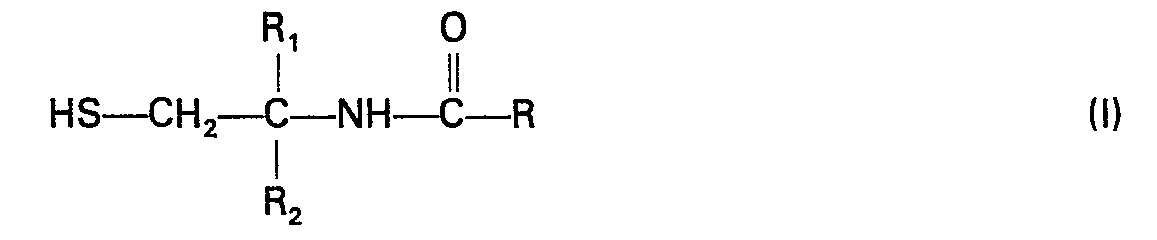
wherein R is alkyl and R, and R2 are each independently hydrogen, lower alkyl (C,-C61, hydroxy-substituted lower alkyl or phenyl, by reacting a 2-alkyl-2-oxazoline with an excess of hydrogen sulfide under essentially anhydrous conditions, characterised in that the hydrogen sulfide is reacted in a continuous process with the 2-alkyl-2-oxazoline at a temperature in the range of from 100 to 185°C, both of the reactants being maintained in the liquid phase throughout the reaction by the application of a gauge pressure in the range of from 36 to 63 bar.
wherein R is alkyl and R, and R2 are each independently hydrogen, lower alkyl (C,-C61, hydroxy-substituted lower alkyl or phenyl, by reacting a 2-alkyl-2-oxazoline with an excess of hydrogen sulfide under essentially anhydrous conditions, characterised in that the hydrogen sulfide is reacted in a continuous process with the 2-alkyl-2-oxazoline at a temperature in the range of from 100 to 185°C, both of the reactants being maintained in the liquid phase throughout the reaction by the application of a gauge pressure in the range of from 36 to 63 bar.
2. The process described in claim 1, characterised in that up to 1.5 moles of hydrogen
sulfide per mole of oxazoline are employed.
3. The process described in claim 1, characterised in that 1.10 to 1.30 moles of hydrogen
sulfide per mole of oxazoline are employed.
4. The process as described in claim 1, characterised in that the 2-alkyl-2-oxazoline
and the hydrogen sulfide reactant are premixed in the specified ratio prior to the
occurrence of substantial reaction.
5. The process as described in claim 4, characterised in that the 2-alkyl-2-oxazoline
is 2-methyl-2-oxazoline or 2-ethyl-2-oxazoline.
1. Ein Verfahren zur Herstellung von N-(2-Mercaptoäthyl)alkanamiden, die durch die
allgemeine Formel (I) wiedergegeben werden
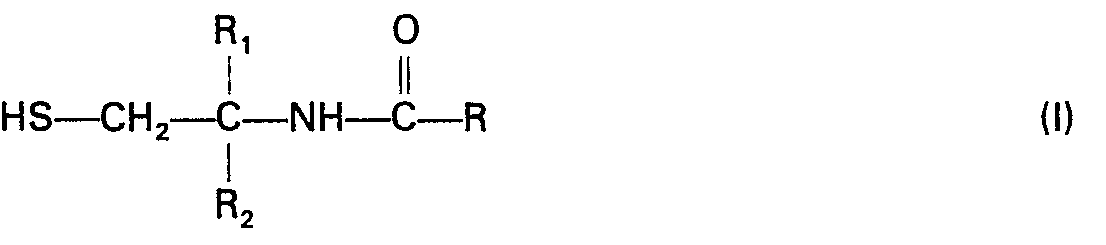
in der R Alkyl ist und R, und R2 jeweils unabhängig Wasserstoff, Niederalkyl (C,―Cg), hydroxysubstitutuiertes Niederalkyl oder Phenyl sind, durch Umsetzung eines 2-Alkyl-2-oxazolins mit einem Überschuß von Schwefelwasserstoff unter im wesentlichen wasserfreien Bedingungen, dadurch gekennzeichnet, daß der Schwefelwasserstoff in einem kontinuierlichen Verfahren mit dem 2-Alkyl-2-oxazolin bei einer Temperatur im Bereich von 100 bis 185°C umgesetzt wird, wobei beide Umsetzungsteilnehmer während der Umsetzung durch Anwendung eines Uberdrucks im Bereich von 36 bis 63 bar in der flüssigen Phase gehalten werden.
in der R Alkyl ist und R, und R2 jeweils unabhängig Wasserstoff, Niederalkyl (C,―Cg), hydroxysubstitutuiertes Niederalkyl oder Phenyl sind, durch Umsetzung eines 2-Alkyl-2-oxazolins mit einem Überschuß von Schwefelwasserstoff unter im wesentlichen wasserfreien Bedingungen, dadurch gekennzeichnet, daß der Schwefelwasserstoff in einem kontinuierlichen Verfahren mit dem 2-Alkyl-2-oxazolin bei einer Temperatur im Bereich von 100 bis 185°C umgesetzt wird, wobei beide Umsetzungsteilnehmer während der Umsetzung durch Anwendung eines Uberdrucks im Bereich von 36 bis 63 bar in der flüssigen Phase gehalten werden.
2. Das in Ansruch 1 beschriebene Verfahren, gekennzeichnet dadurch, daß bis zu 1,5
Mol Schwefelwasserstoff pro Mol Oxazolin verwendet werden.
3. Das in Anspruch 1 beschriebene Verfahren, gekennzeichnet dadurch, daß 1,10 bis
1,30 Mol Schwefelwasserstoff pro Mol Oxazolin verwendet werden.
4. Das in Anspruch 1 beschriebene Verfahren, gekennzeichnet dadurch, daß das 2-Alkyl-2-oxazolin
und der Schwefelwasserstoff-Umsetzungsteilnehmer in dem bestimmten Verhältnis vor
dem Auftreten einer nennenswerten Umsetzung vorgemischt werden.
5. Das in Anspruch 4 beschriebene Verfahren, gekennzeichnet dadurch, daß das 2-Alkyl-2-oxazolin
2-Methyl-2-oxazolin oder 2-Äthyl-2-oxazolin ist.
1. Procédé de préparation de N-(2-mercaptoéthyl)alcanamides représentés par la formule
générale (I)
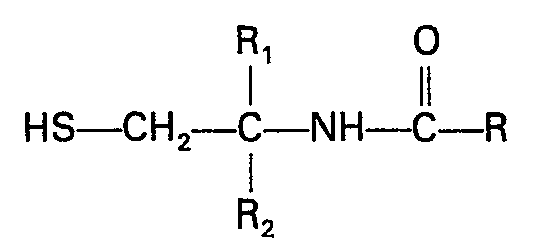
dans laquelle R représente un groupe alcoyle et R, et R2 représentent chacun indépendamment de l'hydrogène, un groupe alcoyle inférieur (C1―C6), hydroxyalcoyle inférieur ou phényle, en faisant réagir une 2-alcoyl-2-oxazoline avec un excès d'hydrogène. sulfuré dans des conditions essentiellement anhydres, caractérisé en ce que l'on fait réagir l'hydrogène sulfuré dans un procédé en continu avec la 2-alcoyl-2-oxazoline, à une température comprise entre 100 et 185°C, les réactifs étant tous deux maintenus en phase liquide pendant toute la réaction par l'application d'une pression manométrique comprise entre 36 et 63 bars.
dans laquelle R représente un groupe alcoyle et R, et R2 représentent chacun indépendamment de l'hydrogène, un groupe alcoyle inférieur (C1―C6), hydroxyalcoyle inférieur ou phényle, en faisant réagir une 2-alcoyl-2-oxazoline avec un excès d'hydrogène. sulfuré dans des conditions essentiellement anhydres, caractérisé en ce que l'on fait réagir l'hydrogène sulfuré dans un procédé en continu avec la 2-alcoyl-2-oxazoline, à une température comprise entre 100 et 185°C, les réactifs étant tous deux maintenus en phase liquide pendant toute la réaction par l'application d'une pression manométrique comprise entre 36 et 63 bars.
2. Procédé tel que décrit dans la revendication 1, caractérisé en ce qu'on emploie
jusqu'à 1,5 mole d'hydrogène sulfuré par mole d'oxazoline.
3. Procédé tel que décrit dans la revendication 1, caractérsé en ce qu'on emploie
1,1 à 1,3 mole d'hydrogène sulfuré par mole d'oxazoline.
4. Procédé tel que décrit dans la revendication 1, caractérisé en ce que l'on prémélange
la 2- alcoyl-2-oxazoline et l'hydrogène sulfuré dans le rapport spécifié avant l'apparition
a'une réaction importante.
5. Procédé tel que décrit dans la revendication 4, caractérisé en ce que la 2-alcoyl-2-oxazoline
est la 2-méthyl-2-oxazoline ou la 2-éthyl-2-oxazoline.