| (19) |
 |
|
(11) |
EP 0 023 426 A1 |
| (12) |
EUROPEAN PATENT APPLICATION |
| (43) |
Date of publication: |
|
04.02.1981 Bulletin 1981/05 |
| (22) |
Date of filing: 25.07.1980 |
|
| (51) |
International Patent Classification (IPC)3: A44B 11/25 |
|
| (84) |
Designated Contracting States: |
|
AT BE CH DE FR GB IT LI LU NL SE |
| (30) |
Priority: |
28.07.1979 GB 7926379
|
| (71) |
Applicant: Britax Overseas Limited |
|
Yardley
Birmingham B25 8BB (GB) |
|
| (72) |
Inventor: |
|
- Spalding, David Norman
Woking
Surrey (GB)
|
| (74) |
Representative: Hollinghurst, Antony |
|
B.S.G. International plc
Patent Department
Castle Trading Estate
East Street
Portchester, Hants PO16 9SD
Portchester, Hants PO16 9SD (GB) |
|
| |
|
| (54) |
Buckles for harnesses |
(57) A buckle for a safety harness consists of two identical parts Each part comprises
a plate (10) having a D-shaped aperture (12) in one end. for receiving a harness,
and a portion (14) at the other end folded at right angles to the rest of the plate
(10) along an oblique fold line (16) A slot (18) extends half way along the fold line
16. A second plate (20) has a tab (22) welded to the portion (14) of the plate 10
at the side thereof adjacent to the slot (18). The two parts interlock with the upstanding
portions (14) and (22) of one part projecting through the slot (18) in the other and
vice versa. Tension applied to a harness connected to the apertures (12) tends to
draw the ends (24) of the slots (18) into abutment with each other.
|
|
[0001] This invention relates to a buckle for a safety harness.
[0002] According to the invention, a buckle of the foregoing type is formed in two identical
parts, each comprising a plate having a means for connection to a harness strap at
one end and an upstanding portion at its other end folded at right angles along an
oblique fold line, a slot being cut in the plate from the end of the fold line nearer
to the harness aperture to the mid point of the fold line, and the upstanding end
portion having a protuberance on the side thereof remote from the harness connection
means to provide an abutment surface on the level of the plate on the inside of the
fold line, whereby, if the two parts are interengaged with each upstanding end portion
received in the oblique slot of the other part, tension applied to the harness apertures
puljs the two parts so that the ends of their slots abut.
[0003] Preferably, each upstanding end portion has a hole extending therethrough with its
axis aligned with the end of the slot in the corresponding plate whereby, when the
two parts are interengaged, the two holes in the upstanding end portions are aligned
with one another to permit an object to be inserted therethrough to lock the two parts
in engagement with one another.
[0004] The object inserted through the holes may be a carabiner or snap-link for connecting
the buckle to a lifeline.
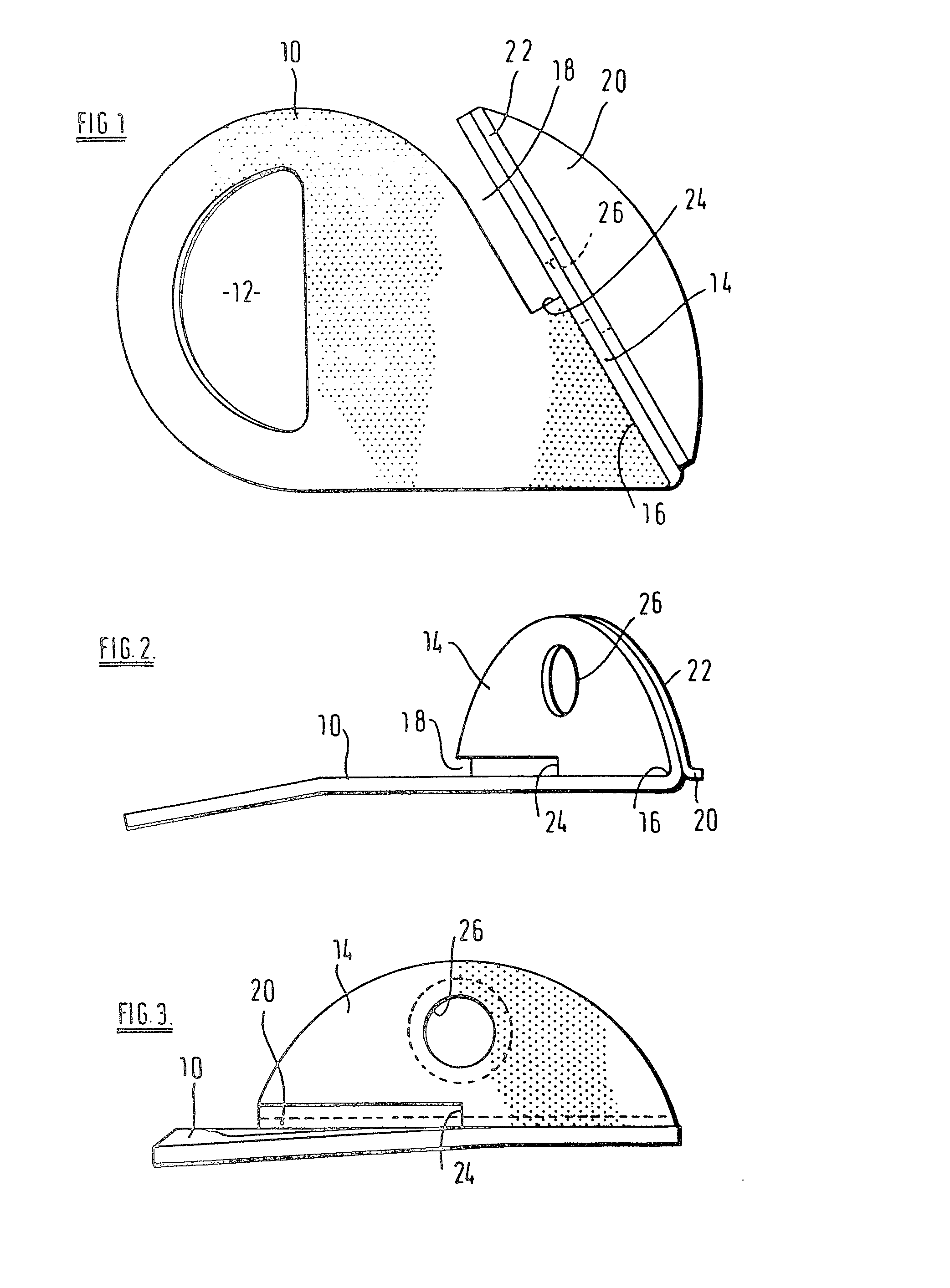
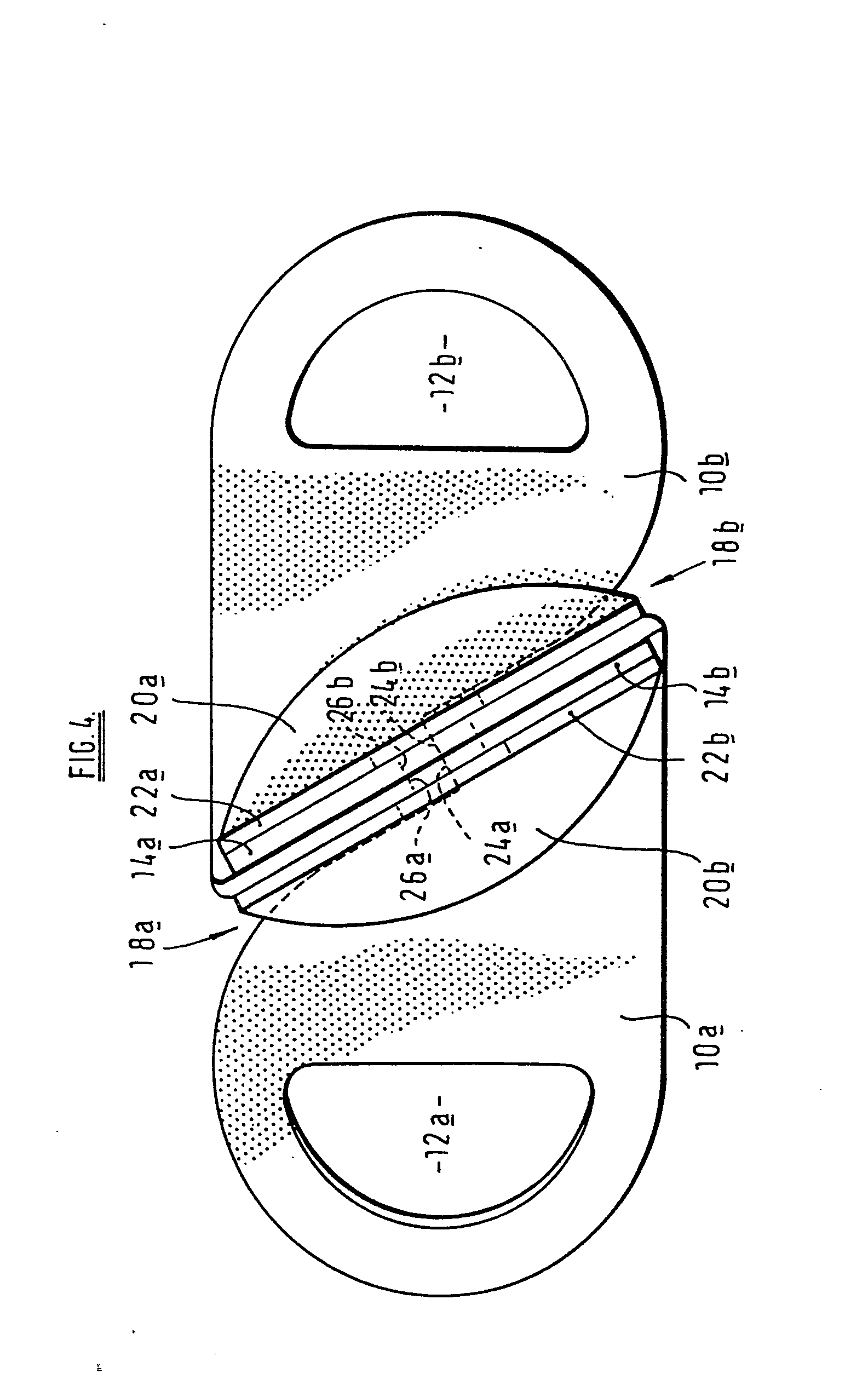
[0005] An embodiment of the invention is illustrated in the accompanying drawings, in which:
Figure 1 is a plan view of one part of a buckle.
Figure 2 is a side elevation of the buckle part shown in Figure 1.
Figure 3 is an oblique elevation of the buckle part shown in Fipure 1, and
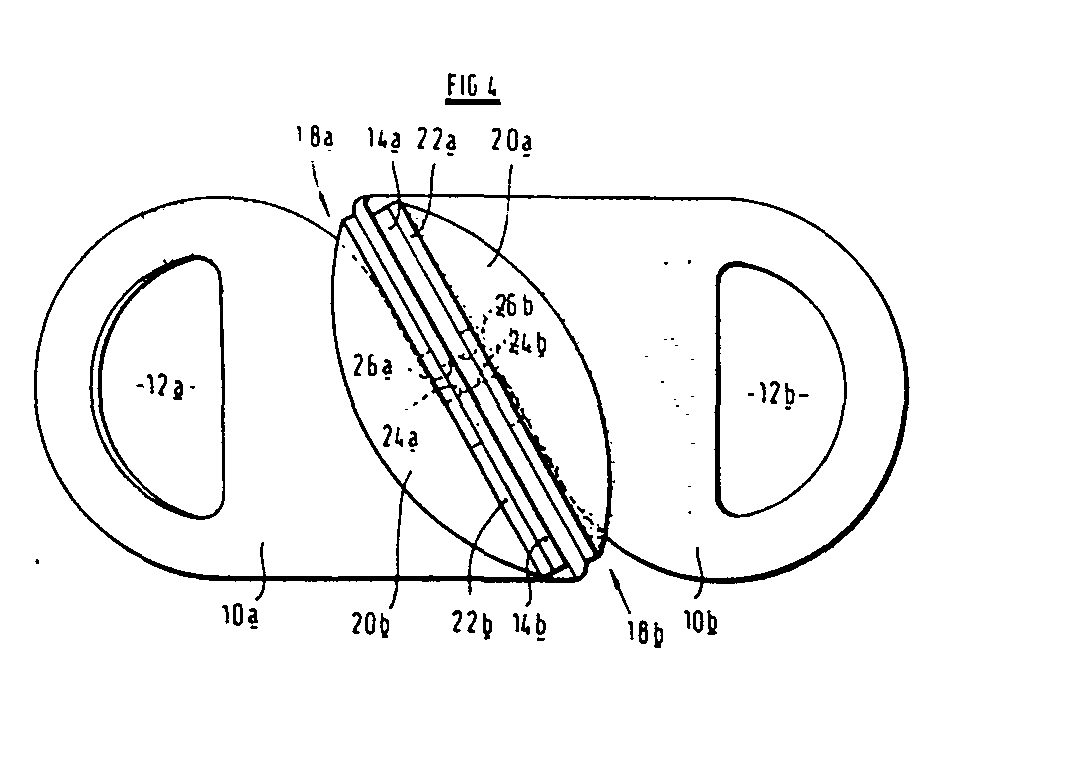
Figure 4 is a plan view showing two identical buckle parts engaging with one another.
[0006] Referring to Figures 1 to 3, one part of a buckle comprises a plate 10 having a D-shaped
aperture 12 in one end for receiving a harness.
[0007] A portion 14 at the other end of the plate 10 is folded at right angles to the rest
of the plate 10 along an oblique fold line 16. A slot 18 extends half way along the
fold line 16 from the end therefore nearer to the aperture 12. A second plate 20 has
a tab 22 bent at right angles thereto and welded to the portion 14 of the plate 10
at the side thereof adjacent to the slot 18 so that the bottom of the plate 20, as
viewed in Figures 2 and 3,is level with the top of the plate 10.
[0008] Turning now to Figure 4, two identical buckle parts are shown in engagement with
one another. The various component parts are denoted by the same reference numerals
as are used in Figures 1 to 3 with the suffix "a" for one part of the buckle and the
suffix "b" for the other. The upstanding portions 14a and 22a project through the
slot 18b and vice versa. Tension applied to a harness connected to the apertures 12a
and 12b tends to draw the two buckle parts apart so that the ends 24a and 24b of the
slots 18a and 18b are brought into abutment with each other. Holes 26a and 26b in
the upstanding positions 14a and 14b are then in alignment with each other. If a snap
link (not shown) is inserted through the holes 26a and 26b, the two parts of the buckle
are prevented from separating from one another.
1. A buckle for a safety harness formed in two identical parts, each havinp means
(12) for connection to a harness strap at one end characterised in that each part
comprises a plate (10) having an upstanding portion (14) at its other end folded at
right apples along an oblique fold line (16), a slot (18) being cut in the plate (10)
from the end of the fold line (16) nearer to the harness aperture to the mid point
of the fold line, and the upstanding end portion having a protuberance (20) on the
side thereof remote from the harness connection means (12) to provide an abutment
surface on the level of the plate (10) on the inside of the fold line (16), whereby,
if the two parts are interengaged with each upstanding end portion (14) received in
the oblique slot (18) of the other part, tension applied to the harness apertures
(12) pulls the two parts so that the ends of their slots (18) abut.
2. A buckle according to claim 1, characterised in that end portion (14) has a hole
(26) extending therethrough with its axis aligned with the end of the slot (18) in
the corresponding plate whereby, when the two parts are interengaged the two holes
(26) in the upstanding end portions (14) are aligned with one another to permit an
object to be inserted therethrough to lock the two parts in engagement with one another.