|
(11) | EP 0 024 210 A1 |

| (12) | EUROPEAN PATENT APPLICATION |
|
|
|
|
|||||||||||||||||||||||||||
| (54) | Process for the production of optically active threo-3-(3,4-dihydroxyphenyl) serine, and product thus produced |
| (57) A process for the production of optically active (D- or L-) threo-3-(3,4-dihydroxyphenyl)
serine, which comprises subjecting racemic threo-3-(3,4-dibenzyloxyphenyl) -N-carbobenzyloxyserine
to optical resolution using as a resolving reagent an optically active amino alcohol
derivative, and then subjecting the resulting optically active (D- or L-) threo-3-(3,4-dibenzyloxyphenyl)
-N-carbobenzyloxyserine to hydrogenolysis. |
[0001] The present invention relates to a process for the production of optically active threo-3-(3,4-dihydroxyphenyl) serine (hereinafter, referred to as "DOPS") which is useful as a medicine.
[0002] It is known that the optically active (D- or L-) threo-DOPS is a precursor of norepinephrine which is an important catecholamine in the body, and that this threo-DOPS has activities on the circulatory system and psychotropic activities (c.f. Japanese Patent Publication (unexamined) No. 49252/1975).
[0003] Various processes for the production of the optically active (D- or L-) threo-DOPS are known, as disclosed, for example, in Japanese Patent Publication (unexamined) Nos. 49252/1975, 32540/1976, and 36233/1979. However, according to the processes disclosed in Japanese Patent Publication (unexamined) Nos. 49252/1975 and 36233/1979, it is difficult to obtain a suitable resolving reagent for resolving the racemic mixture into the optically active isomers.
[0004] In the process disclosed in Japanese Patent Publication (unexamined) No. 32540/1976, a racemic mixture of threo-DOPS is first prepared and then the racemic mixture is subjected to optical resolution, which is economically unfavourable.
[0005] We have now found an economical and industrially applicable process for the production of optically active (D- or L-) threo-DOPS, involving first subjecting a racemic protected DOPS to optical resolution with a specific resolving reagent and then subjecting the resulting optically active protected DOPS to hydrogenolysis.
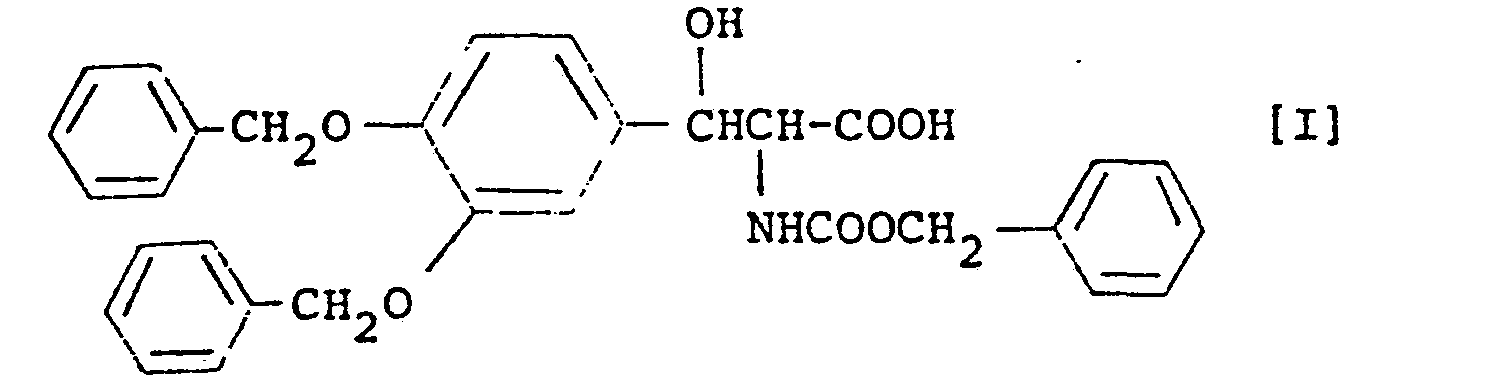
[0006] The improved process of the present invention comprises subjecting a mixture, for example a racemic mixture of D- and L-threo-3-(3,4-dibenzyloxyphenyl)-N-carbobenzyloxyserine of the formula:
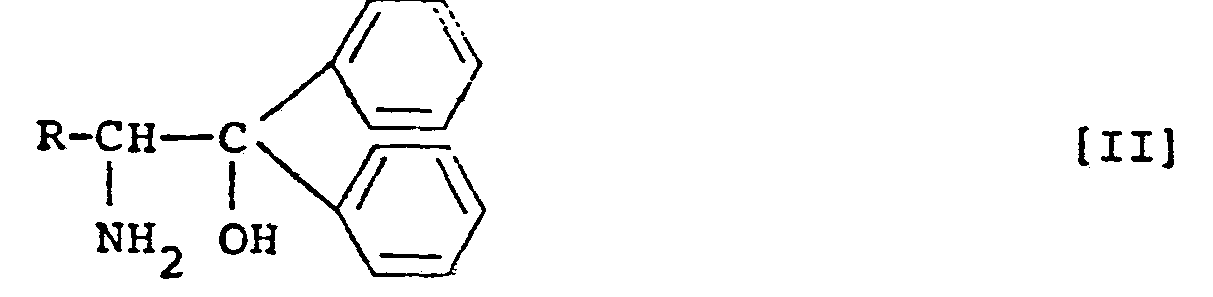
to optical resolution with an optical active amino alcohol derivative of the formula:
'wherein R is methyl, isopropyl or isobutyl, and then subjecting the resulting optically active (D- or L-) threo-3-(3,4-dibenzyloxyphenyl)-N-carbobenzyloxyserine to hydrogenolysis to give the desired optically active (D- or L-) threo-DOPS.
[0007] The diastereomer salts obtained by the reaction of the racemic 3-(3,4-dibenzyloxyphenyl)-N-carbobenzyloxyserine I with the optically active amino alcohol derivative II have different solubility, and owing to the different solubility, the racemic mixture of diastereomer salts can be separated into each diastereomer salt, i.e. D-3-(3,4-dibenzyloxyphenyl)-N-carbobenzyloxyserine amino alcohol derivative salt and L-3-(3,4-dibenzyloxyphenyl)-N-carbobenzyloxyserine amino alcohol derivative salt. The diastereomer salts thus resolved are each decomposed with an acid to obtain optically active (D- or L-) 3-(3,4-dibenzyloxyphenyl)-N-carbobenzyloxyserine, which is then subjected to hydrogenolysis.
[0008] The process of the present invention is advantageous for economical industrial production of the desired optically active (D- or L-) threo-DOPS in view of the easy availability of the starting materials and high optical resolution yield.
[0009] Preferably, an equimolar or less amount of optically active (S- or R-) amino alcohol derivative II is added to racemic threo-3-(3,4-dibenzyloxyphenyl)-N-carbobenzyl-oxyserine I in a solvent to prepare a solution containing diastereomer salts. The amount of the resolving reagent may vary, but is usually from 0.5 to 1 mole per mole of the racemic mixture to be resolved. When the optically active resolving reagent is used in an amount of less than 1 mole (e.g. 0.5 mole), the remaining amount (e.g. O.5 mole) of an optically inactive amine or an inorganic base may be added.
[0010] The solvent used should be a neutral one. Acidic solvents (e.g. acetic acid) and basic solvents (e.g. amines) are excluded because they inhibit the formation of the diastereomer salts. Suitable examples of the solvent,because of their convenience and low cost are ketones such as acetone, methyl ethyl ketone, alcohols having 1 to 4 carbon atoms such as methanol, ethanol and isopropanol, aqueous mixtures of such ketones or alcohols, ethyl acetate, toluene, acetonitrile, dichloroethane, and mixtures of two or more thereof. Alcohols are preferred, particularly methanol.
[0011] The resolution procedure is usually carried out at room temperature, but may be carried out at a higher or lower temperature. In order to obtain a uniform solution, the mixture may be heated up to the boiling point of the solvent, and the reaction mixture may optionally be cooled gradually in order to obtain a pure diastereomer salt.
[0012] By the resolution procedure, the diasteromer salt having the lower solubility is crystallized out from the reaction mixture. When S-2-amino-1,1-diphenylpropanol or S-2-amino-3-methyl-1,1-diphenyl- butanol is used as the resolving reagent, the diastereomer salt having the lower solubility is the salt of L-threo-2-(3,4-dibenzyloxyphenyl)-N-carbobenzyloxyserine, and the salt of D-threo-3-(3,4-dibenzyloxy- phenyl)-N-carbobenzyloxy-serine remains in solution. When S-2-amino-4-methyl-l,l-diphenylpentanol is used as the resolving reagent, the diastereomer salt having the lower solubility is the salt of D-threo-3-(3,4-dibenzyloxyphenyl)-N-carobenzyloxyserine, and the salt of L-threo-3-(3,4-dibenzyloxyphenyl)-N-carbobenzyloxyserine remains in solution.
[0013] The diastereomer salt crystallized out from the reaction mixture may be recrystallized from an alcohol or ketone solvent in order to improve its optical purity. The diastereomer salt remaining in the mixture can be isolated from the mixture by concentrating the filtrate obtained after removinq the diastereomer salt first crystallized out and then collecting the resulting precipitate.
[0014] The diastereomer salts thus resolved can each be decomposed into the optical active (D- or L-) threo-3-(3,4-dibenzyloxyphenyl)-N-carbobenzyloxyserine I by- conventional methods. For example, the diastereomer salt first crystallized out or obtained from the filtrate maybe added to an aqueous solution of a mineral acid, such as hydrochloric acid, sulfuric acid, phosphoric acid, or the like, and thereby the desired optically active (D- or L-) threo-3-(3,4-dibenzyloxyphenyl)-N-carbobenzyloxyserine 1 is obtained from the organic layer. The resolving reagent, optical active amino alcohol derivative II moves into the aqueous layer.
[0015] The optical active (D- or L-) threo-3-(3,4-dibenzyloxyphenyl)-N-carbobenzyloxyserine thus obtained is then subjected to hydrogenolysis to produced the corresponding optically active (D- or L-) threo-DOPS. The hydrogenolysis can be carried out by treating the resolved salt with hydrogen in an appropriate solvent in the presence of a catalyst at a temperature of from 0 to 100°C under atmospheric or higher pressure. Suitable examples of the catalyst are palladium, platinum, nickel, or the like, which may be carried on an appropriate carrier such as active carbon, barium carbonate, or the like. Suitable examples of the solvent are lower alcohols havinq from 1 to 4 carbon atoms such as methanol, ethanol, or the like, or an aqueous mixture of the alcohols.
[0016] In order to promote the hydrogenolysis or to improve the solubility of the reaction product, an appropriate acid may be added to the reaction mixture, preferably in an amount of 0.8 to 2.0 moles to 1 mole of the resolved salt. Suitable examples of the acid are mineral acids such as hydrochloric acid, sulfuric acid, or the like or organic acids such as acetic acid, methanesulfonic acid, or the like.
[0017] After the hydrogenolysis is completed, the reaction mixture is filtered to remove the catalyst, and concentrated, and when an acid is added, it is neutralized, and thereby, the desired optically active (D- or L-) threo-DOPS can be obtained in the crystalline form.
[0018] The starting racemic threo-3-(3,4-dibenzyl- oxyphenyl)-N-carbobenzyloxyserine [I] is a known compound and can easily be obtained by introducing a carbo- benzyloxy group onto the amino group of racemic threo-3-(3,4-dibenzyloxyphenyl)serine which can advantageously be produced by a process discovered by the present inventors (cf. Japanese Patent Publication (unexamined) No. 19931/1979). The optical active amino alcohol derivatives [II] used as the resolving reagent is also known [cf. J. Chem.Soc., 287 (1925), 785 (1926); J. Pharm.Soc., Japan 48, 46 (l928)] and can easily be produced from an optically active α-amino acid by a single step as shown in the following reaction scheme A:
wherein R is as defined above, and X is a halogen atom.
Example 1
[0020] Racemic threo-3-(3,4-dibenzyloxyphenyl)-N-carbobenzyloxyserine (65 g) is dissolved in methanol (650 g) at 50°C, and therein is dissolved S-2-amino-1,1-diphenylpropanol (28.0 g). The mixture is cooled to 30°C over a period of one hour. The mixture is again heated to 50°C and is then cooled to 25°C over a period of 2 hours and is agitated under ice-cooling for 3 hours. The precipitated crystals are collected to obtain L-threo-3-(3,4-dibenzyloxyphenyl)-N-carbobenzyloxyserine·S-2-amino-1,1-diphenylpropanol salt (40.5 g). Melting point 151 - 153°C,
-30.5° (c=l, tetrahydrofuran)
[0021] The salt (20 g) thus obtained is decomposed by treating with 3 % hydrochloric acid to give L-threo-3-(3,4-dibenzyloxyphenyl)-N-carbobenzyloxyserine in the crystalline form (13.5 g). Melting point 130 - 132°C,
-18.3° (c=1, methanol)
[0022] The filtrate obtained after removing the diastereomer salt is concentrated and is decomposed with 3 % hydrochloric acid to give D-threo-3-(3,4-dibenzyl- oxyphenyl)-N-carbobenzyloxyserine in the crystalline form (34 g). Melting point 128 - 132°C,
+16.5° (c=l, methanol)
Example 2
[0023] Racemic threo-3-(3,4-dibenzyloxyphenyl)-N-carbobenzyloxyserine (2.0 g) is dissolved in 20 % aqueous methanol (20 ml), and therein is dissolved with agitation S-2-amino-l,l-diphenylpropanol (0.86 g) at 55°C. The mixture is cooled to 30°C over a period of 3 hours. After the reaction mixture is allowed to stand overnight, the precipitated crystals are collected by filtration to give L-threo-3-(3,4-dibenzyloxyphenyl)-N-carbobenzyloxyserine-S-2-amino-1,1-diphenylpropanol salt (1.52 g). Melting point 150 - 153°C.
[0024] The salt thus obtained is decomposed with 3 % hydrochloric acid and extracted with ethyl acetate to give L-threo-3-(3,4-dibenzyloxyphenyl)-N-carbobenzy- oxyserine (0.95 g). Melting point 118 - 122°C,
-16.3° (c=l, methanol)
Example 3
[0025] Racemic threo-3-(3,4-dibenzyloxyphenyl)-N-carbobenzyloxyserine (0.8 g) and R-2-amino-l,l-diphenyl- propanol (0.8 g) are dissolved in ethyl acetate (10 ml). The mixture is allowed to stand for 5 days, and thereby there is obtained D-threo-3-(3,4-dibenzyloxyphenyl)-N-carbobenzyloxyserine·R-2-amino-1,1-diphenylpropanol salt (0.45 g). Melting point 150 - 152°C
[0026] The salt thus obtained is decomposed with 3 % hydrochloric acid and extracted with ethyl acetate to give D-threo-3-(3,4-dibenzyloxyphenyl)-N-carbobenzyloxyserine (0.26 g). Melting point 148 - 152°C,
-15.0° (c=l, methanol)
Example 4
[0027] Racemic threo-3-(3,4-dibenzyloxyphenyl)-N-carbobenzyloxyserine (0.53 g) and S-2-amino-3-methyl-1,1-diphenylbutanol (0.26 g) are dissolved in methanol (3 ml). After the mixture is allowed to stand at 5°C overnight, the precipitated crystals are collected by filtration to give L-threo-3-(3,4-dibenzyloxyphenyl)-N-carbobenzyloxyserine·S-2-amino-3-methyl-1,1-diphenyl-, butanol salt (0.35 g). Melting point 125 - 130°C
[0028] The salt thus obtained is decomposed with 3 % hydrochloric acid and extracted with ethyl acetate to give L-threo-3-(3,4-dibenzyloxyphenyl)-N-carbobenzyloxyserine (0.20 g) .
-6.0° (c=l, methanol)
Example 5
[0029] Racemic threo-3-(3,4-dibenzyloxyphenyl)-N-carbobenzyloxyserine (2.1 g) and S-2-amino-4-methyl-l,l-diphenylpentanol (1.1 g) are dissolved in methanol (15 ml). The mixture is allowed to stand overnight, and the precipitated crystals are collected by filtration to give D-threo-3-(3,4-dibenzyloxyphenyl)-N-carbobenzyloxyserine·S-2-amino-4-methyl-l,l-diphenylpentanol salt (1.35 g). Melting point 106 - 110°C
[0030] The salt thus obtained is decomposed with 3 % hydrochloric acid and extracted with ethyl acetate to give D-threo-3-(3,4-dibenzyloxyphenyl)-N-carbobenzyloxyserine (0.84 g). Melting point 90 - 96°C
+14.0° (c=l, methanol)
Example 6
[0031] L-Threo-3-(3,4-dibenzyloxyphenyl)-N-carbobenzyloxyserine,
-19.3° (c=1, methanol) (20 g) is dissolved in a mixture of methanol (300 g) and water (10 g). To the solution are added concentrated hydrochloric acid (4.9 g) and 5 % palladium-active carbon (0.6 g), and the mixture is subjected to hydrogenolysis with hydrogen gas at room temperature under atmospheric pressure. After absorption of hydrogen gas is observed no more, the reaction mixture is filtered to remove undissolved materials, and the mixture is neutralized with 5N aqueous sodium hydroxide solution. The mixture is agitated under ice-cooling for 2 hours. The precipitated crystals are collected by filtration to give L-threo-3-(3,4-dihydroxyphenyl)serine (8.0 g). Melting point 203 - 206°C (decomp.)
[0032] The compound thus obtained is recrystallized from water (450 g) containing L-ascorbic acid (80 mg) to give a purified product (5.7 g). Melting point 229 - 232°C (decomp.),
-42.0° (c=l, 1N hydrochloric acid)
Example 7
[0033] D-Threo-3-(3,4-dibenzyloxyphenyl)-N-carbobenzyloxyserine,
+19.1° (c=1.2, methanol) (20.3 g) is dissolved in a mixture of methanol (370 ml) and lN hydrochloric acid (43 ml). To the mixture is added 5 % palladium-active carbon (1.7 g), and the mixture is subjected to hydrogenolysis in the same manner as in Example 6. After absorption of hydrogen gas is observed no more, the undissolved materials are removed off by filtration, and then the filtrate is neutralized with diethylamine. The mixture is agitated under ice-cooling for 2 hours. The precipitated crystals are collected by filtration to give D-threo-3-(3,4-dihydroxyphenyl)serine (8.3 g). This compound is recrystallied from water (500 ml) containing L-ascorbic acid (80 mg) to give a purified product (6.3 g). Melting point 213 - 219°C,
+41.2° .(c=1.1, 1N hydrochloric acid)
1. A process for the production of optically active (D- or L-) threo-3-(3,4-dihydroxyphenyl)
serine, which comprises subjecting a mixture of D- and L- threo-3-(3,4-dibenzyloxyphenyl)-N-carbobenzyloxyserine
of the formula
to optical resolution using a resolving reagent which is an optically active amino alcohol derivative of the formula:
wherein R is methyl, isopropyl or isobutyl, and then subjecting the resulting optically active (D- or L-) threo-3-(3,4-dibenzyloxyphenyl)-N-carbobenzyloxyserine to hydrogenolysis.
to optical resolution using a resolving reagent which is an optically active amino alcohol derivative of the formula:
wherein R is methyl, isopropyl or isobutyl, and then subjecting the resulting optically active (D- or L-) threo-3-(3,4-dibenzyloxyphenyl)-N-carbobenzyloxyserine to hydrogenolysis.
2. The process according to claim 1, wherein the resolving reagent is a compound of
the formula II wherein R is methyl.
3. The process according to claim 1, wherein the resolving reagent is a compound of
the formula II wherein R is isopropyl.
4. The process according to claim 1, wherein the resolving reagent is a compound of
the formula II wherein R is isobutyl.
5. The process according to any one of the preceding claims wherein the resolving
reagent II is used in an amount of 0.5 to 1 mole per mole of the starting compound
I .
6. The process according to any one of the preceding claims wherein the optical resolution
is carried out in a solvent which is an alcohol having from 1 to 4 carbon atoms or
an aqueous mixture thereof.
7. The process according to claim 6, wherein the alcohol is methanol.
8. D- or L- threo-3--(3,4-dihydroxyphenyl) serine, when produced by a process as claimed
in any one of the preceding claims.