|
(11) | EP 0 024 727 A1 |

| (12) | EUROPEAN PATENT APPLICATION |
|
|
|
|
|||||||||||||||||||||||||||
| (54) | Anthracycline glycosides, processes for their preparation and pharmaceutical composition containing them |
| (57) Anthracycline glycosides, which in form of pharmaceun- cal compositions, exhibit
antitumoral activity. The anthracycline glycosides are of the general formula I
in which R represents a hydrogen atom or a hydroxy group, one of R1 and R2 represents a methyl group, and the other of R1 and R2 represents a hydroxy group, and their pharmaceutically acceptable acid addition salts, a process for producing said compounds and pharmaceutical compositions containing same. |
[0001] The invention relates to anthracycline glycosides, processes for their preparation and to pharmaceutical compositions containing them. Also included in the invention are new branched-chain amino-deoxy sugar derivatives used in the preparation of said anthracycline glycosides.
[0002] The invention provides anthracycline glycosides of the general formula I:
in which R represents a hydrogen atom or a hydroxy group, one of R1 and R2 represents a methyl group, and the other of R1 and R2 represents a hydroxy group, and their pharmaceutically acceptable acidaddition salts. The anthracycline glycosides I may be named as follows:
They are referred to hereinafter, for convenience, as compounds I-A, I-B, I-C and I-D respectively.
[0003] The compounds according to the invention may be prepared according to a process characterized in that daunomycinone is condensed with 2,3,6-trideoxy-4-C-methyl-4-0-p.nitrobenzoyl 3-trifluoro-acetamido-L-lyxo-hexopyranosyl chloride or 2,3,6-trideoxy-4-C-methyl-4-0-p.nitrobenzoyl-L-arabino- hexopyranosyl chloride,from the obtained corresponding protected glycoside derivatives all protecting groups are then removed in a manner known per se, the so obtained free glycosidic bases (R2=H) of general formula I are isolated, optionally in form of acid addition salt, which are eventually brominated in 14-position, from which; by hydrolysis the corresponding free glycosidic bases (R2=OH) of general formula I are isolated and eventually transformed in their pharmaceutically acceptable acid addition salts.
[0004] This process will be described in more detail hereinafter with reference to a specific embodiment.
[0005] Compounds I-A and I-C may be prepared by a process, which process comprises condensing daunomycinone with 2,3,6-trideoxy-4-C-methyl-4-0-p.nitrobenzoyl-3-trifluoro- acetamido-L-lyxo-hexopyranosyl chloride or 2,3,6-trideoxy-4-C-methyl-4-O-p.nitrobenzoyl-L-arabino-- hexopyranosyl chloride (hereinafter, for convenience, referred to as compounds II-A and II-B respectively) in an inert organic solvent, in the presence of a soluble silver salt catalyst, and of a molecular sieve as dehydrating agent, and removing'the N-trifluoroacetyl protecting group from the resultant anthracycline glycoside by mild alkaline hydrolysis.
[0006] The mild alkaline hydrolysis may be carried out in accordance with the method described in United States Patent Specifi-' cation No. 4,112,076. The inert organic solvent is suitably methylene dichloride or chloroform. Silver trifluoromethanesulphonate is the preferred silver salt. Compounds I-A and I-C may be isolated as their hydrochlorides.
[0007] Compounds I-B and I-D may be prepared from compounds I-A and I-C respectively by a further process within the scope of the invention. The said further process comprises brominating the compound I-A or I-C at the 14-position and hydrolysing the resultant 14-bromoderivative to give the compound I-B or I-D. The bromination and hydrolysis conditions may be those described in British Patent Specification No. 1,217,133 or those described in United States Patent Specification No. 3,803,124.
[0008] Compounds II-A and II-B are themselves novel and are included within the scope of the invention. They may be respectively prepared from methyl 2,3,6-trideoxy-4-C-methyl-3-trifluoroacetamido-α-L-lyxo-hexopyranoside(IV-A) and from methyl 2,3,6-trideoxy-4-C-methyl-3-trifluoroacet- amido-α-L-arabinohexopyranoside (IV-B), known compounds described in British Patent Application No. 41, 937/78, filed on October 25, 1978.
[0009] Acid hydrolysis of compounds-TV-A and IV-B gives respectively 2,3,6-trideoxy-4-C-methyl-α-L-lyxo-hexopyranose (V-A) and α-L-arabino-hexopyranose (V-B) which by treatment with p-nitrobenzoyl chloride in methylene dichloride and triethylamine in the presence of a catalytic amount of 4-dimethylaminopyridine are transformed into the corresponding 1,4-di-O-p.nitrobenzoyl derivatives VI-A and VI-B. Treatment of these with dry hydrogen chloride in anhydrous methylene dichloride affords respectively compounds II-A and II-B.
[0010] This process is within the scope of the invention. Compounds I-A, I-B, I-C and I-D are useful as antitumour agents and compounds II-A and II-B are useful as intermediates for the preparation of compounds I-A, I-B,.I-C and I-D.
[0012] The invention further provides a pharmaceutical composition comprising an anthracycline glycoside of the general formula I or a pharmaceutically acceptable addition salt thereof in admixture with a therapeutically acceptable diluent or carrier.
BIOLOGICAL ACTIVITY DATA
Antitumor activity
[0013] The new compounds have been tested on HeLa cells in vitro (time of exposure to the drugs : 24 hours) and on P-388 ascitic leukemia in mice in comparison with daunorubicin (daunomycin) and doxorubicin (adriamycin). The results of the in vitno tests are shown in Table 1.
[0014] The in vivo data obtained in mice are reported in Table 2. All the new compounds at the tolerated dose showed on P-388 leukemia an activity comparable or higher to that of the parent compounds.
[0016] The invention is illustrated by the following Examples in which degrees of temperature are degrees Celcius.
EXAMPLE 1
4-O-p.nitrobenzoyl-2,3,6-trideoxy-4-C-methyl-3'--trifluoroacetamido-L-lyxo-hexopyranosylphloride (II-'A)
[0017] A solution of 1 g (3.7 mmoles) of methyl 2,3,6-trideoxy-4-C-methyl-3-trifluoroacetamido-a-L-Iyxo-hexopyranoside (IV-A) in 20 ml of acetic acid and 80 ml of water was reacted at 100° for 2 hours. The solution was evaporated and2,3,6-trideoxy-4-C--methyl-3-trifluoroacetamido-α-L-lyxo-hexopyranose (V-A; 0.95 g, 95 %) was obtained as a white solid; m.p. 181-182°,
(c = .1.0 in methanol) . The PMR spectrum (CDCl3 + DMSO - d6) showed inter alia absorptions at: 1.05 (s, CH3-C-4) , 1.16 (d, CH3-C-5) , and 5.27 6 (C-1-H) . A solution of 0.75 g (2.9 mmoles) of compound V-A in a mixture of 10 ml of di triethylamine and 20'ml of dry methylene /chloride was treated under stirring with 2,20 g of p.nitrobenzoyl chloride and 0.220 g of 4-dimethylaminopyridine, then heated at 45° for 90 minutes. The solution was evaporated off and the residue was dissolved in 100 ml of chloroform, washed with 10% sodium bicarbonate solution and with water, and then the chloroform solution was dried over sodium sulphate. The residue obtained by evaporation was chromatographed on a silica gel column. Elution with a 95:5 chloroform: acetone mixture gave 1,4-di-O-p.nitrobenzoyl-2,3,6-trideoxy-4--C-methyl-3-'trifluoroacetamido-L-lyxo-hexopyranose (VI-A, 1,55 g, 95 %): m.p. 168-170 ,
(c=1 in chloroform).
[0018] A solution of 1.10 g (2.0 mmoles) of compound VI-A in 25 ml of dry methylene dichloride was saturated at O° with anhydrous hydrogen chloride.
[0019] The resulting precipitate of p.nitrobenzoic acid was filtered off under anhydrous conditions and the filtrate was evaporated to give 2,3,6-trideoxy-4--C-methyl-4-O-p.nitrobenzoyl-3-trifluoroacetamido-L--lyxo-hexopyranosyl chloride (II-A, 0.80 g) as a white solid Suitable for the subsequent coupling reaction without further purification.
EXAMPLE 2
4-O-p.nitrobenzoyl-2,-3,6-trideoxy-4-C-methyl-3--trifluoroacetamido-L-arabino-hexopyranosyl- chloride (II-B)
[0020] Acid hydrolysis of methyl 2,3,6-trideoxy-4-C--methyl-3-trifluoroacetamido-α-L-arabino-hexopyranoside (IV-B,O.80 g, 3 mmoles) as described in Example 1 gave 2,'3,6-trideoxy-4-C-methyl-3-trifluoroacetamido-α-L--arabino-hexopyranose (V-B, 0.700 g, 90 % ) as a solid; m.p. 110-111°,
( c = 1 in methalo.). The PMR spectrum (CDCl3 + DMSO-d6) showed inter alia adsorptions at: 1.10 (s, CH3-C-4), 1.17 (d; CH3-C-5), and 5.23 δ (broad s, C-1-H).
[0021] Treatment of compound V-B (0,60 g, 2,33 mmoles) with p.nitrobenzoyl chloride as described in Example 1 gave the corresponding 1,4-di-O-p.nitrobenzoyl derivative (VI-B, 1.030 g, 80 %) ; m.p. 151°,
(c= 1.1 in chloroform),
[0022] A solution of 0.90 g (1.62 mmoles) of compound VI-B in 20 ml of dry methylene dichloride was saturated at O° with anhydrous hydrogen chloride. After off filtering / the precipitated p.nitrobenzoic acid, the solution was evaporated to dryness to give 2,3,6-trideoxy-4-C-methyl-4-O-p.nitrobenzoyl-3--trifluoroacetamido-L-arabino-hexopyranosyl chloride (II-B, 0.650 g ) as a white solid suitable for the subsequent coupling reaction without further purification.
EXAMPLE '3
4'-C-Methyl-daunorubicin (I-A) (IMI 105)
[0023] To a solution of daunomycinone ( 0.900 g, 2.26 mmoles) in dry methylene dichloride (90 ml) was added 2,3,6-trideoxy-4-C-methyl-4-O-p.nitrobenzoyl-3--trifluoroacetamido-L-lyxo-hexopyranosyl chloride (II-A, 0.800 g, prepared as described in Example I) in 15 ml of methylene dichloride and molecular sieve (4 A Merck, 6 g). The mixture was then treated with 0.58 g of silver trifluoromethanesulphonate in anhydrous diethyl ether (15 ml ) under vigorous stirring. After 1 hour at room temperature, the reaction mixture was neutralized with a saturated a queous solution of sodium bicarbonate and the organic phase was separated off and evaporated under vacuum. Chromatographic purification of the crude residue on a silica gel column, using 95:5 chloroform: acetone as eluent, gave (0.965 g, 65 %) 4-C -methyl-4'-O-p.nitrobenzoyl-N--trifluoroacetyl-daunorubicin, m.p. 172-173°,
(c = 0.05 in chloroform). The PMR spectrum (CDC13) showed inter alia absorption at: 1.28 (d, CH3-C-51), 1.56 (s, CH3-C-4'), 2.48 (s, CH3CO), 4.02 (s, OCH3) , 5.21 (broad s, C-7-H), 5.50 (broad s, C-1'-H), 13.11 and 13.92 6 (two s, phenolic OH ).
[0024] A solution of 0.8 g of the compound prepared above in 15 ml of acetone was treated with 45 ml of 0.1 N aqueous sodium hydroxide and stirred under nitrogen at room temperature. After 1 hour the reaction mixture was adjusted to pH 3.5 with 1 N aqueous hydrogen chloride and then extracted with. chloroform to eliminate impurities. The aqueous phase, adjusted to pH 8.0, was extracted twice with chloroform. The combined organic extracts were dried over sodium sulphate, concentrated to a small volume and acidified to pH 4.5 with 0,25 N methanolic hydrogen chloride. Addition of an excess of diethyl ether gave 4'-C-methyl-daunorubicin (I-A)-as the hydrochloride (0.515 g, 88 %), - m.p. 162-163° (with decomposition),
(c = 0.05 in methanol).
EXAMPLE .4
4'-C-Methyl-doxorubi'cin (I-B) (IMI 109)
[0025] A solution of 4'-C-methyl-daunorubicin hydrochloride (I-A, 0.450 g, 0.78 mmoles) prepared as described in Example 3, in a mixture of 6 ml of anhydrous methanol, 17.5 ml of dioxan and 0.45 ml of ethyl orthoformate was treated with 1.8 ml of a solution containing 0.95 g of bromine in 10 ml of chloroform. After 1.5 hours at 10° the reaction mixture was poured into a mixture of 90 ml of diethyl ether and 45 ml of petroleum ether. The resultant red precipitate, after being filtered off and washed with diethyl ether, was dissolved in a mixture of 15 ml of acetone and 15 ml of 0. 25 N aqueous hydrogen bromide. After 20 hours at 30° the reaction mixture was treated with 0.68 g of sodium formate in 7.5 ml of water and stirred at 30° for 48 hours. The reaction mixture was extracted with chloroform in order to remove some lipophilic impurities. The aqueous phase, after being adjusted to pH 7.6 with aqueous sodium bicarbonate, was repeatedly extracted with chloroform until the extracts were colourless. The combined chloroform extracts were dried on sodium sulphate and evaporated to a small volume . (about 20 ml) under vacuum. To the resulting red solution, adjusted to pH 3.5 with anhydrous methanolic hydrogen chloride, was added diethyl ether in excess to give 4'-C-methyl-doxorubicin (I-B, 0.410 g) as the hydrochloride, m.p.185-186 (with decomposition),
(c = 0.05 in methanol).
EXAMPLE 5
4'-Epi-4'-C-inethyl-daunorubicin (T-C) (IMI 110)
[0026] The synthesis of the title compound, starting from daunomycinone and 2,3,6-trideoxy-4-C-methyl-4--O-p.nitrobenzoyl-3-triiluoroacetamido-L-arabino--hexopyranosyl chloride (II-B), prepared as described in Example 2, was carried out according to the procedure described in Example 3.
[0027] 4'-Epi-4'-C-methyl-daunorubicin (I-C) was obtained as the hydrochloride in the form of red crystals, m.p. 187-188° (with decomposition) ,
(c=0.05inmethanol).
EXAMPLE 6
-4-Epi-4 -C-methyl-doxorubichin (I-D).
[0028] The compound I-C, prepared as described in Example 5, was transformed into the corresponding 14-hydroxy derivative, according to the procedure described in Example 4. 4'-Epi-4'-C-methyl-doxorubicin (I-D) was obtained as the hydrochloride in the form of red crystals, m.p. 169-170° (with decomposition),
250° (c =0.04 in methanol).
1. Anthracycline glycosides of the general formula I:
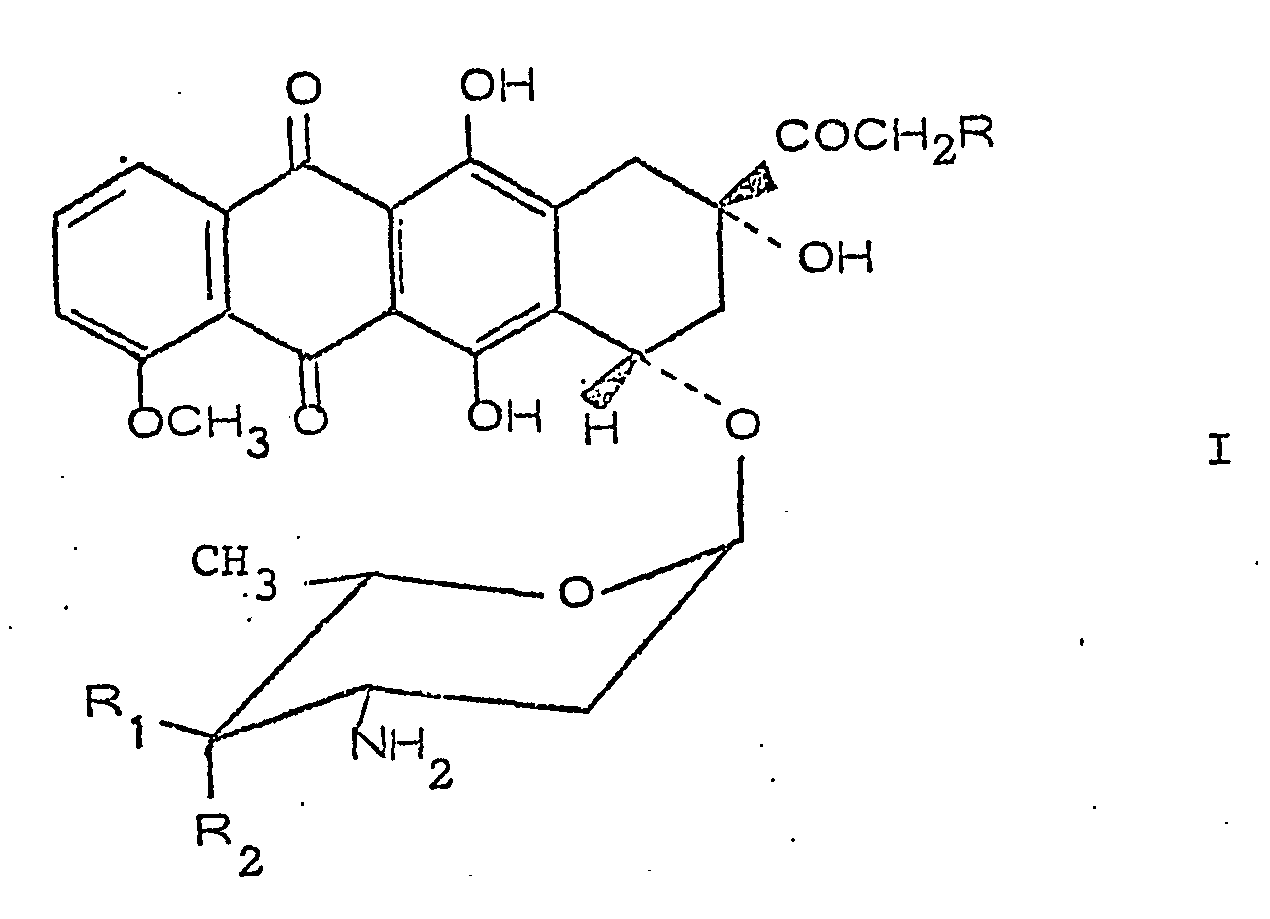
in which R represents a hydrogen atom or hydroxy group, one of R1 and R2 represents a methyl group, and the other of R1 and R2 represents a hydroxy group, and their pharmaceutically acceptable acid addition salts.
in which R represents a hydrogen atom or hydroxy group, one of R1 and R2 represents a methyl group, and the other of R1 and R2 represents a hydroxy group, and their pharmaceutically acceptable acid addition salts.
2. 4'-C-methyl-daunorubicin.
3. 4'-C-methyl-doxorubicin.
4. 4'-epi-4'-C-methyl-daunorubicin.
5. 4'-epi-4'-C-methyl-doxorubicin.
6. A process for the preparation of anthracycline glycosides according to claim 1,characterized
in that daunomycinone is condensed with 2,3,6-trideoxy-4-C-methyl-4-0-p.nitrobenzoyl-3-trifluoro-acetamido-L-lyxo-hexopyranosyl
chloride or 2,3,6-trideoxy-4-C-methyl-4-0-p.ni- trobe nzoyl-L-arabino-hexopyranosyl
chloride from the obtained corresponding protected glycoside derivatives all protecting
groups are then removed in a manner known per se, the so obtained free glycosidic
bases (R =H) of general formula I are isolated, optionally in form of acid addition salt, which
are eventually brominated in 14-position from which, by hydrolysis the corresponding
free glycosidic bases (R =OH) of general formula I are isolated and eventually transformed
in their pharmaceutically acceptable acid addition salts.
7. A process according to claim 6, wherein the protecting groups are removed by mild
alkaline hydrolysis.
8. A process according to claim 6, wherein bromination is carried out with a solution
of bromine in organic solvent.
9. A process according to claim 6, wherein hydrolysis of 14-bromo derivatives is carried
out with an aqueous solution of sodium formate.
10. A pharmaceutical composition comprising a compound of general formula I, according
to claim 1, or a pharmaceutically acceptable salt thereof in admixture with a pharmaceutically
acceptable diluent or carrier.