|
(11) | EP 0 026 332 B1 |

| (12) | EUROPEAN PATENT SPECIFICATION |
|
|
| (54) |
Non-adhesive gel composition for stabilizing dentures Nicht haftende Gel-Zusammensetzung zum Stabilisieren von Kunstgebissen Composition gélifiée non adhérente pour stabilisation de dentiers |
|
|
|||||||||||||||||||||||||||||||
| Note: Within nine months from the publication of the mention of the grant of the European patent, any person may give notice to the European Patent Office of opposition to the European patent granted. Notice of opposition shall be filed in a written reasoned statement. It shall not be deemed to have been filed until the opposition fee has been paid. (Art. 99(1) European Patent Convention). |
[0001] The invention relates to a substantially non-adhesive gel composition and its use in improving the fit, adaptation and physical and chemical environment of dentures in the oral cavity of the user.
Background of the invention
[0002] A large proportion of the population are denture wearers. The prosthetic appliance in denture wearers covers a large portion of the oral mucous membranes, especially those of the maxilla. Although the adaptation of the denture appliance to the oral cavity can be improved by the use of denture adhesives, the adaptation is gradually lowered with the passage of time due in part to the breakdown of the denture adhesive or change in the oral cavity. Moreover a substantial number of denture wearers do not or will not employ denture adhesives for various reasons. Additionally, many denture wearers keep their dentures in the oral cavity twenty- four hours a day and, in so doing, the covered mucous membranes or tissues do not benefit from the cleansing action of the tongue, mechanical cleansing action during mastication, or from the buffering and cleansing action of saliva.
[0003] These patterns of use among denture wearers have led to various undesirable consequences. Among such consequences which have been documented in numerous studies published in the scientific literature, there may be mentioned, for example, tissue inflammation caused by instability, trauma and stress as a result of the loss of adaptation of the denture to the oral cavity; pain, discomfort and irritation caused by food particles becoming lodged beneath the denture appliance; the buildup of bacteria as well as the development of pathological yeasts, such as Candida albicans, whose combined endotoxins or metabolic products are potential inflammatory products which can also result in denture stomatitis; odor and taste problems resulting from stagnant areas beneath the dentures and from by-products of bacterial and yeast metobolism; slipping and sliding of the dentures during mastication resulting in inflammation and soreness; and inflammation, soreness or disease caused by the breakdown of the natural and physiological environment of the oral cavity and the mucous membranes thereof simply by the presence of the denture appliance in the oral cavity covering the mucous membranes for prolonged periods of time.
[0004] In the past, certain temporary measures have been utilized to alleviate the distress caused by illfitting dentures. Among these may be mentioned various pastes employing gum arabic as the base material or elastic polymeric compositions of polyacrylic ester and polyvinyl acetate or polyvinyl chloride with a low molecular weight plasticizer. However, none of these has been entirely acceptable and they fail to provide the required degree of maintenance of the natural an physiological environment in the oral cavity of denture wearers. Moreover, numerous denture wearers who do not use denture adhesives for one reason or another object to said compositions for the same or similar reasons. There is therefore a need for a suitable composition which alleviates or eliminates most or all of these undesirable features and problems.
Summary of the invention
[0005] It has now been discovered that a denture composition comprising 1 to 10% by weight cross-linked sodium carboxymethyl-cellulose, 5 to 40% by weight demulcent selected from glycerine, sorbitol, and propylene glycol and at least 50% by weight water provides such a composition which alleviates or eliminates to a substantial degree most or all of the undesirable features and problems encountered with the use of heretofore known denture compositions. Moreover, the compositions of this invention help to maintain the natural and physiological environment in the oral cavity when dentures are being worn. In a preferred form of the invention, the hydrophilic cellulose polymer is employed in a cross-linked form and the composition takes the form of a substantially non-adhesive cohesive gel.
Detailed description of the invention
[0006] The denture compositions of this invention can employ any suitable cross-linked sodium carboxyethylcellulose.
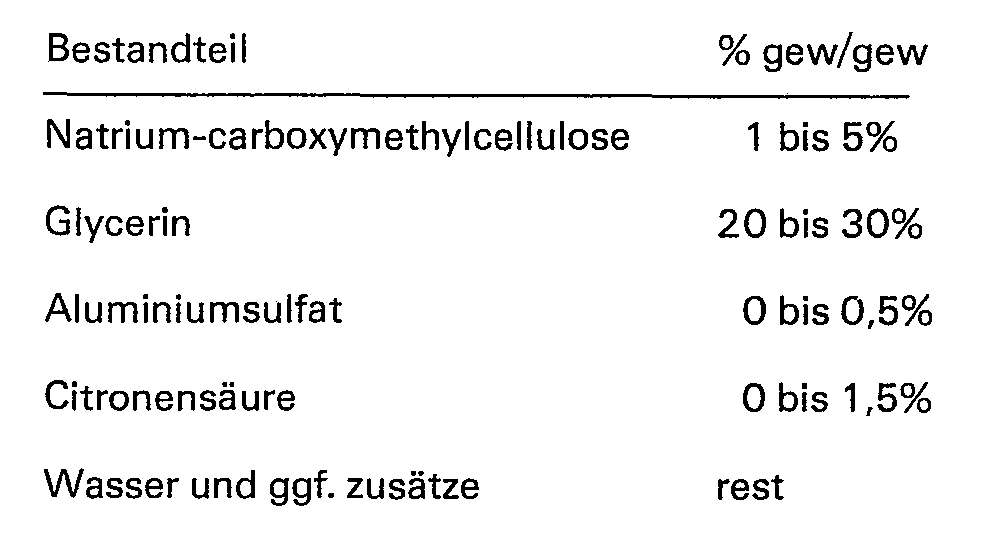
[0007] The cross-linked sodium carboxymethyl- cellulose employed in the compositions of this invention is cross-linked in a known manner with aluminum sulfate and citric acid. Cross-linking of the cellulose polymer can also be accomplished with equimolar amounts of water soluble salts of chromium or ferric cation such as chromium or ferric chloride or the like, employed in place of the aluminum sulfate. It is generally desirable to cross-link the cellulose polymer with about 10 to 25% by weight of aluminum sulfate and about 5 to 10% by weight of aluminum sulfate and about 5 to 10% by weight of citric acid based on the weight of cellulose polymer employed. When aluminum sulfate and citric acid are employed as the cross-linking agents for the cellulose polymer, they may be employed in the following amounts by weight based on the total weight of the compositions of this invention: aluminum sulfate in an amount up to about 0.5% and citric acid in an amount up to about 1.5%.
[0008] As demulcents in the compositions of this invention, there may be employed for example glycerine, sorbitol or propylene glycol and preferably glycerine and in amounts of 5 to 40% by weight, preferably about 20 to about 30% by weight and most preferably about 25% by weight.
[0009] The compositions of this invention can vary from hypotonic to moderately hypertonic and the appropriate amount of sodium chloride can be added to the composition to adjust the tonicity of the composition.
[0010] The composition of the present invention will generally have a pH in the range of from about 6.0 to about 7.5, preferably from about 7.0 to 7.5 and most preferably about 7.0 and any suitable orally acceptable buffering agents may be employed, such as for example, sodium and potassium mono- and dibasic phosphate salts and the like.
[0011] The compositions of this invention can also have incorporated therein preservatives, antimicrobial agents, dyes and flavors in generally used amounts.
[0012] The compositions of this invention are generally characterized by having a product viscosity in the range of from 25,000 to 200,000 mPas at room temperature, having an elastic memory and being non-sticky. The compositions are also characterized by being antibacterial or bacteriostatic and/or mycostatic or mycocidal against Candida albicans, all of which can play a pathogenic role in denture stomatitis.
[0013] In use in the oral cavity as adaptive compositions for dentures, the compositions provide a cushioning effect which takes pressure off the gums and provides a demulcent action that soothes both healthy and irritated gums. The compositions also enhance the stability of the dentures in the oral cavity yet do not stick to the dentures or mucous tissues of the oral cavity. Additionally, the compositions of this invention prevent harmful deposits from building up beneath the denture surfaces, reduce odor and reduce or prevent tenderness and irritation of tissue. The compositions also provide a cooling and soothing effect on the oral tissue. And, as previously mentioned, the compositions of this invention maintain the natural and physiological environment in the oral cavity when the dentures are being worn and a composition of this invention is being employed.
[0016] It is preferred that the cross-linking in the compositions of this invention be in situ, that is, in the compounding of the composition of the invention.
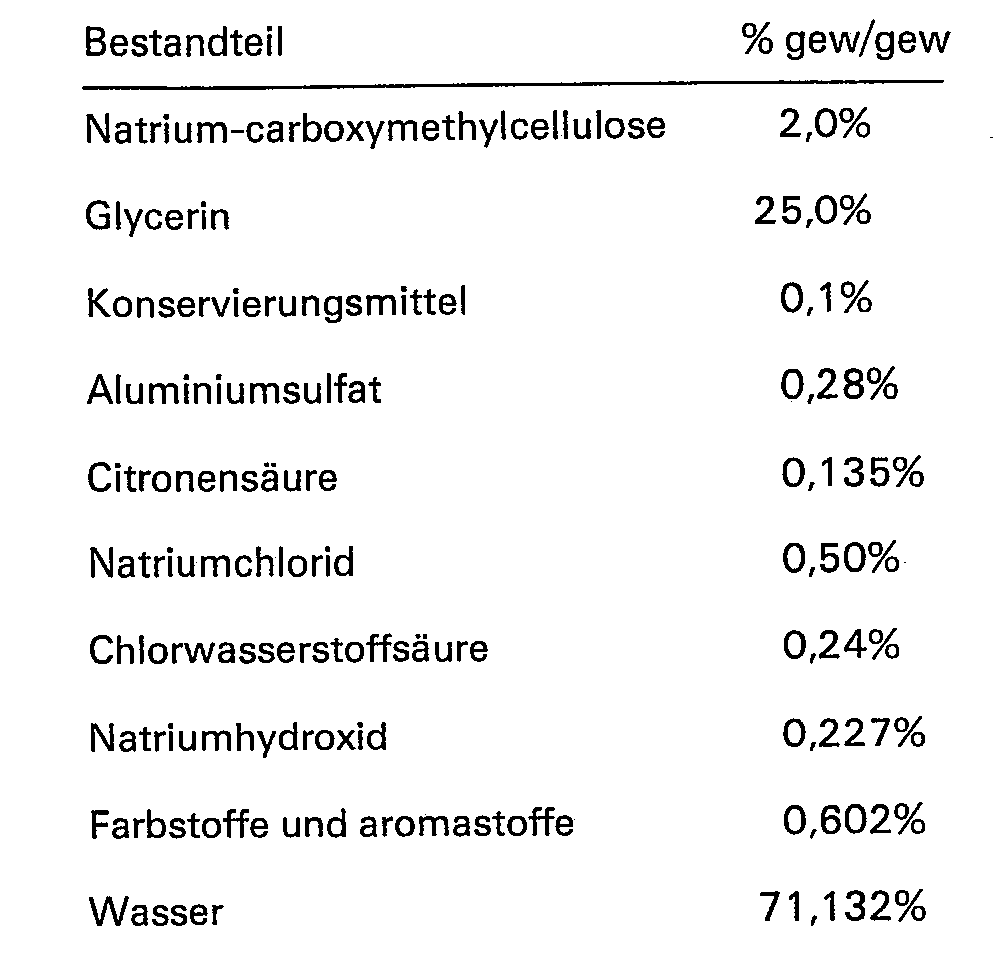
[0017] For example, the most preferred composition of this invention, as set forth hereinbefore, is compounded in the following exemplary manner.
[0018] In any suitable size stainless steel tank, the glycerin is added and the propylparaben, methylparaben and sodium carboxymethyl- cellulose are slowly added with stirring over a period of about fifteen minutes until a smooth slurry is obtained.
[0019] Into another suitable vessel, add approx- mately 2.4% of the total water employed and slowly add the hydrochloric acid and add any dyes to the acidified water. Add the dyed acidified water with mixing to another vessel containing approximately 84.5% of the total water employed. Next add the slurry containing the glycerine and sodium carboxymethylcellulose with adequate agitation and mix for about an hour until a uniform gum is obtained.
[0020] In another suitable vessel, add, in order, the citric acid, aluminum sulfate and sodium chloride into approximately 11.4% of the total water employed and mix to dissolve the components. Separately dissolve the sodium hydroxide in about 1.6% of the total water employed and add to the citric acid containing solution with mixing until a uniform solution of pH about 7.15 is obtained and thereafter add this resulting solution with agitation to the uniform gum previously obtained and continue the agitation for about an hour. Thereafter flavoring agents as desired may be added to the product and the product mixed thoroughly. If desired the product can be processed through any suitable homogenizer, such as for example, a Versator@, to improve the homogenization of the product.
1. Non-adhesive gel composition for stabilizing dentures to the oral cavity of the
wearer thereof, comprising 1 to 10% by weight of a cross-linked sodium carboxymethyl-
cellulose, from 5 to 40% by weight of a demulcent and at least 50% by weight water
and having a viscosity in the range of 25.000 to 200.000 mPas at room temperature.
2. A composition of claim 1 wherein the demulcent is selected from the group consisting
of glycerine, sorbitol and propylene glycol.
3. A composition of claim 2 wherein the demulcent is glycerine.
4. A composition of any of claims 1 to 3 wherein the sodium carboxymethylcellulose
is cross-linked with aluminum sulfate and citric acid.
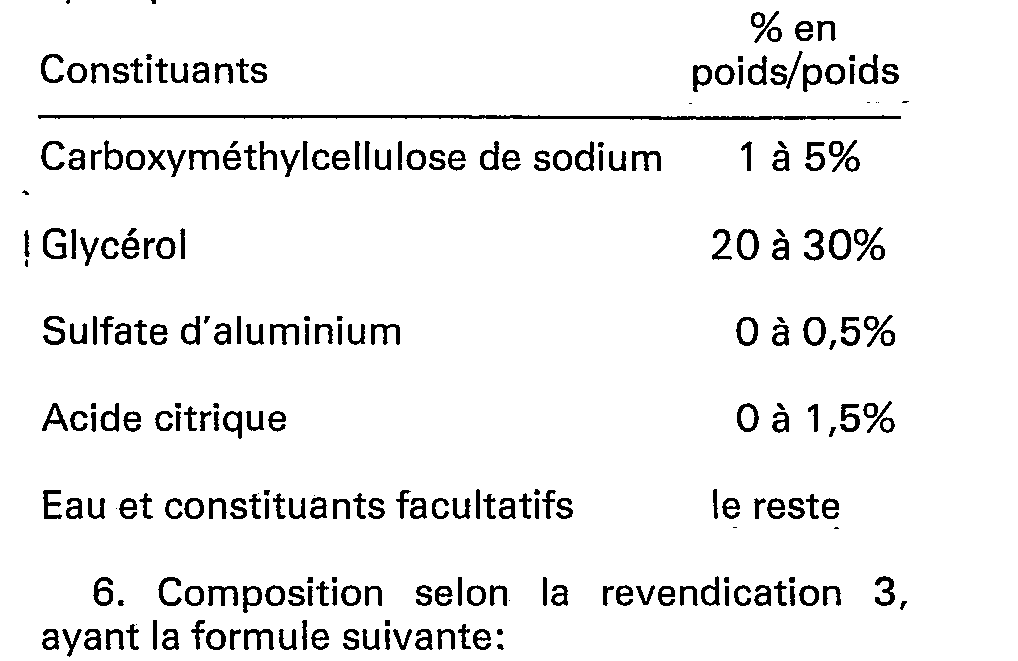
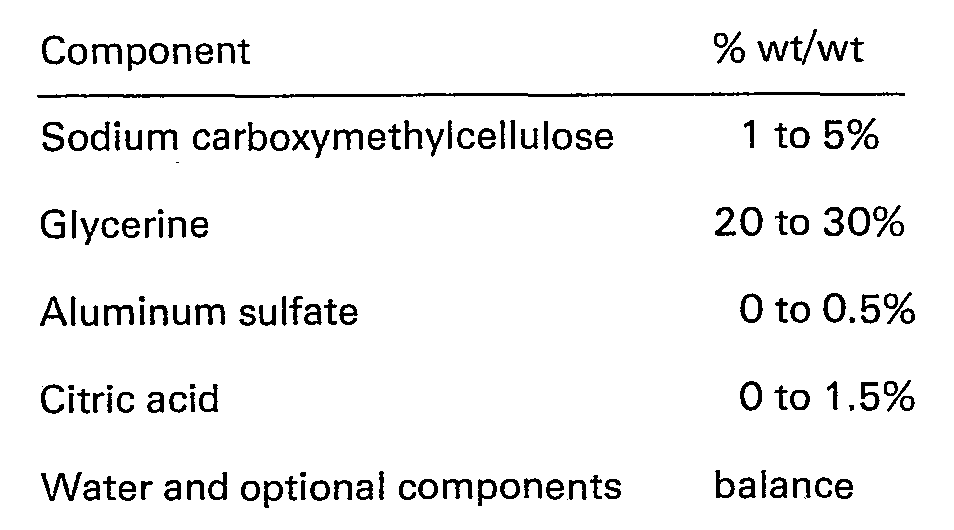
5. A composition of claim 3 having the formula:
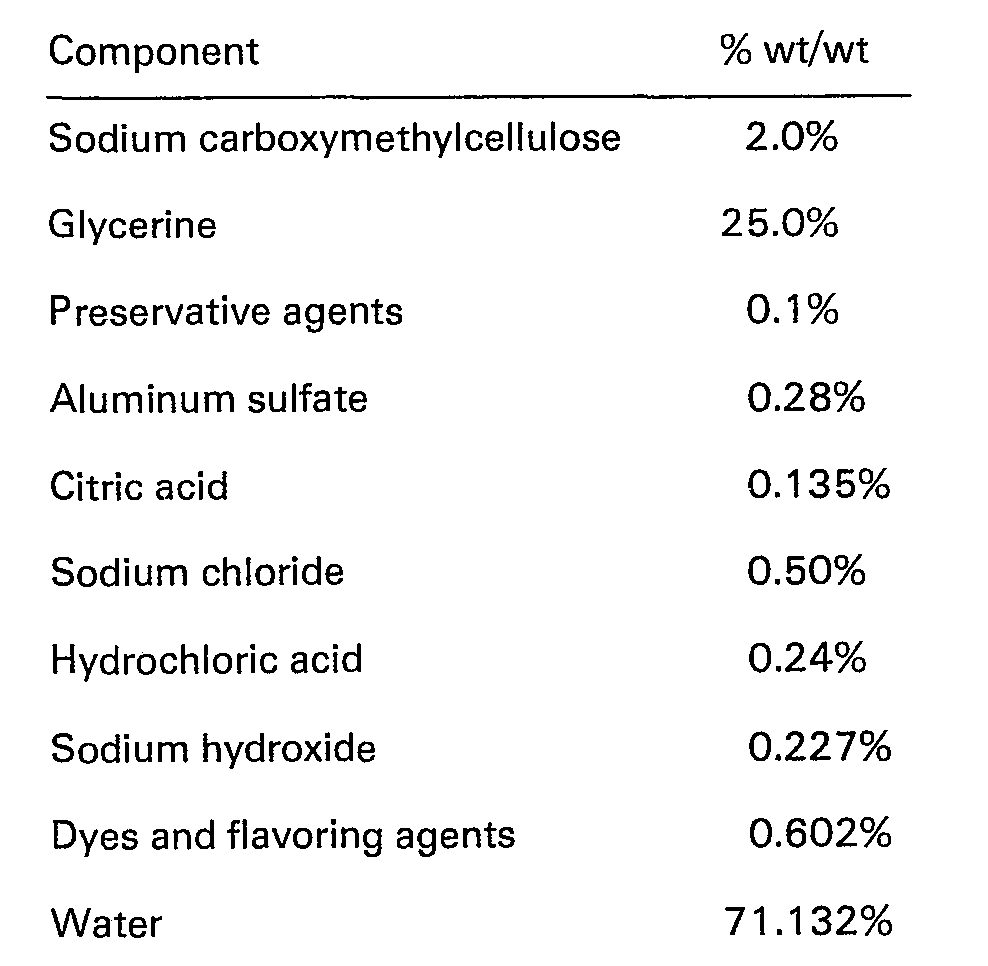
6. A composition of claim 3 having the following formula:
1. Nicht haftende Gel-Zusammensetzung zum Stabilisieren von Kunstgebissen in der Mundöffnung
ihres Trägers, dadurch gekennzeichnet, daß sie 1 bis 10 Gew.-% einer vernetzten Natrium-carboxymethylcellulose,
5 bis 40 Gew.-% eines Demulcens (Schleimhautschutz) und mindestens 50 Gew.-% Wasser
enthalten und eine Viskosität im Bereich von 25.000 bis 200.000 mPas bei Raumtemperatur
aufweisen.
2. Zusammensetzung nach Anspruch 1, dadurch gekennzeichnet, daß das Demulcens aus
der Gruppe Glycerin, Sorbit und Propylenglycol ist.
3. Zusammensetzung nach Anspruch 2, dadurch gekennzeichnet, daß das Demulcens Glycerin
ist.
4. Zusammensetzung nach jedem der Ansprüche 1 bis 3, dadurch gekennzeichnet, daß die
Natrium-carboxymethylcellulose mit Aluminiumsulfat und Citronensäure vernetzt ist.
5. Zusammensetzung nach Anspruch 3 mit derfolgenden Formulierung:
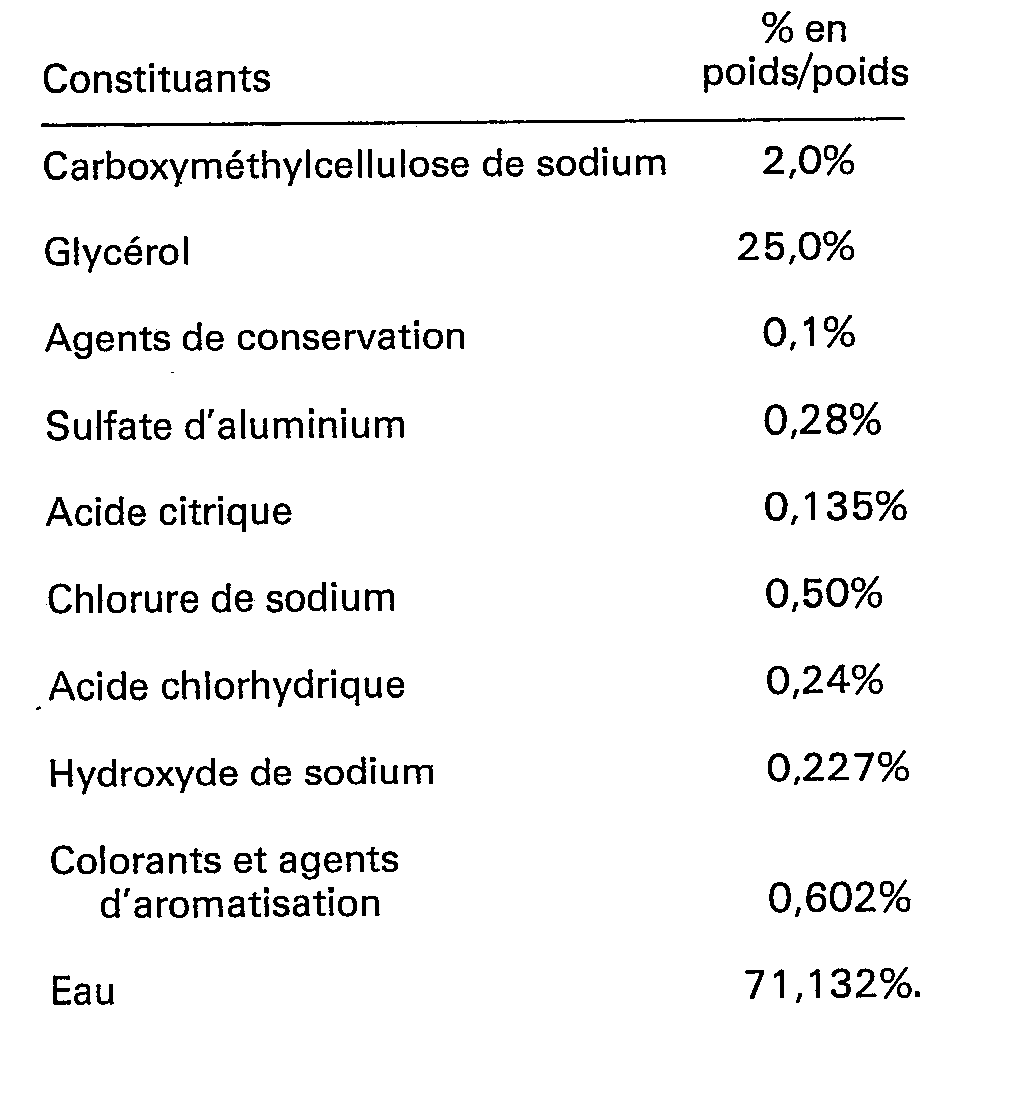
6. Zusammensetzung nach Anspruch 3 mit der folgenden Formulierung:
1. Composition gélifiée non adhérente, destinée à stabiliser des dentiers dans la
cavité buccale du porteur de dentier, la composition comprenant 1 à 10% en poids d'une
carboxy- méthylcellulose de sodium réticulée, de 5 à 40% en poids d'un agent protecteur
de la muqueuse et au moins 50% en poids d'eau et ayant une viscosité comprise entre
25 000 et 200 000 mPa.s à la température ambiante.
2. Composition selon la revendication 1, dans laquelle l'agent protecteur de la muqueuse
est choisi dans le groupe constitué per le glycérol, le sorbitol et du propylèneglycol.
3. Composition selon la revendication 2, dans laquelle l'agent protecteur de la muqueuse
et le glycérol.
4. Composition selon l'une quelconque des revendications 1 à 3, dans laquelle la carboxy-
méthylcellulose de sodium est réticulée à l'aide des sulfate d'aluminium et d'acide
citrique.
5. Composition selon la revendication 3, avant pour formule: