|
(11) | EP 0 026 811 A1 |

| (12) | EUROPEAN PATENT APPLICATION |
|
|
|
|
|||||||||||||||||||||||||||||||
| (54) | Cephalosporin derivatives |
| (57) Novel imidazole dicarboxylic acid derivatives having the following formula
wherein X is a group selected from the group consisting of hydrogen atom and hydroxyl group, and pharmaceutically acceptable salts thereof. The novel compounds are effective antibacterial agents, particularly against Pseudomonas aeruginosa. |
[0001] The present invention relates to novel imidazoledicarboxylic acid derivatives, which are useful as antibiotics, particularly, for oral administration, particularly as antibacterial agents in the treatment of Pseudomonas aeruginosa infectious diseases in both human beings and animals.
[0002] The present inventors have succeeded in synthesizing novel imidazoledicarboxylic acid derivative, having the following formula:
wherein X is a group selected from the group consisting of hydrogen atom and hydroxyl group, and pharmaceutically acceptable nontoxic salts thereof, and have discovered that these novel compounds have a good antibacterial activity and oral absorption, particularly against Pseudomonas aeruginosa and can be used as antibiotics, particularly for oral administration.
[0003] The amino acid which forms the compounds of the present invention is phenylglycine, or 4-hydroxyphenylglycine which may be in the L-, D-form, or DL-form.
[0005] Suitable pharmaceutically acceptable salts of such compounds are conventional non-toxic salts and may include metal salts such as alkali metal salt (e.g., sodium salt, potassium salt, etc.) or an alkaline earth metal salt (e.g., calcium salt, magnesium salt, etc.), ammonium salts, organic amine salts (e.g., trimethylamine salt, triethylamine salt, pyridine salt, picoline salt, dicyclohexyl amine salt, N,N'-dibenzylethylene diamine salt, procain salt, dibenzylammonium salt, N-benzyl-3-phtnylammonium salt and salt with ammino acid such as L-lysine etc.) and the like.
[0006] Such salts of the present invention are prepared by conventional methods, for example by neutralizing the free base form of a compound of the present invention with alkali.
[0007] The imidazoledicarboxylic acid derivative of the present invention has effective antibacterial activity against not only gram positive and gram negative bacteria but also Pseudomonas aeruginosa and has good oral absorption, and therefore, can be practically used as medicine for human beings and animals, particularly for oral administration.
[0008] The imidazoledicarboxylic acid derivative of the present invention can be prepared by reacting a compound having the formula:
with an imidazoledicarboxylic acid having the formula:
or its reactive derivative such as the acid chloride derivative or a compound having the formula:
to produce a compound having the formula:
and reacting the compound with carboxymethylpyridine having the formula:
[0010] The reaction with carboxymethylpyridine can be carried out in the presence of catalyst such as KI, KSCN, and NaI, preferably, in a solvent such as water or a mixture of water and hydrophilic organic solvent such as acetone, acetonitrile, methanol, ethanol tetrahydrofuran, dimethylformamide.
[0012] The reaction products of the modification reaction can be isolated in pure form by known procedures, for example by extraction, column chromatography, recrystallization and the like.
Example 1
[0014] Imidazole-4,5-dicarboxylic acid (3.12 g, 20 mM) was suspended in dry benzene (40 mℓ) containing DMF (6 drops). To this mixture thionyl chloride (8 mt) was added. The thus obtained mixture was stirred at 85°C for 5.5 hours under reflux. The mixture was concentrated to yield solid material under reduced pressure. And the acid chloride derivative produced thereby was suspended in dry dichloromethane (40 mℓ).
[0015] Anhydrous 7-S-β-(-)-α-aminophenylacetamido]cephalosporanic acid (4.05 g, 10 mM) was suspended in dichloromethane (40 mℓ). To this mixture triethyl amine (14 mt) was added and thereby a homogeneous solution was prepared.
[0016] 7-β-[D-(-)-α-aminophenylacetamido]cephalosporanic acid dichloromethane solution was added stepwise little by little to the acid chloride derivative dichloromethane suspension prepared above in an ice bath while stirring over a period of 15 minutes. After addition of the 7-β-(D-(-)-α-aminophenyl- acetamido]cephalosporanic acid, the mixture was further stirred for two hours in the ice bath. Insoluble material was removed by filtration, and the solution was concentrated at less than 30°C under reduced pressure to yield solid material. The thus obtained solid material was dissolved in water (70 mℓ). To this mixture ethyl acetate (70 mℓ) was added and thereby a solution having two layers was prepared. The water solution was separated and to this solution ethyl acetate (100 mt) was added. 6% Hydrochloric acid was added to the mixture while stirring and thereby the water phase of the solution was adjusted to PH 2. The precipitate was removed by filtration and a solution having two layers was obtained. The water solution was separated and extracted with ethyl acetate (100 mt), once more. The ethyl acetate solutions obtained were combined and dried with anhydrous magnesium sulphate. The ethyl acetate solution was concentrated at less than 30°C and the solid material thus obtained was triturated by adding ether (100 mℓ) thereto, and separated by filtration. The powdered material was dried to give 7-S-[D-(-)-a-(4-carboxyimidazole-5-carboxamido)phenylacetamido]cephalosporanic acid monohydrate (1.87 g, yield: 34.4%).
M.P., 209 - 218°C (dec.)
Elemental analysis:
Found C 49.66%, H 3.98%, N 12.77%, S 5.66%
Calcd. for C23H21N5O9S·1H2O C 49.19%, H 4.14%, N 12.47%, S 5.71%
TLC (silica gel) Rf = 0.70
I.R. spectrum (Nujol)
νCO(β-lactam) = 1775 cm-1
νCO(-OCOCH3) = 1745 cm-1
[0017] Thus obtained 7-β-[D(-)-α-(4-carboxyimidazole-5-carboxyamide)-phenylacetamide]-cephalosporanic acid (16.3 g, 30 mM) and 3-pyridylacetic acid (8.2 g, 60 mM) were suspended in water (150 mℓ), and to this mixture 2N-NaOH aqueous solution was added dropwise, slowly to dissolve such starting materials, and then the solution was adjusted to PH 7.5. To the thus obtained solution sodium iodide (120 g, 0.8 M) was added and the thus obtained mixture was reacted while stirring at 70°C for 2 hours. After completion of the reaction, the reaction solution was passed through the column of Amberlite XAD-2 (2 ℓ) produced by Rhom & Haas for absorption of the desired product. By elution with water, fractions containing-the desired product were collected and freeze-dried.
[0018] The thus obtained solid material (10.4 g) was dissolved in water (50 mℓ), and thereto ethanol (250 mℓ) was added slowly dropwise while stirring and being cooled to precipitate a solid material. Such mixture was stood in the refrigerator overnight, and then the precipitated solid material was obtained by filtration and dried. The thus obtained solid material (5.5 g) was dissolved in water (20 mℓ) and the solution was passed through the column of Amberlite XAD-7 (700 mℓ) for absorption of the desired product. By elution with water, fractions containing the desired product were collected and freezedried to give the desired product, 7-β-[D(-)-α-(4-carboxyimidazole-5-carboxyamide)-phenylacetamide]-3-(3-carboxymethylpyridinium)-methyl-3-cephem-4-carboxylic acid disodium salt (3.6 g, yield: 19%). I.R. spectrum (Nujol)
N.M.R. spectrum (D20, 6)
Example 2
[0019] Imidazoledicarboxylic acid (7.8 g, 0.05 M) was suspended in dry benzene (100 mℓ), and thereto DMF (4 mℓ) and then thionyl chloride (30 mℓ) were added. The thus obtained mixture was refluxed at a temperature of 85°C while stirring. After completion of the reaction, the reaction mixture was concentrated to yield solid material. To the thus obtained material, dry benzene (50 mℓ) was added and the mixture was concentrated to yield solid material, once more. To the remaining material benzene (50 mℓ) was added and the mixture was stirred at room temperature for 30 minutes. Insoluble solid material was collected by filtration and then washed with benzene and dried under reduced pressure to give the desired product, 5,10-dioxo-5, 10-dihydrodiimidazo [1,5a,1',5' d]pyrazine-1,6-dicarboxylic acid dichloride (7.0 g, yield: 89%).
Elemental analysis:
Found C 38.03%, H 0.74%, N 17.81%, Cl 22.37%
Calcd. as C10H2N404C12
C 38.36%, H 0.64%, N 17.90%, Cl 22.65%
[0020] The thus obtained acid chloride (7.0 g) was suspended in water (150 mℓ) and the mixture was stirred at 10-20°C overnight. An insoluble solid material was obtained by filtration and washed with water, a small amount of THF, and then ether. The material was dried under reduced pressure to give the desired product, 5,10-dioxo-5,10-dihydrodiimidazo [1,5a,1',5' d]pyrazine-1,6-dicarboxylic acid dihydrate (7.0 g, yield: 100%).
M.P., 284°C (dec.)
I.R. spectrum:
3500 cm-1, 1750 cm-1, 1710 cm-1, 1255 cm-1, 930 cm-1
Elemental analysis:
Found C 38.65%, H 2.40%, N 18.02%,
Calcd. as C10H4N4O6·2H2O
C 38.47%, H 2.58%, N 17.95%
Anhydrous 7-β-[D(-)-α-aminophenylacetamido]cephalos poranic acid (6.5 g, 16 mM) was suspended in dry dichloromethane (100 mℓ) and triethylamine (6 mℓ) was added thereto. The mixture was stirred for 30 minutes while being cooled with ice-water. To this solution 5,10-dioxo-5,10-dihydrodiimidazo[1,5a,1',5' d] pyrazine-1,6-dicarboxylic acid dihydrate (2.2 g, 7 mM) was added while stirring and cooling. The mixture was stirred overnight, and concentrated to give solid material. This material was added to water (50 mℓ) and stirred to give a homogeneous solution. The solution was adjusted to PH 8 with 6% aqueous HC1 solution, stirred for 10 minutes, and then washed with ethyl acetate (50 mℓ). The water phase was adjusted to PH 2 with 6% aqueous HC1 solution, and the mixture was stirred for 20 minutes. The precipitated crystalline material was collected by filtration, washed with water, and then dried under reduced pressure at 40°C. The thus obtained solid material was suspended in a solvent (500 mℓ) obtained by mixing ethylacetate and methanol (volume ratio: 1/1), and the mixture was stirred at 40°C for 20 minutes. An insoluble material was separated by filtration. Thus obtained organic phase was concentrated under reduced pressure to volume of 50 mi, and ether (500 mℓ) was added thereto. This mixture was left overnight in the refrigerator. Thus precipitated crystals were collected, washed with petroleum ether and dried to give the desired product, 7-β-[D(-)-α-(4-carboxyimidazole-5-carboxamido)-phenylacetamido]cephalosporanic acid (6.5 g, yield: 75%).
[0021] Hereinafter, 7-S-[D(-)-a-(4-carboxyimidazole-5-carboxyamido)-phenylacetamidol-3-(3-carboxymethylpyridinium)-methyl-3-cephem-4-carboxylic acid disodium salt was obtained in the same manner as in Example 1.
Example 3
[0022] Anhydrous 7β-[D(-)-α-amino-phenylacetoamido] cephalos- poranic acid (16 mM) was suspended in dry dichloromethane (100 ml) and triethylamine (6 ml) was added thereto. The mixture was stirred for 30 minutes under cooling with ice-water. To this solution the compound 5,10-dioxo-5,10-dihydrodiimidazo [1,5a, 1',5'd]pyrazine-1,6-dicarboxylic acid. 2 hydrate (2.2g,7mM) was added while stirring and cooling. The mixture was stirred overnight and concentrated to give a solid material. This material was added to water (50 ml) and stirred to give a homogeneous solution. The solution was adjusted to PH8 and 6 % HC1 aqueous solution, stirred for 10 minutes, and then washed with ethyl acetate (50 ml). The water phase was adjusted to PH2 with 6 % HC1 aqueous solution, and the mixture was stirred for 20 minutes. The precipitated crystals were . obtained by filtration, washed with water, and then dried under reduced pressure at 40 °C. The thus obtained solid material was suspended in a solvent (500 ml) obtained by mixinq ethylacetate and methanol (volume ratio: 1/1) and the mixture stirred at 40 °C for 20 minutes. An insoluble material was separated by filtration. The thus obtained organic phase was concentrated under reduced pressure to a volume of 50 ml, and ether (500 ml) was added therto. This mixture was kept overnight in the refrigerator. The precipitated crystals were recovered washed with petroleum ether and dried to give the 7β-(D-(-)-α-(4-carboxyimidazole-5-carboxyamido)-phenylacetamido]-cephalosporanic acid. 7β-[D-(-)-α-(4-carboxyimidazole-5-carboxyamido)phenyl- acetamidoJ-cephalosporanic acid.2Na salt (1.17 g, 2 mM) was reacted with 3-pyridylacetic acid (0.55 g, 4 mM) to give 7β=(D-(-)-α-(4-carboxyimidazole-5-carboxymido)phenyl- acetamido]-3-(3-carboxymethylpyridinium) methyl-3-cephem-4-carboxylic acid disodium salt (0.17 g, yield: 12 %) in aqueous solution under adjusting the pH to 7 with 2N NaOH solution. To the solution sodium iodide was added (8.3 g) and the solution was reacted at 70 °C with stirring for two hours. The reaction mixture was treated with Amberlite XAD-2 produced by Rohm and Haas Co. in a column. By dilution with water the fractions containing the desired compound were collected. The object compound as above defined was finally obtained by lyophilization of the obtained solution.
[0025] The object compound showed an MIC when using Pseudomonas aeruginosa AJ 1116 as a test organism of 12.5 µg/ml.
[0026] As regards the compound produced in Example 1 described above, anti-bacterial activities were determined. Some of them were shown Table 1. Now, "MIC" represents the Minimum Inhibitory Concentration in µg/mℓ of the compound required to inhibit the growth of the test organism.
[0027] As regards the compound produced in Example 1, the oral absorption in mouse was.tested and results were shown in Table 2.
[Experiment] -
[0028] Concentration in Blood (µg/mℓ) by oral administration was obtained.
Mouse: ICR 5W
Oral administration dose: 50 mg/kg
Test organism: Staph. aureus 209P
[0029] Practical treatment by oral administration for an infectious disease of mouse was tested. Results were shown in Table 3.
[Experiment]
1. An imidazoledicarboxylic acid derivative having the following formula:
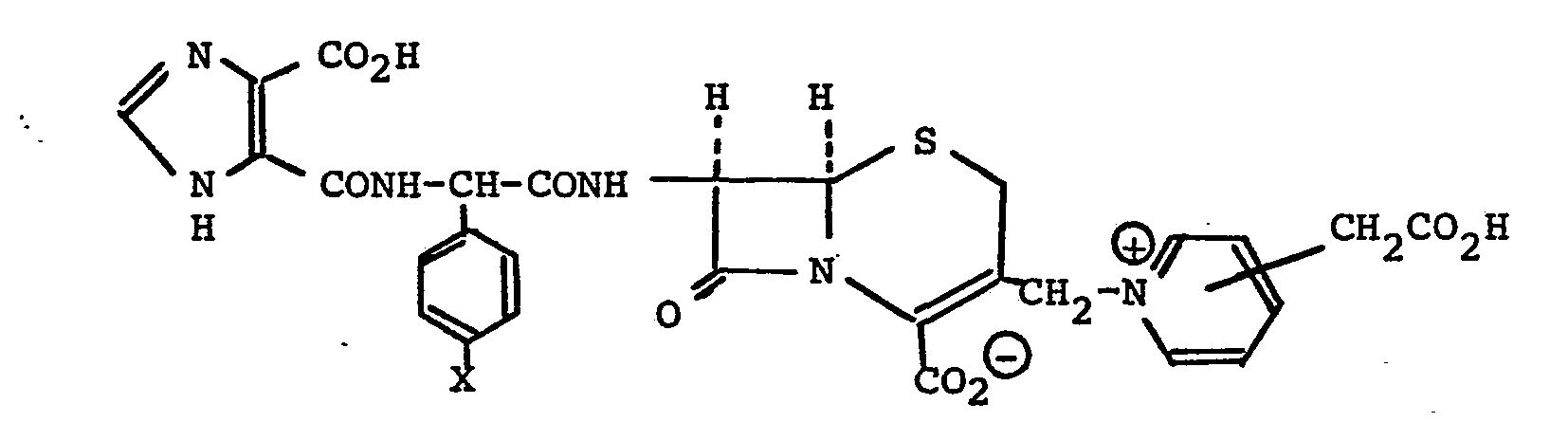
wherein X is a group selected from the consisting of hydrogen atom and hydroxyl group.
wherein X is a group selected from the consisting of hydrogen atom and hydroxyl group.
2. An imidazole dicarboxylic acid derivative of Claim 1, wherein the amino acid forming
said imidazoledicarboxylic acid derivative is in the D-form.
3. An imidazole dicarboxylic acid derivative of Claim 1, wherein said derivative is
in the salt form.
4. Pharmaceutical composition, containing an active substance together with usual
carriers, characterized in that the active substance is a compound according to any
of the claims 1 to 3.