|
(11) | EP 0 026 983 A1 |

| (12) | EUROPEAN PATENT APPLICATION |
|
|
|
|
|||||||||||||||||||||||||||
| (54) | Polycyclic polyamines, process for their preparation and epoxy resins cured by these polyamines |
| (57) The invention relates to polycyclic polyamines of formula I
wherein m is an integer having the value 0 or 1; X and Y, which may be the same or different, each represents a group, subject to the proviso that X and Y may not both represent -CH2NH2 groups; and R1, R2, R3 and R4, which may be the same or different, each represents a hydrogen atom or a methyl group. The invention further relates to a process for the preparation of polycyclic polyamines of formula I and to epoxy resins cured by the use of such compounds which may act as non-visibly carbonating epoxy curing agents and furthermore, unlike many other amines, exhibit a mild amine odour. |
[0001] The present invention relates to polycyclic polyamine compounds suitable for use as epoxy curing agents and for other uses similar to those of conventional amines.
[0002] Tricyclic polyamines of various tvpes are described in United States Patent 3,470,248 issued on September 30, 1969 to Brotherton et al. The materials described in the Brotherton et al. patent are stated to be useful in the resin art, such as in the preparation of urethane polvmers, polyamides and polyurethane polyurea elastomers. United States Patent 3,787,371 issued on January 22, 1974 to Brinkmann et al discloses bis(aminomethyl)-tricyclo-decanes which are stated to be useful in the formation of clear polyamides.
[0003] United States Patent 3,317,469 issued on May 2, 1967 to Feichtinqer et al discloses materials described as di(aminomethyl)tricyclodecane for use as epoxy curing agents. It is also stated in the Feichtinger et al. patent that the diamines produced therein are clear, colorless, mobile liquids of weak odour. Wagner et al, in German OLS 2641662, published on March 23, 1978, disclose tricyclodecane derivatives having amine functionality which may be condensed with adipic acid, acrylic acid, 2-hydroxyethylacrylate, or N-methylol acrylamide for use as storage stable radiation hardenable printing inks. British Patent 1,266,016, published on March 8, 1972 and naming Wilhelm Becker as an inventor, discloses the use of bis(aminomethyl) tricyclodecane as a curing agent for polyglycidyl ethers. In Japanese published patent application 54-4992, published on January 16, 1979 naming Kaya as inventor, bis-aminomethyl compounds possessing at least one bicyclo[2.2.1]-heptane rina are reported as modified epoxy curina agents. It is stated therein that the starting compounds have high reactivity, thereby making control of the cure extremely difficult. It is also noted that the basic compounds disclosed therein exhibit a high degree of hygroscopicity and that the obtained epoxy paint film shows a whitish cloudiness, apparently from carbonation, at high humidity. Kaya states he cures the defect of high reactivity by partially adducting the amine with a material such as acrylonitrile. However, this solution is incomplete as the acrylonitrile may be split off during cure. In any event, the Kaya material reduces functionality thereby providing a much lower cross-link density which is disadvantageous.
[0004] Throughout this specification and the claims thereof, unless otherwise indicated, percentages and ratios given are by weight and temperatures are in degrees of Celsius.
[0005] According to one aspect of the present invention we provide polycyclic amines of formula I
wherein m is an integer having the value 0 or 1; X and Y, which may be the same or different, each represents a -CH2NH2, -CH2NH(CH2CHR4CH2NH2),
or -CH2N(CH2CH2CH2NH2)(CH2CHR4CH2NH2) group, subject to the proviso that X and Y may not both represent -CH2NH2 groups; and R1, R2, R3 and R4, which may be the same or different, each represents a hydrogen atom or a methyl group.
[0006] According to a further aspect of the present invention we provide a process for the preparation of polycyclic polyamines of formula I as defined above, which process comprises reacting a bis-aminomethyl compound of formula II
[wherein m, R1, R2 and R3 are as defined above] with acrylonitrile and/or methacrylonitrile and reducing the nitrilodiamine thereby obtained. The reduction step is preferably effected by hydrogenation.
[0007] In the process of the present invention, the bis-aminomethyl compound of formula II is preferably produced by the hydroformylation of a diene of formula III
[wherein m, R1, R2 and R3 are as defined above] and the subsequent reductive amination of the bis-aldehyde of formula IV
[wherein m, R1, R2 and R3 are as defined above] thereby obtained. The dienes of formula III are conveniently produced by the polymerization of cyclopentadiene and/or methylcyclopentadiene.
[0008] According to a yet further aspect of the present invention we provide epoxy resins whenever cured by the use of a compound of formula I according to the invention as hereinbefore defined.
[0009] Polycyclic amines of formula I as hereinbefore defined may have several positional- and stereo-isomeric forms and the present invention should be recognised as relating to each of these isomers as well as mixtures thereof.
[0010] The present invention thus relates to the formation and utilization of polycyclic polyamines which are particularly useful as epoxy curing agents. The most convenient starting materials for preparing the polycyclic polyamines of the present invention are those compounds, known by their trivial names of dicyclopentadiene and tricyclopentadiene. Both materials are polymers of cyclopentadiene (or its methylated derivative) which, following polymerization, may be hydroformylated to give the corresponding dialdehyde which then may be subjected to a reductive amination to give the corresponding bis(aminomethyl) structure such as is shown in the Brinkmann et al. patent.
[0011] The bis(aminomethyl) compounds which are substantially free from any odour, may then be reacted with an acrylonitrile component comprising acrylonitrile and/or methacrylonitrile. The acrylonitrile component adds to each primary amine functional group of the starting diamine in 1:1 or 2:1 mole ratio respectively. The amine functional substituents are defined as those amine groups of the starting diamine represented by X and Y independently in the above structural formulae.
[0012] Thus the addition of the acrvlonitrile component may be varied depending on the desired amine functionality required for a particular use. For instance, the addition of two moles of the acrylonitrile component to the starting diamine will give substantial amounts of a disecondary amine which upon reduction will yield a disecondary diprimary amine. On the addition of sufficient amounts of acrylonitrile component to replace each of the primary amine hydrogens on the starting diamine it is possible, after hydrogenation, to obtain a compound which is a ditertiary, tetraprimary amine. Of course, also found in mixture with the aforementioned particularly desirable components will be the incomplete acrylonitrile addition products giving rise to values of X or Y wherein the corresponding monotertiary, monosecondary, triprimary amine is obtained after hydrogenation. A particularly interesting product which can be made is the monosecondary diprimary amine corresponding to only having either X or Y converted to the diprimary amine structure by addition and reduction of the acrylonitrile component.
[0013] The principal compounds with which the present invention is concerned are described below. The ring number system for the tricyclodecane ring system is shown in formula V. While the R1 and R3 groups are omitted from the later formulae (formulae VI to XI), compounds according to such formulae which contain R1 and/or R3 methyl substituents are also preferred compounds according to the invention. Similarly, the compounds represented by formulae V to XI in which one or more of the R4 groups is a methyl group and which result from the use of methacrylonitrile or methacrylonitrile and acrylonitrile in the process of the present invention are included within the preferred compounds of the present invention.
[0014] The compounds represented by formula VI are a mixture of isomeric triamines having the chemical name 3(4) (5)-[N-(3-aminopropyl)aminomethyl]-8-amino- methyl tricyclo (5,2,1,02,6) decane while the reverse triamines represented bv formula VII are named 3(4) (5)-aminomethyl-8-[N-(N-aminopropyl)aminomethyl)-tricyclo (5,2,1,02,6)decane. The compounds represented by formula VIII are 3 (4) (5), 8-bis[N-(3-aminopropyl)-aminomethyl]tricyclo (5,2,1,02,6) decane. The pentamines represented by formula IX are named 3 (4) (5)-N,N-bis(3-aminopropyl)aminomethyl, 8-N(3-aminopropyl) aminomethyl tricyclo (5,2,1,02,6) decane while the reverse pentamines (formula X) are 3 (4) (5)-N-(3-aminopropyl)aminomethyl, 8-N,N-bis(3-aminopropyl)amino- methyl tricyclo (5,2,1,02,6) decane. The hexamine compounds represented by formula XI are appropriately named as 3 (4) (5), 8-bis[N,N-bis(3-aminopropyl)amino- methyl]tricyclo (5,2,1,02,6) decane.
[0015] A facet that has been noted as a particular advantage of the present invention over the acrylonitrile modified polycyclic amines of the Kaya patent is that the present products following hydrogenation are substantially free from any acrylonitrile and thus acrylonitrile cannot be liberated during their use as curing agents for epoxy resins. It should also be observed that a distinct advantage is found in the materials of the present invention in that they are excellent polyfunctional epoxy curing agents leading to substantially cross-linked materials. The present compounds are also extremely beneficial in that they do not visibly carbonate or form solid insoluble carbonates upon storage or use. Thus while the compounds of the present invention may carbonate, the whitish precipitate as described in the Kaya patent does not occur and thus clear epoxy compounds are obtained. The present products are also found to carbonate less upon curing than diethylenetriamine (DETA), a widely used amine.
[0016] In the compounds according to the present invention and the bis-aminomethyl compounds used for their manufacture, it is preferred that R1, R2 and R3 each represents a hydrogen atom. It is also preferred that R4 represents a hydrogen atom (corresponding to the use of acrylonitrile as the original starting material). This is particularly important when forming higher polyamines in order to avoid the steric hindrance caused by the use of methacrylonitrile. However, if methacrylonitrile is employed, the compounds according to the invention which are thereby obtained still possess advantageous properties.
[0017] The value of m given as 0 corresponds to the tricyclo compounds; where m is 1 the corresponding pentacyclo compound is obtained. As previously noted, X and Y may be the same or different. While the preferred compounds have m equal to 0 and have 3 or 4 amine groups, the corresponding pentamines and hexamines are highly useful. In practice, the higher polycyclic polyamines of the invention may be mixed with the starting bis-aminomethyl compound and may thus be utilized in mixtures preferably of from about 90:10 to 50:50 respectively.
[0018] As previously noted, it is highly desirable that all of the nitrile groups be reduced by hydrogenation. This is done to avoid liberation of acrylonitrile upon use of the compounds as curing agents for epoxy resins. It was observed by Kaya that the presence of unreduced nitrile in the starting material slows the reactivity of the resin with the possibility that the coating is adversely affected.
[0019] It should also be noted that, in addition to the primary utility of the present compounds as epoxy curing agents, they may be adducted with materials such as caprolactam or polyfunctional acids to form polyamides, for example by the use of adipic acid or the phthalic acids. In general, the compounds of the present invention may be utilized for any of the conventional uses of polyamines. It is also noted that the compounds of the present invention are not particularly hygroscopic.
[0020] A further distinct advantage of the compounds of the present invention over the starting bis-amino- methyl compounds is that of the mild but definite amine odour in the compounds of the present invention. The starting amino-methyl compounds do not have any pronounced amine odour and thus their use by workers in the coating industry must be closely monitored to avoid any adverse affects on the workers. On the other hand, the present amines by their amine odour provide a warning as to their concentration in a coatings plant.
[0021] The following is a description of the manufacture of the polycyclic polyamines of the present invention.
[0022] Conveniently the starting polycyclic bis-amino- methyl compound, a solvent and the nitrile are placed in an enclosed vessel and stirred and heated under reflux for a period of from about 1 to 3 hours after which time the reaction is substantially complete. Inasmuch as the reaction is exothermic, little energy need be applied. However, it is preferable that the temperature of the reaction vessel be maintained between about 30 and 90°C to ensure substantial completion of the reaction. The reaction mixture is thereafter hydrogenated, preferably using a hydrogenation catalyst such as Raney nickel, Raney cobalt, or platinum to form the polycyclic polyamine of formula I. Where the nitrile is not completely consumed in the addition reaction it is desirable to flush the excess out of the vessel prior to the hydrogenation to avoid undesirable byproducts.
[0023] The formation of the polycyclic polyamine of formula I is accomplished by hydrogenating the corresponding nitrilodiamine. The conditions for the hydrogenation are as previously noted preferably using a hydrogenation catalyst. Again, any excess nitrile should be removed prior to hydrogenation. Conviently, hydrogenation is effected at a pressure in absolute units of no less than 10 atmospheres and at a temperature of from about 60°C to about 160"C. Preferably the hydrogenation conditions are such that the pressure is at least about 50 atmospheres absolute and the temperature is from about 80°C to abut l40°C. It is preferred that during the hydrogenation reaction ammonia be added to the reaction vessel to minimize the tendency of the reactants to condense with itself and liberate ammonia gas. The total pressure requirements for the mixture of the reactants, the hydrogen gas and the ammonia are generally required to be in the range of about 50 to about 100 atmospheres or higher.
[0024] In use, polycyclic polyamines according to the invention may be reacted with suitable epoxy resins to effect curing. Such epoxy resins may be either solid or liquid materials. It is, of course, preferable that the epoxy resin be a liquid material to facilitate mixing and enhance pot life.
[0025] In general, the most commonly available epoxy resins are those which are the reaction products of epichlorohydrin and bis(parahydroxyphenyl) propane ("bisphenol A") such as are described in U.S. Patent 3 280 074 to McCaleb et al. Alternativley, "bisphenol F" which is bis(parahydroxyphenyl)methane may be utilized.
[0026] Other such suitable epoxy resins are those which are the reaction product of epichlorohydrin and bis(parahydroxyphenyl)sulfone. Still another group of epoxy compounds which may be employed are the glycidyl esters of the polymeric fat acids. These glycidyl esters are obtained by reacting the polymeric fat acids with polyfunctional halohydrins such as epichlorohydrins. In addition, the glycidyl esters are also commercially available epoxide materials. The glycidyl esters of the polymeric fat acids are also useful in the present invention and are also described in the McCaleb et al. patent.
[0027] The polymeric fat acids are well known materials, commercially available, which are the products from the polymerization of unsaturated fatty acids to provide a mixture of dibasic and higher polymeric fat acids. The polymeric fat acids are those resulting from the polymerization of the drying or semi-drying oils or the free acids or the simple aliphatic alcohol esters of such acids. Suitable drying or semi-drying oils include soybean, linseed, tung, perilla, oiticia, cotton-seed, corn, sunflower, safflower and dehydrated castor oil. The term "polymeric fat acids" as used herein and as understood in the art, is intended to include the polymerized mixture of acids which usually contain a predominant portion of dimeric acids, a small quantity of "rimeric and higher polymeric fat a-ids and some residual monomers.
[0028] In general, the lost readily available naturally occurring polyunsaturated acid available in large quantities is linoleic acid. Accordingly, it should be appreciated that polymeric fat acids will, as a practical matter, result from fatty acid mixtures that contain a preponderance of linoleic acid and will thus generally be composed largely of dimerized linoleic acid. However, polymerized fatty acids may be prepared from the naturally occurring fatty acids having from 8 to 22, and preferably 16 to 20, carbon atoms. Illustrative thereof are oleic, linolenic, palmitoleic, and the like.
[0029] Other types of epoxy resins which may be cured with the present products and which are commercially available epoxy materials are the polyglycidyl ethers of tetraphenols which have two hydroxy aryl groups at each end of an aliphatic hydrocarbon chain. These polyglycidyl ethers are obtained by reacting the tetraphenols with polyfunctional halohydrins such as epichlorohydrin. The tetraphenols used in preparing the polyglycidyl ethers are a known class of compounds readily obtained by condensing the appropriate dialdehyde with the desired phenol. Typical tetraphenols useful in the preparation of these epoxy resins are the alpha, omega, omega-tetrakis (hydroxyphenol) alkanes, such as, for example, I.,1,2,2-tetrakis(hydroxyphenol)-ethane, 1,1,4,4-tetrakis(hydroxyphenol)butane and l,l,4,4-tetrakis(hydroxyphenol)-2-ethylbutane. The epoxy resin reaction product of the epichlorohydrin and tetraphenol is also shown in the McCaleb et al. patent with the appropriate limitations shown therein. A preferred group of aliphatic polyglycidyl ethers are those described in the pending application of Rogier (U.S. patent application Serial No. ) which are prepared from hydroxymethyl alcohols. Other glycidyl ethers of aliphatic polyols may be employed.
[0030] Still another group of epoxide materials are the epoxidized novolac resins. Such resins are well-known substances and readily available commercially as evidenced in the McCaleb et al patent.
[0031] In general, these resins are obtained by epoxidation of the well-known novolac resins. The novolac resins, as is known in the art, are produced by condensing the phenol with an aldehyde in the presence of an acid catalyst. Although novolac resins from formaldehyde are generally employed, novolac resins from other aldehydes such as, for example, acetaldehyde, chloral, butyraldehyde and furfural may also be used. The alkyl groups, if present, may have a straight or a branched chain. Illustrative of the alkylphenol from which the novolac resins may be derived are cresol, butylphenol, tertiary butylphenol, tertiary amylphenol, hexylphenol, 2-ethylhexylphenol, nonylphenol, decylphenol and dodecylphenol. It is generally preferred, but not essential, that the alkyl substituent be in the para position in the phenolic nucleus. However, novolac resins in which the alkyl groups are in the ortho position have been prepared.
[0032] The epoxidized novolac resin is formed in the well-known manner by adding the novolac resin to the epichlorohydrin and then adding an alkali metal hydroxide to the mixture so as to effect the desired condensation reaction.
[0033] In addition, other epoxy resins which may be cured with the curing agent of the present invention are the glycidyl ethers of the polyalkylene glycols, epoxidized olefins such as epoxidized polybutadiene and epoxidized cyclohexanes.
[0035] In addition, the epoxy resins may be characterized further by reference to their epoxy equivalent weight; the epoxy equivalent weight of pure epoxy resin being the mean molecular weight of the resins divided by the mean number of epox, radicals per molecule, or, in any case, the number of grams of epoxy resin equivalent to one epoxy group or one gram equivalent of epoxide. The epoxy resinous materials employed in this invention have an epoxy equivalent weight of from about 140 to about 2,000, preferably of from about 140 to 300.
[0036] Liquid modifiers such as triphenyl phosphite (Mod-Epox), a tertiary amine (DMP30), nonyl phenol, and flow control agents such as silicone resins and oils may be used to achieve quicker curing or smoother films when dried under adverse conditions. Liquid plasticizers such as dibutyl phthalate may be added. The addition of judicious amounts of triphenyl phosphite or fluid plasticizers would reduce viscosity further to facilitate handling. Small amounts of solvents may be used to secure even lower viscosity, but of course, the combination would not then be solvent free.
[0037] Solid modifiers may be used such as pigments and fillers normally used in paints, or sand which might be added to produce trowelling concrete toppings or floor coatings. Treated clays and amorphous silica may be used to secure non-sagging thick coatings for vertical surfaces.
[0038] The following Examples are intended to serve to illustrate the present invention without limiting the scope of protection sought therefor:
EXAMPLE I
[0039] 3(4)(5), 8-diformyltricyclo (5,2,1,02,6) decane is prepared as the initial starting material from dicylopentadiene (DCPD).
[0040] The process is conducted by utilizing a 1 litre, 316 SS Magnadrive autoclave equipped with a turbine stirrer, heat exchange coils and a thermocouple. This apparatus is charged with 203 g (1.54 moles) of the DCPD. 244 g of toluene, 2.0 g of 5% rhodium on alumina and 0.88 g of triphenylphosphite are added. The latter materials are utilized as the catalyst. The autoclave is then purged with nitrogen and pressurized- with carbon monoxide-hydrogen (1:1) mole ratio to 70 atmospheres of pressure. The reaction mixture is then stirred and steam heated to 70 degrees C and, following a period of about 13 minutes, gas uptake is observed.
[0041] The temperature in the reaction vessel is slowly increased to 101 degrees C over a period of about 40 minutes whereupon gas uptake is noted essentially to stop.
[0042] A gas chromatography analysis of the sample taken at this time indicates a 97% conversion to 3 (4) (5), 8-formyltricyclodecane. The temperature is increased to 120-123 degrees C and held at this temperature for 1.8 hours at 70 atmospheres. The autoclave is then cooled to 50 degrees C, vented, purged with nitrogen and discharged through a pressure filter. Vacuum distillation of toluene from the reaction mixture yielded 278 g of the 3 (4) (5), 8-diformyltricyclo (5,2,1,02,6) decane. The product is observed by GLC, IR and NMR to consist primarily of two diformyl isomers of the tricylodecane.
EXAMPLE II
[0043] The product of Example I is converted to 3 (4)(5)-8-bis(aminomethyl) tricylo (3,2,1,02,6) decane.
[0044] An autoclave, such as the one used in Example I, is charged with 78.5 g of wet Raney nickel (washed with ethanol), 350 g of ethanol and 312 g of ammonia. The autoclave is heated to 128 degrees C, and the resulting pressure is observed as approximately 48 atmospheres.
[0045] The autoclave is then pressurized to about 62 atmospheres with hydrogen and the addition of 679 g of the product of Example I dissolved in 496 g of ethanol is started using a positive displacement pump.
[0046] The temperature during the addition is controlled between 125-132 degrees C and the pressure is at from about 55 to 63 atmospheres by the hydrogen addition.
[0047] The addition of the product of Example I is completed in about 41 minutes. This reaction mixture is then held under these conditions for an additional 2.3 hours and cooled to 55 degrees C, vented, purged with nitrogen and discharged through a pressure filter. The filtrate is then stripped under reduced pressure (60 degrees C at less than 1 torr) to yield 680 g of 3(4)(5),8-bis(aminomethyl)tricyclo (5,2,1,0,2,6) decane having an amine equivalent weight = 99.8.
EXAMPLE III
[0048] The product of Example II is converted to the corresponding 3(4)(5),8-bisrN(2-cyanoethyl)-aminomethyl]-tricyclo (5,2,1,02,6) decane.
[0049] This transformation is accomplished utilizing a 2 litre glass reaction flask equipped with stirrer, heat exchange coil, and thermocouple. Into this reaction flask is introduced 667 g (3.44 moles) of the product of Example II under a blanket of nitrogen. The system is heated to 40 degrees C and 391 g (7.37 moles) of acrylonitrile is metered into the reaction system over a period of one hour with stirring.
[0050] The temperature of this reaction mixture is - then maintained at 40 degrees C for an additional hour and then increased to 60 degrees C for 5.5 hours. ;
[0051] The product is then stripped under vacuum (i.e. a pressure of less than 1 torr) for one hour. Total yield of the product of Example III is 1018 g.
EXAMPLE IV
[0052] The dinitrile product obtained in Example III is converted through hydrogenation to the desired products of the present invention as follows.
[0053] Into a 1 litre, 316 SS Magnadrive autoclave is charged 325 g (1.08 moles) of the dinitrile of Example III. 168 g of ethanol and 37.6 g of ethanol wet Raney nickel are also added. The autoclave is sealed, flushed with nitrogen and charged with 41 g of liquid ammonia.
[0054] The system is then charged with hydrogen to 99 atmospheres pressure and heating and stirring is started. The temperature then increases to 134 degrees C over a period of 1.8 hours and is maintained at 132-134 degrees C at about 91 atmospheres for 1.67 hours.
[0055] The autoclave is then cooled to 43 degrees C, vented to ambient pressure, flushed with nitrogen and the contents discharged through a pressure filter. The filtrate is stripped of volatiles in a rotary evaporator at 65 degrees C and a pressure of less than 1 torr. The yield of crude amine is observed as follows: 2.9% of dicyclopentadiene (starting material), the triamines represented by formulae VI and VII are present at 33.6% and the tetramine represented by formula VIII is present at 63.3%.
[0056] The products may be separated from one another by first running the crude amine through a wiped- film distillation apparatus and then by separating the various components by using a fractional distillation using a 15 plate, 50 mm O.D. Oldershaw fractionating column.
[0057] The abcve example may be varied by reacting the diamine of Example II with sufficient am unts of acrylonitrile followed by the present hydrogenation process to obtain compounds of formulae IX, X and XI. These materials may also be separated from one another through by the process described above to yield essentially pure materials.
1. Polycyclic polyamines of formula I

wherein m is an integer having the value 0 or 1; X and Y, which may be the same or different, each represents a -CH2NH2, -CH2NH(CH2CHR4CH2NH2),

)2 or -CH2N(CH2CH2CH2NH2)(CH2CHR4CH2NH2) group, subject to the proviso that X and Y may not both represent -CH2NH2 groups; and R1, R2, R3 and R4, which may be the same or different, each represents a hydrogen atom or a methyl group.
wherein m is an integer having the value 0 or 1; X and Y, which may be the same or different, each represents a -CH2NH2, -CH2NH(CH2CHR4CH2NH2),
)2 or -CH2N(CH2CH2CH2NH2)(CH2CHR4CH2NH2) group, subject to the proviso that X and Y may not both represent -CH2NH2 groups; and R1, R2, R3 and R4, which may be the same or different, each represents a hydrogen atom or a methyl group.
2. Compounds as claimed in claim 1 wherein m is 0.
3. Compounds as claimed in claim 2 wherein R1 and R3 both represent hydrogen atoms.
4. Compounds as claimed in claim 1 wherein R1, R2 and R3 each represents a hydrogen atom.
5. Compounds as claimed in any one of the preceding claims wherein R4 represents a hydrogen atom.
6. Compounds as claimed in claim 1 selected from the following:
(a) 3(4)(5)-[N-(3-aminopropvl)aminomethyl]-8-aminomethyl tricyclo (5,2,1,02,6) decane;
(b) 3(4)(5)-aminomethyl-8-[N-(3-aminopropyl)aminomethyl] tricyclo (5,2,1,02,6) decane;
(c) 3(4)(5),8-bis[N-(3-aminopropyl)aminomethyl]tricyclo (5,2,1,02,6) decane;
(d) 3(4)(5)-N,'N-bis(3-aminopropyl)aminomethyl, 8-N(3-aminppropyl)aminomethyl to cyclo (5,2,1,02,6) decane;
(e) 3(4)(5)-N-(3-aminopropyl)aminomethyl, 8-N,N-bis(3-aminopropyl)aminomethyl tricyclo
(5,2,1,02,6) decane;
and
(f) 3(4)(5), 8-bis[N,N-bis(3-aminopropyl)-aminomethyl]-tricyclo (5,2,1,02,6) decane.
7. A process for the preparation of a compound of formula I as defined in claim 1,
which process comprises reacting a bis-aminomethyl compound of formula II
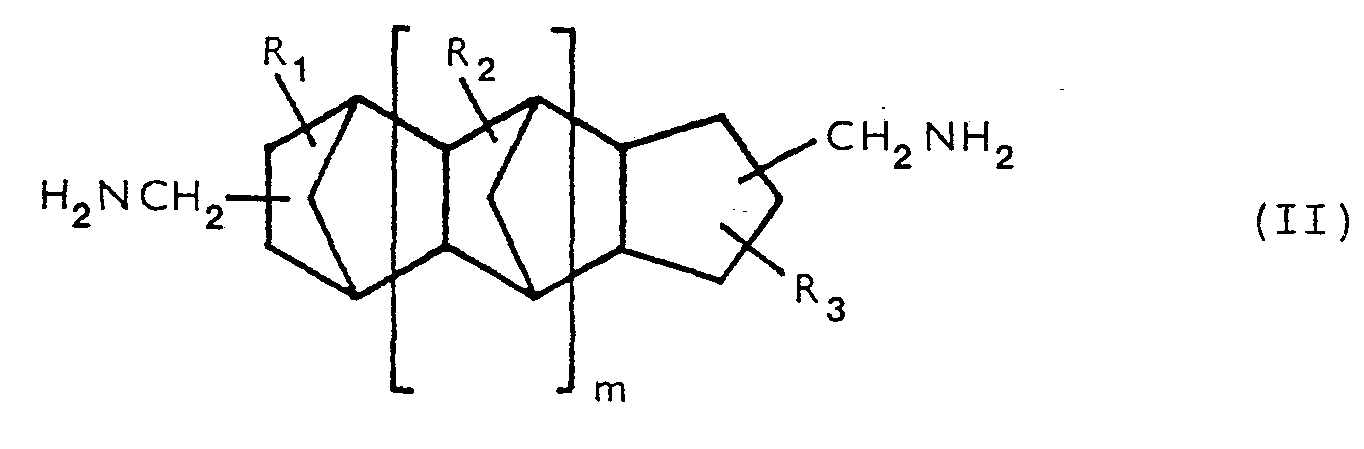
[wherein m, Rl, R2 and R3 are as defined in claim 1] with acrylonitrile and/or methacrylonitrile and reducing the nitrilodiamine thereby obtained.
[wherein m, Rl, R2 and R3 are as defined in claim 1] with acrylonitrile and/or methacrylonitrile and reducing the nitrilodiamine thereby obtained.
8. A process as claimed in claim 7 wherein the reduction is effected by hydrogenation.
9. A process as climed in either of claims 7 and 8 wherein the bis-aminomethyl compound
of formula II is produced by the hydroformylation of a diene of formula III

[wherein m, R1, R2 and R3 are as defined in claim 1] and the subsequent reductive amination of the bis-aldehyde compound of formula IV

[wherein m, R1, R2 and R3 are as defined above] thereby obtained.
[wherein m, R1, R2 and R3 are as defined in claim 1] and the subsequent reductive amination of the bis-aldehyde compound of formula IV
[wherein m, R1, R2 and R3 are as defined above] thereby obtained.
10. A process as claimed in claim 9 wherein the diene of formula III is produced by
the polymerization of cyclopentadiene and/or methylcyclopentadiene.
11. Epoxy resins whenever cured by the use of a compound of formula I as claimed in
claim 1.