|
(11) | EP 0 027 009 A1 |

| (12) | EUROPEAN PATENT APPLICATION |
|
|
|
|
|||||||||||||||||||||||||||
| (54) | Process for producing fluorinated polymer having ion-exchange groups |
| (57) A fluorinated copolymer having ion-exchange groups is produced by copolymerizing
a fluorinated ethylenic unsaturated monomer and a functional monomer having a carboxylic
acid group or another functional group which can be converted into a carboxylic acid
group in an aqueous medium in the presence of a polymerization initiator source and
in the presence of a specific molecular weight regulator. The specific molecular weight
regulator is selected from aliphatic alkanes, alicyclic alkanes and water soluble
organic solvents and controls the molecular weight without lowering the copolymerization
velocity or the stability of the aqueous latex. |
[0001] The present invention relates to a process for producing a fluorinated polymer having ion-exchange groups. More particularly, it relates to an improved process for producing a fluorinated polymer having carboxylic acid-type cation exchange groups by a copolymerization in an aqueous medium.
[0002] It is known that a cation exchange membrane of a carboxylic acid-type fluorinated polymer can be used as a partitioning membrane for the electrolysis of an aqueous solution of an alkali metal chloride. The membrane separates the anode and cathode regions of the electrolytic cell and it is possible in this way to produce an alkali metal hydroxide having high purity and to operate the process at high current efficiency and high current density and also to produce an alkali metal hydroxide at high concentration in a cathode compartment. For example, a current efficiency greater than 90% can be maintained even when concentration-of the resulting sodium hydroxide is higher than 40%.
[0003] It has been proposed to produce a fluorinated polymer having carboxylic acid-type cation exchange groups, which has high ion exchange capacity and remarkably high molecular weight, by a copolymerization in an aqueous medium at a ratio of the aqueous medium to the carboxylic acid-type monomer of less than 20:1 under a pressure of higher than 7 kg/cm2. This is disclosed in U.S. Patent 4,138,373, U.K. Patent 1,552,060 and Japanese Unexamined Patent Publication No. 49090/1978.
[0004] The inventors have studied various copolymerizations of carboxylic acid-type monomers and fluorinated olefins such as tetrafluoroethylene in aqueous media and have found the following interest facts.
[0005] It has been found that the molecular weights of the copolymers can be controlled over a wide range by polymerizing in an aqueous medium with a water soluble organic solvent such as an alcohol or an aliphatic or alicyclic alkane such as ethane and cyclohexane. When the molecular weight is controlled in this way the reduction of the polymerization velocity is only small, the reproducibility of the molecular weight is remarkably high and the stability of the resulting latex is maintained.
[0006] When an alkane is incorporated as a molecular weight regulator, it has been found that the deterioration of the monomers in the copolymerization in an aqueous medium can be reduced and the copolymerization velocity can be increased. Since the deterioration of the monomers in the copolymerization is reduced, the efficiency of use of the carboxylic acid type monomer is improved, increasing the yield of the desired copolymer without any adverse effect on the characteristics of the object copolymer.
[0007] The present invention provides a process for producing a fluorinated copolymer having ion-exchange groups which comprises copolymerizing a fluorinated ethylenic unsaturated monomer and a functional monomer having a carboxylic acid group or another functional group which can be converted into a carboxylic acid group, in an aqueous medium in the presence of a polymerization initiator source, characterised in that the copolymerization reaction is carried out in the presence of a molecular weight regulator selected from aliphatic alkanes, alicyclic alkanes and water soluble organic solvents.
[0008] By the process of the present invention, a fluorinated polymer can be produced containing the carboxylic acid type monomer units in a proportion of 5 to 30 mol % . The molecular weight regulator is preferably used in an amount of 0.0001 to 10 wt. parts per 100 wt. parts of the aqueous medium.
[0009] The carboxylic acid type functional monomer (I) is preferably a fluorovinyl compound to improve the chlorine resistance and oxidation resistance of the resulting copolymer.
[0010] Suitable fluorovinyl compounds are those having the general formula:
wherein p is O or 1: ℓ is O to 3: m is O to 1: n is O to 12: X represents -F, -Cℓ or -CF3 X' represents -F or -CF3: Y and Y' respectively represent -F or a C1-10 perfluoroalkyl group and A represents -CN, -COF, -COOH, -COOR1, wherein R1 represents a C1-C10 alkyl group, -COOM wherein M represents an alkali metal atom or a quarternary ammonium group or -COONR2R3 wherein R2 and R3 respectively represent -H or R1.
[0011] From the viewpoints of properties and availability, it is preferable to use a fluorovinyl compound having the above-mentioned formula wherein X and X' are -F; Y is -CF3; Y' is -F; p is O or 1; ℓ is O to 1; m is O to 1; n is O to 8.
[0012] From the viewpoint of the copolymerization reaction, it is preferable to use the fluorovinyl compound having the formula wherein A is-COOR1 and R1 is a C1-5 alkyl group.
[0014] Suitable fluorinated ethylenic unsaturated monomers (II) include CZF4, C2F3Cℓ, C3F6, CZHF3, C2H2F2 and CZH3F.
[0015] The fluorinated ethylenic unsaturated monomers are preferably fluorinated olefins having the formula
wherein Z and Z' respectively represent -F, -Cℓ, -H or -CF3. It is preferable to use a perfluoroolefine especially tetrafluoroethylene.
[0016] In the process of the invention, it is possible to use two or more types of the functional monomers (I) and the ethylenic unsaturated monomers (II), respectively.
[0017] It is also possible to add one or more other monomer such as an olefin compound (III) having the formula
wherein R4 and R5 respectively represent -H, a C1-8 alkyl group or an aromatic ring;
a fluorovinyl ether having the formula
wherein Rf represents a C1-10 perfluoroalkyl group;
a divinyl monomer e.g. CF2=CF-CF=CF2 or CF2=CFO(CF2)1-4OCF=CF2 and other functional monomers such as a sulfonic acid-type functional monomer.
Suitable olefins (III) include
[0018] ethylene, propylene, butene-1, isobutylene, styrene, a-methyl styrene, pentene-1, hexane-1, heptene-1, 3-methyl butene-1 and 4-methyl pentene-1.
[0019] From the viewpoints of the manufacture and properties of the resulting copolymer, it is especially preferable to use ethylene, propylene or isobutylene.
[0020] When a divinyl monomer or the like is added, the resulting copolymer is crosslinkable and the mechanical strength of the membrane made of the crosslinked copolymer is improved.
[0021] The ratio of the functional monomer (I), the fluorinated olefin (II), and the olefin compound (III) and other components are important because it affects the characteristics of a cation exchange membrane when used in an electrolytic cell.
[0022] The content of the functional monomer (I) is important and directly affects the ion exchange capacity. It is preferably 5 to 30 mole %.
[0023] When the content of the functional monomer (I) is too high, the resulting cation exchange membrane has disadvantageously low mechanical strength and low ion permselectivity caused by the increase of the water content.
[0024] When the content of the functional monomer (I) is too low, the ion exchange function is unacceptably reduced. -
[0025] The fluorinated olefin (II), the olefin compound (III) and the other compound are the residual components in the copolymer. The content of the olefin (III) is important and relates to the electrical and mechanical properties and the chlorine resistance of the resulting cation exchange membrane.
[0026] Accordingly, when the olefin compound (III) is added, the molar ratio of the olefin compound (III) to the fluorinated olefin (II) is preferably 5/95 to 70/30, especially 10/90 to 60/40.
[0027] When the fluorovinyl ether or the divinyl ether is added, it is preferable to give a content of the fluorovinyl ether or the divinyl ether of less than 30 mole % preferably 2 to 20 mole % in the copolymer.
[0028] The ion exchange capacity of the copolymer can be in a range of 0. 5 to 2.2 meq./g dry polymer. It is special characteristic that even though the ion exchange capacity is large, the molecular weight of the resulting copolymer can be high whereby the mechanical strength and durability of the copolymer can be high enough.
[0029] The ion exchange capacity is dependent upon the type of the copolymer in the above-mentioned range and is preferably more than 0. 8 meq/g dry polymer, especially more than 1. 0 meq/g dry polymer, from the viewpoints of the mechanical and electrochemical properties as the cation exchange membrane.
[0030] The molecular weight of the copolymer produced by the process of the invention is important and relates to the mechanical properties and the fabricability of the cation exchange membrane.
[0031] When it is shown by the value of TQ, it is usual to have TQ of higher than 150°C preferably 170 to 340 °C especially about 180 to 300°C.
[0033] The term of TQ relates to a molecular weight of the copolymer and is a temperature to result in a volumetric melt flow rate of 100 mm/second. The volumetric melt flow rate is a rate of the molten copolymer flowed out from an orifice having a diameter of 1 mm and a length of 2 mm at a specific temperature under the load of 30 kg/cm2 and is shown by a unit of mm3/second.
[0034] In the examples, an ion exchange capacity of a cation exchange membrane was measured as follows.
[0035] A H-type cation exchange membrane was immersed in IN-HCℓ at 60'C for 5 hours to completely convert it to H-type membrane, and then the membrane was washed with water so as to be free of HCℓ. Then, 0. 5 g. of the H-type membrane was immersed into a solution prepared by adding 25 mi of water to 25 mℓ of 0. 1N-NaOH. Then, the membrane was taken out and the amount of NaOH in the solution was measured by a back titration with 0. 1N-HCℓ.
[0036] In the process of the present invention, it is important to carry out the copolymerization of the functional monomer and the fluorinated olefin in an aqueous medium. It is preferable to carry out the copolymerization by using an aqueous medium at a ratio of the aqueous medium to the functional monomer of less than 20/1 by weight preferably less than 10/1 by weight. When the amount of the aqueous medium is too much, the reaction velocity of the copolymerization is remarkably low. It takes a long time for obtaining high yield of the copolymer. Moreover, when the amount of the aqueous medium is too much, it is difficult to give high molecular weight in the case of high ion exchange capacity. The use of a large amount of the aqueous medium causes the following disadvantages. For example, a large size of a reactor is needed. The operation for separation and a recovery of the copolymer are disadvantageous.
[0037] In the process of the invention, it is important to carry out the copolymerization under the pressure of higher than 7 kg/cm. When the pressure for the copolymerization is too low, it is difficult to maintain the reaction velocity for the copolymerization at a high enough level and to produce a copolymer having high molecular weight. When the pressure for copolymerization is too low, the ion exchange capacity of the resulting copolymer is too high whereby the mechanical strength and the ion permselectivity are lowered by the increase of the water content.
[0038] The pressure for copolymerization is preferably not more than 50 kg/cm , from the viewpoints of the reactor and the operation of the industrial process. Even though a higher pressure can be employed for the copolymerization, the effect of the invention is not proportionally improved by increasing the pressure. Accordingly, the pressure for copolymerization is usually in a range of 7 to 50 kg/cm2 preferably 9 to 30 kg/cm .
[0039] In the process of the present invention, it is important to carry out a copolymerization in the presence of the specific molecular weight regulator selected from aliphatic or alicyclic alkanes and water soluble organic solvents.
[0040] Various alkanes can be used preferably a C1-C8 alkane such as methane, ethane, propane, butane, pentane, hexane, heptane or octane or a cycloalkane such as cyclobutane, cyclopentane or cyclohexane. It is also possible to use a branched alkane such as isobutane, isopentane, isohexane and 3-methyl-pentane or an alkyl-substituted cycloalkane such as methylcyclopentane or methylcyclohexane.
[0041] The water soluble organic solvents can be selected from a wide range but is preferably a CI-Ca alcohol such as methanol, ethanol, isopropanol, butanol, ethyleneglycol or propyleneglycol. It is also possible to use an alkyleneoxide such as ethyleneoxide or propyleneoxide; an aldehyde such as formaldehyde or acetaldehyde; a ketone such as acetone or methyl ethyl ketone a cyclic ether such as dioxane or tetrahydrofuran and a lactone such as y-butyrolactone.
[0042] The specific molecular weight regulator can be incorporated before or during the copolymerization, continuously or in separate additions. The specific molecular weight regulator is usually incorporated at a ratio of 0.0001 to 10 wt.parts preferably 0.001 to 5 wt. parts per 100 wt parts of the aqueous medium.
[0043] When the amount of regulator used is too small, it is difficult to control the molecular weight. When it is too much, the molecular weight is lowered too much whereby it is difficult to obtain the desired cation exchange membrane and the polymerization velocity is lowered.
[0044] In the copolymerization of the invention, the reaction conditions the other conditions and the particular operation used are not crucial and can be selected from wide ranges. For example, the optimum reaction temperature for copolymerization can be selected depending upon the type of the polymerization initiator source, the aqueous medium or the molar ratio of the components in the reaction. Usually, high or low temperatures are not advantageous in the industrial process and accordingly the temperature is generally selected from the range of 20 to 90°C, preferably 30 to 80°C.
[0045] It is preferable to select a polymerization initiator source which imparts high activity at the reaction temperature used in the process of the invention. It is possible to use ionized high energy radiation at room temperature, but it is preferable to use an azo compound or a peroxy compound in the industrial process.
[0046] Suitable polymerization initiator sources are compounds having high activity at about 20 to 90°C under the reaction pressure for copolymerization and include diacyl peroxides such as disuccinic peroxide, benzoyl peroxide, lauroyl peroxide and dipentafluoro- propionyl peroxide; azo compounds such as 2, 2'-azobis(2-aminopropane) hydrochloride, 4,4'-azobis(4-cyanovalerianic acid) and azobisisobutyronitrile; peroxyesters such as t-butyl peroxyisobutylate and t-butyl peroxy-pivalate; peroxydicarbonates such as diisopropyl peroxydicarbonate and di-2-ethylhexyl peroxydicarbonate; hydroperoxides such as diisopropylbenzene hydroperoxide; inorganic peroxides such as potassium persulfate and ammonium persulfate; and redox systems thereof.
[0047] In the process of the invention, the concentration of the polymerization initiator is usually in a range of 0.0001 to 3 wt. % preferably 0. 001 to 2 wt. % to total monomers.
[0048] The molecular weight of the resulting copolymer can be increased and high ion exchange capacity is kept by decreasing the concentration of the polymerization initiator. When the concentration of the polymerization initiator is too high, the molecular weight of the copolymer is decreased to cause disadvantages for the production of the copolymer having high ion exchange capacity and high molecular weight.
[0049] It is possible to incorporate a desired conventional surfac- tam, a dispersing agent, a buffer agent and a pH regulator used in the conventional polymerizations in an aqueous medium. It is also possible to incorporate an inert organic solvent such as a fluorinated or chlorofluorinated saturated hydrocarbon known as fluorocarbon solvents, which do not inhibit the copolymerization of the fluorinated olefin with the specific functional monomer and have not high chain transfer activity.
[0050] In the process of the invention, it is preferable to carry out the copolymerization while keeping the concentration of the resulting copolymer at less than 40 wt.%, preferably less than 30 wt.%. When the concentration is too high, the disadvantages of high stirring load, difficulty of heat removal and insufficient absorption and diffusion of the fluorinated olefin gas are found.
[0051] The copolymer of the invention can be processed to form a membrane by any suitable method. For example, the functional group can be converted to carboxylic acid group by hydrolysis, if necessary. The hydrolysis can be carried out before or after the fabrication of a membrane. It is usually preferable to hydrolyze the group after the fabrication of a membrane.
[0052] The fabrication of a membrane can be carried out by various methods such as heat melt molding, latex molding, casting using a solvent solution of the copolymer and other known methods.
[0053] The cation exchange membranes made of the copolymers of the invention have excellent characteristics and can be used in various fields and for various purposes. For example, they can be preferably used in the field in which the anticorrosion is required, as in a diaphragm for diffusion dialysis, electrolytic reduction or a fuel cell.
[0054] When it is used as a cation selective membrane for electrolysis of alkali metal compound, high performance which could not be attained by using the conventional cation exchange membrane can be achieved. Thus, in the case of the two compartment cell wherein an anode compartment and a cathode compartment are formed by partitioning the anode and the cathode with the cation exchange membrane made of the fluorinated copolymer of the invention, and an aqueous solution of an alkali metal chloride is fed into the anode compartment to electrolyze it to obtain an alkali hydroxide from the cathode compartment, it is possible to produce sodium hydroxide having a concentration higher than 40% at a current efficiency higher than 90% by electrolyzing an aqueous solution of sodium chloride having a concentration of higher than 2N at a current density of 5 to 50A/dm .
[0055] It is also possible to carry out the electrolysis at a low cell voltage typically lower than 4.5 volts.
[0056] A further understanding can be obtained by reference to the following specific examples which are provided herein for purposes of illustration only.
EXAMPLE 1:
[0057] In a 0.2 liter stainless steel autoclave, 100 g. of water, 0.2 g. of C8F17COONH4, 0.5 g. of NaH2PO4 · 2H2O, and 0.052 g. of (NH4)2S2O8 were charged and then, 20 g. of CF2 = CFO(CF2 )3COOCH3 and 0.02 g. of ethane were charged. Air in the autoclave was purged with liquid nitrogen and the autoclave was heated to 60 °C and tetrafluoroethylene was fed at a rate of 15.2 kg./cm2 to initiate the reaction. During the reaction, tetrafluoroethylene was continuously fed to maintain the pressure of 15. 2 kg. /cm2. After 4 hours, 18. 2 wt. % of a latex was obtained. The unreacted tetrafluoroethylene gas was purged and the unreacted CF2 = CFO(CF2)3COOCH3 was separated by extracting with trichlorotrifluoroethane and then, H2SO4 was added to precipitate and to separate the copolymer from the latex. The separated polymer was washed with water and with methanol and then, methanol at a ratio of 5 times of the weight of the copolymer was added and the mixture was stirred at 60°C for 16 hours. The polymer was separated from methanol and dried at 60 °C under a reduced pressure to obtain 22. 2 g. of white copolymer having TQ of 215°C.
[0058] Excellent film having a thickness of 300 µ was obtained by heat-press-molding at 215°C. The film was hydrolyzed to obtain a cation exchange membrane having an ion-exchange capacity of 1.25 meq. /g.
[0059] A percent decomposition of monomer of CF2 = CFO(CF2)3 COOCH3 is defined by the equation:
100 x (A - B - C)/A
wherein A: the charged functional monomer; B: functional monomer units in the polymer; and C: the unreacted functional monomer.EXAMPLE 2:
[0061] In accordance with the process of Example 1 except charging 0.02 g. of n-hexane instead of ethane and copolymerizing under a pressure of 14. 5 kg. /cm2 a copolymerization was carried out. After 6.4 hours, 16.8 wt.% of a latex was obtained and 20.2 g. of the copolymer having TQ of 221°C and an ion-exchange capacity of 1.27 meq. /g. was obtained. The percent decomposition of CF2 = CFO· (CF2)3COOCH3 monomer was 8.0%.
EXAMPLE 3:
[0062] In accordance with the process of Example 2 except charging 0.015 g. of cyclohexane instead of n-hexane, a copolymerization was carried out. A copolymer having TQ of 222 °C and an ion-exchange capacity of 1. 26 meq. /g. was obtained.
EXAMPLE 4:
[0063] In accordance with the process of Example 2 except charging 0.017 g. of isopropyl alcohol instead of n-hexane, a copolymerization was carried out. After 7. hours, 17.0 wt.% of a latex was obtained and 20. 5 g. of a copolymer having TQ of 215°C and an ion exchange capacity of 1.28 meq. /g. was obtained. The percent decomposition of CF2 = CFO(CF2)3COOCH3 monomer was 19.5%.
EXAMPLE 5:
[0064] In a 0.2 liter stainless steel autoclave, 100 g. of water, 0.2 g. of C8F17COONH4, 0.5 g. of NaH2PO4 · 2H2O, 0.026 g. of (NH4)2S2O8 were charged, and then, 20 g. of CF2 = CFO(CF2)3-COOCH3 and 0.008 g. of isopropyl alcohol were charged. Air in the autoclave was purged with liquid nitrogen, and the autoclave was heated at 60°C and tetrafluoroethylene was fed at a rate of 14. 5 kg. /cm to initiate the reaction. During the reaction, tetrafluoroethylene was continuously fed to maintain a pressure of 14. 5 kg. /cm2. After 6 hours, 17.3 3 wt.% of a latex was obtained. The unreacted tetrafluoroethylene was purged. The unreacted monomer of CF2 = CFO(CF2)3-COOCH3 was extracted with trichlorotrifluoroethane and then H2SO4 was added to precipitate and to separate the copolymer. The separated polymer was washed with water and with acetone and then, with trichlorotrifluoroethane. Methanol was added at a ratio of 5 times of the copolymer and the mixture was treated at 60 °C with stirring for 16 hours. The copolymer was separated from methanol and dried at 60°C under a reduced pressure to obtain 20.9 g. of a white copolymer having TQ of 230 C. Excellent film having a thickness of 300 µ was obtained by heat-press-molding at 230°C. The film was hydrolyzed to obtain a cation exchange membrane having an ion-exchange capacity of 1. 25 emq. /g.
REFERENCE 1:
[0065] In accordance with the process of Example 5 except that isopropyl alcohol was not incorporated, a copolymerization was carried out to obtain a copolymer having TQ of 295°C. It was difficult to obtain a desired film by a heat-press-molding process.
EXAMPLE 6:
[0066] In accordance with the process of Example 5 except that charging 0. 012 g. of isopropyl alcohol, a copolymerization and a post-treatment were carried out, to obtain a copolymer having TQ of 221 °C. Excellent film having a thickness of 270µ was obtained by a heat-press-molding at 230 °C. The film was hydrolyzed to obtain a cation exchange membrane having an ion-exchange capacity of 1.25 meq./g.
EXAMPLE 7:
[0067] In accordance with the process of Example 5 except charging 0. 5 g. of acetone instead of isopropyl alcohol, a copolymerization and a post-treatment were carried out to obtain a polymer having TQ of 245°C. Excellent film having a thickness of 300µ was obtained by a heat-press-molding at 250°C. The film was hydrolyzed to obtain a cation exchange membrane having an ion-exchange capacity of 1. 27 meq . /g.
1) A process for producing a fluorinated copolymer having ion-exchange groups which
comprises copolymerizing a fluorinated ethylenic unsaturated monomer and a functional
monomer having a carboxylic group or another functional group which can be converted
into a carboxylic acid group, in an aqueous medium in the presence of a polymerization
initiator source,characterised in that the copolymerization reaction is carried out
in the presence of a molecular weight regulator selected from aliphatic alkanes, alicyclic
alkanes and water soluble organic solvents.
2) A process according to Claim 1 characterised in that said molecular weight regulator
is incorporated in an amount of 0.0001 to 10 wt.parts per 100 wt.parts of said aqueous
medium.
3) A process according to Claim 1 or Claim 2 characterised in that said fluorinated
copolymer comprises said functional monomer component at a ratio of 5 to 30 mol %.
4) A process according to any preceding Claim characterised in that said weight regulator
is a C1-C8 alkane.
5) A process according to any one of Claims 1 to 3 characterised in that said weight
regulator is a C1-C8 alcohol.
6) A process according to any preceding Claim characterised in that the functional
monomer is a fluorovinyl compound having the general formula:

wherein p is O or 1; ℓ is O to 3; m is O to 1; n is O to 12; X represents -F, -Cℓ or -CF3; X' represents -F or -CF3; Y and Y' respectively represent -F or a C1-10 perfluoroalkyl group and A represents -CN, -COF, -COOH, -COOR, wherein R represents a C1-10 alkyl group -COOM wherein M represents an alkali metal atom or a quarternary ammonium group or -COONR2R3 wherein R2 and R3 respectively represent -H or R1 defined above.
wherein p is O or 1; ℓ is O to 3; m is O to 1; n is O to 12; X represents -F, -Cℓ or -CF3; X' represents -F or -CF3; Y and Y' respectively represent -F or a C1-10 perfluoroalkyl group and A represents -CN, -COF, -COOH, -COOR, wherein R represents a C1-10 alkyl group -COOM wherein M represents an alkali metal atom or a quarternary ammonium group or -COONR2R3 wherein R2 and R3 respectively represent -H or R1 defined above.
7) A process according to Claim 6 characterised in that the said fluorovinyl compound
is the compound having the general formula:
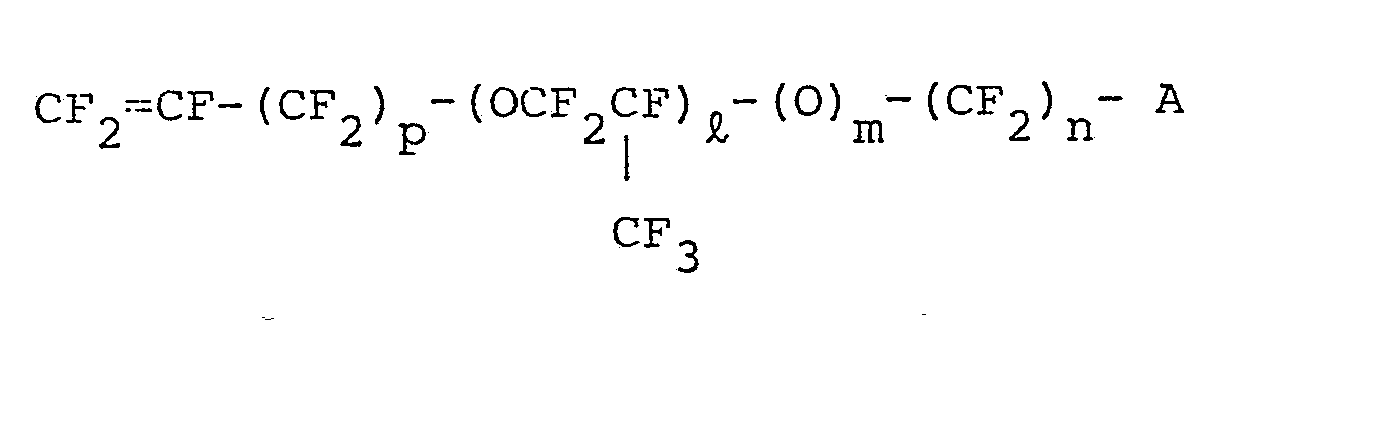
wherein p is 0 or 1; ℓ is O to 1; m is O to 1; n is O to 8; and A represents -COOR1 wherein R1 represents a C1-C5 alkyl group.
wherein p is 0 or 1; ℓ is O to 1; m is O to 1; n is O to 8; and A represents -COOR1 wherein R1 represents a C1-C5 alkyl group.
8) A process according to any preceding Claim characterised in that the fluorinated
ethylenic unsaturated monomer is a fluorinated olefin having the formula:
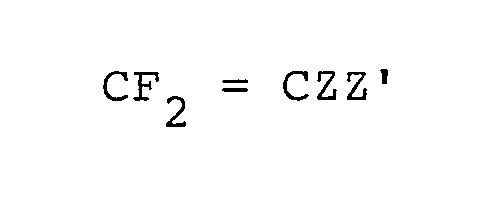
wherein Z and Z' respectively represent -F, -Cℓ, -H or -CF3.
wherein Z and Z' respectively represent -F, -Cℓ, -H or -CF3.
9) A process according to Claim 8 characterised in that the fluorinated ethylenic
unsaturated monomer is tetrafluoroethylene.
10) A process according to any preceding claim characterised in that the temperature
for the copolymerization reaction is in a range of 20 to 90°C.
11) A process according to any preceding claim chatacterised in that the pressure
in the copolymerization reaction is in a range of 7 to 50 kg/cm2.
12) A process according to any preceding claim characterised in that the concentration
of the copolymer in the slurry is maintained at less than 40 wt.% in the copolymerization
reaction.