|
(11) | EP 0 027 279 A1 |

| (12) | EUROPEAN PATENT APPLICATION |
|
|
|
|
|||||||||||||||||||||||||||||||
| (54) | Isoxazolo(5,4-C)pyridines |
| (57) The compound
wherein Z is hydrogen or an amino-protecting group and W is hydrogen or a group removable to yield the free hydroxy group, with the proviso that at least one of Z and W is different from hydrogen, is a novel intermediate for preparing compound I. The invention covered bytheformula in which R" is hydrogen, acetyl or a group of the general formula VII in which R5 is C1-8 alkyl; phenyl; phenyl substituted in the 4-position with halogen, Ci-4 alkoxy, or C1-4 alkyl; or phenylalkyl in which the phenyl group may be substituted in the 4-position with halogen, lower alkoxy, or lower alkyl. Compound I, in which R" is hydrogen, possesses GABA-related activity. |
[0001] The present invention relates to novel intermediates for compounds having GABA-related activity, which are discussed and claimed in the European patent application 78100191.2, the disclosure of which is made part of the present application. Similar intermediates for compounds having GABA-related activity are described and claimed in the copending European patent application of the even date, which is also a divisional application of the European patent application 78100191.2, published on January 1, 1979 under No. 0000338.
[0002] Intermediates of the present invention are compounds of the general formula V
in which Z is hydrogen or an amino-protecting group readily removable, e.g. by hydrolysis, suitably a group R", wherein R" is hydrogen, acetyl or a group of the general formula VII
wherein R5 is C1-8 alkyl; phenyl; phenyl substituted in the 4-position with halogen, lower alkoxy, or lower alkyl; or phenylalkyl such as benzyl or phenylethyl in which the phenyl group may be substituted in the 4-position with halogen, lower alkoxy, or lower alkyl; or a trityl or formyl group, and W is hydrogen or a group readily removable, e.g. by hydrolysis, to yield the free hydroxy group, such as a lower alkyl group, aralkyl, tetrahydropyranyl, acetyl, arylsulfonyl, or lower alkoxycarbonyl, with the proviso that at least one of Z and W in formula V is different from hydrogen.
[0003] In the present specification, "lower alkyl" and "lower alkoxy" designate such groups containing 1 - 4 carbon atoms.
[0004] These compounds are intermediates in the preparation of compounds of the general formula I
wherein R" is as defined above. Compound Ia (4,5,6,7-tetrahydroisoxazolo(5,4-c)pyridine-3-ol), which corresponds to formula I, in which R" is hydrogen, is for example fully synthesized from a known starting material via that claimed compound (Va) according to Reaction Scheme I:
[0005] The conversion of ethyl l-benzyl-3-oxy-piperidine-4-carboxylate into the intermediate IV as exemplified by IVa, is usually performed in lower alkanols, e.g. ethanol or ethanol/water. The removal of the N-benzyl group may be effected with gaseous hydrogen in the presence of a hydrogenation catalyst, e.g. platinum, palladium or Raney nickel. The alkyl 3-oxy-piperidine-4-carboxylate formed is dissolved, e.g. in water, and treated with an acid acceptor, e.g. alkali carbonate, and an ester of chloroformic acid, e.g. methyl chloroformate. The temperature is kept near 0°C during the reaction. The compound IV is isolated by extraction into an organic solvent followed by evaporation of the solvent.
[0006] The formation of the compound of formula. VIII' as exemplified by the ethylene acetal VIIIa is usually performed in a solvent, e.g. benzene, which forms an azeotropic mixture with water. The reaction is preferably carried out at reflux temperature and with a strong acid, e.g. a sulfonic acid as catalyst.
[0007] The hydroxamic acid IX' as exemplified by IXa is synthesized by reacting VIIIa with hydroxylamine, preferably in water or a lower alcohol, e.g. methanol and usually at a temperature between -20°C and room temperature, preferably at 0 - 10 C. The compound may be isolated and purified by a manner known per se, e.g. column chromatography. When Q in formula VIII' is a halogen or the residue of an acid, the reaction is effected in the presence of a . base. Alternatively, the piperidine carboxylic acid itself (VIII', Q=OH) may be reacted with hydroxylamine in the presence of a condensing agent, e.g..dicyclohexyl carbodiimide or carbonyldiimidazole. As solvent, an inert solvent, e.g. methylene chloride or chloroform can be used.
[0008] The hydrolysis of the acetal group of IXa or, quite generally, the conversion of T in compounds of formula IX' into an oxo group, | followed by cyclization to a compound of formula V as exemplified by Va may be effected by an aqueous solution of a strong acid optionally also containing acetic acid, e.g. concentrated hydrochloric acid or 70% perchloric acid at a temperature between 0 C and 100°C, preferably at 50 - 80°C. The compound V may be isolated by extraction with an organic solvent or by evaporation of the water. The compound can be purified by column chromatography or by crystallization.
[0009] Removal of the protecting group Z and/or W in compound V may be effected with a strong inorganic acid, e.g. hydrochloric or hydrobromic acid, in a solvent, e.g. glacial acetic acid or water, or a mixture of water and glacial acetic acid. The temperature may be kept between room temperature and the boiling point of the solvent. The reaction time is usually short, e.g. less than 1 hour. The Ia salt may be isolated by evaporation of the solvent. The Ia salt may be transformed into Ia by treatment with a base, e.g. a tertiary amine, in a solvent, usually a mixture of water and a lower alkanol.
[0011] An interesting synthesis is illustrated in the below reaction scheme II in which a compound of the general formula I, as exemplified by the compound Ia, is prepared:
[0012] The reaction of a compound of the general formula IV as exemplified by IVa with hydroxylamine may give a mixture of a compound of the general formula V and the corresponding isomeric compound V as exemplified by Va and VIa. The reaction may be effected at a temperature between -30°C and 50°C, preferably between -30 and -10°C. The solvent is usually water or a lower alkanol or mixtures thereof.
[0013] The process illustrated in reaction scheme II, although yielding a mixture of two isomers, is nevertheless advantageous. It 'is very time-saving in that it avoids the protection of the oxo group in compounds of the general formula IV and the subsequent hydroxamic acid formation. The compounds formed in the reaction of IV with hydroxylamine, as exemplified by Va and VIa, are easily separated by manners known per se, e.g. by column chromatography.
[0014] When it is desired to prepare compounds of the general formula I in which R"-is different from hydrogen, one may either omit the removal of the group Z if the group Z has the same identity as the desired group R", or one may introduce such group R" into the compound of the general formula Ia.
[0015] The introduction of the group R" may be performed by manners known per se. Thus, for example, when R" is a group of the above formula VII, the introduction may be performed by treatment of compound Ia with the appropriate. formic acid ester of the general formula X'-
-OR5 wherein X' is a leaving group, especially halogen, azido, etc., in the presence of an acid acceptor, for example an alkali carbonate. For example, the BOC-derivative can be made by means of tert.butyl azidoformate: When R" is acetyl, a reactive derivative of acetic acid, e.g. acetyl chloride or acetanhydride may be used for the introduction of the group R".
[0016] The invention is further illustrated by the following working examples. All compounds prepared according to the working examples have been subjected to elemental analysis for C, H, N and halogen, when present, and all agreed within ± 0.3% with the calculated values.
a) Ethyl 1-methoxycarbonyl-3-oxopiperidine-4-carboxylate (IVa).
[0018] A solution of ethyl l-benzyl-3-oxopiperidine-4-carboxylate (Iselin, B.M. and Hoffmann, K., Helv.Chim. Acta, 1954, 37, 178) (14.0 g; 47 mmol) in aqueous ethanol (300 ml; 50%) was hydrogenated (ca. 300 kPa) in a PARR hydrogenation apparatus by using a 10% Pd-C catalyst (1.4 g). The reaction mixture was. filtered and evaporated to dryness in vacuo. To an ice cooled solution of the residue in water (50 ml) was added with stirring an iced solution of potassium carbonate (19.4 g; 140 mmol) in water (20 ml) followed by addition of methyl chloroformate (11.3 g; 120 mmol). Stirring was continued at 0°C for 30 minutes and at 25°C for 30 minutes. The mixture was extracted with three 100 ml portions of ether. The combined and dried (Na2SO4) ether phases were evaporated in vacuo to give 10.0 g of crude product. Ball--tube distillation at 40--130 Pa (oven temperature 170°C) gave IVa (9.0 g; 84%) as a colourless oil, which slowly crystallized, m.p. 36--38°C. IR (film): 2980--2850 (several bands, m-s), 1700 (s), 1655 (s), 1620 (m) cm-1. 1H NMR (CCl4) : δ 12.3 (.1 H, s), 4.13 (q, J 7 Hz) and 4.0--3.9 (m) (a total of 4 H), 3,62 (3 H, s) , 3,43 (2 H, t, J 6 Hz), 2.4--2.1 (2 H, m) 1.30 (3 H, t, J 7 Hz).
b) Ethyl 1-methoxycarbonyl-3-oxopiperidine-4-carboxylate ethylene acetal (VIIIa).
[0019] A mixture of ethyl l-methoxycarbonyl-3-oxopiperidine-4-carboxylate (9.0 g; 39 mmol), ethylene glycol (100 ml), 4-toluenesulfonic acid (0.7 g), and benzene (500 ml) was refluxed for 6 days using a Dean-Stark water separator. The mixture was washed with aqueous sodium carbonate (300 ml; 1 M), water (300 ml), and saturated aqueous sodium chloride (300 ml). The organic phase was dried (K2CO3) and evaporated in vacuo to give 8.6 g of an oil. CC [silica gel (Woelm 0.063--0.1 mm): 350 g; eluents: methylene chloride to which ethyl acetate (20--35%) was added] followed by ball-tube distillation at 40 Pa (oven temperature 170°C) gave VIIIa (7.0 g; 65%) as a colourless oil. IR (film): 2970 (s), 2900 (s), 1730 (s) cm-1. 1H NMR (CCl4) : 6 4:05 (q, J 7 Hz) and 3.92 (s) (a total of 6 H), 3.60 (s) and 3.7--3.0 (m) (a total of 7 H), 2.8--2.5 (1 H, t), 2.2--1.6 (2H, m), 1.23 (3 H, t, J 7 Hz).
c) 1-Methoxycarbonyl-3-oxopiperidine-4-carbohydroxamic acid ethylene acetal (IXa).
[0020] To a stirred and iced solution of potassium hydroxide (7.3 g; 130 mmol) in methanol (30 ml) was added hydroxylammonium chloride (6.9 g; 100 mmol). After stirring at 0°C for further 30 minutes a solution of ethyl 1-methoxycarbonyl-3-oxopiperidine-4-carboxylate ethylene acetal (6.8 g; 25 mmol) in methanol (20 ml) was added, and the mixture was left at 8°C for 8 days. Upon addition of glacial acetic acid (15 ml) and filtration the filtrate was evaporated in vacuo to give a treacly mass. CC [silica gel (Woelm 0.063--0.1 mm): 250 g; eluents: ethyl acetate to which methanol (15--26%) and formic acid (1%) was added] afforded IXa (1.9 g; 29%) as a crystalline and TLC-pure substance [RF: 0.23; eluent: ethyl acetate-methanol-formic acid (90:9:1)]. An analytical sample was recrystallized (ethanol-benzene) to give IXa as colourless crystals, m.p. 150.0--152.0°C. IR (KBr): 3700--3350 (m), 3280 (m), 3210 (s), 3055 (w), 3000--2870 (several bands, w-m), 1690 (s), 1640 (s), 1550 (w) cm-1. 1H NMR [CDC13-DMSO-d6 (1:1): δ 10.5--10.1 (1 H, m), 4.9--4.3 (1 H, m), 3.93 (s), 3.60 (s), and 4.1--3.1 (m) (a total of 11 H), 2.8--2.6 (1 H, m), 2.2--1.8 (2 H, m).
d) Methyl 3-hydroxy-4,5,6,7-tetrahydroisoxazolo[5,4-c]pyridine-6--carboxylate (Va).
[0021] A solution of 1-methoxycarbonyl-3-oxopiperidine-4-carbohydroxamic acid ethylene acetal (750 mg; 2.9 mmol) in concentrated hydrochloric acid (13 ml) was heated to 70°C for 10 minutes. The mixture was evaporated in vacuo to give a black oil. CC [silica gel (Woelm 0.063--0.1 mm): 60 g; eluents: benzene to which ethyl acetate (40--70%) and formic acid (1%) was added] gave crystalline and TLC-pure Va (244 mg; 43%) [RF: 0.27; eluent: benzene-ethyl acetate-formic acid (50:50:1)]. An analytical sample was recrystallized (benzene--cyclohexane) to give pure Va as colourless crystals, m.p. 136.0--138.0°C. IR (KBr): 3700--3300 (m), 3300--2500 (several bands, w-m), 1655 (s), 1525 (m), 1490 (s) cm-1.
[0022] UV [methanol (log e)]: 212 (3.64) nm. 1H NMR (CDCl3): 6 10.6 (1 H, s), 4.43 (2 H, s), 3.70 (s) and 3.8--3.5 (t) (a total of 5 H), 2.6--2.3 (2 H, t).
e) 3-Hydroxy-4,5,6,7-tetrahydroisoxazolo[5-,4-c]pyridinium bromide (Ia (salt)).
[0023] A solution of methyl 3-hydroxy-4,5,6,7-tetrahydroisoxazolo[5,4-c]-pyridine-6-carboxylate (309 mg; 1.6 mmol) in a solution of bydro- gen bromide in glacial acetic acid (3 ml; 43%) was refluxed for 15 minutes. Upon evaporation to dryness in vacuo the residue was treated with the same reagent (3 ml) for further 15 minutes. Evaporation of the reaction mixture to dryness in vacuo and recrystallization (methanol-ether) of the residue gave Ia (salt) (193 mg; 56%) as faintly reddish crystals, m.p. 162--163°C (decomp.). IR (KBr): 3700--3300 (m), 3070 (s), 3000-2300 (several. bands, m-s), 1670 (m), 1580 (m), 1525 (s) , 1505 (w) cm-1. UV (methanol): <210 nm. 1H NMR [D2O (sodium 3-(trimethylsilyl)-propanesulfonate was used as an internal standard)]: δ 4.77 (ca. 5 H, s), 4.43 (2 H, t, J 1 Hz), 3.7--3.4 (2 H; q; J 6 and 7 Hz), 3.0--2.7 (2 H, t).
f) 4,5,6,7-Tetrahydroisoxazolo[5,4-c]pyridin-3-ol zwitterion (Ia).
[0024] To a solution of 3-hydroxy-4,5,6,7-tetrahydroisoxazolo[5,4-c]pyridinium bromide (77 mg; 0.35 mmol) in water (0.6 ml) was added a solution of triethylamine (39 mg; 0.39 mmol) in ethanol (0.6 ml) . The mixture was left at 25°C for 2 hours. Ia (42 mg; 86%) was isolated as colourless crystals, m.p. 242--244°C (decomp.). IR (KBr): 3700--2900 (s), 2900--1900 (several bands, m-s), 1670 (s), 1625 (m) cm-1. UV [methanol (log ε)]: 212 (3.64) nm. pKA values (H2O, 25°C) 4.44 ± 0.03, 8.48 ± 0.04.
Methyl 3-hdrox-4,5,6,7-tetrahydroisoxazolo[5,4-c pyridine-6-carboxylate (Va) and methyl-1,4,5,6,7,7a-hexahydro-1-oxoisoza- zolo[3,4-c]pyridine-5-carboxylate (VIa).
[0026] To an iced solution of sodium hydroxide (9.6 g; 0.24 mol) and hydroxylammonium chloride (8.34 g:, 0.12 mol) in water (100 ml) was added with stirring ethyl l-methoxycarbonyl-3-oxopiperidine--4-carboxylate (22.9 g; 0,1 mol). Upon standing at 5°C for 5 hours the solution was evaporated to dryness in vacuo. The residue was dissolved in concentrated hydrochlorid acid (75 ml) and heated to 70°C for 10 minutes. The mixture was evaporated in vacuo to the formation of a black residue, which was extracted with three 100 ml portions of chloroform. The combined chloroform phases were dried (Na2SO4) and evaporated in vacuo to the formation of a black semisolid residue. TLC ((silica gel F254), eluent: benzene-ethyl acetate-formic acid (25:25:1)) showed the presence of two compounds with RF, values 0.31 and 0.16 corresponding to Va and VIa, respectively. Column chromatography (silica gel:.300 g; eluent: benzene-ethyl acetate-formic acid (30:20:1)) lead to Va and VIa.
Example 3.
Methyl 3-hydroxy-4,5,6,7-tetrahydro[5,4-c]pyridine-6-carboxylate-(Va) (Reaction Scheme I).
[0027] A solution of the hydroxamic acid (IXa) (10 g) in perchloric acid (70%; 35 ml) was heated to 60°C for 30 minutes. Upon cooling, NaOH (40 ml; 28%) was added with stirring and cooling. The mixture was extracted with three 50 ml portions of chloroform. The combined and dried (MgSO4) chloroform phases were filtered and evaporated to dryness in vacuo to form a residue which was dissolved in ethyl acetate (50 ml). Upon standing and cooling, Va was isolated as crystals (6.3 g; 82%). Isolation and washing twice with 30 ml portions of ethyl acetate yielded crystalline Va, m.p. 139 - 141°C.
[0028] Instead of heating to 60°C for 30 minutes, the same result may be achieved on standing at ambient temperature for 16 hours. 4,5,6,7-Tetrahdroisoxazolo[5,4-c]ridine-3-ol zwitterion (Ia).
[0029] A solution of methyl 3-hydroxy-4,5,6,7-tetrahydroisoxazolp[5,4-c]-pyridine-6-carboxylate (Va) (37 g) in hydrogen bromide in glacial acetic acid (33% HBr, 250 ml) was left for 16 hours at ambient temperature. Evaporation to dryness in vacuo gave the HBr salt of Ia as a yellowish crystalline material, which was dissolved in a mixture of water (100 ml) and ethanol (200ml). Triethylamine was added until pH 6.5, which caused Ia zwitterion to crystallize. Upon standing for 3 hours at 5°C and filtration, the precipitate was washed on the filter with a mixture of water (25 ml) and ethanol (50 ml) to give the zwitterion (26 g; 95%) as a white crystalline material, m.p. 242 - 244°C (decomp.).
1. Compounds of the general formula V
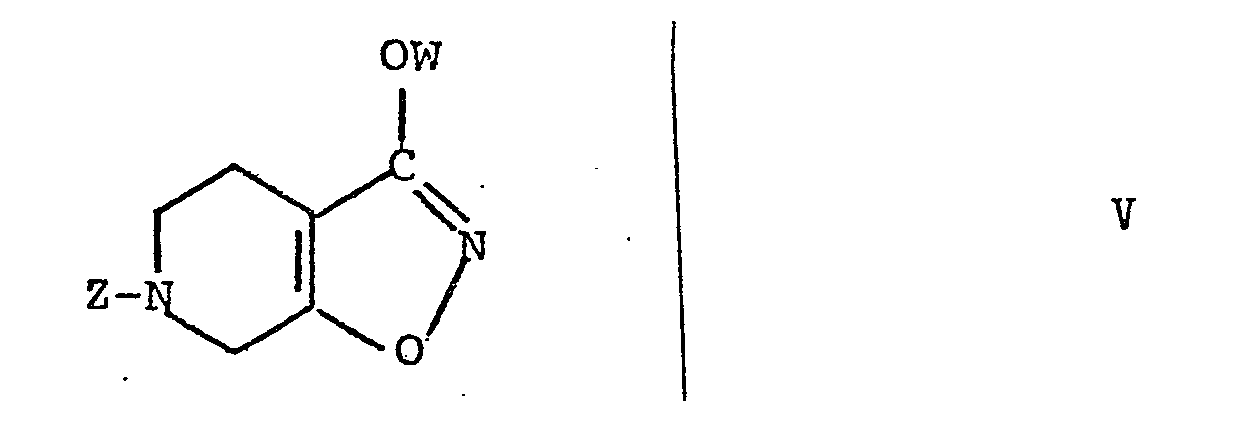
wherein Z is hydrogen or an amino-protecting group and W is hydrogen or a group removable to yield the free hydroxy group, with the proviso that at least one of Z and W is different from hydrogen.
wherein Z is hydrogen or an amino-protecting group and W is hydrogen or a group removable to yield the free hydroxy group, with the proviso that at least one of Z and W is different from hydrogen.