|
(11) | EP 0 029 719 B1 |

| (12) | EUROPEAN PATENT SPECIFICATION |
|
|
| (54) |
Vulcanizable rubber compositions inhibited from premature vulcanization by methylene thioethers, and novel methylene thioethers Methylen-Thioäther als Inhibitoren der vorzeitigen vulkanisation Vulkanisierbarer Kautschukzusammensetzungen und Methylen-Thioäther Méthylène-thioéthers comme inhibiteurs de vulcanisation prématurée de compositions vulcanisables de caoutchouc et méthylène-thioéthers |
|
|
|||||||||||||||||||||||||||||||
| Note: Within nine months from the publication of the mention of the grant of the European patent, any person may give notice to the European Patent Office of opposition to the European patent granted. Notice of opposition shall be filed in a written reasoned statement. It shall not be deemed to have been filed until the opposition fee has been paid. (Art. 99(1) European Patent Convention). |
[0001] This invention relates to improved vulcanizable rubber compositions inhibited from premature vulcanization by active methylene thioethers and to certain novel active methylene thioethers.
[0002] Sulfenamide inhibitors are especially potent for vulcanizable rubber compositions containing sulfenamide accelerators but are less effective when the accelerator is 2-mercaptobenzothiazole or bis-2-benzothiazolyl disulfide. Acid retarders reduce scorchiness of benzothiazole accelerated stocks by adversely affecting both the cure rate and the extent of cure. A study of the mechanism of retarders in rubber vulcanization led to a class of retarders consisting of hydrocarbylthio derivatives of trialkylsulfonyl methane, J. Appl. Poly. Sci., Vol. 16, pages 2647-2655 (1972). However, these retarders have not gained acceptance. Therefore, there is a need for more effective inhibitors for benzothiazole accelerated stocks.
SUMMARY OF THE INVENTION
[0003] It has now been discovered that vulcanizable rubber compositions are protected from premature vulcanization by di(thioethers) derived from activated methylene compounds in which the adjacent activating groups are either carbonyl or cyano. Thus, the inhibitors of the invention are either α,α-gem- disulfenated ketones or a,a-gem-disulfenated nitriles. The two activating groups adjacent to the methylene group may be two carbonyl groups, two cyano groups, or one carbonyl group and one cyano group.
[0004] Vulcanizable compositions of the invention comprise sulfur-vulcanizable rubber, sulfur-vulcanizing agent, organic vulcanization accelerating agent and, in an amount effective to inhibit premature vulcanization, a di(thioether) of the formulas
in which R is alkyl of 1-20 carbon atoms, cycloalkyl of 5-12 carbon atoms, benzyl, a-methylbenzyl, phenyl, or substituted phenyl wherein the substituents are lower alkyl, lower alkoxy, or halo, R1 is R or anilino or substituted anilino wherein the substituents are lower alkyl, lower alkoxy or halo, R2 is phenyl or substituted phenyl as above,
in which R is the same as above and X is o-phenylene or straight or branched alkylene of 2-4 chain carbon atoms,
in which R is the same as above, R3 is lower alkyl or lower alkoxy, and R4 is carboalkoxy of 1-5 carbon atoms or
or R4 may be lower alkyl provided that the vulcanization accelerating agent is 2-mercaptobenzothiazole, and --
in which R is the same as above and R5 is cyano, carboalkoxy of 1-5 carbon atoms, substituted carbamoyl of the formula
in which R6 is hydrogen or R, R7 is R or carboalkoxy of 1-5 carbon atoms, or R6 and R7 together is alkylene or oxydialkylene of 4-8 carbon atoms which along with the nitrogen atoms forms a heterocycle, or Rµ may be carbamoyl provided that the vulcanization accelerating agent is 2-mercaptobenzothiazole.
[0005] As indicated by the above provisos, inhibitors of Formula (III) wherein R4 is lower alkyl and inhibitors of Formula (IV) wherein R5 is unsubstituted carbamoyl are potent inhibitors when the accelerating agent is 2-mercaptobenzothiazole but are less effective and require high loadings to inhibit premature vulcanization of compositions containing other accelerators, for example, sulfenamide accelerators. This contrasts with the inhibitors of Formula (I) and (II) and the remaining inhibitors of Formulas (III) and (IV) which exhibit inhibitor activity at conventional loadings with all ordinary organic accelerating agents for sulfur vulcanization.
[0006] The term "lower" when referring to alkyl or alkoxy means a radical containing 1-5 carbon atoms. Preferred inhibitors of Formula (I) are derived from acetoacetanilide or α-benzoylacetanilide. Preferred inhibitors of Formula (II) are derived from 1,3-cyclohexanedione or 5,5-dialkyl-1,3-cyclohexanedione. More preferred inhibitors are compounds in which R is phenyl. Preferred inhibitors of Formula (IV) are compounds in which R5 is cyano, carbethoxy, carbomethoxy, carbethoxycarbamoyl or carbomethoxycarbamoyl.
[0007] Examples of satisfactory radicals for R are methyl, ethyl, propyl, isopropyl, n-butyl, sec.-butyl, isobutyl, pentyl, sec.-pentyl (1-methylbutyl), hexyl, heptyl, octyl, nonyl, decyl, dodecyl, eicosyl, cyclopentyl, cyclohexyl, 2-methylcyclohexyl, 4-methylcyclohexyl, cycloheptyl, cyclooctyl, cyclodecyl, cyclododecyl, 2-methylphenyl, 3-methylphenyl, 4-methylphenyl, 2-methyl-4-t-butylphenyl, 4-t-butylphenyl, 2,4,6-trimethylphenyl, 3-isopropylphenyl, 4-methoxyphenyl, 4-ethoxyphenyl, 4-chlorophenyl, and 2,4-dichlorophenyl. Hydrocarbon radicals are preferred. Preferred alkyl radicals are primary or secondary lower alkyl radicals of 1-5 carbon atoms.
[0008] Examples of satisfactory radicals for
are methylamino, ethylamino, propylamino, isopropylamino, butylamino, t-butylamino, cyclo- hexylamino, benzylamino, anilino, dimethylamino, diethylamino, dipropylamino, dicyclohexylamino, diphenylamino, pyrrolidinyl, piperidino, morpholino, 2,6-dimethylmorpholino, and hexahydro-1 H-azepine-1-yl.
[0009] The inhibitors of the invention are incorporated into rubber stocks by mixing on a mill or in an internal mixer such as a Banbury mixer. However, the inhibitors may be incorporated by addition to latex, if desired. The process of the invention is particularly applicable to sulfur-vulcanizable rubber compositions containing a sulfur vulcanizing agent such as an amine disulfide or a polymeric polysulfide but preferably, the vulcanizing agent is elemental sulfur (usually about 0.5-5 parts by weight of sulfur are used per 100 parts by weight of rubber). Rubber compositions containing organic accelerating agents are particularly improved by the inhibitors of the invention with compositions containing 2-mercaptobenzothiazole accelerator being preferred. Any organic accelerating agent in an amount effective (generally about 0.1-5 parts by weight accelerator per 100 parts by weight rubber) to accelerate the sulfur vulcanization of rubber is satisfactory in the practice of this invention. The inhibitors of the invention are effective with any sulfur-vulcanizable natural and synthetic rubber and mixtures thereof. Suitable accelerators and rubbers are described in U.S. Patent 3,546,185, Col. 9, lines 53-75, Col. 10, lines 15-21, and U.S. Patent 3,780,001, Col. 4, lines 43-72, Col. 5, lines 5-33, respectively, the disclosures of which are incorporated herein by reference. The vulcanizable composition may also contain conventional compounding ingredients such as reinforcing pigments, extenders, processing oils, antidegradants and the like.
[0010] Small amounts of inhibitors are effective to inhibit premature vulcanization. Improvements in processing safety may be observed with 0.05 parts or less of inhibitor per 100 parts rubber. Although there is no upper limit in the amount of inhibitor used, generally the amount does not exceed 5 parts inhibitor per 100 parts rubber. Typically, the amount of inhibitor added is about 0.1 to 2.5 parts per 100 parts rubber with amounts of about 0.2 to 1 parts of inhibitor per 100 parts rubber being commonly used. Methods for determining scorch times and curing characteristics of rubber stocks used in illustrating this invention are described in U.S. Patent 3,546,185, Col. 13, lines 30-53. Stress-strain properties are reported in megapascals (MPa).
[0011] One embodiment of the invention concerns novel compounds of the formulas
in which R is alkyl of 1-20 carbon atoms, cycloalkyl of 5-12 carbon atoms, benzyl, α-methylbenzyl, phenyl, or substituted phenyl wherein the substituents are lower alkyl, lower alkoxy, or halo, R1 is R or anilino or substituted anilino wherein the substituents are lower alkyl, lower alkoxy or halo, R2 is phenyl or substituted phenyl as above,
in which R is the same as above and X is o-phenylene or straight or branched alkylene of 2-4 chain carbon atoms,
in which R is the same as above, R3 is lower alkyl or lower alkoxy and R4 is carboalkoxy of 1-5 carbon atoms or
in which R is the same as above and R5 is carboalkoxy of 1-5 carbon atoms, substituted carbamoyl of the formula
in which R6 is hydrogen or R, R7 is R or carboalkoxy of 1-5 carbon atoms, or R6 and R7 together is alkylene or oxydialkylene of 4-8 carbon atoms which along with the nitrogen atoms forms a heterocycle. In preferred compounds of Formula (V), R1 is methyl or phenyl and R2 is phenyl. In preferred compounds of Formula (VIII), R5 is carboalkoxy or carboalkoxycarbamoyl. In more preferred compounds R is phenyl.
[0012] Certain inhibitors of the invention are known, for example, 3,3-diphenylthio-2,4-pentanedione and 2,2-diphenylthiomalononitrile are described in Bulletin of the Chemical Society of Japan, Vol. 45, 866-870 (1972). The synthesis methods described therein are suitable for preparing inhibitors of this invention. Alternatively, the inhibitors of the invention may be prepared by reacting a sulfenyl chloride with the appropriate active methylene compound. Preferably, the reaction is carried out in the presence of an acid acceptor such as triethylamine, pyridine, and piperidine. Examples of suitable active methylene compounds useful as intermediates are acetoacetanilide (N-phenyl-3-oxobutaneamide), benzoylacetanilide, bis(phenylcarbamoyl)methane, 1,3-cyclohexanedione, indandione, methylacetoacetate, diethyloxalacetate or sodium salt thereof, 2-cyanoacetamide, ethyl cyanoacetate, N-cyanoacetylurethane (ethyl-N-cyanoacetylcarbamate), N-methyl-2-cyanoacetamide, and 2-cyanoacetanilide. Other suitable intermediates are 1-cyanoacetylpyrrolidine, N-phenyl-3-oxo-pentaneamide, 2,4-pentanedione, 2,4-hexanedione, 3,5-heptanedione, 1,3-cyclopentanedione, 1,3-cyclo- heptanedione, 4-methylindandione, 5-methylindandione, ethylacetoacetate, propylacetoacetate, di- methyloxalacetate (dimethyl-2-oxo-butanedioate), dipropyloxalacetate, methyl cyanoacetate, propyl cyanoacetate, N-cyclohexylcyanoacetamide, 4-(cyanoacetyl)morpholine, N,N-dimethylcyanoacetamide, N,N-diphenylcyanoacetamide, N-methyl-N-phenylcyanoacetamide, 1-cyanoacetylpiperidine, methyl N-cyanoacetylcarbamate, propyl N-cyanoacetylcarbamate, bis(N-methylcarbamoyl)methane and dimethyl 1,3-acetonedicarboxylate.
[0013] Examples of inhibitors of the invention are a-acetyl-a,a-di(benzylthio)acetanilide, α-acetyl-α,α-di(butylthio)acetanilide, α-acetyl-α,α-di(cyclohexylthiolacetanilide, bis(phenylcarbamoyl)bis(isopropyl- thio)methane, bis(phenylcarbamoyl)bis(cyclohexylthio)methane, 2,2-di(phenylthio)-1,3-cyclopentanedione, 2,2-di(phenylthio)-1,3-cycloheptanedione, 2,2-di(isopropylthio)-1,3-cyclopentanedione, 2,2-di(isopropylthio)-1,3-cycloheptanedione, 2,2-di(cyclohexylthio)-indandione, 2,2-di-(isopropylthio)-indandione, 2,2-di(phenylthio)-N-phenyl-3-oxo-pentaneamide, 2,2-di(isopropylthio)-N-phenyl-3-oxo-pentaneamide, 2,2-dilcyclohexylthio)-N-phenyl-3-oxo-pentaneamide, 2,2-di-(benzylthio)-1,3-cyclohexanedione, bis(phenylcarbamoyl)bis(benzylthio)methane, 3,3-di(isopropyl- thio)-2,4-pentanedione, 3,3-di(phenylthio)-2,4-hexanedione, 4,4-di(phenylthio)-3,5-heptanedione, 2,2-di(benzylthio)indandione, 2,2-di(phenylthio)-4-methylindandione, 2,2-di(phenylthio)-5-methylindandione, ethyl a-acetyl-a,a-di(isopropylthio) acetate, propyl α-acetyl-α,α-di(isopropylthio)-acetate, dimethyl 2,2-di(phenylthio)oxalacetate, dipropyl 2,2-di(phenylthio)-oxalacetate, bis(phenylthio)bis(N-methylcarbamoyl)methane, bis(benzylthio)bis(N-methylcarbamoyl)methane, bis(isopropyl- thio)bis(N-methylcarbamoyl)methane, bis(cyclohexylthio)bis(N-methylcarbamoyl)methane, methyl di-(benzylthio)cyanoacetate methyl di(isopropylthio)cyanoacetate, methyl di(cyclohexylthio)cyanoacetamide, 4-(1,1-di[phenylthio]-1-cyanoacetyl)morpholine, N,N-dimethyl-2,2-di(phenylthio)cyanoacetamide, N,N-diphenyl-2,2-di(isopropylthio)cyanoacetamide, N-methyl-N-phenyl-2,2-di(phenylthio)-cyanoacetamide, methyl di(phenylthio)cyanoacetylcarbamate, methyl di(isopropylthio)-N-cyanoacetylcarbamate and dimethyl 1,1,3,3-tetra(isopropylthio)-1,3-acetonedicarboxylate.
PREFERRED EMBODIMENTS
[0014] Examples of inhibitors of the invention are prepared by the following typical procedure. A sulfenyl chloride solution is first prepared by conventional procedures by chlorination at about 0°C of a mercaptan in an appropriate solvent, for example, methylene chloride. A solution containing two molecular equivalents of a sulfenyl chloride is then added at 0-25°C with stirring to a solution containing one molecular equivalent of an active methylene compound, 2.2 molecular equivalents of an acid acceptor, for example, triethylamine, and an appropriate solvent, for example, methylene chloride. The reaction mixture is then stirred for 30-60 minutes. Recovery and purification of the product are conventional. The reaction mixture is then washed with water to remove amine salt by-product. In the case of insoluble products, the solid product is then recovered by filtration. In the case of soluble products, the organic layer is dried over sodium sulfate, filtered and the filtrate is evaporated to recover the product. The product is then recrystallized from an appropriate solvent, for example, ethanol. Identification of the products is confirmed by one or more analyses consisting of elemental, infrared and nuclear magnetic spectral analyses.
[0016] The invention is illustrated by incorporating inhibitors of the invention into the following natural rubber masterbatch.
[0017] Vulcanizable compositions are prepared by incorporation of accelerator and sulfur. Compositions of the invention are prepared by incorporating inhibitors in the indicated quantities into the vulcanizable compositions. Compositions containing no inhibitors are controls. The results are shown in Tables 5-12.
[0018] In Table 5, the vulcanizable rubber composition comprises 158 parts of natural rubber masterbatch, 2 parts of N-(1,3-dimethylbutyl)-N'-(phenyl)-p-phenylenediamine (Santoflex 13 anti- degradant), 0.5 parts of N-(t-butyl)benzothiazolesulfenamide (Santocure NS accelerator) and 2.5 parts of sulfur. All parts are by weight. Stock 1 is a control containing no inhibitor. Stocks 2-10 contain 1 part of inhibitor.
[0019] The data show that a,a-gem-disulfenated derivatives of acetoacetanilide and benzoylacetanilide impart processing safety to the vulcanizable compositions as shown by the increase in scorch delay. The data further indicate that the phenyl and isopropyl compounds exhibit greater activity and that the benzoylacetanilide compound is especially potent.
[0020] Vulcanizable compositions containing 2-mercaptobenzothiazole as the vulcanization accelerator are illustrated in Tables 6 and 7. The data show that the inhibitors substantially enhance the scorch safety of the compositions and, in addition, increase the cure rate and the tensile strength. The data of Stocks 5-9 of Table 6 show that the amount of scorch delay is essentially directly proportional to the quantity of inhibitor used.
[0021] Vulcanizable rubber compositions containing different accelerators are shown in Table 8. The data indicate that the inhibitor of the invention is especially potent in the composition in which the accelerator is the amine salt of 2-mercaptobenzothiazole.
[0022] Inhibitors of the invention derived from cyclic diones are illustrated in Table 9. The data indicate the phenyl derivatives are more active.
[0023] Inhibitors of the invention derived from oxalacetate ester, acetoacetate ester, 2,4-pentanedione and indandione are illustrated in Table 10. The data show that the inhibitors exhibit substantial prevulcanization inhibitor activity in compositions in which the accelerator is 2-mercaptobenzothiazole. In other experiments, not shown, a,a-di(phenylthio) derivatives of diethyloxalacetate, 2,4-pentanedione, and methylacetoacetate at comparable loadings exhibit little or no activity in vulcanizable rubber compositions containing sulfenamide accelerators.
[0024] Inhibitors of the invention derived from cyano containing active methylene compounds are illustrated in Tables 11 and 12. The data of Table 11 indicate that the 2,2-di(phenylthio)malononitrile' and N-(cyanodi[phenylthio])urethane are especially potent. The data of Table 12 show that derivatives of 2-cyanoacetamide and 2-cyanoacetanilide exhibit good activity and that the isopropyl derivatives are better.
[0025] Inhibitors derived from diethyl 1,3-acetonedicarboxylate are illustrated in Table 13. Stocks 1-3 contain 2-mercaptobenzothiazole as accelerator. Stocks 4-6 contain a sulfenamide accelerator. Stocks 1 and 4 are controls containing no inhibitor. The data show that the phenylthio derivative is more potent than the corresponding cyclohexylthio derivative.
1. A vulcanizable composition comprising sulfur-vulcanizable rubber, sulfur-vulcanizing
agent, organic vulcanization accelerating agent and, in an amount effective to inhibit
premature vulcanization, an inhibitor of the formula

in which R is alkyl of 1-20 carbon atoms, cycloalkyl of 5-12 carbon atoms, benzyl, a-methylbenzyl, phenyl, or substituted phenyl wherein the substituents are lower alkyl, lower alkoxy, or halo, R1 is R or anilino or substituted anilino wherein the substituents are lower alkyl, lower alkoxy or halo, and R2 is phenyl or substituted phenyl as above,
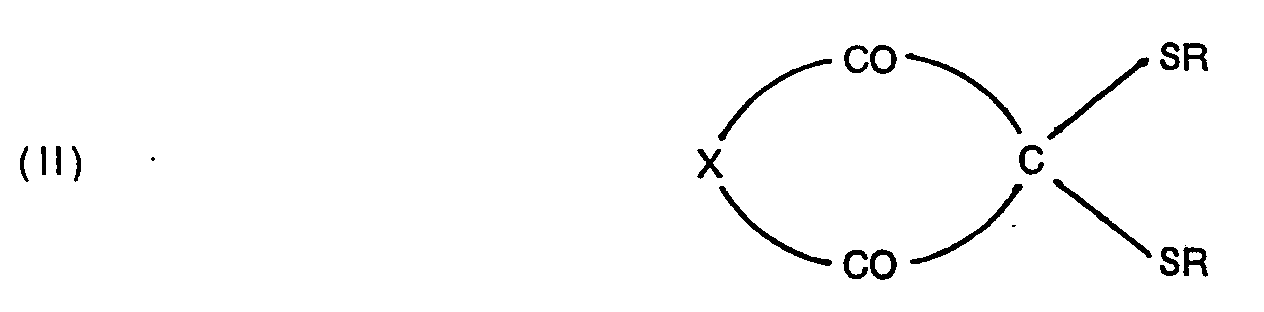
in which R is the same as above and X is o-phenylene or straight or branched alkylene of 2-4 chain carbon atoms,
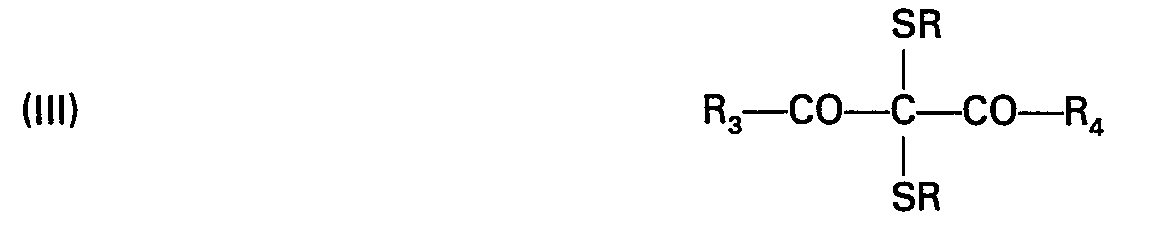
in which R is the same as above, R3 is lower alkyl or lower alkoxy, and R4 is carboalkoxy of 1-5 carbon atoms or
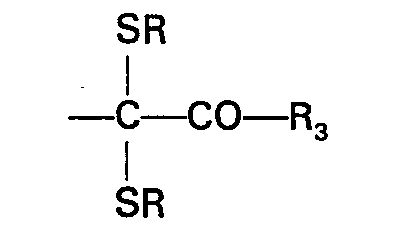
or R4 may be lower alkyl provided that the vulcanization accelerating agent is 2-mercaptobenzothiazole, or
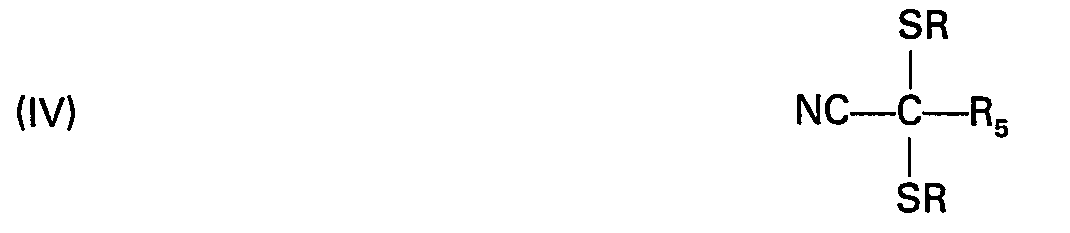
in which R is the same as above and R5 is cyano, carboalkoxy of 1-5 carbon atoms, substituted carbamoyl of the formula
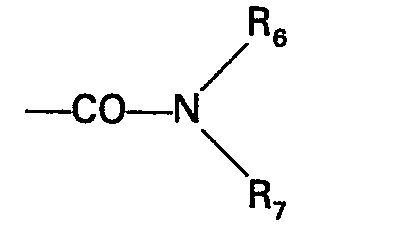
in which R6 is hydrogen or R, R7 is R or carboalkoxy of 1-5 carbon atoms, or R6 and R7 together is alkylene or oxydialkylene of 4-8 carbon atoms which along with the nitrogen atom forms a heterocycle, or R5 may be carbamoyl provided that the vulcanization accelerating agent is 2-mercaptobenzothiazole.
in which R is alkyl of 1-20 carbon atoms, cycloalkyl of 5-12 carbon atoms, benzyl, a-methylbenzyl, phenyl, or substituted phenyl wherein the substituents are lower alkyl, lower alkoxy, or halo, R1 is R or anilino or substituted anilino wherein the substituents are lower alkyl, lower alkoxy or halo, and R2 is phenyl or substituted phenyl as above,
in which R is the same as above and X is o-phenylene or straight or branched alkylene of 2-4 chain carbon atoms,
in which R is the same as above, R3 is lower alkyl or lower alkoxy, and R4 is carboalkoxy of 1-5 carbon atoms or
or R4 may be lower alkyl provided that the vulcanization accelerating agent is 2-mercaptobenzothiazole, or
in which R is the same as above and R5 is cyano, carboalkoxy of 1-5 carbon atoms, substituted carbamoyl of the formula
in which R6 is hydrogen or R, R7 is R or carboalkoxy of 1-5 carbon atoms, or R6 and R7 together is alkylene or oxydialkylene of 4-8 carbon atoms which along with the nitrogen atom forms a heterocycle, or R5 may be carbamoyl provided that the vulcanization accelerating agent is 2-mercaptobenzothiazole.
2. A composition of Claim 1 in which the rubber is a diene rubber and the vulcanizing
agent is elemental sulfur.
3. A composition of Claim 2 comprising, per 100 parts by weight of rubber, 0.5-5 parts
by weight sulfur, 0.1-5 parts by weight of accelerating agent, and 0.1 to 2.5 parts
by weight of inhibitor.
4. A composition of any of Claims 1 to 3 comprising an inhibitor of Formula (I), in
which R is lower alkyl, cycloalkyl of 5-8 carbon atoms, benzyl or phenyl, R1 is lower alkyl, phenyl or anilino and Rz is phenyl.
5. A composition of Claim 4 in which R1 is methyl.
6. A composition of Claim 5 in which R is isopropyl, phenyl or cyclohexyl.
7. A composition of any of Claims 1 to 3 comprising an inhibitor of Formula (11) in
which R is lower alkyl, cycloalkyl of 5-8 carbon atoms, benzyl or phenyl and X is
o-phenylene or 1,3-propylene.
8. A composition of Claim 7 in which R is cyclohexyl.
9. A composition of any of Claims 1 to 3 comprising an inhibitor of Formula (III)
in which R is lower alkyl, cycloalkyl of 5-8 carbon atoms, benzyl or phenyl.
10. A composition of any of Claims 1 to 9 in which the accelerating agent is 2-mercaptobenzothiazole.
11. A compound of the formula

in which R is alkyl of 1-20 carbon atoms, cycloalkyl of 5-12 carbon atoms, benzyl, α-methylbenzyl, phenyl, or substituted phenyl wherein the substituents are lower alkyl, lower alkoxy, or halo, R1 is R or anilino or substituted anilino wherein the substituents are lower alkyl, lower alkoxy or halo, and R2 is phenyl or substituted phenyl as above,
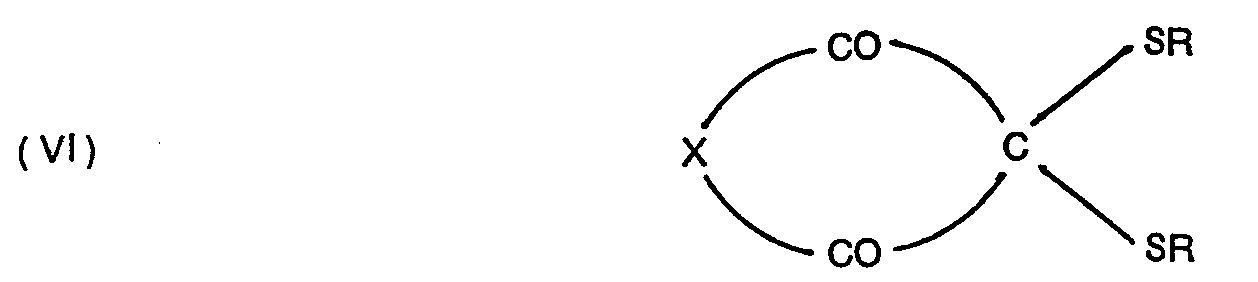
in which R is the same as above and X is o-phenylene or straight or branched alkylene of 2-4 chain carbon atoms.
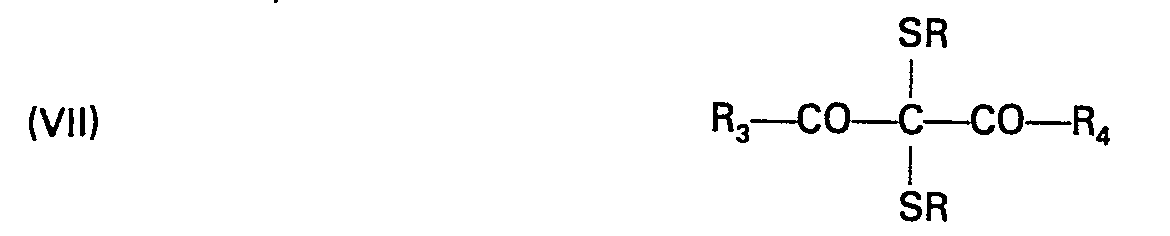
in which R is the same as above, R3 is lower alkyl or lower alkoxy, and R4 is carboalkoxy of 1-5 carbon atoms or
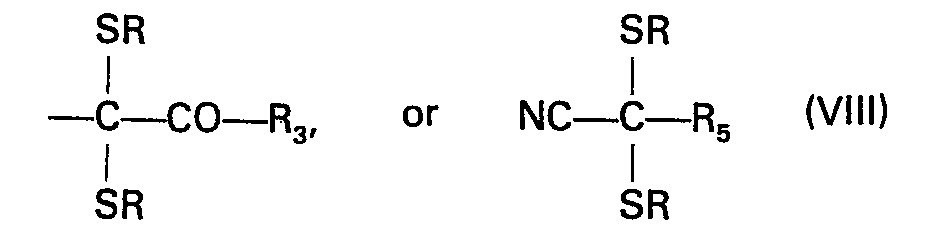
in which R is the same as above and R5 is carboalkoxy of 1-5 carbon atoms, substituted carbamoyl of the formula
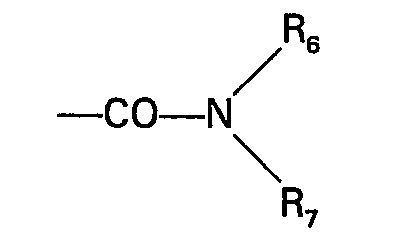
in which R6 is hydrogen or R, R7 is R or carboalkoxy of 1-5 carbon atoms, or R6 and R7 together is alkylene or oxydialkylene of 4-8 carbon atoms which along with the nitrogen atom forms a heterocycle.
in which R is alkyl of 1-20 carbon atoms, cycloalkyl of 5-12 carbon atoms, benzyl, α-methylbenzyl, phenyl, or substituted phenyl wherein the substituents are lower alkyl, lower alkoxy, or halo, R1 is R or anilino or substituted anilino wherein the substituents are lower alkyl, lower alkoxy or halo, and R2 is phenyl or substituted phenyl as above,
in which R is the same as above and X is o-phenylene or straight or branched alkylene of 2-4 chain carbon atoms.
in which R is the same as above, R3 is lower alkyl or lower alkoxy, and R4 is carboalkoxy of 1-5 carbon atoms or
in which R is the same as above and R5 is carboalkoxy of 1-5 carbon atoms, substituted carbamoyl of the formula
in which R6 is hydrogen or R, R7 is R or carboalkoxy of 1-5 carbon atoms, or R6 and R7 together is alkylene or oxydialkylene of 4-8 carbon atoms which along with the nitrogen atom forms a heterocycle.
12. A compound of Claim 11 of Formula (V) in which R is lower alkyl, cyclohexyl, benzyl,
or phenyl, R1 is lower alkyl, phenyl, or anilino, and R2 is phenyl.
13. A compound of Claim 12 in which R1 is methyl.
14. A compound of Claim 13 in which R is isopropyl or phenyl.
15. A compound of Claim 12 in which R1 is phenyl and R is isopropyl or phenyl.
16. A compound of Claim 11 of Formula (VI) in which R is lower alkyl, cyclohexyl,
benzyl, or phenyl and X is o-phenylene.
17. A compound of Claim 11 of Formula (VII) in which R is lower alkyl, cyclohexyl,
benzyl or phenyl, and R3 is methoxy or ethoxy.
18. A compound of Claim 11 of Formula (VIII) in which R is lower alkyl, cyclohexyl,
benzyl, or phenyl and R5 is carboalkoxy of 1-5 carbon atoms.
19. A compound of Claim 18 in which R is lower alkyl, cyclohexyl, benzyl, or phenyl
and R5 is substituted carbamoyl in which R6 is hydrogen and R7 is phenyl or carboalkoxy of 1-5 carbon atoms.
1. Vulkanisierbare Masse enthaltend mit Schwefel vulkanisierbaren Kautschuk, schwefelhaltiges
Vulkanisiermittel, organischen Vulkanisationsbeschleuniger und eine zur Inhibierung
der vorzeitigen Vulkanisation wirksame Menge eines Inhibitors der Formel

in der R Alkylgruppen mit 1 bis 20 Kohlenstoffatomen, Cycloalkylgruppen mit 5 bis 12 Kohlenstoffatomen, Benzylgruppen, a-Methylbenzylgruppen, Phenylgruppen oder substituierte Phenylgruppen, worin die Substituenten niedrigmolekulare Alkylgruppen, niedrigmolekulare Alkoxygruppen oder Halogenatome darstellen, bedeutet, R1 die Bedeutungen von R besitzt oder eine Anilinogruppe oder eine substituierte Anilinogruppe darstellt, worin die Substituenten niedrigmolekulare Alkylgruppen, niedrigmolekulare Alkoxygruppen oder Halogenatome darstellen, und R2 eine Phenylgruppe oder eine substituierte Phenylgruppe der obigen Definition bedeutet,
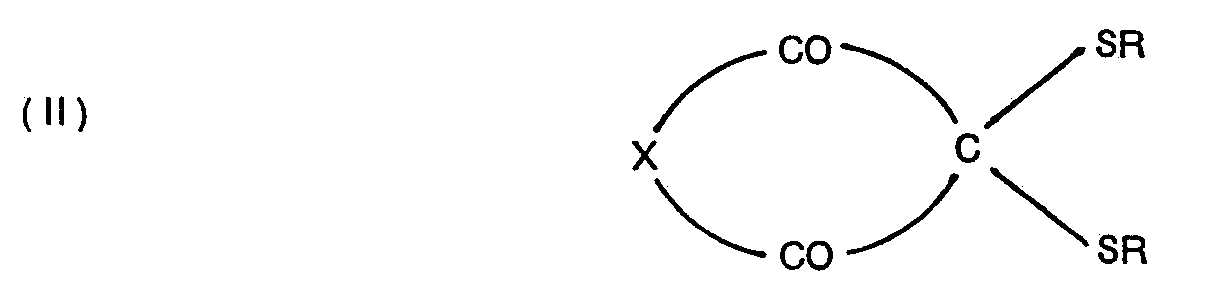
in der R die oben angegebenen Bedeutungen besitzt und X für eine o-Phenylengruppe oder eine geradkettige oder verzweigte Alkylengruppe mit 2 bis 4 Kettenkohlenstoffatomen steht,
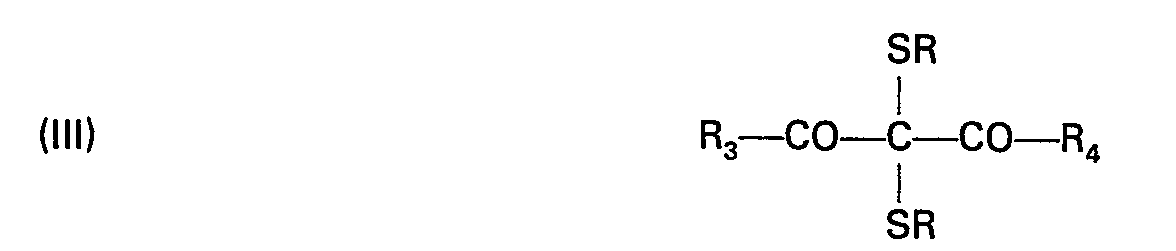
in der R die oben angegebenen Bedeutungen besitzt, R3 eine niedrigmolekulare Alkylgruppe oder eine niedrigmolekulare Alkoxygruppe und R4 eine Carbalkoxygruppe mit 1 bis 5 Kohlenstoffatomen oder eine Gruppe der Formel
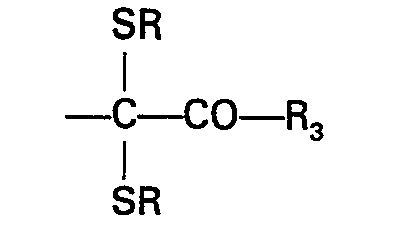
oder R4 eine niedrigmolekulare Alkylgruppe mit der Maßgabe, daß der Vulkanisationsbeschleuniger 2-Mercaptobenzothiazol ist, bedeuten, oder
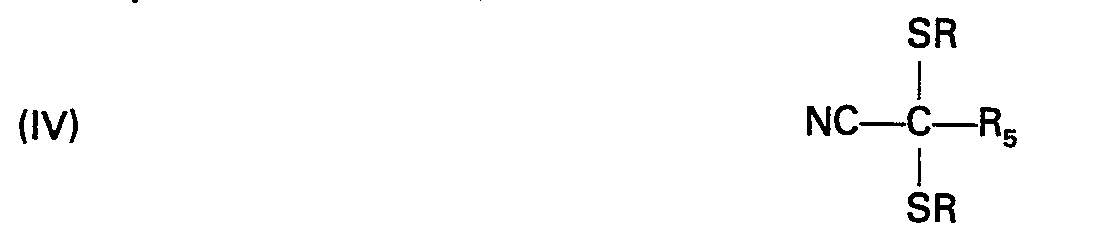
in der R die oben angegebenen Bedeutungen besitzt und R5 eine Cyanogruppe, eine Carbalkoxygruppe mit 1 bis 5 Kohlenstoffatomen, eine substituierte Carbamoylgruppe der Formel
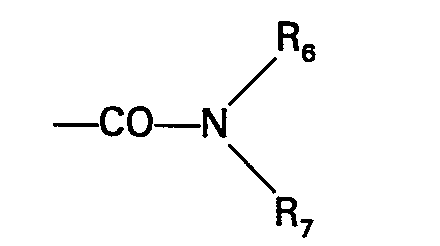
worin R6 für ein Wasserstoffatom steht oder die Bedeutungen von R besitzt, R7 die Bedeutungen von R besitzt oder eine Carbalkoxygruppe mit 1 bis 5 Kohlenstoffatomen darstellt, oder R6 und R7 gemeinsam eine Alkylengruppe oder eine Oxydialkylengruppe mit 4 bis 8 Kohlenstoffatomen, die zusammen mit dem Stickstoffatom einen Heterozyklus bildet, darstellen, oder R5 eine Carbamoylgruppe mit der Maßgabe, daß der Vulkanisationsbeschleuniger 2-Mercaptobenzothiazol ist, bedeutet.
in der R Alkylgruppen mit 1 bis 20 Kohlenstoffatomen, Cycloalkylgruppen mit 5 bis 12 Kohlenstoffatomen, Benzylgruppen, a-Methylbenzylgruppen, Phenylgruppen oder substituierte Phenylgruppen, worin die Substituenten niedrigmolekulare Alkylgruppen, niedrigmolekulare Alkoxygruppen oder Halogenatome darstellen, bedeutet, R1 die Bedeutungen von R besitzt oder eine Anilinogruppe oder eine substituierte Anilinogruppe darstellt, worin die Substituenten niedrigmolekulare Alkylgruppen, niedrigmolekulare Alkoxygruppen oder Halogenatome darstellen, und R2 eine Phenylgruppe oder eine substituierte Phenylgruppe der obigen Definition bedeutet,
in der R die oben angegebenen Bedeutungen besitzt und X für eine o-Phenylengruppe oder eine geradkettige oder verzweigte Alkylengruppe mit 2 bis 4 Kettenkohlenstoffatomen steht,
in der R die oben angegebenen Bedeutungen besitzt, R3 eine niedrigmolekulare Alkylgruppe oder eine niedrigmolekulare Alkoxygruppe und R4 eine Carbalkoxygruppe mit 1 bis 5 Kohlenstoffatomen oder eine Gruppe der Formel
oder R4 eine niedrigmolekulare Alkylgruppe mit der Maßgabe, daß der Vulkanisationsbeschleuniger 2-Mercaptobenzothiazol ist, bedeuten, oder
in der R die oben angegebenen Bedeutungen besitzt und R5 eine Cyanogruppe, eine Carbalkoxygruppe mit 1 bis 5 Kohlenstoffatomen, eine substituierte Carbamoylgruppe der Formel
worin R6 für ein Wasserstoffatom steht oder die Bedeutungen von R besitzt, R7 die Bedeutungen von R besitzt oder eine Carbalkoxygruppe mit 1 bis 5 Kohlenstoffatomen darstellt, oder R6 und R7 gemeinsam eine Alkylengruppe oder eine Oxydialkylengruppe mit 4 bis 8 Kohlenstoffatomen, die zusammen mit dem Stickstoffatom einen Heterozyklus bildet, darstellen, oder R5 eine Carbamoylgruppe mit der Maßgabe, daß der Vulkanisationsbeschleuniger 2-Mercaptobenzothiazol ist, bedeutet.
2. Masse nach Anspruch 1, worin der Kautschuk ein Dienkautschuk und das Vulkanisiermittel
elementarer Schwefel sind.
3. Masse nach Anspruch 2, enthaltend pro 100 Gew.-Teile Kautschuk 0,5 bis 5 Gew.-Teile
Schwefel, 0,1 bis 5 Gew.-Teile Beschleuniger und 0,1 bis 2,5 Gew.-Teile Inhibitor.
4. Masse nach einem der Ansprüche 1 bis 3, enthaltend einen Inhibitor der Formel (1),
worin R niedrigmolekulare Alkylgruppen, Cycloalkylgruppen mit 5 bis 8 Kohlenstoffatomen,
Benzylgruppen oder Phenylgruppen, R1 eine niedrigmolekulare Alkylgruppe, eine Phenylgruppe oder eine Anilinogruppe und
R2 eine Phenylgruppe bedeuten.
5. Masse nach Anspruch 4, worin R1 eine Methylgruppe darstellt.
6. Masse nach Anspruch 5, worin R Isopropylgruppen, Phenylgruppen oder Cyclohexylgruppen
bedeutet.
7. Masse nach einem der Ansprüche 1 bis 3, enthaltend einen Inhibitor der Formel (II),
worin R niedrigmolekulare Alkylgruppen, Cycloalkylgruppen mit 5 bis 8 Kohlenstoffatomen,
Benzylgruppen oder Phenylgruppen und X eine o-Phenylengruppe oder eine 1,3-Propylengruppe
bedeuten.
8. Masse nach Anspruch 7, worin R eine Cyclohexylgruppe darstellt.
9. Masse nach einem der Ansprüche 1 bis 3, enthaltend einen Inhibitor der Formel (III),
in der R niedrigmolekulare Alkylgruppen, Cycloalkylgruppen mit 5 bis 8 Kohlenstoffatomen,
Benzylgruppen oder Phenylgruppen bedeutet.
10. Masse nach einem der Ansprüche 1 bis 9, worin der Beschleuniger 2-Mercaptobenzothiazol
ist.
11. Verbindung der Formel

in der R Alkylgruppen mit 1 bis 20 Kohlenstoffatomen, Cycloalkylgruppen mit 5 bis 12 Kohlenstoffatomen, Benzylgruppen, α-Methylbenzylgruppen, Phenylgruppen oder substituierte Phenylgruppen, worin die Substituenten niedrigmolekulare Alkylgruppen, niedrigmolekulare Alkoxygruppen oder Halogenatome darstellen, bedeutet, R, die Bedeutungen von R besitzt oder eine Anilinogruppe oder eine substituierte Anilinogruppe, worin die Substituenten niedrigmolekulare Alkylgruppen, niedrigmolekulare Alkoxygruppen oder Halogenatome darstellen, bedeutet und Rz eine Phenylgruppe oder eine substituierte Phenylgruppe der oben definierten Art darstellt,
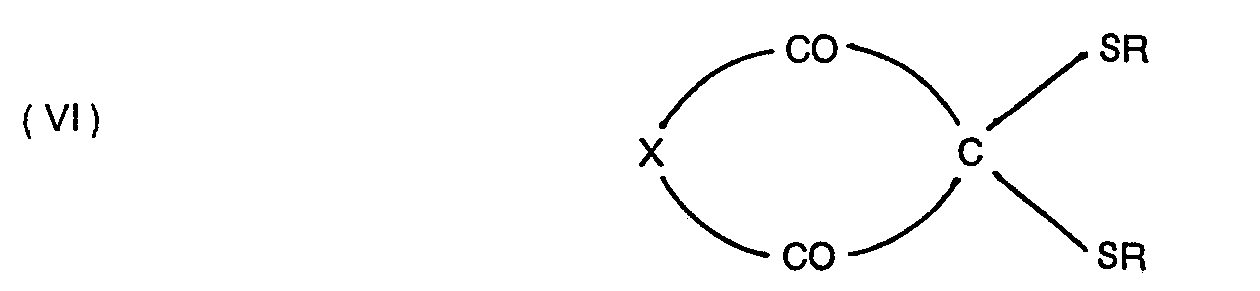
worin R die oben angegebenen Bedeutungen besitzt und X eine o-Phenylengruppe oder eine geradkettige oder verzweigte Alkylengruppe mit 2 bis 4 Kettenkohlenstoffatomen darstellt,
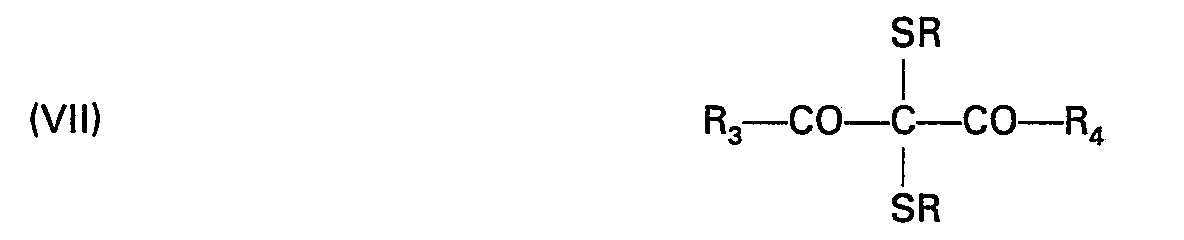
in der R die oben angegebenen Bedeutungen besitzt, R3 eine niedrigmolekulare Alkylgruppe oder eine niedrigmolekulare Alkoxygruppe darstellt und R4 eine Carbalkoxygruppe mit 1 bis 5 Kohlenstoffatomen oder eine Gruppe der Formel
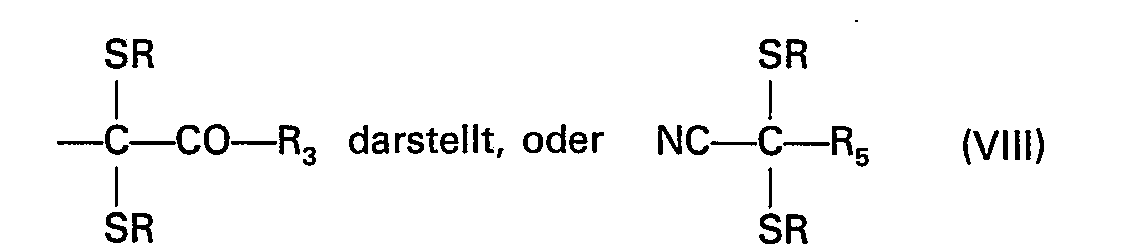
in der R die oben angegebenen Bedeutungen besitzt und R5 eine Carbalkoxygruppe mit 1 bis 5 Kohlenstoffatomen, eine subtituierte Carbamoylgruppe der Formel
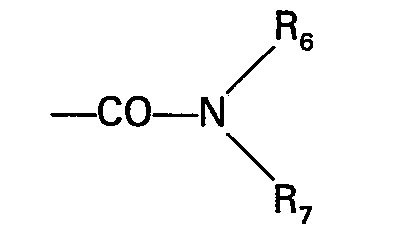
worin R6 ein Wasserstoffatom darstellt oder die Bedeutungen von R besitzt, R7 die Bedeutungen von R besitzt oder eine Carbalkoxygruppe mit 1 bis 5 Kohlenstoffatomen darstellt oder R6 und R7 gemeinsam eine Alkylengruppe oder eine Oxydialkylengruppe mit 4 bis 8 Kohlenstoffatomen bedeuten, die zusammen mit dem Stickstoffatom einen Heterozyklus bilden.
in der R Alkylgruppen mit 1 bis 20 Kohlenstoffatomen, Cycloalkylgruppen mit 5 bis 12 Kohlenstoffatomen, Benzylgruppen, α-Methylbenzylgruppen, Phenylgruppen oder substituierte Phenylgruppen, worin die Substituenten niedrigmolekulare Alkylgruppen, niedrigmolekulare Alkoxygruppen oder Halogenatome darstellen, bedeutet, R, die Bedeutungen von R besitzt oder eine Anilinogruppe oder eine substituierte Anilinogruppe, worin die Substituenten niedrigmolekulare Alkylgruppen, niedrigmolekulare Alkoxygruppen oder Halogenatome darstellen, bedeutet und Rz eine Phenylgruppe oder eine substituierte Phenylgruppe der oben definierten Art darstellt,
worin R die oben angegebenen Bedeutungen besitzt und X eine o-Phenylengruppe oder eine geradkettige oder verzweigte Alkylengruppe mit 2 bis 4 Kettenkohlenstoffatomen darstellt,
in der R die oben angegebenen Bedeutungen besitzt, R3 eine niedrigmolekulare Alkylgruppe oder eine niedrigmolekulare Alkoxygruppe darstellt und R4 eine Carbalkoxygruppe mit 1 bis 5 Kohlenstoffatomen oder eine Gruppe der Formel
in der R die oben angegebenen Bedeutungen besitzt und R5 eine Carbalkoxygruppe mit 1 bis 5 Kohlenstoffatomen, eine subtituierte Carbamoylgruppe der Formel
worin R6 ein Wasserstoffatom darstellt oder die Bedeutungen von R besitzt, R7 die Bedeutungen von R besitzt oder eine Carbalkoxygruppe mit 1 bis 5 Kohlenstoffatomen darstellt oder R6 und R7 gemeinsam eine Alkylengruppe oder eine Oxydialkylengruppe mit 4 bis 8 Kohlenstoffatomen bedeuten, die zusammen mit dem Stickstoffatom einen Heterozyklus bilden.
12. Verbindung nach Anspruch 11 der Formel (V), in der R niedrigmolekulare Alkylgruppen,
Cyclohexylgruppen, Benzylgruppen oder Phenylgruppen, R1 eine niedrigmolekulare Alkylgruppe, eine Phenylgruppe oder eine Anilinogruppe und
R2 eine Phenylgruppe bedeuten.
13. Verbindung nach Anspruch 12, worin R1 eine Methylgruppe darstellt.
14. Verbindung nach Anspruch 13, worin R Isopropylgruppen oder Phenylgruppen darstellt.
15. Verbindung nach Anspruch 12, worin R1 eine Phenylgruppe und R Isopropylgruppen oder Phenylgruppen bedeuten.
16. Verbindung nach Anspruch 11 der Formel (VI), in der R niedrigmolekulare Alkylgruppen,
Cyclohexylgruppen, Benzylgruppen oder Phenylgruppen und X eine o-Phenylengruppe bedeuten.
17. Verbindung nach Anspruch 11 der Formel (VII), in der R niedrigmolekulare Alkylgruppen,
Cyclohexylgruppen, Benzylgruppen oder Phenylgruppen und R3 eine Methoxygruppe oder eine Ethoxygruppe bedeuten.
18. Verbindung nach Anspruch 12 der Formel (VIII), in der R niedrigmolekulare Alkylgruppen,
Cyclohexylgruppen, Benzylgruppen oder Phenylgruppen und R5 eine Carbalkoxygruppe mit 1 bis 5 Kohlenstoffatomen bedeuten.
19. Verbindung nach Anspruch 18, worin R niedrigmolekulare Alkylgruppen, Cyclohexylgruppen,
Benzylgruppen oder Phenylgruppen und Rs eine substituierte Carbamoylgruppe, in der R6 ein Wasserstoffatom und R7 eine Phenylgruppe oder eine Carbalkoxygruppe mit 1 bis 5 Kohlenstoffatomen darstellen,
bedeuten.
1. Composition vulcanisable comprenant du caoutchouc vulcanisable au soufre, un agent
de vulcanisation par le soufre, un agent organique d'accélération de vulcanisation
et, en quantité efficace pour inhiber la vulcanisation prématurée, un inhibiteur ayant
la formule:
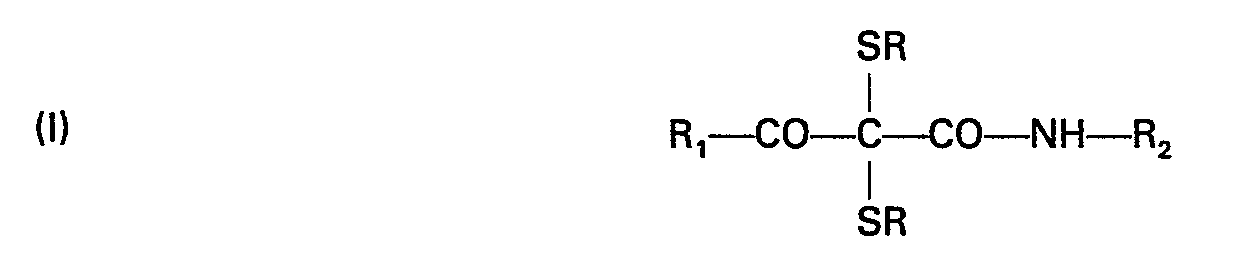
où R est un groupe alkyle ayant 1-20 atomes de carbone, cycloalkyle ayant 5-12 atomes de carbone, benzyle, α-méthylbenzyle, phényle ou phényle substitué où les substituants sont un groupe alkyle inférieur, alcoxy inférieur ou halo, R1 est R ou un groupe anilino ou anilino substitué où les substituants sont un groupe alkyle inférieur, alcoxy inférieur ou halo, et Rz est le groupe phényle ou un groupe phényle substitué comme ci-dessus,
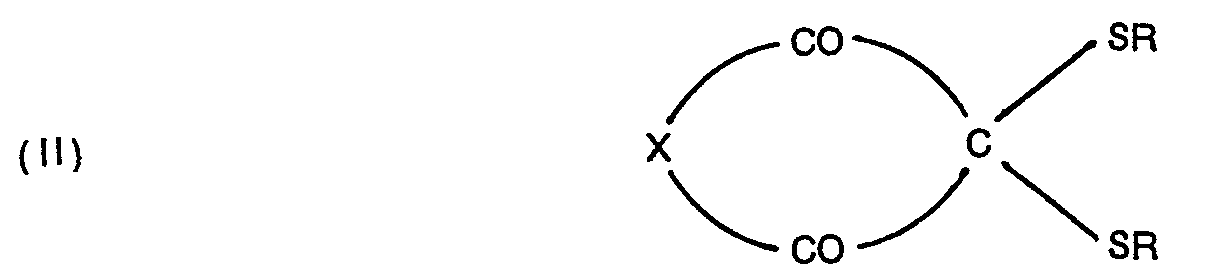
où R est le même que ci-dessus et X est le groupe o-phénylène ou un groupe alkylène à chaîne droite ou ramifiée ayant 2-4 atomes de carbone,
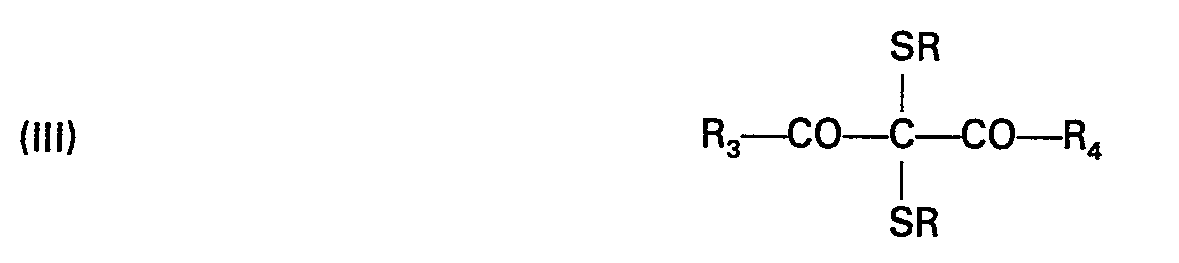
où R est le même que ci-dessus, R3 est un groupe alkyle inférieur ou alcoxy inférieur, et R4 est un groupe carboalcoxy ayant 1―5 atomes de carbone ou
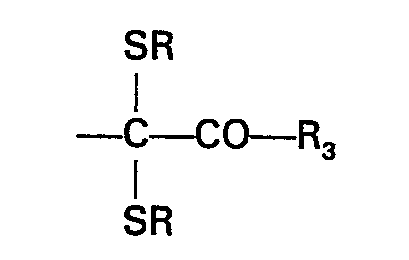
ou bien R4 peut être un groupe alkyle inférieur, pourvu que l'agent d'accélération de vulcanisation soit le 2-mercaDtobenzothiazole, ou

où R est le même que ci-dessus et Rs est le groupe cyano, carboalcoxy ayant 1-5 atomes de carbone, carbamoyle substitué ayant la formule:
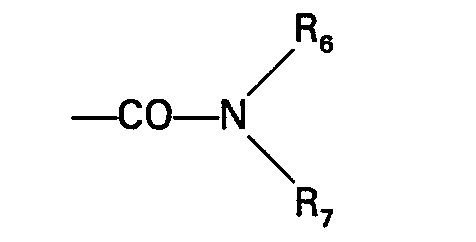
où R6 est l'hydrogène ou R, R7 est R ou un groupe carboalcoxy ayant 1-5 atomes de carbone, ou bien R6 et R7 ensemble constituent un groupe alkylène ou oxydialkylène ayant 4-8 atomes de carbone qui, avec l'atome d'azote, forme un hétérocycle, ou R5 peut être un groupe carbamoyle pourvu que l'agent d'accélération de vulcanisation soit le 2-mercaptobenzothiazole.
où R est un groupe alkyle ayant 1-20 atomes de carbone, cycloalkyle ayant 5-12 atomes de carbone, benzyle, α-méthylbenzyle, phényle ou phényle substitué où les substituants sont un groupe alkyle inférieur, alcoxy inférieur ou halo, R1 est R ou un groupe anilino ou anilino substitué où les substituants sont un groupe alkyle inférieur, alcoxy inférieur ou halo, et Rz est le groupe phényle ou un groupe phényle substitué comme ci-dessus,
où R est le même que ci-dessus et X est le groupe o-phénylène ou un groupe alkylène à chaîne droite ou ramifiée ayant 2-4 atomes de carbone,
où R est le même que ci-dessus, R3 est un groupe alkyle inférieur ou alcoxy inférieur, et R4 est un groupe carboalcoxy ayant 1―5 atomes de carbone ou
ou bien R4 peut être un groupe alkyle inférieur, pourvu que l'agent d'accélération de vulcanisation soit le 2-mercaDtobenzothiazole, ou
où R est le même que ci-dessus et Rs est le groupe cyano, carboalcoxy ayant 1-5 atomes de carbone, carbamoyle substitué ayant la formule:
où R6 est l'hydrogène ou R, R7 est R ou un groupe carboalcoxy ayant 1-5 atomes de carbone, ou bien R6 et R7 ensemble constituent un groupe alkylène ou oxydialkylène ayant 4-8 atomes de carbone qui, avec l'atome d'azote, forme un hétérocycle, ou R5 peut être un groupe carbamoyle pourvu que l'agent d'accélération de vulcanisation soit le 2-mercaptobenzothiazole.
2. Composition selon la revendication 1, dans laquelle le caoutchouc est un caoutchouc
diénique et l'agent de vulcanisation est du soufre élémentaire.
3. Composition selon la revendication 2, comprenant pour 100 parties en poids de caoutchouc,
0,5-5 parties en poids de soufre, 0,1-5 parties en poids d'agent d'accélération, et
0,1 à 2,5 parties en poids d'inhibiteur.
4. Composition selon l'une quelconque des revendications 1 à 3, comprenant un inhibiteur
de formule (1), où R est un groupe alkyle inférieur, cycloalkyle ayant 5-8 atomes
de carbone, benzyle ou phényle, R1 est un groupe alkyle inférieur, phényle ou anilino et R2 est le groupe phényle.
5. Composition selon la revendication 4, dans laquelle R1 est le groupe méthyle.
6. Composition selon la revendication 5, dans laquelle R est le groupe isopropyle,
phényle ou cyclohexyle.
7. Composition selon l'une quelconque des revendications 1 à 3, comprenant un inhibiteur
de formule (II) où R est un groupe alkyle inférieur, cycloalkyle ayant 5-8 atomes
de carbone, benzyle ou phényle et X est le groupe o-phénylène ou 1,3-propylène.
8. Composition selon la revendication 7, dans laquelle R est le groupe cyclohexyle.
9. Composition selon l'une quelconque des revendications 1 à 3 comprenant un inhibiteur
de formule (III) où R est un groupe alkyle inférieur, cycloalkyle ayant 5-8 atomes
de carbone, benzyle ou phényle.
10. Composition selon l'une quelconque des revendications 1 à 9 dans laquelle l'agent
d'accélération est le 2-mercaptobenzothiazole.
11. Composé ayant la formule:
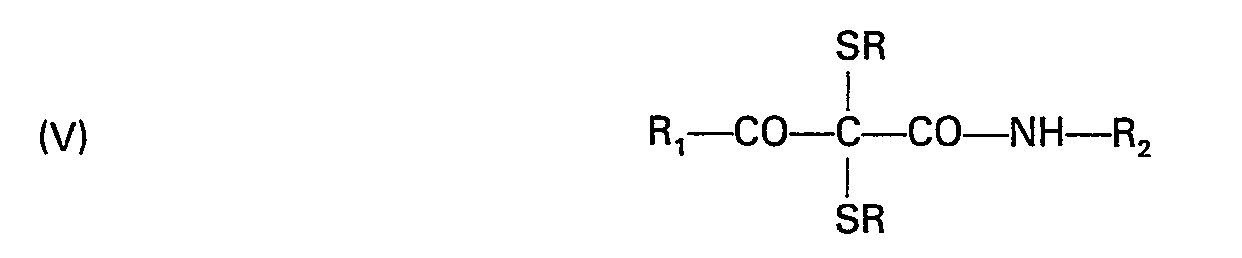
où R est un groupe alkyle ayant 1-20 atomes de carbone, cycloalkyle ayant 5-12 atomes de carbone, benzyle, a-méthylbenzyle, phényle ou phényle substitué où les substituants sont un groupe alkyle inférieur, alcoxy inférieur ou halo, R1 est R ou un groupe anilino, ou un groupe anilino substitué où les substituants sont un groupe alkyle inférieur, alcoxy inférieur ou halo, et R2 est le groupe phényle ou phényle substitué comme ci-dessus
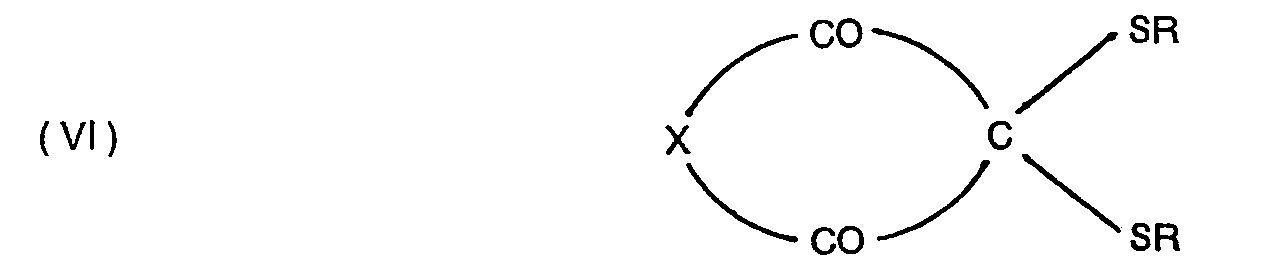
où R est le même que ci-dessus, et X est le groupe o-phénylène ou un groupe alkylène à chaîne droite ou ramifiée ayant 2-4 atomes de carbone par chaîne,
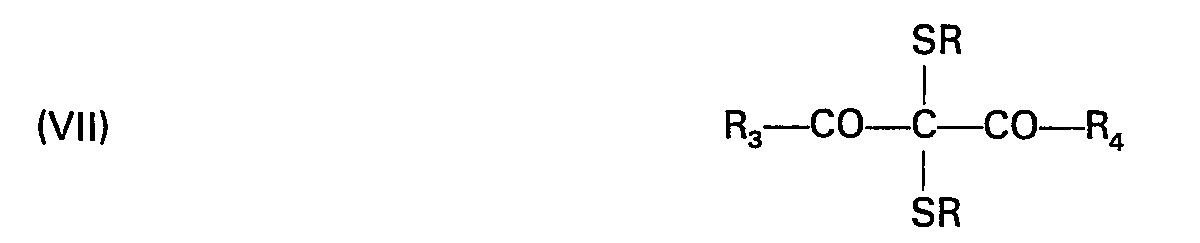
où R est le même que ci-dessus et R3 est un groupe alkyle inférieur ou alcoxy inférieur, et R4 est un groupe carboalcoxy ayant 1―5 atomes de carbone ou
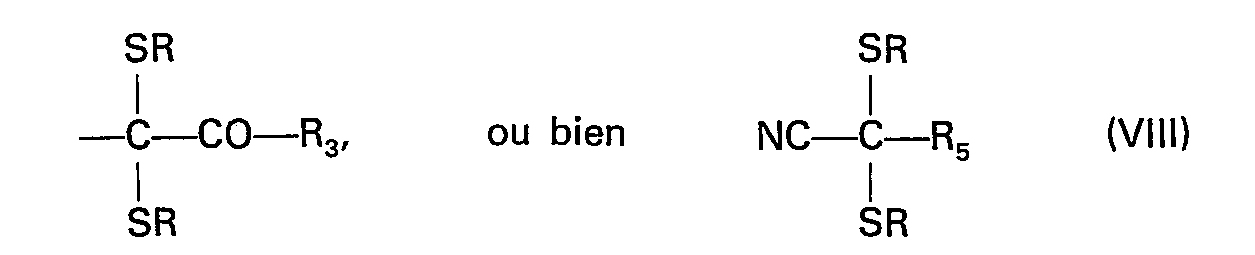
où R est le même que ci-dessus et Rs est un groupe carboalcoxy ayant 1-5 atomes de carbone, carbamoyle substitué ayant la formule:
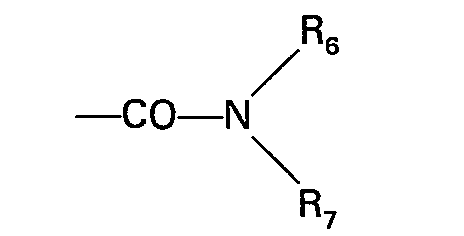
où R6 est l'hydrogène ou R, R7 est R ou un groupe carboalcoxy ayant 1-5 atomes de carbone, ou bien R6 et R7 ensemble constituent un groupe alkylène ou oxydialkylène ayant 4-8 atomes de carbone qui, avec l'atome d'azote, forme un hétérocycle.
où R est un groupe alkyle ayant 1-20 atomes de carbone, cycloalkyle ayant 5-12 atomes de carbone, benzyle, a-méthylbenzyle, phényle ou phényle substitué où les substituants sont un groupe alkyle inférieur, alcoxy inférieur ou halo, R1 est R ou un groupe anilino, ou un groupe anilino substitué où les substituants sont un groupe alkyle inférieur, alcoxy inférieur ou halo, et R2 est le groupe phényle ou phényle substitué comme ci-dessus
où R est le même que ci-dessus, et X est le groupe o-phénylène ou un groupe alkylène à chaîne droite ou ramifiée ayant 2-4 atomes de carbone par chaîne,
où R est le même que ci-dessus et R3 est un groupe alkyle inférieur ou alcoxy inférieur, et R4 est un groupe carboalcoxy ayant 1―5 atomes de carbone ou
où R est le même que ci-dessus et Rs est un groupe carboalcoxy ayant 1-5 atomes de carbone, carbamoyle substitué ayant la formule:
où R6 est l'hydrogène ou R, R7 est R ou un groupe carboalcoxy ayant 1-5 atomes de carbone, ou bien R6 et R7 ensemble constituent un groupe alkylène ou oxydialkylène ayant 4-8 atomes de carbone qui, avec l'atome d'azote, forme un hétérocycle.
12. Composé selon la revendication 11 ayant la formule (V) où R est un groupe alkyle
inférieur, cyclohexyle, benzyle ou phényle, R1 est un groupe alkyle inférieur, phényle ou anilino et R2 est le groupe phényle.
13. Composé selon la revendication 12, dans lequel R1 est le groupe méthyle.
14. Composé selon la revendication 13 dans lequel R est le groupe isopropyle ou phényle.
15. Composé selon la revendication 12 dans lequel R1 est le groupe phényle et R est le groupe isopropyle ou phényle.
16. Composé selon la revendication 11 ayant la formule (VI) où R est un groupe alkyle
inférieur, le groupe cyclohexyle, benzyle ou phényle et X est le groupe o-phénylène.
17. Composé selon la revendication 11 ayant la formule (VII) où R est un groupe alkyle
inférieur, le groupe cyclohexyle, benzyle ou phényle et R3 est le groupe méthoxy ou éthoxy.
18. Composé selon la revendication 11 ayant la formule (VIII) où R est un groupe alkyle
inférieur, le groupe cyclohexyle, benzyle ou phényle et R5 est un groupe carboalcoxy ayant 1-5 atomes de carbone.
19. Composé selon la revendication 18 dans lequel R est un groupe alkyle inférieur,
cyclohexyle, benzyle ou phényle et R5 est un groupe carbamoyle substitué où R6 est l'hydrogène et R7 est le groupe phényle ou un groupe carboalcoxy ayant 1-5 atomes de carbone.