|
(11) | EP 0 031 690 A1 |

| (12) | EUROPEAN PATENT APPLICATION |
|
|
|
|
|||||||||||||||||||||||||||
| (54) | O-alkyl-S-alpha branched alkyl alkylphosphonodithioate insecticides and nematocides |
| (57) O-alkyl-S-alpha branched alkyl alkylphosphonodithioates, a process for preparing
these compounds and their use as insecticides and nematocides. |
[0001] This invention relates to 0-alkyl-S-alpha branched alkyl alkylphosphonodithioate compounds, a process for preparing them and their use as insecticides and nematocides.
[0002] The present invention provides a compound of the formula
in which R is alkyl of 1 to 8 carbon atoms; R1 is alkyl of 1 to 8 carbon atoms; and R2 is alpha branched alkyl of 4 to 8 carbon atoms.
[0003] The present invention also provides a process for preparing a compound of the formula
in which R is an alkyl of 1 to 8 carbon atoms; R is an alkyl of 1 to 8 carbon atoms; and R2 is alpha branched alkyl of 4 to 8 carbon atoms which comprises reacting an S-alpha alkylphosphonodithioic halide of the formula
wnerein R and R2 are defined as above and X is naisgen with an alcohol of the formula R1OH wherein Rl is defined as above in the presence of a base.
[0004] The compounds of the present invention exhibit wide range of insecticidal activity and are of particular interest in controlling corn rootworm because of their excellent activity against this pest and their low phytotoxicity to corn plants.
[0005] An important structural feature of the compounds of this invention is that R2 in the above formula is alpha branched alkyl, i.e., branching occurs on the carbon directly attached to the sulfur. Certain alkylphosphonodithioate insecticides are described in U.S. Patent No. 3,209,020. However, none of the species described in this patent correspond to the above formula where R2 is branched alkyl.
[0006] It has been found that the branched compounds of this invention possess unexpected advantageous properties. In particular, they exhibit low phytotoxicity to corn. Since the activity of the branched compounds against corn rootworm is good and their phytotoxicity to corn is low, the compounds of this invention are of special interest for controlling corn rootworm.
[0007] The compounds of the present invention may be prepared by the method described in U.S. Patent No. 3,209,020. Preferably, the compounds of this invention are prepared from a starting material which is an S-alkyl alkylphosphonodithioic halide, the preparation of which is illustrated in Example 1. The S-alkyl alkylphosphonodithioic halide is reacted with an alcohol in the presence of a base to arrive at the compounds of this invention.
[0008] The preferred reaction scheme is as follows:
in which R is alkyl of 1 to 8 carbon atoms; R1 is alkyl of 1 to 8 carbon atoms; R2 is alpha branched alkyl of 4 to 8 carbon atoms; and X is halogen, preferably chlorine.
[0009] The reaction is advantageously carried out at a temperature of from 0°C to 100°C in an organic solvent in the presence of a tertiary amine or aqueous base such as aqueous NaOH or by forming the alkali salt of the alcohol using alkali metals such as sodium.
[0010] Suitable organic solvents are, for example, benzene, toluene, cyclohexane and 2-butanone or the alcohol itself.
[0011] Suitable tertiary amines include trimethylamine, triethylamine, dimethylaniline, diethylaniline and pyriaine.
[0012] The alkylphosphonodithioate compounds of this invention are effective as insecticides and/or nematocides at low concentrations. Because of the small amounts of the compounds required for effective control, it is generally impractical to apply the compounds directly as such. Therefore, it is desirable that the compounds be applied in the form of liquid compositions or in combination with other vehicles or extenders.
[0013] The compositions containing the active compounds of this invention can be dispersions or emulsions. Since the active compounds are substantially water insoluble, it is desirable to add a small amount of an inert, non-phytotoxic organic solvent which can be readily dispersed in an aqueous medium to produce a uniform dispersion of the active component. For example, an effective liquid composition can be prepared with the active component, acetone or ethanol, water, and a surface-active agent such as Tween-20 (polyoxyethylene sorbitan monolaurate) or any of the other well-known surface-active agents.
[0014] The compositions containing the active compounds can also be in powdered or granular form. For example, the active compound can be mixed with a suitable solid carrier such as kaolinite, bentonite or talc in amounts of from 5% to 20% by weight.
[0015] For the control of insects, the active ingredients are used at concentrations of from 0.01% to about 1% by weight of the total formulation. As nematocides, the active component is effective within the range of about 0.5 to 5 pounds/acre. Under ideal conditions, depending on the pest to be controlled, the lower rate may offer adequate protection. On the other hand, adverse weather conditions, resistance of the pest and other factors may require that the active ingredient be used in higher proportions.
[0016] When the pest is soil-borne, the formulation containing the active ingredient is distributed evenly over the area to be treated in any convenient manner. The active component can be washed into the soil by spraying with water over the area or can be left to the natural action of rainfall. After application, the formulation can be distributed in the soil by plowing or disking. Application can be prior to planting, after planting but before sprouting has taken place or after sprouting.
EXAMPLE 1
Preparation of S-tert.-butyl ethylphosphonodithioic chloride (Intermediate)
[0018] To a solution of ethylphosphonothioic dichloride (80 g, 0.5 mol) in 500 ml dry toluene was added 2-methyl-2-propanethiol (50 g, 0.55 mol). The solution was stirred while triethylamine (60 g, 0.6 mol) was added dropwise. After the complete addition of the amine, the mixture was stirred and heated up to 80°C for three hours and allowed to stand overnight. The reaction mixture was washed with 5% cold HC1 solution (100 ml), followed by another wash with 5% cold NaOH solution (100 ml), finally washed twice with water (100 ml each), and dried over magnesium sulfate. Toluene was evaporated under a water aspirator vacuum, and the oil residue was distilled. The product was distilled at 78-80°C/0.2 mm. The yield was 60 g (55.4% of theoretical yield). The structure was confirmed by NMR.
EXAMPLE 2
Preparation of O-ethyl-S-tert.-butyl-ethyl- phosphonodithioate
[0019] Sodium (1.0 g, 0.043 g/atom) was dissolved in 50 ml anhydrous ethanol. To this solution was added S-tert.-butyl-ethylphosphonodithioic chloride (8.0 g, 0.037 mol) in one portion. The mixture was stirred at room temperature for two hours. The reaction mixture was concentrated under vacuum, and the residual was taken up in ether. The ether solution was washed with water, and dried over anhydrous Na2S04. Ether was stripped off under vacuum, and the residual liquid was distilled, to give 6.5 g of product; b.p. 71-72/0.1 mm (77.7% yield). The structure was confirmed by NMR.
EXAMPLES 3-12
EXAMPLE 15
[0021] Tests for corn rootworm intrinsic activity, corn phytotoxicity and activity against Southern Armyworm.
A. Corn rootworm intrinsic activity (CRW)
[0022] The test compound is prepared in a one percent solution with acetone or ethanol. The stock solution is then diluted with an aqueous solution of Tween 20 and water to the appropriate concentration (i.e., 100, 10, 1, 0.1, 0.05 ppm). Two ml of this solution is pipetted into a 9 cm petri dish containing two layers of filter paper. Second instar larvae are introduced and the dish closed. Observations for mortality and moribund larvae are made after two days' (48 hours) exposure. Insecticidal activity is primarily contact and vapor action with minimum ingestion. The results are tabulated in TABLE 1.
B. Corn phytotoxicity
[0023] Test compounds are dissolved in acetone to provide concentrations of 0.5 and 1.0% active ingredient. Corn seeds are planted in double rows in 9" X 7" fiber flats containing pasteurized soil. Five seeds are planted in each furrow and lightly covered with soil. Treatment is made by applying 5 ml/row of test solution directly over the corn seed at the bottom of the furrow. The 0.5% and 1.0% solutions provide a rate of application equivalent to 1 and 2 pounds active ingredient/acre. After the furrows are closed, the flats are removed to the greenhouse, watered and held for observation and harvest. Three replicate flats are used for each treatment.
[0024] Assessment of corn tolerance after 11 days is made by rating the response of individual plants on a 0-10 scale (where 0 = no effect and 10 = complete kill). Overall ratings are made for each replicate flat 2 weeks after treatment. Assessment of corn tolerance is also based on fresh weight of shoots that are harvested after the two week visual rating. The results are tabulated in TABLE 2.
C. Southern Armyworm Intrinsio Activity (SAW)
[0025] Stock solution (1%) of test material was made in acetone anc diluted to the desired concentration by a 500 ppm Tween 20 aqueous solution. Lima bean leaves are dipped into the solution and transferred to petri dishes (100 X 15 mm) containing two filter papers moistened with 2 ml water. Each petri dish contained one leaf and was kept open to dry out the solution on the leaf. Five third instar leavae of Southern Armyworm (Spodoptera eridania) were added to the leaf and the dish was finally covered.
1. A compound of the formula
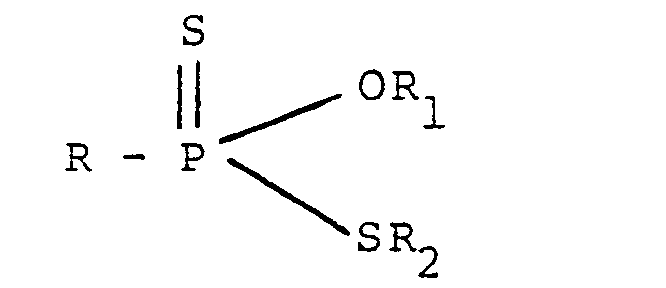
in which R is an alkyl of 1 to 8 carbon atoms; R1 is an alkyl of 1 to 8 carbon atoms; and R2 is alpha branched alkyl of 4 to 8 carbon atoms.
in which R is an alkyl of 1 to 8 carbon atoms; R1 is an alkyl of 1 to 8 carbon atoms; and R2 is alpha branched alkyl of 4 to 8 carbon atoms.
2. A compound of Claim 1 in which R1 is unbranched alkyl of 1 to 6 carbon atoms.
3. A compound of Claim 1 or 2 in which R2 is tertiary alkyl.
4. A compound of Claim 3 in which R2 is t-butyl.
5. A compound of Claim 4 in which R is methyl or ethyl.
6. A compound of Claim 5 in which R and R1 are ethyl.
7. A compound of Claim 5 in which R is ethyl and R1 is methyl.
8. A compound of Claim 5 in which R and R1 are methyl.
9. A compound of Claim 5 in which R is methyl and R1 is ethyl.
10. A compound of Claim 5 in which R is methyl and R1 is n-propyl.
11. A compound of Claim 5 in which R is ethyl and R1 is n-propyl.
12. A compound of Claim 3 in which R2 is t-amyl.
13. A method for controlling insects and nematodes which comprises applying thereto
or their habitat a pesticidal amount of a compound of any one of Claims 1 to 12.
14. A method for controlling corn rootworm which comprises providing a pesticidal
amount in the soil of a compound of any of of Claims 1 to 12.
15. A composition for controlling insects or nematodes comprising as the active ingredient
a compound of any one of Claims 1 to 12, and an inert, non-phytotoxic organic solvent
or a solid carrier; said active ingredient being present in an amount effective as
an insecticide or a nematocide.
16. A process for preparing a compound of any one of Claims 1 to 12, which comprises
reacting an S-alpha alkylphosphonodithioic halide of the formula
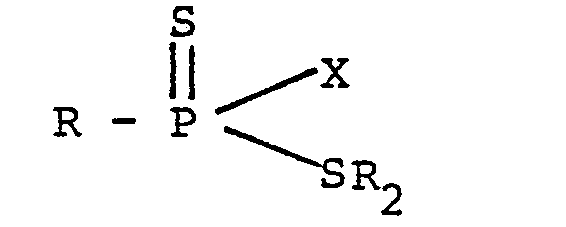
wherein R and R2 are defined as above and X is halogen with an alcohol of the formula R1OH wherein R1 is defined as above in the presence of a base.
wherein R and R2 are defined as above and X is halogen with an alcohol of the formula R1OH wherein R1 is defined as above in the presence of a base.
17. The process of Claim 16 wherein the reaction is carried out in the presence of
a tertiary amine or aqueous base
18. The process of Claim 17 wherein the aqueous base is aqueous sodium hydroxide.
19. The process of claim 16 wherein the alkali salt of the alcohol is used.