|
(11) | EP 0 033 596 B1 |

| (12) | EUROPEAN PATENT SPECIFICATION |
|
|
| (54) |
Oxidation of alpha-alkylated, benzyl-substituted 2-thiopyridine 1-oxides Oxidation alpha-alkylierter, benzyl-substituierter 2-Thiopyridin-1-oxide Oxydation de thio-2 pyridineoxydes-1 substitués par un groupe benzyle alcoylé en position alpha |
|
|
|||||||||||||||||||||||||||||||
| Note: Within nine months from the publication of the mention of the grant of the European patent, any person may give notice to the European Patent Office of opposition to the European patent granted. Notice of opposition shall be filed in a written reasoned statement. It shall not be deemed to have been filed until the opposition fee has been paid. (Art. 99(1) European Patent Convention). |
[0001] According to the invention, alpha-alkylated, benzyl substituted 2-thiopyridine 1-oxides may be oxidized to the respective sulfones by admixing the compound to be oxidized, a solvent, acetonitrile, hydrogen peroxide and a base.
[0002] U.S. Patent No. 3,960,542, issued June 1, 1976, discloses, inter alia, novel substituted 2-sulfonyl pyridine 1-oxides useful as herbicides. A method of controlling weeds through use of such compounds is disclosed in U.S. Patent No. 4,019,893, issued April 16, 1977. The disclosures of both of the aforementioned patents are herewith incorporated by reference herein. As taught in both of these patents, the subject compounds may be prepared via formation of intermediate thio compounds i.e., substituted 2-thiopyridines, and the subsequent oxidation of the same to substituted 2-sulfonyl pyridine 1- oxides. Alternatively, the 2-sulfonyl pyridine 1-oxide derivatives may be prepared from known compounds. See, for example, W. Walter et al, Liebig's Ann., 695, 77 (1966); E. Shaw et a/., J.A.C.S. 72, 4362 (1050); A. R. Katritsky, J. Chem. Soc., 191 (1957); and U.S. Patents Nos 3,107,994 and 3,155,671. Parent 2-thiopyridine 1-oxides may be prepared by (1) the reaction of 2-chloropyridine 1- oxide with the appropriate mercaptan in the presence of an acid acceptor such as an alkaline earth hydroxide; or (2) reaction of the sodium salt of 2-mercaptopyridine 1-oxide with a suitable halide preferentially, but not necessarily, of the benzyl type.
[0003] As described in U.S. Patent No. 3,960,542, one useful synthesis route to the above-described herbicidal compounds involves the oxidation of a 2-thiopyridine prepared by methods described in the literature. The oxidation involves the conversion of both the sulfur and nitrogen to their higher oxidative states in a single preparative step. In this case the products are sulfones as the sequence of oxidation proceeds from sulfide - sulfoxide- sulfone - sulfone N-oxide. The oxidant most generally employed is 30-50% hydrogen peroxide in glacial acetic acid. In excess of three equivalents of peroxide is necessary. Glacial acetic acid and water are noted as being preferred solvents when hydrogen peroxide is used.
[0004] In Example 6 of the U.S. patent No 3960542 2-(1-[2,5-dimethylphenyl]ethyl thio)pyridine 1-oxide is oxidized to the sulfone by admixing the thio compound with chloroform and metachloroperoxybenzoic acid. The metachloroperoxybenzoic acid is, at the present time, too expensive a compound for practical commercial use in oxidizing such thio compounds.
[0005] There exist may other known procedures for converting sulfides to sulfoxides and sulfones. These known methods arose primarily to meet specific needs and are tailored to certain structures. The need for tailoring is particularly evident with respect to the compounds herein described. Application of known procedures failed in every instance to give satisfactory yields. Since commercial application of a procedure requires that economic and safety factors be considered, a number of procedures which gave moderate yields i.e., from about 50 to about 70%, were iliminated as viable routes. A further failing of many of the published methods is that they yield a product comprising an unacceptable, inseparable mixture of sulfoxide and sulfone.
[0006] An oxidation reaction for preparing acetamide and oxygen from acetonitrile has been known for some time. Radziszewski, Ueber die Oxydation mittelst Wasserstoffsuperoxyds, Berichte, 17, 1289-1290 (1884). More recently, this "Radziszewski Reaction" has been employed in a method for preparing epoxides from olefins. Payne and Williams, Reactions of Hydrogen Peroxide. VI. Alkaline Epoxidation of Acrylonitile, J. Organic Chemistry, 26, 651-659 (1961); Reactions of Hydrogen Peroxide, VII. Alkali-Catalyzed Epoxidation and Oxidation Using a Nitrile as Co-reactant, id at 659-663. However, no evidence of the application of this procedure to sulfur chemistry has been found in the literature.
[0007] The invention comprises a process for the oxidation of alpha-alkylated, benzyl-substituted 2-thio pyridine 1-oxides having the general formula '
to the corresponding sulfones, wherein R is alkyl having from 1 to 8 carbon atoms and n is 1 or 2. R is preferably an alkyl group having from 1 to 4 carbon atoms and, in the most preferred application, R is ethyl and n is 2. The process comprises admixing the compound to be oxidized, a solvent, acetonitrile, hydrogen peroxide and a base. Preferred solvents include the lower alcohols, such as methanol, propanol and butanol, with the former being most preferred in part because it is relatively easily recovered and recycled. Preferably; sufficient base should be admixed to form a mildly alkaline mixture, with a pH of from 8.5 to 9 being especially preferred.
[0008] To allow for the loss of some hydrogen peroxide, somewhat more than the theoretical amount of oxidant must be employed to complete the reaction. In general 2.25 to 2.5 mols of H202 per mol of sulfide to be oxidized to the sulfone is sufficient.
[0009] It has been hypothesized that the reaction of mildly alkaline hydrogen peroxide and acetonitrile produces an intermediate percarboximidic acid which then reacts with a substrate, in the instant case a sulfide, to form the sulfoxide and ultimately the sulfone. In the method of this invention, the reaction is preferably carried out at a somewhat higher pH than is described in the literature, with a resulting secondary reaction involving the hydrogen peroxide:
When operating at the preferred pH of about 8.5 to about 9, a slow stream of oxygen usually evolves and the rate of oxygen evolution, along with the observed pH, serves as a monitor for preferred operating conditions. The temperature of the reaction may be easily maintained at 30-400C by intermittent application of coolant to a jacket.
[0010] The product may be filtered directly from the reaction mixture where it exists as a crystalline slurry. The acetamide impurity is flushed from the cake by water washing and may be recovered from the filtrate for disposal or use. The resulting effluent is ecologically acceptable with a minimum of effort and expense.
[0011] The preparation of specific sulfones by methods according to the invention is described in detail in the following examples.
Example I
Preparation of 2-[1-(2,5-Dimethylphenyl)ethylsulfonyl] pyridine 1-oxide
[0012] A solution of 77.7 g (0.3 mol) 2-[1-(2,5-dimethylphenyl)ethylthio] pyridine 1-oxide and 30 g (0.75 mol) acetonitrile in 200 ml of methanol was added to a five necked flask fitted with a stirrer, thermometer, dropping funnel, combination pH electrode and a condenser fitted with a gas bubbler. 50 g (0.75 mol) of 50% hydrogen peroxide was added gradually with stirring and, as necessary, the admixture was cooled to maintain the temperature at 30° to 35°C
[0013] The system was closed and a 0.5N solution of sodium hydroxide added with good stirring to obtain the desired pH (approximately 12.5 by meter and 8.5 to 9.0 by paper). A slow gassing at the bubbler of from about 2 to 4 cc per minute served to monitor the pH level in the reactor. As the amount of water in the system increased, the meter readings became truer. Intermittent cooling maintained the temperature at the desired 35-40°C.
[0014] After three hours the level of hydrogen peroxide remaining had become very low and the slurry of sulfone was filtered directly. Washing with five or six fold volumes of water removed the acetamide in the cake and the product air dried to yield 83 g of product (95% theory).
Example II
Preparation of 2-[1-(2,4-Dimethylphenyl)ethyl sulfonyl] pyridine 1-oxide
[0015] To a solution of 38.9 g (0.15 mol) 2-[1-(2,4-dimethylphenyl)ethyl thio]pyridine 1-oxide and 15.6g g (0.38 mol) acetonitrile in 100 ml of methanol was added sufficient 0.1 N NaOH to obtain the desired pH (approximately 11-11.3 (meter), 8.5-9 (paper)). With good stirring and cooling, as necessary, to maintain a 30-35°C reaction temperature, 13 g (0.19 mol) of 50% hydrogen peroxide was added in increments. The pH dropped and had to be brought back up by the addition of more caustic to maintain the desired pH level. At this pH, oxygen evolved and a bubbler attached to the system served as an indicator of excess alkalinity.
[0016] Another 13 g (0.19 mol) of hydrogen peroxide was added over a period of 15 minutes with cooling and the mixture stirred for an additional hour. Separation of the product started to occur during this period. The reaction was quenched with one liter of cold water, filtered and water-washed to yield a white powder.
[0017] Recrystallization from a large volume of ethanol yielded 35 g pure product having a melting point of 183-185°C.
Example III
Preparation of 2-[1-(2,5-Dimethylphenyl) octyl sulfonyl] pyridine 1-oxide
[0018] To a solution of 34.3 g (0.1 mol) 2%[1-(2,5-dimethylphenyl)octylthio) pyridine 1-oxide and 10.7 g (0.26 mol) acetonitrile in 400 ml of methanol was added sufficient NaOH solution (6 N to minimize water) to adjust the pH in the operating range of 8.5 to 9.0 (true), approximately 11-11.3 (meter).. 17 g (0.26 mol) of 50% hydrogen peroxide was added in the same manner as in the preceding example.
1. A method of oxidizing alpha-alkylated, benzyl-substituted 2-thio pyridine 1-oxides
to produce the corresponding sulfone characterised in that the pyridine 1-oxides have
the general formula
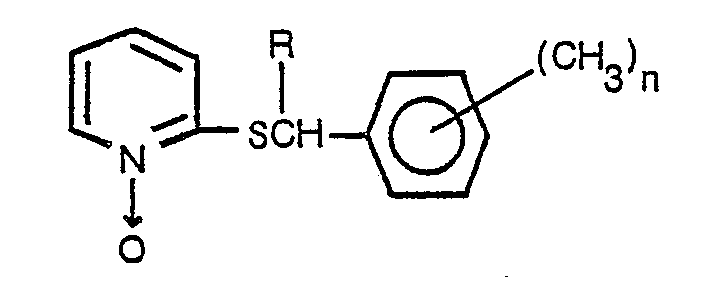
where R is alkyl having from 1 to 8 carbon atoms and n is 1 or 2 and said method comprises the admixing of the compound to be oxidized, a solvent for said compound, acetonitrile, hydrogen peroxide and a base.
where R is alkyl having from 1 to 8 carbon atoms and n is 1 or 2 and said method comprises the admixing of the compound to be oxidized, a solvent for said compound, acetonitrile, hydrogen peroxide and a base.
2. A method according to claim 1 characterised in that R is alkyl having from 1 to
4 carbon atoms.
3. A method according to claim 1 or claim 2 characterised in that n is 2.
4. A method according to any of the preceding claims characterised in that the pH
of said admixture is from 8.5 to 9.
5. A method according to claim 1 characterised in that R is ethyl, n is 2 and pH of
said admixture is from 8.5 to 9.
6. A method of making 2-[1-(2,5-dimethylphenyl)ethyl sulfonyl] pyridine 1-oxide characterised
in that said method comprises the step of admixing 2-[1-(2,5-dimethylphenyl) ethyl
thio]pyridine 1-oxide, a solvent for said thio compound, acetonitrile, hydrogen peroxide
and a base.
7. A method according to claim 6 characterised in that the pH of said admixture is
from 8.5 to 9.
8. A method according to any of the preceding claims characterised in that said solvent
is methanol.
9. A method according to any of the preceding claims characterised in that said base
is sodium hydroxide.
1. Verfahren zum Oxidieren von a-alkylierten, benzyl-substituierten 2-Thiopyridin-l-oxiden
für die Herstellung des entsprechenden Sulfons, dadurch gekennzeichnet, daß die Pyridin-1-oxide
die allgemeine Formel:
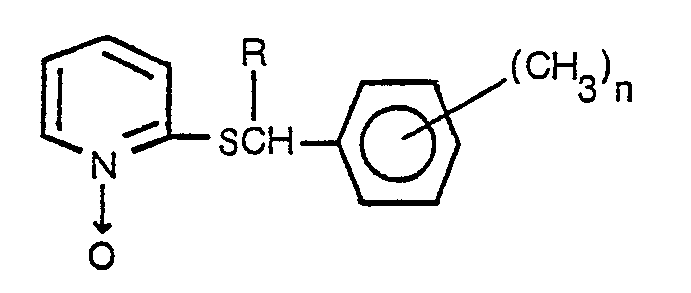
haben, worin R eine Alkylgruppe mit 1 bis 8 Kohlenstoffatomen ist und n 1 oder 2 ist, und daß bei dem Verfahren die zu oxidierende Verbindung, ein Lösungsmittel für diese Verbindung, Acetonitril, Wasserstoffperoxid und eine Base vermischt werden.
haben, worin R eine Alkylgruppe mit 1 bis 8 Kohlenstoffatomen ist und n 1 oder 2 ist, und daß bei dem Verfahren die zu oxidierende Verbindung, ein Lösungsmittel für diese Verbindung, Acetonitril, Wasserstoffperoxid und eine Base vermischt werden.
2. Verfahren nach Anspruch 1, dadurch gekennzeichnet, daß R eine Alkylgruppe mit 1
bis 4 Kohlenstoffatomen ist.
3. Verfahren nach Anspruch 1 oder 2, dadurch gekennzeichnet, daß n 2 ist.
4. Verfahren nach einem er vorhergehenden Ansprüche, dadurch gekennzeichnet, daß der
pH-Wert der Mischung 8,5 bis 9 beträgt.
5. Verfahren nach Anspruch 1, dadurch gekennzeichnet, daß R eine Ethylgruppe ist,
n 2 ist und der pH-Wert der Mischung 8,5 bis 9 begrägt.
6. Verfahren zur Herstellung von 2-[1-2,5-DimethylphenylJ-ethylsulfonyl]-pyridin-1-oxid,
dadurch gekennzeichnet, daß das Verfahren einen Schritt enthält, bei dem 2-[1-(2,5-Dimethylphenyl)-ethylthio]-pyridin-1-oxid,
ein Lösungsmittel für diese Thioverbindung, Acetonitril, Wasserstoffperoxid und eine
Base vermischt werden.
7. Verfahren nach Anspruch 6, dadurch gekennzeichnet, daß der pH-Wert der Mischung
8,5 bis 9 beträgt.
8. Verfahren nach einem der vorhergehenden Anspüche, dadurch gekennzeichnet, daß das
Lösungsmittel Methanol ist.
9. Verfahren nach einem der vorhergehenden Ansprüche, dadurch gekennzeichnet, daß
die Base Natriumhydroxid ist.
1. Méthode d'oxydation de 2-thio pyridine 1-oxydes substitués en benzyle et alpha-alcoylés,
pour produire la sulfone correspondante, caractérisée en ce que les pyridines 1-oxydes
ont pour formule générale:
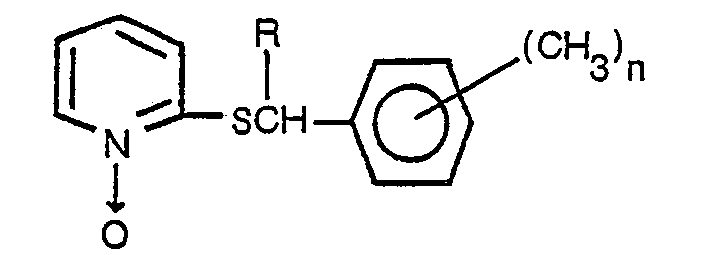
dans laquelle R est un alcoyle ayant de 1 à 8 atomes de carbone et n et 1 ou 2 et ladite méthode comprend le mélange du composé à oxyder d'un solvant dudit composé, de l'acétonitrile, du peroxyde d'hydrogène et d'une base.
dans laquelle R est un alcoyle ayant de 1 à 8 atomes de carbone et n et 1 ou 2 et ladite méthode comprend le mélange du composé à oxyder d'un solvant dudit composé, de l'acétonitrile, du peroxyde d'hydrogène et d'une base.
2. Méthode selon la revendication 1 caractérisée en ce que R est un alcoyle ayant
de 1 à 4 atomes de carbone.
3. Méthode selon la revendication 1 ou la revendication 2 caractérisée en ce que n
est égal à 2.
4. Méthode selon l'une quelconque des revendications précédentes caractérisée en ce
que le pH dudit mélange est compris entre 8,5 et 9.
5. Méthode selon la revendication 1 caractérisée en ce que R est de l'éthyle, n est
2 et le pH dudit mélange est compris entre 8,5 et 9.
6. Méthode de production de 2-[1-(2,5-diméthylphényl) éthyl sulfonyl]pyridine 1-oxyde
caractérisée en ce que ladite méthode comprend l'étape de mélanger du 2-[1-2,5-diméthylphényl)éthyl
thio]pyridine 1-oxyde, un solvant dudit composé thio, de l'acétonitrile, du peroxyde
d'hydrogène et une base.
7. Méthode selon la revendication 6 caractérisée en ce que le pH dudit mélange et
de 8,5 à 9.
8. Méthode selon l'une quelconque des revendications précédentes caractérisée en ce
que ledit solvant est du méthanol.
9. Méthode selon l'une quelconque des revendications précédentes caractérisé en ce
que ladite base est de la soude.