|
(11) | EP 0 034 488 A1 |

| (12) | EUROPEAN PATENT APPLICATION |
|
|
|
|
|||||||||||||||||||||||||||
| (54) | Carrier particle for electrostatographic developer mixture, developer mixture, and imaging process using the mixture |
| (57) A carrier particle for electrostatographic developer mixtures, having a core and
an outer coating. The core is of an average diameter between 30 microns and 1000 microns.
The outer coating comprises a polyvinyl acetal such as polyvinyl butyral or polyvinyl
formal. The coated carrier particles have negative triboelectric charging properties
and are particularly useful in development systems, employing negatively charged photoconductive
surfaces. Imaging processes are also disclosed. |
[0001] This invention relates to a carrier particle for electrostatographic developer mixtures, the carrier particle comprising a core having an average diameter bwtween 30 and 1000 microns, and an outer coating.
[0002] It is well known to form and develop images on the surface of photoconductive materials by electrostatic methods such as described, for example, in U.S. Patents 2,297,691; 2,277,013; 2,551,582; 3,220,324; and 3,220,833. In summary, these processes as described in the aforementioned patents involve the formation of a charged electrostatic latent image on an insulating electrophotographic element and rendering the latent image visible by a development step whereby the charged surface of the photoconductive element is brought into contact with a developer mixture. As described in U.S. Patent 2,297,691, for example, the resulting electrostatic latent image is developed by depositing thereon a finely-divided electroscopic material referred to in the art as toner, the toner being generally attracted to the areas of the layer which retain a charge thus forming a toner image corresponding to the electrostatic latent image. Subsequently, the toner image can be transferred to a support surface such as paper and this transferred image can be permanently affixed to the support surface using a variety of techniques including pressure fixing, heat fixing, solvent fixing, and the like.
[0003] Many methods are known for applying the electroscopic particles to the latent image including' cascade development, touchdown and magnetic brush development as illustrated in U.S. Patents 2,618,552; 2,895,847 and 3,245,823. One of the most widely used methods is cascade development wherein the developer material comprising relatively large carrier particles having finely-divided toner particles electrostatically clinging to the surface of the carrier particles is conveyed to and rolled or cascaded across the electrostatic latent image-bearing surface. Magnetic brush development is also known and involves the use of a developer material comprising toner and magnetic carrier particles which are carried by a magnet so that the magnetic field produced by the magnet causes alignment of the magnetic carriers in a brush-like configuration. Subsequently, this brush is brought into contact with the electrostatic latent image-bearing surface causing the toner particles to be attracted from the brush to the electrostatic-latent image by electrostatic attraction, as more specifically disclosed in U.S. Patent 2,874,063.
[0004] Carrier materials used in the development of electrostatic latent images are described in many patents including, for example, U.S. Patent 3,590,000. The type of carrier material to be used depends on many factors such as the type of development used, the quality of the development desired, the type of photoconductive material employed and the like. Generally, however, the materials used as carrier surfaces or carrier particles or the coating thereon should have a triboelectric charging response commensurate with the triboelectric charging value of the toner in order to generate electrostatic adhesion of the toner to the carrier. Further, carrier materials should be selected that are not brittle so as to cause flaking of the surface or particle break-up under the forces exerted on the carrier during recycle as such causes undesirable effects and could, for example, be transferred to the copy surface thereby reducing the quality of the final image.
[0005] There have been recent efforts to develop carriers and particularly coatings for carrier particles in order to obtain better development quality and also to obtain a material that can be recycled and does not cause any adverse effects to the photoconductor. Some of the coatings commercially utilized deteriorate rapidly especially when employed in a continuous process whereby the entire coating may separate from the carrier core in the form of chips or flakes as a result of 'poorly adhering coated material and fail upon impact and abrasive contact with machine parts and o'ther carrier particles. Such carrier particles generally cannot be reclaimed and reused and usually provide poor print quality results. Further, the triboelectric values of some carrier coatings have been found to fluctuate when changes in relative humidity occur and thus these carriers are not desirable for use in electrostatographic systems as they can adversely affect the quality of the developed image.
[0006] In addition, in particular electrostatographic reproduction systems in order to develop a latent image comprised of negative electrostatic charges, an electrostatic carrier and toner powder combination must be selected in which the toner is triboelectrically charged positively relative to the granular carrier. Likewise, in order to develop a latent image comprised of positive electrostatic charges such as where a selenium photoreceptor is employed, an electroscopic toner powder and carrier mixture must be selected in which the toner is triboelectrically charged negatively relative to the carrier. Thus, where the latent image is formed of negative electrostatic charges such as when employing an organic electrophotosensitive material as the photoreceptor, it is highly desirable to develop the latent image with a positively charged electroscopic powder and a negatively charged carrier material.
[0007] Further, for a given toner-carrier pair, the magnitude of the triboelectric charge is important in that, if the charge is too low, the developed copy will be characterized by high print density but resolution will be poor and background areas will be overdeveloped. By the same token, if the triboelectric charge is too high, background areas will not contain unwanted deposits and resolution will be good, but the developed image print density will be too low. Therefore, for a toner-carrier pair to be satisfactory, the carrier material must be one wherein its coating has a high resistance to abrasion and good adhesion properties, it must be capable of triboelectrically charging the toner to the desired polarity, and charge the toner to a level within a range of triboelectric values whereby developed copies of high quality are obtained.
[0008] The development of electrostatographic coated carrier materials has been to a main extent on a trial and error basis. Since certain desirable functional characteristics of carrier materials having coatings are known, it has been somewhat possible to select coating materials for the purpose of determining their potential usefulness as carrier coatings. However, it has not been possible to reliably predict whether any particular coating material is viable or possesses any advantage over another coating material for use as an electrostatographic carrier coating. The only effective means of determining whether any coating material will satisfy the functional characteristics of a carrier material is to actually prepare carrier particles with the coating material and evaluate the product. Thus, even if a coating material is a member of a broad class of generally desirable materials, it may be that the particular coating material is difficult or impossible to coat by normal means or requires a complicated or expensive preparation process.
[0009] One such class of generally desirable carrier coating materials is the class of fluoropolymers as disclosed iηU.S. Patent 3,798,167 to Kukla et al. In said patent, carrier particle cores are coated with a substantially insoluble fluoropolymer or a mixture of a fluoropolymer and a modifying resin in which the fluoropolymer is essentially insoluble. As the fluoropolymer therein, that is, polytetrafluoroethylene or a copolymer thereof is substantially insoluble, it is applied to the carrier cores by first preparing a suspension or dispersion of the coating material. After coating the carrier cores, the coating material is heated to a temperature sufficiently. high, that is, about 400° C., so that the coating will be cured and fused as to adhere to the cores. As will be appreciated, such a coating procedure is multi-step, time-consuming and more expensive than standard coating processes such as dipping or spray-drying a coating solution. Further, after treatment at the temperature required to fuse the fluoropolymer coating to the carrier cores, it is found that the carrier particles possess more negative triboelectric charging characteristics than the untreated coated particles. Also, inasmuch as it would be desirable to provide a carrier particle coated with a negatively charging coating, but provide such a coated carrier particle by a single-step coating operation, such a need exists.
[0010] The present invention is intended to meet this need, and accordingly provides carrier particles which are characterised in that the outer coating comprises a polyvinyl acetal.
[0011] Carrier particles in accordance with the invention have negative triboelectric charging characteristics, greatly. increased life, better flowability properties, and can be reclaimed if desired.
[0012] Such carrier particles which may be used in an electrostatographic development environment where the photoreceptor is negatively charged.
[0013] The polyvinyl acetal coating material used in the carrier particles of this invention may be selected from the group of polyvinyl acetals prepared from aldehydes and .vinyl alcohols. Typical -polyvinyl acetals include polyvinyl butyral and polyvinyl formal which are commercially available from Monsanto Plastics and Resins, St. Louis, Missouri under the tradenames Bulvar and Formvar, respectively. The thus coated carrier particles are mixed with finely-divided toner particles to form electrostatographic developer mixtures wherein the toner particles electrostatically cling to the carrier particles. The resultant developer mixtures are preferably employed in an electrostatographic development system where development of a negatively charged photoreceptor is desired. It has been found that the carrier coating materials of this invention provide electrostatographic coated carrier materials which possess desirable negative triboelectric charging properties, excellent copy print quality, and life performance superior to known negatively charging coated carrier particles such as carrier particles coated with halogenated polymers.
[0014] When employing the polyvinyl acetal coating compositions of this invention on electrostatographic carrier core particles, it has been found that the thus coated carrier particles possess vastly improved life performance characteristics over known halogenated polymer coating materials. Although not wishing to be bound by an explanation therefor, it is believed that the improved life performance characteristics of the carrier compositions of this invention are due to the outstanding adhesion and film forming properties of the coating materials. Such improved life performance characteristics of the carrier materials areespecially notable when these polyvinyl acetals are applied to metallic carrier cores, since typically, halogenated resins applied to metallic carrier cores are unstable as evidenced by short carrier life. In addition, the coating compositions of this invention have been found to provide an especially desirable and useful range of triboelectric charging properties to the carrier materials when employed in developer mixtures for the development of electrostatic latent images formed of negative charges. Further, the negative triboelectric charging values of these polyvinyl acetal coated carrier particles are completely unexpected when employed with finely-divided toner particle compositions containing triboelectric charge control additives and result in improved performance in the development of negatively charged electrostatic latent images.
[0015] The polyvinyl acetal carrier particle coating compositions of this invention are formed by the well-known reaction between aldehydes and alcohols. Typically, the addition of one molecule of an alcohol to one molecule of an aldehyde produces a hemiacetal which is inherently unstable. However, hemiacetals are further reacted with another molecule of alcohol to form a stable acetal. In like fashion, polyvinyl acetals are prepared from aldehydes and polyvinyl alcohols. Polyvinyl alcohols are usually classified as partially hydrolyzed, that is, containing 15 to 3016 of polyvinyl acetate groups, and completely hydrolyzed, or containing 0 to 5% of polyvinyl acetate groups. Both types, in various molecular weights, may be employed in producing commercial polyvinyl acetals.
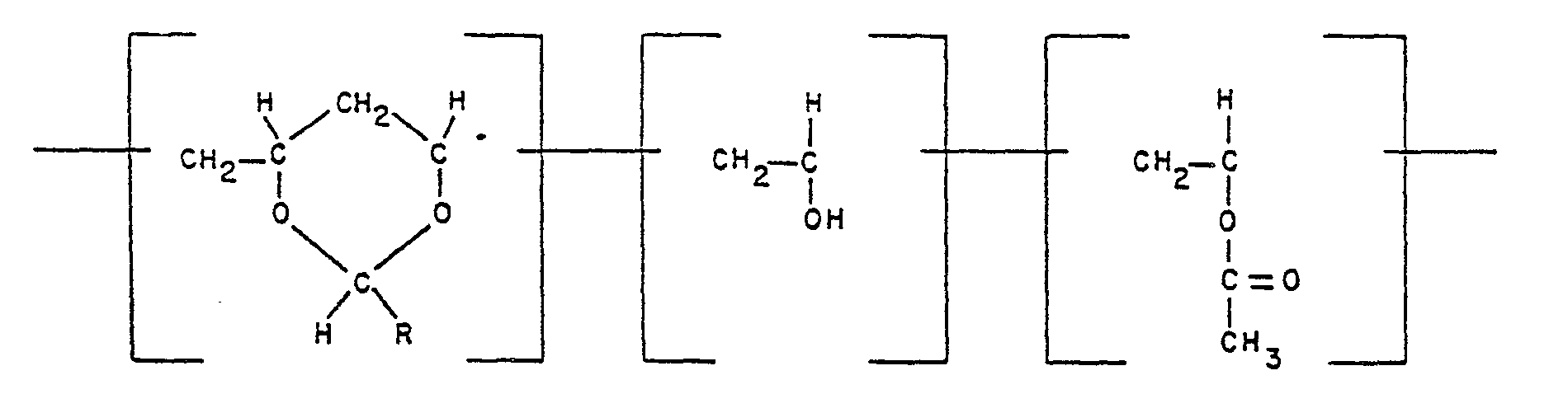
[0016] In synthesis, the conditions of the acetal reaction and the concentration of the particular aldehyde and polyvinyl alcohol used are closely controlled to form polymers containing predetermined properties of hydroxyl groups, acetate groups, and acetal groups. The product obtained may be represented by the following generic structural formula wherein the proportions of A, B, and C are controlled and are randomly distributed along the molecule.
[0017] As earlier indicated, these materials are commercially available from Monsanto Plastics and Resins, St. Louis, Missouri under various tradenames such as Butvar and Formvar. Number designations have been given for . these commercial compositions and provide a summary indication of the molecular nature of the polymer. For example, the first digits of the Formvar resins indicate the viscosity of the polyvinyl acetate from which the resin was made. The second digits indicate the extent to which acetate groups have been removed by hydrolysis. For example, Formvar 12/85 is made from a polyvinyl acetate having a viscosity of 12.0 cps (viscosity of a benzene solution containing 86 grams of polyvinyl acetate per 1000 ml. of solution, measured at 20° C.). Approximately 85 percent of the acetate groups have been replaced with alcohol and formal groups.
[0018] Formvar resins can be described in general terms by their viscosity and solubility characteristics. Formvar 12/85 has the widest solubility range and is a medium viscosity type. All other types are more limited in solubility but are available in several viscosity ranges.
[0019] In Butvar resins, the acetate content is maintained at a low level and therefore exerts little influence on polymer properties. They are available in a variety of molecular weight ranges and types B-76 and B-79 have a lower hydroxyl content which permits broader solubility characteristics.
[0020] As a general rule, the substitution of butyral or formal groups for acetate groups results in a more hydrophobic polymer with a higher heat distortion temperature. At the same time, the polymer's toughness and adhesion to various substrates is considerably increased. The outstanding adhesion of the vinyl acetal resins is believed to be a result of their terpolymer constitution because each molecule presents the choice of three different functional groups to a surface and thus the probability of adhesion to a wide variety of substrates is increased substantially.
[0021] Although polyvinyl acetal resins normally are thermoplastic and soluble in a range of solvents, they may be cross-linked through heating and with a trace of mineral acid. Cross-linking is thought to be caused by trans- acetalization, but may also involve more complex mechanisms such as a reaction between acetate or hydroxyl groups on adjacent chains. Generally, cross-linking of the polyvinyl acetals is carried out by reaction with various thermosetting resins such as phenolics, epoxies, ureas, di-isocyanates and melamines. Incorporation of a small amount of vinyl acetal resin into thermosetting compositions will markedly improve toughness, flexibility and adhesion of the cured coating.
[0022] . Vinyl acetal films are characterized by high resistance to aliphatic hydrocarbons, mineral, animal and vegetable oils (with the exception of castor - and blown oils). They withstand strong alkalis but are subject to some attack by strong acids. However, when employed as components of cured coatings, their stability to acids as well as solvents and other chemicals is improved greatly. The vinyl acetals will withstand heating up to 93°C for prolonged periods with little discoloration.
[0023] The carrier coating compositions of this invention may have a weight average molecular weight of between about 30,000 and about 270,000 and preferably between about 30,000 and about 45,000. Further, the coating compositions comprise from between about 1.0 and about 21.0 percent polyvinyl alcohol, from between about 0 and about 2.5 percent polyvinyl acetate, and from between about 80.0 and about 88.0 percent polyvinyl acetal, all percentages being by weight of the composition. In addition, these polymers have a yield tensile strength of between about 5800 and about 7800 psi, and an apparent modulus of elasticity of between about -280,000 and about 340,000 psi, as determined by ASTM method D638-58T. As to the thermal properties, the polymers have an apparent glass temperature (Tg) of between about 48° C. and about 68° C. as determined by ASTM method D1043-51.
[0024] In the preparation of the carrier materials of this invention, a coating solution is applied to the carrier core particles to provide them with a thin, substantially continuous coating of polyvinyl acetal. The polyvinyl acetal coating is applied to the carrier core particles by dissolving the coating material in a suitable solvent such as methyl ethyl ketone and dipping, tumbling or spraying the core particles with the coating solution. Preferably, a fluidized bed coating process is employed as typically a more uniform coating is provided to the carrier core particles. In such a coating process, the core particles are suspended and circulated in an upwardly flowing stream of heated air so that the particles are sprayed by the coating material in a first zone. Then, in a second zone, the particles settle through an air stream of lower air velocity where the solvent evaporates to form a thin solid coating on the particles. Successive layers of coating on the particles are obtained by recirculating them through the first and second zones of the fluid bed coating apparatus.
[0025] Any suitable coating weight or thickness of polyvinyl acetal may be employed to coat the carrier core particles. However, a coating having a thickness at least sufficient to form a substantially continuous film on the core particles is preferred because the carrier coating will then possess sufficient thickness to resist abrasion and minimize pinholes which may adversely affect the triboelectric properties of the coated carrier particles, and also in order that the desired triboelectric effect to the carrier is obtained and to maintain a sufficient negative charge on the carrier, the toner being charged positively in such an embodiment so as to allow development of negatively charged images to occur. Generally, for cascade and magnetic brush development, the carrier coating may comprise from about 0.05 microns to about 3.0 microns in thickness on the carrier particle. Preferably, the coating should comprise from about 0.2 microns to about 0.7 microns in thickness on the carrier particle because maximum coating durability, toner impaction resistance, and copy quality are achieved. To achieve further variation in the properties of the final coated product, other additives such as plasticizers, reactive or nonreactive resins, dyes, pigments, conductive fillers such as carbon black, wetting agents and mixtures thereof may be mixed with the coating material. In addition, where the carrier core is a magnetizable material, it is possible to provide carrier particles having magnetic properties.
[0026] Following application of the coating to the carrier particles of this invention, it has been found that, when the carrier particles are mixed with a conventional toner material such as one comprising a styrene/n-butyl methacrylate copolymer and carbon black, the triboelectric charge generated on the carrier particles is of a positive polarity. Since such a triboelectric charge is unsuitable to provide satisfactory developed image print density with a negatively charged photoconductive surface, it has been found that when these coated carrier particles are mixed with finely-divided toner particles containing a triboelectric charge control additive, the carrier particles of this invention unexpectedly obtain negative triboelectric charging values in the range of between about -15 to about -40 microcoulombs per gram of toner material. It was found that the triboelectric charging values of the thus coated carrier particles are excellent to provide developed copies having high image print density, high resolution and low background. In addition, the triboelectric charging values of the carrier particles remain stable over extended periods of milling.
[0027] Any suitable well-known coated or uncoated carrier material may be employed as the core or substrate for the carrier particles of this invention. Typical carrier core materials are methyl methacrylate, glass, silicon dioxide, flintshot, ferromagnetic materials such as iron, steel, ferrite, magnetite, nickel, and mixtures thereof. An ultimate coated carrier particle having an average diameter in the range substantially 30 microns to substantially 1,000 microns is preferred because the carrier particle then possesses sufficient density and inertia to avoid adherence to the electrostatic images during the development process. Adherence of carrier particles to an electrostatographic drum is undesirable because of the formation of deep scratches on the drum surface during the image transfer and drum cleaning steps, particularly where cleaning is accomplished by a web cleaner such as the web disclosed by W. P. Graff, Jr., et al. in U.S. Patent 3,186,838.
[0028] Any suitable pigmented or dyed toner material may be employed with the carrier particles of this invention. Typical toner materials are gum copal, gum sandarac, resin, cumarone-indene resin, asphaltum, gilsonite, phenolformaldehyde resins, resin-modified phenolformaldehyde resins, methacrylic resins, polystyrene resins, epoxy resins, polyester resins, polyethylene resins, vinyl chloride resins, and copolymers or mixtures thereof. The particular toner material to be employed depends upon the separation of the toner particles from the carrier particles in the triboelectric series. However, it is preferred that the toner material comprise styrene and a lower alkyl acrylate or methacrylate such as methyl methacrylate, n-butyl methacrylate, and 2-ethyl hexyl methacrylate in the form of mixtures or copolymers and terepolymers thereof. Among the patents describing toner compositions are U.S. Patent 2,659;670 issued to Copley; U.S. Patent 2,753,308 issued to Landrigan; U.S. Patent 3,070,342 issued to Insalaco; U.S. Reissue 25,136 to Carlson, and U.S. Patent 2,788,288 issued to Rheinfrank et al. These toners generally have an average particle diameter in the range substantially 5 to 30 microns.
[0029] Any suitable pigment or dye may be employed as the colorant for the toner particles. Colorants for toners are well known and are, for example, carbon black, nigrosine dye, aniline blue, Calco Oil Blue, chrome yellow, ultramarine blue, Quinoline Yellow, methylene blue chloride, Monastral Blue, Malachite Green Oxalate, lampblack, Rose Bengal, Monastral Red, Sudan Black BN, and mixtures thereof. The pigment or dye should be present in the toner in a sufficient quantity to render it highly colored so that it will form a clearly visible image on a recording member.
[0030] Any suitable triboelectric charge controlling additive may be employed in the toner composition. Preferably, the additive will be one that enhances the positive triboelectric charging characteristics of the toner particles. Typical triboelectric charge controlling additives for this purpose include cetyl pyridinium chloride, cetyl pyridinium bromide, cetyl pyridinium tolsylate, cetyl alpha picolinium bromide, cetyl beta picolinium chloride, cetyl gamma picolinum bromide, n-lauryl, n-methyl morpholinium bromide, n,n-dimethyl n-cetyl hydrazinium chloride, and n,n-dimethyl n-cetyl hydrazinium tolsylate available from Hexcel Company; tetraethyl ammonium bromide available from Eastman Kodak Company; spirit soluble black dyes such as Nigrosine SSB, 3-lauramidopropyl trimethylammonium methylsulfate, stearamidopropyl dimetyl B-hydroxyethyl ammonium dihydrogen phosphate, and stearamidopropyl dimethyl B-hydroxyethyl ammonium nitrate available from American Cyanamid Company; alkyl dimethyl benzyl ammonium chloride, cetyl dimethyl benzyl ammonium chloride, and stearyl dimethyl benzyl ammonium chloride available from Hexcel Company; distearyl dimethyl ammonium chloride available from Ashland Chemical Company; di-isobutyl- cresoxylthoxyethyl dimethyl benzyl ammonium chloride available from Rohm and Haas Co.; and substituted imidazolines available from Ciba-Geigy Corporation.
[0031] Any suitable conventional toner concentration may be employed with the carrier particles of this invention. Typical toner concentrations are 1 part toner with 10 to 200 parts by weight of carrier.
[0032] Any suitable well-known electrophotosensitive material may be employed as the photoreceptor with the carrier particles of this invention. Well-known photoconductive materials are vitreous selenium, organic or inorganic photoconductors embedded in a non-photoconductive matrix, organic or inorganic photoconductors embedded in a photoconductive matrix, or the like. Representative patents in which photoconductive materials are disclosed include U.S. Patent 2,803,542 issued to Ullrich, U.S. Patent 2,970,906 issued to Bixby, U.S. Patent 3,121,006 issued to Middleton, U.S. Patent 3,121,007 issued to Middleton, and U.S. Patent 3,151,982 issued to Corrsin.
[0033] In the following examples, the relative triboelectric values generated by contact of carrier particles with toner particles are measured by means of a Faraday Cage. This device comprises a stainless steel cylinder having a diameter of about 25mm and a length of about 25mm. A screen is positioned at each end of the cylinder; the screen openings are of such a size as to permit the toner particles to pass through the openings but prevent the carrier particles from making such passage. The Faraday Cage is weighed, charged with about 0.5 gram of the carrier particles and toner particles, reweighed, and connected to the input of a coulomb meter. Dry compressed air is then blown through the cylinder to drive all the toner particles from the carrier particles. As the electrostatically charged toner particles leave the Faraday Cage, the oppositely charged carrier particles cause an equal amount of electronic charge to flow from the Cage, through the coulomb meter, to ground. The coulomb meter measures this charge which is then taken to be the charge on the toner which was removed. Next, the cylinder is reweighed to determine the weight of the toner removed. The resulting data are used to calculate the toner concentration and the average charge to mass ratio of the toner. Since the triboelectric measurements are relative, the measurements should for comparative purposes be conducted under substantially identical conditions. Other suitable toners may be substituted for the toner composition used in the examples.
[0034] The following examples, other than the control example, further illustrate and compare methods of preparing and utilizing the carrier particles of the present invention in electrostatographic applications. Parts and percentages are by weight unless otherwise indicated.
EXAMPLE I
[0035] A developer mixture was prepared by first applying a coating composition to steel carrier particles having an average diameter of about 100 microns. The coating composition comprised polyvinyl butyral commercially available as Butvar 98 from Monsanto Plastics and Resins, St. Louis, Missouri. The coating composition was diluted with methyl ethyl ketone and applied to the carrier particles in a fluidized bed coating apparatus. About 0.2 parts by weight solids of the coating composition was applied per about 100 parts of the carrier particles. After removal of the solvent, the coated carrier particles were dried by heating in an oven at about 75° C for about 30 minutes to remove any residual solvent. The coated carrier particles were cooled to room temperature and screened to remove agglomerated particles. About 100 parts of the screened carrier particles were mixed with about 3 parts of finely-divided toner particles to form a developer mixture. The composition of the toner particles comprised styrene, methyl methacrylate, 2-ethylhexyl methacrylate, carbon black, and 3-Iauramidopropyl trimethylammonium methylsulfate. The developer mixture was roll-mill mixed and samples taken therefrom after about 1 and about 6 hours for measurement of the triboelectric charge generated on the carrier particles as indicated above. The triboelectric value was found to be about -26.3 and -17.8 microcoulombs per gram of toner particles, respectively.
EXAMPLE II
[0036] A developer mixture was prepared by first applying a coating composition to steel carrier particles having an average diameter of about 100 microns. The coating composition comprised polyvinyl butyral commercially available as Butvar 98 from Monsanto Plastics and Resins, St. Louis, Missouri. The coating composition was diluted with methyl ethyl ketone and applied to the carrier particles in a fluidized bed coating apparatus. About 0.15 parts by weight solids of the coating composition was applied per about 100 parts of the carrier particles. After removal of the solvent, the coated carrier particles were dried by heating in an oven at about 75° C for about 30 minutes to remove any residual solvent. The coated carrier particles were cooled to room temperature and screened to remove. agglomerated particles. About 100 parts of the screened carrier particles were mixed with about 3 parts of finely-divided toner particles to form a developer mixture. The composition of the toner particles was the same as in Example I. The developer mixture was roll-mill mixed and samples taken therefrom after about 1 and about 6 hours for measurement of the triboelectric charge generated on the carrier particles as indicated above. The triboelectric value was found to be about -27.9 and -18.7 microcoulombs per gram of toner particles, respectively.
EXAMPLE III
[0037] A developer mixture was prepared by first applying a coating composition to steel carrier particles having an average diameter of about 100 microns. The coating composition comprised polyvinyl butyral commercially available as Butvar 98 from Monsanto Plastics and Resins, St. Louis, Missouri. The coating composition was diluted with methyl ethyl ketone and applied to the carrier particles in a fluidized bed coating apparatus. About 0.1 parts by weight solids of the coating composition was applied per about 100 parts of the carrier particles. After removal of the solvent, the coated carrier particles were dried by heating in an oven at about 75° C for about 30 minutes to remove any residual solvent. The coated carrier particles were cooled to room temperature and screened to remove agglomerated particles. About 100 parts of the screened carrier particles were mixed with about 3 parts of finely-divided toner particles to form a developer mixture. The composition of the toner particles was the same as in Example I. The developer mixture was roll-mill mixed and samples taken therefrom after about 1 and about 6 hours for measurement of the triboelectric charge generated on the carrier particles as indicated above. The triboelectric value was found to be about -26.6 and -19.0 microcoulombs per gram of toner particles, respectively.
EXAMPLE IV
[0038] A developer mixture was prepared by first applying a coating composition to steel carrier particles having an average diameter of about 100 microns. The coating composition comprised polyvinyl butyral commer- mercially available as Butvar 79 from Monsanto Plastics and Resins, St. Louis, Missouri. The coating composition was diluted with methyl ethyl ketone and applied to the carrier particles in a fluidized bed coating apparatus. About 0.15 parts by weight solids of the coating composition was applied per about 100 parts of the carrier particles. After removal of the solvent, the coated carrier particles were dried by heating in an oven at about 75° C for about 30 minutes to remove any residual solvent. The coated carrier particles were cooled to room temperature and screened to remove agglomerated particles. About 100 parts of the screened carrier particles were mixed with about 3 parts of finely-divided toner particles to form a developer mixture. The composition of the toner particles was the same as in Example I. The developer mixture was roll-mill mixed and samples taken therefrom after about 1 and about 6 hours for measurement of the triboelectric charge generated on the carrier particles as indicated above. The triboelectric value was found to be about -25.0 and -30.8 microulombs per gram of toner particles, respectively.
EXAMPLE V
[0039] A developer mixture was prepared by first applying a coating composition to steel carrier particles having an average diameter of about 100 microns. The coating composition comprised polyvinyl butyral commercially available as Butvar 79 from Monsanto Plastics and Resins, St. Louis, Missouri. The coating composition was diluted with methyl ethyl ketone and carbon black commercially available as Vulcan XC-72 from Cabot Corporation, Boston, Mass., was dispersed therein. The polymer solution-carbon black dispersion was applied to the carrier particles in a fluidized bed coating apparatus. About 0.2 parts by weight solids of the polymer and about 0.05 parts by weight solids of the carbon black was applied per about 100 parts of the carrier particles. After removal of the solvent, the coated carrier particles were dried by heating in an oven at about 75° C for about 30 minutes to remove any residual solvent. The coated carrier particles were cooled to room temperature and screened to remove agglomerated particles. About 100 parts of the screened carrier particles were mixed with about 3 parts of finely-divided toner particles to form a developer mixture. The composition of the toner particles was the same as in Example I. The developer mixture was roll-mill mixed and samples taken therefrom after about 1 and about 6 hours for measurement of the triboelectric charge generated on the carrier particles as indicated above. The triboelectric value was found to be about -23.8 and -15.5 microcoulombs per gram of toner particles, respectively.
EXAMPLE VI
[0040] A developer mixture was prepared by first applying a coating composition to steel carrier particles having an average diameter of about 100 microns. The coating composition comprised polyvinyl butyral commercially available as Butvar 79 from Monsanto Plastics and Resins, St. Louis, Missouri. The coating composition was diluted with methyl ethyl, ketone and carbon black commercially available as Vulcan XC-72 from Cabot Corporation, Boston, Mass., was dispersed therein. The polymer solution-carbon black dispersion was applied to the carrier particles in a fluidized bed coating apparatus. About 0.4 parts by weight solids of the polymer and about 0.1 parts by weight solids of the carbon black was applied per about 100 parts of the carrier particles. After removal of the solvent, the coated carrier particles were dried by heating in an oven at about 75° C for about 30 minutes to remove any residual solvent. The coated carrier particles were cooled to room temperature and screened to remove agglomerated particles. About 100 parts of the screened carrier particles were mixed with about 3 parts of finely-divided toner particles to form a developer mixture. The composition of the toner particles was the same as in Example I. The developer mixture was roll-mill mixed and samples taken therefrom after about 1 and about 6 hours for measurement of the triboelectric charge generated on the carrier particles as indicated above. The triboelectric value was found to be about -24.7 and -21.5 microcoulombs per gram of toner particles, respectively.
EXAMPLE VII
[0041] A developer mixture was prepared by first applying a coating composition to steel carrier particles having an average diameter of about 100 microns. The coating composition comprised polyvinyl butyral commercially available as Butvar 79 from Monsanto Plastics and Resins, St. Louis, Missouri. The coating composition was diluted with methyl ethyl ketone and carbon black commercially available as Vulcan XC-72 from Cabot Corporation, Boston, Mass., was dispersed therein. The polymer solution-carbon black dispersion was applied to the carrier particles in a fluidized bed coating apparatus. About 0.7 parts by weight solids of the polymer and about 0.175 parts by weight solids of the carbon black was applied per about 100 parts of the carrier particles. After removal of the solvent, the coated carrier particles were dried by heating in an oven at about 75° C for about 30 minutes to remove any residual solvent. The coated carrier particles were cooled to room temperature and screened to remove agglomerated particles. About 100 parts of the screened carrier particles were mixed with about 3 parts of finely-divided toner particles to form a developer mixture. The composition of the toner particles was the same as in Example I. The developer mixture was roll-mill mixed and samples taken therefrom after about 1 and about 6 hours for measurement of the triboelectric charge generated on the carrier particles as indicated above. The triboelectric value was found to be about -29.6 and -22.5 microcoulombs per gram of toner particles, respectively.
[0042] In summary, it has been shown that electrostatographic carrier particles coated with a polyvinyl acetal will provide carrier particles having negative triboelectric charging properties. These carrier particles possess such desirable negative triboelectric charging characteristics combined with excellent mechanical properties, low cost, and facile processability. Further, the range of triboelectric charging values obtained is especially desirable and enables developer mixtures which provide maximum copy quality. Further, no post-treatment or fusing step is required in preparing the coated carrier particles of this invention such as with halogenated polymer coated carrier particles of the prior art.
[0043] Further, although specific materials and conditions are set forth in the foregoing examples, these are merely intended as illustrations of the present invention. Various other, suitable thermoplastic toner resin components, additives, colorants, and development processes such as those listed above may be substituted for those in the examples with similar results. Other materials may also be added to the toner or carrier to sensitize, synergize or otherwise improve other desirable properties of the system.
1. A carrier particle for electrostaographic developer mixtures, said carrier particles
comprising a core having an average diameter between 30 microns and 1000 microns,
and an outer coating, characterised in that the outer coating comprises a polyvinyl
acetal.
2. A carrier particle for electrostatographic developer mixtures in accordance with
claim 1 wherein said polyvinyl acetal comprises polyvinyl butyral.
3. A carrier particle for electrostatographic developer mixtures in accordance with
claim 1 wherein said polyvinyl acetal comprises polyvinyl formal.
4. A carrier particle for electrostatographic developer mixtures in accordance with
claim 1 wherein said outer coating has the generic structure
5. A carrier particle for electrostatographic developer mixtures in accordance with
any one of claims 1 to 4 wherein said outer coating has a weight average molecular
weight of between about 30000 and about 270000.
6. A carrier particle for electrostatogaphic developer mixtures in accordance with
any one of claims 1 to 5 wherein said polyvinyl acetal is present in an amount sufficient
to form a substantially continuous film on said core.
7. A carrier particle for electrostatographic developer mixtures in accordance with
any one of claims 1 to 6 wherein said outer coating is present in a thickness of from
0.2 microns to 0.7 microns.
8. A carrier particle for electrostatographic developer mixtures in accordance with
any one of claims 1 to 7 wherein said core comprises a ferromagnetic material selected
from the group consisting of iron, steel, ferrite, magnetite, nickel, and mixtures
thereof.
9. An electrostatographic developer mixture comprising finely-divided toner particles
electrostatically clinging to the surface of carrier particles, said carrier particles
being in accordance with any one of claims 1 to 8.
10. An electrostatographic imaging process comprising the steps of providing an electrostatographic
imaging member having a recording surface, forming a negatively charged electrostatic
latent image on said recording surface, and contacting said electrostatic latent.
image with the developer mixture of claim 9, whereby at least a portion of said finely-divided
toner composition is attracted to and deposited on said recording surface in conformance
with said electrostatic latent image.