|
(11) | EP 0 036 270 A1 |

| (12) | EUROPEAN PATENT APPLICATION |
|
|
|
|
|||||||||||||||||||||||||||
| (54) | Additives for hydrocarbon fuels |
| (57) An additive for a liquid hydrocarbon fuel comprising the following components in
the following ranges of relative proportions in % by volume of the total volume of
these components:
|
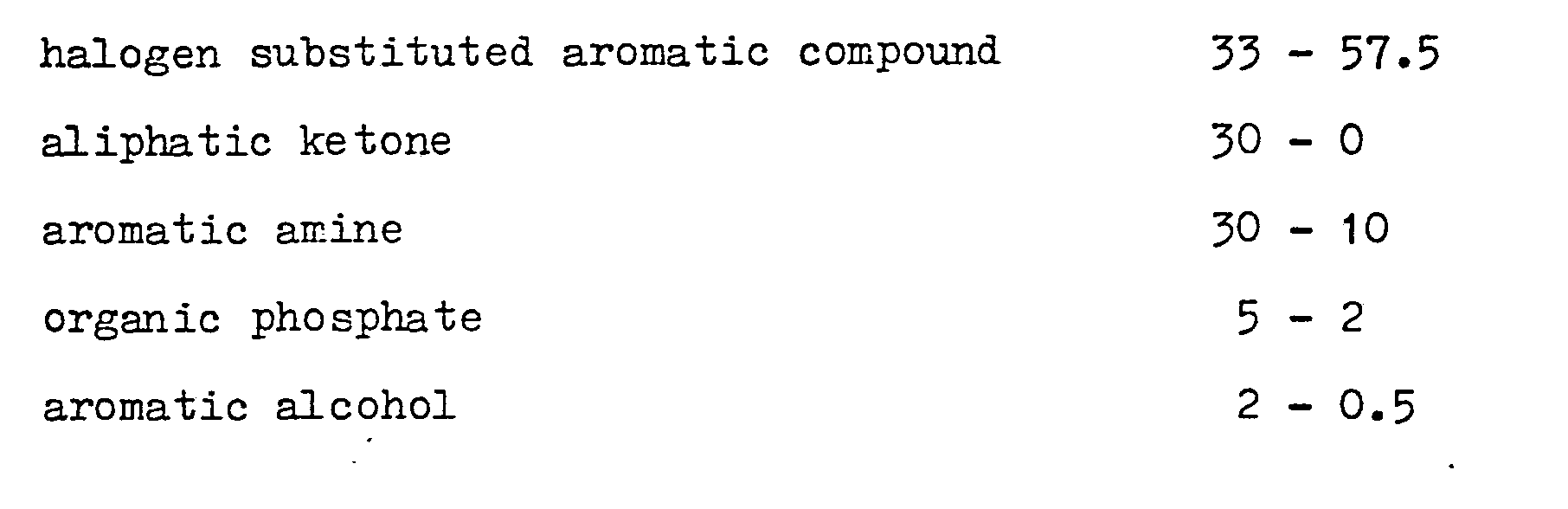
[0002] According to the invention there is provided an additive for a liquid hydrocarbon fuel comprising the following components in the following ranges of relative proportions in % by volume of the total volume of these components:
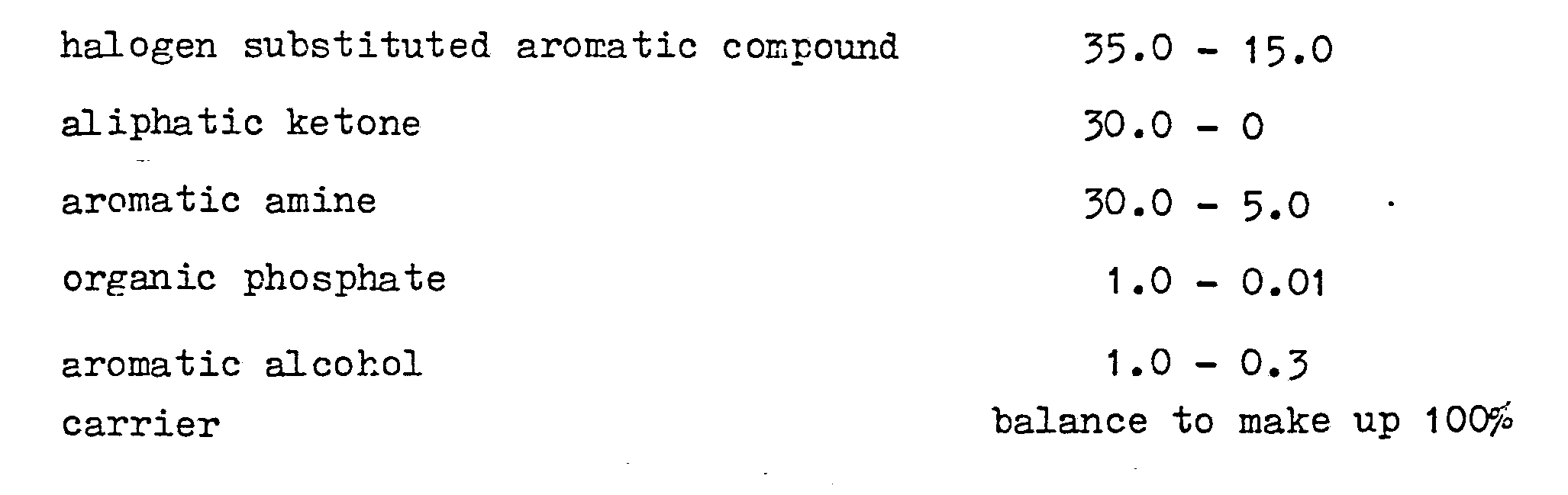
[0005] The additive is preferably dispersed in a carrier, preferably a liquid hydrcarbon carrier, e.g. oil in the range 10 second to 60 second,preferably 35 second oil. Preferred additives in such a carrier have the components within the following ranges in % by volume:
[0009] Also according to the invention, a liquid hydrocarbon fuel comprises additive (with or without a carrier) as defined above, preferably in the proportion by volume of ½ to 1 part additive to 1000 parts of fuel, preferably 1 part additive to 1000 parts of fuel.
[0010] The invention may be performed in various ways and some specific Examples will now be described by way of illustration.
Example 1
Example 2 .
[0015] The components are of commercially available quality. The hydrocarbon carrier is preferably oil in the range 10 second to 60 second, preferably 35 second. Other suitable carriers are for example petrol, paraffin, white spirit or fuel oils. The viscosity of the fuel oil may vary.
[0016] The additive may, for example, be used with the following liquid hydrocarbon fuels: petrol, diesel oil, paraffin for domestic heaters, kerosene and other fuels for jet engines, industrial fuel oil.
[0017] The additive (with carrier) is preferably added to the fuel in the proportion of 1 part additive, including carrier, per 1000 parts fuel by volume, but the amount of additive added may be varied to suit requirements, for example it may be more than 1 part per 1000 or it could be as low as ½ part per 1000 or even less.
[0019] It is possible to add the additive direct to the fuel without prior dispersion in a carrier. This is particularly applicable where the fuel is present in a large volume, for example in a commercial jet-propelled aircraft.
[0020] The specific formulation of the additive of the invention may need to be adjusted according to the kind of fuel to which it is to be added. For example when the additive is to be used with heavy fuel oils, for example 900 seconds oil, the quantity of amine present is preferably towards the lower end of the range particularly in the range 15-10 percent by volume based on the total volume of additive excluding carrier or 15-5 percent by volume based on the total volume of additive plus carrier.
[0021] In the case of an additive for petrol (that is to say gasoline) the aliphatic ketone can be omitted completely.
[0022] Consumption of hydrocarbon fuel with the additive present for the same output is less than the consumption of the same fuel but without the additive.
[0023] It is thought that the additive achieves this reduction in fuel consumption by increasing the proportion of fuel usefully burnt. In the case of a vehicle internal combustion engine there is an increase in achieved brake horse power and it may be possible to achieve an equivalent performance with a lower grade of petrol.
[0024] The halogen substituted aromatic compound is preferably a polychlorinated aromatic compound such as o- or m-dichlorobenzene, dichlorotoluene or trichlorobenzene.
1. An additive for a liquid hydrocarbon fuel comprising the following components in
the following ranges of relative proportions in % by volume of the total volume of
these components:
2. An additive as claimed in Claim 1 wherein the components are present in the following
relative proportions:

3. An additive as claimed in Claim 1 or Claim 2, dispersed in a carrier.
4. An additive as claimed in Claim 3, wherein the components are present in the following
proportions in % by volume:
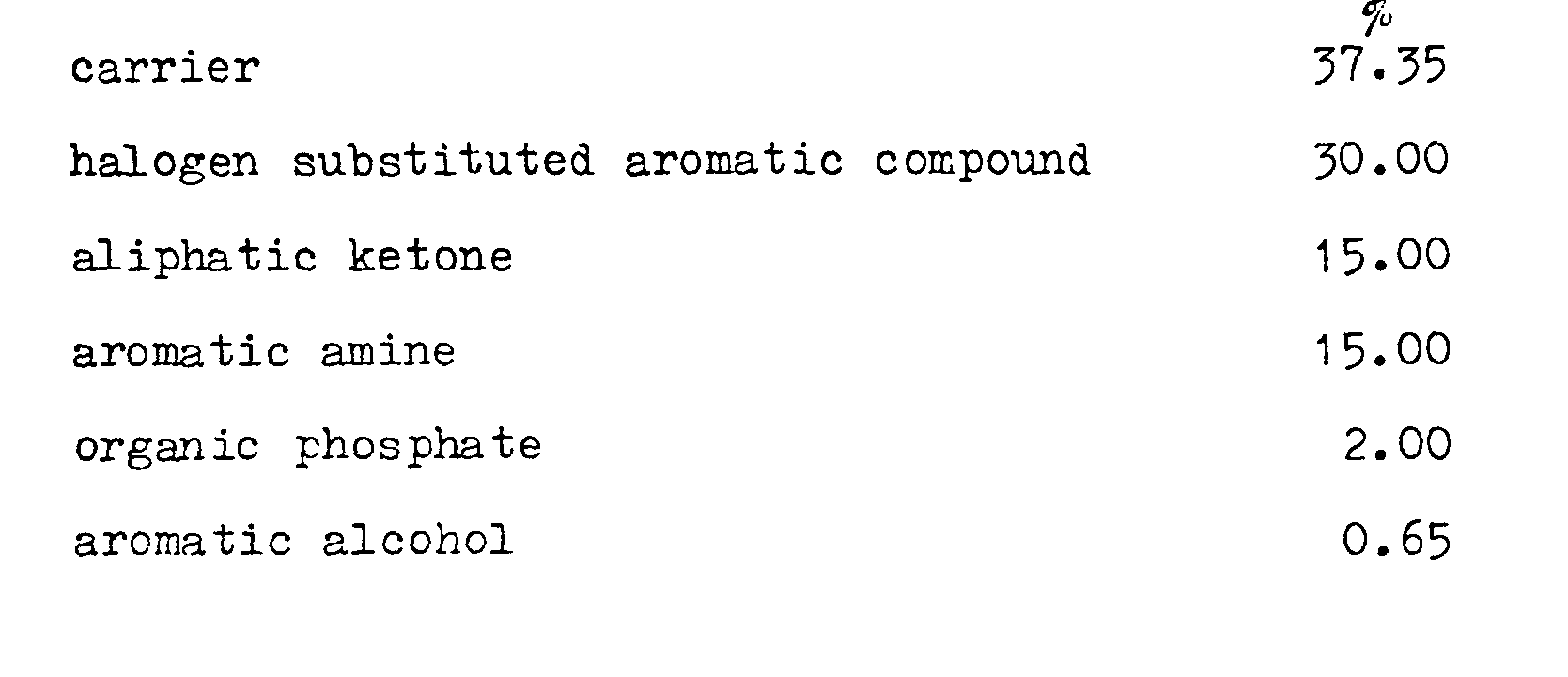
5. An additive as claimed in Claim 4, wherein the components are present in the following
proportions:
6. An additive as claimed in any preceding claim wherein the halogen substituted aromatic
compound is dichlorobenzene, dichlorotoluene or trichlorobenzene.
7. An additive as claimed in any preceding claim wherein the ketone is 2,6-dimethyl
heptan 4-one, 2-ethyl 6-methyl heptan 4-one, 2-propyl 6-methyl heptan 4-one or 2-propyl
6-ethyl-heptan 4-one.
8. An additive as claimed in any preceding claim wherein the aromatic amine is aniline
or methyl aniline.
9. An additive as claimed in any preceding claim, wherein the aromatic alcohol is
a xylenol.
10. An additive as claimed in any preceding claim wherein the carrier is an oil, petrol,
paraffin, white spirit, fuel oil or vegetable oil.
11. An additive as claimed in Claim 10, wherein the carrier is an oil in the range
10-60 seconds.
12. A hydrocarbon fuel including an additive as claimed in any preceding claim.
13. A fuel as claimed in Claim 12 wherein the additive is present in the range of
proportion from 0.5 to 1 part by volume additive to 1000 parts by volume of fuel.
14. A fuel as claimed in Claim 12 or Claim 13, wherein the fuel is a heavy fuel oil,
the proportion of amine in the additive being from 10 to 15% by volume based on the
total volume of additive components excluding carrier.
15. A fuel as claimed in Claim 12 or Claim 13, wherein the fuel is a gasoline and
the aliphatic ketone is omitted from the additive components.