| (19) |
 |
|
(11) |
EP 0 041 388 B1 |
| (12) |
EUROPEAN PATENT SPECIFICATION |
| (45) |
Mention of the grant of the patent: |
|
17.04.1985 Bulletin 1985/16 |
| (22) |
Date of filing: 01.06.1981 |
|
| (51) |
International Patent Classification (IPC)4: H02G 15/18 |
|
| (54) |
Heat recoverable closure assembly
Wärmerückstellbare Verschlussanordnung
Assemblage de fermeture thermorétractable
|
| (84) |
Designated Contracting States: |
|
AT BE CH DE FR IT LI NL SE |
| (30) |
Priority: |
02.06.1980 US 155817
|
| (43) |
Date of publication of application: |
|
09.12.1981 Bulletin 1981/49 |
| (71) |
Applicant: RAYCHEM CORPORATION (a California corporation) |
|
Menlo Park
California 94025 (US) |
|
| (72) |
Inventors: |
|
- Fentress, Vernon Alvin
CA. 94546 (US)
- Kinsch, Michael John
Half Moon Bay
California 94019 (US)
|
| (74) |
Representative: Benson, John Everett et al |
|
Raychem Limited
Intellectual Property Law Department
Faraday Road
Dorcan
Swindon, Wiltshire SN3 5HH
Swindon, Wiltshire SN3 5HH (GB) |
|
| |
|
| Note: Within nine months from the publication of the mention of the grant of the European
patent, any person may give notice to the European Patent Office of opposition to
the European patent
granted. Notice of opposition shall be filed in a written reasoned statement. It shall
not be deemed to
have been filed until the opposition fee has been paid. (Art. 99(1) European Patent
Convention).
|
[0001] This invention relates to a heat-recoverable closure assembly for enclosing e.g.
cable splices, to a support member or liner for use in such an assembly, and to a
method of enclosing a body using such an assembly, and cable splices enclosed thereby.
[0002] U.S. Patent Number 4142592 describes an assembly for protecting and insulating cable
splices wherein a heat-recoverable sleeve is shrunk down over a tubular support member
which surrounds the spliced cable and has flexible prongs or fingers at its ends which
can be deformed towards the cable to provide a tapered transition from the support
member to the cable surface. In that U.S. patent, the fingers are provided in end
pieces which fit into the generally tubular body of the support member, but the fingers
and support member body could be integrally formed if desired. The present invention
can be used to improve the vapour moisture resistance and heat-resistance of such
closure assemblies.
[0003] The present invention accordingly provides a heat-recoverable closure assembly comprising
a heat-recoverable outer sleeve surrounding a body to be enclosed thereby, a support
member surrounding the body and within the sleeve which support member has slotted
end portions arranged to be capable of forming a tapering transition from the support
member to the body, and a flexible barrier layer associated with at least the slotted
portions of the support member and bridging the slots thereof. The flexible barrier
layer may cover substantially all of one major surface of the support member as well
as bridging the slots of the slotted portions.
[0004] The barrier layer may be a vapour moisture barrier, for which purpose a metallic
layer carried on a flexible carrier member is preferred, or the barrier may be a heat
barrier, for which purpose flexible foam sheet is preferred. Both of these purposes
may be served by a barrier comprising a metallic layer laminated with a flexible foam
sheet.
[0005] The barrier layer may be inside or outside the support member as installed around
the body to be enclosed, according to end use requirements, and it will be understood
that the use of a heat barrier outside the support member is preferred when thermoplastic
support members are to be used, the heat barrier then being arranged substantially
to prevent thermal deformation of the support member during heat recovery of the sleeve.
Preferably, the barrier layer will cover substantially the whole of a major surface
of the support.
[0006] Metal supports, as known per se, can benefit from the present invention by virtue
of reduced heat build up within the metal support during recovery of the heat-recoverable
sleeve, and by reduced ingress of moisture at the slotted end portions. Thermoplastic
supports can be used to provide relatively inexpensive closures, which nevertheless
can have sufficient strength for use in forming cable splice enclosures of up to 200
mm diameter, calcium carbonate filled polypropylene being a preferred thermoplastic
material for the support, and flexible foams of suitably high melting point, such
as neoprene foam or cross-linked polyolefin end portions. Thermoplastic supports can
be used to provide relatively inexpensive closures, which nevertheless can have sufficient
strength for use in forming cable splice enclosures of up to 200 mm diameter, calcium
carbonate filled polypropylene being a preferred thermoplastic material for the support,
and flexible foams of suitably high melting point, such as neoprene foam or cross-linked
polyolefin foam being preferred as the heat barrier layer for such thermoplastic supports.
[0007] The support and the barrier layer may be laminated together, convenient materials
such as adhesives and convenient techniques being readily selected by a person familiar
with such technology, and the resulting laminate may also include other layers. For
example it may comprise the support, a vapour impermeable moisture barrier layer and
a foam heat barrier layer. In the latter case, the moisture barrier layer may be sandwiched
between the foam and the support, or may be carried on the outer surface of the foam.
Other arrangements may also be used according to need. For example, the moisture barrier
layer could be carried on the inner surface of the heat-recoverable sleeve, which
can then receive the usual coating of heat activatable adhesive or sealant.
[0008] The support may be a flexible metal shield, or may comprise hinged segments of substantially
rigid metal, and it will be understood that the support may have score lines or indentations
in its surface arranged to facilitate wrapping around the body, such as a cable splice,
to be protected.
[0009] In use, when the support is placed around the body to be protected and the slotted
end portions or fingers are tapered down on to the body in question, e.g. to form
a tapered transition from the support member to a cable surface, the barrier layer,
being flexible, folds so as not to hinder the tapering of the fingers, while maintaining
a barrier action by virtue of its bridging the slots. The assembly of the present
invention is thus surprisingly versatile and can be advantageously adapted to improve
the end result in a variety of working environments.
[0010] Embodiments of the invention will now be described in more detail with reference
to the accompanying drawings wherein:
Figure 1 shows a closure assembly of known type having a heat-recoverable sleeve 8
surrounding a support member 5 with slotted end portions 1;
Figure 2 shows the assembly of Figure 1 installed around a cable splice 10 with the
sleeve 8 recovered on to the support 5 and the slotted end portions 1 tapered on to
the surface of the cable 11;
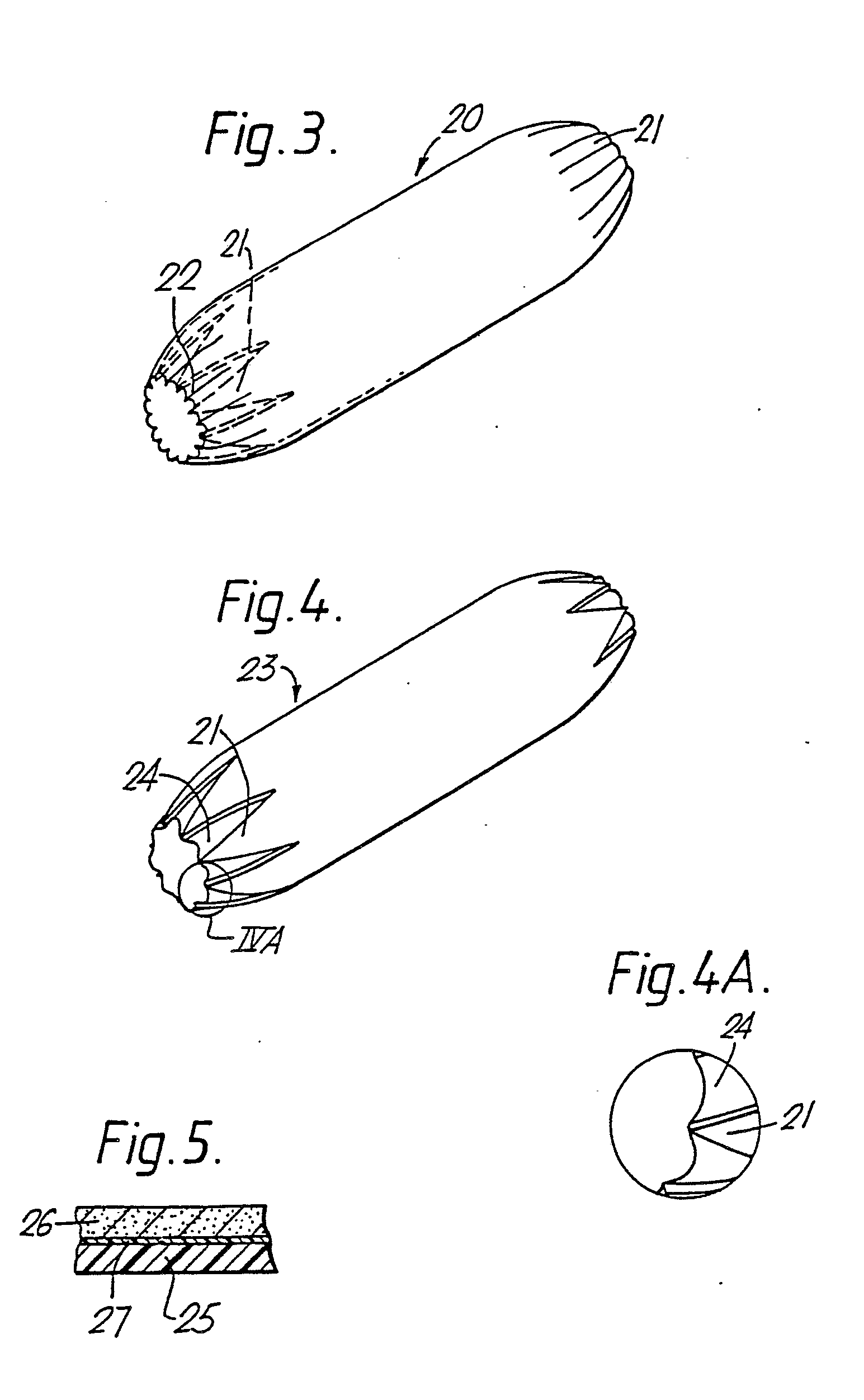
Figure 3 shows a support member 20 according to the present invention with the slotted
portions 21 formed integrally therewith, and the barrier layer 22 on the outside thereof
and covering not only the slotted end portions but substantially all of the outer
surface of the support, which support is wrapped as it would be when placed around
a body such as a cable;
Figure 4 shows a support member according to the present invention which is similar
to that shown in Figure 3, except that the barrier layer 24 is inside a support member
23;
Figure 4a shows a magnified detail of the support shown in Figure 4, with the vapour
moisture barrier 24 clearly bridging the slots between the fingers 21; and
Figure 5 illustrates a preferred laminated structure comprising a thermoplastic support
member 25 and a foamed polymeric heat barrier 26 between which layers is sandwiched
a flexible substantially vapour impermeable moisture barrier metallic layer 27.
[0011] Referring now to the drawings, Figures 3 and 4 show how the principle of the present
invention can be applied to supports such as the support 5 shown in Figures 1 and
2, since it is immaterial to the present invention whether or not the fingers are
formed integrally with the body of the support.
[0012] Figure 3 shows a support member 20 of calcium carbonate filled polypropylene having
slotted end portions arranged to form fingers 21 integrally with the body of the support,
and a thermal barrier layer 22 of foamed neoprene (alternatively foamed cross-linked
polyethylene) having sufficient heat resistance to avoid melting at temperatures encountered
within the closure assembly in operation. The foam is flexible and bridges the slots
between fingers 21 so as to provide a continuous barrier, and may be laminated with
a vapour moisture barrier layer (not shown) e.g. a metallic layer, to enhance the
moisture resistance of the assembly. The structure shown in Figure 5 comprising thermoplastic
support member 25, metallic vapour barrier 27 and foam thermal barrier layer 26 could
be used in this connection.
[0013] Figure 4 shows a support member 23 which is made of metal (or other material which
is substantially infusible at temperatures encountered in use) and has an internal
moisture barrier layer 24 bridging the slots between fingers 21. This moisture barrier
layer could of course cover the whole internal surface of the support if the support
material has any significant degree of moisture vapour permeability. The vapour barrier
is a metallic coating carried on a flexible sheet, and the flexible sheet may be the
aforementioned foam if it is desired to enhance the thermal insulation of the assembly.
The construction of Figure 5 would again be suitable (but in reversed order from inside
to outside) provided that the material of support member 25 were capable of withstanding
the temperatures encountered in use without an external thermal barrier layer. The
metal support exemplified in Figure 4 could alternatively have a plastics barrier
layer on one or both of its major surfaces, and could be indented or scored to provide
hinged portions capable of facilitating wrapping of the support around a body such
as a cable splice. Even if the indentations should cause the metal to break when a
support is thus wrapped, the plastics coating would tend to remain intact, owing to
its flexibility, thus maintaining the hinge connection and the protective function
of the support.
[0014] The invention also provides a method of enclosing a body, comprising positioning
about the body the aforementioned support layer, the aforementioned barrier layer,
and the aforementioned sleeve, and heating to effect recovery of the sleeve about
the body. A cable splice enclosed by this method or otherwise enclosed in a heat-recoverable
closure assembly according to this invention is a major concern of this invention,
and it will be understood that a kit of parts for making such cable splices can be
provided.
[0015] The heat-recoverable sleeve may be any known suitable sleeve, either of the "ciosed"
or "wraparound" kind, for example using elastic memory as described in our U.S. patents
2027962, 3086242, and 3957372, or using elastomeric recovery after a support holding
the sleeve in a stretch state is softened by heating, as described in our British
patent 1440524.
[0016] The aforementioned filled polypropylene support members are preferably 0.8 to 1.2
mm in thickness, and it will be understood that the barrier layer need not cover the
entire surface of the support, although this is usually preferred.
1. A heat-recoverable closure assembly comprising a heat-recoverable outer sleeve
surrounding a body to be enclosed thereby, a support member (20) surrounding the body
and within the sleeve which support member (20) has slotted end portions (21) arranged
to be capable of forming a tapering transition from the support member to the body,
characterised in that a flexible barrier layer (22) is associated with at least the
slotted portions of the support member (20) and bridges the slots thereof.
2. A heat-recoverable closure assembly according to claim 1, characterised in that
the flexible barrier layer (22) covers substantially all of one major surface of the
support member (20) as well as bridging the slots of the slotted portions thereof.
3. 'An assembly according to claim 1 or 2, characterised in that the barrier layer
(22) is a substantially vapour impermeable moisture barrier layer (27).
4. An assembly according to claim 1, 2 or 3, characterised in that the barrier layer
(22) comprises a metallic layer (27) carried on a flexible carrier member.
5. An assembly according to any preceding claim, characterised in that the barrier
layer (22) comprises a metallic layer (27) laminated with a flexible foam sheet (26).
6. An assembly according to claims 1 or 2, characterised in that the barrier layer
(22) is a heat barrier layer (26).
7. An asoenbly according to claim 1, 2 or 3, characterised in that the barrier layer
(22) comprises a flexible foam sheet.
8. An assembly according to any preceding claim, characterised in that the support
member (20) is thermoplastic (25) and the barrier layer (22) is a heat barrier layer
(26) arranged substantially to prevent-thermal deformation of at least part of the
support member (20) during heat recovery of the sleeve.
9. An assembly according to any of claims 1-3 and 6-8, characterised in that the support
member (20) is thermoplastic (25) and the barrier layer (22) comprises foamed polymeric
material (26) arranged substantially to prevent thermal deformation of at least part
of the support member (20) during heat recovery of the sleeve.
10. An assembly according to any of claims 1-3 and 6-9, characterised in that the
support member (20) is thermoplastic and the barrier layer (22) comprises foamed polymeric
material (26) covering substantially the whole surface of the support member (20)
which is outermost as installed around the body.
11. An assembly according to any of claims 1-3 and 8, characterised in that the barrier
layer (22) is a coating of polymeric material on one or both main surfaces of the
support member (20).
12. An assembly according to any preceding claim, characterised in that the barrier
layer (22) and the support member (20) are laminated together.
13. An assembly according to any preceding claim, characterised in that a heat barrier
layer (26) and the support member (20) and a substantially vapour impermeable moisture
barrier layer (27) are laminated together.
14. An assembly according to any preceding claim, characterised in that the support
member (20) is a flexible metal sheet.
15. An assembly according to any of claims 1-13, characterised in that the support
member (20) comprises hinged segments of substantially rigid metal.
16. An assembly according to any preceding claim, characterised in that the barrier
layer (22) is outside the support member (20) as installed around the body.
17. An assembly according to any of claims 1-15, characterised in that the barrier
layer (22) is inside the support member (20) as installed around the body.
18. An assembly according to any preceding claim, characterised in that it is installed
around a cable splice.
19. An assembly according to any of claims 1-17, wherein the body to be enclosed comprises
a cable.
20. A method of enclosing a body which comprises positioning about the body firstly
a support member (20) and a flexible barrier layer (22), and secondly a heat-recoverable
outer sleeve, characterised in that the support member (20) has slotted end portions
(21) arranged to be capable of forming a tapered transition from the support member
to-the body, and has the flexible barrier layer associated therewith such that it
bridges the slots of the slotted portions thereof.
21. A method according to claim 20 characterised in that the barrier layer (22) covers
substantially all of one major surface of the support member (20) as well as bridging
the slots of the slotted portions thereof.
22. A kit of parts, characterised in that it comprises a heat-recoverable sleeve,
a support member (20) and a barrier layer (22) for making a closure assembly according
to any of claims 1-17.
1. Wärmerückstellbare Verschlußanordnung, die eine wärmerückstellbare äußere Muffe,
die einen zu umschließenden Körper umgibt, und ein Stützelement (20) aufweist, das
den Körper umgibt und sich innerhalb der Muffe befindet, wobei das Stützelement (20)
geschlitzte Endabschnitte (21) hat, die derart angeordnet sind, daß sie einen konischen
Übergang von dem Stützelement zu dem Körper bilden, dadruch gekennzeichnet, daß eine
flexible Sperrschicht (22) wenigstens den geschlitzten Abschnitten des Stützelements
(20) zugeordnet ist und die Schlitze desselben überbrückt.
2. Wärmerückstellbare Verschlußanordnung nach Anspruch 1, dadurch gekennzeichnet,
daß die flexible Sperrschicht (22) im wesentlichen insgesamt eine Hauptfläche des
Stützelements (20) bedeckt sowie die Schlitze der geschlitzten Abschnitte desselben
überbrückt.
3. Anordnung nach Anspruch 1 oder 2, dadurch gekennzeichnet, daß die Sperrschicht
(22) eine im wesentlichen dampfundurchlässige Feuchtigkeitssperrschicht (27) ist.
4. Anordnung nach Anspruch 1, 2 oder 3, dadurch gekennzeichnet, daß die Sperrschicht
(22) eine metallische Schicht (27) aufweist, die auf einem flexiblen Trägerelement
getragen ist.
5. Anordnung nach einem der vorhergehenden Ansprüche, dadurch gekennzeichnet, daß
die Sperrschicht (22) eine metallische Schicht (27) aufweist, die mit einem flexiblen
Schaum-Flächenmaterial (26) laminiert ist.
6. Anordnung nach Anspruch 1 oder 2, dadurch gekennzeichnet, daß die Sperrschicht
(22) eine Wärmesperrschicht (26) ist.
7. Anordnung nach Anspruch 1, 2 oder 3, dadurch gekennzeichnet, daß die Sperrschicht
(22) ein flexibles Schaum-Flächenmaterial aufweist.
8. Anordnung nach einem der vorhergehenden Ansprüche, dadurch gekennzeichnet, daß
das Stützelement (20) thermoplastisch (25) ist und die Sperrschicht (22) eine Wärmesperrschicht
(26) ist, die im wesentlichen angeordnet ist, um die thermische Deformation wenigstens
eines Teils des Stützelements (20) während der Wärmerückstellung der Muffe zu verhindern.
9. Anordnung nach einem der Ansprüche 1 bis 3 und 6 bis 8, dadurch gekennzeichnet,
daß das Stützelement (20) thermoplastisch (25) ist, und daß die Sperrschicht (22)
ein geschäumtes polymeres Material (26) aufweist, das im wesentlichen vorgesehen ist,
um die thermische Deformation wenigstens eines Teils des Stützelements (20) während
der Wärmerückstellung der Muffe zu verhindern.
10. Anordnung nach einem der Ansprüche 1 bis 3 und 6 bis 9, dadurch gekennzeichnet,
daß das Stützelement (20) thermoplastisch ist und die Sperrschicht (22) geschäumtes
polymeres Material (26) aufweist, das im wesentlichen die gesamte Fläche des Stützelements
(20) bedeckt, das im um den Körper eingebauten Zustand am weitesten außen liegt.
11. Anordnung nach einem der Ansprüche 1 bis 3 und 8, dadurch gekennzeichnet, daß
die Sperrschicht (22) ein Überzug aus polymerem Material auf einer oder beiden Hauptflächen
des Stützelements (20) ist.
12. Anordnung nach einem der vorhergehenden Ansprüche, dadurch gekennzeichnet, daß
die Sperrschicht (22) und das Stützelement (20) zusammengeschichtet sind.
13. Anordnung nach einem der vorhergehenden Ansprüche, dadurch gekennzeichnet, daß
eine Wärmesperrschicht (26) und das Stützelement (20) und eine im wesentlichen dampfundurchlässige
Feuchtigkeitssperrschicht (27) zusammengeschichtet sind.
14. Anordnung nach einem der vorhergehenden Ansprüche, dadurch gekennzeichnet, daß
das Stützelement (20) ein flexibles Metallblech ist.
15. Anordnung nach einem der Ansprüche 1 bis 13, dadurch gekennzeichnet, daß das Stützelement
(20) Gelenksegmente aus im wesentlichen starrem Metall aufweist.
16. Anordnung nach einem der vorhergehenden Ansprüche, dadurch gekennzeichnet, daß
die Sperrschicht (22) außerhalb des Stützelements (20) im um den Körper eingebauten
Zustand vorgesehen ist.
17. Anordnung nach einem der Ansprüche 1 bis 15, dadurch gekennzeichnet, daß die Sperrschicht
(22) innerhalb des Stützelements (20) in seinem um den Körper eingebauten Zustand
vorgesehen ist.
18. Anordnung nach einem der vorhergehenden Ansprüche, dadurch gekennzeichnet, daß
sie um eine Kabelspleißung angebracht ist.
19. Anordnung nach einem der Ansprüche 1 bis 17, dadurch gekennzeichnet, daß der zu
umschliessende Körper ein Kabel ist.
20. Verfahren zum Umschließen eines Körpers, bei dem um den Körper zuerst ein Stützelement
(20) und eine flexible Sperrschicht (22) gelegt werden und dann eine wärmerückstellbare
äußere Muffe angebracht wird, dadurch gekennzeichnet, daß das Stützelement (20) geschlitzte
Endabschnitte (21) hat, die so angeordnet sind, daß sie fähig sind, einen konischen
Übergang von dem Stützelement zum Körper zu bilden, und das eine damit verbundene
flexible Sperrschicht derart hat, daß sie die Schlitze der geschlitzten Abschnitte
überrückt.
21. Verfahren nach Anspruch 20, dadurch gekennzeichnet, daß die Sperrschicht (22)
im wesentlichen eine Hauptfläche des Stützelements (20) insgesamt bedeckt sowie die
Schlitze der geschlitzten Abschnitte überbrückt.
22. Teilesatz, dadurch gekennzeichnet, daß er eine wärmerückstellbare Muffe, ein Stützelement
(20) und eine Sperrschicht (22) zur Herstellung einer Verschlußanordnung nach einem
der Ansprüche 1 bis 17 aufweist.
1. Assemblage de fermeture à reprise thermique comprenant un manchon extérieur à reprise
thermique entourant un corps devant être enfermé par celui-ci, un organe de support
(20) entourant le corps et, à l'intérieur du manchon, cet organe de support (20) présentant
des parties terminales fendues (21) qui sont agencées pour pouvoir établir une transition
convergente depuis l'organe de support jusqu'au corps, caractérisé en ce qu'une couche-barrière
flexible (22) est associée avec au moins les parties fendues de l'organe de support
(20) et pontent les fentes dans celui-ci.
2. Assemblage de fermeture à reprise thermique selon la revendication 1, caractérisé
en ce que la couche-barrière flexible (22) couvre sensiblement la totalité d'une surface
majeure de l'organe de support (20) et aussi ponte les fentes des parties fendues
de celui-ci.
3. Assemblage selon la revendication 1 ou 2, caractérisé en ce que la couche-barrière
(22) est une couche-barrière sensiblement imperméable de l'humidité de la vapeur (27).
4. Assemblage selon la revendication 1, 2 ou 3, caractérisé en ce que la couche-barrière
(22) comprend une couche métallique (27) portée sur un organe de support flexible.
5. Assemblage selon l'une quelconque des revendications précédentes, caractérisé en
ce que la couche-barrière (22) comprend une couche métallique (27) stratifiée à une
feuille de mousse flexible (26).
6. Assemblage selon la revendication 1 ou 2, caractérisé en ce que la couche-barrière
(22) est une couche de barrière thermique (26).
7. Assemblage selon la revendication 1, 2 ou 3, caractérisé en ce que la couche-barrière
(22) comprend une feuille de mousse flexible.
8. Assemblage selon l'une quelconque des revendications précédentes, caractérisé en
ce que l'organe de support (20) est thermoplastique (25) et la couche-barrière (22)
est une couche-barrière thermique (26) disposée sensiblement pour empêcher la déformation
thermique d'au moins une partie de l'organe de support (20) pendant la reprise thermique
du manchon.
9. Assemblage selon l'une quelconque des revendications 1 à 3 et 6 à 8, caractérisé
en ce que l'organe de support (20) est thermoplastique (25) et la couche-barrière
(22) comprend une mousse de matière polymère (26) disposée sensiblement pour empêcher
la déformation thermique d'au moins une partie de l'organe de support (20) pendant
la reprise thermique du manchon.
10. Assemblage selon l'une quelconque des revendications 1 à 3 et 6 à 9, caractérisé
en ce que l'organe de support (20) est thermoplastique et la couche-barrière (22)
comprend une mousse de matière polymère (26) couvrant sensiblement toute la surface
de l'organe de support (20) qui est le plus à l'extérieur lors de l'installation autour
du corps.
11. Assemblage selon l'une quelconque des revendications 1 à 3 et 8, caractérisé en
ce que la couche-barrière (22) est un revêtement en une matière polymère sur une ou
les deux surfaces principales de l'organe de support (20).
12. Assemblage selon l'une quelconque des revendications précédentes, caractérisé
en ce que la couche-barrière (22) et l'organe de support (20) sont stratifiés ensemble.
13. Assemblage selon l'une quelconque des revendications précédentes, caractérisé
en ce que la couche-barrière thermique (26) et l'organe de support (20) ainsi qu'une
couche-barrière d'humidité sensiblement imperméable à la vapeur (27) sont stratifiés
ensemble.
14. Assemblage selon l'une quelconque des revendications précédentes, caractérisé
en ce que l'organe de support (20) est en tôle métallique flexible.
15. Assemblage selon l'une quelconque des revendications 1 à 13, caractérisé en ce
que l'organe de support (20) comprend des segments en un métal sensiblement rigide
réunis par charnières.
16. Assemblage selon l'une quelconque des revendications précédentes, caractérisé
en ce que la couche-barrière (22) est à l'extérieur du l'organe de support (20) quand
il est installé autour du corps.
17. Assemblage selon l'une quelconque des revendications 1 à 15, caractérisé en ce
que la couche-barrière (22) est à l'intérieur de l'organe de support (20) quand il
est installé autour du corps.
18. Assemblage selon l'une quelconque des revendications précédentes, caractérisé
en ce qu'il est monté autour d'une épissure de câble.
19. Assemblage selon l'une quelconque des revendications 1 à 17, dans lequel le corps
à enfermer comprend un câble.
20. Procédé pour enfermer un corps qui consiste à positionner autour du corps d'abord
un organe de support (20) et une couche-barrière flexible (22). et, en second lieu,
un manchon extérieur à reprise thermique, caractérisé en ce que l'organe de support
(20) présente des parties terminales fendues (21) agencées pour pouvoir former une
transition convergente de l'organe de support au corps, et une couche-barrière flexible
est associée avec lui de façon à ponter les fentes dans les parties fendues du support.
21. Procédé selon la revendication 20, caractérisé en ce que la couche-barrière couvre
sensiblement la totalité d'une surface majeure de l'organe de support (20) et aussi
ponte les fentes de ses parties fendues.
22. Trousse de pièces, caractérisée en ce qu'elle comprend un manchon à reprise thermique,
un organe de support (20) et une couche-barrière (22) pour établir un ensemble de
fermeture selon l'une quelconque des revendications 1 à 17.