|
(11) | EP 0 041 748 A2 |

| (12) | EUROPEAN PATENT APPLICATION |
|
|
|
|
|||||||||||||||||||||||||||
| (54) | Manufacture of macrocyclic polyethers |
| (57) Process for the preparation of macrocyclic polyethers by reacting a sulphonyl halide
in the presence of a base and a halogen-containing solvent, preferably chlorobenzene,
with a glycol of the formula:-
wherein x is an integerfrom 1 to 9 inclusive, and each R, which may be the same or different, represents a hydrogen atom or an aryl or lower alkyl group, or two groups R bonded to adjacent carbon atoms may form together with these carbon atoms a cyclic hydrocarbyl group. The process is of special interest for the manufacture of 18-crown-6. |
[0001] The present invention relates to a process for the preparation of macrocyclic polyethers, commonly referred to as "crown ethers", and in particular to the preparation of 1,4,7,10,13,16-hexa- oxacyclooctadecane, also known as l8-crown-6.
[0002] Synthetic macrocyclic polyethers are of interest because they contain intra-molecular cavities of a shape and size which can accommodate alkali-metal or alkaline-earth ions.. Salts of alkali metals and alkaline-earth metal ions which are substantially insoluble can thus be rendered soluble in aqueous and/or organic solvents in the presence of certain macrocyclic polyethers. Macrocyclic polyethers, and especially 18-crown-6, have therefore found recognition as solvents for chemical reactions, and also as phase-transfer catalysts for chemical reactions.
[0003] A number of synthetic techniques have been proposed for preparing macrocyclic polyethers. Among those, reference may be made to the catalytic oligomerization of ethylene oxide, as described in US Patent Specification 3,928,386, leading to mixtures of various macrocyclic polyethers. The reaction of tetraethylene- glycol with bis-(2-chloroethyl) ether in the presence of potassium hydroxide and tetrahydrofuran without addition of water is described in "Synthesis" (1976) pages 515-516. However, even reaction times of at least 18 hours give only moderate yields, and the working-up procedure includes a distillation or distillative decomposition of the macrocyclic polyether (complex) produced. It is further known from J. Chem. Soc. Chem. Comm., 1978, pages 504-505 that macrocyclic polyethers may be prepared by reacting (un)substituted polyethylene glycols having suitable ethylenoxy units with a sulphonyl chloride in the presence of an alkali metal hydroxide in an aprotic solvent such as dioxane or dimethoxyethane, followed by pyrolysis of the salt complex obtained in order to liberate the macrocyclic polyether.
[0004] It is remarkable, however, that despite a fast growing interest in macrocyclic polyethers, no large scale preparations have yet been reported. It has now been found, and forms the subject of the present invention, that the use of a halogen-containing solvent enables macrocyclic polyethers to be prepared on a large scale without the serious disadvantage of either having to decompose a solid. complex or having to purify the product by distillation.
[0005] The present invention therefore relates to a process for the preparation of macrocyclic polyethers by reacting a sulphonyl halide in the presence of a base with a glycol of the formula:-
wherein x is an integer of from 1 to 9 inclusive; and each R, which may be the same or different, represents a hydrogen atom or an aryl or lower alkyl group, or two groups R bonded to adjacent carbon atoms form, together with these carbon atoms, a cyclic hydrocarbyl group, characterised in that the reaction is carried out in the presence of a halogen-containing solvent.
[0006] The process according to the present invention is of special interest for the preparation of macrocyclic polyethers from glycols of the above general formula wherein x is an integer of from 2 to 4 inclusive; and R represents a hydrogen atom or a lower alkyl group, and in particular to the preparation of 18- crown-6 by reacting triethylene glycol (x = 3) with a sulphonyl chloride in the presence of a base and a halogen-containing solvent.
[0007] It will be appreciated that the process according to the present invention may occur via cyclization of a polyethylene glycol derivative originating from the appropriate polyethylene glycol as well as via cyclization of polyethylene glycol.derivatives obtained from smaller polyethylene units which may have been subject to a condensation reaction. For instance, 18- crown-6 can be prepared starting from hexaethylene glycol but also starting from triethylene glycol or from mixtures containing triethylene glycol. It has been found in general that a polyethylene glycol having one oxygen atom more in the molecule than the macrocyclic polyether to be produced is to be preferred as a starting material over a lower polyethylene glycol unit having one oxygen atom more than half the amount of oxygen atoms present in the macrocyclic polyether to be produced, which tends to give a rather wide product range.
[0008] Sulphonyl halides which can suitably be used in the process according to the present invention include alkyl, aryl, alkaryl and aralkyl sulphonyl chlorides and bromides containing up to 12 carbon atoms in the molecule. Preference is given to the use of alkyl sulphonyl halides, and especially of alkyl sulphonyl chlorides having up to 6 carbon atoms in the molecule, such as methane sulphonyl chloride and ethane sulphonyl chloride, as well as to aryl and alkaryl sulphonyl halides having up to 12 carbon atoms in the molecule such as benzenesulphonyl chloride and toluene-p-sulphonyl chloride. Normally, the sulphonyl halide will be applied in the stoichiometrically required amount, though a moderate excess of the sulphonyl halide, e.g. up to 50% on polyethylene glycol intake, can sometimes be used to advantage.
[0009] Suitable bases which can be used in the process according to the present invention include inorganic bases, such as lithium hydroxide, sodium hydroxide, potassium hydroxide, calcium hydroxide and barium hydroxide, as well as mixtures of such bases. Metal alkoxides, such as potassium t-butoxide or isopropoxide, can also be used. They can be applied as solids, e.g. in the form of pellets, powders or flakes. Preference is given to the use of powdered potassium hydroxide or potassium hydroxide/sodium hydroxide mixtures. Normally an excess of base is used in order to facilitate the reaction. Up to 5 times the molar amount of base can be used conveniently, amounts up to 3 times being preferred. Very large amounts of base should be avoided as this may lead to a thick, unstirrable reaction mixture.
[0010] It should be noted that the handleability of the reaction mixture is a key issue in the manufacture of large quantities of macrocyclic polyethers. The use of oxygenated solvents such as tetrahydrofuran and dioxane, normally gives rise to serious working-up problems which do not occur, or occur only to a minor degree, in small-scale operations, and also requires a solvent switch during the working-up procedure,. which is very unattractive and can cause severe filtration problems. The Applicants have surprisingly discovered that the use of a halogenated solvent enables the large scale preparation of macrocyclic polyethers to be carried out in an economically attractive manner.
[0011] Suitable halogen-containing solvents include poly-halogenated aliphatic hydrocarbons and halogenated aromatic hydrocarbons. Examples of halogenated aliphatic hydrocarbons include dichloromethane, carbon tetrachloride, dichloroethane, trichloroethane, trichloroethylene, tetrachloroethane, dibromoethane and tetrachloroethylene, preference being given to dichloromethane. Examples of halogenated aromatic hydrocarbons include chlorobenzene, bromobenzene, o-dichlorobenzene and m-dichlorobenzene. Preference is given to the use of halogenated aromatic compounds, and especially to the use of chlorobenzene since the use of this solvent has also considerable advantages in the working-up procedure of the crude macrocyclic polyether as will be explained hereinafter.
[0012] The amount of solvent to be used should be sufficient to ensure at least a workable reaction mixture. Amounts of solvent in the range of from 2 to 30 times the weight of the reactants can be suitably applied. Higher ratios can also be applied but they are not advantageous in that this would require the handling of very large quantities of solvent during the working-up procedure- Preference is given to a solvent:reaetants ratio in the range of from 2 to 10.
[0013] The temperature at which the process according to the present invention is carried out is not critical. Normally the reactions are slightly exothermic and can be conveniently carried out at room temperature or under gentle heating. Higher temperatures can also be applied when desired. The process is normally carried out under atmospheric or autogenous pressure. Higher pressures can be applied but do not contribute substan tially to the process.
[0014] The process according to the present invention can be operated batch wise or semi-continuously. It has been found convenient to add a mixture of the appropriate polyethylene glycol and the sulphonyl halide, if desired in the presence of part of the halogen-containing solvent, to a slurry containing the base in a finely divided form and the bulk of the halogen-containing solvent. If required, the reactants may also be added in stages and it is also possible to add a further quantity of the sulphonyl halide, if necessary in the halogen-containing solvent, after the exothermic reaction has subsided. It is also highly recommended to equip the reactor with an adequate stirring device and, if necessary, to add additional solvent so as to ensure the operability of the reaction mixture.
[0015] The reaction mixture obtained may be worked up in various manners. It is possible, for instance, to isolate the macrocyclic polyether(s) in the form of complexes which can be obtained by the addition of suitable complexing agents, and separated from the reaction mixture by filtration. A number of solids will be entrained with the separated mass, however, so that an appropriate wash with a complexing agent such as nitromethane or acetonitrile will be necessary to obtain the macrocyclic polyether complex. But it is an implied disadvantage of-this method that the complex formed to isolate the product has to be decomposed in order to liberate the macrocyclic polyether. This last step normally involves a distillation/re-complexation of the macrocyclic polyether produced and this is preferably to be avoided.
[0016] It has been found that a. very convenient and attractive working-up procedure can be applied which comprises removal of at least part of the halogen-containing solvent, and especially of chlorobenzene, by distillation. The use of chlorobenzene has a further advantage in that water - produced during the reaction - is removed simultaneously in the form of the low-boiling chlorobenzene-water azeotrope which precedes the removal of chlorobenzene. Since the amount of halogenated solvent to be removed is much larger than the amount of water produced, the chlorobenzene-water removal also provides an almost quantitative removal of water from the reaction mixture. As the chlorobenzenewater azeotrope is a heterogeneous azeotrope, any chlorobenzene obtained after the azeotropic drying can be easily separated from the water and can be recycled partly or totally to the reactor or the appropriate make-up stream. Normally, the azeotropic drying is carried out at atmospheric pressure at a temperature of about 135°C. The subjection of the reaction mixture to an elevated temperature during the azeotropic distillation has also the advantage that macrocyclic polyether complexes are decomposed in a very dilute system to give the free macrocyclic polyether without it being distilled as such. If desired, a filtration step can be incorporated after the azeotropic drying step to remove any solid materials. Finally, the remaining reaction mixture, comprising predominantly the macrocyclic polyether(s) in the remainder of the halogen-containing solvent, is subjected to a distillation, which can be carried out at reduced pressure, in order to remove the solvent, whilst leaving the macrocyclic polyether as the bottom product. The product may be used as such in many applications since any salts and/or solvent have been removed already.
[0017] In order to obtain the macrocyclic polyether in a very pure state, the product obtained may be subjected to a final purification procedure. Use can be made of purification methods known in the art, e.g. by complexation with acetonitrile or nitromethane,. followed by isolation and decomposition of the complex obtained. Very good results can be obtained, depending to some extent on the macrocyclic polyether concerned, by using dimethyl oxalate or dimethylcarbonate, especially dimethyl oxalate as described in our co-pending UK application 43945/78.
EXAMPLE 1
[0019] A one-litre reactor equipped with a stirrer, a reflux con- densor, a dropping funnel and a gas outlet' tube was charged with chlorobenzene (650 ml) and powdered potassium hydroxide (412.6g). A mixture of triethylene glycol (39g), methane sulphonyl choride (31g) and chlorobenzene (50g) was added over a two hour period through the dropping funnel to the suspension obtained. The temperature of the reaction mixture rose to 45°C. Finally, a further mixture of methane sulphonyl chloride (6.3g) and chlorobenzene (7g) was added as a single charge to the reaction mixture, which was then kept under stirring for another hour.
[0020] Thereafter, the contents of the reaction were heated to reflux whilst, azeotropically removing water produced during the reaction. During this azeotropic drying the temperature rose to 135 C. When no more water distilled the reaction mixture was allowed to cool to 40°C. The reaction mixture was then filtered in order to remove potassium chloride and potassium methane sulphonate salts. The removed salts were washed with chlorobenzene (50g). The filtrate was then subjected to a flash distillation under reduced pressure (0.2 kPa) in order to remove the solvent chlorobenzene. During the distillation the temperature rose to 110oC. A residue was obtained (35g), containing unconverted triethyleneglycol (8g), and 18-crown-6 (13g; selectivity 46%) the remainder being heavy ends.
[0021] In order to obtain 18-crown-6 in a very pure state, the residue was dissolved in a mixture of methyl tertiary butyl ether (40g) and isopropanol (8g). After filtration, molten dimethyl oxalate (7g) was added and the mixture kept for two hours at 50C. During this time the l8-crown-6/dimethyl oxalate complex precipitated. It was filtered off and washed with a mixture of methyl tertiary butyl ether (85g) and isopropanol (lg). The complex thus obtained was subjected to pyrolysis to distill off the dimethyl oxalate at elevated temperature (110 C - 145°C) and reduced pressure (0.3 kPa). As bottom product 18-crown-6 was obtained as a pure product ( >99% w) in a yield of 11.2g (76% calculated on crude product).
EXAMPLE 2
[0022] The experiment described in the previous Example was repeated using dichloromethane as the solvent (750ml), twice the amount of potassium hydroxide 1.6 times the amount of triethylene glycol and methane sulphonyl chloride, but in the absence of a further addition of the last two reactants. 18-crown-6 was obtained in a very pure state (>99%) in a reasonable yield.
EXAMPLE 3
[0023] The experiment described in Example 1 was repeated on a larger scale. A mixture of triethyleneglycol (195g) and methane sulphonylchloride (155g) in chlorobenzene (250g) was added at room temperature over two hours to a suspension of powdered potassium hydroxide (208g) in chlorobenzene (3250g) in a five- litre reactor. During the addition the temperature gradually rose to 450C. Thereafter a mixture of methane sulphonylchloride (31.5g) in chlorobenzene (35g) was added as a single charge and the reaction mixture kept under stirring for another hour. After the azeotropic removal of water (about 85g) the reaction product was worked up in the manner as described in Example 1, giving after the final pyrolysis of the 18-crown-6/dimethyloxalate complex at elevated temperature and reduced pressure a residue of very pure l8-crown-6 (> 99%) in a yield almost identical to that obtained in the experiment described in Example 1.
EXAMPLE 4
[0024] The experiment described in Example 3 was repeated on kmol scale whilst recycling chlorobenzene obtained from the heterogeneous chlorobenzene/water azeotrope to the reactor. Due to the use of a halogenated solvent no problems with respect to handleability were encountered during the reaction procedure. The reaction mixture could be stirred efficiently during the reaction. During the various stages of this production run samples were taken and analysed which were in full agreement with the product compositions as detected in the earlier experiments described hereinbefore.
EXAMPLE 5
[0025] The experiment. described in Example 1 was repeated using a commercially available polyethylene glycol (PEG 300) as the reactant together with a mixture of powdered sodium hydroxide and powdered potassium hydroxide in chlorobenzene. After the removal of water by azeotropical drying and the removal of the excess chlorobenzene by flash distillation, a mixture of crown-ethers ranging from 15-crown-5 to 27-crown-9 had been obtained, the main product being 18-crown-6. This compound could be recovered almost quantitatively from the reaction products using dimethyl oxalate as the complexing agent in the manner as described in Example 1.
1. A process for the preparation of macrocyclic polyethers by reacting a sulphonyl
halide in the presence of a base with a glycol of the formula:-
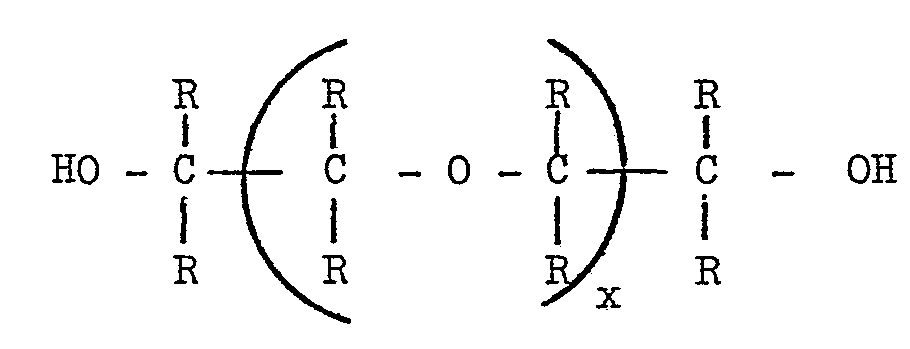
wherein x is an integer from 1 to 9 inclusive, and each R, which may be the same or different, represents a hydrogen atom or an aryl or lower alkyl group, or two groups R bonded to adjacent carbon atoms may form together with these carbon atoms a cyclic hydrocarbyl group, characterised in that the reaction is carried out in the presence of a halogen-containing solvent. 2. A process as claimed in claim 1, characterised in that the sulphonyl halide is an alkylsulphonyl chloride having up to 6 carbon atoms in the molecule.
wherein x is an integer from 1 to 9 inclusive, and each R, which may be the same or different, represents a hydrogen atom or an aryl or lower alkyl group, or two groups R bonded to adjacent carbon atoms may form together with these carbon atoms a cyclic hydrocarbyl group, characterised in that the reaction is carried out in the presence of a halogen-containing solvent. 2. A process as claimed in claim 1, characterised in that the sulphonyl halide is an alkylsulphonyl chloride having up to 6 carbon atoms in the molecule.
3. A process as claimed in claim 1 or 2, characterised in that the solvent is a poly-halogenated
aliphatic hydrocarbon or a halogenated aromatic hydrocarbon.
4. A process as claimed in claim 3, characterised in that the solvent is dichloromethane
or chlorobenzene.
5. A process as claimed in 1, 2, 3 or 4, characterised in that the halogen containing
solvent is present in a weight ratio solvent:reactants in the range of from 2 to 10.
6. A process as claimed in. any one of claims 1-5, characterised in that at least
part of the halogen-containing solvent is removed from the reaction mixture by distillation,
and at least part of the solvent thus removed is recycled to the reactor or the appropriate
make-up stream.
7. A process as claimed in any one of claims 1-6, wherein, in the glycol of formula
I, x is an integer of from 2 to 4 inclusive; and each R represents a hydrogen atom
or a lower alkyl group.
8. A process as claimed in claim 7, wherein the glycol reactant is triethyleneglycol.
and/or hexaethyleneglycol.
9. Macrocyclic polyethers whenever prepared according to a process as claimed in any
one of claims 1-8.