|
(11) | EP 0 041 792 A1 |

| (12) | EUROPEAN PATENT APPLICATION |
|
|
|
|
|||||||||||||||||||||||||||
| (54) | Platinum compounds having antitumor or antimicrobial activity, and pharmaceutical preparations containing them |
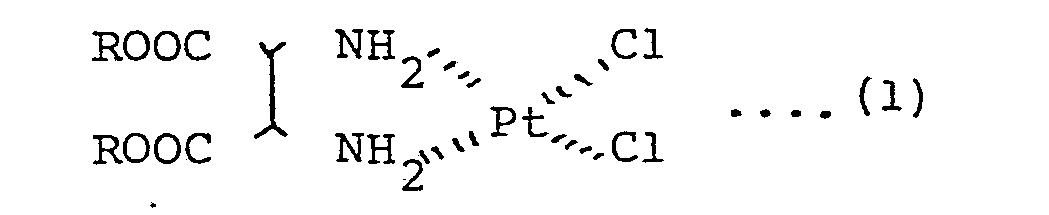
| (57) The present invention relates to a platinum compound having the formula
wherein R represents hydrogen atom, an alkali metal atom or a lower alkyl group. The platinum compound is effective as an antitumor and antimicrobial drug. |
BACKGROUND OF THE INVENTION:
FIELD OF THE INVENTION:
[0001] The present invention relates to a platinum compound having the formula
wherein R represents hydrogen atom, an alkali metal atom or a lower alkyl group and a drug comprising the same.
DESCRIPTION OF THE PRIOR ARTS:
[0002] Antitumor effects of platinum compounds have been studied to expect clinical applications. For example, cis-[diamine dichloro- platinum (II)] (hereinafter referring to as cis-ddp) has been proposed. The cis-ddp is water insoluble and has kidney toxicity and accordingly, the administration is limited. Various studies for overcoming the disadvantage have been .made as disclosed in J. NATL. CANCER Inst. 57 841 - 845 (1976) ; Gann 69, 263 - 265 (1978). It has not been satisfactory to impart water solubility and to reduce kidney toxicity.
SUMMARY OF THE INVENTION:
[0004] It is an object of the present invention to provide novel platinum compounds having antimicrobial effects and antitumor effects.
[0005] The novel platinum compounds of the present invention are compounds having the formula
wherein R represents hydrogen atom, an alkali metal atom or a lower alkyl group.
DETAILED DESCRIPTION OF THE PREFERRED EMBODIMENTS:
[0006] According to various studies for overcoming the disadvantages of the known platinum compounds, it has been found that platinum complexes having an amino acid derivative as ligand are effective. The present invention has been attained by the finding.
[0007] The novel platinum compound has a dimer of glycine as a ligand and one or two carboxyl groups thereof are converted into the ester or salt form to increase the solubility to water and to reduce the side-effect.
[0008] In the formula (1), R represents hydrogen atom,an alkali metal atom or a lower alkyl group. The lower alkyl group is methyl, ethy or propyl group and the alkali metal atom is sodium, potassium or lithium atom.
[0009] The process for producing the platinum compounds in'this invention will be illustrated. A compound having the formula (2)
wherein R and R1 respectively represent a lower alkyl group of methy, ethyl or propyl group (the known compound described'in JCS: chem. comm. 238 (1977))was dissolved in an alcohol such as methanol and ethanol and an acid such as hydrochloric acid and sulfuric acid is added to said solution to react them for 0.5 to 10 hours preferably 1 to '5 hours under refluxing. Then, the reaction mixture is concentrated under a reduced pressure and the product is recrystal- lyzed from an organic solvent such as a mixed solvent of methanol, ethanol, propanol, n-hexane and dioxane to obtain a compound (3).
wherein R is defined in the formula (2). Then, the compound (3) is dissolved into water. A solution of a chloroplatinoate in water and a hydrogencarbonate are added to the solution of the compound (3).
[0010] The chloroplatinoate is sodium or potassium salt and the hydrogencarboriate is sodium, potassium, calcium or magnesium salt.
[0011] The reaction is performed at room temperature for 5 minutes to 3 hours and a precipitate is separated and dissolved into water and recrystallized. The resulting compound has the formula (4)
wherein R is defined in the formula (2).
[0012] The compound (4) is dispersed and dissolved in water and a metal hydroxide such as sodium or potassium hydroxide is addec at an equimole and the mixture is heated at 60 to 100°C for 10 to 180 minutes to react them. A water soluble organic solvent such as acetone, dioxane and DMSO is added to the reaction mixture to obtain a precipitate. The resulting precipitate is sodium or potassium salt as the compound of the present invention.
[0013] The free carboxylic acid thereof can be obtained by addin an acidic aqueous solution such as an aqueous solution of hydrochloric acid (pH : 1 to 4).
[0016] Acute toxicity of the compounds is studied by an administration by route of intraperitoneal injection for ICR-JCL mice.
[0017] A solution of the compound in a physiological saline solution is administrated to the mice and the toxicity is observed after the administration to study mortal number for 7 days and lethal dosage (LD50) is measured by Litchfield-Wilcoxon graph method.
[0018] LD50 of Compound No. 5 as the reference compound is 50 mg. /kg. whereas LD50 of Compounds Nos. 1 to 4 as the compounds of the invention is more than 130 mg./kg. The lower toxicity of the compounds of the present invention is found. The compounds of the present invention have antimicrobial effects and antitumor effects. The compounds of the present invention are effective for various tumors such as sarcoma 180, P-388 leukemia, L-1210 leukemia, Ehrlich cancer, Yoshida sacroma, and ovarian tumor, prostatic tumor, laryngeal tumor, vesical tumor, breast tumor and endometritis tumor. The compounds of the invention have antimicrobial effects to gram's stain negative bacillius such as coliform bacillius and are effective for remedy from infection and especially effective as antimicrobial drug.
[0019] The drug is administrated as a desired composition for oral or parenteral administration. The formulations of the drug compositions can be tablet, sugar coated tablet, pill, capsule, powder, granule, troche, liquid, suppository .and injection. The drug is prepared by admixing the compound with a pharmacologically acceptable carrier. Suitable carriers include sugar, glucose, sorbitol, mannitol, potatostarch, cornstarch, amylopectin, and other starches; cellulose derivatives such as carboxymethyl cellulose, hydroxypropyl cellulose; gelatin, magnesium stearate, polyvinyl alcohol, calcium stearate, polyethyleneglycol, arabic gum, talc, titanium dioxide; vegetable oils such as olive oil, peanut oil and sesame oil; paraffin oil, neutral fats, ethanol, normal saline solution, sterilized water, glycerin, coloring agents, seasonings, thickners, stabilizers, surfactants and buffers and other pharmacologically acceptable carriers. The drug may comprises 0.001 to 85 wt.% especially 0.005 to 60 wt.% of the compound of the invention. The dose of the compound of the invention is ranging from 0.005 to 100 mg. preferably 0.01 to 50 mg./kg./day/adult depending upon the condition.
[0020] The present invention will be further illustrated by certain examples and references which are provided for purposes of illustration only.
EXAMPLE 1:
[0021] Into 80 ml. of methanol, 2,000 mg. of dimer of methyl ester of N-acetyl glycine was dissolved and about 1 ml. of hydrochloric acid was added and the mixture was refluxed for 3 hours.
[0022] After the reaction, the reaction mixture was concentrated under a reduced pressure and the product was recrystallized from a mixture of ethanol and n-hexane to obtain 1.5 g. of the compound having the formula (3) wherein R is methyl group. The yield was 78%. The product had a melting point of 158 to 159°C and the following elementary analysis.
[0023] The product was soluble in water, methanol and ethanol and insoluble in benzene and chloroform. The Infrared spectrum is shown in Table 6-1.
EXAMPLE 2:
[0024] Into 1 ml. of water, 400 mg. of the compound obtained by Example 1 was dissolved and a solution of 540 mg. of potassium chloroplatinoate in 2 ml. of water was added and 108 mg. of NaHCO 3 as powder was gradually added. The precipitated crystal was separated and recrystallized from water to obtain 4 mg. of powdery crystal. The product was soluble in hot water of 60°C and insoluble in organic solvents. The yield was 56%. The product had a melting point of 253°C (decomposition) and had the following elementary analysis:
[0025] The product had the formula (4) wherein R is methyl group. The infrared spectrum is shown in Table 6-2.
EXAMPLE 3:
[0026] To 10 ml. of water, 200 mg. of the product of Example 2 and sodium hydroxide at an equimolar ratio were added and the mixture was stirred at 80°C for 30 minutes. After cooling the mixture, acetone was added to separate a precipitate. The precipitate was dried to obtain a powder. The yield was 53%. The product had a melting point of 265°C (decomposition). The product was soluble in water and insoluble in organic solvents of benzene and chloroform. The infrared spectrum is shown in. Table 6-3. The product had the formula (4) wherein R is Na.
[0027] In accordance with the same process except using potassium hydroxide instead of sodium hydroxide , the product of the present invention as the potassium salt was obtained. The product had a melting point of 270°C (decomposition). The yield was 55%. The infrared spectrum is shown in Table 6-4. The product had the formula (4) wherein R is K.
EXAMPLE 4:
[0028] Into 5 ml. of water, 100 mg. of the product of Example 3 as the sodium salt was dissolved and hydrochloric acid was added to give pH of 2 to 3 to precipitate the crystal. The yield was 45%. The product had a melting point of 250°C (decomposition) and was soluble in water. The product had the formula (4) wherein R is H.
EXAMPLE 5:
[0030] P-388 ascites cells obtained by a successive cultivation in DBA/2 mice were transplanted by the route of intraperitoneal injection into CDF1 mice (10 mice in one group) at a rate of 1 x 10 /mouse. From 24 hours after the transplantation, a solution of each compound in physiological saline solution was injected once a day for 5 days as 5 times by the route of intraperitoneal injection. Each average survival days (T) of the administrated group and each average survival days (C) of control group were measured to calculate each percentage increase in. life span (ILS(%) )
[0031] As it is clear from the results, the compounds of the present invention impart higher ILS(%) than that of the reference cis-ddp. Moreover, the solubilities of the compounds of the present invention to water are increased to reduce kidney toxicity and other side-effects.
[0032] In the group for the administration of cis-ddp, remarkable weight decrease and kidney cell damage were observed for all of 10 mice. In the groups of the administration of the compounds of the present invention, slight weight decreases were found during the administration, however, the weight were recovered and kidney cell damages were remarkably slight.
EXAMPLE 6:
Antitumor effect to rabbit V-7 tumor:
[0033] A solid tumor obtained by transplantation and proliferation to rabbit femoralis was extracted and cut by scissors in pie- cies and scieved through a stainless steel screen (200 mesh). The tumor cell was transplanted into thin muscle of rabbit femoralis by the route of an injection at a rate of about 1.5 x 10⁷ cells/0.4 ml. Each compound was administrated for 2 times 7th and llth day after the transplantation, and average survival days were measured with the control group and each life prolonging rate was calculated.
Each side-effect and each solubility to water were tested.
[0034] In the tests, severe albuminuria as the indication of kidney toxicity was found in the control group whereas only slight albuminuria was found in the groups, of the administrations of the compounds of the present invention.
[0035] The results of the observation of alubuminuria and the solubilities of the compounds are shown in Table 4.
[0036] The- properties of the compound disclosed in the prior art are also compared. The improvement of solubilities to water and the reduction of kidney toxicity of the compound of the present invention are found.
EXAMPLE 7:
Antimicrobial effect:
[0037] (7-1) Each compound diluted as series of two times dilutions and each diluted solution was admixed with Heart infusion agar medium (Nippon Eiyo Kagaku K.K.) to prepare each plate for culture.
[0038] Escherichia coli strain was cultured in Trypto-soy bouillon at 37°C for 17 hours and one platinum loop of the cultured coliform bacillius strain was put on each plate to culture it at 37°C for 18 hours and each growth of the strain was observed.
[0039] In vitro tests, the antimicrobial effects of the compounds of the present invention were found. (7-2) Since the compounds of the present invention had antimicrobial effects to coliform bacillius, the infection remedy tests of the compounds of the present invention were carried out.
[0040] Coliform bacillius strain was inoculated to mice by route of intraperitoneal injection at a rate of 1 x 10⁸/mouse. Each compound was administrated at a dose of 1 mg. to 100 mg./kg. 1 to 3 hours after the injection by route of intraperitoneal injection or route of oral administration. During 7 days from the administration, the conditions of mice were observed to measure survival rates. The survival rates were higher than 50%.
[0041] The fact show that the compounds of the present invention are effective not only in vitro tests but also as chemotherapeutic drugs for test infections.
EXAMPLE 8:
[0043] The components were well mixed and the mixture was tabletted or the mixture was kneaded as granulated by passing through a screen of an extrusion type granulation machine and the granule was dried well and tabletted.
EXAMPLE 9:
[0044] In each vial, 10 mg. of Compound No. 2 was charged in asepsis and moisture and bacteria were removed in closed' condition. Before the administration, 5 ml. of 5% glucose solution for injection was charged to prepare an injection.
EXAMPLE 10:
1) A platinum compound characterised by the general formula
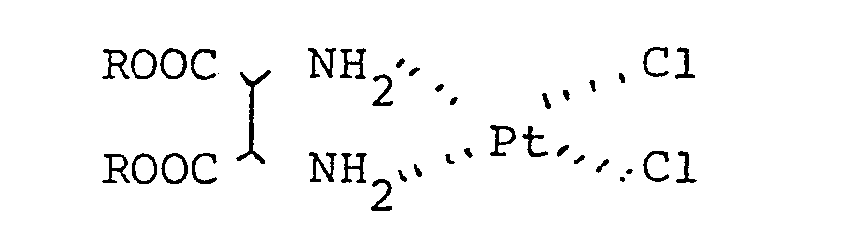
wherein R represents hydrogen atom, an alkali metal atom or a lower alkyl group.
wherein R represents hydrogen atom, an alkali metal atom or a lower alkyl group.
2) A platinum compound according to Claim 1 characterised in that said lower alkyl
group is a methyl, ethyl or propyl group.
3) A platinum compound according to Claim 2 characterised in that R is a methyl group.
4) A platinum compound according to Claim 1 characterised in that R is a hydrogen,
potassium or sodium atom.
5) An antitumor drug characterised in that it.includes as an active ingredient a platinum
compound having the formula
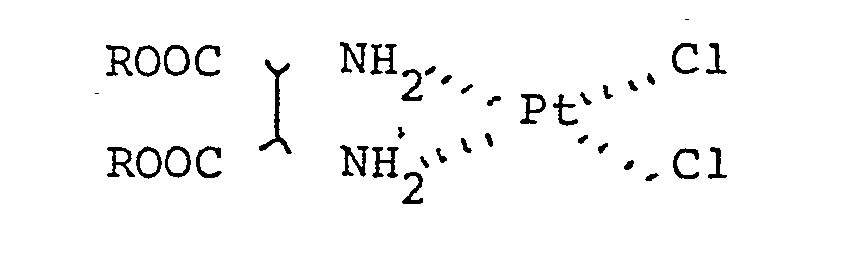
wherein R is a hydrogen atom, an alkali metal atom or a lower alkyl group.
wherein R is a hydrogen atom, an alkali metal atom or a lower alkyl group.
6) An antitumor drug according to Claim 5 characterised in that said lower alkyl group
is a methyl, ethyl or propyl group.
7) An antitumor drug according to Claim 6 characterised in that R is a methyl group.
8) An antitumor drug according to Claim 5 characterised in that R is a hydrogen, sodium
or potassium atom.
9) An antimicrobial drug characterised in that it includes as an active ingredient
a platinum compound having the formula
wherein R represents hydrogen atom, an alkali metal atom or a lower alkyl group as an active ingredient.
wherein R represents hydrogen atom, an alkali metal atom or a lower alkyl group as an active ingredient.
10) An antimicrobial drug according to Claim 9 characterised in that R is a methyl
group.
11) An antimicrobial drug according to Claim 9 characterised in that R is a hydrogen,
sodium or potassium aton