|
(11) | EP 0 042 654 A1 |

| (12) | EUROPEAN PATENT APPLICATION |
|
|
|
|
|||||||||||||||||||||||||||||||
| (54) | Powder metal composition |
| (57) A sintered powder metal composition comprises by weight 1.0 - 2.5% Ni, 0.3 - 0.7%
Mo, 0.15 - 0.30% Mn, 0.5 - 1.5% Cu, and 0.3 - 0.7% C, the balance being Fe. |
[0002] Many commercial powder metal compositions are available for fabrication of metal parts by compacting, sintering, and heat treating. One of the more frequently used and readily available metal powders is manufactured and marketed by Hoeganaes Corporation of U.S.A. under the trade name "Ancorsteel 4600V". Although this metal powder when used in the fabrication of parts has shown good results, it has certain shortcomings which would be advantageous to eliminate. The specific composition of Ancorsteel 4600v is 1.8 Ni, 0.25 Mn, 0.5 Mo and the balance Fe. This composition with appropriate amounts of carbon and zinc stearate will hereinafter be referred to as the known composition. It has been found that using this composition results in too much shrinkage during the sintering stage and the parts are generally difficult to machine. Obviously, it would be advantageous if these shortcomings could be eliminated without sacrificing the generally high strength and ductility possessed in parts made from such a metal powder composition.
[0003] It has been found unusually advantageous to add a small quantity of copper to the known composition when metal parts are to be fabricated. Including a small quantity of copper in the known composition has not only resulted in better machinability and reduction of shrinkage, but surprisingly has yielded higher tensile strengths and higher toughness.
[0004] There is disclosed in French published patent application No. 2 179 186 (TOYO KOHAN CO. LTD.) and in British Patent Specification No. 1 378 844 a prealloyed steel powder for the formation of articles by powder forging which comprises up to 0.5% by weight of carbon, 0.8 to 5.0% by weight of copper, 0.1 to 0.7% by weight of molybdenum, 0.3 to 1.3% by weight of nickel, and up to 0.6% by weight of manganese, the balance, apart from incidental impurities, being of iron.
[0005] According to the invention, there is provided a sintered powder metal composition comprising, by weight, 1.0 to 2.5% Ni, 0.3 to 0.7%Mo, 0.15 to 0.30%Mn, 0.5 to 1.5% Cu, and 0.3 to 0.7%C, the balance being Fe.
[0006] Also according to the invention, there is provided a method for improving the tensile strength,fracture toughness, machineability and dimension stability of a sintered powder metal composition, said composition including by weight 1.0-2.5% Ni, 0.3-0.7% Mo, 0.15-0.30% Mn, 0.3-0.7% C, the balance being Fe, comprising including copper in said powder metal composition in an amount from 0.5-1.5%.
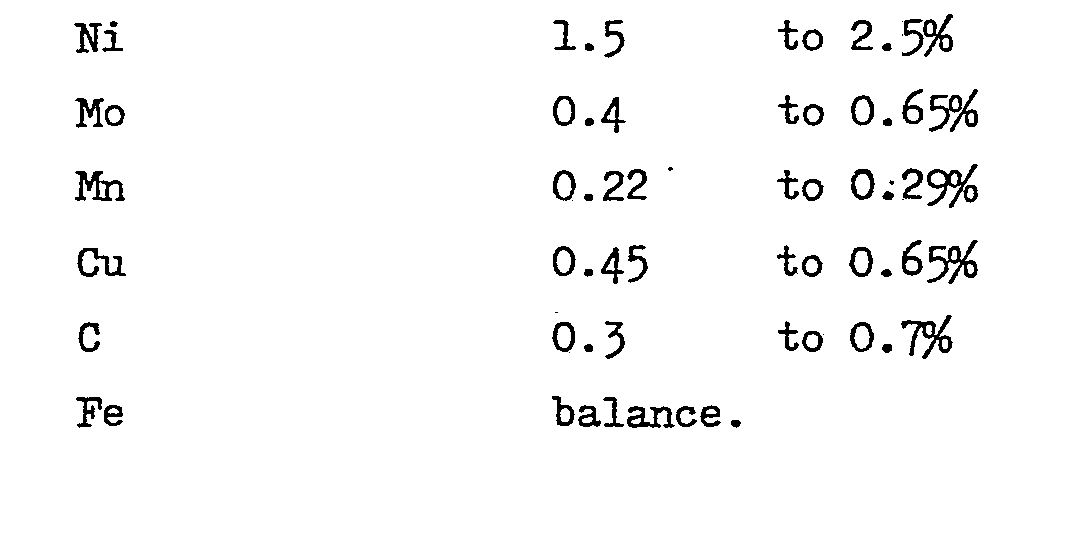
[0007] In a preferred starting composition for use in making an article according to the invention, the components may be as follows, by weight:-
[0008] Unusually good properties are found to be present in the metal part that results from the sintering stage. As is known, it is advantageous to have a sintered part with high strength as the same may be subjected to stresses during a subsequent heat treatment stage.
[0009] The invention will be better understood from the following non-limiting particular description of examples thereof.
[0010] As a result of adding the copper to the known composition, it was unexpectedly found that the tensile strength increased after heat treating, the fracture toughness increased after heat treating and the machineability was substantially improved. In regard to machineability, it was found that drill bits used to machine the heat treated products made in accordance with this invention lasted from 50 to 100% longer.
EXAMPLE I
[0011] A composition was prepared having the following ingredients:
A 1.25" x 0.5" x .25" (i.e. 31.75 x 12.7 x 6.35 mm.) transverse rupture bar was compacted from this composition at 50 t.s.i. psi and sintered at 2050°F (12110C) for 15 - 30 minutes, with a dew point of 35°F to 55°F (1.7 to 12.8°C) and under endothermic atmosphere. There was only 0.0006" (0.015 mm.) shrinkage in length. After carbonitriding at 1550° F (843°C) for 30 minutes, the bar was oil quenched and tempered at 350°F (177°C) for one hour. There was only 0.0008" (0.02 mm.) expansion.
[0012] In addition to maintaining stable dimensions, high strength and toughness were also achieved.
[0013] A number of samples of the above dimensions from both the known and the disclosed compositions were made in processes similar to the Example given as stated in Example I. In one series of tests the percentages of components (except copper) as stated in Example I were kept constant and the amount of copper was varied from 0.77 to 1.22% by weight. In another series of tests the percentages of components (except graphite) were kept constant at the values stated in Example I and the carbon (graphite) content was varied from 0.35 to 0.55%. All such samples were found to give superior results, similar to those found with samples resulting from Example I.
[0014] The samples according to the disclosed composition and resulting from Example I were found to have a transverse rupture strength of approximately 160,000 psi (1103.2 newtons per sq. mm.) after sintering and a transverse rupture strength of approximately 200,000 psi (1379 newtons per sq. mm.) after heat treating. This compares with a transverse rupture strength of approximately 141,000 psi (1034.2 newtons per sq. mm.) for the known composition in the sintered condition and approximately 196,000 psi (1351.37 newtons per sq. mm.) in the heat treated condition. The disclosed composition was found to have a fracture toughness as sintered of approximately 21,000 psi-in1/2 and 23,000 psi-in1/2 in the heat treated condition. This compares with the known composition having a fracture toughness of approximately 21,000 psi-in1/2 both in the sintered and the heat treated condition.
[0015] With respect to machineability, a test was run wherein a drill bit with a load of 24 lbs. (10.89 Kg.) was applied to the above samples and rotated at a speed of 1,000 RPM. These loads were applied to samples which had a thickness of approximately 1/4" (6.35 mm.). For the disclosed material it was found that approximately 11 seconds were required to drill through a sample and for the standard material approximately 15 seconds were required. Even more significant was that the drill bit showed considerably more wear after drilling through the known material than it did after drilling through the disclosed material.
[0016] The tensile strength of samples made from the disclosed composition was measured at 81,000 psi (558.5 newtons per sq. mm.) sintered and 125,000 psi (861.9 newtons per sq. mm.) heat treated whereas samples made from the known composition were found to be 75,000 psi (517.1 newtons per sq. mm.) and 110,000 psi (758.45 newtons per sq. mm.) respectively.
[0017] It will be seen from the above that it has been unexpectedly found that substantially better results are achieved in making parts using the known composition when 0.5 to 1.5% of copper is added as disclosed. These findings are unexpected as one would not expect that a copper addition would increase the physical properties in the way that has been discovered.
1. A sintered powder metal composition comprising by weight 1.0 - 2.5% Ni, 0.3 - 0.7%
Mo, 0.15 - 0.30% Mn, 0.5 - 1.5% Cu, and 0.3 - 0.7% C, the balance being Fe.
2. The composition of claim 1 wherein the amount of Ni is 1.8%,the amount of Mo 0.6%,
the amount of Mn is 0.25%, and the amount of C is 0.6%.
3. The composition of claim 1 or 2 wherein said amount of Cu is 0.82%.
4. A method for improving the tensile strength, facture toughness machineability and
dimension stability of a sintered powder metal composition, said composition including
by weight 1.0 - 2.5% Ni, 0.3 - 0.7% Mo, 0.15 - 0.30% Mn, 0.3 - 0.7% C, the balance
being Fe, comprising including in said powder metal composition copper in an amount
from 0.5 - 1.5%.
5. A sintered powder metal composition which comprises, by weight:-