| (19) |
 |
|
(11) |
EP 0 042 758 B2 |
| (12) |
NEW EUROPEAN PATENT SPECIFICATION |
| (45) |
Date of publication and mentionof the opposition decision: |
|
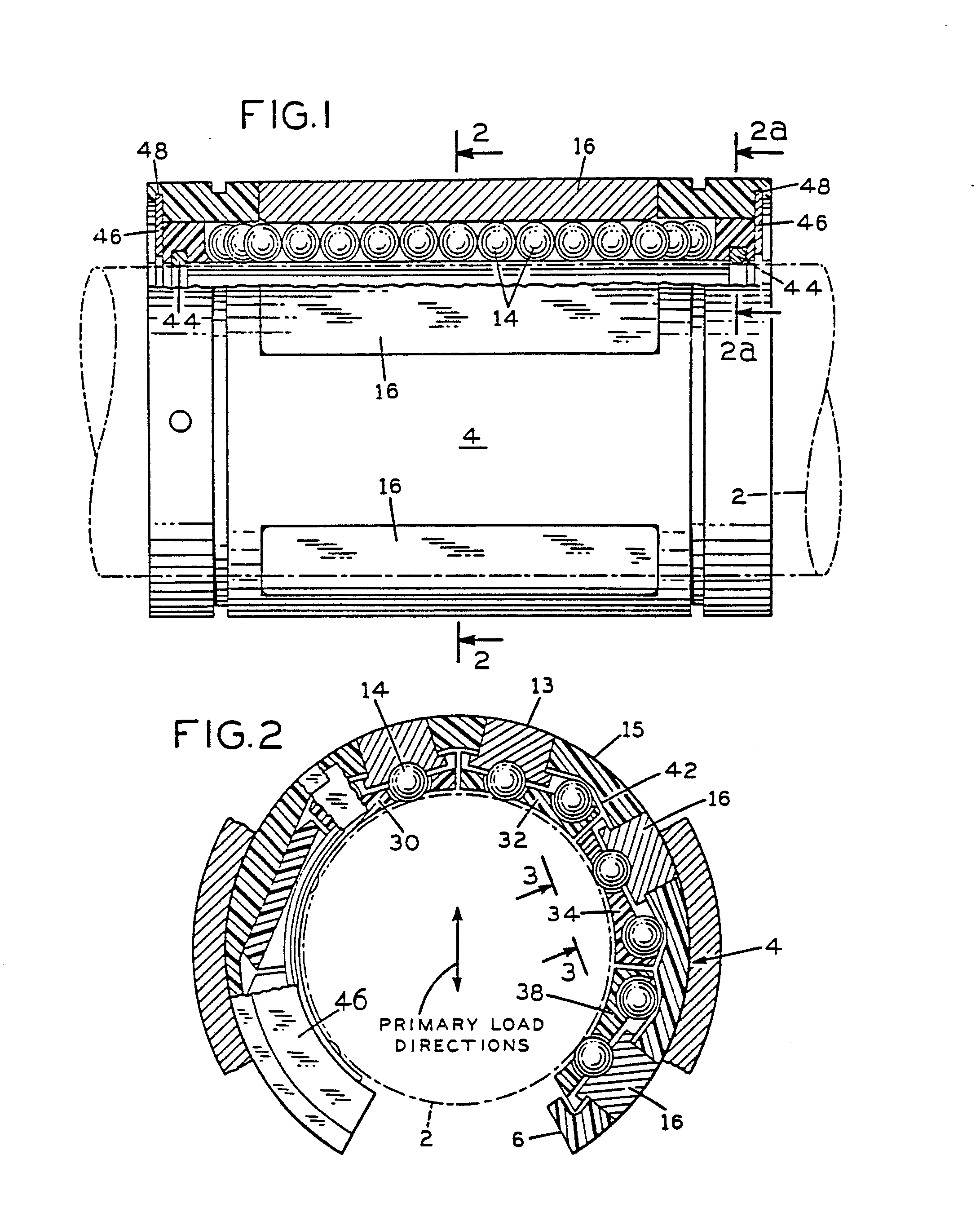
12.07.1989 Bulletin 1989/28 |
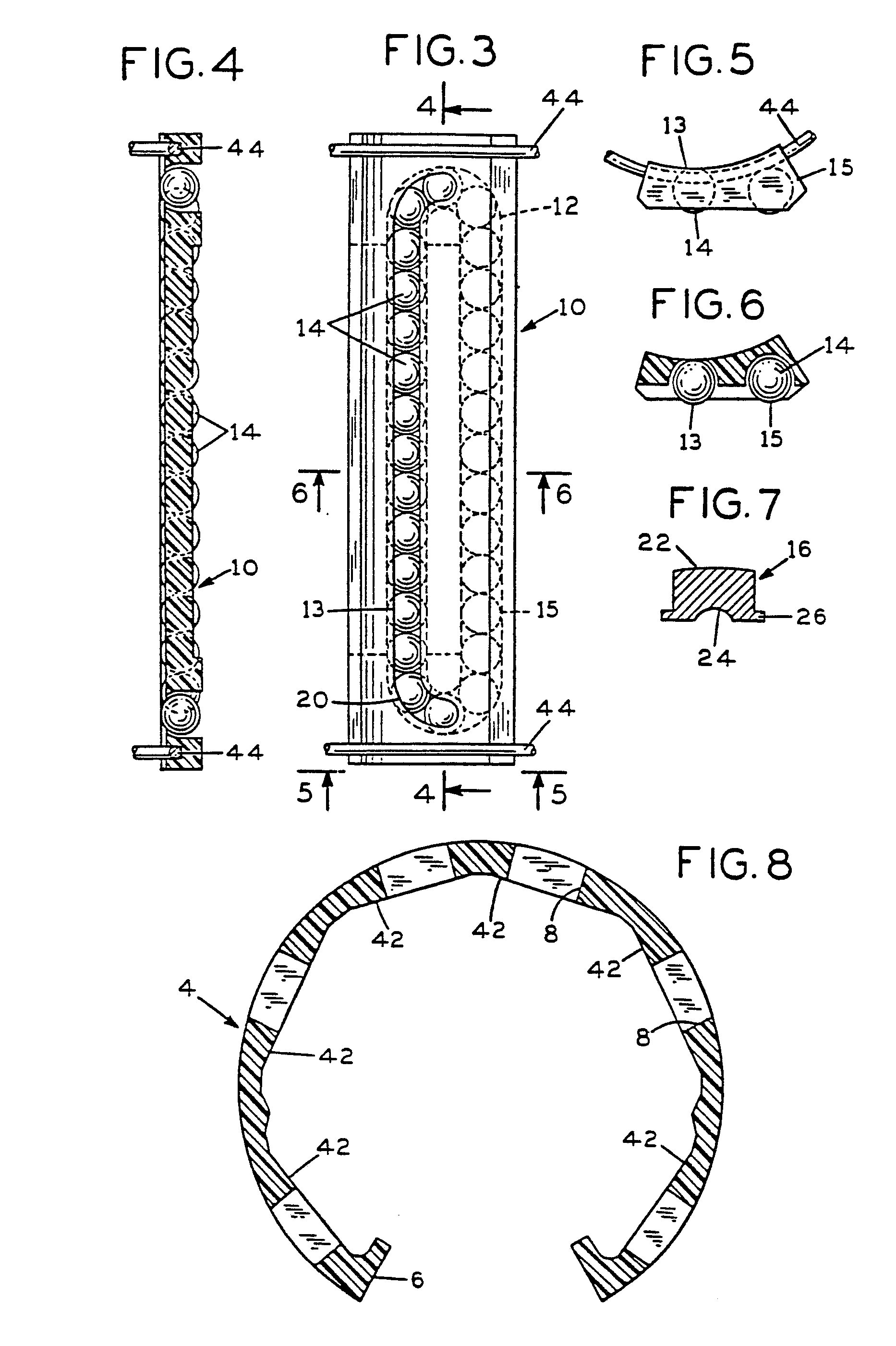
| (45) |
Mention of the grant of the patent: |
|
13.11.1985 Bulletin 1985/46 |
| (22) |
Date of filing: 23.06.1981 |
|
| (51) |
International Patent Classification (IPC)4: F16C 29/06 |
|
| (54) |
Improvements in and relating to linear bearings
Linearlager
Palier linéaire
|
| (84) |
Designated Contracting States: |
|
AT BE CH DE FR IT LI NL SE |
| (30) |
Priority: |
25.06.1980 US 162863
|
| (43) |
Date of publication of application: |
|
30.12.1981 Bulletin 1981/52 |
| (73) |
Proprietor: THOMSON INDUSTRIES INC. |
|
Manhasset
New York 11030 (US) |
|
| (72) |
Inventors: |
|
- Mc Gee, Robert C.
Manhasset
New York 11030 (US)
- Rogers, Alfred M. III
Huntington
New York 11743 (US)
|
| (74) |
Representative: Lewin, John Harvey et al |
|
Elkington and Fife,
Prospect House,
8 Pembroke Road
Sevenoaks,
Kent TN13 1XR
Sevenoaks,
Kent TN13 1XR (GB) |
| (56) |
References cited: :
CH-A- 606 848
DE-U- 7 705 155
US-A- 3 844 629
US-A- 3 951 472
|
DE-A- 2 835 127
US-A- 3 545 826
US-A- 3 900 233
US-A- 3 958 845
|
|
| |
|
|
- Konstruktionselemente des Maschinenbaues, Teil 2, page 147, Springer Verlag, 1979
|
|
| |
|
[0001] The present invention relates generally to ball bearings and more particularly to
ball bearings for linear motion of the type specified in the preamble of claim 1.
[0002] There are in the prior art many forms of ball bearings for linear motion such as
those disclosed in United States Patents 3 545 826 and 3 900 233. The present invention
relates to new and useful improvements over the aforesaid patents and to new and useful
improvements in ball bearings for linear motion.
[0003] A problem encountered in linear ball bearing involves the accurate alignment of the
ball circuits of the retainer with the ball grooves of the races without involving
excessive manufacturing costs. This problem can be acute where several circumferentially
spaced circuits of balls are contained within a single large retainer element. It
has proven to be difficult to accurately match the circumferential spacing of these
retainer circuits with the circumferential spacing of the groove of the mating bearing
plates resulting in misalignment and wear and tear on the bearing assembly.
[0004] There is a need, therefore, for a ball bearing structure wherein misalignment between
the ball guiding tracks of the retainers and the ball grooves in their associated
bearing plates is substantially eliminated.
[0005] DE-U-7 705 155 discloses a linear bearing having a plurality of retainer segments,
each associated with a respective recirculating ball loop, and capable of circumferential
movement with respect to the outer bearing sleeve to compensate for misalignment between
the ball races provided on the sleeve and the working tracks of the ball loops.
[0006] In view of the foregoing, it is a primary object of this invention to provide a new
and improved ball bearing for linear motion wherein the balls within each retainer
circuit can be quickly, expeditiously and accurately assembled in alignment with respect
to the ball grooves in its mating bearing plate, and will automatically maintain that
proper alignment during operation. This object is achieved by the features of the
characterising part of claim 1.
[0007] Additional objects and advantages of the invention will be set forth in the specification
which follows.
[0008] The accompanying drawings which are incorporated in and constitute part of this specification
illustrate an embodiment of the invention and, together with the description, serve
to explain the principles of the invention.
Of the Drawings
[0009]
Figure 1 is a side view of the bearing with then upper portion shown partly in section.
Figure 2 is a vertical section taken along line 2 - 2 and 2a - 2a of Figure 1.
Figure 3 is a front view taken generally along line 3 - 3 of Figure 2.
Figure 4 is a view in section along line 4 - 4 of Figure 3.
Figure 5 is an end view along 5 - 5 of the retainer section shown in Figure 3.
Figure 6 is a sectional view taken along line 6 - 6 of Figure 3.
Figure 7 is a view in section taken through one of the bearing plates shown in Figure
2.
Figure 8 is a view in section along line 2 - 2 of Figure 1 with certain parts removed.
[0010] This invention relates to a ball bearing for linear motion and is adapted to be used
with a shaft 2. The invention utilizes a bearing sleeve 4 which is preferably made
of plastic material within which the elements of the linear bearing are mounted. The
bearing sleeve is of the open type as can be seen by the opening 6 at the bottom of
the bearing sleeve 4.
[0011] As shown in Figure 8, the bearing sleeve has a plurality of bearing plate receiving
openings 8 spaced around the bearing sleeve.
[0012] In accordance with this invention, individual retainer means are provided for retaining
the balls in the desired circulating path. As embodied, the retainer means consists
of individual retainer segments 10, preferably made of plastic, having a closed loop
path 12 in which are positioned a plurality of balls 14. The closed loop path 12 has
two straight track portions - a load bearing track 13 and a return or no load track
15 as can be seen in Figures 2, 3, 5 and 6. For this purpose, the retainer element
10 is cut away at 20 so that the balls can assume the load position as shown in Figures
2 and 3. In other words, each retainer segment contains one row or track each of load
carrying and non-load carrying balls.
[0013] Positioned within each of the bearing plate receiving openings 8 are bearing plates
16 shown in detail in Figure 7. As shown in Figures 2 and 7, the outer surface 22
of the bearing plate 16 has a curvature which conforms to the curvature of the outer
surface of the bearing sleeve 4 and the inner surface of the mounting housing shown
in Figure 2. The inner surface of the bearing plate 16 has a ball receiving groove
24 in which the balls are located when in the load position. The bearing plate further
includes flanges 26 which prevent the bearing plate from being accidentally moved
outwardly through the bearing plate opening 8 when the bearing is not installed in
a surrounding housing which in use supports the bearing plates when load is applied.
[0014] Means is provided for insuring that the maximum load capacity of the bearing is in
the primary load direction. Generally speaking this is in a direction towards or away
from the open side of the bearing or in radial direction 180° apart. More specifically
it may be the vertical direction as shown in Figure 2. As embodied, this means comprises
positioning the retainer segments so that the major number of load carrying ball tracks
are located opposite the open portion of the bearing sleeve and immediately adjacent
the open portion of the bearing sleeve.
[0015] As embodied, the two retainer segments 30, 32 are positioned so that their working
or load bearing ball tracks are immediately adjacent the vertical center line of the
bearing sleeve (See Figure 2.) The next pair of retainer segments only one of which,
34, is shown, are positioned immediately adjacent the non-load bearing ball tracks
of retainer segments 30, 32 so that there are four load bearing ball tracks on one
side of the horizontal centre line of the bearing sleeve. In other words, there are
four tracks of working load bearing balls in half of the ball bearing sleeve to receive
loads in that vertical direction. The next pair of retainer segments only one of which,
38, is shown, are reversed so that the tracks of the load bearing balls are adjacent
the opening in the bearing sleeve and the non-load bearing tracks of these retainer
segments are adjacent the non-load bearing tracks of retainer segments 34, 36.
[0016] In this way, there are load bearing ball tracks immediately adjacent the opening
in the bearing so that the majority of the load bearing balls are adjacent the vertical
center line of the bearing to provide maximum resistance to loads in that vertical
direction. Furthermore, with this arrangement it is possible to position six (6) working
tracks within the open type bearing whereas with the standard open bearing only five
(5) tracks can be so positioned. Moreover, there are load bearing tracks immediately
adjacent the opening whereas usually with the open type bearing there is one working
and one non-working track adjacent the opening.
[0017] In accordance with the invention, positioning means is provided for positioning the
balls within the ball bearing receiving grooves on the bearing plates. As embodied,
this means comprises a plurality of flat surfaces 42, one for each ball retaining
segment on the inside surface of the bearing sleeve. As shown, there are six (6) retainer
segments and six (6) flat surfaces. The flat surfaces permit the retainer segment
to move a small amount across the width of the flat surface so that the balls fit
within the grooves 24 in the bearing plates. Without this arrangement, misalignment
can occur resulting in severe wear and tear of the balls, retainer segments or the
bearing plates. Misalignment can also result in prevention of ball circulation due
to binding and cause improper diameter sizing of the bearings.
[0018] The retainer segments are held in place by a retaining ring 44 which pushes the retainer
segment against the flat surfaces 42 to retain the balls so that they will not fall
out of the bearing, and to maintain the ball tracks in alignment with the ball bearing
receiving groove 24 on the bearing plate 16. There are end washers 46 positioned in
grooves 48 in the bearing sleeve which function as cover plates and prevent lengthwise
movement of the retainer segments.
[0019] While the above-described positioning means is useful in the open type of bearing,
its usefulness is not limited to that type of bearing and may be useful in other closed
type bearings.
[0020] The invention is also useful in connection with a self-aligning crown or a compliance
groove as shown and described in United States Patent No. 3 545 826.
1. A ball bearing for linear motion comprising a plurality of closed loops (12) containing
recirculating balls (14), each loop having a working track (13) where the balls are
under load and a non-working track (15) wherein the balls are not under load, a plurality
of bearing plates (16) corresponding in number to the number of working tracks mounted
in openings in a bearing sleeve, and a ball receiving groove (14) in each bearing
plate adapted to be engaged by the balls, characterised in that:
(a) each closed loop is retained in the bearing sleeve by a respective retainer segment
(10, 30, 32, 34, 38, 40), the retainer segments being separated from each other by
radially extending gaps;
(b) the inside surface of the bearing sleeve is formed with a plurality of flat surfaces
(42) corresponding in number to the number of retainer segments, each of the flat
surfaces extending substantially perpendicularly to and on both sides of a radial
line passing through the respective ball receiving groove in the bearing plate;
(c) each retainer segment has a flat surface extending on both sides of a radial line
passing through the working track of the closed loop;
(d) means (44) are provided for maintaining the flat surfaces of the retainer segments
in engagement with the corresponding flat surfaces of the bearing sleeve, said flat
surfaces permitting individual movement of each retainer segment with respect to the
sleeve so as to align the balls in the working tracks of the closed loops with the
ball reciving grooves in the bearing plates.
2. A linear ball bearing as defined in claim 1 which further includes an opening in
said bearing sleeve and means positioning said retainer segments with in said bearing
sleeve so that the load carrying balls are positioned so that the critical ball bearing
capacity is in two radial directions approximately 180° apart.
3. A linear ball bearing as defined in claim 2 wherein a majority of said load carrying
ball tracks are located within one-half of said bearing sleeve.
4. A linear ball bearing as defined in claim 3 wherein load carrying ball tracks are
positioned adjacent the opening in said bearing sleeve.
5. A linear ball bearing as defined in claim 4 wherein at least four load carrying
ball tracks are positioned within one-half of said bearing sleeve and at least two
load carrying ball tracks are positioned within the other half of said bearing sleeve.
6. A linear motion ball bearing as defined in claim 1 which further includes an opening
in said bearing sleeve and said retainer segments being arranged within said sleeve
so that the bearings under load are positioned to resist radial forces in predetermined
directions.
7. A linear motion ball bearing as defined in claim 6 wherein said retainer segments
are arranged so that there are at least two paths of working tracks positioned immediately
on each side of the centerline of the bearing sleeve and at least one path of working
tracks positioned adjacent each side of the opening in said bearing sleeve.
8. A linear motion ball bearing as defined in claim 1, for reducing radial deflection
primarily in two predetermined radial directions, spaced 180° apart, which further
includes an opening in said bearing sleeve, a ball receiving groove (24) in each bearing
plate adapted to be engaged by the balls, and said segments being arranged within
said bearing sleeve so that working balls are positioned so as to prevent radial deflection
in radial directions spaced 180° apart.
9. A ball bearing for linear motion as defined in claim 8 wherein at least one track
of working balls is located immediately adjacent and on opposite sides of the centerline
of said bearing sleeve and at least one track of working balls is located adjacent
each side of the opening in said bearing sleeve.
10. A ball bearing for linear motion as defined in claim 9 wherein said tracks of
ball bearings are arranged so that, beginning immediately adjacent the centerline
of the bearing sleeve, there is a working track of balls, a non-working track of ball
bearings, a working track of balls, a non-working track of balls, and a working track
of balls.
10. A ball bearing for linear motion as defined in claim 9 wherein said tracks of
ball bearings are arranged so that, beginning immediately adiacent the centerline
of the bearing sleeve, there is a working track of balls, a non-working track of ball
bearing, a working track of balls, a non-working track of balls, and a working track
of balls.
11. A ball bearing for linear motion as defined in claim 10 wherein the centerline
is a vertical centerline.
1. Kugellager für Linearbewegung, mit einer Mehrzahl von geschlossenen Schleifen (12),
die Umlaufende Kugeln (14) enthalten, wobei jede Schleife eine Arbeits-Laufbahn (13),
wo die Kugeln unter Belastung stehen, und eine Nichtarbeits-Laufbahn (15) aufweist,
in der die Kugeln nicht unter Belastung stehen, mit einer Mehrzahl von in Öffnungen
in einer Lagerhülse angebrachten Lagerplatten (16), die in ihrer Anzahl der Anzahl
von Arbeits-Laufbahnen entsprechen, und einer für einen Eingriff mit den Kugeln geeigneten
Kugelaufnahmerille (24) in jeder Lagerplatte, dadurch gekennzeichnet, daß
a) jede geschlossene Schleife in der Lagerhülse durch ein entsprechendes Käfigsegment
(10, 30, 32, 34, 38, 40) gehalten ist, wobei die Käfigsegmente durch radial verlaufende
Spalte voneinander getrennt sind;
b) die Innenfläche der Lagerhülse mit einer Mehrzahl von ebenen Flächen (42) in einer
Anzahl entsprechend der Anzahl der Käfigsegmente ausgebildet ist, wobei sich jede
der ebenen Flächen im wesentlichen senkrecht zu und beidseits einer radialen Linie
erstreckt, die durch die jeweilige Kugelaufnahmerille in der Lagerplatte verläuft;
c) jedes Käfigsegment eine ebene Fläche hat, die sich beidseits einer radialen Linie
erstreckt, die durch die Arbeits-Laufbahn der geschlossenen Schleife verläuft;
d) Mittel (44) vorgesehen sind zum Halten der ebenen Flächen der Käfigsegmente in
Eingriff mit den entsprechenden ebenen Flächen der Lagerhülse, wobei die ebenen Flächen
eine individuelle Bewegung jedes Käfigsegments relativ zur Hülse erlauben, um die
Kugeln in den Arbeits-Laufbahnen der geschlossenen Schleifen mit den Kugelaufnahmerillen
in den Lagerplatten auszurichten.
2. Linearkugellager nach Anspruch 1, welches ferner eine Öffnung in der Lagerhülse
und Mittel enthält, die die Käfigsegmente in der Lagerhülse positionieren, so daß
die eine Belastung aufnehmenden Kugeln derart in Position gebracht werden, daß die
kritische Kugellager-Belastungsfähigkeit in zwei ungefähr 180° auseinanderliegenden
radialen Richtungen vorliegt.
3. Linearkugellager nach Anspruch 2, wobei eine Mehrheit der eine Belastung aufnehmenden
Kugel-Laufbahnen innerhalb einer Hälfte der Lagerhülse angeordnet ist.
4. Linearkugellager nach Anspruch 3, wobei eine Belastung aufnehmende Kugel-Laufbahnen
benachbart der Öffnung in der Lagerhülse angeordnet sind.
5. Linearkugellager nach Anspruch 4, wobei wenigstens vier eine Belastung aufnehmende
Kugel-Laufbahnen innerhalb einer Hälfte der Lagerhülse und wenigstens zwei eine Belastung
aufnehmende Kugel-Laufbahnen innerhalb der anderen Hälfte der Lagerhülse angeordnet
sind.
6. Linearbewegungs-Kugellager nach Anspruch 1, welches ferner eine Öffnung in der
Lagerhülse und innerhalb der Hülse derart angeordnete Käfigsegmente enthält, daß die
unter Belastung stehenden Lager in Position sind, um radialen Kräften in vorherbestimmten
Richtungen zu widerstehen.
7. Linearbewegungs-Kugellager nach Anspruch 6, wobei die Käfigsegmente derart angeordnet
sind, daß wenigstens zwei Pfade von Arbeits-Laufbahnen unmittelbar beidseits der Mittenlinie
der Lagerhülse und wenigstens ein Pfad der Arbeits-Laufbahnen benachbart jeder der
beiden Seiten der Öffnung in der Lagehülse in Position sind.
8. Linearbewegungs-Kugellager nach Anspruch 1, zum Reduzieren radialer Ablenkungen
primär in zwei vorherbestimmten radialen Richtungen in einem Abstand von 180° voneinander,
welches ferner eine Öffnung in der Lagerhülse enthält, wobei eine Kugelaufnahmerille
(24) in jeder Lagerplatte für einen Eingriff mit den Kugeln geeignet ist, und die
Segmente innerhalb der Lagerhülse derart angeordnet sind, daß Arbeitskugeln in Position
sind, um radiale Auslenkungen in radialen Richtungen in einem Abstand von 180° voneinander
zu verhindern.
9. Kugellager für Linearbewegung nach Anspruch 8, wobei wenigstens eine ArbeitskugelLaufbahn
unmittelbar benachbart und an gegenüberliegenden Seiten der Mittenlinie der Lagerhülse
und wenigstens eine ArbeitskugelLaufbahn benachbart jeder Seite der Öffnung in der
Lagerhülse ist.
10. Kugellager für Linearbewegung nach Anspruch 9, wobei die Kugellager-Laufbahnen
derart angeordnet sind, daß beginnend unmittelbar benachbart der Mittenlinie der Lagerhülse,
eine Arbeits-Kugellaufbahn, eine Nichtarbeits-Kugellaufbahn, eine Nichtarbeits-Kugellaufbahn
und eine Arbeitskugellaufbahn vorliegen.
11. Kugellager für Linearbewegung nach Anspruch 10, wobei die Mittenlinie eine vertikale
Mittenlinie ist.
1. Un palier à billes à mouvement linéaire, comprenant un ensemble de boucles fermé
(12) contenant des billes en circulation (14), chaque boucle présentant un chemin
de roulement en travail (13) dans lequel les billes sont soumises à une charge, et
un chemin de roulement hors travail (15) dans lequel les billes ne sont pas soumises
à une charge, un ensemble de plaques d'appui (16) dont le nombre correspond au nombre
de chemins de roulement en travail monté dans des ouvertures d'un manchon de palier,
et une gorge (14) de réception des billes dans chaque plaque d'appui agencée pour
que les billes s'y engagent, caractérisé en ce que:
a) chaque boucle fermée est retenue dans le manchon de palier par un segment de cage
correspondant (10, 30, 32, 34, 38, 40), les segments de cage étant séparés les uns
des autres par des intervalles s'étendant radialement,
b) la surface intérieure du manchon de palier comprend un ensemble de surfaces planes
(42) dont le nombre correspond au nombre des segments de cage, chacune des surfaces
planes s'étendant de manière sensiblement perpendiculaire et sur les deux côtés d'une
ligne radiale passant par la gorge de réception des billes correspondantes dans la
plaque d'appui,
c) chaque segment de cage présente une surface plane s'étendant des deux côtés d'une
ligne radiale passant par le chemin de roulement en travail de la boucle fermée;
d) des moyens (44) sont prévus pour maintenir les surfaces planes des segments de
cage en prise avec les surfaces planes correspondantes du manchon de palier, ladite
surface plane permettant un mouvement individuel de chaque segment de cage par rapport
au manchon afin d'aligner les billes dans les chemins de roulement en travail des
boucles fermées avec les gorges de réception des billes dans les plaques d'appui.
2. Un palier linéaire à billes selon la revendication 1, qui comprend en outre une
ouverture dans le manchon de palier et des moyens pour positionner lesdits segments
de cage à l'intérieur dudit manchon de palier de telle sorte que les billes supportant
la charge soient positionnées de manière à ce que la charge critique admissible du
palier à billes s'étende dans deux directions radiales séparées d'environ 180°.
3. Un palier linéaire à billes selon la revendication 2, dans lequel une majorité
desdits chemins de roulement des billes supportant la charge sont situés dans une
moitié dudit manchon de palier.
4. Un palier linéaire à billes selon la revendication 3, dans lequel les chemins de
roulement des billes supportant la charge sont positionnés à proximité de l'ouverture
dudit manchon de palier.
5. Un palier linéaire à billes selon la revendication 4, dans lequel au moins quatre
chemins de roulement de billes supportant la charge sont situés dans une moitié dudit
manchon de palier, et au moins deux chemins de roulement de billes supportant la charge
sont situés dans l'autre moitié dudit manchon de palier.
6. Un palier à billes à mouvement linéaire selon la revendication 1, qui comprend
en outre une ouverture dans ledit manchon de palier, lesdits segments de cage étant
disposés à l'intérieur dudit manchon de telle sorte que les paliers soumis à une charge
soient positionnés de manière à s'opposer à des forces radiales dans des directions
prédéterminées.
7. Un palier à billes à mouvement linéaire selon la revendication 6, dans lequel lesdits
segments de cage sont disposés de telle sorte qu'il existe au moins deux trajets de
chemins de roulement en travail situés immédiatement de chaque côté de la ligne centrale
du manchon de palier, et au moins un trajet de chemin de roulement en travail situé
à proximité de chaque côté de l'ouverture dudit manchon de palier.
8. Un palier à billes à mouvement linéaire selon la revendication 1, destiné à réduire
un décalage radial principalement dans deux directions radiales prédéterminées, séparées
de 180°, qui comprend en outre une ouverture dans ledit manchon de palier, une gorge
(24) de réception de billes dans chaque plaque d'appui, destinée à recevoir les billes,
lesdits segments de palier étant disposés à l'intérieur dudit manchon de palier de
telle sorte que les billes en travail soient positionnées de manière à empêcher un
décalage radial dans des directions radiales séparées de 180°.
9. Un palier à billes à mouvement linéaire selon la revendication 8, dans lequel au
moins un chemin de roulement de billes en travail est situé à proximité immédiate
et de part et d'autre de la ligne centrale du manchon de palier, et au moins un chemin
de roulement de billes en travail est situé à proximité de chaque côté de l'ouverture
dudit manchon de palier.
10. Un palier à billes à mouvement linéaire selon la revendication 9, dans lequel
lesdits chemins de roulement des paliers à billes sont disposés de telle sorte que,
en commençant à proximité immédiate de la ligne centrale du manchon de palier, il
existe un chemin de roulement de billes en travail, un chemin de roulement de billes
hors-travail, un chemin de roulement de billes en travail, un chemin de roulement
de billes hors-travail, et un chemin de roulement de billes en travail.
11. Un palier à billes à mouvement linéaire selon la revendication 10, dans lequel
la ligne centrale est une ligne centrale verticale.