Background of the Invention
[0001] 3-Methyl-2-p-chlorophenyl butyrylnitrile is useful as an intermediate for preparing
the (±)-cyano(3-phenoxyphenyl)methyl ester of (±)-3-methyl-2-(4-chlorophenyl)butanoic
acid which is useful as an insecticide and acaricide composition and has the chemical
structure
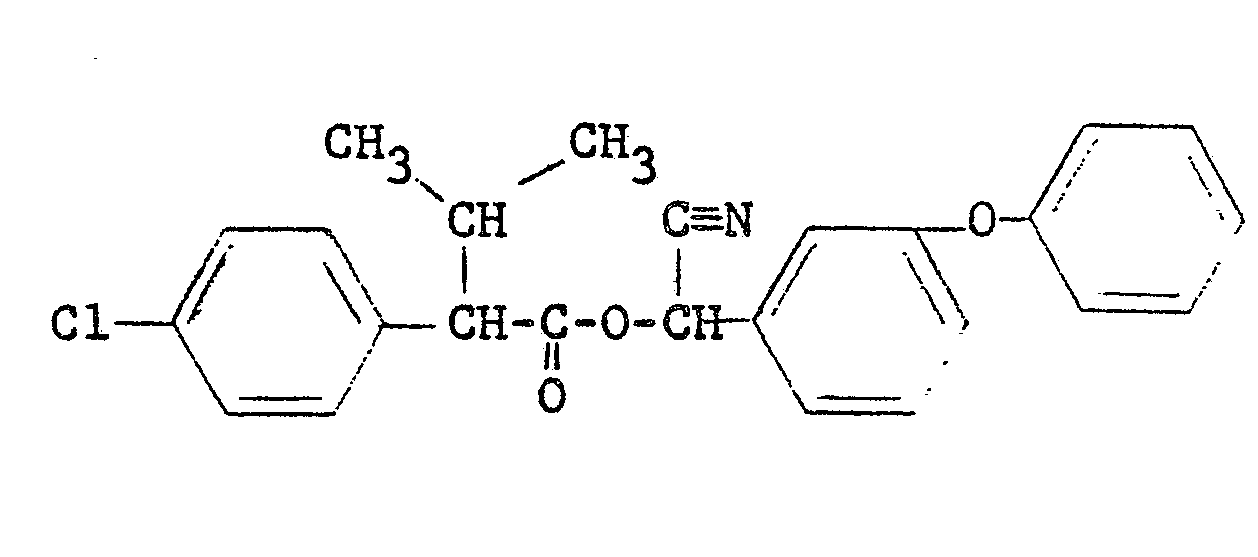
This compound can be prepared by reacting 3-methyl-2-p-chlorophenyl butyryl acid chloride
with m-phenoxybenzaldehyde cyanohydrin in the presence of an acid scavenger such as
triethylamine. 3-Methyl-2-p-chlorophenyl butyryl acid chloride can be prepared from
3-methyl-2-p-chlorophenyl butyrylnitrile by hydrolyzing the nitrile to an acid and
converting the acid to an acid chloride by standard known procedures.
Detailed Description of the Invention
[0002] 3-Alkyl-2-p-chlorophenyl butyrylnitrile can be prepared by reacting p-chlorophenyl
acetylnitrile with a lower alkyl sulfonate of a lower alkyl alcohol under phase transfer
catalytic conditions in the presence of a 40 weight percent to saturated basic solution
such as 50% NaOH or 50% KOH. Any number of phase transfer catalysts can be used such
as tetrabutylphosphonium chloride, benzyltriethylammonium chloride, tricaprylmethylammonium
chloride, tetrabutylammonium chloride, or cryptates or crown ethers such as 18-crown-6.
The amount of phase transfer catalyst present can range from 1/2 to 10 weight percent.
The reaction can be conducted at a temperature from about 0°C to about 200°C, preferably
from about 50°C to about 100°C. Reaction times are from one-half hour to 48 hours,
preferably two to three hours depending on reaction temperature. The reaction rate
depends upon reaction temperature. The reaction is as follows:
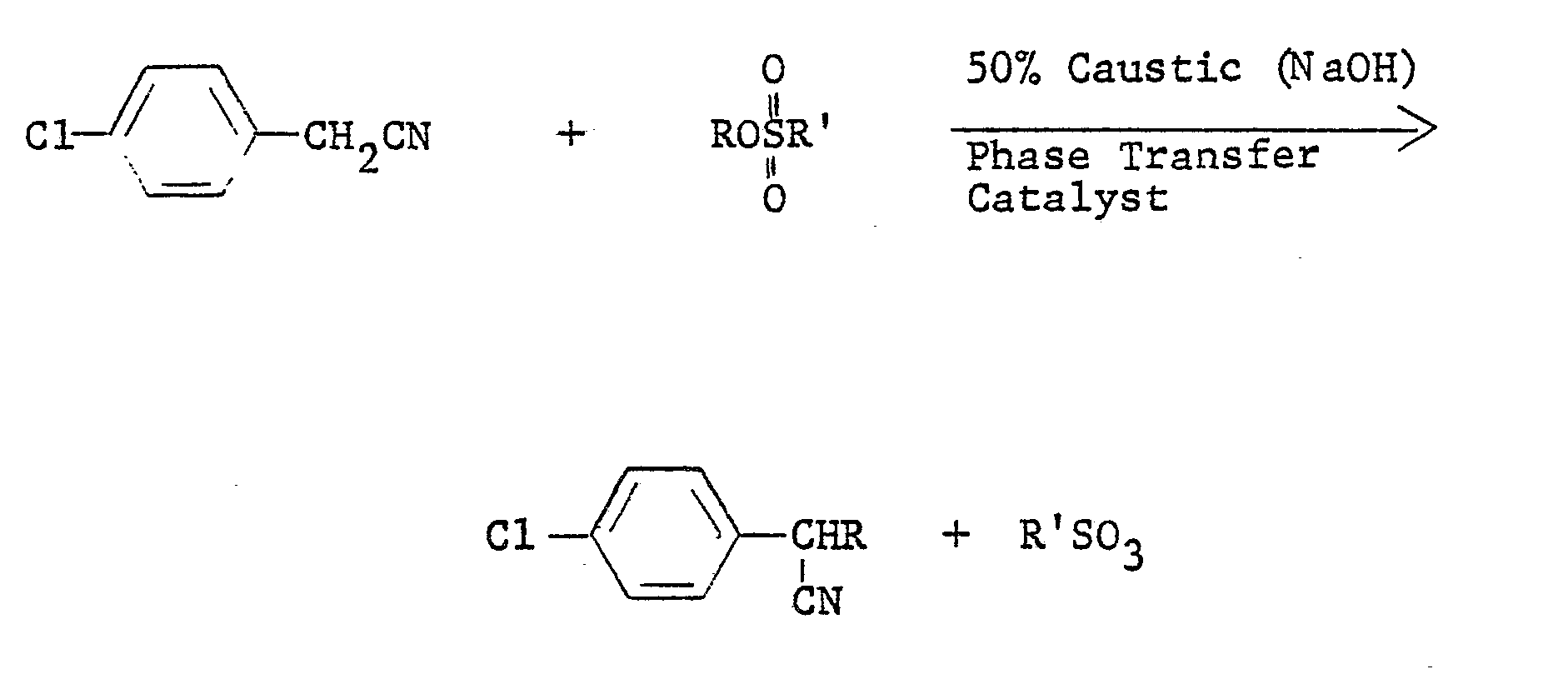
wherein R can be C
1-C
5 primary or secondary alkyl such as methyl, ethyl, propyl, isopropyl, butyl, isobutyl,
valeryl and isovaleryl and R' can be primary, secondary or tertiary C
1-C
5 such as methyl, ethyl, propyl, isopropyl, butyl, isobutyl, t-butyl, valeryl, isovaleryl
or t-valeryl. The above process has an additional advantage in that the alkyl sulfonate
of the alkyl alcohol are high boiling (~200°C) and do not require pressure equipment
during the reaction as do lower alkyl chlorides (RC1 wherein R is as defined above)
whose boiling point is about 35°C.
[0003] The process of this invention is exemplified by the following example.
EXAMPLE I
3-METHYL-2-p-CHLOROPHENYL BUTYRYLNITRILE
[0004] In a one liter flask was placed 135 grams (g) (0.9 mole (m)) of p-chlorophenyl acetonitrile
and 138 g (1 m) of isopropyl methanesulfonate. To this was added in one portion 300
milliliters (ml) of 50% NaOH and 30 ml of 40% tetrabutylammonium hydroxide. The mixture
was heated on a steam bath with vigorous stirring for three hours. Two liters of water
was then added and the mixture extracted three times with 200 ml portions of CH
2Cl
2. The organic layers were combined, dried with MgS0
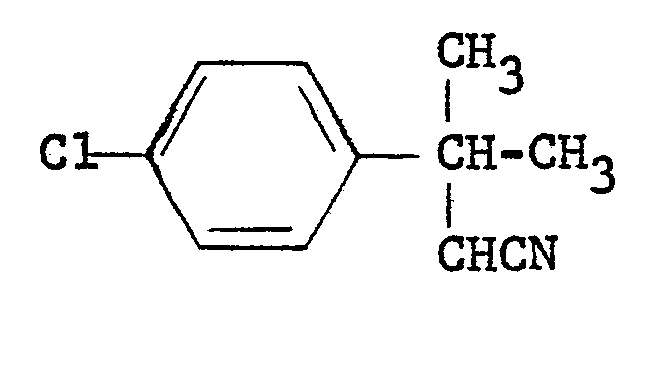
4 and evaporated. A quantitative yield of 3-methyl-2-p-chlorophenyl butyrylnitrile
was obtained. The product was identified by infrared and nuclear magnetic resonance
spectra as the title compound having the structural formula
1. A process for preparing a 3-alkyl-2-p-chlorophenyl butyrylnitrile having the formula
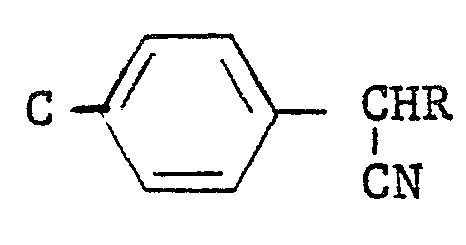
wherein R is a C
1-C
5 primary or secondary lower alkyl selected from the group consisting of methyl, ethyl,
propyl, isopropyl, butyl, isobutyl, valeryl and isovaleryl comprising reacting p-chlorophenyl
acetylnitrile with a lower alkyl sulfonate of a lower alkyl alcohol having the formula
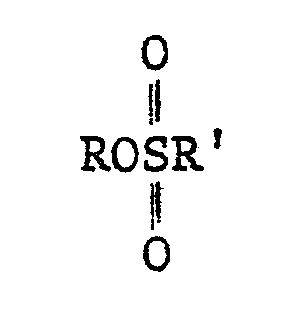
wherein R is a C
1-C
5 primary or secondary lower alkyl selected from the group consisting of methyl, ethyl,
propyl, isopropyl, butyl, isobutyl, valeryl and isovaleryl and R' is a C
1-C
5 lower alkyl selected from the group consisting of methyl, ethyl, propyl, isopropyl,
butyl, isobutyl, t-butyl, valeryl, isovaleryl or t-valeryl in the presence of a base
and a phase transfer catalyst.
2. The process of Claim 1 wherein R is isopropyl.
3. The process of Claims 1 or 2 wherein the base is selected from the group consisting
of 50% NaOH and 50% KOH, the reaction temperature is from about 0°C to about 200°C
and the phase transfer catalyst is selected from the group consisting of tetrabutylphosphonium
chloride, benzyltriethylammonium chloride, tricaprylmethylammonium chloride or tetrabutylammonium
chloride.
