| (19) |
 |
|
(11) |
EP 0 046 715 B1 |
| (12) |
EUROPEAN PATENT SPECIFICATION |
| (45) |
Mention of the grant of the patent: |
|
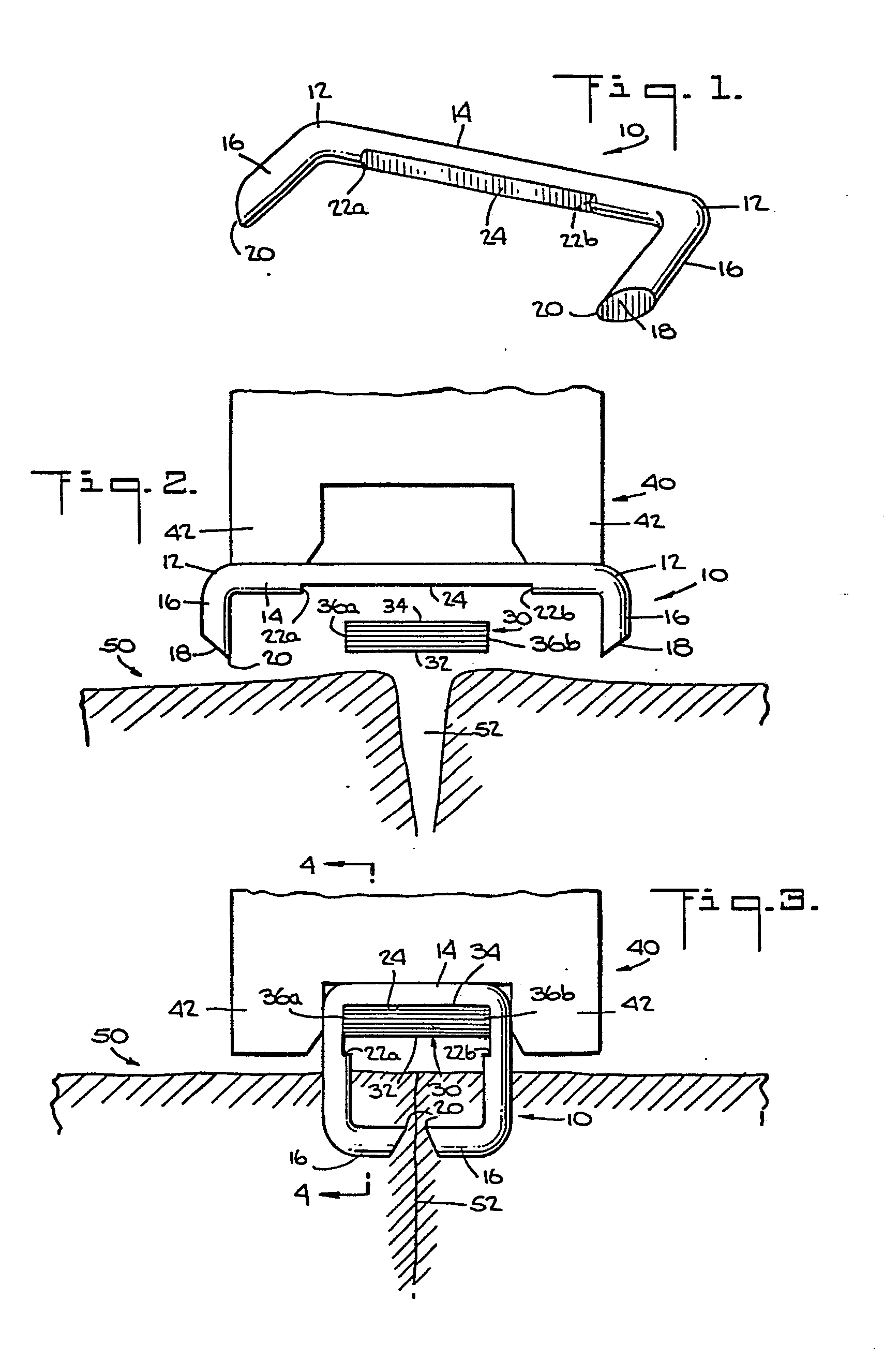
13.06.1984 Bulletin 1984/24 |
| (22) |
Date of filing: 24.08.1981 |
|
| (51) |
International Patent Classification (IPC)3: A61B 17/08 |
|
| (54) |
Improved surgical staples
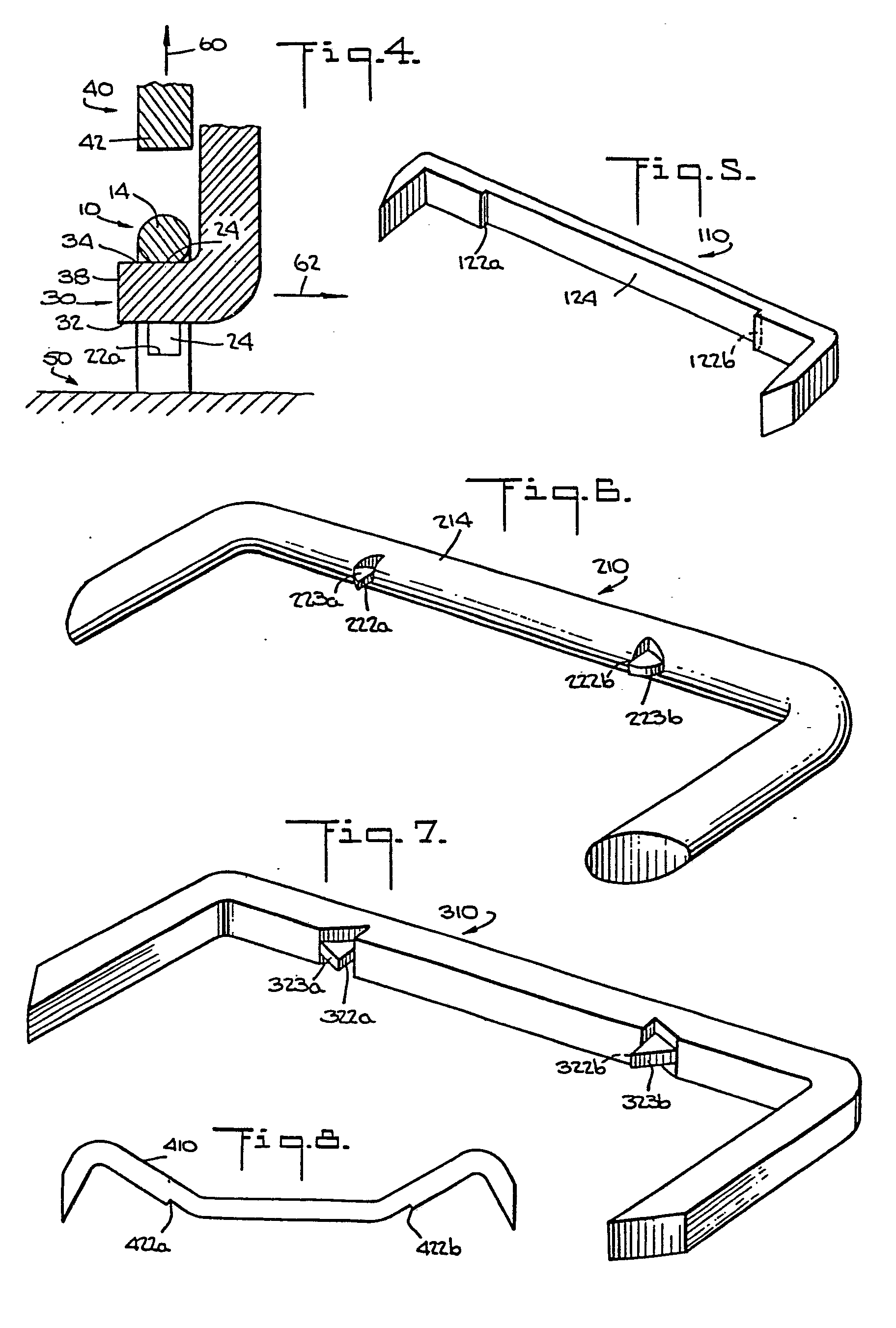
Chirurgische Klammern
Agrafes chirurgicales
|
| (84) |
Designated Contracting States: |
|
AT BE CH FR IT LI NL SE |
| (30) |
Priority: |
25.08.1980 US 181092
|
| (43) |
Date of publication of application: |
|
03.03.1982 Bulletin 1982/09 |
| (71) |
Applicant: United States Surgical Corporation |
|
Norwalk,
Connecticut 06856 (US) |
|
| (72) |
Inventors: |
|
- Noiles, Douglas George
New Canaan
Connecticut 06840 (US)
- Crawford, John Okerson
Brookfield
Connecticut 06805 (US)
|
| (74) |
Representative: Corre, Jacques Denis Paul et al |
|
Cabinet Regimbeau
26, Avenue Kléber
75116 Paris
75116 Paris (FR) |
|
| |
|
| Note: Within nine months from the publication of the mention of the grant of the European
patent, any person may give notice to the European Patent Office of opposition to
the European patent
granted. Notice of opposition shall be filed in a written reasoned statement. It shall
not be deemed to
have been filed until the opposition fee has been paid. (Art. 99(1) European Patent
Convention).
|
Background of the invention
[0001] This invention relates to surgical staples, and more particularly to surgical staples
of the type which are formed around an anvil in a surgical stapler.
[0002] Surgical stapling apparatus for applying staples to close incisions or wounds in
body tissue are shown, for example, in Green et al. U.S. patent 3,643,851, Smith U.S.
patent 3,650,453, and Green U.S. patent 3,837,555. In these devices, a surgical staple
which is typically preformed in a broad-based, square- cornered U-shape is advanced
toward an anvil by a staple pusher having an end with a generally U-shaped recess.
The base of the U-shaped recess in the staple pusher is broader than the anvil, but
not as broad as the base of the U-shaped staple. When the st3p)e reaches the anvil,
the staple pusher causes the staple to bend around the anvil into a closed, square-
cornered C shape. (In this specification and in the appended claims, this is referred
to as forming the staple). As this is taking place, the ends of the staple enter the
tissue on the respective opposite sides of the incision or wound and draw the tissue
together. When the staple has been fully formed, the staple pusher is retracted and
the stapler is removed by sliding the anvil out from within the staple. The staple
remains in the tissue to hold it together during healing.
[0003] Occasionally in surgical staplers of the type described above, the staple may not
readily release from the U-shaped recess in the staple pusher after the staple has
been formed and the staple pusher is being retracted. This may be because of residual
stresses in the staple which cause it to press against the sides of the staple pusher
recess in the spring-like fashion. When this occurs, the formed staple tends to be
pulled back into the stapler, with the possible consequences of injury to the tissue
being stapled and difficulty in freeing the stapler from the staple.
[0004] One solution which has been found to this occasional problem is to design the stapler
so that the fit between the staple pusher, the staple, and the anvil is relatively
loose, with the degree of looseness being carefully selected and controlled to minimize
the instances in which the staple pusher fails to readily release the staple. Achieving
and maintaining just the right degree of looseness in the design of the stapler, however,
requires extremely precise manufacturing tolerances, thereby increasing the cost of
the stapler. This relatively loose design may also produce finished staples which
are not as neatly and regularly formed as would be most desirable. It may also contribute
to other possible operating problems in the stapler, such as allowing a staple to
occasionally roll, twist, or slip off the anvil during formation, with the result
that the staple is improperly or incompletely formed or not formed at all. These problems
of rolling, twisting, and slipping are most likely to occur with staples made of round
wire, which is the most common and generally the preferred surgical staple stock.
[0005] In view of the foregoing, it is an object of this invention to provide improved surgical
staples of the type which are formed by being bent around an anvil as specified in
the claims.
[0006] It is a more particular object of this invention to provide improved surgical staples
of this type which are not subject to being pulled back into the stapler when the
staple pusher is retracted, and which may also have reduced tendency to roll, twist,
or slip off the anvil during formation.
Summary of the invention
[0007] These and other objects of the invention are accomplished in accordance with the
principles of the invention by providing a surgical staple with two spaced surfaces
transverse to the longitudinal axis of the staple and located on the staple so that
when the staple is formed around the anvil, these transverse surfaces cooperate with
the anvil to prevent the staple from being pulled back into the stapler when the staple
pusher is retracted. The improved staples of this invention allow the staplers with
which they are used to be designed so that there is a tighter fit among the staple
pusher, staple, and anvil. This eases manufacturing tolerances, reduces manufacturing
cost, produces more neatly formed staples, and reduces the possibility that a staple
may roll, twist, or slip off the anvil during formation. To further reduce the possibility
of staple roll, twist, or slip, particularly with staples made of round wire, the
portion of the side surface of the staple which contacts the anvil may be made flat
to help stabilize the staple on the anvil during staple formation.
[0008] Further features of the invention, its nature and various advantages will be more
apparent from the accompanying drawing and the following detailed description of the
invention.
Brief description of the drawing
[0009]
Figure 1 is a perspective view of an illustrative embodiment of the improved surgical
staple of this invention.
Figure 2 is another view of the staple of Figure 1 in use in conjunction with illustrative
surgical stapler apparatus.
Figure 3 shows the apparatus of Figure 2 after the staple has been fully formed by
the stapler.
Figure 4 is a sectional view taken along the line 4-4 in Figure 3 showing how the
stapler apparatus is removed from the finished staple.
Figure 5 is a perspective view of another illustrative embodiment of the improved
surgical staple of this invention.
Figure 6 is a perspective view of another illustrative embodiment of the improved
surgical staple of this invention.
Figure 7 is a perspective view of yet another illustrative embodiment of the improved
surgical staple of this invention.
Figure 8 is an elevational view of still another illustrative embodiment of the improved
surgical staple of this invention.
Detailed description of the invention
[0010] An illustrative embodiment of the surgical staple of this invention is shown prior
to formation in a stapler in Figures 1 and 2. As shown in these Figures, illustrative
staple 10 is made of metal wire having initially round cross section. The staple is
preformed into a broad-based U or channel shape with relatively sharp corners 12.
The base of the staple is designated 14, and the parallel legs of the staple are designated
16. The ends 18 of legs 16 opposite base 14 are cut off at an angle to provide sharp
tips 20 for allowing the staple to more easily and cleanly enter the tissue. Typical
material for staple 10 is 316-L stainless steel wire having a diameter of .020 (.051
cm) or .022 inches (.056 cm). Other materials and sizes are, of course, well known
to those skilled in the art.
[0011] In accordance with the present invention, staple 10 is preformed with two spaced
surfaces 22a and 22b on staple base 14 transverse to the longitudinal axis of the
staple base and located on the side of the staple base which initially contacts anvil
30 in a stapler as described below. In the particular embodiment shown in Figures
1 and 2, transverse surfaces 22a and 22b are the opposite ends of a recessed portion
24 of the side surface of staple base 14. Recessed surface 24 is located centrally
between staple legs 16 so that transverse surfaces 22a and 22b are located symmetrically
about the midpoint of staple base 14. The considerations governing the spacing of
surfaces 22a and 22b are discussed in detail below.
[0012] Recessed surface 24 may be formed in the staple in any of a number of ways to produce
transverse surfaces 22a and 22b. For example, surface 24 may be formed by coining,
milling, shaving, or broaching the staple. Although in the particular embodiment shown
in Figures 1 and 2, surfaces 22a and 22b are substantially perpendicular to the longitudinal
axis of staple base 14, this is not necessarily the case, and the term "transverse"
as applied to such surfaces is used herein and in the appended claims to mean a surface
forming a substantial angle with the longitudinal axis of the adjacent portion of
the staple and capable of performing the functions described in detail below. The
considerations governing the dimensions of surfaces 22a and 22b are discussed in detail
below. For present purposes, however, it will be sufficient to indicate that for staples
having diameter of .020 (.051 cm) or .022 inches (.056 cm), surface 24 may be recessed
approximately .002 inches (.0051 cm) so that the maximum dimension of surfaces 22a
and 22b measured perpendicular to surface 24 is about .002 inches (.0051 cm).
[0013] Although recessed surface 24 is preferably flat as shown in Figures 1 and 2 for reasons
discussed in detail below, this is not required, and surface 24 may have any shape
which will produce suitable transverse surfaces 22a and 22b at its respective opposite
ends.
[0014] In use in a surgical stapler as shown in Figures 2 and 3, staple 10 is advanced toward
anvil 30 by staple pusher 40, both of which are part of the stapler (not otherwise
shown in the drawing). The stapler may be a conventional instrument of the type shown,
for example, in Green et al. U.S. patent 3,643,851, and it may be used in the conventional
way. Assuming for purposes of illustration that the stapler is a skin stapler, the
stapler is held as shown in Figure 2 so that the distal side 32 of anvil 30 is adjacent
the skin tissue 50 to be stapled and so that one of staple legs 16 is on each side
of the incision or wound 52 to be closed. The staple is oriented in the stapler so
that the sharp ends 20 of staple legs 16 point toward the tissue to be stapled. The
staple is aligned in the stapler so that it is located symmetrically relative to anvil
30. This orientation and alignment of the staple causes recessed surface 24 of the
staple to face the proximal side 34 of anvil 30, with transverse surfaces 22a and
22b being respectively spaced at equal distances from the adjacent lateral sides 36a
and 36b of the anvil.
[0015] As staple pusher 40 advances staple 10 toward anvil 30, the central portion of recessed
surface 24 initially contacts proximal side 34 of anvil 30. The ends 20 of staple
legs 16 also begin to penetrate the tissue. Thereafter, as staple pusher 40 continues
to advance, the distal ends 42 of staple pusher 40 bend the portions of staple base
14 which extend beyond the distal side of anvil 30 around the anvil until those portions
of the staple base are substantially parallel to one another and substantially perpendicular
to the remaining central portion of the staple base as shown in Figure 3. As this
occurs, staple legs 16 further penetrate the tissue, are reoriented toward one another,
and, in cooperation with the portions of the staple base which enter the tissue, draw
the tissue on the two sides of incision or wound 52 together, as is also shown in
Figure 3. Formation of the staple is now complete.
[0016] It will be noted in Figure 3 that when the staple has been fully formed as shown,
transverse surfaces 22a and 22b are adjacent the respective opposite ends of the distal
side 32 of anvil 30. When staple pusher 40 is retracted to release the staple from
the stapler, these surfaces will contact the ends of distal side 32 to substantially
prevent the staple from moving transversely or laterally of the anvil in the direction
opposite the direction in which the staple was advanced toward the anvil. In particular,
transverse surfaces 22a and 22b cooperate with the distal side of anvil 30 to pull
the staple from the recessed end of the staple pusher in the event that the staple
pusher does not otherwise readily release the staple. In this way transverse surfaces
22a and 22b cooperate with anvil 30 to prevent the staple pusher from pulling the
staple back into the stapler when the staple pusher is retracted.
[0017] In order to have transverse surfaces 22a and 22b properly located relative to the
distal side 32 of anvil 30 when the staple has been fully formed, the initial spacing
of transverse surfaces 22a and 22b must be at least slightly greater than the portion
of the periphery of the anvil cross section immediately adjacent the finished staple,
i.e., the portion of the anvil periphery excluding distal side 32. For example, in
the case of a stapler for use with an anvil 30 of rectangular cross section as shown
in Figures 2 and 3, the initial spacing of transverse surfaces 22a and 22b is preferably
equal to the width of the anvil, plus twice the thickness of the anvil, plus a small
clearance (e.g., approximately .01 inches (.025 cm) in the case of staples with the
specific dimensions mentioned above). This clearance must be large enough to compensate
for any shortening of the inside surface 24 of the staple due to bending of staple
base 14 during staple formation.
[0018] In order for transverse surfaces 22a and 22b to cooperate with the distal side 32
of anvil 30 as described above, transverse surfaces 22a and 22b must be at least prominent
enough to overlap the ends of distal side 32 when the staple has been fully formed.
The important dimension of transverse surfaces 22a and 22b for this purpose is the
amount by which these surfaces project from the staple surface between them (i.e.,
surface 24 in the illustrative embodiment being described). The required amount of
this projection will depend on several factors such as the overall size of the staple
and the closeness of the staple to the lateral sides 36a and 36b of the anvil when
the staple is fully formed around the anvil. In the case of staples with the specific
dimensions mentioned above, it has been found that transverse surfaces 22a and 22b
projecting about .002 inches (.0051 cm) outward from recessed surface 24 give good
results.
[0019] Figure 4 shows how the stapler is removed after the staple has been fully formed.
First, staple pusher 40 is retracted as indicated by arrow 60. Thereafter, anvil 30
is slipped out of the staple by moving it in the direction of arrow 62. The staple
typically remains in the tissue during healing of the incision or wound, after which
the staple may be removed by other conventional means.
[0020] The presence of transverse surfaces 22a and 22b to help prevent the staples from
being pulled back into the stapler when staple pusher 40 is retracted makes the design
of all components of the system (i.e., staple 10, anvil 30, and staple pusher 40)
less critical than would otherwise be necessary to minimize the possibility of this
type of malfunction. The anvil and staple pusher can be made to form the staple much
more closely around the anvil without increasing the possibility that a staple may
not release from the staple pusher when it retracts. This produces staples which are
more perfectly, uniformly, and neatly formed. It is no longer as critical to maintain
the precise degree of looseness between the staple, anvil, and staple pusher which
is otherwise desirable to promote release of the fully formed staples from the staple
pusher without loss of control of the staples during formation. This eases manufacturing
tolerances on the staples and the stapler, thereby facilitating manufacture, reducing
costs, and enhancing reliability.
[0021] The staple shown in Figures 1-4 and described above has other advantages which have
not yet been discussed. The presence of substantially flat recessed surface 24 on
the side of the staple which contacts anvil 30 stabilizes the staple on the anvil
while it is being formed. This reduces the possibility that a staple may roll or twist
on the anvil as it is being forced into the tissue and formed around the anvil. It
also reduces the possibility that a staple may slip off the end 38 (Figure 4) of the
anvil before it has been fully formed and the stapler is being deliberately removed
from the staple. Thus, although the staple is basically a round wire staple as is
most common and also frequently preferred, it has a relatively small flat surface
24 which contributes substantially to its stability during formation by the stapler
and thereby enhances the reliability of the apparatus.
[0022] Although in the embodiment shown in Figures 1-4 the staple is round wire and transverse
surfaces 22a and 22b are the opposite ends of a recessed portion of the side surface
of the staple, the staples of this invention may have many other cross sectional shapes
and the transverse surfaces may be formed in many other ways. In Figure 5, for example,
staple 110 has a flat or rectangular cross section and transverse surfaces 122a and
122b are formed as the respective opposite ends of recess 124. In other respects staple
110 is similar to staple 10 and may be used in the same way.
[0023] In the alternative embodiment shown in Figure 6, staple 210 is again made of round
wire, but transverse surfaces 222a and 222b are the facing surfaces of two spaced
projections or barbs 223a and 223b on staple base 214. These barbs may have any of
a wide variety of shapes and may be formed in any of a wide variety of ways. For example,
barbs 223a and 223b may be formed by staking or pinching the wire of the staple and
thereby raising the bars. In other respects staple 210 may be similar to the previously
described embodiments, although it does not have a flat surface for cooperating with
a flat anvil surface to increase the stability of the staple on the anvil during staple
forming as described above in connection with Figures 1-4.
[0024] Staple 310 in Figure 7 is similar to staple 210 except that the staple is made of
square wire. As in the case of staple 210, transverse surfaces 322a and 322b are the
facing surfaces of barbs 323a and 323b, respectively.
[0025] The invention is not limited in its application to surgical staples having an initially
square- cornered U or channel shape, but is equally applicable to surgical staples
having many other starting shapes. For example, Figure 8 shows a staple 410 of the
type shown in Rothfuss U.S. patent 4,014,492 but modified in accordance with the principles
of the present invention to include transverse surfaces 422a and 422b for cooperating
with the anvil in the Rothfuss apparatus in the same way that surfaces 22a and 22b
cooperate with anvil 30 in the apparatus of Figures 2-4 above.
[0026] It will be understood that the embodiments shown and described herein are merely
illustrative of the principles of the invention, and that various modifications can
be made by those skilled in the art without departing from the scope and spirit of
the invention. For example, the staple can be made with any of a wide variety of cross
sectional shapes as described above.
1. A surgical staple for use in a surgical stapler having an anvil around which the
staple is formed and a staple pusher for advancing the staple to the anvil and forming
it around the anvil, characterized by two spaced surfaces transverse to the longitudinal
axis of the staple, on the side of the staple facing the anvil and located so that
when the staple is formed around the anvil, the transverse surfaces cooperate with
the anvil to substantially prevent the staple from being pulled back in the direction
opposite the staple advancing direction.
2. A surgical staple as defined in claim 1, further characterized in that the transverse
surfaces are spaced apart by a distance equal to the sum of the portion of the anvil
periphery immediately adjacent the staple when the staple is formed around the anvil
plus a clearance dimension.
3. A surgical staple as defined in claim 1 for use with an anvil having a rectangular
cross section, further characterized in that the spacing between the transverse surfaces
is equal to the sum of the anvil width, twice the anvil thickness, and a clearance.
4. A surgical staple as defined in claim 1, further characterized in that the transverse
surfaces are the respective opposite ends of a recessed portion of the staple surface
facing the anvil.
5. A surgical staple as defined in claim 4, further characterized in that the recessed
portion of the staple surface intermediate the transverse surfaces is substantially
flat prior to formation of the staple around the anvil.
6. A surgical staple as defined in claim 1, further characterized in that each transverse
surface is a portion of the surface of a projection on the side of the staple facing
the anvil.
7. A surgical staple as defined in claim 1, further characterized in that the transverse
surfaces contact anvil surface portions facing away from the anvil surface initially
contacted by the staple to substantially prevent the staple from being pulled back
in the direction opposite the staple advancing direction.
8. A surgical staple as defined in claim 7, further characterized in that the anvil
surface portions contacted by the transverse surfaces are portions of the anvil surface
opposite the anvil surface initially contacted by the staple.
9. A surgical staple for use in conjunction with an instrument having an anvil around
which the staple is bent to form a finished staple, characterized by a pair of spaced
surfaces transverse to the longitudinal axis of the staple on the side of the staple
adjacent the anvil, the transverse surfaces being located so that when the staple
is bent around the anvil,- the transverse surfaces cooperate with the anvil to substantially
prevent the staple from moving transversely of the anvil.
10. A surgical staple as defined in claim 9, further characterized in that the transverse
surfaces are spaced apart by the sum of the portion of the anvil periphery immediately
adjacent the finished staple plus a clearance.
11. A surgical staple as defined in claim 9 for use with an anvil having a rectangular
cross section, further characterized in that the spacing between the transverse surfaces
is equal to the sum of the anvil width, twice the anvil thickness, and a clearance
dimension.
12. A surgical staple as defined in claim 9, further characterized in that the transverse
surfaces are the respective opposite ends of a recessed portion of the staple.
13. A surgical staple as defined in claim 12, further characterized in that the surface
of the recessed portion intermediate the transverse surfaces is initially substantially
flat.
14. A surgical staple as defined in claim 9, further characterized in that each of
the transverse surfaces is a portion of a respective one of a pair of projections
from the staple.
15. A surgical staple as defined in claim 9, further characterized in that the transverse
surfaces contact anvil surface portions which are not otherwise immediately adjacent
the finished staple to substantially prevent the staple from moving transversely of
the anvil.
16. An improved surgical staple for use in a surgical stapler of the type in which
the staple is formed around an anvil, wherein the improvement comprises a pair of
spaced surfaces transverse to the longitudinal axis of the staple, on the staple,
located so that when the staple is formed around the anvil, the transverse surfaces
are adjacent to and cooperate with the side of the anvil opposite the side which initially
contacts the staple.
17. The staple defined in claim 16 wherein the transverse surfaces are spaced apart
by a distance slightly greater than the periphery of the anvil around which the staple
is formed, excluding the side of the anvil opposite the side which initially contacts
the staple.
18. The staple defined in claim 16 wherein the transverse surfaces are the respective
opposite ends of a recessed portion of the side surface of the staple.
19. The staple defined in claim 18 wherein the length of the recessed portion is slightly
greater than the portion of the periphery of the anvil contacted by the staple when
formed around the anvil.
20. The staple defined in claim 16 wherein each of the transverse surfaces is a projection
from the side surface of the staple.
21. The staple defined in claim 20 wherein the spacing between the projections is
slightly greater than the portion of the periphery of the anvil contacted by the staple
when formed around the anvil.
22. The staple defined in claim 16 for use in a surgical stapler in which the anvil
has rectangular cross section and wherein the transverse surfaces are spaced apart
by a distance equal to the width of the anvil, plus twice the thickness of the anvil,
plus a small clearance.
23. The staple defined in claim 22 wherein the portion of the side surface of the
staple between the transverse surfaces which initially contacts the anvil is substantially
flat.
24. The staple defined in claim 23 wherein the staple is formed of substantially round
wire, wherein the transverse surfaces are the respective opposite ends of a recessed
portion of the side surface of the wire, and wherein the recessed surface is substantially
flat.
25. A surgical staple of the type which is applied by bending it around an anvil and
which has a longitudinal base member and a pair of substantially parallel leg members
integral with and substantially perpendicular to the base member at the respective
opposite ends of the base member, characterized by a pair of spaced surfaces transverse
to the longitudinal axis of the staple, on the base member between the leg members
and on the same side of the base member as the leg members.
26. A surgical staple as defined in claim 25, further characterized in that the transverse
surfaces are spaced apart by a distance greater than the portion of the anvil periphery
around which the staple is to be bent.
27. A surgical staple as defined in claim 26, further characterized in that the transverse
surfaces are spaced apart by a distance equal to the portion of the anvil periphery
around which the staple is to be bent plus a clearance dimension.
28. A surgical staple as defined in claim 27 for use with an anvil having a rectangular
cross section, further characterized in that the transverse surfaces are spaced apart
by a distance equal to the sum of the anvil width, twice the anvil thickness, and
a clearance.
29. A surgical staple as defined in claim 28, further characterized in that the transverse
surfaces are the respective opposite ends of a recessed portion of the base member.
30. A surgical staple as defined in claim 29, further characterized in that the surface
of the recessed portion intermediate the transverse surfaces is substantially flat.
31. A surgical staple as defined in claim 30, further characterized in that the staple
is formed from round 316-L stainless steel wire.
32. A surgical staple as defined in claim 28, further characterized in that each transverse
surface is a portion of the surface of a respective one of a pair of projections from
the base member.
33. A surgical staple as defined in claim 32, further characterized in that the staple
is formed from round 316-L stainless steel wire.
34. A surgical staple of the type which is applied by bending it around an anvil and
which has a longitudinal base member and a pair of substantially parallel leg members
integral with and substantially perpendicular to the base member at the respective
opposite ends of the base. member, characterized by a pair of spaced surfaces transverse
to the longitudinal axis of the staple, on the base member between the leg members
and on the same side of the base member as the leg members, the transverse surfaces
cooperating with the anvil when the staple is bent around the anvil to substantially
prevent the staple from moving transversely of the anvil.
1. Chirurgische Heftklammer zur Verwendung in einem chirurgischen Heftgerät mit einem
Amboß, um welchen herum die Klammer verformt wird, und einem Klammervordrücker zum
Vorwärtsbewegen der Klammer zu Amboß und zur Verformung derselben um den Amboß herum,
gekennzeichnet durch zwei quer zur Längsachse der Klammer verlaufende im Abstand liegende
Flächen auf der dem Amboß zugekehrten Seite der Klammer, die so angeordnet sind, daß,
wenn die Klammer um den Amboß herum verformt ist, die Querflächen mit dem Amboß ein
Zurückziehen der Klammer in der zur Vorwärtsbewegungsrichtung der Klammer entgegengesetzten
Richtung im wesentlichen verhindernd zusammenwirken.
2. Chirurgische Heftklammer nach Anspruch 1, ferner dadurch gekennzeichnet, daß die
Querflächen in einem Abstand voneinander liegen, der gleich der Summe aus dem Teil
des Amboßaußenrandes, der unmittelbar an die Klammer angrenzt, wenn die Klammer um
den Amboß herum verformt ist, und einem Spielmaß ist.
3. Chirurgische Heftklammer nach Anspruch 1 zur Verwendung mit einem einen rechteckigen
Querschnitt aufweisenden Amboß, ferner dadurch gekennzeichnet, daß der Abstand zwischen
den Querflächen gleich der Summe aus der Amboßbreite, zweimal der Amboßdicke und einem
Spiel ist.
4. Chirurgische Hertklammer nach Anspruch 1, ferner dadurch gekennzeichnet, daß die
Querflächen die entgegengesetzten Enden eines zurückgesetzten Abschnitts der dem Amboß
zugekehrten Klammerfläche ist.
5. Chirurgische Heftklammer nach Anspruch 4, ferner dadurch gekennzeichnet, daß der
zurückgesetzte Abschnitt der Klammerfläche zwischen den Querflächen vor der Verformung
der Klammer um den Amboß herum im wesentlichen eben ist.
6. Chirurgische Heftklammer nach Anspruch 1, ferner dadurch gekennzeichnet, daß jede
Querfläche ein Teil der Fläche eines Vorsprungs auf der dem Amboß zugekehrten Seite
der Klammer ist.
7. Chirurgische Heftklammer nach Anspruch 1, ferner dadurch gekennzeichnet, daß die
Querflächen Amboßflächenabschnitte berühren, die der anfangs von der Klammer berührten
Amboßfläche abgekehrt sind, um im wesentlichen zu verhindern, daß die Klammer in der
zur Klammervorwärtsbewegungsrichtung entgegengesetzten Richtung zurückgezogen wird.
8. Chirurgische Heftklammer nach Anspruch 7, ferner dadurch gekennzeichnet, daß die
durch die Querflächen berührten Amboßflächenabschnitte Teile der Amboßfläche sind,
die entgegengesetzt sur anfänglich durch die Klammer berührten Amboßfläche liegen.
9. Chirurgische Heftklammer zur Verwendung in Verbindung mit einem Instrument, welches
einen Amboß aufweist, um den die Klammer zur Bildung einer fertigen Klammer herumgebogen
wird, gekennzeichnet durch ein Paar von im Abstand liegenden quer zur Längsachse der
Klammer verlaufenden Flächen auf der dem Amboß benachbarten Seite der Klammer, wobei
die Querflächen so angeordnet sind, daß, wenn die Klammer um den Amboß herumgebogen
ist, die Querflächen mit dem Amboß ein Bewegen der Klammer quer zum Amboß im wesentlichen
verhindernd zusammenwirken.
10. Chirurgische Heftklammer nach Anspruch 9, ferner dadurch gekennzeichnet, daß die
Querflächen in einem Abstand voneinander liegen, der durch die Summe aus dem unmittelbar
an die fertige Klammer angrenzenden Teil des Amboßaußenrandes und einem Spiel gegeben
ist.
11. Chirurgische Heftklammer nach Anspruch 9 zur Verwendung bei einem Amboß mit einem
rechteckigen Querschnitt, ferner dadurch gekennzeichnet, daß der Abstand zwischen
den Querflächen gleich der Summe aus der Amboßbreite, zweimal der Amboßdicke und einem
Spielmaß ist.
12. Chirurgische Heftklammer nach Anspruch 9, ferner dadurch gekennzeichnet, daß die
Querflächen die entgegengesetzten Enden eines zurückgesetzten Abschnitts der Klammer
sind.
13. Chirurgische Heftklammer nach Anspruch 12, ferner dadurch gekennzeichnet, daß
die Fläche des zurückgesetzten Abschnitts zwischen den Querflächen anfänglich im wesentlichen
eben ist.
14. Chirurgische Heftklammer nach Anspruch 9, ferner dadurch gekennzeichnet, daß jede
der Querflächen ein Abschnitt eines entsprechenden aus einem Paar von Vorsprüngen
der Klammer ist.
15. Chirurgische Heftklammer nach Anspruch 9, ferner dadurch gekennzeichnet, daß die
Querflächen Amboßflächenabschnitte berühren, die sonst nicht unmittelbar an die fertige
Klammer angrenzen, um im wesentlichen zu verhindern, daß sich die Klammer quer zum
Amboß bewegt.
16. Verbesserte chirurgische Heftklammer zur Verwendung in einem chirurgischen Heftgerät
der Art, bei welcher die Klammer um einen Amboß herum verformt wird, worin die Verbesserung
ein Paar von im Abstand quer zur Längsachse der Klammer liegenden Flächen auf der
Klammer umfaßt, die so angeordnet sind, daß, wenn die Klammer um den Amboß Herum verformt
ist, die Querflächen an die Seite des Ambosses angrenzen, die zu der Seite, welche
anfänglich die Klammer berührt, entgegengesetzt lieft, und mit dieser zusammenwirken.
17. Heftklammer nach Anspruch 16, bei welcher die Querflächen in einem Abstand voneinander
liegen, der geringfügig größer als der Außenrand des Ambosses ist, um welchen die
Klammer verformt wird, ausschließlich der Seite des Ambosses, die zu der Seite entgegengesetzt
liegt, welche anfänglich die Klammer berührt.
18. Heftklammer nach Anspruch 16, bei welcher die Querflächen die entgegengesetzten
Enden eines zurückgesetzten Abschnittes der Seitenfläche der Klammer sind.
19. Heftklammer nach Anspruch 18, bei welcher die Länge des zurückgesetzten Abschnitts
geringfügig größer als der Teil des Außenrandes des Ambosses ist, der von der Klammer
bei ihrer Verformung um den Amboß herum berührt wird.
20. Heftklammer nach Anspruch 16, bei welcher jede der Querflächen ein Vorsprung der
Seitenfläche der Klammer ist.
21. Heftklammer nach Anspruch 20, bei welcher der Abstand zwischen den Vorsprüngen
geringfügig größer als der Teil des Außenrandes des Ambosses ist, der durch die Klammer
bei ihrer Verformung um den Amboß herum berührt wird.
22. Heftklammer nach Anspruch 16 zur Verwendung in einem chirurgischen Heftgerät,
bei welchem der Amboß einen rechteckigen Querschnitt hat, und wobei die Querflächen
in einem Abstand voneinander liegen, der gleich der Breite des Ambosses plus zweimal
der Dicke des Ambosses plus einem kleinen Spiel ist.
23. Heftklammer nach Anspruch 22, bei welcher der Abschnitt der Seitenfläche der Klammer
zwischen den Querflächen, welcher anfänglich den Amboß berührt, im wesentlichen eben
ist.
24. Heftklammer nach Anspruch 23, wobei die Klammer aus im wesentlichen rundem Draht
gebildet ist, wobei die Querflächen die entgegengesetzten Enden eines zurückgesetzten
Abschnittes der Seitenfläche des Drahtes sind, und wobei die zurückgesetzte Fläche
im wesentlichen eben ist.
25. Chirurgische Heftklammer der Art, welche durch Biegen derselben um einen Amboß
herum angebracht wird und welche ein langgestrecktes Basiselement und an entgegengesetzten
Enden des Basiselementes ein Paar im wesentlichen paralleler Schenkelelemente aufweist,
die mit dem Basiselement ein- . stückig und im wesentlichen senkrecht zu diesem sind,
gekennzeichnet durch ein Paar im Abstand liegender quer zur Längsachse der Klammer
verlaufender Flächen auf dem Basiselement zwischen den Schenkelelementen und auf der
gleichen Seite des Basiselements wie die Schenkelelemente.
26. Chirurgische Heftklammer, nach Anspruch 25, ferner dadurch gekennzeichnet, daß
die Querflächen in einem Abstand voneinander liegen, der größer als der Teil des Amboßaußenrandes
ist, um welchen herum die Klammer zu biegen ist.
27. Chirurgische Heftklammer nach Anspruch 26, ferner dadurch gekennzeichnet, daß
die Querflächen in einem Abstand voneinander liegen, der gleich dem Teil des Amboßaußenrandes,
um den herum die Klammer zu biegen ist, plus einem Spielmaß ist.
28. Chirurgische Heftklammer nach Anspruch 27 zur Verwendung mit einem Amboß, welcher
einen rechteckigen Querschnitt hat, ferner dadurch gekennzeichnet, daß die Querflächen
in einem Abstand voneinander liegen, der gleich der Summe aus der Amboßbreite, zweimal
der Amboßdicke und einem Spiel ist.
29. Chirurgische Heftklammer nach Anspruch 28, ferner dadurch gekennzeichnet, daß
die Querflächen die entgegengesetzten Enden eines zurückgesetzten Abschnitts des Basiselements
sind.
30. Chirurgische Heftklammer nach Anspruch 29, ferner dadurch gekennzeichnet, daß
die Fläche des zurückgesetzten Abschnitts zwischen den Querflächen im wesentlichen
eben ist.
31. Chirurgische Heftklammer nach Anspruch 30, ferner dadurch gekennzeichnet, daß
die Klammer aus rundem 316-L rostfreiem Stahldraht gebildet ist.
32. Chirurgische Heftklammer nach Anspruch 28, ferner dadurch gekennzeichnet, daß
jede Querfläche ein Abschnitt der Fläche eines entsprechenden aus einem Paar von Vorsprüngen
des Basiselements ist.
33. Chirurgische Heftklammer nach Anspruch 32, ferner dadurch gekennzeichnet, daß
die Klammer aus rundem 316-L rostfreiem Stahldraht gebildet ist.
34. Chirurgische Heftklammer der Art, welche durch Biegen derselben um einen Amboß
herum angebracht wird und welche ein Längsbasiselement und an entgegengesetzten Enden
des Basiselements ein Paar von im wesentlichen parallelen Schenkelelementen, die mit
dem Basiselement einstückig und im wesentlichen senkrecht dazu sind, aufweist, gekennzeichnet
durch ein Paar von im Abstand liegenden quer zur Längsachse der Klammer verlaufenden
Flächen auf dem Basiselement zwischen den Schenkelelementen und auf der gleichen Seite
des Basiselements wie die Schenkelelemente, wobei die Querflächen eine Bewegung der
Klammer quer zum Amboß im wesentlichen verhindernd mit dem Amboß zusammenwirken, wenn
die Klammer um den Amboß herum gebogen wird.
1. Une agrafe chirurgicale conçue pour être utilisée dans une agrafeuse chirurgicale
ayant une enclume autour de laquelle l'agrafe est mise en forme et un pousse-agrafe
pour faire avancer l'agrafe jusqu'à l'enclume et la mettre en forme autoure de l'enclume,
caractérisée par deux surfaces espacées transversales à l'axe longitudinal de l'agrafe
formées sur le côté de l'agrafe qui fait face à l'enclume et disposées de telle sorte
que, lorsque l'agrafe est mise en forme autour de l'enclume, les surfaces transversales
coopèrent avec l'enclume pour empêcher pratiquement l'agrafe d'être tirée en arrière
dans la direction opposée à la direction d'avance de l'agrafe.
2. Une agrafe chirurgicale telle que définie dans la revendication 1, caractérisée,
en outre, en ce que les surfaces transversales sont espacées l'une de l'autre d'une
distance égale à la somme de la partie de la périphérie de l'enclume immédiatement
adjacente à l'agrafe lorsque l'agrafe est mise en forme autour de l'enclume plus une
dimension de dégagement.
3. Une agrafe chirurgicale telle que définie dans la revendication 1, conçue pour
être utilisée avec une enclume ayant une section transversale rectangulaire, caractérisée,
en outre, en ce que l'espacement entre les surfaces transversales est égal à la somme
de la largeur de l'enclume, du double de l'épaisseur de l'enclume et d'un jeu de dégagement.
4. Une agrafe chirurgicale telle que définie dans la revendication 1, caractérisée,
en outre, en ce que les surfaces transversales sont les extrémités opposées respectives
d'une partie évidée de la surface de l'agrafe qui fait face à l'enclume.
5. Une agrafe chirurgicale telle que définie dans la revendication 4, caractérisée,
en outre, en ce que la partie évidée de la surface de l'agrafe située entre les surfaces
transversales est sensiblement plate avant la mise en forme de l'agrafe autour de
l'enclume.
6. Une agrafe chirurgicale telle que définie dans la revendication 1, caractérisée,
en outre, en ce que chaque surface transversale est une partie de la surface d'une
saillie formée sur le côté de l'agrafe qui fait face à l'enclume.
7. Une agrafe chirurgicale telle que définie dans la revendication 1, caractérisée,
en outre, en ce que les surfaces transversales entrent en contact avec des parties
de surface de l'enclume orientées à l'opposé de la surface d'enclume avec laquelle
l'agrafe entre initialement en contact pour empêcher pratiquement l'agrafe d'être
tirée en arrière dans la direction opposée à la direction d'avance de l'agrafe.
8. Une agrafe chirurgicale telle que définie dans la revendication 7, caractérisée,
en outre, en ce que les parties de surface de l'enclume avec lesquelles entrent en
contact les surfaces transversales sont des parties de la surface de l'enclume opposées
à la surface de l'enclume avec laquelle l'agrafe entre initialement en contact.
9. Une agrafe chirurgicale conçue pour être utilisée en combinaison avec un instrument
comportant une enclume autour de laquelle l'agrafe est pliée pour former une agrafe
finie, caractérisée par une paire de surfaces espacées transversales à l'axe longitudinal
de l'agrafe formées sur le côté de l'agrafe adjacent à l'enclume, les surfaces transversales
étant disposées de telle sorte que, lorsque l'agrafe est pliée autour de l'enclume,
les surfaces transversales coopèrent pour empêcher pratiquement l'agrafe de se déplacer
transversalement à l'enclume.
10. Une agrafe chirurgicale telle que définie dans la revendication 9, caractérisée,
en outre, en ce que les surfaces transversales sont espacées l'une de l'autre de la
somme de la partie de la périphérie de l'enclume immédiatement adjacente à l'agrafe
finie plus un jeu de dégagement.
11. Une agrafe chirurgicale telle que définie dans la revendication 9, conçue pour
être utilisée avec une enclume ayant une section transversale rectangulaire, caractérisée,
en outre, en ce que l'espacement entre les surfaces transversales est égal à la somme
de la largeur de l'enclume, du double de l'épaisseur de l'enclume et d'une dimension
de dégagement.
12. Une agrafe chirurgicale telle que définie dans la revendication 9, caractérisée,
en outre, en ce que les surfaces transversales sont les extrémités opposées respectives
d'une partie évidée de la surface de l'agrafe.
13. Une agrafe chirurgicale telle que définie dans la revendication 12, caractérisée,
en outre, en ce que la partie évidée de la surface de l'agrafe située entre les surfaces
transversales est initialement sensiblement plate.
14. Une agrafe chirurgicale telle que définie dans la revendication 9, caractérisée,
en outre, en ce que chacune des surfaces transversales est une partie d'une saillie
respective d'une paire de saillies formées sur l'agrafe.
15. Une agrafe chirurgicale telle que définie dans la revendication 9, caractérisée,
en outre, en ce que les surfaces transversales entrent en contact avec des parties
de surface de l'enclume qui ne sont pas autrement immédiatement adjacentes à l'agrafe
finie pour empêcher pratiquement l'agrafe de se déplacer transversalement par rapport
à l'enclume.
16. Une agrafe chirurgicale perfectionnée, conçue pour être utilisée dans une agrafeuse
chirurgicale du type dans lequel l'agrafe est mise en forme autour d'une enclume,
dans laquelle le perfectionnement comprend une paire de surfaces espacées transversales
à l'axe longitudinal de l'agrafe, formées sur l'agrafe, disposées de telle sorte que,
lorsque l'agrafe est mise en forme autoure de l'enclume, les surfaces transversales
sont adjacentes au côté de l'enclume opposé au côté qui entre initialement en contact
avec l'agrafe.
17. L'agrafe définie dans la revendication 16, dans laquelle les surfaces transversales
sont espacées l'une de l'autre d'une distance légèrement supérieure à la périphérie
de l'enclume autour de laquelle l'agrafe est mise en forme, à l'exclusion du côté
de l'enclume opposé au côté qui entre initialement en contact avec l'agrafe.
18. L'agrafe définie dans la revendication 16, dans laquelle les surfaces transversales
sont les extrémités opposées respectives d'une partie évidée de la surface latérale
de l'agrafe.
19. L'agrafe définie dans la revendication 18, dans laquelle la longueur de la partie
évidée est légèrement supérieure à la partie de la périphérie de l'enclume avec laquelle
l'agrafe entre en contact lorsqu'elle est mise en forme autour de l'enclume.
20. L'agrafe définie dans la revendication 16, dans laquelle chacune des surfaces
transversales est une saillie formée sur la surface latérale de l'agrafe.
21. L'agrafe définie dans la revendication 20, dans laquelle l'espacement entre les
saillies est légèrement supérieur à la partie de la périphérie de l'enclume avec laquelle
l'agrafe entre en contact lorsqu'elle est mise en forme autour de l'enclume.
22. L'agrafe définie dans la revendication 16, conçue pour être utilisée dans une
agrafeuse chirurgicale dans laquelle l'enclume a une section transversale rectangulaire,
et dans laquelle les surfaces transversales sont espacées l'une de l'autre d'une distance
égale à la largeur de l'enclume plus le double de l'épaisseur de l'enclume plus un
petit jeu de dégagement.
23. L'agrafe définie dans la revendication 22, dans laquelle la partie de la surface
latérale de l'agrafe située entre les surfaces transversales qui entre initialement
en contact avec l'enclume est sensiblement plate.
24. L'agrafe définie dans la revendication 23, dans laquelle l'agrafe est formée en
fil sensiblement rond, dans laquelle les surfaces transversales sont les extrémités
opposées d'une partie en retrait de la surface latérale du fil et dans laquelle la
surface en retrait est sensiblement plate.
25. Une agrafe chirurgicale du type que l'on applique en la pliant autour d'une enclume
et qui comporte un élément formant base longitudinale et une paire d'éléments formant
branche sensiblement parallèles formés en une seule pièce avec l'élément formant base
et sensiblement perpendiculaires à ce dernier, situés aux extrémités opposées respectives
de l'élément formant base, caractérisée par une paire de surfaces espacées transversales
à l'axe longitudinal de l'agrafe, formées sur l'élément formant base entre les éléments
formant branche et sur le même côté de l'élément formant base que les éléments formant
branche.
26. Une agrafe chirurgicale telle que définie dans la revendication 25, caractérisée,
en outre, en ce que les surfaces transversales sont espacées l'une de l'autre d'une
distance supérieure à la partie de la périphérie de l'enclume autour de laquelle l'agrafe
doit être pliée.
27. Une agrafe chirurgicale telle que définie dans la revendication 26, caractérisée,
en outre, en ce que les surfaces transversales sont espacées l'une de l'autre d'une
distance égale à la partie de la périphérie de l'enclume autour de laquelle l'agrafe
doit être pliée plus une dimension de dégagement.
28. Une agrafe chirurgicale telle que définie dans la revendication 27, conçue pour
être utilisée avec une enclume ayant une section transversale rectangulaire, caractérisée,
en outre, en ce que les surfaces transversales sont espacées l'une de l'autre d'une
distance égale à la somme de la largeur de l'enclume, du double de l'épaisseur de
l'enclume et d'un jeu de dégagement.
29. Une agrafe chirurgicale telle que définie dans la revendication 28, caractérisée,
en outre, en ce que les surfaces transversales sont les extrémités opposées respectives
d'une partie évidée de l'élément formant base.
30. Une agrafe chirurgicale telle que définie dans la revendication 29, caractérisée,
en outre, en ce que la surface de la partie évidée située entre les surfaces transversales
est sensiblement plate.
31. Une agrafe chirurgicale telle que définie dans la revendication 30, caractérisée,
en outre, en ce que l'agrafe est formée en fil d'acier inoxydable rond 316-L.
32. Une agrafe chirurgicale telle que définie dans la revendication 28, caractérisée,
en outre, en ce que chaque surface transversale est une partie d'une surface d'une
saillie respective d'une paire de saillies formées au-dessus de l'élément formant
base.
33. Une agrafe chirurgicale telle que définie dans la revendication 32, caractérisée,
en outre, en ce que l'agrafe est formée en fil d'acier inoxydable rond 316-L.
34. Une agrafe chirurgicale du type que l'on applique en la pliant autour d'une enclume
et qui comporte un élément formant base longitudinal et une paire d'éléments formant
branche sensiblement parallèles formés en une seule pièce avec l'élément formant base
et sensiblement perpendiculaires à ce dernier, situés aux extrémités opposées respectives
de l'élément formant base, caractérisée par une paire de surfaces espacées transversales
à l'axe longitudinal de l'agrafe, formées sur l'élément formant base entre les éléments
formant branche et sur le même côté de l'élément formant base que les éléments formant
branche, les surfaces transversales coopérant avec l'enclume, lorsque l'agrafe est
pliée autour de l'enclume, pour empêcher pratiquement l'agrafe de se déplacer transversalement
par rapport à l'enclume.