|
(11) | EP 0 047 464 B2 |

| (12) | NEW EUROPEAN PATENT SPECIFICATION |
|
|
| (54) |
Undrawn polyester yarn and process for manufacturing the same Ungestrecktes Polyestergarn und Verfahren zu dessen Herstellung Fil polyester non-étiré et procédé pour sa fabrication |
|
|
|||||||||||||||||||||||||||||||
Brief Description of the Invention
[0001] The present invention relates to a novel undrawn polyester yarn and a process for manufacturing the same. More particularly, the present invention provides an undrawn polyester yarn, the productivity of which is enhanced by adding a certain specific polymer to a polyester, and a process for manufacturing such an undrawn polyester yarn.
Background of the Invention
[0002] A method of increasing the amount of a melt extruded from a spinneret in melt-spinning for production of polyester fibers is very effective for increasing the output or productivity. At present the demand for fibers having a finer denier is increasing. However, if the speeds of taking up the spun yarns are the same, the productivity of a fine yarn is lower than that of a thick yarn. The above-described method is very desirable for overcoming the low productivity which has been unavoidable when producing a fine yarn, and for increasing the productivity and reducing the yarn-manufacturing cost. For this purpose, there can be mentioned a method in which the speed of taking up a spun yarn is increased and the amount of a melt extruded from a spinneret is thereby increased. According to this method, however, since the take-up speed is high, the molecular orientation of the spun yarn is generally enhanced, resulting in reduction of the residual elongation of the obtained undrawn yarn. Therefore, at the subsequent drawing or draw texturing step, the draw ratio should naturally be decreased. Accordingly, although the amount of the extruded melt is increased because of the increase of the take-up speed during a melt spinning step, the effect which is less than that previously expected can only be obtained due to the reduction of the draw ratio during a drawing step. More specifically, in melt-spinning of a polyester, when the denier of the intended yarn obtained through a drawing step is denoted by de and the draw ratio in the drawing step is denoted by DR, the denier of the spun yarn is expressed by de x DR. If the speed (m/min) of taking up the spun yarn is denoted by V, the extrusion amount Q (g/min) of the molten polymer is expressed by the following formula:
[0003] Accordingly, if the denier of the drawn yarn is constant, the extrusion amount Q is proportional to the product of the take-up speed V multiplied by the draw ratio DR. If the draw ratio DR is constant regardless of the take-up speed V, the extrusion amount Q is proportionally increased as the take-up speed V is increased. However, in fact, as described above, the draw ratio DR is decreased as the take-up speed is increased, and therefore, the extrusion amount does not increase as it is expected.
[0004] This problem will be solved by controlling increase of the molecular orientation of the spun yarn even if the speed of taking up the spun yarn is increased. As such a means, there has been considered a method in which a heated spinning chimney is disposed just below the spinneret, and the stream of the polymer extrudate is gradually cooled and solidified. This method, however, is defective in that a specially designed heating apparatus should be disposed and that control of the process of cooling the spun yarn is very difficult.
[0005] Separately, there has been proposed a method in which a chain branching agent such as pentaerythritol is copolymerized as a third component with a polyester and the extrusion amount and draw ratio are increased to improve the productivity (see Japanese Patent Application Laid-Open Specification No. 292/78). This method, however, is still disadvantageous in that special polymerization conditions should be adopted, also the spinning condition is often degraded and that the physical properties of the obtained yarn are deteriorated.
[0006] The present inventors have carefully done research with a view to overcoming the foregoing defects involved in the conventional methods, and they have found that when a polymer having a certain specific recurring unit structure is added to a polyester, even if the take-up speed is increased, the molecular orientation is not enhanced, whereby an undrawn polyester yarn having a high residual elongation is obtained. As a result, drawing at a high draw ratio becomes possible and the productivity is increased. The present inventors have now completed the present invention based on this finding.
Summary of the Invention
[0007] More specifically, in accordance with one fundamental aspect of the present invention, there is provided an undrawn polyester yarn which comprises a polyester comprising an aromatic dicarboxylic acid as the main acid component characterized in that it further comprises 0.2 to 10% by weight of a polymer (exclusive of a styrene type polymer) having a recurring unit structure represented by the following formula (1):
wherein R, and R2 stand for substituents consisting of optional atoms selected from C, H, N, O, S, P and halogen atoms, with the proviso that the sum of the molecular weights of R, and R2 is at least 40, and n is a positive integer, and having a molecular weight of at least 1,000, the elongation increase ratio (I) of said undrawn polyester yarn, represented by the following formula (2), being at least 8%:
wherein ELb stands for the residual elongation (%) of said undrawn yarn and EL. stands for the residual elongation (%) of a corresponding undrawn polyester yarn substantially free of said polymer having a recurring unit structure represented by the formula (1), and said yarn being prepared by a process which comprises melting said polyester containing 0.2 to 10% by weight of said polymer having a recurring unit structure represented by the above formula (1); spinning the melt from a spinneret; and taking up the spun yarn at a speed of 2500 to 8000 m/min.
Detailed Description of the Invention
[0008] The polyester that is used in the present invention is a polyester having a fiber-forming property, which comprises as the main acid component an aromatic dicarboxylic acid. For example, there can be mentioned polyethylene terephthalate, polytetramethylene terephthalate, polycyclohexane-dimethylene terephthalate and polyethylene-2,6-naphthalene dicarboxylate. These polyesters may be copolymers copolymerized with either another alcohol or another carboxylic acid such as isophthalic acid or 5-sodium sulfoisophthalate as a third component. Furthermore, mixtures of two or more of these polyesters may be used. Among these polyesters, polyethylene terephthalate is especially preferred.
[0009] These polyesters may comprise additives such as a delustering agent, a thermal stabilizer, an ultraviolet absorber, an antistatic agent, a terminating agent and a fluorescent whitening agent, if necessary.
[0010] It is preferable that these polyesters have an intrinsic viscosity of between 0.5 and 1.1 determined at a temperature of 25°C in O-chloro phenol solution having a concentration of 8% taking into consideration their ability to be spun and their yarn forming properties.
[0011] The polymer that is added to the polyester have recurring units represented by the above formula (1), and it is preferred that R, and R2 constituting side chains be bulky to some extent.
[0012] As typical instances, there can be mentioned polymethacrylates and derivatives thereof, polyacrylates and derivatives thereof, poly(4-methyl-1-pentene), poly-octadecene-1, and poly(vinyl benzyl) and derivatives thereof. Poly(methylmethacrylate) and poly(4-methyl-1-pentene) are especially preferred. If the sum of the molecular weights of R, and R2 is equal to or more than 40, the modifying effects of improving the residual elongation of the undrawn yarn is sufficiently prominent. Contrary to this, if the sum of the molecular weights of R, and R2 is smaller than 40, modifying effect can scarcely be attained.
[0013] This polymer may be a mixture of polymers composed mainly of recurring units represented by the formula (1) or a copolymer composed mainly of recurring units represented by the formula (1). It is indispensable that the average molecular weight of the polymer should be equal to or more than 1000. In the case of a prepolymer or polymer having a molecular weight of at least 1000, an effect of enhancing the elongation of the undrawn yarn can be attained. Contrary to this, if the molecular weight is lower than 1000, because of the low molecular weight, function changing the molecular movement of the polyester which will be explained later in detail cannot be manifested, and accordingly, the effect of increasing the residual elongation cannot fully be attained. The polymer is added to the polyester in an amount of 0.2 to 10% by weight, preferably 0.5 to 6% by weight. If the amount of the polymer is smaller than 0.2%, the intended effect of increasing the residual elongation according to the present invention cannot be attained. If the amount of the polymer exceeds 10%, filament breakage and entanglement about take-up rollers often occur during the spinning step, and therefore, the spinning condition is degraded, and furthermore, physical properties such as strength and elongation are deteriorated in the obtained yarn.
[0014] An optional method may be adopted for adding the polymer comprising recurring units represented by the formula (1) to the polyester. For example, the addition may be effected during the polymerization process for forming the polyester. Furthermore, there may be adopted a method in which the polymer is melt-mixed with the polyester and the mixture is extruded, cooled and formed into chips. Moreover, there may be adopted a method in which both the polymers are mixed in the form of chips, and then, the mixture is melt-spun.
[0015] At the step of the addition of the polymer, in order to enhance the degree of kneading, it is preferred that a screw type melt extruder be used. Whatever method may be adopted for the addition, it is necessary to make sure that mixing is performed sufficiently and the additive polymer is finely and uniformly dispersed in the polyester. In the case where kneading is insufficient and the additive polymer is dispersed in the polyester in such a condition as the form of relatively large sized islands, i.e., the diameter of which is larger than 1 pm, in the sea, the effect of improving the residual elongation is not fully attained, and an undesirable phenomenon such as fibrillation occurs.
[0016] In the present invention, the molecules of the additive polymer, dispersed in the polyester, will probably act as members having a function similar to that of "rolls" used in a machine and will cause the delayed deformation of the polyester component. The detailed mechanism will be explained later.
[0017] In obtaining the undrawn polyester yarn of the present invention, it is important that the speed of taking up the spun yarn should be between 2500 and 8000 m/min. If the take-up speed is too low, the molecular chain of the yarn being spun is scarcely oriented and the additive polymer fails to act as the above-mentioned rolls, and therefore, the effect of improving the residual elongation of the spun undrawn yarn is not attained. As the take-up speed is increased, the effect of the improving the residual elongation is increased. However, if the take-up speed is higher than 8000 m/min, adverse effects are caused by the addition of the polymer comprising recurring units represented by the formula (1). That is, a weakening phenomenon, namely reduction of the strength and elongation of the spun undrawn yarn, occurs.
[0018] The undrawn polyester yarn obtained by performing the spinning and take-up operations in the above mentioned manner has a higher residual elongation than that of a corresponding undrawn polyester yarn obtained in the same manner except that the polymer having recurring units represented by the formula (1) is not added. More specifically, the elongation increase ratio (I) represented by the following formula is equal to or more than 8%, preferably equal to or more than 15%, in the obtained undrawn polyester yarn:
wherein ELb stands for the residual elongation (%) of the undrawn yarn of the present invention, and EL. stands for the residual elongation (%) of a corresponding yarn substantially free of the polymer component having recurring units represented by the formula (1).
[0019] Accordingly, the undrawn yarn of the present invention can be drawn at a higher draw ratio than the corresponding undrawn yarn free of the additive polymer. Furthermore, the undrawn yarn of the present invention is advantageous in that, when the residual elongation is increased, also the draw ratio improvement ratio (J) represented by the following formula is increased.
wherein DRb stands for the draw ratio for the undrawn yarn of the present invention, and DR. stands for the draw ratio for a corresponding undrawn yarn free of the polymer having recurring units represented by the formula (1) which gives the same residual elongation as that of a drawn yarn obtained by drawing the undrawn yarn of the present invention at the draw ratio of DRb.
[0020] In melt-spinning of a polyester, the extrusion amount Q (g/min) of the molten polymer is generally expressed by the following formula:
wherein de stands for the denier of the intended drawn yarn, V (m/min) stands for the speed of taking up the spun yarn, and DR stands for the draw ratio used during a drawing step.
[0021] Accordingly, the fact that the draw ratio can be increased by J% under the condition of the same speed of taking up the spun yarn means that the extrusion amount Q at the spinning step can be increased by J% and the productivity throughout the spinning and drawing steps can proportionally be enhanced.
[0022] If the elongation increase ratio (I) is equal to or more than 8%, the draw ratio improvement ratio (J) is equal to or more than 5%, and the productivity is also enhanced by at least 5%.
[0023] The reason why a special effect of increasing the extrusion amount Q and accordingly enhancing the productivity can be attained in the present invention by addition of the polymer consisting essentially of recurring units represented by the formula (1) has not completely been elucidated. It is considered, however, that the effect is achieved by the combination of the following three matters. First is a chemical structural feature of the additive polymer created by the presence of bulky chains, such as a conformation that can hardly be elongated, and a low mobility. Second is the compatibility of the additive polymer with the polyester. Third is the mix characteristic of the additive polymer and the polymers, such as the dispersion state of the additive polymer in the blended state. The molecules of the additive polymer will probably act as "rolls" and cause delayed deformation of the polyester.
[0024] Presumably because of such a mechanism, if a polymer having a molecular weight lower than 1000 is added, substantial effect can scarcely be attained. Contrary to this, if the molecular weight exceeds 1000, the larger the molecular weight, the higher is the effect. However, if the molecular weight of the polymer is extremely large, the ability to be spun tends to be deteriorated to some extent.
[0025] As will be apparent from the foregoing description, according to the present invention, the productivity at the spinning step can drastically be improved in a very simple way, and therefore, the industrial significance of the present invention is very great.
Examples
[0026] The present invention will now be described in detail with reference to the following Examples.
Example 1
[0027] Polyethylene terephthalate having an intrinsic viscosity of 0.64 (determined at a temperature of 25°C in O-chloro phenol solution having a concentration of 8%) and containing 0.5% of titanium oxide as a delustering agent was dried in the form of chips at 160°C for 4 hours, and thereafter, chips of poly(methyl methacrylate) (Delpet 80N - a registered trademark of Asahi Kasei) were mixed with the dried polyester chips at various mixing ratios described in Table 1. The mixture was melt-blended at 300°C by a screw type melt extruder having a diameter of 25 mm to disperse the polymethacrylate into the polyethylene terephthalate.
[0028] Then, the molten polymer was extruded from a spinneret having 24 nozzles, each having a diameter of 0.35 mm, and was cooled and solidified in a lateral-blow type spinning chimney located at a distance of between 10 and 110 cm below the spinneret by blowing air at room temperature at a speed rate of 12 m/ min. The spun yarn was treated by an oiling agent and taken up at a take-up speed of 2500 m/min to obtain an undrawn yarn of 120 de. The ability to be spun and the strength, residual elongation and elongation increase ratio (I) of the obtained undrawn yarn are shown in Table 1.
breakages often took place and the ability to be spun was degraded. The residual elongation of the undrawn yarn increased with the increase of the mixing ratio of poly(methyl methacrylate), and the elongation increase ratio (I) became as high as 12 to 132% in the undrawn yarns of the present invention.
Example 2
[0029] Undrawn yarns obtained in Runs Nos. 1 through 9 of Example 1 were drawn at a drawing speed of 300 m/min at a preheating temperature of 80°C and a slit heater temperature of 180°C. The draw ratio (DR) providing a residual elongation of 25% in the obtained drawn yarn was determined.
[0031] When the undrawn yarns of Runs Nos. 3 through 9 of Example 1 according to the present invention were used, the draw ratio improvement ratio (J), that is, the productivity improvement ratio, was as high as 9 to 91%.
Example 3
[0032] To the same polyethylene terephthalate as used in Example 1 was added the same poly(methyl methacrylate) as used in Example 1 in an amount of 2.5% by weight. Melt extrusion was carried out under the same conditions as described in Example 1, and the spun yarn was taken up at various speeds described in Table 3 to obtain an undrawn yarn of 120 de. The ability to be spun and the strength, residual elongation and elongation increase ratio (I) of the obtained drawn yarn are shown in Table 3.
[0033] In Run No. 1, since the spinning take-up speed was too low, orientation was not caused in the molecular chain of the spun yarn, and no substantial effect of increasing the elongation was observed.
[0034] In Run No. 9, since the spinning take-up speed was too high, yarn breakages often occurred and the ability to be spun was extremely poor.
[0035] In Runs Nos. 2 through 8, the elongation increase ratio was elevated with increase of the take-up speed and was as high as 20 to 344%.
Example 4
[0036] To the same polyethylene terephthalate as used in Example 1 was added 2.5% of polyethylene, polypropylene, polybutene, polypentene, poly(4-methyl-1-pentene) or polyacrylonitrile having a molecular weight of between about 30000 and about 60000, and the mixture was molten, spun and taken up at 2500 m/min in the same manner as described in Example 1 to obtain an undrawn yarn of 120 de.
[0037] The ability to be spun and the residual elongation and elongation increase ratio (I) of the resulting undrawn yarn are shown in Table 4.
[0038] When the sum of the molecular weights of R, and R2 was at least 40, a remarkable increase of the elongation was observed, and when this sum of the molecular weights was smaller than 40, this effect was drastically reduced.
Example 5
[0039] Poly(methyl methacrylate) having various molecular weights described in Table 5 was added in amount of 3% to a polyethylene terephthalate/5-sodium sulfoisophthalate copolymer (2.6 mole % of 5- sodium sulphoisophthalate was copolymerized) having an intrinsic viscosity of 0.60 (determined at a temperature of 25°C in O-chloro phenol solution having a concentration of 8%) and containing 0.5% of titanium oxide as a delustering agent, and the mixture was melt-spun and taken up under the same conditions as described in Example 1 except that the melting temperature was changed to 290°C, to obtain an undrawn yarn of 120 de. For comparison, the copolymer was similarly spun without addition of poly(methyl methacrylate).
1. An undrawn polyester yarn which comprises a polyester comprising an aromatic dicarboxylic
acid as the main acid component and containing, dispersed therein, 0.2 to 10% by weight
of a polymer (exclusive of a styrene type polymer) having a recurring unit structure
represented by the following formula (1):
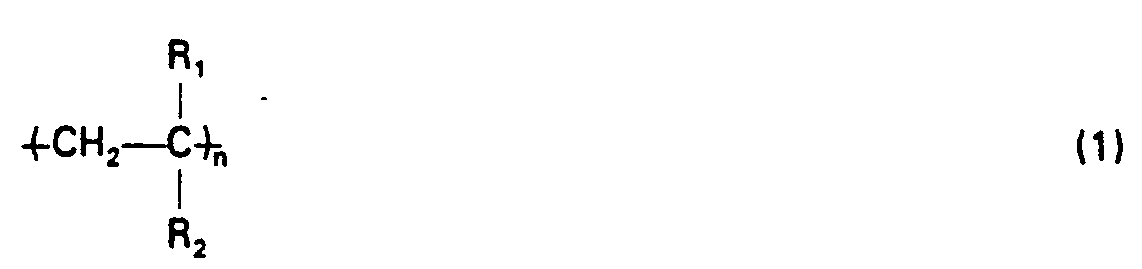
wherein R, and R2 stand for substituents consisting of optional atoms selected from C, H, N, 0, S, P and halogen atoms, with the proviso that the sum of the molecular weights of R, and R2 is at least 40, and n is a positive integer, and having a molecular weight of at least 1,000, the elongation increase ratio (I) of said undrawn polyester yarn, represented by the following formula (2), being at least 8%:

wherein ELb stands for the residual elongation (%) of said undrawn yarn and ELo stands for the residual elongation (%) of a corresponding undrawn polyester yarn substantially free of said polymer having a recurring unit structure represented by the formula (1), and said yarn being prepared by a process which comprises melting said polyester containing 0.2 to 10% by weight of said polymer having a recurring unit structure represented by the formula (1 spinning the melt from a spinneret, and taking up the spun yarn at a speed of between 2500 to 8000 m/min.
wherein R, and R2 stand for substituents consisting of optional atoms selected from C, H, N, 0, S, P and halogen atoms, with the proviso that the sum of the molecular weights of R, and R2 is at least 40, and n is a positive integer, and having a molecular weight of at least 1,000, the elongation increase ratio (I) of said undrawn polyester yarn, represented by the following formula (2), being at least 8%:
wherein ELb stands for the residual elongation (%) of said undrawn yarn and ELo stands for the residual elongation (%) of a corresponding undrawn polyester yarn substantially free of said polymer having a recurring unit structure represented by the formula (1), and said yarn being prepared by a process which comprises melting said polyester containing 0.2 to 10% by weight of said polymer having a recurring unit structure represented by the formula (1 spinning the melt from a spinneret, and taking up the spun yarn at a speed of between 2500 to 8000 m/min.
2. An undrawn polyester yarn as set forth in claim 1, wherein the elongation increase
ratio (I) is at least 15%.
3. An undrawn polyester yarn as set forth in claim 1, wherein the content of the polymer
having recurring units represented by the formula (1) is 0.5 to 6% by weight.
4. An undrawn polyester yarn as set forth in claim 1, wherein R, and R2 each of the formula (1) stand for a linear or branched alkyl group having up to 15
carbon atoms.
5. An undrawn polyester yarn as set forth in claim 4, wherein the polymer having recurring
units represented by the formula (1) is poly(4-methyl-1-pentene).
6. An undrawn polyester yarn as set forth in claim 1, wherein in the formula (1),
R, stands for an alkyl group having up to 5 carbon atoms and R2 stands for a carboxylic acid ester represented by the formula
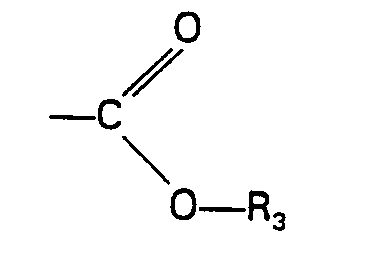
in which R3 stands for an alkyl group having 1 to 5 carbon atoms.
in which R3 stands for an alkyl group having 1 to 5 carbon atoms.
7. An undrawn polyester yarn as set forth in claim 6, wherein the polymer having recurring
units represented by the formula (1) is poly(methyl methacrylate).
1. Ungestrecktes Polyestergarn, welches einen Polyester umfaßt, der seinerseits eine
aromatische Dicarbonsäure als Hauptsäurekomponente umfaßt, und der, darin dispergiert,
0,2 bis 10 Gew.-% eines Polymers (ausschließlich eines Polymers vom Styroltyp) enthält,
bei dem die Struktur der wiederkehrenden Einheiten durch die folgende Formel (1) dargestellt
wird:
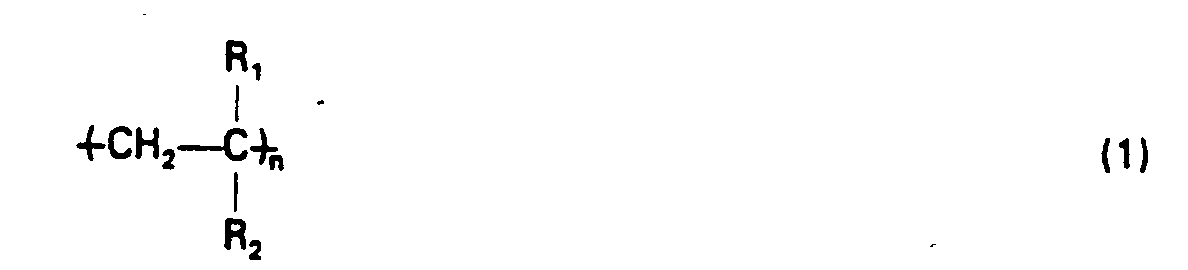
wobei R, und R2 für Substituenten stehen, die wahlweise aus Atomen bestehen, die ausgewählt sind unter C-, H-, N-, O-, S-, P- und Halogen-Atomen, mit der Maßgabe, daß die Summe der Molekulargewichte von R1 und R2 mindestens 40 ist, und wobei n eine positive ganze Zahl ist, und das ein Molekulargewicht von mindestens 1000 hat, wobei das Dehnungs-Zunahme-Verhältnis (1) des ungestreckten Polyestergarns, welches durch die folgende Formel (2) dargestellt wird, mindestens 8% beträgt:

wobei ELb für die restliche Dehnung (%) des ungestreckten Garns steht und wobei ELo für die restliche Dehnung (%) eines entsprechenden ungestreckten Polyestergarns steht, welches im wesentlichen frei von dem Polymer ist, welches eine Struktur der wiederkehrenden Einheiten hat, wie sie durch die Formel (1) dargestellt ist, wobei das Garn nach einem Verfahren hergestellt wird, welches umfaßt: das Schmelzen des Polyesters, welcher 0,2 bis 10 Gew.-% des Polymers enthält, welches die durch die Formel (1) dargestellte Struktur der wiederkehrenden Einheiten besitzt, das Spinnen der Schmelze aus einem Spinnkopf und das Aufwickeln des gesponnenen Garns mit einer Geschwindigkeit zwischen 2500 und 8000 m/min.
wobei R, und R2 für Substituenten stehen, die wahlweise aus Atomen bestehen, die ausgewählt sind unter C-, H-, N-, O-, S-, P- und Halogen-Atomen, mit der Maßgabe, daß die Summe der Molekulargewichte von R1 und R2 mindestens 40 ist, und wobei n eine positive ganze Zahl ist, und das ein Molekulargewicht von mindestens 1000 hat, wobei das Dehnungs-Zunahme-Verhältnis (1) des ungestreckten Polyestergarns, welches durch die folgende Formel (2) dargestellt wird, mindestens 8% beträgt:
wobei ELb für die restliche Dehnung (%) des ungestreckten Garns steht und wobei ELo für die restliche Dehnung (%) eines entsprechenden ungestreckten Polyestergarns steht, welches im wesentlichen frei von dem Polymer ist, welches eine Struktur der wiederkehrenden Einheiten hat, wie sie durch die Formel (1) dargestellt ist, wobei das Garn nach einem Verfahren hergestellt wird, welches umfaßt: das Schmelzen des Polyesters, welcher 0,2 bis 10 Gew.-% des Polymers enthält, welches die durch die Formel (1) dargestellte Struktur der wiederkehrenden Einheiten besitzt, das Spinnen der Schmelze aus einem Spinnkopf und das Aufwickeln des gesponnenen Garns mit einer Geschwindigkeit zwischen 2500 und 8000 m/min.
2. Ungestrecktes Polyestergarn gemäß Anspruch 1, bei dem das Dehnungs-Zunahme-Verhältnis
(I) mindestens 15% beträgt.
3. Ungestrecktes Polyestergarn gemäß Anspruch 1, bei dem der Gehalt an dem Polymer,
welches die wiederkehrenden Einheiten hat, die durch die Formel (1) dargestellt sind,
0,5 bis 6 Gew.-% beträgt.
4. Ungestrecktes Polyestergarn gemäß Anspruch 1, bei dem R, und R2 in der Formel (1) jeweils für eine lineare oder verzweigte Alkylgruppe mit bis zu
15 Kohlenstoff-Atomen stehen.
5. Ungestrecktes Polyestergarn gemäß Anspruch 4, bei dem das Polymer, welches die
wiederkehrenden Einheiten hat, die durch die Formel (1) dargestellt sind, Poly(4-Methyl-1-Penten)
ist.
6. Ungestrecktes Polyestergarn gemäß Anspruch 1, bei dem in der Formel (1) R, für
eine Alkyl-Gruppe mit bis zu 5 Kohlenstoff-Atomen und R2 für einen Carboxylsäureester steht, der durch die Formel dargestellt wird:
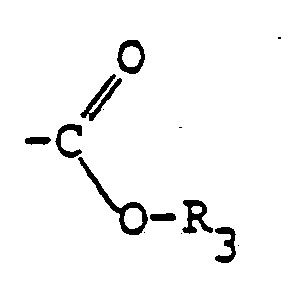
wobei R3 für eine Alkyl-Gruppe mit 1 bis 5 Kohlenstoff-Atomen steht.
wobei R3 für eine Alkyl-Gruppe mit 1 bis 5 Kohlenstoff-Atomen steht.
7. Ungestrecktes Polyestergarn gemäß Anspruch 6, bei dem das Polymer mit den wiederkehrenden,
durch die Formel (1) dargestellten Einheiten Poly(Methyl-Methacrylat) ist.
1. Fil de polyester non étiré comprenant un polyester qui comporte un acide dicarboxylique
aromatique en tant que composant acide principal et contenant en outre, dispersé dans
ce polyester, de 0,2 à 10% en poids d'un polymère (à l'exclusion d'un polymère du
type styrène) ayant une structure à motif récurrent, représenté par la formule (1)
suivante:

dans laquelle R, et R2 représentent des substituants dont les atomes peuvent être choisis parmi les atomes de C, H, N, O, S, P et des halogènes, la somme des poids moléculaires de R, et R2 étant au moins égale à 40, et n est un nombre entier positif, et ayant un poids moléculaire d'au moins 1000, le rapport d'accroissement de l'allongement (1) de ce fil de polyester non étiré, représenté par la formule (2) suivante, étant d'au moins 8%:

dans laquelle ELb représente l'allongement résiduel (%) du fil non étiré et ELo représente l'allongement résiduel (%) d'un fil de polyester non étiré correspondant pratiquement exempt du polymère ayant une structure à motif récurrent représentée par la formule (1), et ce fil étant fabriqué par un procédé consistant à fondre ledit polyester contenant de 0,2 à 10% en poids du polymère ayant une structure à motif récurrent représentée par la formule (1), à filer la matière fondue à partir d'une filière et à envider le fil filé à une vitesse comprise entre 2500 et 8000 m/min.
dans laquelle R, et R2 représentent des substituants dont les atomes peuvent être choisis parmi les atomes de C, H, N, O, S, P et des halogènes, la somme des poids moléculaires de R, et R2 étant au moins égale à 40, et n est un nombre entier positif, et ayant un poids moléculaire d'au moins 1000, le rapport d'accroissement de l'allongement (1) de ce fil de polyester non étiré, représenté par la formule (2) suivante, étant d'au moins 8%:
dans laquelle ELb représente l'allongement résiduel (%) du fil non étiré et ELo représente l'allongement résiduel (%) d'un fil de polyester non étiré correspondant pratiquement exempt du polymère ayant une structure à motif récurrent représentée par la formule (1), et ce fil étant fabriqué par un procédé consistant à fondre ledit polyester contenant de 0,2 à 10% en poids du polymère ayant une structure à motif récurrent représentée par la formule (1), à filer la matière fondue à partir d'une filière et à envider le fil filé à une vitesse comprise entre 2500 et 8000 m/min.
2. Fil de polyester non étiré suivant la revendication 1 caractérisé en ce que le
rapport d'accroissement de l'allongement (I) est d'au moins 15%.
3. Fil de polyester non étiré suivant la revendication 1 caractérisé en ce que la
teneur en polymère ayant les motifs récurrents, représenté par la formule (1), est
de 0,5 à 6% en poids.
4. Fil de polyester non étiré suivant la revendication 1 caractérisé en ce que R1 et R2 représentent chacun, dans la formule (1), un groupe alkyle à chaîne droite ou ramifiée
ayant jusqu'à 15 atomes de carbone.
5. Fil de polyester non étiré suivant la revendication 4 caractérisé en ce que le
polymère ayant les motifs récurrent, représenté par la formule (1), est le poly(4-méthyl-1-pentène).
6. Fil de polyester non étiré suivant la revendication 1 caractérisé en ce que dans
la formule (1) Ri représente un groupe alkyle ayant jusqu'à 5 atomes de carbone et R2 représente un ester d'acide carboxylique représenté par la formule:
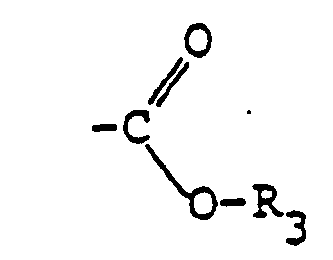
dans laquelle R3 représente un groupe alkyle ayant de 1 à 5 atomes de carbone.
dans laquelle R3 représente un groupe alkyle ayant de 1 à 5 atomes de carbone.
7. Fil de polyester non étiré suivant la revendication 6 caractérisé en ce que le
polymère ayant des motifs récurrents, représenté par la formule (1), est le poly(méthacrylate
de méthyle).