|
(11) | EP 0 048 718 B2 |

| (12) | NEW EUROPEAN PATENT SPECIFICATION |
|
|
| (54) |
PROCESS FOR INHIBITING CORROSION OF METAL SURFACES VERFAHREN ZUM KORROSIONSSCHUTZ VON METALLOBERFLAECHEN PROCEDE SERVANT A EMPECHER LA CORROSION DE SURFACES METALLIQUES |
|
|
|||||||||||||||||||||||||||||||
|
||||||||||||||||||||||||||||||||
[0001] Ferrous and non-ferrous metal surfaced articles, for example, cold rolled steel, aluminized and galvanized iron and steel, aluminum, aluminum-zinc alloy, magnesium-aluminum alloys may suffer surface deterioration by corrosion through contact with the atmosphere or moisture, or both. Chemical passivation treatments are widely used to inhibit or suppress such surface corrosion.
[0002] One of the passivating treatments employed for this purpose consists in treating the ferrous or non-ferrous metal surface with an aqueous solution of phosphoric acid or its salt and a solution of chromic acid, respectively.
[0003] While phosphate and chromic acid based passivating solutions have been widely adopted they have been by no means effective in preventing corrosion under all conditions, particularly in high speed operations and especially where the treated surface is further coated with a synthetic resin coating composition which dries to form a synthetic resinous film. The manner in which the ferrous and/or non-ferrous metal surface is pretreated may make the difference between satisfactory adherence of the resinous film to the substrate and non-adherence as well as satisfactory resistance of the coating or film to impact, bending, boiling water, and creeping corrosion between the surface of the metal and the resinous film.
[0004] US-A-3895969 discloses an aqueous composition for inhibiting corrosion non-ferrous metal surfaced-articles, which composition comprises hexavalent chromium and trivalent chromium as well as one or more of fluoboric acid, fluosilicic acid and hydrofluoric acid. These three acids are stated to enhance adherence of the treated surface to film-forming polymers which dry to a water resistant coating. If the coating's composition is non-aqueous, the chromate-covered surface should be mixed with water and dried before it is coated.
[0005] US-A-3130086 discloses a corrosion resistant chromate conversion coating comprising
a) at least 3.0 grams/litre of zinc ion (calculated as Zn),
b) from 5.0 to 35 grams/litre of hexavalent chromium ion (calculated as Cr03),
c) from 0.05 to 27 grams/litre of sulfate ion (calculated as S04), and
d) at least 0.15 gram/litre of a complex fluoride radical selected from TiF6, BF4 and 5iFe.
[0006] The specification teaches that free fluoride radicals are detrimental to the compositions disclosed therein and also specifies that the compositions are preferably rinsed with water prior to the application of a siccative coating.
[0007] DE-A-2242908 discloses compositions for the surface treatment of aluminium which are based on 1.5 to 20 grams/litre Cr03, 0 to 40 grams/litre P206 0 to 0.5 grams/litre HF with 0.05 to 30 grams/litre of HBF4 or from 0.05 to 10 grams/litre HF with 0 to 30 grams/litre of HBF4. Potassium ferricyanide is an optional ingredient in these compositions.
[0008] It would be desirable, therefore, to provide a process in which corrosion of the ferrous or non-ferrous metal surface is inhibited and wherein the ferrous or non-ferrous metal surface is receptive to a synthetic resinous coating composition so that the resultant coating products containing a dried film of the resin have satisfactory impact and bending qualities as well as resistance to creeping corrosion beneath the coating of synthetic resin.
[0009] It would also be desirable to provide a process in which ferrous or non-ferrous metal surfaces can be treated at high linear speeds of say 50-1000 feet (15.2 to 305 m) per minute or even higher so as to produce a treated article which is corrosion resistant and has a surface which will adhere to synthetic resin coating compositions.
[0011] One of the objects of the present invention is to provide a new and improved process for preparing said ferrous or non-ferrous metal surfaced articles with surfaces inhibited against corrosion and adapted to adhere to synthetic resin coating compositions, thereby producing articles coated with a synthetic resinous film having satisfactory impact and bending resistance and resistance to creeping corrosion between the metal and the resinous coating.
[0012] Another object of the invention is to provide a process of the type described in which a ferrous or non-ferrous metal surfaced article is brought into contact at a high rate of speed, for example, at a linear speed of at least 50 feet (15.2 m) per minute, with an aqueous solution of a composition which will inhibit corrosion on the surface of said article and at the same time enhance the receptivity of said surface for synthetic coating compositions.
[0013] A further object is to provide a no-rinse treating bath that when properly applied will not generate spent bath containing either phosphate or chromate that must be disposed of and which by avoiding rinsing overcomes disposal problems with respect to contaminant containing environmentally undesirable rinse waters.
[0014] According to the invention there is provided a process for treating ferrous or non-ferrous surfaced articles to improve corrosion resistance and receptivity to synthetic resin coatings which comprises said surface into contact with a chromate depositing solution composed of water and ingredients consisting essentially of the following:
the ratio of said additive to the total acids being such as to give a pH within the range of 1.5 to 3.6 at 22°C and a chromate concentration of 0.05 to 10.0 grams per liter as Cr, the metal surfaced article being dried without rinsing and a coating composition which dries to a water resistant film being applied thereto.
[0015] Compositions of the type described when employed in treating clean ferrous or non-ferrous metal surfaced articles provide enhanced adherency of the treated surface to organic film-forming polymers which dry to a water resistant coating and do not require rinsing of the treated surface prior to the application of the organic film-forming polymers, thereby avoiding environmental contamination that would otherwise be caused by rinse waters.
[0016] The composition of the chromate depositing solution should be such that it will be effective in inhibiting corrosion and in enhancing adherence of a surface coating when a ferrous or non-ferrous metal surfaced article is brought into contact with the chromate depositing solution for one to three seconds, which may represent a linear speed of a metal sheet to be treated of 50 to 1000 feet (15.2 to 30.5 m) per minute at a pH of 1.5 to 3.6 at 22°C. A chromate concentration of 0.05-10.0 grams per liter, as Cr, will give approximately, depending upon the equipment used, a total coating of 3 milligrams per square foot to 80 milligrams per square foot (23 to 861 mg/m2). The coating weight will depend upon the metal used and the end use. The pH is an important factor depending upon the particular metal. Thus, in treating aluminum and galvanized iron, as the pH goes down from 3.5 to 1.8 the coating weight increases with the same Cr concentration. Just the opposite effect occurs in the treatment of cold rolled steel. After the surface has been coated with the previously described chromate depositing solution. It can be coated or painted without rinsing with a composition comprising an organic film-forming polymer which dries to a water .resistant coating.
[0017] The organic film-forming polymer can be any of the well known types of coating resins used, either as primer coats or as finish coats, including either water dispersed or oil dispersed resins. While acrylic resin coating compositions are especially useful, other organic film-forming polymers can be emploed, for example, polyvinyl chloride, epoxy resins, mixed epoxy-acrylic resins, polyester resins and polyurethane resins. In most cases these resins are applied and baked on the coated metal but it appears that some further reaction takes place on the surface of the ferrous or non-ferrous metal after the resinous film has been applied and during the baking period. A particular advantage of the invention resides in the fact that the coating composition contains no sodium salts or other highly soluble salts which would tend to take up moisture after the coating has dried or even after the coated article has dried.
[0018] The coating composition is normally prepared as a concentrate which is then diluted with water to the desired concentration for coating a particular type of metal, the concentration also depending upon the amount of the coating to be deposited upon the metal.
[0019] In carrying out the process of the invention the temperature of the chromate depositing solution for use on ferrous or non-ferrous metal surfaced articles is normally within the range of 21°C to 99°C and usually 49°C to 60°C.
[0020] The time of contact between the chromate depositing solution and the ferrous or non-ferrous metal surfaced article will normally be within the range of one second to 3 seconds. In the latter case the pH of the solution can also be somewhat higher but would be within the range of 0.8 to 5.0.
[0021] The chromate depositing composition preferably has solids content within the range from 0.2 gram per liter to 75.0 grams per litre, and the chemical composition should be essentially the following:
[0023] Especially good results are obtained by using zinc oxide as the additive in proportions 1 to 6 grams per liter. It will be understood, of course, that zinc oxide can combine with the chromic acid to form zinc chromate (ZnCr04). Normally, however, it is preferable for the quantity of chromic acid to exceed the quantity of zinc oxide which could combine with the chromic acid to form zinc chromate. Thus, in a preferred concentrate formula the weight ratio of Cr03 to ZnO is approximately 1.8:1 or a molar ratio of Cr03 to ZnO of 1.4:1 whereas the molar ratio of Cr03 to ZnO in zinc chromate is 1:1. As indicated, the hydrofluoric acid can be omitted from the formula. It is not required in coating aluminum and only a small amount is desired in coating cold rolled steel. The ratio of the additive (e.g., zinc oxide) to total acids in the coating bath is preferably such as to give a pH within the range of 1.8 to 3.5 at predetermined concentrations used in the coating process.
[0024] The invention will be further illustrated but is not limited by the following examples in which the proportions are in weight unless otherwise indicated.
Example 1
[0027] Water is added to the foregoing concentrate in sufficient amount to give a running bath having a concentration of 0.5-1 % with a pH of approximately 1.8.
[0028] The metal to be processed or coated can, for example, be cold rolled steel, aluminized and galvanized iron and steel, aluminum, aluminum-zinc alloys, magnesium or magnesium-aluminum alloys. Typical examples of cold rolled steel are SAE 1005 or 1010.
[0029] The concentration of 0.5-1.0% is given as Cr. The weight ratio of the amount of water added to the concentrate is approximately 15:1. This ratio may vary depending upon the desired concentration of the depositing solution but will usually be within the range of 3:1 to 50:1.
[0030] The metal to be coated is carefully cleaned with an alkaline cleaner at 71°C, hot water rinsed at 60-163°C and then coated in a coating bath containing a predetermined concentration of the foregoing composition and having a predetermined pH which is adjusted by adding more or less of the zinc oxide or other additive previously described to the concentrates. The coating weight on the metal will depend upon the particular metal and the pH of the coating bath. Thus, on aluminum, lowering the pH from 2.7 to 1.8 increases the coating weight with a given concentration of chromate, as Cr, from 7 to 14.4 mg/square foot (75 to 152 mg/m2) as Cr. Likewise, on galvanized iron lowering the pH from 2.7 to 1.8 increases the coating weight from 2.8 to 12 mg/square foot (30 to 129 mg/m2) as Cr. An optimum pH is 1.8 to 2.0.
[0031] On cold rolled steel lowering the pH reduces the coating weight. Thus, at a pH of 3 the coating weight is approximately 34.5 mg/square foot (371 mg/m2) as Cr, and at a pH of 2 the coating weight is approximately 20.0 mg/square foot (215 mg/m2) as Cr. As the Cr concentrate is increased from 0.05 to 10.0 grams per liter, with constant pH, the total coating weight may increase from 3 mg/square foot to 80 mg/square foot (23 to 861 mg/m2).
[0032] The foregoing coating weights are based on an application of 3 seconds contact time using a roll coater, dip, spray or other type of coating, followed by a squeegee to remove excess coating composition. Removal of excess coating composition is quite important. The application of the coating composition to the metal is preferably with a time period range of 1 second to 10 seconds. After coating, most of the excess is removed by passing the metal strip form through a squeegee and it is desirable to dehydrate the coated metal as much as possible before painting. Paints are preferably baked on the metal at temperatures up to 288°C. Any kind of synthetic resin coating composition can be applied which dries to a water resistant film.
[0034] Aluminum coated with a coating composition of the type described above is coated with a polyvinyl chloride primer and top coat baked on in the manner described above will withstand standard salt spray tests at least 2000-3000 hours. Galvanized steel similarly coated will withstand standard salt spray tests at least 900-1000 hours. Cold rolled steel similarly coated will withstand standard salt spray tests at least 600 hours.
Example II
[0035] The following example illustrates other compositions in the form of cocentrates which can be prepared in accordance with the invention and diluted with water to coating baths having various concentrations depending upon the metal to be coated and the desired coating weight.
When diluted with water to a concentration of 30% the pH at 22°C is approximately 3.0.
Example III
Example IV
Example V
[0040] In the foregoing Examples I to V the concentration percentages, after dilution with water, refer to percentages of the original concentrate. Thus, the addition of 3000 parts by weight of water to 1000 parts by weight of the concentrate would be a dilution with water to a concentration of 25% of the original concentrate. In general, as previously indicated the amount of water added would be within the range of 3 to 50 times the weight of the concentrate.
Example VI
[0042] When the foregoing concentrate is diluted the pH at 22°C varies from about 3.1 at a concentration of chromate depositing a solution of 2.0% to a pH of 2.9 at a concentration of 10% to a pH of 2.4 at a concentration of 20% to a pH of approximately 2.3 at a concentration of 30%.
[0043] When the zinc oxide concentration in the concentrate is varied from zero to the saturation level the pH of a 1 % solution of the concentrate varies from approximately 1.9 to 4.0 at 22°C using pH paper to measure the pH.
[0044] The amount of zinc oxide that will go into solution also varies with the percent concentration by weight of Cr03 in the concentrate and increases within increasing concentrations of Cr03, the preferred weight ratio of Cr03 to ZnO being that given in Example VI which is approximately 2:1.
[0045] The best modes contemplated for the practice of the invention are illustrated by Examples I and VI. Example VI illustrates the practice of the invention where aluminum sulfate is used rather than zinc oxide. The proportions of these alternative ingredients in each case are generally the same as the preferred proportions of the zinc oxide.
[0046] The invention is especially advantageous in providing a no-rinse composition for inhibiting corrosion of ferrous or non-ferrous metal surfaced articles and in providing a receptive surface for synthetic resin coating compositions which is free from substances that would tend to increase or produce absorption of water or otherwise cause deterioration of the metal surface or of the synthetic resin coating applied thereto. At the same time the practice of the invention avoids rinsing after the application of the chromate depositing solution and thereby also avoids contamination of the environment and the cost of removing waste rinse waters. By the application of the invention the coating which is applied to the metal remains as such. Any excess coating which is removed by a squeegee or otherwise is re-used and does not become a waste product.
[0047] The invention is especially advantageous in treating ferrous or non-ferrous metal surfaced articles in the form of sheets, coils, wires, tubes or rods which are brought into contact with the chromate depositing solution at a linear speed of at least 50 feet (15.2 m) per minute, the contact time preferably being 1-3 seconds so as to give a total coating weight within the range of 3 mg/square foot to 80 mg/square foot (23 to 861 mg/m2) or a coating weight of approximately 0.2 to 20 mg/square foot (2.15 to 215 mg/m2) as Cr. When the resultant surface is dried or allowed to dry without rinsing and over-coated with a paint or synthetic coating composition, ferrous or non-ferrous metal surfaced articles are obtained which exhibit satisfactory resistance of the coating or film to impact, bending, boiling water, and creeping corrosion : between the surface of the metal and the resinous film.
1. A process for treating ferrous or non-ferrous metal surfaced articles to improve
corrosion resistance and receptivity to synthetic resin coatings which comprises bringing
said surface into contact with a chromate depositing solution composed of water, and
ingredients consisting essentially of the following:
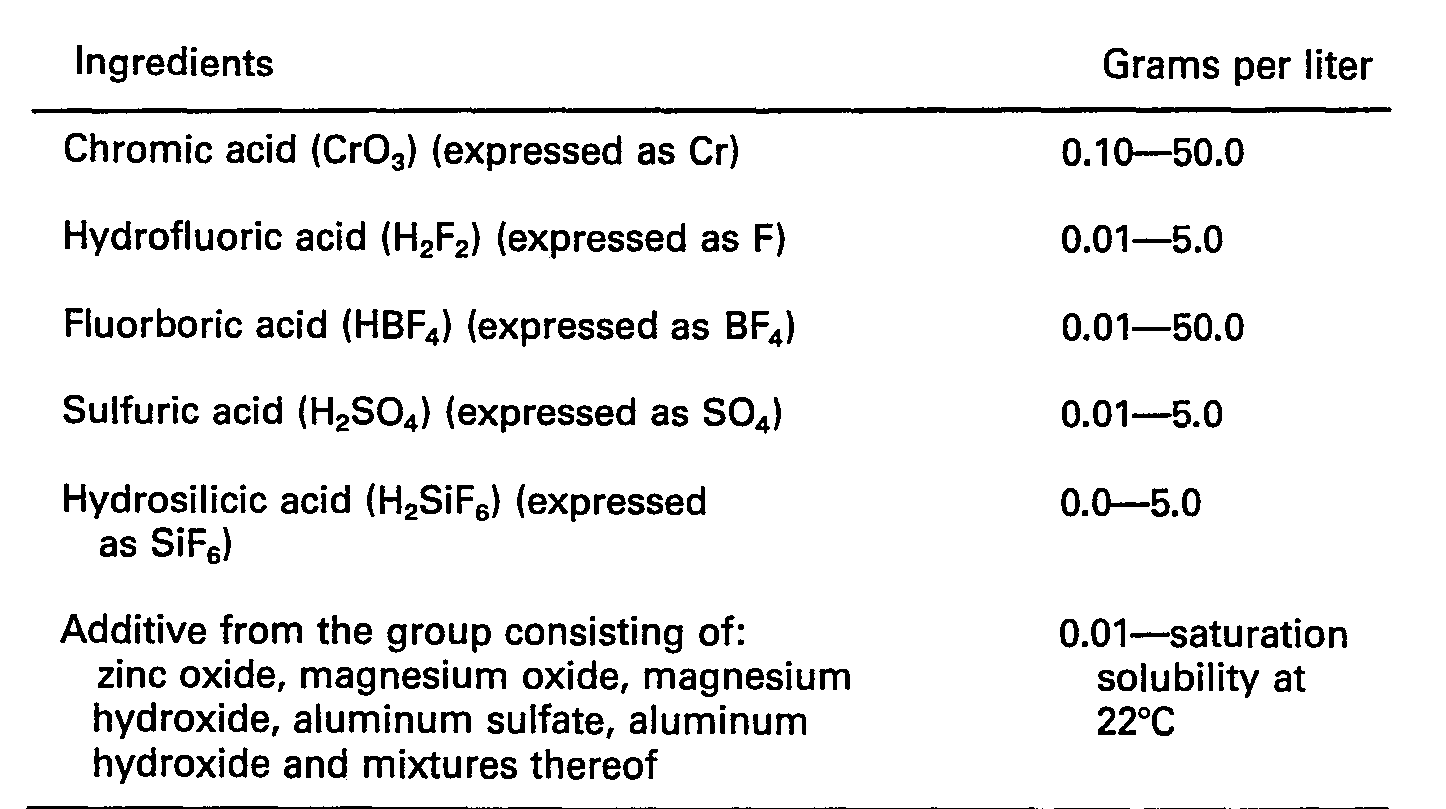
the ratio of said additive to the total acids being such as to give a pH within the range of 1.5 to 3.6 at 22°C and a chromate concentration of 0.05 to 10.0 grams per liter, as Cr, the metal surfaced article being dried without rinsing and a coating composition which dries to a water resistant film being applied thereto.
the ratio of said additive to the total acids being such as to give a pH within the range of 1.5 to 3.6 at 22°C and a chromate concentration of 0.05 to 10.0 grams per liter, as Cr, the metal surfaced article being dried without rinsing and a coating composition which dries to a water resistant film being applied thereto.
2. A process for treating ferrous or non-ferrous metal surfaced articles as claimed
in claim 1 in which the additive is zinc oxide.
3. A process for treating ferrous or non-ferrous metal surfaced articles as claimed
in claim 1 in which the additive is magnesium oxide.
4. A process for treating ferrous or non-ferrous metal surfaced articles as claimed
in claim 1 in which the additive is magnesium hydroxide.
5. A process for treating ferrous or non-ferrous metal surfaced articles as claimed
in claim 1 in which the additive is aluminum sulfate.
6. A process as claimed in claim 1 in which the coating composition is an arylic resin
coating composition.
7. A process as claimed in claim 1 in which said ferrous and non-ferrous metals are
from the group consisting of cold rolled steel, aluminized and galvanized iron and
steel, aluminum, aluminum-zinc alloys, magnesium and magnesium-aluminum alloys.
8. A process as claimed in claim 1 in which said metal surfaced articles are in the
form of sheets, coils, wires, tubes or rods which are brought into contact with said
chromate depositing solution at a linear speed of at least 50 feet (15.2 m) per minute,
the said solution being effective to deposit at least 0.2 mg/square foot (2.15 mg/m2) of chromate, as Cr.
9. A process as claimed in claim 1 in which the additive is zinc oxide and the weight
ratio of chromic acid to zinc oxide is approximately 2.1.
10. A process as claimed in claim 1 in which the metal is aluminum and the ratio of
the additive to the total acids is such as to give a pH within the range of 1.8 to
3.5 at 22°C.
11. A process as claimed in claim 1 in which the metal is galvanized iron or steel
and the ratio of the additive to the total acids is such to give a pH within the range
of 1.8 to 3.5 at 22°C.
12. A process as claimed in claim 1 in which the metal is cold rolled steel and the
ratio of the additive to the total acids is such as to give a pH within the range
of 1.8 to 3.5 at 22°C and the composition contains hydrofluosilicic acid.
13. A process as claimed in claim 1 or claim 2 in which the additive is zinc oxide
and the amount thereof corresponds to 1 to 6 grams per litre.
14. A process as claimed in claim 1 wherein the chromate depositing solution has a
solids content within the range of from 0.2 to 75.0 grams per litre.
1. Verfahren zum Behandeln von Oberflächen von Gegenständen aus Eisen- oder Nichteisenmetallen
zur Verbesserung der Korrosionsbeständigkeit und des Aufnahmevermögens von Beschichtenungen
aus synthetischen Harzen durch In-Berührung-Bringen der Oberfläche einer Chromat ablagernden
Lösung aus Wasser und Bestandteilen, bestehend im wesentlichen aus
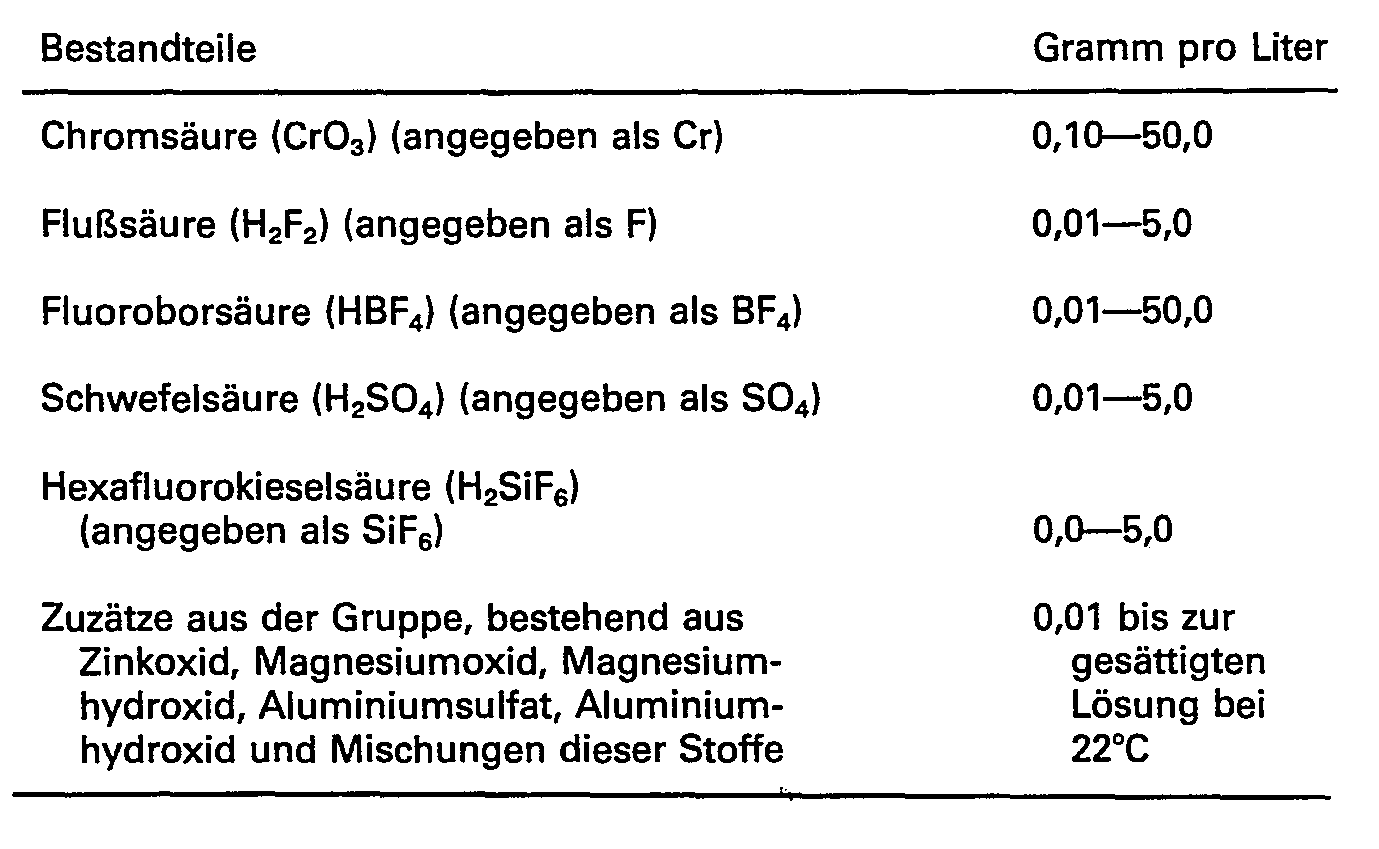
wobei das Verhältnis dieser Zusätze zur Gesamtmenge der Säure so groß ist, daß sich ein pH-Wert im Bereich von 1,5-3,6 bei 22°C und eine Chromatkonzentration von 0,05-10,0 g/I als Cr ergeben und der Gegenstand mit Metalloberfläche ohne Spülen getrocknet wird und eine Beschichtungszusammensetzung wird, die zu einem wasserbeständigen Film trocknet.
wobei das Verhältnis dieser Zusätze zur Gesamtmenge der Säure so groß ist, daß sich ein pH-Wert im Bereich von 1,5-3,6 bei 22°C und eine Chromatkonzentration von 0,05-10,0 g/I als Cr ergeben und der Gegenstand mit Metalloberfläche ohne Spülen getrocknet wird und eine Beschichtungszusammensetzung wird, die zu einem wasserbeständigen Film trocknet.
2. Verfahren zum Behandeln von Oberflächen von Gegenständen aus Eisen- oder Nichteisenmetallen
nach Anspruch 1, dadurch gekennzeichnet, daß der Zusatz Zinkoxid ist.
3. Verfahren zum Behandeln von Oberflächen von Gegenständen aus Eisen- oder Nichteisenmetallen
nach Anspruch 1, dadurch gekennzeichnet, daß der Zusatz Magnesiumoxid ist.
4. Verfahren zum Behandeln von Oberflächen von Gegenständen aus Eisen- oder Nichteisenmetallen,
dadurch gekennzeichnet, daß der Zusatz Magnesiumhydroxid ist.
5. Verfahren zum Behandeln von Oberflächen von Gegenständen aus Eisen- oder Nichteisenmetallen
nach Anspruch 1, dadurch gekennzeichnet, daß der Zusatz Aluminiumsulfat ist.
6. Verfahren nach Anspruch 1, dadurch gekennzeichnet, daß die Beschichtungszusammensetzung
eine Acrylharzbeschichtungszusammensetzung ist.
7. Verfahren nach Anspruch 1, dadurch gekennzeichnet, daß die Eisen- und Nichteisenmetalle
aus der Gruppe ausgewählt sind, die aus kaltgewalztem Stahl, aluminisiertem und galvanisiertem
Eisen oder Stahl, Aluminium, Aluminiumzinkleigierungen, Magnesium und Magnesiumaluminiumlegierungen
besteht.
8. Verfahren nach Anspruch 1, dadurch gekennzeichnet, daß die Gegenstände mit Metalloberflächen
in form von Blechen, Bändern, Drähten, Rohren oder Stäben mit der Chromat ablagernden
Lösung mit einer linearen Geschwindigkeit von mindestens 15,2 m/Min. (50 feet/minutes)
in Berührung gebracht werden, wobei die Lösung in der Lage ist, mindestens 2,15 mg/m2 (0,2 mg/square foot) Chromat als Chrom abzulagern.
9. Verfahren nach Anspruch 1, dadurch gekennzeichnet, daß der Zusatz Zinkoxid ist
und das Gewichtsverhältnis von Chromsäure:Zinkoxid etwa 2:1 ist.
10. Verfahren nach Anspruch 1, dadurch gekennzeichnet, daß das Metall Aluminium ist
und das Verhältnis von Zusatz zu Gesamtmenge der Säure so ist, daß sich ein pH-Wert
im Bereich von 1,8 bis 3,5 bei 22°C ergibt.
11. Verfahren nach Anspruch 1, dadurch gekennzeichnet, daß das Metall galvanisiertes
Eisen oder Stahl ist und das Verhältnis von Zusatz zu Gesamtmenge der Säure so ist,
daß sich ein pH-Wert im Bereich von 1,8 bis 3,5 bei 22°C ergibt.
12. Verfahren nach Anspruch 1, dadurch gekennzeichnet, daß das Metall kaltgewalzter
Stahl ist und das Verhältnis von Zusatz zu Gesamtmenge der Säure so ist, daß sich
ein pH-Wert im Bereich von 1,8 bis 3,5 bei 22C ergibt und die Zusammensetzung Hexafluorokieselsäure
enthält.
13. Verfahren nach Anspruch 1 oder 2, dadurch gekennzeichnet, daß der Zusatz Zinkoxid
ist und die Menge desselben 1-6 g/Liter entspricht.
14. Verfahren nach Anspruch 1, dadurch gekennzeichnet, daß die Chromat ablagernde
Lösung einen Feststoffgehalt im Bereich von 0,2 bis 75 g/Liter aufweist.
1. Procédé pour le traitement d'articles à surface de métal ferreux ou non-ferreux
pour améliorer la . résistance à la corrosion et la réceptivité envers les enduits
de résine synthétique, ce procédé consistant à mettre cette surface en contact avec
une solution de dépôt de chromate constituée par de l'eau et des ingrédients consistant
essentiellement en les suivants:
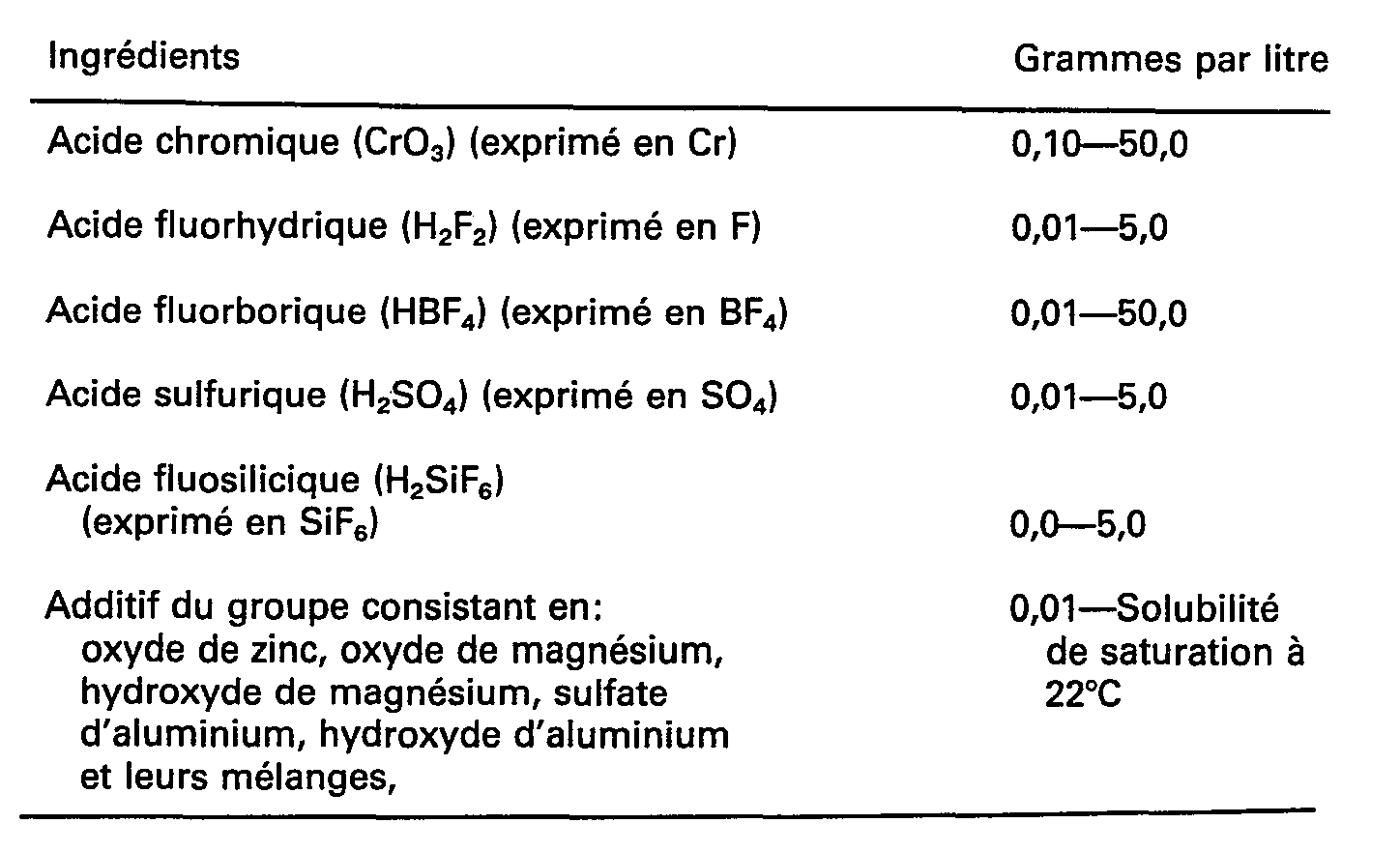
le rapport de cet additif aux acides totaux étant tel qu'il donne un pH dans l'intervalle de 1,5 à 3,6 à 22°C et une concentration de chromate de 0,05 à 10,0 g par litre, calculée en Cr, puis à sécher l'article à surface de métal sans rinçage et à y appliquer une composition d'enduit qui sèche en un film résistant à l'eau.
le rapport de cet additif aux acides totaux étant tel qu'il donne un pH dans l'intervalle de 1,5 à 3,6 à 22°C et une concentration de chromate de 0,05 à 10,0 g par litre, calculée en Cr, puis à sécher l'article à surface de métal sans rinçage et à y appliquer une composition d'enduit qui sèche en un film résistant à l'eau.
2. Procédé de traitement d'articles à surface de métal ferreux ou non-ferreux selon
la revendication 1, dans lequel l'additif est de l'oxyde de zinc.
3. Procédé de traitement d'articles à surface de métal ferreux ou non-ferreux selon
la revendication 1, dans lequel l'additif est de l'oxyde de magnésium.
4. Procédé de traitement d'articles à surface de métal ferreux ou non-ferreux selon
la revendication 1, dans lequel l'additif est de l'hydroxyde de magnésium.
5. Procédé de traitement d'articles à surface de métal ferreux ou non-ferreux selon
la revendication 1, dans lequel l'additif est du sulfate d'aluminium.
6. Procédé selon la revendication 1, dans lequel la composition d'enduit est une composition
d'enduit de résine acrylique.
7. Procédé selon la revendication 1, dans lequel les métaux ferreux et non-ferreux
appartiennent au groupe consistant en de l'acier laminé à froid, du fer et de l'acier
aluminisé et galvanisé, de l'aluminium, des alliages aluminium-zinc, du magnésium
et des alliages magnésium-aluminium.
8. Procédé selon la revendication 1, dans lequel les articles à surface de métal sont
sous la forme de feuillards, bobinages, fils métalliques, tubes ou barres qui sont
mis en contact avec la solution de dépôt de chromate à une vitesse linéaire d'au moins
15,2 m par minute (50 pieds/minute), la solution étant en mesure de déposer au moins
2,15 Mg/M2 (0,2 mg/pied carré) de chromate, calculé en Cr.
9. Procédé selon la revendication 1, dans lequel l'additif est de l'oxyde de zinc
et le rapport pondéral de l'acide chromique à l'oxyde de zinc est approximativement
de 2:1.
10. Procédé selon la revendication 1, dans lequel le métal est de l'aluminium et le
rapport de l'additif aux acides totaux est tel qu'il donne un pH dans l'intervalle
de 1,8 à 3,5 à 22°C.
11. Procédé selon la revendication 1, dans lequel le métal est du fer ou de l'acier
galvanisé et le rapport de l'additif aux acides totaux est tel qu'il donne un pH dans
l'intervalle de 1,8 à 3,5 à 22°C.
12. Procédé selon la revendication 1, dans lequel le métal est de l'acier laminé à
froid et le rapport da l'additif aux acides totaux est tel qu'il donne un pH dans
l'intervalle de 1,8 à 3,5 à 22°C, et la composition contient de l'acide fluosilicique.
13. Procédé selon la revendication 1 ou la revendication 2, dans lequel l'additif
est de l'oxyde de zinc et la quantité de celui-ci correspond à 1 à 6 g par litre.
14. Procédé selon la revendication 1, dans lequel la solution de dépôt de chromate
a une teneur en solides dans l'intervalle de 0,2 g par litre à 75,0 g par litre.