|
(11) | EP 0 049 133 A1 |

| (12) | EUROPEAN PATENT APPLICATION |
|
|
|
|
|||||||||||||||||||||||||||
| (54) | Stabilizing composition |
| (57) The present invention relates to non-staining stabilizing compositions for synthetic
resins and rubbers and lubricating oils which comprise a diphenylamine compound, a
phosphite compound, a thiodipropionate compound and one or more polysubstituted phenols. |
[0001] The present invention relates to non-staining stabilizing compositions for synthetic resins and rubbers and lubricating oils which comprise a diphenylamine compound of the formula (I), a phosphite compound of the formula (II), a thiodipropionate compound of the formula (III) and one or more phenols selected from compounds of the formulae (IV-A), (IV-B) and (IV-C) in a weight ratio of 1/0.1 - 10/0.2 - 10/0 - 5, the above formulae being as follows:
wherein R1 and R2 are selected independently from a hydrogen atom and alkyl groups having 3 to 12 carbon atoms but are not both a hydrogen atom;
wherein R3 to R8 are selected independently from a hydrogen atom and alkyl groups having 1 to 12 carbon atoms;
wherein R9 and R10 are the same or different alkyl groups having 8 to 20 carbon atoms;
wherein R11 and R13 are branched alkyl groug having 3 to 12 carbon atoms, and R12 is a methyl, ethyl or -CH2CH2COOR14 group (in which R14 is an alkyl group having 1 to 20 carbon atoms);
wherein R15 is a branched alkyl group having 3 to 12 carbon atoms, R16 is a methyl or ethyl group, and R17 is an alkylidene group having 1 to 4 carbon atoms; and
wherein R18 is a branched alkyl group having 3 to 12 carbon atoms, R19 is a hydrogen atom or an alkyl group having 1 to 12 carbon atoms, and when R19 is a hydrogen atom, R20 is a methyl group and when R19 is an alkyl group having 1 to 12 carbon atoms, R20 is a hydrogen atom, and R21 is a direct bond, a sulfur atom, or a methylene, -CH2-S-CH2-or alkylidene group having 1 to 4 carbon atoms.
[0002] Synthetic resins such as polystyrene, styreneacrylonitrile copolymers (AS resin), acrylonitrile-butadienestyrene copolymers (ABS resin) and etc., and synthetic rubbers such as styrene-butadiene copolymers (SBR), acrylonitrile-butadiene copolymers (NBR) and etc. are in use as automobile parts and electrical appliance parts in many fields.
[0003] These polymers themselves, however, deteriorate by heat, oxygen and light on storage, processing and use, lowering in physical properties particularly mechanical strength with phenomena such as color change, hardening, brittleness and generation of odor. For this reason, various stabilizing compositions are added to these polymers on production or processing thereof.
[0004] Of the conventional stabilizing compositions, however, there are those having a property to stain synthetic resins and rubbers, the so-called staining property, which is inherent to the compositions themselves. Particularly, when amine compounds have been added to synthetic resins and rubbers, the amines themselves change or decompose to stain the polymers to a large extent. When a non-staining property is therefore required, the use of amine compounds was difficult.
[0005] As similar stabilizing compositions to those of the present invention, those comprising an amine compound and dialkyl 3,3'-thiodipropionate were developed (Japanese Patent Publication No. 24446/1970), but they are not satisfactory enough in non-staining property and stabilizing effect. Further, stabilizing compositions comprising dithiophosphonite, a thiodipropionate compound and a phenol compound, and ones comprising a thiodipropionate compound, a phosphite compound and a phenol compound were developed (Japanese Patent Publication No. 23344/1973), but they are also not satisfactory enough in stabilizing effect.
[0006] Lubricating oils also deteriorate by heat, oxygen and light on storage and use, lowering in lubricating characteristics with the change of viscosity and formation of sludge. The use of phenol compounds or amine compounds alone is so far well known, but compounds are not known which are satisfactory in stabilizing effect at high temperatures and stabilizing effect on lubricating oils. For this reason, development of stabilizing compositions superior in not only stabilizing effect but also non-staining property has been demanded.
[0007] As a result of extensive study on such stabilizing compositions, the inventors found that combination of a diphenylamine compound, a phosphite compound, a thiodipropionate compound and a phenol compound in a specified weight ratio shows a surprising synergistic effect, enabling a very superior stabilizing effect on heat, oxygen and light as compared with the prior art,, as well as remarkable improvement in the staining property which is inherent to the use of amine compounds. The inventors thus attained to the present invention.
[0008] As the diphenylamine compound of the formula (I), there are given for example dioctyldiphenylamine, mono and dioctyldiphenylamine, monooctyldiphenylamine, dinonyldiphenylamine, mono and dinonyldiphenylamine, monononyl- diphenylamine, diisopropyldiphenylamine, dodecyldiphenyl- amine and bis(«,a-dimethylbenzyl)diphenylamine. These compounds may be used alone or in combination.
[0009] Particularly preferably, R1 and R2 in the formula (I) are an alkyl group having 4 to 9 carbon atoms, in terms of the volatility, compatibility with polymers and performances of stabilizing compositions.
[0010] The phosphite compound of the formula (II) includes for example tris(monoamylphenyl)phosphite, tris(2,4-di-tert-butylphenyl)phosphite, tris(monooctylphenyl)phosphite, tris-(mixed mono and dioctylphenyl)phosphite, tris(monononylphenyl)-phosphite and tris(mixed mono and dinonylphenyl)phosphite. These compounds may be used alone or in combination.
[0011] In terms of performance as stabilizing compositions and the stability to hydrolysis of the compounds themselves, it is preferred that at least one in each of three pairs, R3 and R4, R5 and R6, R7 and R8, in the formula (II) is an alkyl group having 1 to 12, particularly 4 to 12, carbon atoms.
[0012] The thiodipropionate compound of the formula (III) includes for example didodecyl-3,3'-thiodipropionate, ditridecyl-3,3'-thiodipropionate, ditetradecyl-3,3'-thiodipropionate, dihexadecyl-3,3'-thiodipropionate, distearyl-3,3'-thiodipropionate and dioctadecyl-3,3'-thiodipropionate. These compounds may be used alone or in combination.
[0013] The phenol compound of the formula (IV-A) includes for example 2,6-di-tert-butyl-p-cresol, stearyl β-(3,5-di-tert-butyl-4-hydroxyphenyl)propionate, methyl β-(3,5-di-tert-butyl-4-ixydroxyphenyl)propionate, 2,6-di-tert-butyl-4-ethylphenol, and 2,6-di-tert-octyl-4-methylphenol. These compounds may be used alone or in combination.
[0014] The phenol compound of the formula (IV-B) includes for example 2,2'-methylenebis(6-tert-butyl-4-methylphenol), 2,2'-methylenebis(6-tert-butyl-4-ethylphenol), 2,2'-methy- lenebis(6-a-methyleyclohexyl-4-methylphenol) and 2,2'-iso- propylidenebis(6-tert-amyl-4-methylphenol). These compounds may be used alone or in combination.
[0015] The phenol compound of the formula (IV-C) includes for example 4,4'-thiobis(6-tert-butyl-3-methylphenol), 4,4'-thiobis(2-methyl-6-tert-butylphenol), bis(3-methyl-5-tert-butyl-4-hydroxybenzyl)sulfide, bis(3,5-di-tert-butyl-4-hydroxybenzyl)sulfide, 2,2',6,6'-tetra-tert-butyl-biphenol, 4,4'-butylidenebis(6-tert-butyl-3-methylphenol), 4,4'-methylenebis(2,6-di-tert-butylphenol) and 2,2',6,6'-tetra-tert-butylbisphenol A. These compounds may be used alone or in combination.
[0016] In terms of performance as stabilizing compositions, it is preferred that R11, R13, R15 and R18 in the formula, (IV-A), (IV-B) and (IV-C), are a tertiary alkyl group branched at the a-position having 4 to 9 carbon atoms, for.example, tertiary butyl, tertiary amyl and tertiary octyl groups.
[0017] The non-staining stabilizing compositions of the present invention are made by combining a diphenylamine compound of the formula (I), a phosphite compound of the formula (II), a thiodipropionate compound of the formula (III) and one or more selected from phenol compounds of the formula, (IV-A), (IV-B) and (IV-C), in a weight ratio of 1/0.1 - 10/0.2 - 10/0 - 5.
[0018] In terms of performance as stabilizing compositions, it is preferred that the phenol compound is 0.2 to 5 times by weight based on the diphenylamine compound, the total of the phosphite compound and thiodipropionate compound is 2 to 15 times by weight based on the diphenylamine compound, and that the thiodipropionate compound is larger in amount than the phosphite compound.
[0019] The non-staining stabilizing compositions of the present invention are particularly suitable for synthetic resins such as polystyrene, AS resins, ABS resins and etc., synthetic rubbers such as SBR, NBR and etc., and lubricating oils, but they are more effective when applied to ABS resins and SBR for which a non-staining property is regarded as important.
[0020] The amount of the non-staining stabilizing compositions used is not particularly critical but preferably, it is 0.05 to 10 % by weight, particularly 0.1 to 5 % by weight based on substances to be stabilized.
[0021] In using the non-staining stabilizing compositions of the present invention, the compositions may be added as usual to substances to be stabilized without special limitations. For example, in the case of synthetic resins and rubbers, methods such as addition to polymer latices or solutions, addition to resin powders, addition to resins on pelletizing, addition to polymers on molding and etc. are employed. In the case of lubricating oils, the compositions are added on production or use.
[0022] Specifically, methods such as mixing by rolls, screw extrusion, mixing by Banbury mixer, line blending and addition in the form of emulsion or master batch solution in suitable solvents, are employed without special limitations.
[0023] The non-staining stabilizing compositions of the present invention may be used together with other additives such as ultraviolet absorbers, photo-stabilizers, antioxidants, metal-inactivating agents, metallic soaps, pigments, dyes, plasticizers, fillers and etc.
[0024] Next, the present invention will be illustrated in detail with reference to the following examples.
Example 1
[0025] Stabilizing compositions, a to n, where prepared by blending the compounds in Table 1 in proportions (weight ratios) shown in Table 1, and 0.5 part by weight of each of the compositions obtained was mixed with 100 parts.by weight of ABS resin to prepare respective ABS resin compositions, A to N. The resin compositions thus obtained were then measured for staining property (degree of color change), thermal resistance (degree of color change), long-term stability and light resistance by the following test methods. The results are shown in Table 2.
(1) Staining property
[0026] A test piece (70 x 120 x 3 mm) obtained by forming the ABS resin composition was allowed to stand at 100°C. for 24 hours in a gear oven, and measured for spectral reflectance by a spectrophotometer. Degree of color change, ΔE, was calculated from the spectral reflectances before and after standing using the CIE-system color difference equation (1976).
(2) Thermal resistance
[0027] A test piece (70 x 120 x 3 mm) obtained by forming the ABS resin composition was allowed to stand at 180°C. for 24 hours in a gear oven, and measured for spectral reflectance by a spectrophotometer. Degree of color change, ΔE, was calculated from the spectral reflectances before and after standing using the CIE-system color difference equation (1976).
(3) Long-term stability
[0028] The ABS resin composition was stored in a house at room temperature for 6 months. The composition was then measured for impact strength with notch (1/4", 23°C.) according to the method described in ASTM D-256-56, and the percentage retention of strength was calculated therefrom.
(4) Light resistance
1) Color change
[0029] A test piece (70 x 120 x 3 mm) obtained by forming the ABS resin composition was exposed to Sunshine weather-0- meter for 100 hours and measured for spectral reflectance by a spectrophotometer. Degree of color change, ΔE, was calculated from the spectral reflectances before and after exposure using the CIE-system color difference equation (1976).
2) Gloss
[0030] A test piece after exposure obtained in the same manner as in 1) and the same test piece before exposure were measured for reflectance at an angle of incidence of 60° by a glossmeter. The percentage retention of gloss was calculated from the reflectances obtained.
[0031] · The ABS resin used in this example was a 1:1 (weight ratio) mixture of ABS graft polymer and AS copolymer produced as usual according to the formulations described below..
Example 2
[0034] - Styrene/butadiene rubber (SBR 1502, produced by Sumitomo Chemical Company, Limited) containing no stabilizing composition was mixed on a roll together with the stabilizing compositions each described below and in Table 1 to prepare SBR compositions. The compositions obtained were measured for thermal stability to obtain the results as shown in Table 3. The thermal stability was evaluated based on a time required for the gel content (toluene-insoluble portion) of the SBR composition to reach 10 % by weight when the composition was allowed to stand at 1000°C, in a gear oven (the time required was expressed in Gel I.P.) and the color of the composition after standing at the same temperature for 40 hours in the gear oven. Symbol of stabilizing composition:
o : Styrenated phenol
p : 1:3 (weight ratio) Mixture of styrenated phenol and tris-nonylphenylphosphite
q : 2,6-Di-Tert-butyl-p-cresol
r : 1:3 (weight ratio) Mixture of 2,6-di-tert-butyl-p-cresol and trisnonylphenylphosphite
s : Wingstay T (commercially available stabilizing composition)
t : 1:3 (weight ratio) Mixture of Wingstay T and trisnoylphenylphosphite
u : Agerite Geltrol (commercially available stabilizing composition)
Example 3
[0036] Daikyo Sekiyu Co.) was mixed with each of the present stabilizing compositions formulated as shown in Table 4 and stabilizing compositions as control shown below. Fifty grams of each mixed oil was oxidized as follows according to the rotary bomb oxidation test method in ASTM D-2272: To the mixed oil were added distilled water (5 ml) and copper catalyst (copper spirals obtained by polishing, washing with ethyl ether and drying), and the whole was placed in a glass container and oxidized in an oxygen atmosphere..In this test, the glass container was placed in a stainless steel container connected with a recording pressure gauge, and then the steel container was placed in an oil bath kept at 150°C. and rotated about its axis at 100 r.p.m. with the axis inclined by 30 degrees against a horizontal line. Before heating, the oxygen pressure in the steel container was adjusted to about 7 kg/cm2, and it rose with the progress of heating to a maximum which was kept constant until beginning of oxidation. A time required for the oxygen pressure to drop by 2.0 kg/cm2 from the maximum, referred to as oxygen absorption induction period, was recorded in minutes. The results are shown in Table 5.
1. A non-staining stablilizing composition for synthetic resins and rubbers and lubricating
oils which comprises a diphenylamine compound of the formula (I), a phosphite compound
of the formula (II), a thiodipropionate compound of the formula (III) and one or more
phenols selected from compounds of the formulae (IV-A), (IV-B) and (IV-C) in a weight
ratio of 1/0.1 - 10/0.2 - 10/0 - 5, the above formulae being as follows:
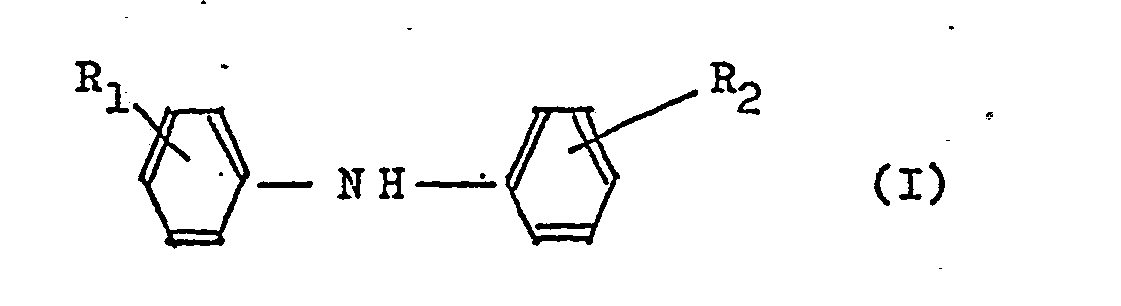
wherein R1 and R2 are selected independently from a hydrogen atom and alkyl groups having 3 to 12 carbon atoms but are not both a hydrogen atom;
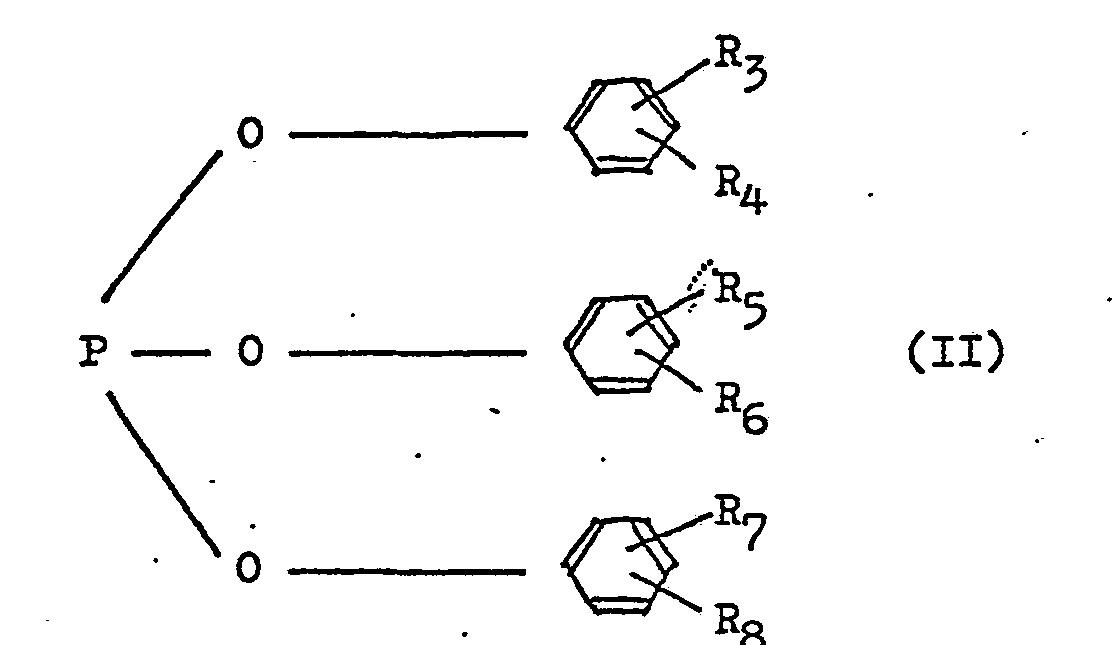
wherein R3 to R8 are selected independently from a hydrogen atom and alkyl groups having 1 to 12 carbon atoms;
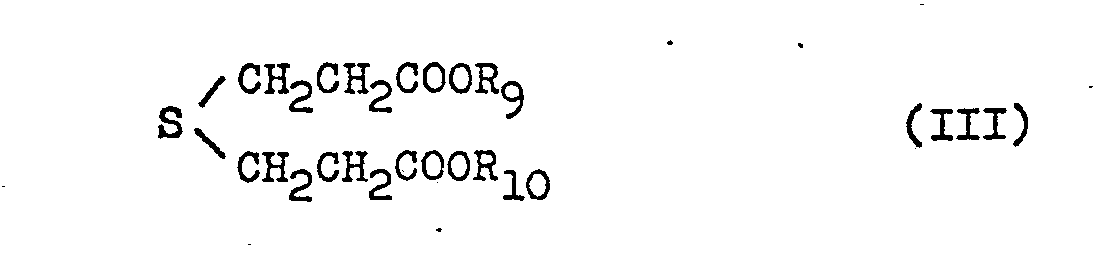
wherein R9 and R10 are the same or different alkyl groups having 8 to 20 carbon atoms;
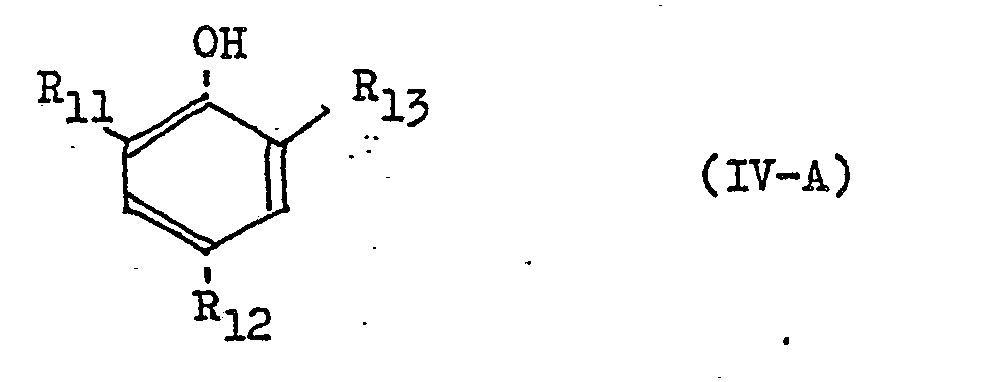
wherein R11 and R13 are branched alkyl group having 3 to 12 carbon atoms, and R12 is a methyl, ethyl or -CH2CH2COOR14 group (in which R14 is an alkyl group having 1 to 20 carbon atoms);
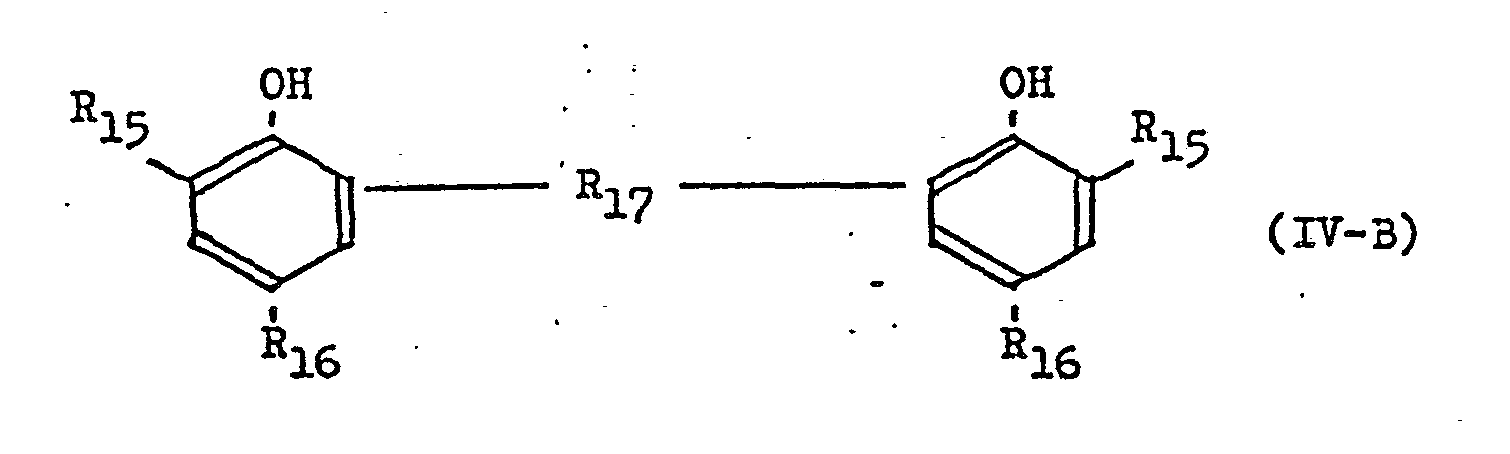
wherein R15 is a branched alkyl group having 3 to 12 carbon atoms, R16 is a methyl or ethyl group, and R17 is an alkylidene group having 1 to 4 carbon atoms; and
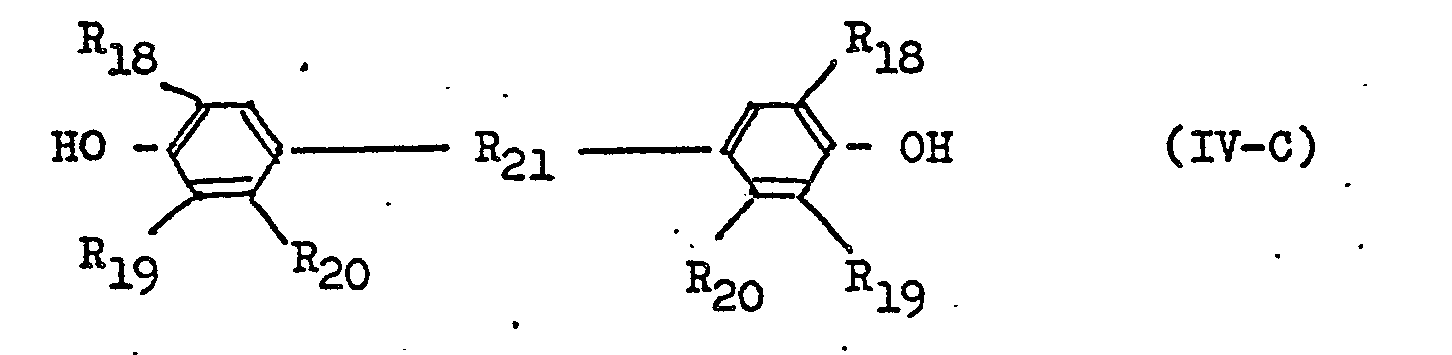
wherein R18 is a branched alkyl group having 3 to 12 carbon atoms, R19 is a hydrogen atom or an alkyl group having 1 to 12 carbon atoms, and when R19 is a hydrogen atom, R20 is a methyl group and when R19 is an alkyl group having 1 to 12 carbon atoms, R20 is a hydrogen atom, and R21 is a direct bond, a sulfur atom, or a methylene, -CH2-S-CH2-or alkylidene group haying 1 to 4 carbon atoms.
wherein R1 and R2 are selected independently from a hydrogen atom and alkyl groups having 3 to 12 carbon atoms but are not both a hydrogen atom;
wherein R3 to R8 are selected independently from a hydrogen atom and alkyl groups having 1 to 12 carbon atoms;
wherein R9 and R10 are the same or different alkyl groups having 8 to 20 carbon atoms;
wherein R11 and R13 are branched alkyl group having 3 to 12 carbon atoms, and R12 is a methyl, ethyl or -CH2CH2COOR14 group (in which R14 is an alkyl group having 1 to 20 carbon atoms);
wherein R15 is a branched alkyl group having 3 to 12 carbon atoms, R16 is a methyl or ethyl group, and R17 is an alkylidene group having 1 to 4 carbon atoms; and
wherein R18 is a branched alkyl group having 3 to 12 carbon atoms, R19 is a hydrogen atom or an alkyl group having 1 to 12 carbon atoms, and when R19 is a hydrogen atom, R20 is a methyl group and when R19 is an alkyl group having 1 to 12 carbon atoms, R20 is a hydrogen atom, and R21 is a direct bond, a sulfur atom, or a methylene, -CH2-S-CH2-or alkylidene group haying 1 to 4 carbon atoms.
2. A non-staining stabilizing composition according to Claim 1, wherein the weight
ratio of diphenylamine compound to phosphite compound to thiodipropionate compound
to phenol compound is 1/0.1 - 10/0.2 - 10/0.2 - 5.
3. A non-staining stabilizing composition according to Claim 2, wherein the total
of the phosphite compound and the thiodipropionate compound is not more than 15 times
by weight based on the diphenylamine compound.
4. A non-staining stabilizing composition according to Claim 3, wherein the thiodipropionate
compound is larger in amount than the phosphite compound.
5. A non-staining stabilizing composition according to any preceding claim wherein
the diphenylamine compound is dioctyldiphenylamine and/or dinonyldiphenylamine.
6. A non-staining stabilizing composition according to any preceding claim wherein
the phosphite compound is tris(mono- nonylphenyl)phosphite or tris(mixed mono and
dinonylphenyl)-phosphite.
7. A non-staining stabilizing composition according to any preceding claim wherein
the thiodipropionate compound is one or more selected from didodecyl-3,3'-thiodipropionate,
ditridecyl-3,3'-thiodipropionate, ditetradecyl-3,3'-thiodipropionate and dioctadecyl-3,3'-thiodipropionate.
8. A non-staining stabilizing composition according to any Preeeding claim wherein
the phenol compound is one or more selected from 2,6-di-tert-butyl-p-cresol, stearyl
β-(3,5-di-tert-butyl-4-hydroxyphenyl)propionate, 2,2'-methylenebis(6-tert-butyl-4-methylphenol),
4,4'-thiobis(6-tert-butyl-3-methylphenol) and 4,4'-butylidenebis(6-tert-butyl-3-methylphenol).
9. A non-staining stabilizing composition according to any preceding claim comprising
dinonyldiphenylamine, tris(monononylphenyl)phosphite, ditridecyl-3,3'-thiodipropionate
and 2,6-di-tert-butyl-p-cresol or 2,2'-methylene- bis(6-tert-butyl-4-methylphenol).
10. A synthetic resin stabilized with a non-staining stabilizing composition according
to any preceding claim.
11. A stabilized synthetic resin according to Claim 10, wherein said synthetic resin
is ABS resin.
12. A synthetic rubber stabilized with a non-staining stabilizing composition according
to any of claims 1 to 9.
13. A lubricating oil stabilized with a non-staining stabilizing composition according
to any of claims 1 to 9.