|
(11) | EP 0 049 338 A1 |

| (12) | EUROPEAN PATENT APPLICATION |
|
|
|
|
|||||||||||||||||||||||||||
| (54) | Ink for use in ink jet printing |
| (57) An ink for use in ink jet printing has as its colouring material a dye having the
formula:
where R is -OCH2CO2-, -CH2CO2-, -PO3- or -CH2-PO3-. |
[0002] Ink jet printing is well known in the art. Several formulations for ink to be used in ink jet printing are known in the art. In this connection reference may be made to U.S. Patents 3,846,141; 3,945,836; 3,945,837; 4,155,768; 4,159,203 and 4,176,361. None of these patents, however, in any way teaches the use of dyes having the structure of the dyes of the present invention.
[0003] According to the invention there is provided an ink for use in ink jet printing comprising an aqueous solution of a colouring material having the formula
where R is -OCH2CO2-, -CH2CO2-, -P03 or -CH2-PO3=.
[0004] The dyes used in the ink according to the invention confer several unexpected advantages upon the ink. In particular, the resulting inks have very desirable colour characteristics. Furthermore, the dyes are quite soluble in water at a pH of 7. When the ink has a pH of 7, it causes fewer corrosion problems with the equipment for jet printing. In addition, the resulting ink has waterfastness.
[0005] The dyes of the present invention may readily be synthesized by known synthetic methods. For example, the well known dye Carta Black BI (also known as 4-amino-3,6-bis-(p-aminophenylazo)-5-hydroxy-2,7-naphthalenedisulfonic acid) and an appropriately functionalized m-phenylenediamine may be used as starting materials.
[0006] Carta Black BI (56.5g) was dissolved in concentrated hydrochloric acid (600ml) in a 51. roundbottom flask and chilled to 0-4°C. A solution of sodium nitrite (13.8g) in water (200 ml) was added with stirring. Then, with cooling to maintain a temperature less than 10°C, sodium acetate (82g) was added and the reaction brought to pH3 with 50% aqueous sodium hydroxide. A 1M solution of 2,4-diamino- phenylacetic acid in 1N hydrochloric acid (200ml) was added and the pH brought to 4. Other solubilizing diamines such as 2,4-diamino- phenoxyacetic acid, 2,4-diaminophenylphosphonic acid or 2,4-diamino- penzylphosphonic acid may be substituted with equivalent results. After 3 hours at room temperature the pH was reduced to 1 with concentrated hydrochloric acid. The precipitated dye was obtained by centrifugation, washed with water and dried to yield product dye
[0007] As is known in the art, the dyes in the present invention may be formulated into ink formulations with known additives to confer desirable properties. These additives include, for example, a buffer to maintain the pH at 7. Other possible additives include a surfactant, a humectant, a penetrant, and an antimicrobial agent.
[0008] In general, it is desirable that the dyes be present in the ink - formulation at a concentration of from about 1 to about 10% by weight. Usually it is most preferable that the dye be present at about 5% concentration.
1. An ink for use in ink jet printing comprising an aqueous solution of a colouring
material having the formula
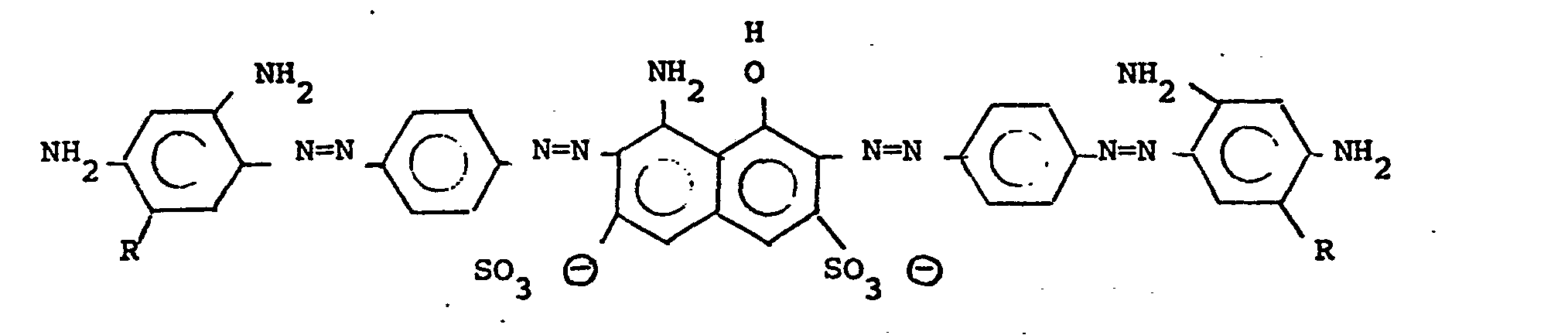
where R is -OCH2CO2, -CH2CO2-, -PO3= or -CH2-PO3=.
where R is -OCH2CO2, -CH2CO2-, -PO3= or -CH2-PO3=.
2. An ink as claimed in Claim 1, in which R is -OCH2CO2-.
3. An ink as claimed in Claim 1, in which R is -CH2CO2-.
4. An ink as claimed in Claim 1, in which R is -PO3=.
5. An ink as claimed in Claim 1, in which R is -CH2-PO3=.
6. An ink as claimed in any one of the preceding claims, in which the dye is present
in from 1 to 10% by weight concentration.
7. An ink as claimed in any one of the preceding claims, which also contains a buffer
to maintain the pH of the solution at 7.