| (19) |
 |
|
(11) |
EP 0 049 938 B1 |
| (12) |
EUROPEAN PATENT SPECIFICATION |
| (45) |
Mention of the grant of the patent: |
|
22.10.1986 Bulletin 1986/43 |
| (22) |
Date of filing: 14.05.1981 |
|
|
| (54) |
Apparatus and method for processing a flexible magnetic recording medium
Einrichtung und Verfahren zum Behandeln eines flexiblen magnetischen Aufzeichnungsmediums
Dispositif et procédé pour le traitement d'un support flexible d'enregistrement magnétique
|
| (84) |
Designated Contracting States: |
|
DE FR GB |
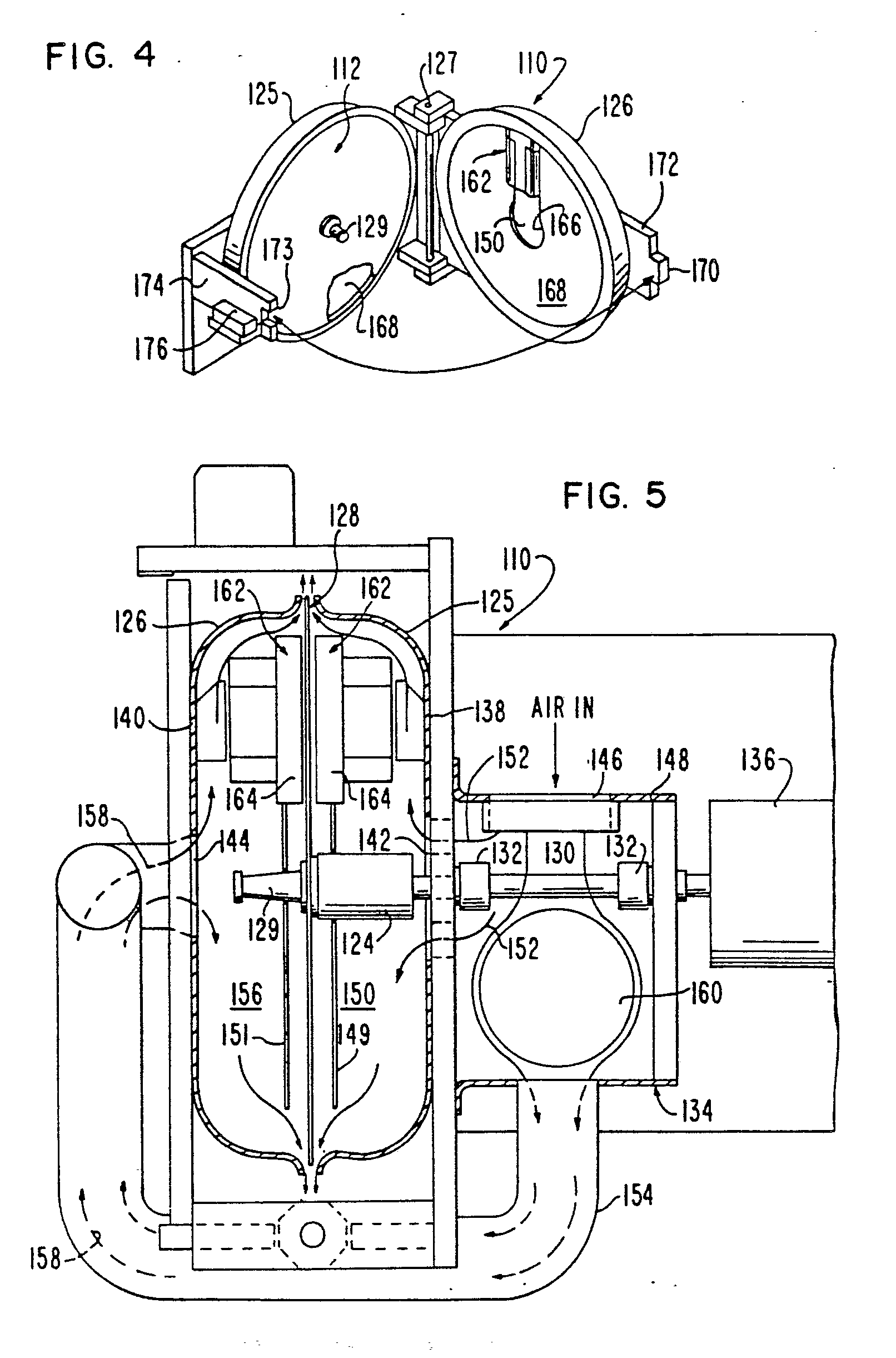
| (30) |
Priority: |
10.10.1980 US 195973
|
| (43) |
Date of publication of application: |
|
21.04.1982 Bulletin 1982/16 |
| (71) |
Applicant: DYSAN CORPORATION |
|
Santa Clara
California (US) |
|
| (72) |
Inventors: |
|
- James, Richard Negus
San Jose, California 95124 (US)
- Goodale, Kenneth Stewart
Mountain View, California 94040 (US)
|
| (74) |
Representative: Wright, Peter David John et al |
|
Willowbrook
Winkfield Row
GB-Bracknell, Berkshire RG42 6LS
GB-Bracknell, Berkshire RG42 6LS (GB) |
|
| |
|
| Note: Within nine months from the publication of the mention of the grant of the European
patent, any person may give notice to the European Patent Office of opposition to
the European patent
granted. Notice of opposition shall be filed in a written reasoned statement. It shall
not be deemed to
have been filed until the opposition fee has been paid. (Art. 99(1) European Patent
Convention).
|
[0001] This invention relates to a method for orienting the particles of the coating on
a magnetic recording disk as the coating is drying, comprising supporting the disk
in the region of a centre portion thereof, rotating the disk and applying a magnetic
field to the disk with the field extending in a predetermined direction relative thereto
to orient the magnetic particles of the coating in said direction.
[0002] The invention also relates to apparatus for orienting the magnetic particles of a
magnetic coating on a magnetic recording disk as the coating is drying comprising
means adapted to be coupled to the disk in the region of a centre portion thereof
for supporting the same in an operative position for rotation in a predetermined plane,
means for rotating said disk when supported in said operative position, and means
adjacent to said operative position for providing a magnetic field magnetically coupled
with the particles of the coating on the disk when the disk is in said operative position
to orient the particles in predetermined directions.
[0003] Such method and apparatus are known, for example from US patent No. 4,001,463 (Schaefer
et al.). The known method and apparatus are suitable for rigid disks but unsatisfactory
for flexible or floppy disks since non-uniform orientation of the material arises
due to instability in the flexible disk as it is rotated.
[0004] The present invention is directed at solving the problem of securing substantially
uniform orientation of the magnetic particles in a flexible recording disk in the
above defined method and apparatus.
[0005] The method according to the present invention is characterised in that said magnetic
recording disk is flexible and said disk is prevented from deviating substantially
from a predetermined plane by limiting or preventing lateral movement of the periphery
of the disk by stabilising means at opposite sides of the disk acting on the outer
periphery of said disk.
[0006] The apparatus according to the present invention is characterised by stabilising
means arranged at opposite sides of the disk so as to act on the outer periphery of
a flexible said disk when supported in said operative position for keeping the flexible
disk from substantially deviating laterally from said predetermined plane when the
flexible disk is rotated by said rotating means whereby the flexible disk is maintained
in said plane.
[0007] It has been found that with the method and apparatus according to the invention the
flexible recording disk is sufficiently stabilized during rotation to provide uniform
orientation of the magnetic particles. Accordingly, the above mentioned problem is
solved by the present invention.
[0008] In one embodiment, a confining force is applied at discrete locations distributed
around the periphery of the recording disk. In another embodiment, a confining force
is applied in a zone which extends substantially continuously around the periphery
of the recording disk.
[0009] Applicants acknowledge that proposals for stabilizing magnetic disks during rotation
have been made in US patent No. 3,179,945 (Shapiro) and in IBM Technical Disclosure
Bulletin, Vol. 17, No. 1, June 1974, p. 326. The Shapiro patent is explicit that the
rotation of the disk should be sufficiently fast to produce the Bernoulli effect and
it is implicit that the same effect is used in the proposal in the IBM Technical Disclosure
Bulletin. Both of these proposals concern arrangements for rotating disks during recording
and/or replay and neither is concerned with the problem of stabilizing a disk during
a manufacturing process in which the magnetic particles are oriented. In fact, the
proposals in this US patent and in the IBM Technical Disclosure are not suitable for
stabilizing the disk during orientation of the magnetic particles because the speed
of rotation necessary to produce the Bernoulli effect is such that the magnetic coating,
which is still in liquid form when the orientation process is carried out, would be
thrown off the disk due to centrifugal forces. Further, as is clear from the Shapiro
US patent, the disk is in fact deformed out of its plane during operation of the Shapiro
apparatus whereas the present invention is concerned with maintaining the recording
disk substantially in its plane.
[0010] The invention is described further by way of example with reference to the accompanying
drawings in which:
Fig. 1 is a perspective view of one embodiment of the apparatus for mounting a floppy
disk for orientation of the magnetic particles of the coatings on the disk immediately
after the coatings have been applied to the disk;
Fig. 1a is a fragmentary, top plan view of the disk and magnets on opposite sides
of the disk to show the magnetic field for orienting the particles;
Fig. 2 is an enlarged, fragmentary perspective view of one portion of the disk, showing
the stabilizing means for the outer peripheral margin of the disk;
Fig. 3 is a top plan view of the stabilizing means near one outer peripheral location
of the disk;
Fig. 4 is a perspective view of a second embodiment of the apparatus for orienting
the magnetic particles on the coatings of a disk; and
Fig. 5 is an enlarged, horizontal section of the apparatus of Fig. 4 when the disk
is mounted thereon for rotation.
[0011] The first embodiment of the apparatus of the present invention is broadly denoted
by the numeral 10 and is adapted for use in mounting a floppy disk 12 in a vertical
plane for rotation about the central axis of the disk. When so mounted and rotating,
the disk can have the magnetic particles of its coating oriented by magnetic means
14 hereinafter described as coatings are drying immediately after application of the
coatings to the disk.
[0012] Apparatus 10 includes a base plate 16, a platform 18 mounted on base plate 16 by
legs 20, and a plurality of disk aligning or stabilizing devices 22 located on base
16 and platform 18 so that the devices will be near the outer peripheral margin of
disk 12 when the disk is mounted on the platform for rotation.
[0013] Platform 18 has a hub 24 shown in dashed lines in Fig. 1, the hub being mounted for
rotation by bearings (not shown) about a generally horizontal axis. The hub has a
shaft 26 coupled to a belt and pulley assembly 28 which, in turn, is coupled to a
drive shaft 30 of a motor 32 mounted in any suitable manner on platform 18. Disk 12
is removably connected to hub 24 by a magnetic member 34 which is magnetically attracted
to hub 24 and urges the center of disk 12 into engagement with the hub for rotation
therewith. Member 34 is manually separated from the disk and hub when it is desired
to remove the disk from the hub. Rotation of the hub causes disk 12 to rotate in the
direction of arrow 36 (Fig. 1 ).
[0014] Devices 22 are provided to keep disk 12 in a generally vertical plane as the disk
is rotated by the hub. Without the stabilizing effect of devices 22, the disk could
wobble or otherwise move out of its vertical plane. In such a case, the disk would
not be properly positioned so that its magnetic particles could be uniformly oriented
by magnetic means 14.
[0015] Each device 22 includes a pair of wire-like members 38 on opposite sides of the disk,
members 38 having parallel legs 40 which are secured at spaced locations to a shaft
42 mounted on a base 43 as shown in Fig. 2. Members 38 also have second, angled legs
44 which are integral with respective legs 40 and extend away from legs 40 and toward
the disk to present a gap 46 for receiving the outer peripheral margin of the disk.
In effect, members 38 are essentially J-shaped and each member 38 has a flat end face
48 on the outer end of its corresponding leg 44.
[0016] Members 38 and shaft 42 are preferably tubular so that air or other pressurized ftuid
can flow into and through the shaft and through members 38 for exit from the open
end faces 48 of members 38. The air leaving members 38 impinges on the adjacent flat
faces of the disk and, if the two air flows are uniform, the disk will be essentially
centered in gap 46 and thereby be stabilized during rotation of the disk about the
axis of hub 24. A fluid line 50 (Fig. 1) is coupled with each shaft 42 for placing
a source of the pressurized fluid in communication with shaft 42.
[0017] There are a number of devices 22 mounted at spaced, circumferential locations about
the path of travel of the outer periphery of disk 12. For instance, several of devices
22 are mounted directly on platform 18. Also, a pair of such devices 22 can be mounted
on a base 43 (Fig. 1) which extend upwardly from the platform. A pair of devices 22
can be mounted on bases 43 directly secured to the upper surface of base plate 16.
Typically, there are six such devices arranged uniformly spaced about the path of
travel of the disk.
[0018] While members 38 are described above as being tubular for receiving the pressurized
fluid, it is possible that no such fluid need be used. In such a case, members 38
could be solid and could still provide a stabilizing effect for disk 12 as it rotates.
[0019] Shaft 42 of each device 22 is preferably movable to permit movement of members 38
into and out of locations on opposite sides of the disk. This allows the disk to be
put into and taken out of the operative position thereof shown in Fig. 1. As shown
in Fig. 2, shaft 42 is rotatable on its base 43 so that members 38 can move from the
dashed line, retracted locations of Fig. 2 to the full line, operative locations thereof.
In the alternative, each base 43 could be linearly movable so that members 38 can
move in a straight line toward and away from their operative locations.
[0020] Magnetic means 14 include an assembly of magnets 54 on each side of the disk respectively.
For purposes of illustration, each of the magnets has a north pole and a south pole
which are in opposition to the corresponding pole on the opposite side of the disk
as shown in Fig. 1a. Thus, the magnetic lines of force from the poles will extend
in the plane of the disk and thereby circumferentially of the disk for orienting the
magnetic particles in the coatings on both sides of the disk.
[0021] For purposes of illustration, there are five magnets 54 on each side of the disk.
Each assembly of magnets is carried by an upright post 56 mounted on a base plate
58 shiftably mounted on a pair of guide rods 60 anchored by end blocks 62 to the upper
surface of base 16. A rack and pinion assembly 64 controlled by a manually rotatable
shaft 66 causes base plates 58 to move toward and away from each other so that the
magnetic assemblies made up of magnets 54 can move toward and away from the disk.
A knob 68 is coupled to shaft 66.
[0022] In operation, members 38 of devices 22 are initially in their retracted locations
(the dashed line locations of Fig. 2). After a disk 12 has been coated with magnetic
coating material on both sides and before the coating has set, the disk is transferred
from the coating station to hub 24 and secured to the hub by magnetic hub member 34.
Then, members 38 of devices 22 are manually moved into the operative locations thereof
shown in Figs. 1 and 3 and motor 32 is energized to cause spinning of disk 12 in the
direction of arrow 36. Then, the magnets 54 are moved into the operative positions
thereof shown in Figs. 1 and 1a, such positions being sufficiently close to the disk
so that the magnetic particles in the magnetic coatings on both faces of disk 12 will
be oriented in circumferential directions as the disk rotates. Typically, the orientation
time is in the range of 15 to 30 seconds, and the magnetic coatings will typically
set after the orientation time has elapsed. After the orientation time, the magnets
are moved away from the disk, the rotation of the disk is stopped, and devices 22
are moved into their retracted locations, and the disk is removed from the hub and
replaced by another disk whose particles are to be oriented.
[0023] If desired, apparatus 10 could be provided with a coating means for both sides of
the disk. In this way, the disk could be coated on apparatus 10 and immediately thereafter,
the magnetic particles of the coatings could be oriented by magnetic means 14 on opposite
sides of the disk. In such a case, the coating means could comprise a spray nozzle
on each side of the disk, each nozzle moving either radially inwardly or radially
outwardly with respect to the central axis of the disk during which time, the magnetic
coatings in liquid form would be sprayed by the nozzle onto the respective faces of
the disk and then allowed to dry as the magnetic particles are being oriented and
as the disk continues to rotate.
[0024] A second embodiment of the apparatus of this invention is broadly denoted by the
numeral 110 and is adapted to magnetically orient the magnetic particles on the coatings
of a floppy disk 112 mounted on a hub 124 carried by one of a pair of bowl-shaped
members 125 and 126 which are hingedly connected together by hinge means 127 (Fig.
4) at respective sides of members 125 and 126. The hinge means is located so that
the members 125 and 126 move into and out of face- to-face relationship as shown in
Fig. 5 in which the circular outer peripheries of members 125 and 126 are spaced apart
to present an annular gap 128 (Fig. 5) which receives the outer peripheral margin
of disk 112. The disk is releasably coupled by a magnetic member 129 to a hub 124,
and the hub is coupled to a shaft 130 carried by bearings 132 on a support 134. A
drive motor 136 is coupled with shaft 130 for rotating hub 124 and thereby disk 112
when member 129 is magnetically coupled to hub 124.
[0025] Members 125 and 126 are provided with flat side walls 138 and 140, respectively,
such walls have openings 142 and 144, respectively, for the entrance of air under
pressure from a blower (not shown) coupled to an air inlet opening 146 on the sidewall
148 of support 134. A pair of walls 149 and 151 (Fig. 5) are carried by respective
members 125 and 126 to define plenums 150 and 156 which are open near the outer peripheries
of walls 149 and 151. Air enters directly into plenum 150 of member 126 from air inlet
opening 146 by way of flow paths identified by arrows 152. Air entering plenum 156
first passes through support 134 and then through a duct 154 to and through opening
144 into plenum 156. The path for this air flow is noted by arrows 158.
[0026] As the air under pressure enters plenums 150 and 156, the air flows out of the plenums
and into and through gap 128 on opposite sides of the outer periphery of the disk.
In this way, the disk is spaced uniformly inwardly from the annular, outer peripheral
end faces of members 125 and 126 and the disk is thereby stabilized during rotation.
To heat the air after it enters opening 146, a heater 160 is provided in support 134.
This heated air when it enters plenums 150 and 156 can seep through openings surrounding
hub 124 and member 129 and enter the space between walls 149 and 151 for contact with
disk 112. This -expedites the drying of the coatings on opposite sides of disk 112.
[0027] Each of members 125 and 126 carries a magnetic means 162 in position to orient the
magnetic , particles of the coatings on opposite sides of the disk. For purposes of
illustration, magnetic means 162 of each of members 125 and 126 comprises an electromagnet
164 which has a certain radial length and juts out from the slot 166 in the corresponding
wall 149 or 151. The magnetic fields of magnets 164 are such that they extend circumferentially
of the disks so that the orientation of the magnetic particles of the coatings on
the disks extend circumferentially as is desired.
[0028] In operation, members 125 and 126 are separated from each other in the manner shown
in Fig. 4. In this condition, member 125 can receive a disk 112 on hub 124 and the
disk can be held on the hub by magnetic member 129. Then, the members are moved into
a position adjacent to each other as shown in Fig. 5 and held in this position in
any suitable manner. For purposes of illustration, a metallic projection 170 on a
plate 172 attached to member 126 is received within a slot 173 in a second plate 174
carried by member 125. A magnet 176 on plate 174 releasably holds projection 170 in
slot 172.
[0029] Then, air is directed from a blower (not shown) into opening 146 where the air passes
into openings 142 and 144 of members 125 and 126. The air is allowed to pass into
and out of plenums 150 and 156 and through annular gap 128.
[0030] Disk 112 is then rotated by actuating motor 136 and electromagnets 164 are energized
for a predetermined period of time during rotation of the disk and as air leaves gap
128. Thus, the disk is stabilized against lateral movement as the magnetic particles
on the coatings on both sides of the disk oriented circumferentially of the disk.
The air can be heated by heater 160 to decrease the drying time of the coatings while
disk 112 rotates and during the magnetic orientation of the magnetic particles of
the coatings. As soon as the orientation and drying have been completed, the disk
can be removed from hub 124 after members 125 and 126 have been separated from each
other and moved into the positions thereof shown in Fig. 4.
1. A method of orienting the particles of the coating on a magnetic recording disk
as the coating is drying, comprising supporting the disk (12, 112) in the region of
a centre portion thereof, rotating the disk and applying a magnetic field to the disk
with the field extending in a predetermined direction relative thereto to orient the
magnetic particles of the coating in said direction, characterised in that said magnetic
recording disk (12, 112) is flexible and said disk is prevented from deviating substantially
from a predetermined plane by limiting or preventing lateral movement of the periphery
of the disk by stabilizing means (22; 125, 126) at opposite sides of the disk acting
on the outer periphery of said disk.
2. A method as set forth in claim 1, characterised in that the outer peripheral portion
of the disk (12, 112) is located in a gap (46, 128) for limiting or preventing said
lateral movement of the periphery of the disk.
3. A method as set forth in claim 1, characterised by directing a fluid under pressure
against opposite sides of the disk (12, 112) near the outer periphery for limiting
or preventing said lateral movement of the periphery of the disk.
4. A method as set forth in claim 3, characterised in that said fluid is directed
against said disk at a plurality of discrete circumferential spaced positions (46).
5. A method as set forth in claim 3, characterised in that said fluid is caused to
flow against said disk in a substantially continuous zone (128) extending around said
periphery.
6. A method as set forth in claim 3, characterised by forming a pair of chambers (150,
156) on opposite sides of the disk (112) and a continuous gap (128) near the outer
peripheries of the chambers, placing the outer peripheral margin of the disk in the
gap, and directing air out of the chambers through the gap on opposite sides of the
disk as the disk rotates.
7. A method according to any preceding claim, characterised in that the magnetic field
extends in a circumferential direction with reference to the direction of rotation
of the disk.
8. Apparatus for orienting the magnetic particles of a magnetic coating on a magnetic
recording disk as the coating is drying comprising means (24, 34; 124,129) adapted
to be coupled to the disk (12; 112) in the region of a centre portion thereof for
supporting the same in an operative position for rotation in a predetermined plane,
means (28, 32; 136) for rotating said disk when supported in said operative position,
and means (14; 162) adjacent to said operative position for providing a magnetic field
magnetically coupled with the particles of the coating on the disk when the disk is
in said operative position to orient the particles in predetermined directions, characterised
by stabilising means (22; 125, 126) arranged at opposite sides of the disk so as to
act on the outer periphery of a flexible said disk (12, 112) when supported in said
operative position for keeping the flexible disk (12, 112) from substantially deviating
laterally from said predetermined plane when the flexible disk (12, 112) is rotated
by said rotating means (28, 32; 136) whereby the flexible disk (12, 112) is maintained
in said plane.
9. Apparatus according to claim 8, characterised in that said stabilising means (22,
125,126) comprises a structure (38) defining a gap (46,128) arranged for receiving
the outer peripheral portion of the disk (12, 112) when supported in said operative
position.
10. Apparatus as set forth in claim 8, characterised in that said stabilising means
(22) comprises a plurality of disk aligning devices at respective circumferential
locations about said operative position, each device having means (38) defining a
gap (46) for receiving the outer peripheral margin of the disk (12) when the disk
is in said operative position.
11. Apparatus as-set forth in claim 10, characterised in that each of said aligning
devices is operative for directing fluid under pressure against opposite sides of
said disk.
12. Apparatus as set forth in claim 8, characterised in that said stabilising means
(125, 126) is operative for applying a confining force to opposite sides of said disk
in a zone extending substantially continuously around the periphery of said disk.
13. Apparatus as set forth in claim 12, characterised in that said confining means
includes a pair of bowl-shaped members (125,126) on opposite sides of said operative
position, each member having an outer peripheral margin spaced from the outer peripheral
margin of the other member to present a gap (128) for receiving the outer peripheral
edge margin of the disk (112) when the disk is in said operative position, and means
(134, 154) coupled with the members for directing a fluid under pressure through the
members and out of the gap on opposite sides of said operative position to create
said stabilising force.
14. Apparatus according to any of claims 8 to 13, characterised in that said means
(14) for providing a magnetic field comprises a magnetic assembly (54) on each side
of said operative position, respectively, each assembly having a magnet with a north
pole and a south pole, the north pole of the assembly on one side of said operative
position being in alignment with and in opposition to the north pole of the assembly
on the opposite side of said operative position whereby the magnetic fields of the
magnets will be oriented in a direction generally transverse to said axis.
1. Verfahren zum Orientieren der Teilchen einer Überzugsschicht auf einer magnetischen
Aufzeichnungsplatte beim Trocknen der Überzugsschicht, bei dem die Platte (12, 112)
in einem Gebiet ihres Zentralteiles abgestützt wird, die Platte gedreht und ein magnetisches
Feld auf die Platte ausgeübt wird, wobei das Feld sich zu ihr in einer vorgegebenen
Richtung erstreckt, um die Magnetteilchen der Überzugsschicht in diese Richtung zu
orientieren, dadurch gekennzeichnet, daß die magnetische Aufzeichnungsplatte (12,
112) flexibel ist und daß die Platte daran gehindert wird, von einer vorgegebenen
Ebene wesentlich abzuweichen, indem eine laterale Bewegung des Randes der Platte begrenzt
oder verhindert wird mittels einer zu beiden Seiten der Platte angeordneten Stabilisierungsvorrichtung
(22,125, 126), die auf den Außenrand dieser Platte einwirkt.
2. Verfahren nach Anspruch 1, dadurch gekennzeichnet, daß der Außenrandteil der Platte
(12, 112) in einem Spalt (46,128) angeordnet ist, um die laterale Bewegung des Randes
der Platte zu begrenzen oder zu verhindern.
3. Verfahren nach Anspruch 1, dadurch gekennzeichnet, daß eine Flüssigkeit unter Druck
gegen die einander gegenüberliegenden Seiten der Platte (12,112) in der Nähe der Außenrandes
gerichtet wird, um die laterale Bewegung des Randes der Platte zu begrenzen oder zu
verhindern.
4. Verfahren nach Anspruch 3, dadurch gekennzeichnet, daß die Flüssigkeit an einer
Anzahl von diskret in Umfangsrichtung im Abstand angeordneten Stellen (46) gegen die
Platte gerichtet ist.
5. Verfahren nach Anspruch 3, dadurch gekennzeichnet, daß man die Flüssigkeit gegen
die Platte in einer im wesentlichen kontinuierlichen Zone (128) fließen läßt, die
sich entlang des Randes erstreckt.
6. Verfahren nach Anspruch 3, dadurch gekennzeichnet, daß ein Paar vom Kammern (150,
156) an einander gegenüberliegenden Seiten der Platte (112) und ein kontinuierlicher
Spalt (128) in der Nähe der Außenränder der Kammern gebildet werden, daß der Außenrandbereich
der Platte im Spalt angeordnet wird, und daß aus den Kammern Luft durch den Spalt
auf die einander gegenüberliegenden Seiten der Platte gerichtet wird, wenn die Platte
rotiert.
7. Verfahren nach einem der vorangehenden Ansprüche, dadurch gekennzeichnet, daß sich
das Magnetfeld in Umfangsrichtung bezüglich der Drehrichtung der Platte erstreckt.
8. Gerät zur Orientierung von Magnetteilchen einer Überzugsschicht auf einer magnetischen
Aufzeichnungsplatte beim Trocknen der Überzugsschicht mit einer Einrichtung (24, 34;
124, 129), die geeignet ist, um an die Platte (12, 112) in einem Gebiet von deren
Zentralteil angekuppelt zu werden, um die Platte in eine Betriebsstellung zur Drehung
in einer vorgegebenen Ebene zu halten, mit einer Einrichtung (28,32; 136) zum Drehen
der Platte, wenn diese in ihrer Betriebsstellung gehalten ist, und mit einer Einrichtung
(14; 162), die dieser Betriebsstellung benachbart ist, um ein Magnetfeld zu liefern,
das mit den Teilchen der Überzugsschicht auf der Scheibe magnetische gekoppelt ist,
wenn die Scheibe sich in ihrer Betriebsstellung befindet, um die Teilchen in vorgegebenen
Richtungen zu orientieren, gekennzeichnet durch eine Stabilisierungseinrichtung (22;
125, 126), die an gegenüberliegenden Seiten der Platte so angeordnet ist, daß sie
auf den Außenrand einer solchen flexiblen Platte (12, 112) einwirkt, wenn diese in
ihrer Betriebsstellung gehalten ist, um die flexible Platte (12, 112) daran zu hindern,
in lateraler Richtung aus der vorgegebenen Ebene wesentlich abzuweichen, wenn dieflexible
Platte (12,112) mit der Dreheinrichtung (28, 32; 136) gedreht wird, wodurch die flexible
Platte (12, 112) in dieser Ebene gehalten wird.
9. Vorrichtung nach Anspruch 8, dadurch gekennzeichnet, daß die Stabilisierungseinrichtung
(22, 125, 126) eine Struktur (38) umfaßt, die einen Spalt (46, 128) festlegt, der
zur Aufnahme des äußeren Randteiles der in Betriebsstellung angeordneten Platte (12,
112) eingerichtet ist.
10. Gerät nach Anspruch 8, dadurch gekennzeichnet, daß die Stabilisierungseinrichtung
(22) eine Anzahl von Plattenausrichtvorrichtungen aufweist, die jeweils an in Umfangsrichtung
um die Betriebsstellung liegenden Stellen angeordnet sind, wobei jede Vorrichtung
eine Einrichtung (38) aufweist, die einen Spalt (46) zum Aufnehmen des äußeren Randteiles
der Platte (12) in ihrer Betriebsstellung festlegt.
11. Gerät nach Anspruch 10, dadurch gekennzeichnet, daß jede der Ausrichtvorrichtungen
dazu dient, Flüssigkeit unter Druck gegen einander gegenüberliegende Seiten der Platte
zu richten.
12. Gerät nach Anspruch 8, dadurch gekennzeichnet, daß die Stabilisierungseinrichtung
(125, 126) dazu dient, eine Begrenzungskraft auf die einander gegenüberliegenden Seiten
der Platte in einer Zone auszuüben, die sich im wesentlichen kontinuierlich entlang
des Randes der Platte erstreckt.
13. Gerät nach Anspruch 12, dadurch gekennzeichnet, daß die Begrenzungseinrichtung
ein Paar von schüsselförmigen Teilen (125, 126) aufweist, die an einander gegenüberliegenden
Seiten der Betriebsstellung angeordnet sind, wobei jedes dieser Teile einen äußeren
Randbereich besitzt, der von dem äußeren .Randbereich des anderen Teiles im Abstand
angeordnet ist, um einen Spalt (128) zu bilden, mit dem der äußere Randbereich der
Platte (112) aufgenommen wird, wenn die Platte sich in ihrer Betriebsstellung befindet,
und daß eine mit diesen Teilen verbundene Einrichtung (134,154) vorgesehen ist, um
eine Flüssigkeit unter Druck durch diese Teile und aus dem Spalt auf einander gegenüberliegenden
Seiten der Betriebsstellung zu richten, um die Stabilisierungskraft zu erzeugen.
14. Gerät nach einem der Ansprüche 8 bis 13, dadurch gekennzeichnet, daß die Einrichtung
(14) zum Liefern eines Magnetfeldes jeweils eine Magnetanordnung (54) auf jeder Seite
der Betriebsstellung aufweist, wobei jede Anordnung einen Magnet mit einem Nordpol
und einem Südpol besitzt, und der Nordpol der Anordnung auf der einen Seite der Betriebsstellung
auf den Nordpol der Anordnung auf der gegenüberliegenden Seite der Betriebsstellung
ausgerichtet ist und ihm gegenüberliegt, wodurch die Magnetfelder der Magnete in einer
im wesentlichen quer zur Achse liegenden Richtung orientiert sind.
1. Procédé pour orienter les particules du revêtement d'un disque d'enregistrement
magnétique au cours du séchage de ce revêtement, consistant à supporter le disque
(12, 112) au voisinage de sa partie centrale à faire tourner le disque et à lui appliquer
un champ magnétique s'étendant dans une direction prédéterminée par rapport à lui,
afin d'orienter les particules magnétiques du revêtement dans ladite direction, caractérisé
par le fait que ledit disque d'enregistrement magnétique (12, 112) est flexible et
est empêche de dévier sensiblement à l'écart d'un plan prédéterminé, en limitant ou
en empêchant un mouvement latéral de sa périphérie, par des moyens stabiIÍsateurs
(22; 125, 126) situés sur des côtés opposés du disque et agissant sur sa périphérie
externe.
2. Procédé selon la revendication 1, caractérisé par le fait que la région périphérique
externe du disque (12, 112) se trouve dans un interstice (46, 128) pour limiter ou
empêcher ledit mouvement latéral de sa périphérie.
3. Procédé selon la revendication 1, caractérisé par le fait qu'il consiste à diriger
un fluide sous pression contre des côtés opposés du disque (12, 112) à proximité de
la périphérie externe, pour limiter ou empêcher ledit mouvement latéral de la périphérie
du disque.
4. Procédé selon la revendication 3, caractérisé par le fait que ledit fluide est
dirigé contre ledit disque en de nombreux emplacements individuels (46) espacés circonférentiellement.
5. Procédé selon la revendication 3, caractérisé par le fait que ledit fluide est
contraint à affluer contre ledit disque dans une zone sensiblement ininterrompue (128)
s'étendant autour de ladite périphérie.
6. Procédé selon la revendication 3, caractérisé par le fait qu'il consiste à former
deux chambres (150, 156) sur des côtés opposés du disque (112) et un interstice ininterrompu
(128) à proximité des périphéries externes de ces chambres, à placer la bordure périphérique
externe du disque dans cet interstice, puis à expulser l'air des chambres à travers
l'interstice sur des côtés opposés du disque, lorsqu'il tourne.
7. Procédé selon l'une quelconque des revendications précédentes, caractérisé par
le fait que le champ magnétique s'étend dans une direction circonférentielle par rapport
au sens de rotation du disque.
8. Dispositif pour orienter les particules magnétiques d'un revêtement magnétique
sur un disque d'enregistrement magnétique lors du séchage de ce revêtement, comprenant
des moyens (24, 34; 124, 129) conçus pour être accouplés au disque (12; 112) au voisinage
d'une partie centrale de ce dernier, de façon à le supporter dans une position efficace
permettant une rotation dans un plan prédéterminé; des moyens (28, 32; 136) pour imprimer
une rotation audit disque lorsqu'il est supporté dans ladite position efficace; et
des moyens (14; 162) adjacents à ladite position efficace, pour engendrer un champ
magnétique couplé magné- tiquement avec les particules du revêtement du disque lorsqu'il
occupe ladite position efficace, de façon à orienter les particules dans des directions
prédéterminées, caractérisé par des moyens stabilisateurs (22; 125, 126) agencés sur
des côtés opposés du disque de façon à agir sur la périphérie externe d'un tel disque
flexible (12, 112) supporté dans ladite position efficace, afin de l'empêcher de dévier
sensiblement dans le sens latéral à l'écart dudit plan prédéterminé lorsqu'une rotation
lui est imprimée par lesdits moyens de rotation (28, 32; 136), si bien qu'il est maintenu
dans ledit plan.
9. Dispositif selon la revendication 8, caractérisé par le fait que lesdits moyens
stabilisateurs (22, 125, 126) présentent une structure (38) délimitant un interstice
(46, 128) destiné à recevoir la région périphérique externe du disque (12, 112) lorsqu'il
est supporté dans ladite position efficace.
10. Dispositif selon la revendication 8, caractérisé par le fait que lesdits moyens
stabilisateurs (22) présentent plusieurs dispositifs d'alignement du disque, occupant
des positions circonférentielles respectives autour de ladite position efficace, chaque
dispositif comportant un moyen (38) délimitant un interstice (46) pour recevoir la
bor-. dure périphérique externe du disque (12) lorsqu'il occupe ladite position efficace.
11. Dispositif selon la revendication 10, caractérisé par le fait que chacun desdits
dispositifs d'alignement a pour effet de diriger un fluide sous pression contre des
côtés opposés dudit disque.
12. Dispositif selon la revendication 8, caractérisé par le fait que lesdits moyens
stabilisateurs (125, 126) ont pour effet d'appliquer une force d'emprisonnement à
des côtés opposés dudit disque, dans une zone s'étendant pour l'essentiel continûment
autour de sa périphérie.
13. Dispositif selon la revendication 12, caractérisé par le fait que lesdits moyens
d'emprisonnement comprennent une paire d'éléments (125, 126) en forme de cuvettes
de part et d'autre de ladite position efficace, chaque élément possédant une bordure
périphérique externe espacée de la bordure périphérique externe de l'autre élément,
de manière à délimiter un interstice (128) pour recevoir le bord périphérique externe
du disque (112) lorsqu'il occupe ladite position efficace; et des moyens (134, 154)
accouplés auxdits éléments, pour diriger un fluide sous pression à travers eux et
pour faire sortir ce fluide par l'interstice de part et d'autre de ladite position
efficace, afin d'engendrer une force de stabilisation.
14. Dispositif selon l'une quelconque des revendications 8 à 13, caractérisé par le
fait que lesdits moyens (14) pour engendrer un champ magnétique consistent en un groupe
magnétique (54) situé respectivement de chaque côté de ladite position efficace, chaque
groupe étant muni d'un aimant ayant un pôle nord et un pôle sud,-le pôle nord du groupe
sur l'un des côtés de ladite position efficace étant aligné et opposé au pôle nord
du groupe situé du côté opposé de ladite position efficace, les champs magnétiques
des aimants étant, de la sorte, assurément orientés dans une direction sensiblement
transversale par rapport audit axe.