| (19) |
 |
|
(11) |
EP 0 050 139 B1 |
| (12) |
EUROPEAN PATENT SPECIFICATION |
| (45) |
Mention of the grant of the patent: |
|
28.08.1985 Bulletin 1985/35 |
| (22) |
Date of filing: 10.04.1981 |
|
| (86) |
International application number: |
|
PCT/US8100/489 |
| (87) |
International publication number: |
|
WO 8102/874 (15.10.1981 Gazette 1981/24) |
|
| (54) |
WORKING SAILS AND METHODS FOR FURLING THEM
SEGEL UND METHODE ZUM EINHOLEN DES SEGELS
VOILES ET PROCEDES DE FERLAGE DES VOILES
|
| (84) |
Designated Contracting States: |
|
FR |
| (30) |
Priority: |
10.04.1980 US 139105
|
| (43) |
Date of publication of application: |
|
28.04.1982 Bulletin 1982/17 |
| (71) |
Applicant: STEVENSON, William H. IV |
|
Easton, MD 21601 (US) |
|
| (72) |
Inventor: |
|
- STEVENSON, William H. IV
Easton, MD 21601 (US)
|
| (74) |
Representative: Chauchard, Robert et al |
|
c/o Cabinet Malémont
42, avenue du Président Wilson
75116 Paris
75116 Paris (FR) |
|
| |
|
| Note: Within nine months from the publication of the mention of the grant of the European
patent, any person may give notice to the European Patent Office of opposition to
the European patent
granted. Notice of opposition shall be filed in a written reasoned statement. It shall
not be deemed to
have been filed until the opposition fee has been paid. (Art. 99(1) European Patent
Convention).
|
[0001] The invention relates to working sails and to methods for furling them while the
sail is aloft.
Background of the invention
[0002] Furling of working sails has historically been accomplished by direct manual manipulation
of the sail, requiring that one or more of the crew go forward (in the case of a headsail)
or at least out of the cockpit (in the case of a mainsail). Furling of working sails
is required under various conditions, including conditions of increasing wind and
heavier seas. Furling by direct manual manipulation is at best laborious and often
unduly dangerous, especially when furling is required during the changing of sails
at sea under heavy weather conditions. Accordingly, prior-art workers have long sought
to devise both improved methods and improved sail systems in an effort to overcome
the disadvantages of manual furling and changing sails.
[0003] Prior-art efforts have concentrated mainly on furling of headsails and the most successful
of the prior-art systems have been those based on the so-called "roller furling" approach,
wherein the luff of the sail is rolled or wound upon either the headstay or a member
independent of but adjacent to the headstay. Typical systems of that type are disclosed
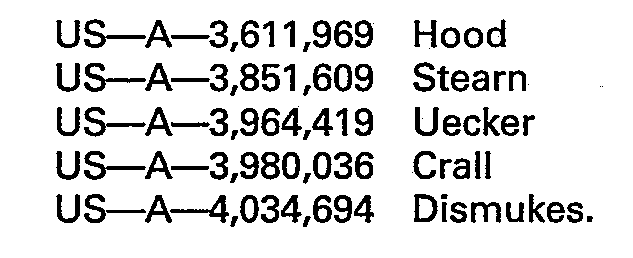
in U.S.A. patents
[0004] Though roller furling systems have achieved rather wide acceptance, they present
certain inherent difficulties. Thus, when the roller furling member is of the type
which itself must be under tension, the furling member must be supported by bearings
and applies a high tension load to the bearings so that the bearings must be serviced
frequently and are subject to undue wear. If the furling member encloses and rotates
about the headstay, so that the furling member itself is not under tension, torsion
problems are encountered since, e.g., a turning moment imparted to the foot of the
member is not immediately transmitted to the head of the member, the result being
that the furling member is twisted and the sail is not rolled uniformly from head
to foot. When the roller furling member is the headstay or directly associated with
the headstay, the sail cannot be lowered at all in its furled condition. If the roller
furling member is separate from the headstay, the sail can be lowered in its furled
condition, but the stiffness and length of the furling member make handling and stowing
the furled sail very difficult. Because of the need for a furling drum at the foot,
and a swivel at the head, roller furling significantly reduces the length of the headstay
which can be occupied by the sail, and eliminates the sail skirt. If roller furling
is to be used, the sail must be flat, or virtually flat; the sail can have little
or no draft. When the furling member is separate from the headstay, as when a wire
member is incorporated in the luff of the sail, the sail exhibits excessive luff sag
in all but the lightest of air. Since a roller furled sail is at best difficult to
lower in furled condition, the sails are usually left aloft when furled and are thus
exposed to the elements for protracted periods. To protect the sail, weather-resistant
cover material has been added along the leech and foot, so as to be wound on the outside
of the furled sail, but addition of this material, which is relatively heavy, tends,
e.g., to collapse the sail in light air. Finally, while roller furling has been applied
to mainsails, its use for mainsails is essentially impractical, requiring extensive
mast modification and undue limitation of sail area. Such difficulties have generated
a continuing need for improvement in the art of furling working sails while aloft.
[0005] There is also known from US-A-3 157 149 a method for furling a working sail, the
sail being of flexible sail material, comprising providing flexible sheet material
extending along the sail from head to foot located and attached aft of the leading
edge of the sail, at least preliminarily furling the sail from leech to luff, progressively
forming said flexible sheet material into a tubular bag the length of which extends
between the head and the foot of the sail and progressively disposing the sail in
fully furled condition within the tubular bag as the bag is formed, and progressively
securing the bag against opening as the tubular bag is formed.
[0006] However, such method is not carried out while the said is aloft.
[0007] From US-A-3 157 149 is also known a working sail according to the pre-characterizing
part of claim 25. However this sail is not suitable for being furled while aloft.
Objects of the invention
[0008] A general object is to devise a method for furling working sails while aloft, and
a sail system with which the method can be practiced, with all operations required
to accomplish furling being carried out from a location, such as the cockpit of the
vessel, which is remote from the sail.
[0009] Another object is to provide such a method and system which does not involve rolling
of any portion of the sail, but rather folds or flakes substantially the entire sail.
[0010] A further object is to provide such a method and system which not only furls the
sail aloft but results in the furled sail being enclosed in an elongated tubular bag
so that the furled sail can be left aloft in a position parallel to and adjacent the
stay or mast.
[0011] Another object is to devise a method and sail system such that the sail can be completely
furled and enclosed in a tubular bag while aloft with the leading edge of the sail
still attached to the stay or mast.
[0012] Yet another object is to devise such a method and sail system wherein the sail is
not encumbered by elongated stiff elements, can be easily lowered in its bagged condition
and easily stowed on board the vessel, and can be easily run back up in its bagged
condition and then unfurled.
[0013] A further object is to devise an improved method for furling, lowering and stowing
a working sail.
[0014] An additional object is to provide an improved sail stowage bag, and the combination
of such a bag with sails stowed therein in an improved fashion.
[0015] Another object is to provide such a method and sail system which assists in reefing
the sail while aloft.
[0016] Another object is to provide a sail which can be remotely furled while aloft and,
when furled, can be left aloft and is protected from the elements.
[0017] A further object is to provide a method and sail system which makes it practical
to furl any working sail aloft, which does not require that the sail be essentially
without draft and does not limit or decrease sail area.
[0018] A still further object is to provide a remotely operable travelling furler for furling
sails while aloft.
Summary of the invention
[0019] The method of the invention is characterized by the steps of the characterising part
of claim 1. The flexible sheet material from which the bag is formed can be material
in addition to the sheet material of the sail, or can include additional material
and a part of the sheet material of the sail itself, or can be made up entirely of
sheet material of the sail itself. In particularly advantageous embodiments, the steps
of progressively furling the sail, progressively forming the tubular bag about the
furled sail and progressively securing the bag against opening are accomplished simply
by pulling furling line means from a remote point, such as the cockpit, and thereby
pulling a travelling furler and separable fastener runner downwardly from head to
foot, the furler advan- tangeously including an intermediate portion, engaged over
the leech, and two arms which extend from the intermediate portion each on a different
side of the aft portion of the sail, the runner of the separable fastener being connected
to the intermediate portion of the furler, and the combination of furler and runner
being pulled downwardly by furling line portions attached to the arms of the furler.
[0020] Advantageously, the flexible sheet material from which the tubular bag is formed
extends along the leading edge of the sail so that, when the sail has been furled
and bagged, the tubular bag containing the sail extends along the stay or mast, and
the sail, though furled and bagged, remains attached to the stay or the mast and can
be lowered simply and easily, or left aloft. All or a selected portion of the flexible
sheet material from which the bag is formed can be of a material resistant to weathering,
particularly to the effects of ultraviolet light.
[0021] The invention applies to all working sails, i.e., any sail used for a particular
boat or most or all points of sail. Specifically included are jibs, stay- sails (when
used on a boat such as a cutter such that the staysail is used on most or all points
of sail), mainsails and mizzens. Working sails are to be distinguished from spinnaker-type
sails.
[0022] Thus the working sail according to the invention is characterized by the characterizing
part of claim 25.
[0023] Further advantageous embodiments are described in the dependant claims.
Identification of the drawings
[0024] In order that the manner in which the foregoing and other objects are attained according
to the invention can be understood in detail, particularly advantageous embodiments
thereof, including the current best method and apparatus modes, will be described
with reference to the accompanying drawings, which form part of the original disclosure
of this application, and wherein:
Fig. 1 is a semidiagrammatic side elevational view of a jibsail according to the invention,
with the sail unfurled and set;
Fig. 2 is a sectional view taken generally on line 2-2, Fig. 1, and on larger scale
then Fig. 1;
Fig. 3 is a fragmentary side elevational view enlarged relative to Fig. 1 and illustrating
the head portion of the sail of Fig. 1;
Fig. 4 is a sectional view taken generally on line 4-4, Fig. 3;
Fig. 5 is a perspective semidiagrammatic view of a travelling furler and closed loop
line means employed with the sail of Fig. 1;
Fig. 6 is a projected plan view of a travelling furler;
Fig. 7 is a detail sectional view taken generally on line 7-7, Fig. 6;
Fig. 8 is an enlarged side elevational view of the furler of Figs. 5-7 in operative
position on the sail during furling;
Figs. 9 and 10 are views similar to Fig. 1 but showing the sail partially furled and
bagged and fully furled and bagged, respectively;
Figs. 11-13 are semidiagrammatic cross-sectional views taken generally on lines 11-11,
12-12 and 13-13, Fig. 9, respectively, and enlarged relative to that figure;
Fig. 14 is a plan view of the sail of Fig. 1 as that sail would be laid out in the
sail loft prior to binding the sail;
Fig. 15 is a perspective view of a sail stowage bag according to the invention;
Fig. 15A is a top plan view of the bag of Fig. 15 with the cover closed;
Fig. 16 is a perspective view illustrating the manner in which the sail of Fig. 1,
once furled and bagged aloft, can be lowered and stowed in the bag shown in Fig. 15;
Fig. 17 is a fore-to-aft semidiagrammatic cross-sectional view of a sail according
to another embodiment of the invention;
Fig. 18 is a cross-sectional view of the sail of Fig. 17 when furled and bagged;
Fig. 19 is a semidiagrammatic side elevational view of a mainsail according to another
embodiment;
Fig. 19A is an enlarged fragmentary side elevational view, with portions broken away
for clarity, of a part of the boom and sail of Fig. 19;
Fig. 20 is an enlarged side elevational view of the head portion of the sail of Fig.
19;
Fig. 20A is a fragmentary side elevational view of a part of the head portion of Fig.
20, enlarged with respect to that figure;
Fig. 21 is a cross-sectional view taken generally on line 21-21, Fig. 19;
Fig. 22 is a cross-sectional view taken generally on line 22-22, Fig. 20;
Fig. 23 is a perspective view of a travelling furler employed with the sail of Figs.
20-22;
Fig. 24 is a transverse cross-sectional view taken generally on line 24-24, Fig. 23;
Fig. 25 is a cross-sectional view of the sail of Figs. 19-22 when furled and bagged;
Fig. 26 is an enlarged side elevational view of a modified form of the jibsail of
Fig. 1 adapted for use with the furler of Figs. 23 and 24;
Fig. 27 is a semidiagrammatic side elevational view of a jibsail according to another
embodiment;
Fig. 27A is an enlarged fragmentary side elevational view of a pre-furling line and
ring arrangement employed in the sail of Fig. 27;
Fig. 28 is a cross-sectional view taken generally on line 28-28, Fig. 27;
Fig. 29 is a transverse cross-sectional view of the sail of Figs 27 and 28 when furled
and bagged;
Fig. 30 is a side elevational view of a combined travelling furler and separable fastener
useful according to the invention;
Fig. 31 is a plan elevational view of the furler of Fig. 30; and
Fig. 32 is a transverse sectional view taken generally on line 32-32, Fig. 30.
Detail description of the sail system of Figs. 1-14
[0025] Figs. 1-14 illustrate the invention as applied to a jibsail 1 connected to headstay
2 by a conventional assembly of grooved headstay extrusions 3 and 3a, Fig. 2, and
equipped with a halyard 4, a tack cringle secured by tack hook 5 and sheets 6. The
sail can be of any sail cloth suitable for a working sail and is advantageously of
a fabric woven from polyethylene terephthalate fiber (e.g., that marketed under the
registeed trademark Dacron by E. I. du Pont de Nemours & Co., Wilmington, Delaware),
and includes a main sail body, indicated generally at 1a, and a reinforced head area,
indicated at 1b and seen in detail in Fig. 3. Main body 1a is in the form of a single
sheet of fabric made up of a plurality of panels as shown, the panels being cut and
sewed, with conventional broad seam tapering, to provide the substantial draft, i.e.,
camber or transverse curvature, when the sail is set and flying, required for optimum
sail performance. Reinforced head area 1 b is also of conventional form, made up of
a plurality of panels with the panels being of multiple sheets of fabric varying progressively
from, e.g., 7 sheets for the uppermost panel to, e.g.. 2 sheets for the lowermost
panel of the head area. Thus, head area 1b is substantially stiffer than the main
body 1a a with the increased stiffness being maximum at the uppermost panel and minimum
at the lowermost panel of the head area.
[0026] Sail 1 is unique in that it comprises an additional portion 7, Figs. 1-3, made up
of an elongated portion of flexible sheet material, typically a fabric woven of, e.g.,
polyethylene terephthalate, nylon or acrylic cover cloth fibers and having a weight
of 0.5-13 oz. per squre yard, depending upon the particular sail. Acrylic cover cloths
and specially finished polyethylene terephthalate fabrics are available which are
resistant to ultra-violet light. Added portion 7 extends completely from the head
of the sail to the foot of the sail on one side only (the port side in this embodiment)
and has a leading edge 8, which overlies and is secured to the leading edge of sail
body 1a a and reinforced head area 1b as seen in Figs. 2 and 4, and a trailing edge
9 which extends over and is secured to the sail along a line spaced aft of the leading
edge of the sail. Between leading edge 8 and trailing edge 9, added portion 7 is free
and unattached, both with respect to the main body of the sail and with respect to
the head area, and lies normally against the sail, separation between portions 1a
a and 7 and portions 1b and 7 being exaggerated in the drawings for clarity. Securing
leading edge 8 to the leading edge of the sail and headboard is advantageously accomplished
by having the leading edges of both the sail and portion 7 disposed within the two
plies 10 of the conventional luff tape 11 and stitching through the luff tape with
heavy duty polyethylene terephthalate thread. The trailing edge of added portion 7
is simply sewed to the sail. Trailing edge 9 of added portion 7 slants at a small
angle downwardly and aft so that portion 7 overlies that triangular portion of main
sail body 1a which is immediately aft of the leading edge of the sail. The head end
of added portion 7 extends upwardly over the leading portion of head area 1b, trailing
edge 9 of portion 7 being parallel to the leading edge of head area 1b, and the upper
end of portion 7 extending across and being stitched to the leech of the head area.
[0027] Commencing at the foot of head area 1b, the seam between the trailing edge 9 of added
portion 7 and the main body of the sail, together with the seam along luff tape 11,
define a forward portion 12 of the sail which has the same dimensions and shape as
that part of portion 7 below the headboard. Below reinforced head area 1b, sail portion
12 is fully exposed, no sheet material being added on the starboard side of the sail.
Over head area 1b, however, this side also carries an additional portion 13 of flexible
sheet material, as seen in Fig. 4, portion 13 being complementary to, and corresponding
in size and shape to, the upper end portion of added portion 7. The leading edge of
portion 13 is secured by stitching between one ply 10 of the luff tape and the starboard
surface of the leading edge of the head area. The trailing edge of portion 13 is stitched
directly to the head area. Portion 13 extends across the leech of the head area and
is stitched thereto. Save for its leading and trailing edges and for being stitched
to the leech, portion 13, like portion 7, simply overlies head area 1b and is not
attached thereto.
[0028] Luff tape 11 is a conventional luff tape for use with the slotted headstay extrusions
and, therefore, includes along its leading edge a boltrope 14, Figs. 2 and 4, engaged
in the headstay slot as shown. Headstay 2 is secured to a conventional bow fitting
15, Fig. 1, and to the masthead assembly 16 so as to be under tension, and the grooved
extrusions 3 combine with extrusions 3a,
[0029] Fig. 2, to slidably embrace the stay in usual fashion. With the leading edge of the
sail held in tension by the halyard, and with boltrope 14 securely engaged in the
groove of the extrusion, the leading edges of the sail and added fabric portions 7,
13 are held taut, secure and parallel to the headstay when the sail is set.
[0030] The sail is equipped with a separable fastener comprising two elongated flexible
fastener elements 17 and 18 and a runner 19. Element 17 extends from the head of the
sail to the foot along the outer surface of added fabric portion 7 and is secured
to that portion throughout its length. Element 18 extends from the head of the sail,
first along added fabric portion 13, then along the starboard surface of sail portion
12, to the foot. As best seen in Fig. 3, both elements 17 and 18 cross the leech of
reinforced head area 1 b, the head end portions of elements 17 and 18 being closed
at the leech and secured there, in closed condition, to the respective ends of portions
7, 13 and the underlying leech. Thus, the separable fastener is maintained permanently
closed at its extreme upper end.
[0031] In this embodiment, fastener elements 17 and 18 are opposite each other, through
the thickness of the sail material and added fabric portions therebetween, throughout
their length and therefore extend along mutually parallel lines (when the sail is
set) which first curve from the leech to become parallel with the leading edge of
the reinforced head area 1b, then remain parallel to that leading edge throughout
the length of the head area 1b, and then slant downwardly and aft at a small angle
away from the leading edge of the sail. Save for their permanently closed upper ends,
fastener elements 17, 18 are (when the sail is set) spaced aft of the leading edge
of the sail by a distance which is slightly more than 50% of the fore-to-aft seam-to-seam
dimension of added fabric portion 7. The separable fastener can be of any conventional
type capable of being progressively closed by moving runner 19 along elements 17,
18 in one direction and progressively opened by movement of the runner along the fastener
elements in the opposite direction. It is particularly advantageous to employ as the
separable fastener a heavy duty conventional slide fastener of the type commonly referred
to as a zipper since such fasteners are characterized by having, as elements 17 and
18, fabric tapes equipped with teeth along one edge of the tape and such tapes can
be readily and securely sewed to fabric portion 7, sail body 1 and fabric portion
13.
[0032] Runner 19 of the separable fastener is releasably attached by ring 20 to a releasable
fastener 21 secured to the intermediate portion 22 of a travelling furler indicated
generally as 23, Figs. 5-8. Furler 23 is in the form of a flexible laminated body
24 which is generally triangular in projected plan and is defined by an elongated
leading edge 25, a relatively short trailing edge 26 and two equal side edges 27,
28 interconnecting the respective ends of the leading and trailing edges. As seen
in Fig. 7, body 24 comprises an intermediate ply 29 of relatively thick and heavy
fabric, a relatively thinner outer ply 30 of woven fabric, a like inner ply 31, and
an inner surface ply 32 which presents, as its inner face, a smooth and uninterrupted
surface which is at least non- abrasive and at best characterized by inherent lubricity.
Plies 29-31 are secured together, advantageously by stitching, both along the marginal
portions of body 24 and over the remainder of the body area. Inner surface ply 32
is secured to plies 29-31 only along the marginal or edge portions of body 24. Thus,
when ply 32 is secured by stitching, none of the stitches is exposed at the surface
of ply 32 which engages the sail. The marginal portions of body 24 are bound with
a strip of relatively thick, strong and compressible binding material, best seen at
33, Fig. 7, by stitching which extends through all of the plies, the stitches being
indented in the outer portion of the binding material. Intermediate ply 29 is typically
of a woven fabric impregnated and coated with a flexible and strong polymeric material.
Thus, the so-called "cloth-backed vinyl" materials, such as are marketed under the
registered trademark Naugahyde by Uniroyal, Inc., New York, New York, are especially
suitable. Plies 30 and 31 can be of fabric woven from polyethylene terephthalate fiber
and having a weight of 210-240 grams per square meter. Inner facing layer 32 is advantageously
of either a hard finish woven nylon fabric or a polymeric film. When a woven nylon
fabric is employed, one having a weight of 70-140 grams per square meter is especially
suitable. When a polymeric film is used, a transparent polyvinylidene chloride film
with a weight of 240-350 grams per square meter and a thickness of the order of 0.04
cm is particularly suitable. For the binding material 33, elkhide and cloth-backed
vinyl materials are particularly useful.
[0033] As seen in Fig. 7, fastener 21 comprises a flat metal arm 34 bent at one end to form
the hook of the fastener, a flat spring 35 secured at one end to arm 34 and biased
to engage the end of the hook, and an apertured plate 36 secured to the end portions
of arm 34 and spring 35 and lying in a plane at right angles to the plane of the arm.
A ring 37 extends through the aperture of plate 36. Arm 34 extends in flat condition
for a significant distance between its junction with spring 35 and the hooked end
and is fixed to body 24 by lashing 38 stitched through plies 39-31 and over the arm.
Thus secured to the travelling furler, fastener 21 is held in such position that the
fastener is centered transversely on intermediate portion 22 with the hook of the
fastener opening toward leading edge 25 and with both the hook of the fastener and
ring 37 located nearer to edge 26 than to edge 25.
[0034] Edge 27 and the corresponding portion of edge 25 define an elongated triangular arm
39. Similarly, edge 28 and the other half of edge 25 define a second elongated triangular
arm 40. At their free ends, arms 39 and 40 are equipped with cringles 41 a and 42a,
respectively. As best seen in Fig. 5, a first furling line 41 is connected to arm
39 through cringle 41 a and a second furling line 42 is connected to arm 40 through
cringle 42a. Furling lines 41, 42 run downwardly from the travelling furler, and about
sheaves 43 and 44, respectively, which are secured to the deck immediately forward
of jibstay bow fitting 15 as seen in Fig. 1. From the bow, lines 41, 42 are run aft
to the cockpit of the vessel, thence gain forward, under a sheave 47 at the foot of
the mast 48 and, from sheave 47 up the mast to join a single unfurling line 49. The
unfurling line is run over a block 50 secured to the mast immediately below the masthead
assembly, then downwardly to furler 23 to which the unfurling line is attached by
ring 37.
[0035] Comparing Figs. 6 and 8, and recognizing that Fig.6 is a projected plan, it will
be seen that when body 24 is not under tension, as later explained, the body is of
generally U-shaped transverse cross-section, intermediate portion 22 being substantially
straight from leading edge to trailing edge and the arms 39, 40 projecting away from
the intermediate portion. When the furler is in its position of use, Fig. 5, intermediate
portion 22 is upwardly exposed and arms 39, 40 can be considered as depending from
the intermediate portion and slanting downwardly and outwardly. Since body 24 is relatively
thick, the lateral dimensions of the four plies making up the body increase from inner
ply 32 to outer ply 30, and the plies are sewed with the body in its generally U-shaped
form so that that configuration persists when sewing is complete.
[0036] As illustrated in Fig. 8, runner 19 of the separable fastener is of conventional
configuration and is detachably connected to the travelling furler by ring 20 engaged
over the hook of fastener 21 and retained in place by spring 35. Figs. 3 and 8 show
travelling furler 23 and fastener runner 19 in their uppermost positions, with the
sail aloft. Fig. 5 illustrates the furler and furling lines after the sail, having
been furled and bagged, has been detached from the furler by disengaging runner 19
from fastener 21.
[0037] Considering now the practice of the method of the invention by use of the sail system
shown in Figs. 1-14, assume that the sail has been attached to the headstay in conventional
fashion, run up, and set as seen in Fig. 1, and that it is desired to furl the sail,
as when sailing is finished or when the sail is to be changed. Before furling is commenced,
furler 23 and fastener runner 19
*are in their uppermost positions, arms 39, 40 of the furler curving over fastener
elements 17 and 18, respectively, and thence extending downwardly and forwardly over
the outer surfaces of fabric portions 7 and 13, respectively, the furler remaining
in that position, and under light tension applied by the furling lines and the unfurling
line so long as furling lines 41, 42 are secured at the cockpit. At this stage, the
trailing end portion of intermediate portion 22 of the furler underlies runner 19
and projects a short distance upwardly therefrom, and this disposition persists until
ring 20 is detached from fastener 21 and the furler removed from the sail. A greater
portion of the furler, lying downwardly or in front of runner 19, embraces the leech
of the sail and is thus interposed between the sail and those portions of fastener
elements 17,18, which are below runner 19 and, therefore, as yet disconnected from
each other. Advantageously, the disposition of fastener 21, the point of connection
for unfurling line 49, and the ends of arms 39, 40 to which furling lines 41, 42 are
attached, and the dimensions of portion 22 are such that, when the furling and unfurling
lines are tensioned and the furler is engaged over the leech of the sail, intermediate
portion 22 slants generally downwardly and aft at an angle of approximately 45°. The
sail is furled progressively from head to foot by pulling down on furling lines 41,
42. This is accomplished from the cockpit by grasping both furling lines and pulling
them aft. Since the combination of furling lines 41 and 42, unfurling line 49 and
travelling furler 23 extends as a closed loop, unfurling line 49 is pulled downwardly
from block 50 as a result of downward travel of furler 23, so that what would otherwise
be the slack in the furling lines is drawn forwardly from the cockpit and thence up
the mast.
[0038] At the outset of furling, intermediate portion 22 of the travelling furler is engaged
over the leech of the sail and is urged both downwardly and forwardly by the tension
applied to arms 39, 40 by the furling lines. As the furlertravels downwardly, it first
traverses the aft portion of head area 1b, urging the material of that portion forwardly.
Since sheaves 43, 44 are positioned just forward of the jibstay fitting, furling lines
41, 42 pull the furler downwardly and slightly forwardly, so that as the downward
travel of the furler progresses toward the foot of head area 1 b, the furler forces
the aft portion of the head area forwardly, carrying the juncture between the trailing
edges of fabric portions 7, 13 toward the leading edge of head area 1 b. As a result,
the aft portions of fabric portions 7, 13 are turned inwardly, to commence progressive
formation of a tubular bag, and the part of the head area 1 b between the trailing
edge of fabric portions 7, 13 and the leech is folded into the bag as the bag is formed.
Since runner 19 of the separable fastener is attached to furler 23, the runner follows
the furler, progressively joining fastener elements 17, 18 to close the fastener and
secure the formed portion of the bag against opening. It is the portions of fabric
portions 7, 13 between fastener elements 17, 18 and the seam between the trailing
edges of portions 7, 13 and the sail which form the bag portion directly containing
all of reinforced head area 1b b aft of the trailing edges of portions 7, 13, as will
be clear from Fig. 11, and it will be noted that the fore portions of fabric portions
7, 13 between the leading edge and fastener elements 17, 18 enclose not only the bag
portion just mentioned but also the fore portion of reinforced head area 1 b, i.e.,
that portion between the leading edge of the reinforced head area and the trailing
edges of fabric portions 7, 13.
[0039] As furler 23 progresses beyond the foot of reinforced head area 1b, it leaves the
fabric portion 13 and commences to force the aft portion of the main body 1a of the
sail forwardly between these portions of added fabric portion 7 and sail portion 12
which lie between fastener elements 17,18 and the juncture between trailing edge 9
of fabric portion 7 and the sail. Since the intermediate portion 22 of the furler
is engaged over the leech while flexible arms 39 and 40, held under tension by the
act of pulling the furling lines, embrace the aft portion of the sail, and since the
furler moves along the material of the sail, the aft portion of the sail is not simply
crumpled and stuffed forwardly. Rather, the furler coacts with added portion 7 and
sail portion 12 to form the aft portion of the sail into a series of folds commencing
at the trailing edge of portion 7 and progressing to the leech, much as the sail would
be folded if "flaked" by hand.
[0040] While arms 39, 40 of the furler lie outside of headboard portions 7, 13 when the
furler and fastener runner are in the uppermost positions seen in Figs. 3 and 8, pulling
the furler downwardly by lines 41, 42 inherently causes the arms of the furler to
move in advance of the lower end of the forming bag, and the furler therefore acts
not only to furl the sail but also to smoothly insert the furled sail material into
the space between the now inwardly and forwardly extending aft portions of fabric
portion 7 and sail portion 12, in the manner seen in Fig. 13. Pulled downwardly by
furler 23, fastener runner 19 progressively closes fastener elements 17 and 18 in
the manner shown by Fig. 8 and comparison of Figs. 12 and 13. Such closing of the
fastener secures the bag about the furled sail so that, when the furler has been pulled
to its lowermost position, seen in Figs. 5 and 10, the entire sail has been furled
and enclosed within a tubular bag which is secured against opening. In this connection,
it is to be noted that, with the sail thus furled and bagged, fastener runner 19 remains
engaged with fastener elements 17, 18 and can be detached from the furler by removing
ring 20 from fastener 21.
[0041] Since fastener elements 17, 18 extend along lines slightly nearer to the trailing
edge of fabric portion 7 than to the leading edge of portion 7, the completed tubular
bag includes an inner portion, which directly encloses the furled sail and is formed
by those parts of portions 7 and 12 which extend between fastener elements 17, 18
on the one hand and the seam at trailing edge 9 on the other hand, and an outer portion
defined by the parts of fabric portion 7 and sail portion 12 which extend forwardly
from fastener elements 17, 18, the inner bag portion being extended in tension by
the enclosed sail material, the outer bag portion not being tensioned but fitting
relatively snugly about the inner bag.
[0042] The dimensions of added fabric portion 7 vary according to the details of the specific
sail involved, including particularly the size of the sail and the weight and stiffness
of the sail cloth. A general rule for designing added fabric portion 7 will be explained
with reference to Fig. 14 which illustrates the plan for a jibsail having a curved
luff, including a forward curve, indicated at 55 and extending for about the first
3/4 of the length from foot to head, and a reverse or "compensator" curve indicated
at 56 and extending for the upper 1/4 of the sail. As a first step, the critical dimension
D of the sail is determined by striking an arc through the clew about the head of
the sail as the center and drawing a chord from the clew to the point at which the
arc intersects the leading edge of the sail, the distance of the chord in meters being
the critical dimension. The width a of portion 7 along the chord is then determined
by the formula:
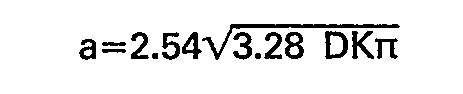
where K is a sailcloth constant selected from the range from 1 to 2 times the weight
of the cloth in grams per square meter multiplied by 0.0424. With main body 1a a of
sail 1 made from a woven polyethylene terephthalate fabric with a weight of 106 grams
per sq. meter, an appropriate value for K is 1.75x106x0.0424=7.9. Assuming the critical
distance D is 5.18 meters, then:

and the value of a is read in centimeters. It should be noted that critical distance
D is taken from the trailing edge of the sail to the leading edge of the sail, and
that the dimension a is the distance from the leading edge of added portion 7 to,
but not including, the seam at trailing edge 9.
[0044] To layout added fabric portion 7 and the lines along which the elongated flexible
fastener elements 17, 18 are to be sewed, the aft end of dimension a is first marked
on the sail cloth as point X. A second critical distance D' is then determined in
the same manner as distance D was determined but in a location immediately below reinforced
head area 1b. Knowing distance D', distance a' is calculated and its aft end marked
as point Y. If the leading edge of the sail is a straight line, the location for the
seam at trailing edge 9 of portion 7 is marked by a straight line connecting points
X and Y. Added fabric portion 7 can then be cut so that the leading edge of portion
7 coincides with the leading edge of the sail and the trailing edge of portion 7 is
parallel to line X-Y but spaced aft thereof by the small distance necessary to accommodate
the seam at trailing edge 9. If, as in Fig. 14, the sail is to be cut with luff curve
55, 56 a paper pattern is made for the curve and the pattern is used to mark the luff
curve on the leading edges of both the sail cloth and the fabric for added portion
7. The leading edges of both the sail cloth and the fabric for portion 7 are then
cut, and portion 7 placed on the sail cloth with its curved leading edge coincident
with that of the sail cloth. Points X and Y are then marked on the fabric for portion
7 and the luff curve pattern is then used to connect points X and Y. The trailing
edge of portion 7 is then cut, using the curve X-Y line as the guide. Distances b,
b' and c, c' are then determined to locate points X' and Y' and the luff curve pattern
is then used to mark the lines along which fastener elements 17 and 8 are to be sewed
to added portion 7 and sail portion 12, respectively. Accordingly, trailing edge 9
of portion 7, though slanting downwardly and aft away from the leading edge of the
sail, follows the same curve 55, 56 as does the leading edge of the sail. The end
result is that the outer bag portion, formed by the parts of added portion 7 and sail
portion 12 which are forwardly of fastener elements 17, 18 will be neither too loose
along curve portion 55 nor too snug along curve portion 56.
[0045] When the sail is made up of panels and broad-seaming is used to provide draft in
the sail, added portion 7 is panelled and broadseamed to match the sail.
Lowering, stowing and changing sails
[0046] After sail 1 has been completely furled and bagged, the sail can be lowered and stowed
in a sail bag more easily and with greater safety than has heretofore been possible.
When sailing is finished, the furled and bagged sail can be disconnected from travelling
furler 23 by detaching ring 20 from fastener 21, the halyard is slacked and the sheets
are disconnected, and the furled and bagged sail pulled down to the deck, leaving
furler 23 and lines 41, 42 and 49 in place. Since the furled and bagged sail includes
no elongated stiff elements, it is easily taken below in compact form.
[0047] When the tasks of lowering and stowing the sail are occasioned by the need to change
sails at sea, it is advantageous to employ the dual sail bag 60 shown in Fig. 15.
Bag 60 comprises a fabric body 61, a mouth reinforcement member 62, a fabric partition
63 and a fabric cover 71. Reinforcement member 62 can be of metal tubing, rod or rigging
wire bent into a circular hoop. The mouth of body 61 is turned inwardly over member
62 and sewed to the fabric body below that member. Partition 63 has its side edges
65 sewed to the inner surface of body 61 along respective vertical lines which are
diametrically opposed across the circular body of the bag. The partition is cut so
that, when it is sewed in place, the fabric of the upper portion is significantly
wider than is necessary to extend across the bag. The upper edge of partition 63 is
hemmed loosely about a closed loop elastic cord 66 which also extends through openings
in the hem at the top of the bag and is secured at each edge of the partition to reinforcement
member 62. The hem at the top of the partition is cut away at its midpoint, providing
an opening 67 through which a portion 66a of cord 66 is run, a hook 66b being attached
to portion 66a. Partition 63 divides the interior of the bag into two compartments
68 and 69 which are generally semicircular in transverse cross-section. Near the top
of the bag, an eye 70 is secured to the inner surface of the side wall of the bag
in a location spaced midway between the edges of the partition. Thus, by grasping
hook 66b, one can stretch cord 66 and engage the hook in eye 70 so that the cord extends
across the top of compartment 69 and deflects the upper portion of partition 63 toward
eye 70, so enlarging the mouth of compartment 68. Cover 71 is a round piece of fabric
hemmed peripherally to enclose an elastic band 72 having, when relaxed, a diameter
smaller than reinforcing member 62, the cover being sewed to the mouth of bag body
61 adjacent one edge of partition 63 so as to be capable of being stretched over the
mouth of body 61, the elastic band then being allowed to contract about body 61 below
member 62 to hold the cover in place. Bag 60 is to occupy a particular position on
the deck during sail changing. Thus, the edge of partition 63 adjacent which cover
71 is hinged should point toward the stern, and as seen in Fig. 15A, cover 71 is provided
with position- indicating indicia, such as an arrow, visible when the cover is closed.
[0048] Compartments 68, 69 and each are sized to contain one jibsail which has been furled
and bagged according to the invention. Compartment 68 is to port when bag 60 is properly
oriented on the fore deck and is equipped with two snap hook fasteners 73, 74 sewed
to the wall of the bag immediately below member 62 in the area adjacent the forward
edge of partition 64. Starboard compartment 69 is similarly provided with two snap
hook fasteners 75, 76. Used for changing sails, bag 60 will normally contain the one
of two jibsails not in use. As viewed in Fig. 15, compartment 69 contains a sail 77
which has been furled and bagged according to the invention, the tack cringle of the
sail being secured to fastener 75, the furled and bagged sail extending downwardly
from fastener 70 to the bottom of compartment 69, then being wound upwardly in generally
helical fashion, and the head cringle being secured to fastener 76. Elastic safety
cord 78 are secured to body 61 near the top of the bag so the bag can be attached
to, e.g., the life lines.
[0049] When sail 1, Fig. 10, is to be replaced by sail 77, bag 60 is carried to the fore
deck and placed on the deck immediately behind the headstay with the portion of the
bag to which fasteners 73-76 are attached directed forwardly. Ring 20 is detached
from fastener 21, freeing furler 23 from the sail. The sheets are disconnected and
the halyard slacked. With the tack of the sail still secured, the remainder of the
bagged sail is pulled downwardly and inserted, generally in a helical fashion, into
compartment 68 of bag 60, as illustrated in Fig. 16. The tack is then unhooked and
attached to fastener 74. When the head of the sail is reached, the halyard is detached
and the head of the sail attached to fastener 73 while retaining the halyard in one
hand. The tack is then unhooked and attached to fastener 74. The head of sail 77 is
then detached from fastener 76 and secured to the halyard, and hook 66b is detached
from eye 70 and attached to eye 70a. The boltrope of the luff tape of sail 77 is fed
into the groove of the lowermost extrusion 3 in usual fashion. The tack of the sail
is then detached from fastener 75 and secured by tack hook 5. The halyard is then
pulled to hoist sail 77. Ring 20 of the fastener runner of sail 77 is then attached
to fastener 21 to secure furler 23 to the sail. The sheets are then attached to the
clew of the new sail. Cover 71 of bag 60 is secured and the bag, with sail 1 properly
stowed, is taken below. Unfurling line 49 is pulled to pull travelling furler 23 upwardly
until the runner of the fastener of the sail reaches the permanently closed end of
the fastener at the head of the sail. As furler 23 moves upwardly, the sail is released
and set automatically.
The embodiment of Figs. 17 and 18
[0050] In this emodiment, the elongated bag into which the sail is furled is formed from
two added pieces of flexible sheet material. The body and reinforced head portion
of sail 101 can be identical to sail 1, Figs. 1-14. The bag to contain the furled
sail results from the action of travelling furler 23, Figs. 6 and 7, and is formed
from two added portions 107 and 112 of flexible sheet material, each disposed on a
different side of the sail, the leading edges of portions 107, 112 being coincident
with the leading edge of sail 101 and disposed between the two trailing plies 110
of luff tape 111 so that, when the luff tape is sewed in place, the leading edges
of the sail and portions 107, 112 are all secured to the luff tape. Leading boltrope
112 of the luff tape is engaged in the groove of headstay extrusions 103 and the sail
and portions 107,112 are thus secured to stay 102 by extrusions 103, 103a in conventional
fashion.
[0051] Slide fastener tape 117 is secured to the trailing edge of portion 107, and fastener
tape 118 is secured to the trailing edge of portion 112. The fore-to-aft dimensions
for portions 107, 112 are determined as described for dimension b, Fig. 14. The fastener
includes a runner (not shown) the same as runner 19 for sail 1, Figs. 1―14. The runner
is detachably connected to furler 23 by fastener 21. As described with reference to
sail 1, the slide fastener is permanently closed at the head end of the sail. Pulling
furler 23 downwardly also pulls the fastener runner downwardly, in the manner described
with reference to sail 1. Thus, pulling furler 23 downwardly causes the sail to be
furled progressively from head to foot and also causes tapes 17, 18 to be joined progressively
to secure portions 107, 112 as an elongated bag containing the furled sail, as shown
in Fig. 18.
[0052] Though the trailing edges of portions 107, 112 can be left free during sailing, it
is advantageous to secure the trailing edges of portions 107, 112 to the sail releasably.
This can be accomplished by means of conventional hook-and-loop fabric fastening means,
e.g., the type available under the registered trademark Velcro and generally described
in U.S. patent 3,009,235, issued November 21, 1961, to de Mestral. Thus, a plurality
of patches 180 of hook fabric can be secured along the inner face of the trailing
edge portions of portions 107, 112 and a like number of patches 181 of loop fabric
can be secured to each surface of sail 101, with the locations of the patches selected
so that each patch of hook fabric is opposed to a patch of loop fabric. When the sail
is first set, the respective patches 180 engage patches 181 and are releasably secured,
as a result of pressure caused aerodynamically, so that portions 107, 112 cannot flutter.
However, when travelling furler 23 is pulled downwardly, the furler arms force portions
107, 112 away from the sail, disengaging patches 180 from patches 181.
[0053] In this embodiment, both portions 107, 112 are advantageously made from material
resistant to ultra-violet light and other weathering effects.
Mainsail embodiment of Figs. 19-25
[0054] In this embodiment, mainsail 201 comprises a hollow-leech loose-footed sail body
201a, a reinforced head portion 201 and a headboard 201c. Reinforced portion 201 b
extends downwardly for a short distance, typically 0.76 meter for a 13 sq. meter sail
having a 8.8 meter leading edge. The fabric of the main body 201 a extends to the
head, terminating at the upper edge of the headboard. Commencing at panel seam 260,
which defines the foot of reinforced portion 201b, a second piece of fabric 261 overlies
the port side of the sail throughout portion 201b. Commencing at the next upper seam
262, a third piece of fabric 263 overlies the starboard side of the sail throughout
portion 201b. Fabric pieces 261, 263 are of the same plan shape and dimensions as
the reinforced area, so the leading and trailing edges of the three plies are coincident
throughout their extent in reinforced head portion 201 b. As seen in Figs. 20 and
20A, the leech at the head of the sail extends downwardly vertically, parallel to
the luff, for a distance approximately equal to the length of the leading edge of
the headboard, then slants downwardly and aft to the clew. Headboard 201c c includes
two metal plates 285, Fig. 22, disposed each on a different side of the head of the
sail and secured together, as by bolts, to clamp the head of the sail between the
plates. The headboard is generally triangular, one side being parallel to the leading
edge of the sail, a second extending horizontally, the third slanting downwardly and
forwardly. The headboard is small, typically four or five inches along the horizontal
side.
[0055] An additional portion of flexible sheet material 207, Figs. 20 and 21, overlies the
port side of sail body 201 a and has its leading edge 208 coincident with the entire
leading edge of the sail and its trailing edge 209 sewed to the sail from a point
209a spaced, e.g., 30 cm. below seam 260, to the foot of the sail. A luff tape 211
having trailing plies 210 is employed, leading edges 208 and 286 and the leading edge
of sail body 201 a being disposed between plies 210 and secured by zig-zag stitching.
At point 209a, the trailing portion of portion 207 stops at a straight horizontal
edge 209b which extends forwardly for slightly less than half of the width of portion
207 at point 209a. A portion 207a of portion 207 extends upwardly from the location
of horizontal edge 209b. The trailing edge of portion 207a is at first parallel to
the luff, then curves upwardly and aft to the leech of reinforced portion 201 b in
a location, e.g. 20 cm. below the bottom of headboard 201c, then following the leech,
and then departing from the leech along a straight vertical line spaced, e.g., 4 cm.
aft of the leech, as best seen in Fig. 20A.
[0056] A second additional portion of flexible sheet material 212, Fig. 21, overlies the
starboard side of sail 201, the leading edge 286 of portion 212 extending along the
entire leading edge of sail 201, the trailing edge of portion 212 extending along
a line spaced forwardly from the trailing edge of portion 207, below point 209a, by
a distance slightly less than half the width of portion 207. Above point 209a, portion
212 extends upwardly over head area 201b and has the same plan configuration and dimensions
as does portion 207a.
[0057] One tape 217 of a conventional zipper type slide fastener extends over the outer
surface of portion 207 and is sewed thereto, a weather-resistant cover strip 217a
being secured over the tape by the same stitching. The second tape 218 of the slide
fastener is sandwiched between the trailing edge 287 of portion 212 and the fabric
of main body 201 a of the sail, and trailing edge 287, tape 218 and the sail cloth
are stitched together throughout the entire length of tape 218 below edge 209b. Above
edge 209b, tapes 217, 218 follow and are sewed to the respective trailing edges of
portion 207a and that part of portion 212 which extends across reinforced head portion
201 but are not sewed to the sail itself. Thus, from edge 209b forwardly, the trailing
edges of the added fabric portions 207a, 212a are not secured to the sail itself.
The extreme upper ends of tapes 217 and 218 are, however, turned forwardly to overlap
the sail, are sewed thereto with the teeth of the fastener permanently engaged (so
the upper end of the fastener is permanently closed) and are clamped between the two
plates 285 of the headboard. Both portions 207a and 212 are stitched to reinforced
head portion 201 along a line 200 commencing at the head and extending downwardly
generally parallel to but spaced forwardly from the leech to the location where tapes
217, 218 cross the leech, at which point line 200 curves to slant downwardly and forwardly
parallel to tapes 217, 218 until, after crossing seam 260, line 200 curves forwardly
to cross the luff tape.
[0058] The bight of tape 211 is sewed to a relatively heavy boltrope 288, Figs. 21 and 22,
which extends along the entire leading edge of the sail. A plurality of cringles 289
are applied to tape 211 at points spaced along the tape immediately adjacent rope
288. A plurality of slides 290 are spaced along rope 289, each slide being secured
to the sail by flat waxed nylon lacing tape 291 laced through one of the cringles
289 and the opening 292 in the flange 293 of the slide. Slides 290 are conventional
and include an elongated forward portion 294 slidably engageably in a longitudinal
slot 295 in the mast 248.
[0059] The tack of sail 201 is hooked to boom mount 205 in conventional fashion. Boom 300
is a conventional hollow boom, connected to mount 205 by a conventional universal
joint, and equipped with a longitudinally extending upper track 201, Fig. 19A, slidably
retaining a clew slug 302 having a retainer 303 to which the clew cringle 304 is detachably
connected by a snap shackel 305. An outhaul line 306 is detachably connected to the
clew cringle by snap shackel 306a and extends outwardly, about outhaul sheave 307,
thence through the interior of the boom toward the mast, exiting the boom via exit
box 308 and being secured to a cleat 309 mounted on the boom. Between cleat 309 and
the mast, a check block 310 is mounted on the boom. An extension 311 of the outhaul
line runs from cleat 309 through block 310 and thence outwardly along the top of the
boom and past clew slug 302 to be spliced to outhaul line 306 as shown. Halyard 204
is connected conventionally to headboard 201c, run upwardly and over a sheave in exit
box 312, thence downwardly through the mast, exiting via exit box 313 to winch 314,
and being secured on cleat 315. The boom is advantageously equipped with a boom topping
lift line 316 connected to the free end of the boom and running to the masthead assembly,
thence downwardly through the mast to exit via exit box 317 to be secured by cleat
318.
[0060] Travelling furler 223, shown in detail in Figs. 23 and 24, is again a laminated fabric
structure comprising an intermediate portion 222 from which two complementary arms
239, 240 depend. In this embodiment, the furler is assembled from two separate pieces,
each constituting one of the arms 239, 240, the two pieces being sewed together along
intermediate portion 222. As seen in Fig. 24, each arm 239, 240 is a laminated structure
comprising an intermediate ply 229 of a material such as a cloth-backed vinyl sheet
which will provide body and suppleness; outer and inner plies 230, 231 of a polyethylene
terephthalate woven fabric or other material offering strength and controlled flexibility,
and an inner surface ply 232 of, e.g., a woven nylon fabric presenting an uninterrupted
low friction surface. Plies 229-231 are sewed together along lines distributed over
the plan area of the piece. The assembly is secured by zig-zag stitching extending
along the entire periphery. The edges of the arms which are to form intermediate portion
222 are curved, from trailing end 226 toward the ends of arms 239, 240 and thence
back to leading end 225, and are sewed together in matched alignment, as by zig-zag
sewing at 222a, Fig. 23. The long sides of arms 239, 240 are bound with elkhide at
233, sewed by straight line stitching extending through the peripheral portion of
all of plies 229-232, thus securing all of the plies but leaving the exposed surface
of inner ply 232 uninterrupted. For a major portion of the length of the curved edges,
the sewed curved edges are found with, e.g., a cloth-backed vinyl tape 320, Fig. 23,
the tape binding stopping short of trailing end 226 by, e.g., about one-quarter of
the length of the curved edges. The remaining portion of the sewed curved edges is
bound by a piece of elkhide 321 sewed over the hem along the curved edges and extending
over the adjacent outer surface portions of the respective arms. Elkhide piece 321
is sewed securely throughout the hem provided by stitching 222a, the portions of the
two arms overlain by the free portions of piece 321 are then flattened so as to lie
approximately in a common plane, and piece 321 is then sewed to the respective arms
at points 322, Fig. 24, while holding the leather piece and the arms smooth and flat.
Then, when piece 321 is released, the trailing edges of arms 339, 340 flare apart,
as seen by comparing Figs. 23 and 24.
[0061] A snap hook 221, identical to hook 21 of Fig. 7, is lashed to intermediate portion
222 of furler 223 immediately adjacent elkhide piece 321 and is engaged by the connecting
ring 220 of slide fastener runner 219 which is engaged with the fastener tapes 217,
218. Snap hook 221 includes an apertured plate 236 equipped with a ring 237 to which
unfurling line 249 is connected. Two furling lines 241 and 242 are connected respectively
to the cringles 239a, 240a of arms 239, 240 of furler 223 and extend downwardly each
on a different side of the sail. Below the boom, lines 241, 242 are spliced at 249a
to the unfurling line 249 which runs under sheave 247 into mast 248, thence upwardly
through the mast to exit over sheave 260 and run downwardly to be attached to ring
237 on snap hook 221. Thus, as in the embodiment of Figs. 1-14, the furling lines,
the unfurling line and the travelling furler combine to form a closed loop such that
the slack which would otherwise result from pulling the furling lines downwardly is
taken up because downward movement of furler 223 pulls the unfurling line downwardly.
[0062] Sail 201 has the usual numer of reefing points for a mainsail, each point including
a reefing line 320, a tack cringle 321 and a clew cringle 322. Line 230 extends horizontally
through a number of apertures in the sail, as shown, so that portions 320a lie on
the port side of the sail and portions 320b on the starboard side. A plurality of
reefing hooks 323 are secured to the port side of the sail, each centered on a different
reefing line portion 320b. A plurality of reefing hooks 324 are secured to the opposite
surface of the sail, each centered with respect to a different one of line portions
320a.
[0063] Added fabric portion 207 can be laid out generally as described for portion 7 of
the embodiment of Figs. 1-14. If sail 201 is of woven polyethylene terephthalate fabric
having a weight of 154 grams per sq. meter the sailcloth constant can be taken as
1.7x154x0.0424=
11.05. Critical dimension D is taken by swinging an arc about the head through clew
304 and intersecting the leading edge, then measuring the chord of that arc from leading
edge to trailing edge, a typical value for the mainsail being 3.05 meters. Then the
width a of portion 207 along the chord is determined as:

The dimension b to locate fastener tape 217 at the chord is:
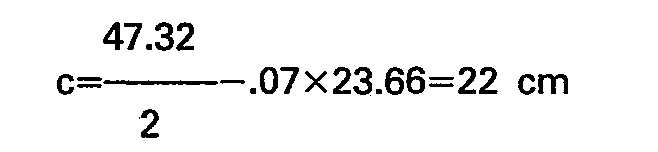
using 7 as the constant T. Similarly, the dimension c along the chord from the seam
of fastener tape 217 to the trailing edge of portion 207 is:
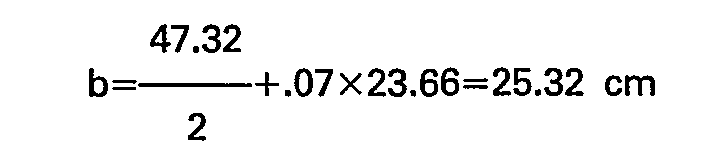
The width b of portion 212 at the chord is equal to that for portion 207. The second
critical dimension D' can be determined at the location of edge 209b and dimensions
a, b and c determined for that location, thus determining a second point for the straight
trailing edge of portion 207 and a second point for the straight seam for fastener
tape 217. If the sail is to have a curved luff, so that the trailing edges of portions
207, 212 must also curve, patterns can be employed as described with reference to
the sail of the embodiment of Figs. 1-14.
[0064] It will be apparent that, with the sail aloft and set as seen in Fig. 19, sail 201
can be furled and bagged, while aloft and still attached to the mast, in much the
same manner described for the sail of Figs. 1-14, simply by pulling furling lines
241, 242 downwardly. With the sail set, as in Figs. 19-20A, the upper ends of fastener
tapes 217, 218 are in their permanently closed condition, with runner 219 engaging
both tapes and extending vertically from the closed ends, and travelling furler 223
is disposed with its trailing end 226 engaged between runner 219 and the vertical
head of the leech of the sail and with the tips of arms 239, 240 engaged between fastener
tapes 217, 218. Furling lines 241, 242 bend over tapes 217 and 218, respectively,
as best seen in Fig. 20A. Arms 239, 240 being held in tension between the furling
lines and unfurling line 249. As furling lines 241, 242 are pulled, downward movement
of furler 223 initially simply closes the slide fastener in a location aft of the
leech and then begins to fold the aft portion of reinforced portion 201b b forwardly,
while continuing to pull runner 219 downwardly to close the fastener behind the furler.
The aft portion of reinforced head area 201b is forced forwardly, against seam 200
and the bag defined by the parts of portions 207a, 212 which are aft of seam 200,
as the slide fastener is progressively closed, and this action continues until furler
223 approaches horizontal edge 209b of portion 207. Commencing at that edge, fastener
tape 218 is sewed to sail body 201 a, and portion 207 is secured to the sail only
at leading edge 208 and trailing edge 209. As the furler continues its downward travel
over the leech, the seam between trailing edge 209 of portion 207 and sail body 201
a is forced forwardly toward the leading edge of the sail, and as best seen in Fig.
25, the combined effect of the furler and slide fastener is to form an inner bag,
defined by the aft part of portion 207 and the portion of sail body 201 between the
seam at trailing edge 209 and the seam at fastener tape 218, and an outer bag, defined
by the forward part of portion 207 and all of portion 212, the aft portion of the
sail being folded into the inner bag, both bags being closed by the joined fastener
tapes 217, 218. The sail is furled and bagged in the fashion seen in Fig. 25 from
the location of edge 209b to the foot of the sail. As the sail is progressively furled
and bagged, the clew must be released, so outhaul line 306 is released from cleat
309 and extension 311 is hauled toward the mast to cause slug 302 to move along track
301 toward the mast, thus moving the clew to the mast by the time that furler 223
approaches the foot. As furling and bagging of the sail is completed, the fact that
the leech is longer than the luff causes some furled sail to extend below the lower
end of the bag, but this furled but unenclosed portion can be easily inserted upwardly
into the lower end of the bag as the last portion of the slide fastener is closed.
[0065] The furled and bagged sail can be left aloft, still secured to the mast by slides
290. In this connection, all of added fabric portions 207, 212, as well as strip 217a,
can be of weather- and ultraviolet light-resistant fabric. The sail can be lowered
simply by slacking the halyard and pulling the bagged sail downwardly.
Modified embodiment of Fig. 26
[0066] Fig. 26 shows the manner in which a jibsail, such as the sail of Figs. 1-14, can
be adapted to include a reinforced head portion generally like that of the mainsail
embodiment just described and to employ the travelling furler of the mainsail embodiment.
Here, reinforced head portions 401 b can be made in any conventional fashion, the
leading edge of portion 401b being sewed between the plies of luff tape 411 secured
to headstay 402 by extrusions 403, 403a as hereinbefore described. The leech of reinforced
head portion 401 b terminates at a point spaced a small distance aft of the leading
edge. At this point, a head extension 401c projects upwardly and is defined by a leading
edge 450, which extends above but parallel to the leading edge of the sail body, a
straight trailing edge 451 which is parallel to edge 450, and an arcuate end 452.
Head cringle 453 is applied in conventional fashion and a heavy reinforcing tape 454
is run through the cringle and downwardly over each side of extension 401 c and onto
head portion 401 b, being secured by stitching as shown. The trailing edge of added
fabric portion 407 curves aft and crosses the leech a short distance below the junction
of the leech with trailing edge 451 of head extension 401c, then parallels the leech
aft thereof, and then extends parallel to trailing edge 451 in a location spaced aft
of edge 451. The trailing edge of the added fabric portion 412 on the other side of
head portion 401 b follows the same path just described for the trailing edge of portion
407. Slide fastener tapes 417, 418 follow and are sewed to the respective trailing
edges of added fabric portions 407, 412. The extreme upper ends of the fastener tapes
are joined at their ends 417a, 418a in permanently closed fashion and extend forwardly
to be sewed to the trailing edge portion of extension 401c adjacent the head cringle.
[0067] Furler 423 is identical to furler 223 of the mainsail embodiment and is therefore
equipped with a snap hook 421 to which the slide fastener runner 419 is connected
by ring 420 and to which unfurling line 449 is permanently connected by ring 437.
When the sail is aloft and set, furler 423 occupies the uppermost position seen in
Fig. 26, with its trailing end portion disposed between runner 419 and head extension
401c and, therefore, enclosed between portions 407a and 412. The tips of arms 439,
440 are disposed at the leech between fastener tapes 417 and 418, with the furling
lines 441, 442 bending outwardly across the toothed edges of tapes 417 and 418, respectively,
and then running downwardly each on a different side of the sail.
[0068] Simultaneous furling and bagging of sail 401 is accomplished as described for the
embodiment of Figs. 19-25. When furled and bagged, the sail can be lowered, stowed
and again installed as described with reference to Figs. 1-15A.
Embodiment of Figs. 27-29
[0069] The embodiment shown in Figs. 27-29 differs from those described above in that the
bag for containing the furled sail is formed from a portion of the sail itself, no
added material corresponding to portion 7, Figs. 1-14, or portions 207 and 212, Figs.
19-25, being employed.
[0070] Jibsail 501 is of usual form, and the halyard 504 is attached to the head cringle,
the tack is secured by hook 505, sheets 506 are attached to the clew, and the luff
is attached to headstay 502 by conventional hanks 503. A first separable fastener
tape 517 of the zipper type is sewed directly to the port side of the sail along a
line parallel and adjacent to the luff tape 511 and extends from the foot of the sail
almost to the head, curving aft just below the head, then crossing the leech and extending
therealong to a point even with the head cringle. The second separable fastener tape
518 is sewed to the starboard side of the sail and extends along a line which commences
at the foot in a location spaced aft of tape 517 and slants upwardly to become opposite
to tape 517 at the upper end of the straight line portion of tape 517. Tape 58 then
curves aft and follows the same line as tape 517. At their uppermost ends, the teeth
of the two fastener tapes are engaged and the tapes sewed to the head of the sail
to keep these ends permanently closed generally in the fashion earlier described for
the tapes of Figs. 20, 20A. A travelling furler 523, similar to furler 223, Figs.
19-25, is employed, ring 537 of furler 523 being connected to unfurling line 549 and
arms 539, 540 of the furler being connected respectively to furling lines 541 and
542. The unfurling lines extend downwardly around sheave 543, thence rearwardly to
the cockpit. Unfurling line 549 extends downwardly adjacent mast 548 and is joined
to the ends of the furling lines, a sheave 547 being provided so that the furling
lines can run forwardly from the cockpit and under that sheave to join the unfurling
line (when the travelling furler is at the head of the sail).
[0071] In this embodiment, the sail is prefurled, while furler 523 is at the head of the
sail or just commencing its downward travel. To provide for prefurling a plurality
of rings 590, best seen in Fig. 27A, are secured to one side of the sail along a line
generally parallel to the foot, the rings being spaced apart equally as seen Fig.
27, and a furling line 591 being run through all of the rings and secured to the leech.
An additional ring 592 is secured to the luff tape, and line 591 extends through this
ring, about sheave 543, thence aft to the cockpit. The sail is prefurled simply by
hauling in on line 591 from the cockpit so that the leech of the sail is brought forwardly
until all of the rings 590 are side-by-side and the material of the sail between each
adjacent pair of rings is disposed in a fold or flake running head-to-foot in direction.
[0072] The sail thus having been prefurled, furling lines 541, 542 are now pulled to move
furler 523 downwardly. The furler acts to finally furl the sail and to bring the runner
519 of the separable fastener downwardly to progressively connect the two fastener
tapes 517, 518. At the start of its downward travel, the upper or trailing end of
the intermediate portion of the furler is engaged between the permanently closed end
portions of tapes 517, 518 and the leech at the head of the sail. Since runner 519
follows the furler, the trailing end of the furler continues to lie inside the closing
fastener tapes, while the arms 539, 540 of the furler embrace the prefurled sail.
The portion of the fabric of the sail lying between tapes 517 and 518 is thus caused
progressively to embrace the furled sail as the runner 519 progressively closes the
separable fastener behind the furler, so that the entire sail is furled and bagged
in the general fashion shown in Fig. 29.
[0073] Though this embodiment is illustrative of the scope of the invention, it lacks some
of the special advantages of the embodiments described earlier. Thus, prefurling is
desirable to make certain that the fabric of the sail cannot become enmeshed in the
slide fastener, and the fact of prefurling can cause problems under some conditions
of wind since the folds of the prefurled sail tend to billow in the wind and thus
impede the action of the travelling furler. Similarly, in this embodiment, the travelling
furler cannot simply follow the leech in straight line fashion, but rather must follow
the path determined by tape 517 in order to bring the portion of the sail between
the two tapes around the furled sail. It will be apparent that the portion of the
sail between tapes 517, 518 can be of cover fabric, i.e., a cloth resistant to weathering
and to ultraviolet light. Also, in this embodiment, it is possible to employ as the
separable fastener a zipper tape slide fastener of the kind in which runner 519 can
be run off the ends of the tapes as the fastener is closed. Then the sail can be prefurled
by the action of line 591, furler 523 then manually put in place at the foot end of
the sail, with fastener tapes 517, 518 being brought together by hand and runner 519
engaged with the tapes by hand, and the sail then being finally furled and bagged
by pulling line 549 to cause the furler and runner to move upwardly, from foot to
head, until runner 519 runs off the closed upper ends of the two fastener tapes.
Furler embodiment of Figs. 30-32
[0074] When an elongated flexible fastener is employed which is of the type which can be
run off the ends of the closed fastener tapes, a combined travelling furter and fastener
slide of the type exemplified by Figs. 30-32 can be used. Here the main body 622 of
furler 623 is of metal or rigid polymeric material and the fastener runner 619 is
integral with or rigidly secured to the trailing end portion 626 of body 622. Recognizing
the position seen in Fig. 30 as the normal position of the device when at the head
of the sail, say in the embodiment of Fig. 26, body 626 curves longitudinally, downwardly
and away from the position to be occupied by the leech of the sail, ending in the
rounded tip 625. Throughout at least most of its length, body 626 is of generally
U-shaped transverse cross section, as seen in Fig. 32, so that in effect the body
includes two arm portions 639, 640 which project away from that side of body 622 occupied
by runner 619. Arm portions 639, 640 are not of as great extent as the arms 39, 40
of furler 23, Figs. 5-7, and for this reason are supplemented by the end portions
641, 642 of the unfurling lines, those lines being run through openings 622a and 622b,
respectively, in arm portions 639, 640. End portions 641, 642 of the unfurling lines
are encased in polymeric tubing 641a and 642a, respectively, for a short distance
to increase the area of surface engagement between these line portions and the sail
being furled. In this embodiment, ring 637 for attachment of the unfurling line (not
shown) is connected directly to fastener runner 619.
Practice of the invention to assist reefing
[0075] The method and sail system of the invention can be employed to assist in reefing
the sail, whether the sail is, e.g., a mainsail or a jibsail.
[0076] Considering the mainsail embodiment of Figs. 19-25, the sail is first furled and
bagged as described above, the line extension 311 being hauled in to cause clew slug
302 to travel along track 301 to a position near the mast. Boom topping lift line
316 is pulled to raise the free end of the boom slightly and the topping lift line
is resecured to cleat 318. Unfurling line 249 is pulled down to raise furler 223 just
far enough to expose clew cringle 322, tack cringle 321 being exposed at all times.
Halyard 204 is slacked, new tack cringle 321 is pulled down to the boom, the tack
cringle last used is unhooked from boom mount 205 and new tack cringle 321 is hooked
to the boom mount. Outhaul line 306 is detached from the original clew and reattached
to new clew cringle 322 by snap shackel 306a. The snap shackel 305 of the clew slug
is detached from cringle 304 and reattached to new clew cringle 322. All of the operations
just described can be accomplished by one person standing at the mast since, at the
time the sail was furled and bagged, clew slug 302 was pulled to the mast by manipulating
line 311. The reefed sail is now unfurled and set simply by hauling on unfurling line
249 until travelling furler 223 reattains the uppermost position shown in Fig. 19.
Now leaving the mast for the first time, the person who has accomplished the tasks
just described moves along the boom, hooking the alternate portions of reefing line
320 about reefing hooks 323 and 324, respectively, with each line portion 320a and
320b extending around the reefed portion of the loose footed sail.
[0077] Though the method and sail system can be used to assist more conventional reefing,
as when the original clew is permanently attached to the clew slug and, when the outhaul
line is reattached to the new clew, the line is run through a snatchblock on the boom
and no slug is employed for the new clew, the procedure and system described above
is particularly advantageous because it minimizes the need for additional reefing
hardware and maximizes the work that can be accomplished during reefing without moving
away from the mast.
[0078] Reefing of jibsails according to the invention differs from reefing the mainsail
in that, for a jibsail, the sheets are slack at the time of furling and bagging the
sail and the clew therefore is brought freely to the stay as the sail is furled and
bagged, so that it is only necessary to secure the new tack, reattach the sheets to
the new clew, and secure in conventional fashion the excess sail below the new tack
and clew.
1. The method for furling a working sail (1, 101, 201, 401, 501), the sail being of
flexible sail material, comprising providing flexible sheet material (7, 12; 107,
112; 207, 212; 407, 412; 501 between 517 and 518) extending along the sail from head
to foot located and attached aft of the leading edge of the sail, at least preliminary
furling the sail from leech to luff, progressively forming said flexible sheet material
into a tubular bag (Figs. 11-13; Fig. 18; Fig. 25; Fig. 29) the length of which extends
between the head and the foot of the sail and progressively disposing the sail in
fully furled condition within the tubular bag as the bag is formed, and progressively
securing the bag against opening as the tubular bag is formed (by 17 and 18, Fig.
12; 117 and 118, Fig. 18; 217 and 218, Fig. 25; 517 and 518, Fig. 29), characterized
in that the furling action is remotely controlled and effected while the sail is aloft
and the leading edge of the sail remains attached to a support (2, Figs. 2-4; 102,
Fig. 17; 248, Fig. 25; 402, Fig. 26; 502, Figs. 28 and 29), the step of progressively
forming said flexible sheet material into a tubular bag and progressively disposing
the sail in fully furled condition within the tubular bag is carried out by engaging
a travelling furler (23; 223; 423; 523) over the aft portion of the sail, and moving
the furler progressively over the aft portion of the sail in a direction extending
between the head and the foot.
2. The method according to claim 1, wherein the sail is progressively furled from
head to foot; and the step of forming said flexible sheet material into a tubular
bag is carried out concurrently with the step of progressively furling the sail.
3. The method according to claim 1, wherein said flexible sheet material (107 and
112, Figs. 17 and 18; 207 and 212, Fig. 25) is in addition to the sheet material of
the sail and comprises two elongated portions each having a leading edge and a trailing
edge portion, each of the two elongated portions being disposed on a different side
of the sail and having its leading edge secured to the sail along the luff (by 111,
Fig. 17; 211, Fig. 25); and the step of progressively forming said flexible sheet
material into a tubular bag is carried out by progressively bringing together the
trailing edge portions of said two elongated portions (by 117 and 118, Figs. 17 and
18; 217 and 218, Fig. 25).
4. The method according to claim 3, wherein the step of progressively securing the
bag against opening is accomplished by releasably securing said trailing edge portions
to each other (by 117 and 118, Figs. 17 and 18; 217 and 218, Fig. 25) as they are
brought together.
5. The method according to claim 1, wherein said flexible sheet material comprises
an elongated portion (7, Fig. 2; 107, Fig. 17; 207, Fig. 21; 407, Fig. 26) of flexible
sheet material having a leading edge and a trailing edge, the leading edge of the
elongated portion being secured to the sail along the leading edge of the sail, the
trailing edge of the elongated portion being secured to the sail along a line extending
from the head to the foot aft of the leading edge of the sail, said elongated portion
of flexible sheet material being free from attachment to the sail other than at its
leading and trailing edges, and the step of progressively forming said flexible sheet
material into a tubular bag is carried out by progressively inserting trailing portions
of said elongated portion of flexible sheet material and the portion of the sail which
said elongated portion overlies forwardly into the space between said elongated portion
and the sail and progressively bringing together linear portions of said elongated
portion of flexible sheet material and the flexible material of the sail which said
elongated portion overlies, said linear portions extending from head to foot and being
intermediate the leading edge of the sail and the trailing edge of said elongated
portion.
6. The method according to claim 5, wherein the step of progressively securing the
bag against opening is carried out by releasably securing said linear portions (at
17 and 18, Fig. 2; 217 and 218, Fig. 21; 417 and 418, Fig. 26) to each other as they
are brought together.
7. The method according to claim 1, wherein said flexible sheet material comprises
a first elongated portion of flexible sheet material (212, Figs. 21 and 25) having
a leading edge (286, Fig. 21) and a trailing edge (287, Fig. 21), said first elongated
portion being disposed on one side of the sail and having its leading edge secured
to the sail along the leading edge of the sail and its trailing of the sail and its
trailing edge secured to the sail along a line running from head to foot aft of the
leading edge of the sail, a second elongated portion of flexible sheet material (207,
Figs. 21 and 25) having a leading edge (208, Fig. 21) and a trailing edge (209, Figs.
21 and 25), said second elongated portion being disposed on the other side of the
sail and having its leading edge secured to the sail along the leading edge of the
sail and its trailing edge secured to the sail along a line running from head to foot
aft of the leading edge of the sail, said second elongated portion being suxtantially
wider than said first elongated portion, whereby the trailing edge of said second
elongated portion is secured to the sail in a location spaced a substantial distance
aft of the trailing edge of said first elongated portion; and the step of progressively
forming said flexible sheet material into a tubular bag is carried out by progressively
bringing together the trailing edge of said first elongated portion of flexible sheet
material and a linear portion of said second elongated portion (at 217, Fig. 21) of
flexible sheet material, said linear portion extending from head to foot and being
located intermediate the leading and trailing edges of said second elongated portion.
8. The method according to claim 7, wherein the step of progressively securing the
bag against opening is carried out by releasably securing the trailing edge of said
first elongated portion to said linear portion of said second elongated portion (by
218, 217, Fig. 21).
9. The method according to claim 1, wherein said flexible sheet material comprises
a fore portion of the sail defined by a first line (at 517, Figs. 28 and 29) running
from head to foot adjacent the leading edge of the sail and a second line (at 518,
Figs. 28 and 29) running from head to foot aft of the first line; and the step of
progressively forming said flexible sheet material into a tubular bag is carried out
by bringing together linear portions of the sail material extending along said first
and second lines.
10. The method according to claim 9, wherein the step of progressively securing the
bag against opening is carried out by releasably securing said linear portions to
each other (by 517, 518, Figs. 28 and 29) as they are brought together.
11. The method according to claim 1, wherein the step of progressively securing the
tubular bag against opening is carried out by progressively closing an elongated separable
fastener comprising elongated elements (17, 18, Fig. 2; 117, 118, Fig. 17; 217, 218,
Fig. 21; 417, 418, Fig. 26; 517,518, Fig. 28) extending along said flexible sheet
material from head to foot.
12. The method according to claim 11, wherein the step of progressively closing the
elongated separable fastener is carried out concurrently with the step of moving the
furler progressively over the aft portion of the sail.
13. The method defined in claim 12, wherein the separable fastener is of the type
comprising a runner (19, Fig. 3; 219, Figs. 20 and 20A; 419, Fig. 26) and is so arranged
that the runner closes the fastener when moved in a direction from head to foot and
opens the fastener when moved in a direction from foot to head; the furler is connected
to the runner (as at 21 Fig. 3), and the steps of progressively securing the bag against
opening and progressively furling the sail are both accomplished by pulling downwardly
on the furler.
14. The method defined in claim 12, wherein the furler includes an intermediate portion
(22, Fig. 6), engaged over the leech portion of the sail, and two arms (39, 40, Fig.
6) extending from the intermediate portion and located each on a different side of
the sail; and the step of progressively furling the sail is carried out by maintaining
the intermediate portion of the furler adjacent the closing point of the separable
fastener as the fastener is progressively closed.
15. The method defined in claim 14, wherein the arms of the furler are flexible; and
the steps of progressively securing the bag against opening and progressively furling
the sail are both carried out by pulling downwardly on end portions (41a, 42a, Fig.
6) of the flexible arms of the furler to cause the flexible arms to slidably embrace
and confine the aft portion of the sail as the sail is progressively furled.
16. The method defined in claim 15, wherein the step of progressively furling the
sail is carried out with the intermediate portion of the furler engaging the sail
in advance of the runner of the separable fastener.
17. The method defined in claim 15, wherein the step of progressively furling the
sail is carried out to confine the furled sail in a compacted form spaced inwardly
(as seen for example in Fig. 12) from the runner of the separable fastener.
18. The method according to claim 1, wherein said flexible sheet material comprises
two elongated portions (7 and 12, Fig. 2) of flexible sheet material of the same shape
and dimensions and each having a leading edge and a trailing edge, the leading edges
of said portions being secured to the luff tape (11, Fig. 2) and the trailing edges
being secured together and to the sail, said portions being free and unattached throughout
their length between their leading and trailing edges; and the step of progressively
forming said flexible sheet material into a tubular bag is carried out by progressively
inserting trailing portions of said two elongated portions forwardly into the space
between said two elongated portions, whereby a double walled bag is formed.
19. The method according to claim 18, wherein the step of progressively securing the
bag against opening is carried out by releasably securing together two linear portions
of said two elongated portions (7 and 12, Fig. 2) said linear portions extending first
from head to foot in locations disposed between the leading and trailing edges of
said two elongated portions.
20. The method according to claim 2 wherein the sail is a headsail having at least
one reefing point (as along 320, Fig. 19) with a secondary tack (as at 321, Fig. 19)
and a secondary clew (322, Fig. 19), further comprising slackening the halyard (4,
Fig. 1) after the sail has been furled and bagged; opening the tubular bag from the
foot of the sail upwardly until the secondary tack and secondary clew are exposed;
pulling the furled and bagged sail downwardly and securing the secondary tack while
the portion of the sail thereabove remains furled and bagged; attaching the sheets
(6, Fig. 1) to the secondary clew; tightening the halyard; then opening the bag to
the head of the sail to free the sail; and securing the portion of the sail below
the secondary tack and clew.
21. The method according to claim 2 wherein the sail is a mainsail having at least
one reefing point (as along 320, Fig. 19) with a secondary tack (321, Fig. 19) and
a secondary clew (322, Fig. 19), further comprising slacking the halyard (204, Fig.
19) after the sail has been furled and bagged; opening the tubular bag from the foot
of the sail upwardly until the secondary tack and secondary clew are exposed; pulling
the furled and bagged sail downwardly and securing the secondary tack while the portion
of the sail thereabove remains furled and bagged; attaching the outhaul line (306,
Fig. 19) to the secondary clew while the secondary clew is held adjacent the mast
(248, Fig. 19) because the sail above the secondary tack and clew remains bagged;
tightening the halyard; then opening the bag to the head of the sail to free the sail
and manipulating the outhaul line to pull the secondary clew outwardly to its working
position; and securing the portion of the sail below the secondary tack and clew.
22. The method according to claim 21 wherein the clew of the sail is connected to
the boom (300, Fig. 19A) by a clew connector (302, 305, Fig. 19A) which is movable
along the boom further comprising moving the clew connector toward the mast as the
sail is furled and bagged; attaching the secondary clew to the clew connector; and
moving the clew connector outwardly along the boom as the bag is opened to the head
of the sail.
23. The method according to claim 13 and further comprising providing at the foot
of the furled and bagged sail a multiple compartment sail stowage bag (60, Fig. 15)
containing in one of its compartments (69, Fig. 15) a second sail (77, Fig. 15) which
has been furled and bagged by the method of claim 13; detaching the furler from the
sail which is still aloft; slacking the halyard (4, Fig. 1); pulling a portion of
the sail near the foot down and into an empty compartment (68, Fig. 15) of the stowage
bag; pulling the remainder of the sail down and into the compartment of the stowage
bag; releasing the head of that sail from the halyard and attaching the halyard to
the head of the second sail; hauling the halyard to raise the second sail until the
tack of that sail is at hand; securing the tack of the second sail; attaching the
furler to the second sail at the foot thereof; and causing the furler to travel to
the head of the second sail to free that sail.
24. The method according to claim 1 wherein the step of at least preliminarily furling
the sail (501, Fig. 27) while the sail is aloft comprises first advancing the foot
portion of the sail from the leech to the luff while pleating the sail from head to
foot to preliminarly furl the sail, and then moving the furler (523, Fig. 27) over
the preliminarily furled sail to complete furling.
25. A working sail capable of being remotely unfurled while aloft comprising, in combination
flexible sheet material (7, 12, Fig. 2; 107,112, Figs. 17 and 18; 207, 212, Fig. 25;
407, 412, Fig. 26; 501 between 517 and 518, Fig. 28) extending from the head to the
foot of the sail; elongated flexible fastener means comprising two elongated flexible
fastener elements (17 and 18, Fig. 2; 117 and 118, Fig. 17; 217 and 218, Fig. 21;
417 and 418, Fig. 26; 517 and 518, Fig. 28), and runner means (19, Fig. 3; 219, Fig.
20; 419, Fig. 26) operatively associated with the elongated flexible fastener elements
to progressively close the fastener means when the runner means is moved in one direction
and progressively open the fastener means when the runner means is moved in the other
direction, each of the elongated fastener elements being secured to said flexible
sheet material along a different linear portion thereof extending substantially from
head to foot; the lateral extent of said flexible sheet material between said different
linear portions being adequate to form a tubular bag capable of containing the sail
when the sail is furled from leech to luff; and means for furling the sail, characterized
in that the sail is capable of being furled while aloft, said means for furling the
sail comprise a travelling furler (23, Fig. 1; 223, Fig. 20; 423, Fig. 26; 523, Fig.
27) engageable over the aft portion of the sail and movable therealong; first remotely
manipulatable line means (41 and 42, Fig. 1; 241 and 242, Fig. 19; 441 and 442, Fig.
26; 541 and 542, Fig. 27) connected to the furler and the runner means of the separable
fastener means for pulling the furler along the sail and pulling the runner means
behind the furler to progressively form said flexible sheet material into a tubular
bag enclosing the sail and secure the bag against opening; and second remotely manipulatable
line means (49, Fig. 1; 249, Fig. 19; 449, Fig. 26; 549, Fig. 27) connected to at
least the runner means of the separable fastener means for pulling the runner means
in a direction to open the tubular bag preparatory to unfurling the sail.
26. The combination defined in claim 25, wherein the means for furling the sail further
comprise means (590-591, Fig. 27) for prefurling the sail in advance of the travelling
furler.
27. The combination defined in claim 25, wherein end portions of the elongated fastener
elements at the head of the sail are secured in closed relation (as by being clamped
between elements 285, Fig. 22); the first line means is arranged to pull the furler
and the runner means downwardly from head to foot (as seen in Figs. 1, 19, 26 and
27); and the second line means is arranged to pull the runner means and the furler
in the opposite direction.
28. The combination defined in claim 27, wherein the furler comprises an intermediate
portion (22, Fig. 6; 222, Fig. 23) engageable over the leech portion of the sail,
and two arms (39 and 40, Fig. 6; 239 and 240, Fig. 23) extending from the intermediate
portion each on a different side of the sail.
29. The combination defined in claim 28, wherein the first remotely manipulatable
line means (41 and 42, Fig. 1; 241 and 242, Fig. 19; 441 and 442, Fig. 26; 541 and
542, Fig. 27) comprises two lines portions (e.g. 41 and 42) each connected to a different
arm (e.g., 39 and 40) of the furler.
30. The combination defined in claim 29, wherein the runner means (19, Fig. 8; 219,
Fig. 20A; 419, Fig. 26) of the separable fastener means is connected to the furler
(as by 20 and 21, Fig. 8), whereby a downward strain applied by the first remotely
manipulatable line means (e.g., 41 and 42, Fig. 1) is also applied to the runner means.
31. The combination defined in claim 30, wherein the runner means is connected to
the intermediate portion (22, Fig. 6; 222, Fig. 23) of the furler.
32. The combination defined in claim 31, wherein the runner means (619, Figs. 30 and
31) and the intermediate portion (622, Fig. 30) of the furler are portions of an integral
unit.
33. The combination defined in claim 31, wherein the runner means (19, Fig. 8) is
detachably connected (by 20, 21 and 38 Fig. 8) to the intermediate portion of the
furler.
34. The combination defined in claim 31, wherein the second remotely manipulatable
line means comprises a line portion (49, Fig. 8) connected to the runner means (VIA
37, 36, 21 and 20 Fig. 8) and extending upwardly therefrom.
35. The combination defined in claim 34, wherein the upwardly extending line portion
is also connected (VIA 36 and 38, Fig. 8) to the intermediate portion of the furler.
36. The combination defined in claim 31, wherein the arms of the furler are flexible;
and the two line portions (41 and 42, Fig. 1) of the first remotely manipulatable
line means are connected to the free ends (at 41 a and 42a, Fig. 6) of the arms.
37. The combination defined in claim 31, wherein the furler is in the form of a relatively
thin generally planiform body (24, Fig. 6) folded upon itself about said intermediate
portion.
38. The combination defined in claim 37, wherein the arms (39 and 40) of the furler
each constitute substantially one-half of the generally planiform body (24, Fig. 6)
and are generally triangular and taper away from the intermediate portion.
39. The combination defined in claim 37, wherein the body of the furler is laminated
(Fig. 7) and the face of the body directed toward the sail is made up of flexible
polymeric material (32, Fig. 7).
40. The combination defined in claim 37, wherein the runner means (19, Fig. 8) is
connected to the intermediate portion of the furler in a location spaced from the
center of that portion toward the head (as in Fig. 8); and the two line portions of
the first remotely manipulatable line means are connected to the respective arms of
the furler in locations (as in Fig. 8) spaced from the center of the intermediate
portion toward the foot.
41. The combination defined in claim 37, wherein the intermediate portion of the furler
extends in a substantially straight line (as in Figs. 7 and 8).
42. The combination defined in claim 37, wherein the intermediate portion (222, Fig.
23) of the furler curves downwardly and aft.
43. The combination defined in claim 25, wherein said flexible sheet material is in
addition to the sheet material of the sail and comprises two elongated portions (107
and 112, Fig. 17) each having a leading edge, and a trailing edge portion, each of
the elongated portions being disposed on a different side of the sail and having its
leading edge secured to the sail along the leading edge of the sail; each of the elongated
flexible fastener elements (117 and 118, Fig. 17) extending along and being secured
to the trailing edge portion of a different one of the two elongated portions of said
flexible sheet material.
44. The combination defined in claim 43 and further comprising additional separable
fastener means (180 and 181, Fig. 17) for releasably securing the trailing edge portions
of the two elongated portions of said sheet material to the sail when the sail is
unfurled and set.
45. The combination defined in claim 44, wherein the additional separable fastener
means is of the hook-and-loop-fabric type and comprises coacting pairs of fastener
members secured one to the sail and one to the respective trailing edge portion and
being automatically engageable on light face-to-face contact.
46. The combination defined in claim 43, wherein the two elongated portions of said
flexible sheet material are of material resistant to ultra-violet light.
47. The combination defined in claim 25, wherein said flexible sheet material comprises
a fore portion (12, Fig. 2) of the sail defined by the leading edge of the sail and
a line spaced aft of the leading edge and extending from head to foot, and an additional
elongated portion (7, Fig. 2) having a leading edge and a trailing edge; the leading
edge of the additional elongated portion extending along and being secured to the
leading edge of the sail, the trailing edge of the additional elongated portion being
secured to the sail along said line spaced aft of the leading edge of the sail; one
of the elongated flexible fastener elements (18, Fig. 2) being secured to said fore
portion of the sail on the side thereof opposite said additional elongated portion;
the other of the elongated flexible fastener elements (17, Fig. 2) being secured to
said additional elongated portion on the side thereof opposite said fore portion of
the sail, at least one of the elongated flexible fastener elements being spaced forwardly
from the juncture between the trailing edge of the additional elongated portion and
said fore portion of the sail, the lateral extent of the flexible sheet material between
the two flexible fastener elements and aft thereof being adequate to enclose the sail
when the sail is furled.
48. The combination defined in claim 47, wherein both of the elongated flexible flastener
elements (17 and 18, Fig. 2) are spaced forwardly from the juncture between the trailing
edge of the additional elongated portion and said fore portion of the sail.
49. The combination defined in claim 48, wherein the lateral extent of the flexible
sheet material between the two flexible fastener elements and aft thereof is significantly
smaller than the lateral extent of the flexible sheet material between the two flexible
fastener elements and forwardly thereof.
50. The combination defined in claim 25, wherein said flexible sheet material comprises
a first elongated portion (212, Fig. 21) disposed on one side of the sail and having
a leading edge and a trailing edge portion, the leading edge of the first elongated
portion being secured to the sail along the leading edge of the sail, the trailing
edge portion of the first elongated portion being secured to the sail along a line
spaced aft of the leading edge of the sail and running from head to foot, a second
elongated portion (207, Fig. 21) disposed on the other side of the sail and having
a leading edge and a trailing edge, the leading edge of the second elongated portion
being secured to the sail along the leading edge of the sail, the lateral extent of
the second elongated portion being substantially greater than that of the first elongated
portion, the trailing edge of the second elongated portion being secured to the sail
along a line spaced aft of the juncture between the trailing edge portion of the first
elongated portion, one of the elongated flexible fastener elements (218, Fig. 2) being
secured to and extending along the trailing edge portion of the first elongated portion
of said flexible sheet material; the other of the elongated flexible fastener elements
(217, Fig. 2) being secured to the second elongated portion of said flexible sheet
material.
51. The combination defined in claim 50, wherein said other elongated flexible fastener
element (217, Fig. 2) is spaced forwardly from the trailing edge of the second elongated
portion of said flexible sheet material.
52. The combination defined in claim 51, wherein the combined lateral extent of the
portions of the second elongated portion aft of said other elongated flexible fastener
element and the portion of the sail between the trailing edge of the second elongated
portion and the juncture between the sail and the trailing edge portion of the first
elongated portion is smaller than the combined lateral extent of the first and second
elongated portions forwardly of the elongated flexible fastener elements.
53. The combination defined in claim 50, wherein at least the portions of the first
and second elongated portions of said flexible sheet material located forwardly of
the elongated flexible fastener elements are of material resistant to ultraviolet
light.
54. The combination defined in claim 25, wherein said flexible sheet material (501
between 517 and 518, Fig. 28) is a fore portion of the sail.
55. The combination defined in claim 54, wherein one of the elongated flexible fastener
elements (517, Figs. 27 and 28) extends along and is secured to the sail adjacent
the leading edge portion of the sail; and the other of the elongated flexible fastener
elements (518, Figs. 27 and 28) is secured to the sail along a line slanting from
the leading edge at the head downwardly and aft to the foot.
56. The combination defined in claim 55, wherein the elongated flexible fastener elements
are disposed on opposite sides of the sail.
57. The combination defined in claim 25, wherein the sail includes a head portion
(1b, Fig. 3; 201b, Fig. 20; 401b, Fig. 26) which, though stiffer than the main portion
of the sail, is aequately flexible to be foldable.
58. The combination defined in claim 57, wherein the trailing edges of the two head
portions (207a and 212a, Figs. 20 and 22) of said flexible sheet material cross the
leech of the head portion of the sail and then extend upwardly in a location aft of
the leech; and the two elongated flexible fastener elements (217 and 218, Fig. 20A)
include upper end portions secured respectively to those trailing edge portions of
the two head portions of said flexible sheet material which are aft of the leech.
59. The combination defined in claim 58, wherein the extreme upper ends of the two
elongated flexible fastener elements (217 and 218, Fig. 20A) curve forwardly and are
secured to the head of the sail (as by being clamped between elements 285, Fig. 22).
60. The combination defined in claim 59, wherein the sail includes a headboard (201c,
Fig. 22) comprising two headboard plates (285, Fig. 22) located each on a different
side of the head of the sail; and the extreme upper ends of the two elongated flexible
fastener elements (217 and 218, Fig. 20A) are clamped between the plates of the headboard.
61. The combination defined in claim 25, wherein said flexible sheet material comprises
two elongated portions (7, 12, Fig. 2) of the same shape and dimensions and each having
a leading edge and a trailing edge, the leading edges of said portions being secured
together at the leading edge of the sail and the trailing edges being secured together
and to the sail, said portions being free and unattached throughout their length between
their leading and trailing edges, one of the elongated flexible fastener elements
being secured to and extending along one of said two elongated portions and exposed
on the outer surface thereof; the other of the elongated flexible fastener elements
being secured to and extending along the other of said two elongated portions and
exposed on the outer surface thereof.
62. The combination defined in claim 25, wherein the furler (Figs. 6 and 23) for progressively
furling a working sail from head to foot while the sail is aloft comprises, in combination
an intermediate portion (22, Fig. 6; 222, Fig. 23) having a face having a configuration
and dimensions such as to be slidably engageable with the leech portion of the sail
during furling; two flexible arms (39 and 40, Fig. 6; 239 and 240, Fig. 23) each extending
from a different side of the intermediate portion so as to be disposed each on a different
side of the sail during furling, the arms being of substantial length and adapted
to be connected (as at 41 a and 42a, Fig. 6) to furling line means by which the furler
can be pulled downwardly to traverse the aft portion of the sail from head to foot;
and fastener means (36 and 37, Figs. 6 and 7) secured to the intermediate portion
and exposed for connection of an unfurling line to the furler.
63. The combination defined in claim 62, wherein the intermediate portion (622, Fig.
30) is rigid; and the combination further comprises a separable fastener runner (619,
Fig. 30) rigidly secured to the intermediate portion.
64. The combination defined in claim 63, wherein the intermediate portion (622, Fig.
30) has a face (639, 640, Fig. 32) of generally U-shaped transverse cross-section
adapted to slidably engage the leech portion of the sail; and the separable fastener
runner (619, Fig. 30) is located between the fastener means (637, Figs. 30 and 31)
for the unfurling line and the trailing end of the intermediate portion on the side
opposite said face; and the two flexible arms comprise two furling line portions (641,
641a and 642, 642a, Figs. 30 and 31) each connected to a different side of said U-shaped
face.
65. The combination defined in claim 25, wherein the furler for progressively furling
a working sail from head to foot while the sail is aloft comprises, in combination
a flexible generally planiform body (24, Fig. 6) having an intermediate portion (22,
Fig. 6), and two arm portions (39 and 40, Fig. 6) extending each from a different
side of the intermediate portion, the body being capable of being folded about the
intermediate portion and when so folded, presenting an inner face (32, Fig. 7), to
be engaged over the sail during furling, and an outer face (30, Fig. 7), to be directed
away from the sail during furling; and means (41a and 42a, Fig. 6) located at the
end of each arm portion for connecting furling line means to the furler.
66. The combination defined in claim 65, wherein the intermediate portion (22, Fig.
6) is of significant length; and the means (41a and 42a, Fig. 6) for connecting furling
line means to the furler are located at the end of the furler which leads as the furler
is pulled downwardly to furl the sail.
67. The combination defined in claim 66 and further comprising attachment means (36
and 37, Fig. 7) secured to the intermediate portion in a location which trails as
the furler is pulled downwardly to furl the sail and by which an unfurling line can
be attached to the furler.
68. The combination defined in claim 65, wherein the flexible generally planiform
body is laminated and the inner lamina (32, Fig. 7) thereof presents an uninterrupted
low-friction face.
69. A triangular working sail according to claim 25, comprising, in combination, a
primary sail body (1, Fig. 1, less portion 12) of generally triangular plan form,
one long side of the primary body constituting the leech of the sail, the other long
side of the primary body being spaced rearwardly of the leading edge of the sail,
a luff portion comprising two portions (7 and 12, Figs. 1 and 2) of flexible sheet
material each having a leading edge and a trailing edge, said two portions being of
the same shape and dimensions, the trailing edges of said two portions each being
secured to said other long side of the primary body of the sail (stitching adjacent
numerals 9, 1a in Fig. 2) and a luff tape (11, Fig. 2), the leading edges of said
two portions being secured to the luff tape, said two portions being free and unattached
throughout their length between the luff tape and said other long side of the primary
body of the sail.
70. In a sail system, the combination of a sail stowage bag (60, Fig. 15), as defined
in claim 23, having means defining at least two compartments (68, 69) having open
tops arranged side-by-side, and a plurality of pairs of releasable fasteners (73,
74; 75, 76), each of said pairs of fasteners being mounted on the bag adjacent the
top of a different one of the compartments; and a working sail (77) furled and bagged
according to claim 1 with the tack of the sail exposed at one end of the tubular bag,
the head of the sail exposed at the other end of the tubular bag and the leading edge
of the sail exposed along the length of the bag; the tack of the sail being detachably
secured to the stowage bag by one fastener of one of said pairs of releasable fasteners,
the furled and bagged sail extending from said one fastener downwardly within and
to the bottom of the one (69) of said compartments with which said one pair of fasteners
is associated and thence being coiled within that compartment with the exposed head
of the sail of the top of the coil, the head of the sail being detachably secured
to the stowage bag by the other fastener of said one pair of releasable fasteners.
71. The combination defined in claim 70, wherein the means defining at least two compartments
on the sail stowage bag, comprise a bag body (61) of flexible sheet material comprising
a bottom wall, and an annular side wall extending upwardly from the bottom wall and
defining an open top; annular reinforcing means (62) connected to the top of the bag
body and dimensioned to hold the top of the bag open; and flexible partition means
(63) extending from near the top of the bag body toward the bottom to divide the interior
of the bag into at least two upright compartments (68, 69) open at the top.
72. The combination defined in claim 71, wherein the flexible partition means (63)
comprises a single piece of sheet material dividing the interior of the bag into two
compartments (68, 69) and the combination further comprises two additional fasteners
(70, 70a) secured to the side wall of the body adjacent the annular retaining means
(62) at points spaced across the open top of the body along a line generally transverse
to the partition (63), and line means (66) operatively connected to the top of the
partition (63) and releasably attachable to one of said additional fasteners (70,
70a) to draw the upper portion of the partition (63) across the open top of the corresponding
one of the two compartments.
73. The combination defined in claim 72, wherein the width of the upper portion of
the flexible partition (63) is greater than the diameter of the open top of the bag
body (61); the line means (66) is operatively connected to the central portion (67)
of the top of the partition (63); and the effective length of the line means (66)
is such as to hold the upper portion of the partition taut when the line means is
attached to one of said additional fasteners (70, 70a).
74. The combination defined in claim 73, wherein the partition (63) is hemmed along
its upper edge; the line means (66) comprises an elastic cord running through the
hem of the partition and secured to the annular reinforcing means (62) adjacent the
ends of the hem; and the hem is interrupted (67) adjacent its midpoint to allow the
cord to be grasped and extended for attachment to one of said additional fasteners
(70, 70a).
75. The combination according to claim 72 and further comprising a cover (71) hinged
to the side wall of the bag body (61) adjacent one edge of the partition (63) and
constructed to close the open top of the bag body; said two pairs of releasable fasteners
(73, 74; 75, 76) being located adjacent one edge of the partition; and the cover having
exposed indicia indicating the location of said two pairs of releasable fasteners.
1. Procédé pour ferler une voile (1, 101, 201, 401, 501), ladite voile étant faite
d'une matériau flexible pour voile, comprenant les étapes consistant à disposer un
matériau flexible en nappe (7, 12; 107, 112; 207, 212; 407, 412; 501 entre 517 et
518) s'étendant le long de la voile depuis la têtière jusqu'à la bordure, disposé
et attaché en arrière du bord d'attaque de ladite voile, à ferler au moins de façon
préliminaire ladite voile depuis la chute arrière jusqu'à la chute avant, à mettre
progressivement ledit matériau flexible en nappe dans la forme d'un sac tubulaire
(figures 11-13; fig. 18; fig. 25; fig. 29) dont la longueur s'étend entre la têtière
et la bordure de la voile, et à disposer progressivement ladite voile en état totalement
ferlé à l'intérieur dudit sac tubulaire au fur et à mesure qu'il est formé, et à attacher
progressivement ledit sac pour l'empêcher de s'ouvrir au fur et à mesure que le sac
tubulaire se forme (en 17 et 18, fig. 12; 117 et 118, fig. 18, 217 et 218, fig 25;
517 et 518, fig. 29), ledit procédé étant caractérisé en ce que leadite action de
ferlage est commandée à distance et effectuée pendant que ladite voile est hissée
et que le bord d'attaque de ladite voile reste fixé à un support (2, fig. 2-4; 102,
fig. 17; 248, fig. 25; 402, fig. 26; 502, fig. 28 et 29), en ce que l'étape consistant
à mettre progressivement ledit matériau flexible en nappe dans la forme d'un sac tubulaire
et à placer progressivement ladite voile en état totalement ferlé à l'intérieur du
sac tubulaire, est réalisée au moyen de la venue en prise d'un dispositif de ferlage
mobile (23; 223; 423; 523) sur toute la partie arrière de la voile, et à déplacer
ledit dispositif de ferlage progressivement sur la partie arrière de la voile dans
une direction s'étendant entre la têtière et la bordure.
2. Procédé selon la revendication 1, dans lequel ladite voile est progressivement
ferlée depuis la têtière jusqu'à la bordure; et dans lequel l'étape consistant à mettre
ledit matériau flexible en nappe dans la forme d'un sac tubulaire est réalisée en
même temps que l'étape consistant à ferler progressivement ladite voile.
3. Procédé selon la revendication 1, dans lequel ledit matériau flexible en nappe
(107 et 112, fig. 17 et 18; 207 et 212, fig. 25) est ajouté au matériau en nappe de
ladite voile, et se compose de deux parties allongées dont chacune comporte une partie
formant un bord de fuite et une partie formant un bord d'attaque, chacune de ces deux
parties allongées étant disposée d'un côté différent de ladite voile et ayant son
bord d'attaque fixé à ladite voile le long de la chute avant (en 111, fig. 17; 211,
fig. 25); et dans lequel l'étape consistant à mettre progressivement ledit matériau
flexible en nappe dans la forme d'un sac tubulaire est réalisée en amenant progressivement
l'une contre l'autre les parties formant un bord de fuite desdites deux parties allongées
(en 117 et 118, fig. 17 et 18; 217 et 218; fig. 25).
4. Procédé selon la revendication 3, dans lequel l'étape consistant à fermer progressivement
ledit sac pour l'empêcher se s'ouvrir est réalisée en fixant l'une contre l'autre
de manière détachable lesdites parties formant un bord de fuite (en 117 et 117, fig.
17 et 18; 217 et 218, fig. 25) au fur et à mesure qu'elles sont amenées l'une contre
l'autre.
5. Procédé selon la revendication 1, dans lequel ledit matériau flexible en nappe
comporte une partie allongée (7, fig. 2; 107, fig. 17; 207, fig. 21; 407, fig. 26)
de matériau flexible en nappe ayant un bord d'attaque en un bord de fuite, le bord
d'attaque de ladite partie allongée étant fixé à la voile le long d'une ligne s'étendant
depuis la têtière jusqu'à la bordure en arrière du bord d'attaque de la voile, ladite
partie allongée de matériau flexible en nappe étant exempte de toute fixation à la
voile autre que par ses bords d'attaque et de fuite, et dans laquelle l'étape consistant
à mettre progressivement ledit matériau flexible en nappe dans la forme d'un sac tubulaire
est réalisée en insérant progressivement les parties de fuite de ladite partie allongée
de matériau flexible en nappe et la partie de la voile que recouvre vers l'avant ladite
partie allongée dans l'espace défini entre ladite partie allongée et la voile et à
amener progressivement en contact les unes avec les autres les parties rectilignes
de la dite partie allongée de matériau flexible en nappe et le matériau flexible de
la voile qui est recouvert par ladite partie allongée, lesdites parties rectilignes
s'étendant depuis la têtière jusqu'à la bordure et étant placées de manière intermédiaire
entre le bord d'attaque de la voile et le bord de fuite de ladite partie allongée.
6. Procédé selon la revendication 5, dans lequel l'étape consistant à fermer progressivement
ledit sac pour l'empêcher de s'ouvrir est réalisée en fixant les unes aux autres de
façon détachable lesdites parties rectilignes (en 17 et 18, fig. 2; 217 et 218, fig.
21; 417 et 418, fig. 26) au fur et à mesure qu'elles sont amenées au contact les unes
des autres.
7. Procédé selon la revendication 1, dans lequel ledit matériau flexible en nappe
comporte une première partie allongée en un matériau flexible en nappe (212, fig.
21 et 25) possédant un bord d'attaque (286, fig. 21) et un bord de fuite (287, fig.
21 ladite première partie allongée étant disposée d'un premier côté de la voile et
ayant son bord d'attaque fixé à la voile le long du bord d'attaque de ladite voile
et son bord de fuite fixé à la voile le long du bord de fuite de ladite voile, une
seconde partie allongée en un matériau flexible en nappe (207, fig. 21 et 25) possédant
un bord d'attaque (208, fig. 21) et un bord de fuite (209, fig. 21 et 25), ladite
seconde partie allongée étant disposée du second côté de la voile et ayant son bord
d'attaque fixé à la voile le long du bord d'attaque de ladite voile et ayant son bord
de fuite fixé à la voile le long d'une ligne s'étendant depuis la têtière jusqu'à
la bordure en arrière du bord d'attaque de ladite voile, ladite second partie allongée
étant sensiblement plus large que ladite première partie allongée, le bord de fuite
de ladite seconde partie allongée étant fixé à la voile en un point espacé d'une distance
notable en arrière du bord de fuite de ladite première partie allongée; et dans laquelle
l'étape consistant à mettre progressivement ledit matériau flexible en nappe dans
la forme d'un sac tubulaire est réalisée en amenant progressivement en contact l'un
avec l'autre le bord de fuite de ladite première partie allongée en matériau flexible
en nappe et une partie rectiligne de ladite seconde partie allongée (en 217, fig.
21) de matériau flexible en nappe, ladite partie rectiligne s'étendant depuis la têtière
jusqu'à la bordure et étant située dans une position intermédiaire entre les bords
d'attaque et de fuite de ladite second partie allongée.
8. Procédé selon la revendication 7, dans lequel l'étape consistant à fixer progressivement
le sac pour l'empêcher de s'ouvrir est réalisée en fixant de manière libérable le
bord de fuite de ladite première partie allongée à ladite partie rectiligne de ladite
seconde partie allongée (en 218,217, fig. 21).
9. Procédé selon la revendication 1, dans lequel ledit matériau flexible en nappe
comporte une partie d'avant de la voile, définie par une première ligne (en 517, fig.
28 et 29) s'étendant depuis la têtière jusqu'à la bordure à proximité du bord d'attaque
de la voile, et une seconde ligne (en 518, fig. 28 et 29) s'étendant depuis la têtière
jusqu'à la bordure en arrière de ladite première ligne; et dans lequel l'étape consistant
à mettre progressivement ledit matériau flexible en napps dans la forme d'un sac tubulaire
est réalisée en amenant l'une contre l'autre les parties rectilignes du matériau de
la voile s'étendant le long desdites première et seconde lignes.
10. Procédé selon la revendication 9, dans lequel l'étape consistant à fermer progressivement
le sac pour l'empêcher de s'ouvrir est réalisée en fixant de manière détachable lesdites
parties rectlignes l'une à l'autre (en 517, 518, fig. 28 et 29) au fur et à mesure
qu'elles sont amenées l'une contre l'autre.
11. Procédé selon la revendication 1, dans lequel l'étape consistant à fermer progressivement
le sac pour l'empêcher de s'ouvrir est réalisée en fermant progressivement un dispositif
d'attache détachable allongé composé d'éléments allongés (17, 18, fig. 2; 117, 118,
fig. 17; 217,218, fig. 21; 417, 418, fig. 26; 517, 518, fig. 28) s'étendant le long
dudit matériau flexible en nappe depuis la têtière jusqu'à la bordure.
12. Procédé selon la revendication 11, dans lequel l'étape consistant à fermer progressivement
le dispositif d'attache séparable allongé est réalisée en même temps que l'étape consistant
à déplacer le dispositif de ferlage progressivement sur la partie d'arrière de la
voile.
13. Procédé selon la revendication 12, dans lequel le dispositif d'attache séparable
est du type comportant un curseur (19, fig. 3; 219, fig. 20 et 20A; 419, fig. 26),
et est disposé de manière à ce que le curseur ferme le dispositif d'attache lorsqu'il
est déplacé dans une direction allant de la têtière jusqu'à la bordure, et à ce qu'il
ouvre le dispositif d'attache lorsqu'il est déplacé dans une direction allant de la
bordure jusqu'à la têtière; dans lequel le dispositif de ferlage est relié au curseur
(comme en 21, fig. 3), et les étapes consistant à fermer progressivement le sac pour
l'empêcher de s'ouvrir et à ferler progressivement la voile sont réalisées l'une et
l'autre en exerçant une traction vers le bas sur le dispositif de ferlage.
14. Procédé selon la revendication 12, dans lequel le dispositif de ferlage comporte
une partie intermédiaire (22, fig. 6) venant en prise sur la partie formant la chute
arrière de la voile, et deux bras (39, 40, fig. 6) s'étendant depuis ladite partie
intermédiaire et situés respectivement d'un côté différent de la voile; et dans lequel
l'étape consistant à ferler progressivement la voile est réalisée en maintenant la
partie intermédiaire du dispositif de ferlage à proximité du point de fermeture du
dispositif d'attache séparable lorsque de dernier est progressivement fermé.
15. Procédé selon la revendication 13, dans lequel les bras du dispositif de ferlage
sont flexibles; et dans lequel les étapes consistant à fermer progressivement le sac
pour l'empêcher de s'ouvrir et à ferler progressivement la voile sont réalisées l'une
et l'autre en exerçant une traction vers la bas sur les parties terminales (41 a,
42a, fig. 6) des bras flexibles du dispositif de ferlage afin d'amener lesdits bras
flexibles à enserrer et à confiner de manière coulissante la partie arrière de la
voile au fur et à mesure que la voile est progressivement ferlée.
16. Procédé selon la revendication 15, dans lequel l'étape consistant à ferler progressivement
la voile est réalisée de manière à ce que la partie intermédiaire du dispositif de
ferlage vienne en prise avec la voile en avance par rapport au curseur du dispositif
d'attache séparable.
17. Procédé selon la revendication 15, dans lequel l'étape consistant à ferler progressivement
la voile est réalisée de manière à confiner la voile ferlée sous une forme compacte,
à une certaine distance vers l'intérieur (du point de vue, par exemple, de la figure
12) du curseur de dispositif d'attache séparable.
18. Procédé selon la revendication 1, dans lequel ledit matériau flexible en nappe
comporte deux parties allongées (7 et 12, fig. 2) de matériau flexible en nappe ayant
une forme et des dimensions identiques, et possédant chacune un bord d'attaque et
un bord de fuite, les bords d'attaque desdites parties étant fixés au ruban de chute
avant (11, fig. 2) et les bords de fuite desdites parties étant fixés l'un à l'autre
et à la voile, lesdites parties étant libres et non fixées sur toute leur longueur
entre leurs bords d'attaque et de fuite; et dans lequel l'étape consistant à mettre
progressivement ledit matériau flexible en nappe dans la forme d'un sac tubulaire
est réalisée en insérant progressivement les parties de fuite desdites deux parties
allongées vers l'avant dans l'espace défini entre lesdites deux parties allongées,
en formant ainsi un sac à double paroi.
19. Procédé selon la revendication 18, dans lequel l'étape consistant à fermer progressivement
le sac pour l'empêcher de s'ouvrir est réalisée en fixant l'une à l'autre de manière
libérable deux parties rectilignes desdites deux parties allongées (7 et 12, fig.
2), lesdites parties rectilignes s'étendant depuis la têtière jusqu'à la bordure en
des points disposés entre les bords d'attaque et de fuite desdites deux parties allongées.
20. Procédé selon la revendication 2, dans lequel la voile est un foc ayant au moins
un point de prise de ris (tel qu'en 320, fig. 19) avec un point d'amure secondaire
(tel qu'en 321, fig. 19) et un point d'écoute secondaire (322, fig. 19), et comprenant
en outre les étapes consistant à choquer la drisse (4, fig. 1) après que la voile
a été ferlée et mise en sac; à ouvrir le sac tubulaire depuis la bordure de la voile
vers le haut jusqu'à ce ce que le point d'amure secondaire et le point d'écoute secondaire
soient exposés; à tirer la voile ferlée et mise en sac vers le bas et à fixer le point
d'amure secondaire tandis que la partie de la voile située au-dessus de celui-ci reste
ferlée et en sac, à fixer les nappes (6, fig. 1) au point d'écoute secondaire; à border
la drisse; puis à ouvrir le sac jusqu'à la têtière de la voile pour libérer la voile;
et à fixer la partie de la voile au-dessous des points d'amure et d'écoute secondaires.
21. Procédé selon la revendication 2, dans lequel la voile est une grand'voile, ayant
au moins un point de prise de ris (tel qu'en 320, fig. 19) avec un point d'amure secondaire
(321, fig. 19) et un point d'écoute secondaire (322, fig. 19), et comprenant en outre
les étapes consistant à choquer la drisse (204, fig. 19) après que la voile a été
ferlée et mise en sac; à ouvrir le sac tubulaire depuis la bordure de la voile vers
le haut jusqu'à ce ce que le point d'amure secondaire et le point d'écoute secondaire
soient exposés; à tirer la voile ferlée et mise en sac vers le bas et à fixer le point
d'amure secondaire tandis que la partie de la voile située au-dessus de celui-ci reste
ferlée et en sac, à fixer la drisse (306, fig. 19) au point d'écoute secondaire pendant
que ledit point d'écoute secondaire est maintenu à proximité du mât (248, fig. 19);
à border la drisse; puis à ouvrir le sac jusqu'à la têtière de la voile pour libérer
la voile et à manoeuvrer ladite drisse pour tirer le point d'écoute secondaire vers
l'extérieur dans sa position de travail; et à fixer la partie de la voile au-dessous
des points d'emure et d'écoute secondaires.
22. Procédé selon la revendication 21, dans lequel le point d'écoute de la voile est
relié au bout-dehors (300, fig. 19A) par un connecteur de point d'écoute (302, 305,
fig. 19A) qui est déplaçable le long du bout-dehors, et comprenant en outre les étapes
consistant à déplacer le connecteur de point d'écoute en direction du mât au fur et
à mesure que la voile est ferlée et mise en sac; à fixer le point d'écoute secondaire
audit connecteur; et à déplacer le connecteur de point d'écoute vers l'extérieur le
long du bout-dehors au fur et à mesure que le sac est ouvert en direction de la têtière
de la voile.
23. Procédé selon la revendication 13, comprenant en outre les étapes consistant à
disposer sur la bordure de la voile ferlée et en sac un sac d'arrimage de voile à
compartiments multiples (60, fig. 15) contenant dans l'un de ses compartiments (69,
fig. 15) une seconde voile (77, fig. 15) qui a été ferlée et mise en sac par le procédé
de la revendication 13; à détacher le dispositif de ferlage de la voile qui est toujours
hissée; à choquer la drisse (4, fig. 1); à tirer une partie de la voile à proximité
de la bordure vers le bas et dans un compartiment vide (68, fig. 15) du sac d'arrimage;
à tirer le reste de la voile vers le bas dans le compartiment du sac d'arrimage; à
libérer la drisse de la têtière de cette voile et à fixer ladite drisse à la têtière
de la seconde voile; à border la drisse pour hisser la seconde voile jusqu'à ce que
le point d'amure de cette voile soit à portée de main; à fixer le point d'amure de
la seconde voile; à fixer le dispositif de ferlage à la bordure de la seconde voile;
et à amener le dispositif de ferlage à se déplacer jusqu'à la têtière de la seconde
voile afin de libérer cette voile.
24. Procédé selon la revendication 1, dans lequel l'étape consistant à ferler de façon
préliminaire la voile (501, fig. 27) pendant que ladite voile est hissée, comporte
tout d'abord un avancement de la partie de bordure de la voile depuis la chute arrière
jusqu'à la chute avant tout en pliant la voile depuis la têtière jusqu'à la bordure
pour ferler ladite voile de manière préliminaire, et ensuite à délacer le dispositif
de ferlage (523, fig. 17) sur la voile ainsi ferlée de manière préliminaire afin de
terminer le ferlage.
25. Voile apte à être déferlée à distance pendant qu'elle est hissée, comprenant une
combinaison d'un matériau flexible en nappe (7,12, fig. 2; 107, 112, fig. 17 et 18;
207,212, fig. 25; 497,412, fig. 26; 501 entre 517 et 518, fig. 28) s'étendant depuis
la têtière jusquà la bordure de la voile; d'un moyen d'attache flexible allongé comportant
deux éléments d'attache flexibles allongés (17 et 18, fig. 2; 117 et 1187ffg. 17;
217 et 218, fig. 21; 417 et 418, fig. 26; 517 et 518, fig. 28); et d'un moyen formant
curseur (19. fig. 3; 219, fig. 20; 419, fig. 26) associé de manière fonctionnelle
avec lesdits éléments d'attache flexibles allongés pour fermer progressivement ledit
moyen d'attache lorsque le moyen formant curseur est déplacé dans une première direction,
et pour ouvrir progressivement ledit moyen d'attache lorsque le moyen formant curseur
est déplacé dans l'autre direction, chacun desdits éléments d'attache allongés étant
fixé audit matériau flexible en nappe le long d'une partie rectiligne différente de
celui-ci et s'étendant sensiblement de puis la têtière jusqu'à la bordure; l'extension
latérale dudit matériau flexible en nappe entre lesdites parties rectilignes différentes
étant apte à former un sac tubulaire capable de contenir la voile lorsque celle-ci
est ferlée depuis la chute arrière jusqu'à la chute avant; et des moyens pour ferler
la voile, ladite voile étant caracactérisée en ce qu'elle est apte à être ferlée pendant
qu'elle est hissée, en ce que lesdits moyens pour ferler la voile comprennent un dispositif
mobile de ferlage (23, fig. 1; 223, fig. 20; 423, fig. 26; 523, fig. 27) apte à venir
en prise sur la partie arrière de la voile et à être déplacé le long de celle-ci;
un premier moyen à écoute manoeuvrable à distance (41 et 42, fig. 1; 241 et 242, fig.
19; 441 et 442, fig. 26; 541 et 542 fig. 27) relié au dispositif de ferlage de au
moyen formant curseur du moyen d'attache séparable pour tirer le dispositif de ferlage
le long de la voile et pour tirer le moyen formant curseur par derrière le dispositif
de ferlage afin de mettre progressivement ledit matériau flexible en nappe dans la
forme d'un sac tubulaire enfermant la voile, et pour fermer ledit sac pour l'empêcher
de s'ouvrir; et un second moyen à écoute manoeuvrable à distance (49, fig. 1; 249,
fig. 19, 449, fig. 26; 549, fig. 27) relié au moins au moyen formant curseur du moyen
d'attache séparable pour tirer le moyen formant curseur dans un sens tel qu'il ouvre
ledit sac tubulaire en le préparant au déferlage de la voile.
26. Combinaison selon la revendication 25, dans lequelle les moyens pour ferler le
voile comprennent en outre un moyen (590-591, fig. 27) pour pré-ferler la voile en
avance par rapport au dispositif mobile de ferlage.
27. Combinaison selon la revendication 25, dans lequel des parties terminales des
éléments d'attache allongés à la têtière de la voile sont fixées de manière fermée
(telle qu'en étant serrées entre des éléments 285, fig. 22); dans laquelle le premier
moyen à écoute est disposé de manière à tirer les moyens formant curseur et dispositif
de ferlage vers la bas depus la têtière jusqu'à la bordure (selon le point de vue
des figures 1, 19, 26 et 27); et dans laquelle le second moyen d'écoute est disposé
de manière à tirer le moyen formant curseur et le dispositif de ferlage dans des sens
opposés.
28. Combinaison selon la revendication 27, dans laquelle le dispositif de ferlage
comporte une partie intermédiaire (22, fig. 6; 222, fig. 23) apte à venir en prise
sur la partie de chute arrière de la voile, et deux bras (39 et 40, fig. 6; 239 et
240, fig. 23) s'étendant depuis ladite partie intermédiaire chacun d'un côté différent
de la voile.
29. Combinaison selon la revendication 28, dans laquelle ledit premier moyen à écoute
manoeuvrable à distance (41 et 42, fig. 1; 241 et 242, fig. 19; 441 et 442, fig. 26;
541 et 542, fig. 27) comporte deux parties d'écoute (par exemple, 41 et 42) reliées
chacune à un bras différent (par exemple, 39 et 40) du dispositif de ferlage.
30. Combinaison selon la revendication 29, dans laquelle le moyen formant curseur
(19, fig. 8; 219, fig. 20A; 419, fig. 26) du moyen d'attache séparable est relié au
dispositif de ferlage (tel qu'en 20 et 21, fig. 8), une tension dirigée vers le bas
et appliquée par ledit premier moyen à écoute manoeuvrable à distance (par exemple,
41 et 42, fig. 1) est également exercée sur le moyen formant curseur.
31. Combinaison selon la revendication 30, dans laquelle le moyen formant curseur
est relié à la partie intermédiaire (22, fig. 6; 222, fig. 23) du dispositif de ferlage.
32. Combinaison selon la revendication 31, dans laquelle ledit moyen formant curseur
(619, fig. 30 et 31) et ladite partie intermédiaire (622, fig. 30) du dispositif de
ferlage sont des parties d'un ensemble en une seule pièce.
33. Combinaison selon la revendication 31, dans laquelle le moyen formant curseur
(19, fig. 8) est relié de manière libérable (en 20, 21 et 38, fig. 8) à la partie
intermédiaire du dispositif de ferlage.
34. Combinaison selon la revendication 31, dans laquelle ledit second moyen à écoute
manoeuvrable à distance comporte une partie à écoute (49, fig. 8) reliée au moyen
formant curseur (via 37, 36, 21 et 20, fig. 8) et s'étendant vers le haut de celui-ci.
35. Combinaison selon la revendication 34, dans laquelle la partie à écoute s'étendant
vers le haut est également reliée (via 36 et 38, fig. 8) à la partie intermédiaire
du dispositif de ferlage.
36. Combinaison selon la revendication 31, dans laquelle les bras du dispositif de
ferlage sont flexibles; et dans laquelle les deux parties à écoute (41 et 42, fig.
1) du premier moyen à écoute manoeuvrable à distance sont reliées aux extrémités libres
(en 41a et 42a, fig. 6) desdits bras.
37. Combinaison selon la revendication 31, dans laquelle le dispositif de ferlage
a la forme d'un corps (24, fig. 6) relativement mince et de forme générale plane replié
sur lui-même autour de ladite partie intermédiaire.
38. Combinaison selon la revendication 37, dans laquelle les bras (39 et 40) du dispositif
de ferlage constituent chacun sensiblement la moitié du corps (24, fig. 6) de forme
générale plane, et sont de façon générale triangulaires et inclinés à partir de ladite
partie intermédiaire.
39. Combinaison selon la revendication 37, dans laquelle le corps du dispositif de
ferlage est stratifié (fig. 7), la face du corps tournée vers la voile étant faite
d'un matériau polymère flexible (32, fig. 7).
40. Combinaison selon la revendication 37, dans laquelle le moyen formant curseur
(19, fig. 8) est relié à la partie intermédiaire du dispositif de ferlage en un point
espacé du centre de cette partie en direction de la têtière (tel que sur la figure
8); et dans laquelle les deux parties à écoute du premier moyen à écoute manoeuvrable
à distance sont reliées aux bras respectifs du dispositif de ferlage en des points
espacés (tels que sur la figure 8) du centre de ladite partie intermédiaire en direction
de la bordure.
41. Combinaison selon la revendication 37, dans laquelle ladite partie intermédiaire
du dispositif de ferlage s'étend selon une ligne sensiblement droite (telle que sur
les figures 7 et 8).
42. Combinaison selon la revendication 37, dans laquelle ladite partie intermédiaire
(222, fig. 23) du dispositif de ferlage s'incurve vers la bas et vers l'arrière.
43. Combinaison selon la revendication 25, dans laquelle ledit matériau flexible en
nappe est disposé en addition audit matériau en nappe de la voile, et comprend deux
parties allongées (107 et 112, fig. 17) ayant chacune une partie de bord d'attaque
et de bord de fuite, chacune des parties allongées étant disposée d'un côté différent
de la voile et ayant son bord d'attaque fixé à ladite voile le long du bord d'attaque
de ladite voile; chacun desdits éléments allongés d'attache (117 et 118, fig. 17)
s'étendant le long et étant fixé à la partie de bord de fuite d'une des deux parties
allongées différente dudit matériau flexible en nappe.
44. Combinaison selon la revendication 43, comprenant en outre un moyen additionnel
d'attache séparable (180 et 181, fig. 17) pour fixer de manière libérable les parties
de bord de fuite des deux parties allongées dudit matériau en nappe à la voile lorsque
celle-ci est déferlée et réglée.
45. Combinaison selon la revendication 44, dans laquelle ledit moyen additionnel d'attache
séparable est du type à tissue auto-agrippant, et comporte des paires coopérantes
d'éléments d'attache fixées l'une à la voile et l'autre à la partie de bord de fuite
respective, et aptes à venir automatiquement en prise au moyen d'un léger contact
d'une face sur l'autre.
46. Combinaison selon la revendication 43, dans laquelle les deux parties allongées
dudit matériau flexible en nappe sont en un matériau résistant à la lumière ultra-violette.
47. Combinaison selon la revendication 25, dans laquelle ledit matériau flexible en
nappe comprend une partie avant (12, fig. 2) de la voile définie par le bord d'attaque
de la voile et une ligne espacée en arrière du bord d'attaque et s'étendant depuis
la têtière jusqu'à la bordure, et une partie additionnelle allongée (7, fig. 2) ayant
un bord d'attaque et un bord de fuite; le bord d'attaque de la partie additionnelle
allongée s'étendant le long et fixé au bord d'attaque de la voile, le bord de fuite
de ladite partie additionnelle allongée étant fixé à la voile le long de ladite ligne
espacée en arrière du bord d'attaque de la voile; un premier élément d'attache allongé
flexible (18, fig. 2) étant fixé à ladite partie avant de la voile sur le côté de
celle ci qui est opposé à ladite partie additionnelle allongée; le second élément
d'attache flexible allongé (17, fig. 2) étant fixé à ladite partie additionnelle allongée
sur le côté de celle-ci qui est opposé à ladite partie avant de la voile, au moins
un des éléments d'attache flexible allongés étant espacé vers l'avant de la jonction
entre le bord de fuite de la partie additionnelle allongée et ladite partie avant
de la voile, l'extension latérale du matériau flexible en nappe entre les deux éléments
d'attache flexibles et en arrière de ceux ci étant aptes à enserrer la voile lorsqu'elle
est ferlée.
48. Combinaison selon la voile 47, dans laquelle les deux éléments d'attache flexible
allongés (17 et 18, fig. 2) sont espacés vers l'avant de la jonction entre le bord
de fuite de la partie additionnelle allongée et ladite partie avant de la voile.
49. Combinaison selon la revendication 48, dans laquelle l'extension latérale du matériau
flexible en nappe entre les deux éléments d'attache flexible et en arrière de ceux-ci
est notablement plus petite que l'extension latérale du matériau flexible en nappe
entre les deux éléments d'attache flexibles et vers l'avant de ceux-ci.
50. Combinaison selon la revendication 25, dans laquelle ledit matériau flexible en
nappe comprend une première partie allongée (212, fig. 21) disposée d'un premier côté
de la voile et ayant une partie de bord d'attaque et une partie de bord de fuite,
le bord d'attaque de ladite première partie allongée étant fixé à la voile le long
du bord d'attaque de la voile, la partie de bord de fuite de ladite première partie
allongée étant fixée à la voile le long d'une ligne espacée vers l'arrière du bord
d'attaque de la voile et s'étendant depuis la têtière jusqu'à la bordure, une seconde
partie allongée (207, fig. 21) disposée du second côté de la voile et ayant un bord
d'attaque et un bord de fuite, le bord d'attaque de ladite seconde partie allongée
étant fixé à la voile le long du bord d'attaque de la voile, l'extension latérale
de ladite seconde partie allongée étant sensiblement plus grande que celle de ladite
première partie allongée, le bord de fuite de ladite seconde partie allongée étant
fixé à la voile le long d'une ligne espacée vers l'arrière de la jonction entre le
partie de bord de fuite de ladite première partie allongée, un premier élément d'attache
flexible allongé (218, fig. 2) étant fixé et s'étendant le long de la partie de bord
de fuite de ladite première partie allongée dudit matériau flexible en nappe; le second
élément d'attache flexible allongé (217, fig. 2) étant fixé à ladite seconde partie
allongée dudit matériau flexible en nappe.
51. Combinaison selon la revendication 50, dans laquelle ledit second élément d'attache
flexible allongé (217, fig. 2) est espacé vers l'avant du bord de fuite de ladite
seconde partie allongée dudit matériau flexible en nappe.
52. Combinaison selon la revendication 51, dans laquelle l'extension latérale combinée
des parties de la seconde partie allongée en arrière dudit second élément d'attache
flexible allongé, et de la partie de la voile comprise entre le bord de fuite de la
seconde partie allongée et la jonction entre la voile et la partie de bord de fuite
de la première partie allongée, est plus petite que l'extension latérale combinée
des première et seconde parties allongées vers l'avant des éléments d'attache flexibles
allongés.
53. Combinaison selon la revendication 50, dans laquelle au moins les parties des
première et seconde parties allongées dudit matériau flexible en nappe situées en
avant des éléments d'attache flexibles allongés sont faites d'un matériau résistant
à la lumière ultra-violette.
54. Combinaison selon la revendication 25, dans laquelle ledit matériau flexible en
nappe (501 entre 517 et 518, fig. 28) constitue une partie arrière de la voile.
55. Combinaison selon la revendication 54, dans laquelle un premier élément d'attache
flexible allongé (517, fig. 27 et 28) s'étend le long et est fixé à la voile à proximité
de la partie de bord d'attaque de la voile; et dans laquelle le second élément d'attache
flexible allongé (518, fig. 27 et 28) est fixé à la voile le long d'une ligne s'inclinant
vers le bas et vers l'arrière depuis le bord d'attaque au niveau de la la têtière
jusqu'à la bordure.
56. Combinaison selon la revendication 55, dans laquelle les éléments d'attache flexibles
allongés sont disposés sur des côtés opposés de la voile.
57. Combinaison selon la revendication 25, dans laquelle la voile comporte une partie
formant têtière (1 b, fig. 3; 201 b, fig. 20; 401 b, fig. 26) qui est flexible d'une
manière appropriée pour être repliable, bien qu'étant plus rigide que la partie principale
de la voile.
58. Combinaison selon la revendication 57, dans laquelle les bords de fuite des deux
parties formant têtière (207a et 212a, fig. 20 et 22) dudit matériau flexible en nappe
transversalement à la chute arrière de la partie formant têtière de la voile, et s'étendent
ensuite vers le haut en un point situé en arrière de ladite chute arrière; et dans
laquelle les deux éléments d'attache flexibles allongés (217, 218, fig. 20A) comprennent
des parties terminales supérieures fixées respectivement à celles des parties de bord
de fuite des deux parties formant têtière dudit matériau flexible en nappe, qui sont
en arrière de la chute arrière.
59. Combinaison selon la revendication 58, dans laquelle les extrémités supérieures
extrêmes des deux éléments d'attache flexibles allongés (217 et 218, fig. 20A) s'incurvent
vers l'avant et sont fixées à la têtière de la voile (par exemple, en étant serrées
entre des éléments 285, fig. 22).
60. Combinaison selon la revendication 59, dans laquelle la voile comporte une plaque
de têtière (201c, fig. 22) composée de deux lames (285, fig. 22) disposées chacune
sur un côté différent de la têtière de la voile; et dans laquelle les extrémités supérieures
extrêmes des deux éléments d'attache flexibles allongés (217 et 218, fig. 20A) sont
serrées entre lesdites lames de la plaque de têtière.
61. Combinaison selon la revendication 25, dans laquelle ledit matériau flexible en
nappe comporte deux parties allongées (7, 12, fig. 2) ayant des dimensions et une
forme identiques, et possédant chacune un bord d'attaque et un bord de fuite, les
bords d'attaque desdites parties étant fixés l'un à l'autre au niveau du bord d'attaque
de la voile, et les bords de fuite étant fixés l'un à l'autre et à la voile, lesdites
parties étant libres et non attachées sur toute leur longueur entre leurs bords d'attaque
et de fuite, un premier élément d'attache flexible allongé étant fixé et s'étendant
le long d'une première desdites deux parties allongées et exposé sur la surface extérieure
de celle-ci; le second élément d'attache flexible allongé étant fixé et s'étendant
le long de la seconde desdites deux parties allongées et étant exposé sur la surface
extérieure de celle-ci.
62. Combinaison selon la revendication 25, dans laquelle le dispositif de ferlage
(fig. 6 et 23) destiné à ferler progressivement une voile active depuis la têtière
jusqu'à la bordure pendant que ladite voile est hissée, comprend en combinaison une
partie intermédiaire (22, fig. 6; 222, fig. 23) ayant une face présentant une configuration
et des dimensions telles qu'elle est apte à venir en prise par coulissement avec la
partie de chute arrière de la voile pendant le ferlage; deux bras flexibles (39 et
40), fig. 6; 239 et 240, fig. 23) s'étendant chacun depuis un côté différent de ladite
partie intermédiaire de manière à être disposés chacun d'un côté différent de la voile
pendant le ferlage, lesdits bras étant d'une longueur appréciable et étant adaptés
pour être reliés (tel qu'en 41a et 42a, fig. 6) au moyen à écoute de ferlage grâce
auquel le dispositif de ferlage peut être tiré vers le bas de manière à traverser
la partie arrière de la voile depuis la têtière jusqu'à la bordure; et un moyen d'attache
(36 et 37, fig. 6 et 7) fixé à ladite partie intermédiaire et exposé en vue du raccordement
d'une écoute de déferlage audit dispositif de ferlage.
63. Combinaison selon la revendication 62, dans laquelle ladite partie intermédiaire
(622, fig. 30) est rigide; et dans laquelle ladite combinaison comprend en outre un
curseur d'attache séparable (619, fig. 30) fixé de manière rigide à ladite partie
intermédiaire.
64. Combinaison selon la revendication 63, dans laquelle ladite partie intermédiaire
(622, fig. 30) comporte une face (639, 640, fig. 32) ayant une section transversale
présentant la forme générale d'un "U", conçue pour venir en prise par coulissement
avec la partie de chute arrière de la voile; et dans laquelle ledit curseur d'attache
séparable (619, fig. 30) est situé entre le moyen d'attache (637, fig. 30 et 31) destiné
à l'écoute de déferlage et l'extrémité de fuite de la partie intermédiaire du côté
opposé à ladite face; et dans laquelle les deux bras flexibles comportent deux parties
à écoute de ferlage (641, 641 a et 642, 642a, fig. 30 et 31, reliées chacune à un
côté différent de ladite face en forme de "U".
65. Combinaison selon la revendication 25, dans laquelle le dispositif de ferlage
destiné à ferler progressivement une voile active depuis la têtière jusqu'à la bordure
pendant qu'elle est hissée, comprend en combinaison un corps flexible de forme générale
plane (24, fig. 6) comportant une partie intermédiaire (22, fig. 6), et deux parties
formant bras s'étendant chacune depuis un côté différent de ladite partie intermédiaire,
ledit corps étant apte à être replié autour de ladite partie intermédiaire et, lorsqu'il
est ainsi replié, présentant une face intérieure (32, fig. 7) pour venir en prise
sur la voile pendant le ferlage, et une face extérieure (30, fig. 7) pour être écartée
de la voile pendant le ferlage; et des moyens (41 a et 42a, fig. 6) situés à l'extrémité
de chaque partie formant bras et destinés à relier l'écoute de ferlage audit disposit
de ferlage.
66. Combinaison selon la revendication 65, dans laquelle la partie intermédiaire (22,
fig. 6) est d'une longueur appréciable; et dans laquelle les moyens (41a et 42a, fig.
6) destinés à relier l'écoute de ferlage au dispositif de ferlage sont situés à l'extrémité
du dispositif de ferlage qui est du côté attaque lorsque le dispositif de ferlage
est tiré vers le bas pour ferler la voile.
67. Combinaison selon la revendication 66, comprenant en outre un moyen de fixation
(36 et 37, fig. 7) fixé à la partie intermédiaire en un point qui est du côté fuite
lorsque le dispositif de ferlage est tiré vers le bas pour ferler la voile, et grâce
auquel une écoute de déferlage peut être fixée au dispositif de ferlage.
68. Combinaison selon la revendication 65, dans laquelle le corps flexible de forme
générale plane est stratifé, la couche intérieure (32, fig. 7 de celui-ci présentant
une face ininterrompue à faible coefficient de friction.
69. Voile triangulaire selon la revendication 25, comprenant en combinaison un corps
de voile primaire (1, fig. 1 moins la partie 12) ayant la forme générale d'un triangle
plan, un premier grand côté dudit corps primaire constituant la chute arrière de la
voile et l'autre grand côté dudit corps primaire étant espacé vers l'arrière du bord
d'attaque de la voile, une partie de chute avant comprenant deux parties (7 et 12,
fig. 1 et 2) d'un matériau flexible en nappe ayant chacune un bord d'attaque et un
bord de fuite, lesdites deux parties ayant des dimensions et une forme identiques,
les bords de fuite desdites deux parties étant fixées audit second grand côté du corps
primaire de la voile (coûture à proximité de la référence 9, la sur la figure 2) et
un ruban de chute avant (11, fig. 2), les bords d'attaque desdites deux parties étant
fixés audit ruban de chute avant, lesdites deux parties étant libres et non fixées
sur toute leur longueur entre le ruban de chute avant et ledit second grand côté du
corps primaire de la voile.
70. Système de voile comprenant la combinaison d'un sac d'arrimage de voile (60, fig.
15) selon la revendication 23, comportant un moyen définissant au moins deux compartiments
(68, 69) ayant leurs parties supérieures ouvertes disposées côte-à-côte, et plusieurs
paires de dispositifs d'attache séparables (73, 74; 75, 76), chacune desdites paires
de dispositifs d'attache étant montée sur le sac à proximité du sommet d'un compartiment
différent; et une voile active (77) ferlée et mise en sac selon le procédé de la revendication
1, le point d'amure de la voile étant exposé à une première extrémité du sac tubulaire,
la têtière de la voile étant exposée à la seconde extrémité du sac tubulaire et le
bord d'attaque de la voile étant exposé le long de la longueur dudit sac; le point
d'amure de la voile étant fixé de manière détachable au sac d'arrimage au moyen d'une
première attache d'une première desdites paires de dispositifs d'attache détachables,
la voile ferlée et en sac s'étendant depuis ledit premier dispositif d'attache vers
le bas à l'intérieur et sur le fond d'un premier compartiment (69) avec lequel ladite
première paire de dispositifs d'attache est associée, et étant ensuite enroulée à
l'intérieur de ce compartiment, la têtière exposée de la voile étant au sommet de
cet enroulement, et la têtière de la voile étant fixée de manière détachable au sac
d'arrimage au moyen de la seconde attache de ladite seconde paire de dispositifs d'attache
détachables.
71. Combinaison selon la revendication 70, dans laquelle le moyen définissant au moins
deux compartiments dans le sac d'arrimage de la voile comprend un corps de sac (61)
en un matériau flexible en nappe comportant une paroi de fond, et une paroi latérale
s'étendant vers le haut depuis la paroi de fond et définissant un sommet ouvert; des
moyens de renforcement annulaires (62) reliés au sommet du corps de sac et dimensionné
de manière à maintenir ouvert le sommet du sac; et des moyens de cloisonnement flexibles
(63) s'étendant depuis un point proche du sommet du corps de sac en direction du fond
pour diviser l'intérieur du sac en au moins deux compartiments (68, 69) verticaux
ouverts au sommet.
72. Combinaison selon la revendication 71, dans laquelle le moyen de cloisonnement
flexible (63) comprend une pièce unique du matériau en nappe divisant l'intérieur
du sac en deux compartiments (68, 69), ladite combinaison comprenant en outre deux
attaches additionnelles (70, 70a) fixées à la paroi latérale du corps à proximité
du moyen de retenue annulaire (62) en des points espacés transversalement au sommet
ouvert du corps le long d'une ligne de façon générale transversale au cloisonnement
(63), et des moyens à écoute (66) reliés fonctionnellement au sommet du cloisonnement
(63) et aptes à être fixés de manière détachable à une première desdites attaches
additionnelles (70, 70a) pour tirer la partie supérieure du cloisonnement (63) en
travers du sommet ouvert de celui des deux compartiments qui lui correspond.
73. Combinaison selon la revendication 72, dans laquelle la largeur de la partie supérieure
du cloisonnement flexible (63) est supérieure au diamètre du sommet ouvert du corps
de sac (61); dans laquelle le moyen à écoute (66) est relié de manière fonctionnelle
à la partie centrale (67) du sommet du cloisonnement (63); et dans laquelle la longueur
effective du moyen à écoute (66) est telle qu'elle retient la partie supérieure du
cloisonnement en tension lorsque le moyen à écoute est attaché à une première desdites
attaches additionnelles (70, 70a).
74. Combinaison selon la revendication 73, dans laquelle le cloisonnement (63) comporte
un ourlet le long de son bord supérieur; dans laquelle le moyen à écoute (66) comporte
un cordage élastique courant dans ledit ourlet du cloisonnement et est fixé au moyen
de renforcement annulaire (62) à proximité des extrémités de l'ourlet; et dans laquelle
l'ourlet est interrompu à proximité de son point médian pour permettre au cordage
d'être saisi et étendu en vue de sa fixation à une première desdites attaches additionnelles
(70, 70a).
75. Combinaison selon la revendication 72, comprenant en outre un couvercle (71) articulé
sur la paroi latérale du corps de sac (61) à proximité d'un premier bord du cloisonnement
(63) et conçu pour fermer le sommet ouvert du corps de sac; deux paires de dispositifs
d'attache détachables (73, 74; 75, 76) disposés à proximité d'un premier bord du cloisonnement;
et le couvercle ayant des repères exposés indiquant la position desdites deux paires
de dispositifs d'attache détachables.
1. Ein Verfahren zum Einholen eines Segels (1, 101, 201, 401, 501), wobei das Segel
aus biegsamen Material besteht, welches das Bereitstellen von biegsamen Tuchmaterial
(7, 12; 107, 112; 207, 212; 501 zwischen 517 und 518) einschliesst, das sich entlang
dem Segel von oben bis unten erstreckt, das sich befindet und festgemacht ist hinter
der Vorderkante des Segels, das fortschreitende Bilden des genannten biegsamen Tuchmaterials
in einen röhrenförmigen Sack (Fig. 11-13; Fig. 18; Fig. 25; Fig. 29), dessen Länge
sich zwischen dem Ober- und Unterteil des Segels erstreckt, und das fortschreitende
Bereitstellen des Segels in vollständig eingeholter Form innerhalb des röhrenförmigen
Sacks bei Bildung des Sacks, und das fortgesetzte Sichern des Sacks gegen ein Öffnen,
wenn der röhrenförmige Sack gebildet wird (durch 17 und 18, Fig. 12; 117 und 118,
Fig. 18; 217 und 218, Fig. 25; 517 und 518, Fig. 29), dadurch gekennzeichnet, dass
der Einholvorgang ferngesteuert und bewirkt wird, während das Segel gesetzt ist, und
die Vorderkante des Segels an einer Stütze (2, Fig. 2-4; 102, Fig. 17; 248, Fig. 25;
402, Fig. 26; 502, Fig. 28 und 29) befestigt bleibt, wobei der Schritt eines forgesetzten
Bildens des genannten Tuchmaterials zu einem röhrenförmigen Sack und des fortgesetzten
Bereitstellens des Segels in vollkommen eingeholtem Zustand durch den Eingriff eines
sich fortbewegenden Einholers (23; 223; 423; 523) über dem Achterteil des Segels bewirkt
wird, und der Einholer sich fortschreitend über den Achterteil des Segels in einer
Richtung bewegt, die sich zwischen dem Ober- und Unterteil erstreckt.
2. Das Verfahren nach Anspruch 1, worin das Segel fortschreitend von oben nach unten
eingeholt wird; und worin der Schritt des Bildens des biegsamen Tuchmaterials in einen
röhrenförmigen Sack gleichzeitig mit dem Schritt des fortschreitenden Einholens des
Segels bewirkt wird.
3. Das Verfahren gemäss Anspruch 1, worin das genannte biegsame Tuchmaterial (107
und 112, Fig. 17 und 18; 207 und 212, Fig. 25) zusätzlich zu dem Tuchmaterial des
Segels vorgesehen ist und zwei langgestreckte Teile einschliesst, wovon jeder eine
Vorder- und eine Hinterkante hat und jeder der beiden langgestreckten Teile auf einer
anderen Seite des Segels vorgesehen ist und seine Vorderkante an dem Segel entlang
der Luvseite (durch 111, Fig. 17; 211, Fig. 25) angebracht ist; und der Schritt des
fortschreitenden Bildens des genannten biegsamen Tuchmaterials in einen röhrenförmigen
Sack durch das fortschreitende Zusammenbringen der Achterkantenteile der beiden genannten
langgestreckten Teile (durch 117 und 118, Fig. 17 und 18; 217 und 218, Fig. 25) durchgeführt
wird.
4. Das Verfahren gemäss Anspruch 3, worin des Schritt des fortschreitenden Sichern
des Sacks gegen ein Öffnen begleitet wird durch ein lösbares Sichern der genannten
Achterkantenteile gegeneinander (durch 117 und 118, Fig. 17 und 18; 217 und 218, Fig.
25), wenn sie zusammengebracht werden.
5. Das Verfahren gemäss Anspruch 1, worin das genannte biegsame Tuchmaterial einen
langestreckten Teil (7, Fig. 2; 107, Fig.17; 207, Fig. 21; 407, Fig. 26) aus biegsamem
Tuchmaterial einschliesst, das eine Vorder- und eine Hinterkante hat, wobei die Vorderkante
des langgestreckten Teils an dem Segel entlang der Vorderkante des Segels befestigt
ist, die Hinterkante des langgestreckten Teils an dem Segel entlang einer Linie befestigt
ist, die sich von oben bis unten achtern von der Vorderkante des Segels erstreckt,
der genannte langgestreckte Teil des biegsamen Tuchmaterials aussen an seinen Vorder-
und Hinterkanten am Segel nicht befestigt ist, und der Schritt des fortschreitenden
Bildens des genannten biegsamen Tuchmaterials in einen röhrenförmigen Sack dadurch
bewirkt wird, dass hintere Teile des genannten langgestreckten Teils des biegsamen
Tuchmaterials und dem Teil des Segels, über welchem der genannte langgestreckte Teil
liegt, nach vorn in den Raum zwischen dem langgestreckten Teil und dem Segel fortschreitend
eingelegt werden, und das lineare Teile des genannten langgestreckten Teils des biegsamen
Tuchmaterials und das biegsame Material des Segels, das über dem langgestreckten Teil
lieft, fortschreitend zusammengebracht werden, wobei die genannten linearen Teile
sich vom oberen zum unteren Ende erstrecken und zwischen der Vorderkante des Segels
und der Hinterkante des genannten langgestreckten Teils liegen.
6. Das Verfahren gemäss Anspruch 5, worin der Schritt des fortschreitenden Sicherns
des Sacks gegen ein Öffnen durch ein lösbares Befestigen der genannten linearen Teile
(bei 17 und 18, Fig. 2; 217 und 218, Fig. 21; 417 und 418, Fig. 26) aneinander bewirkt
wird, wenn die Teile zusammengeführt werden.
7. Das Verfahren gemäss Anspruch 1, worin das genannte biegsame Tuchmaterial einen
ersten langgestreckten Teil aus biegsamen Tuchmaterial (212, Fig. 21 und 25) mit einer
Vorderkante (286, Fig. 21) und einer Hinterkante (287, Fig. 21) einschliesst, wobei
der genannte erste Teil auf einer Seite des Segels vorgesehen ist und mit seiner Vorderkante
an dem Segel entlang der Vorderkante des Segels, mit seiner Hinterkante an dem Segel
entlang einer Linie, die vom Oberzum Unterteil achtern von der Vorderkante des Segels
befestigt ist, einen zweiten langgestreckten Teil aus biegsamem Tuchmaterial (207,
Fig. 21 und 25) mit einer Vorderkante (208, Fig. 21) und einer Hinterkante (209, Fig.
21 und 25), wobei der genannte zweite langgestreckte Teil auf der anderen Seite des
Segels vorgesehen ist und mit seiner Vorderkante an dem Segel entlang der Vorderkante
des Segels ausgerichtet ist, und mit seiner Hinterkante entlang einer Linie, die vom
Ober- zum Unterteil achtern von der Vorderkante des Segels befestigt ist, der genannte
zweite langgestreckte Teil erheblich breiter als der genannte erste langgestreckte
Teil ist, wodurch die Hinterkante des genannten zweiten langgezogenen Teils an dem
Segel an einer Stelle angebracht ist, die einen erheblichen Abstand achtern von der
Hinterkante des genannten ersten langgestreckten Teils hat; und worin der Schritt
des fortschreitenden Umbildens des genannten biegsamen Tuchmaterials in einen röhrenförmigen
Sack so ausgeführt wird, dass die Hinterkante des ersten genannten langgestreckten
Teils des biegsamen Tuchmaterials und ein linearer Teil des genannten zweiten langgezogenen
Teils (bei 217, Fig. 21) des biegsamen Tuchmaterials zusammengebracht werden, wobei
sich der lineare Teil vom Ober- zum Unterteil erstreckt und zwischen den Vorder- und
Hinterkanten des genannten zweiten langgezogenen Teils liegt.
8. Das Verfahren gemäss Anspruch 7, worin der Schritt des fortschreitenden Sicherns
des Sacks gegen ein Öffnen dadurch bewirkt wird, dass die Hinterkante des genannten
ersten langgezogenen Teils an dem genannten linearen Teil des genannten zweiten langgezogenen
Teils befestigt ist (durch 218, 217, Fig. 21).
9. Das Verfahren gemäss Anspruch 1, worin das genannte biegsame Tuchmaterial einen
Vorderteil des Segels einschliesst, der durch eine erste Linie bestimmt wird (bei
517, Fig. 28 und 29), die sich vom Ober- zum Unterteil neben der Vorderkante des Segels
erstreckt, und eine zweite Linie (bei 518, Fig. 28 und 29), die sich von Oberzum Unterteil
achtern von der ersten Linie erstreckt; und der Schritt des fortschreitenden Bildens
des genannten biegsamen Tuchmaterials in einen röhrenförmigen Sack dadurch bewirkt
wird, dass die linearen Teile des Segelmaterials, die sich entlang der genannten ersten
und zweiten Linie erstrecken, zusammengebracht werden.
10. Das Verfahren gemäss Anspruch 9, worin der Schritt des fortschreitenden Sicherns
des Sacks gegen ein Öffnen dadurch bewirkt wird, das die genannten linearen Teile
lösbar miteinander verbunden werden (durch 517, 518, Fig. 28 und 29), wenn sie zusammengebracht
werden.
11. Das Verfahren gemäss Anspruch 1, worin der Schritt des fortschreitenden Sicherns
des röhrenförmigen Sacks gegen ein Öffnen durch ein langgestrecktes, abnehmbares Haltermittel
bewirkt wird, das aus langgestreckten Einzelteilen (17,18, Fig. 2; 117, 118, Fig.
17; 217, 218, Fig. 17; 217, 218, Fig. 21; 417, 418, Fig. 26; 517, 518, Fig. 28) besteht,
die sich entlang dem genannten biegsamen Tuchmaterial vom Ober- zum Unterteil erstrecken.
12. Das Verfahren gemäss Anspruch 11, worin der Schritt des fortschreitenden Schliessens
des langgezogenen abnehmbaren Haltermittels gleichzeitig mit dem Schritt des Bewegens
des Einholers fortschreitend über den Achterteil des Segels durchgeführt wird.
13. Das Verfahren gemäss Anspruch 12, worin das abnehmbare Haltermittel von dem Typ
ist, der einen Läufer (19, Fig. 3; 219, Fig. 20 und 20 A; 419, Fig. 26) einschliesst
und so angeordnet ist, dass der Läufer das Haltermittel schliesst, wenn er in der
Richtung von Ober- zum Unterteil bewegt wird, und das Haltermittel öffnet, wenn er
in der Richtung vom Unter- zum Oberteil bewegt' wird; der Einholer mit dem Läufer
(wie bei 21, Fig.
3) verbunden ist, und die Schritte des fortschreitenden Sicherns des Sacks gegen ein
Öffnen und des fortschreitenden Segeleinholens beide durch Abwärtsziehen des Einholers
bewirkt werden.
14. Das Verfahren gemäss Anspruch 12, worin der Einholer einen Zwischenteil einschliesst
(22, Fig. 6), der über dem Leeteil des Segels eingreift, und zwei Arme (39, 40, Fig.
6) hat, die sich von dem Zwischenteil erstrecken und auf verschiedenen Seiten des
Segels angeordnet sind; und der Schritt des fortschreitenden Einholens des Segels
dadurch bewirkt wird, dass der Zwischenteil des Einholers neben dem Schliesspunkt
des abnehmbaren Haltermittels gehalten wird, wenn das Mittel fortschreitend geschlossen
wird.
15. Das Verfahren gemäss Anspruch 14, worin die Arme des Einholers biegsam sind; und
die Schritte des fortschreitenden Sicherns des Sacks gegen ein Öffnen und des fortschreitenden
Einholens des Segels beide dadurch bewirkt werden, dass man die Endteil (41a, 42b,
Fig. 6) der biegsamen Arme des Einholers nach unten zieht, um zu veranlassen, dass
die biegsamen Arme gleitend den Hinterteil des Segels umfassen und festlegen, wenn
das Segel fortlaufend eingeholt wird.
16. Das Verfahren gemäss Anspruch 15, worin der Schritt des fortschreitenden Einholens
des Segels dadurch bewirkt wird, dass der Zwischenteil des Einholers das Segel vor
dem Läufer des abnehmbaren Halters erfasst.
17. Das Verfahren gemäss Anspruch 15, worin der Schritt des fortschreitenden Einholens
des Segels ausgeführt wird, um das eingeholte Segel in kompakter Form innerhalb (wie
z.B. in Fig. 12 ersichtlich) des Läufers des abnehmbaren Halters festzuhalten.
18. Verfahren gemäss Anspruch 1, worin das genannte biegsame Tuchmaterial zwei langgestreckte
Teil (7 und 12, Fig. 2) einschliesst, die aus biegsamen Tuchmaterial der gleichen
Form und Grösse bestehen und von denen ein jeder eine Vorderkante und eine Hinterkante
hat, wobei die Vorderkanten der genannten Teile am Luvband (11, Fig. 2) und die Hinterkanten
zusammen an dem Segel befestigt werden, welche Teile frei und unbefestigt auf ihrer
Länge zwischen den Vorder- und Hinterkanten sind; und der Schritt des fortschreitenden
Bildens des genannten Tuchmaterials in einen röhrenförmigen Sack durch fortschreitende
Einführung von hinteren Teilen der genannten zwei langgestreckten Teil in den Raum
zwischen den genannten zwei langgestreckten Teilen bewirkt wird, wobei ein Sack mit
zwei Wänden gebildet wird.
19. Das Verfahren gemäss Anspruch 18, worin der Schritt des fortschreitenden Sicherns
des Sacks gegen ein Öffnen dadurch bewirkt wird, dass zwei lineare Teile der genannten
zwei langgestreckten Teile (7 und 12, Fig. 2) lösbar miteinander verbunden werden,
wobei sich die zwei linearen Teile vom Ober- zum Unterteil in Stellen erstrecken,
die zwischen den Vorder- und Hinterkanten der zwei langgestreckten Teile gelegen sind.
20. Das Verfahren gemäss Anspruch 1, worin das Segel ein Kopfsegel ist, das mindestens
einen Reffpunkt hat (wie entlang 320, Fig. 19) mit einem sekundären Stift (wie bei
321, Fig. 19) und einer sekundären Klaue (322, Fig. 19), weiterhin einschliessend;
das Lockern des Hisstaus (4, Fig. 1), nachdem das Segel eingeholt und verpackt wurde;
das Öffnen des röhrenförmigen Sacks vom Unterteil des Segels nach oben, bis der sekundäre
Stift und die sekundäre Klaue freigelegt werden; das Herunterziehen des eingeholten
und verpackten Segels und Sichern des sekundären Stifts, während der darüberliegende
Teil des Segels eingeholt und verpackt bleibt; das Befestigen des Tuches (6, Fig.
1) an die sekundäre Klaue; das Festziehen des Hisstaus; dann das Öffnen des Sacks
nach dem Oberteil des Segels, um das Segel freizulegen; und das Sichern des Teils
des Segels unter dem sekundären Stift und der sekundären Klaue.
21. Das Verfahren gemäss Anspruch 2, worin das Segel ein Hauptsegel ist, das mindestens
einen Reffpunkt (wie entlang 320, Fig. 19) mit einem sekundären Stift (321, Fig. 19)
hat, weiterhin einschliessend; das Lockern des Hisstaus (204, Fig. 19), nachdem des
Segel eingeholt und verpackt wurde; das Öffnen des röhrenförmigen Sacks vom Unterteil
des Segels nach oben bis der sekundäre Stift und die sekundäre Klaue freigelegt werden;
das Herunterziegen des eingeholten und verpackten Segels und Sichern des sekundären
Stifts während der darüberliegende Teil des Segels eingeholt und verpackt bleibt;
das Anhängen der Zugleine (306, Fig. 19) an die sekundäre Klaue, während die sekundäre
Klaue neben dem Mast (248, Fig. 19) gehalten wird, da das Segel über dem sekundären
Stift und der Klaue verpackt bleibt; das Festziehen des Hisstaus; dann das Öffnen
des Sacks nach dem Oberteil des Segels, um das Segel freizulegen und Betätigen der
Zugleine zwecks Herausziehen der sekundären Klaue in ihre Arbeitsstellung; und das
Sichern des Teils des Segels unter dem sekundären Stift und der Klaue.
22. Das Verfahren gemäss Anspruch 21, worin die Klaue des Segels mit dem Ausleger
(300, Fig. 19A) durch ein Klauenverbindungsstück (302, 305, Fig. 19A) verbunden wird,
das entlang dem Ausleger bewegbar ist, weiterhin einschliessend; das Bewegen des Klauenverbindungsstücks
nach dem Mast, wenn das Segel eingeholt und verpackt wird; das Anbringen der sekundären
Klaue an das Klauenverbindungsstück; und das Bewegen des Klauenverbindungsstücks nach
aussen entlang dem Ausleger, wenn der Sack nach dem Oberteil des Segels geöffnet wird.
23. Das Verfahren gemäss Anspruch 3, weiterhin einschliessend; das Vorsehen am Unterteil
des eingezogenen und verpackten Segels eines mehrabteiligen Segelverstausacks (60,
Fig. 15), der in einem seiner Abteile (69, Fig. 15) ein zweites Segel (77, Fig. 15)
enthält, das nach dem Verfahren des Anspruchs 13 eingeholt und verpackt wurde; das
Lösen des Einholers von dem Segel, das noch aufgezogen ist; das Lockerlassen des Hisstaus
(4, Fig. 1); das Herunterziehen eines Teils des Segels in die Nähe des Unterteils
und in ein leeres Abteil (68, Fig. 15) des Verstausacks; das Herunterziehen des verbleibenden
Teils des Segels in das Abteil des Verstausacks; das Freigeben des Oberteils dieses
Segels vom Hisstau und Anbringen des Hisstaus an den Oberteil des zweiten Segels,
das Ziehen des Hisstaus, um das zweiten Segel aufzuziehen, bis der Stift dieses Segels
erreicht wird; das Sichern dieses Stiftes des zweiten Segels; das Befestigen des Einholers
am zweiten Segel an dessen Unterteil; und das Veranlassen des Einholers, sich bis
zum Oberteil des zweiten Segels zu bewegen, um dieses Segel freizugeben.
24. Das Verfahren gemäss Anspruch 1, worin der Schritt, das Segel (501, Fig. 27) zumindestens
vorläufig einzuholen, während das Segel aufgezogen ist, einschliesst: zuerst das Vorwärtsbewegen
des Unterteils des Segels von Lee nach Luv, während das Segel vom Oberteil zum Unterteil
gefaltet wird, um es vorläufig einzuholen, und dann das Bewegen des Einholers (523,
Fig. 27) über das vorläufig eingeholte Segel, um das Einholen zu vervollständigen.
25. Ein Segel, das eingerichtet ist, aus der Entfernung geöffnet zu werden, während
es aufgezogen ist, in Kombination einschliessend: biegsames Tuchmaterial (7, 12, Fig.
2; 107, 112, Fig. 17 und 18; 207, 212, Fig. 25; 407, 412, Fig. 26; 501 zwischen 517
und 518, Fig. 28), das sich vom Oberteil zum Unterteil des Segels erstreckt; langgezogene
Haltermittel, die zwei langgestreckte biegsame Halterteile einschliessen (17 und 18,
Fig. 2; 117,118, Fig. 17; 217 und 218, Fig. 21; 417 und 418, Fig. 26; 517 und 518,
Fig. 28), und Läufermittel (19, Fig. 3; 219, Fig. 20; 419, Fig. 26), die betätigbar
mit den langgestreckten biegsamen Halterteilen verbunden sind, um fortschreitend die
Haltermittel zu schliessen, wenn die Läufermittel in einer Richtung bewegt werden,
und fortlaufend die Haltermittel zu öffnen, wenn die Läufermittel in die andere Richtung
bewegt werden, wobei ein jedes der langgestreckten Haltermittel mit dem genannten
biegsamen Tuchmaterial verbunden wird entlang einem anderen linearen Teil davon, der
sich im wesentlichen vom Oberteil zum Unterteil erstreckt; die seitliche Ausdehnung
des genannten biegsamen Materials zwischen den verschiedenen linearen Teilen angemessen
ist, um einen röhrenförmigen Sack zu bilden, der geeignet ist, das Segel aufzunehmen,
wenn es von Lee bis Luv eingeholt ist; und Mittel zu Einholen, dadurch gekennzeichnet,
dass das Segel eingelegt werden kann, während es aufgezogen ist, die genannten Mittel
zum Einholen des Segels einen bewegbaren Einholer (23, Fig. 1; 223, Fig. 20; 423,
Fig. 26; 523, Fig. 27) einschliessen, der eingerichtet ist, über dem Achterteil des
Segels in Eingriff zu gehen und entlang dem Segel bewegbar zu sein; erste fernbetätigbare
Leinenmittel (41 und 42, Fig. 1; 241 und 242, Fig. 19; 441 und 442, Fig. 26; 541 und
542, Fig. 27), die mit dem Einholer und den Läufermitteln der abnehmbaren Haltermittel
verbunden sind zwecks Ziehen des Einholers entlang dem Segel und Ziehen der Läufermittel
hinter den Einholer, um das genannte biegsame Tuchmaterial in einen röhrenförmigen
Sack zu bringen, der das Segel einschliesst und den Sack gegen ein Öffnen sichert;
und zweite fernbetätigbare Leinenmittel (49, Fig. 1; 249, Fig. 19; 449, Fig. 26; 549,
Fig. 27), die mit mindestens den Läufermitteln der abtrennbaren Haltermittel zum Ziehen
der Läufermittel verbunden sind in einer Richtung zum Öffnen des röhrenförmigen Sacks
in Vorbereitung des Segelöffnens.
26. Die Verbindung gemäss Anspruch 25, worin die Mittel zum Segeleinholen weiterhin
Mittel (590-591, Fig. 27) einschliessen, um das Segel vor dem bewegbaren Einholer
vorzufalten.
27. Die Verbindung gemäss Anspruch 25, worin Endteil der langgestreckten Haltermittel
am Oberteil des Segels geschlossen gesichert werden (wie durch Klemmen zwischen Elementen
285, Fig. 22); die ersten Leinenmittel eingerichtet sind zum Herunterziehen des Einholers
und der Läufermittel vom Ober- zum Unterteil (wie in Fig. 1, 19, 26 und 27 gezeigt);
und die zweiten Leinenmittel eingerichtet sind, die Läufermittel und den Einholer
in die entgegengesetzte Richtung zu ziehen.
28. Die Verbindung gemäss Anspruch 27, worin der Einholer einen Zwischenteil (22,
Fig. 6; 222, Fig. 23) einschliesst, der über dem Leeteil des Segels eingreifen kann,
und zwei Arme (39 und 40, Fig. 6; 239 und 240, Fig. 23), von denen sich jeder, von
dem Zwischenteil aus, in verschiedener Richtung von dem Segel erstreckt.
29. Die Verbindung gemäss Anspruch 28, worin die ersten fernbetätigbaren Leinenmittel
(41 und 42, Fig. 1; 241 und 242, Fig. 19; 441 and 442, Fig. 26; 541 und 542, Fig.
27) zwei Leinenteil einschliessen (z.B. 41 und 42), deren jede mit einem anderen Arm
(z.B. 39 und 40) des Einholers verbunden ist.
30. Die Verbindung gemäss Anspruch 29, worin die Läufermittel (19, Fig. 8; 219, Fig.
20 A; 419, Fig. 26) der abnehmbaren Haltermittel mit dem Einholer verbunden sind (wie
durch 20 und 21, Fig. 8), wobei eine nach unten gerichtete Spannung, die durch die
ersten fernbetätigbaren Leinenmittel (z.B. 41 und 42, Fig. 1) bewirkt wird, ebenfalls
auf die Läufermittel ausgeübt wird. 31. Die Verbindung gemäss Anspruch 30, worin die
Läufermittel mit dem Zwischenteil (22, Fig. 6; 222, Fig. 23) des Einholers verbunden
sind.
32. Die Verbindung gemäss Anspruch 31, worin die Läufermittel (619, Fig. 30 und 31)
und der Zwischenteil (622, Fig. 30) des Einholers Teile einer integralen Einheit sind.
33. Die Verbindung gemäss Anspruch 31, worin die Läufermittel (19, Fig. 8) abnehmbar
mit dem Zwischenteil des Einholers verbunden sind (durch 20, 21 und 38, Fig. 8).
34. Die Verbindung gemäss Anspruch 31, worin die zweiten fernbetätigbaren Leinenmittel
einen Leitenteil (49, Fig. 8) einschliessen, der mit den Läufermitteln (VI A 37, 36,
21 und 20, Fig. 8) verbunden ist und sich von da nach oben erstreckt.
35. Die Verbindung gemäss Anspruch 34, worin der sich nach oben erstreckende Leinenteil
auch mit dem Zwischenteil des Einholers verbunden ist (VI A 36 und 38, Fig. 8).
36. Die Verbindung gemäss Anspruch 31, worin die Arme des Einholers biegsam sind;
und die beiden Leinenteile (41 und 42, Fig. 1) der ersten fernbetätigbaren Leinenmittel
mit den freien Enden der Arme verbunden sind (bei 41 a und 42 a, Fig. 6).
37. Die Verbindung gemäss Anspruch 31, worin der Einholer die Form eines verhältnismässig
dünnen, im allgemeinen flächenförmigen Körpers (24, Fig. 6) hat, der auf sich selbst
über seinen Mittelteil umgebogen ist.
38. Die Verbindung gemäss Anspruch 37 worin die Arme (39 und 40) des Einholers je
etwa die Hälfte des im allgemeinen flächenförmigen Körpers (24, Fig. 6) bilden, im
allgemeinen dreieckig sind und sich von dem Zwischenteil ausgehend verdünnen.
39. Die Verbindung gemäss Anspruch 37, worin der Körper des Einholers aus Platten
besteht (Fig. 7) und die Vorderseite des Körpers, die nach dem Segel gerichtet ist,
aus biegsamem, polymeren Material (43, Fig. 7) besteht.
40. Die Verbindung gemäss Anspruch 37, worin die Läufermittel (19, Fig. 8) mit dem
Zwischenteil des Einholers an einer Stelle verbunden sind, die vom Mittelpunkt dieses
Teils nach dem Oberteil (wie in Fig. 8) entfernt liegt; und die zwei Leinenteile der
ersten fernbetätigbaren Leinenmittel mit den entsprechenden Armen des Einholers an
Stellen (wie in Fig. 8) verbunden sind, die vom Mittelpunkt des Zwischenteils nach
dem Unterteil hin entfernt liegen.
41. Die Verbindung gemäss Anspruch 37, worin der Zwischenteil des Einholers sich in
einer im wesentlichen geraden Linie erstreckt (wie in Fig. 7 und 8).
42. Die Verbindung gemäss Anspruch 37, worin der Zwischenteil (222, Fig. 23) des Einholers
nach unten und nach achtern abgebogen ist.
43. Die Verbindung gemäss Anspruch 25, worin das genannte biegsame Tuchmaterial zusätzlich
zu dem Tuchmaterial des Segels vorhanden ist und zwei langgestreckte Teile (107 und
112, Fig. 17) einschliesst, von denen ein jeder einen Vorderkantenteil und einen Hinterkantenteil
hat und jeder der langgestreckten Teile auf verschiedenen Seiten des Segels vorgesehen
ist und mit seiner Vorderkante an dem Segel entlang der Vorderkante des Segels befestigt
ist; jedes der langgestreckten biegsamen Halterelemente (117 und 118, Fig. 17) sich
entlang dem Hinterkantenteil je eines anderen der zwei langgestreckten Teile des genannten
Tuchmaterials erstreckt und daran befestigt ist.
44. Die Verbindung gemäss Anspruch 43, weiterhin einschliessend zusätzliche abnehmbare
Haltermittel (180 und 181, Fig. 17) zum lösbaren Verbinden des Hinterkantenteils der
zwei langgestreckten Teile des genannten Tuchmaterials mit dem Segel, wenn das Segel
geöffnet und gesetzt ist.
45. Die Verbindung gemäss Anspruch 44, worin die zusätzlichen abnehmbaren Haltermittel
aus Haken- und Schlingenmaterial bestehen und zusammenwirkende Paare von Haltermitteln
bilden, woven ein Teil an dem Segel und der andere Teil an dem entsprechenden Hinterkantenteil
angebracht ist und die Teile zum automatischen Ineinandergreifen bei leichtem Oberflächenkontakt
eingerichtet sind.
46. Die Verbindung gemäss Anspruch 43, worin die beiden langgestreckten Teile des
genannten Tuchmaterials aus Material bestehen, das gegenüber ultravioletten Strahlen
beständig ist.
47. Die Verbindung gemäss Anspruch 25, worin das genannte biegsame Tuchmaterial einen
Vorderteil (12, Fig. 2) des Segels einschliesst, der von der Vorderkante des Segels
und einer Linie bestimmt wird, die von der Vorderkante nach achtern entfernt liegt
und sich vom Ober- zum Unterteil erstreckt, und einen zusätzlichen langgestreckten
Teil (7, Fig. 2), der eine Vorder- und eine Hinterkante hat; die Vorderkante des zusätzlichen
langgestreckten Teils sich entlang der Vorderkante des Segels erstreckt und daran
befestigt ist, die Hinterkante des zusätzlichen langgestreckten Teils an dem Segel
entlang der genannten Linie festgemacht ist, die sich achtern von der Vorderkante
des Segels befindet; eines der langgezogenen biegsamen Halterelemente (18, Fig. 2)
an dem genannten Vorderteil des Segels auf der Seite gegenüber dem zusätzlichen langgestreckten
Teil angebracht ist; das andere der langgezogenen biegsamen Halterelemente (17, Fig.
2) an dem genannten zusätzlichen langgestreckten Teil auf der Seite gegenüber dem
genannten Vorderteil des Segels angebracht ist, und mindestens eines der langgezogenen
biegsamen Halterelemente nach vorn von der Vereinigung zwischen der Hinterkante des
zusätzlichen langgezogenen Teils und dem genannten Vorderteil des Segels entfernt
liegt, wobei die seitliche Ausdehnung des biegsamen Tuchmaterials zwischen den zwei
biegsamen Halterelementen und achtern davon ausreichend ist, um das Segel einzuschliessen,
wenn es eingeholt wird.
48. Die Verbindung gemäss Anspruch 47, worin beide der langgestreckten biegsamen Halterteile
(17 und 18, Fig. 2) nach vorn entfernt liegen von dem Verbindungspunkt zwischen der
Hinterkante des zusätzlichen langgestreckten Teils und dem genannten Vorderteil des
Segels.
49. Die Verbindung gemäss Anspruch 48, worin die seitliche Ausdehnung des biegsamen
Tuchmaterials zwischen den beiden biegsamen Halterelementen und achtern davon erheblich
kleiner ist als die seitliche Ausdehnung des biegsamen Tuchmaterials zwischen den
beiden biegsamen Halterelementen und davor.
50. Die Verbindung gemäss Anspruch 25, worin das biegsame Tuchmaterial einen ersten
langgestreckten Teil (212, Fig. 21) einschliesst, der auf einer Seite des Segels vorgesehen
ist und Vorderkanten- sowie Hinterkantenteile hat, wobei die Vorderkante des ersten
langgestreckten Teils an dem Segel entlang der Vorderkante des Segels angebracht ist,
der Hinterkantenteil des ersten langgestreckten Teils an dem Segel entlang einer Linie
angebracht ist, die achtern von der Vorderkante des Segels liegt und sich vom Ober-
zum Unterteil erstreckt, ein zweiter langgestreckter Teil (207, Fig. 21) auf den anderen
Seite des Segels vorgesehen ist, der eine Vorder- und eine Hinterkante hat, wobei
die Vorderkante des zweiten langgestreckten Teils an dem Segel entlang der Vorderkante
des Segels angebracht ist, die seitliche Ausdehnung des zweiten langgestreckten Teils
erheblich grösser ist als die des ersten langgestreckten Teils, die Hinterkante des
zweiten langgestreckten Teils an dem Segel entlang einer Linie angebracht ist, die
achtern von der Verbindung zwischen dem Hinterkantenteil des ersten langgezogenen
Teils liegt, eines der langgestreckten biegsamen Halterelemente (218, Fig. 2) entlang
dem Hinterkantenteil des ersten langgestreckten Teils des genannten biegsamen Tuchmaterials
sich erstreckt und angebracht ist; das andere der langgestreckten biegsamen Halterelemente
(217, Fig. 2) an dem zweiten langgestreckten Teil des genannten Tuchmaterials angebracht
ist.
51. Die Verbindung gemäss Anspruch 50, worin das genannte andere langgestreckte biegsame
Halterelement (217, Fig. 2) nach vorn von der Hinterkante des zweiten langgestreckten
Teils des genannten biegsamen Tuchmaterials gelegen ist.
52. Die Verbindung gemäss Anspruch 51, worin die kombinierte seitliche Ausdehnung
der Teile des zweiten langgestreckten Teils achtern von dem genannten anderen langgestreckten
biegsamen Halterelement und dem Teil des Segels zwischen der Hinterkante des zweiten
langgestreckten Teils und der Verbindung zwischen dem Segel und dem Hinterkantenteil
des ersten langgestreckten Teils kleiner ist als die kombinierte seitliche Ausdehnung
der ersten und der zweiten langgestreckten Teile nach vorn vor den langgestreckten
biegsamen Halterelementen.
53. Die Verbindung gemäss Anspruch 50, worin mindestens die Teile der ersten und zweiten
langgestreckten Teile des genannten biegsamen Tuchmaterials, die nach vorn vor den
biegsamen Halterelementen liegen, aus Material bestehen, das gegenüber ultravioletten
Strahlen beständig ist.
54. Die Verbindung gemäss Anspruch 25, worin das genannte biegsame Tuchmaterial (501
zwischen 517 und 518, Fig. 28) ein vorderer Teil des Segels ist.
55. Die Verbindung gemäss Anspruch 54, worin eines der langgestreckten Halterelemente
(517, Fig. 27 und 28) sich entlang dem Segel nahe der Vorderkante des Segels erstreckt
und dort angebracht ist; und das andere der langgestreckten biegsamen Halterelemente
(518, Fig. 27 und 28) an dem Segel entlang der Linie angebracht ist, die sich von
der Vorderkante an dem Oberteil nach unten und achtern von dem Unterteil senkt.
56. Die Verbindung gemäss Anspruch 55, worin die langgestreckten biegsamen Halterelemente
auf gegenüberliegenden Seiten des Segels vorgesehen sind.
57. Die Verbindung gemäss Anspruch 25, worin das Segel einen Oberteil einschliesst
(1b, Fig. 3; 201 b, Fig. 20; 401 b, Fig. 26), der, obgleich steifer als der Hauptteil
des Segels, ausreichend biegsam und faltbar ist.
58. Die Verbindung gemäss Anspruch 57, worin die Hinterkanten der zwei Oberteil (207
a und 212 a, Fig. 20 und 22) des genannten Tuchmaterials die Leeseite des Oberteils
des Segels kreuzen und sich dann nach oben in einen Platz achtern von der Leeseite
erstrecken; und die beiden langgestreckten biegsamen Halterteile (217 und 218, Fig.
20 A) obere und untere Teile einschliessen, die an den Hinterkantenteilen der zwei
Oberteile des genannten biegsamen Tuchmaterials angebracht sind, die achtern von der
Leeseite liegen.
59. Die Verbindung gemäss Anspruch 58, worin die ässeren oberen Enden der zwei langgestreckten
biegsamen Halterelemente (217 und 218, Fig. 20 A) nach vorn gebogen und am Oberteil
des Segels angebracht sind (durch Klemmen zwischen Elementen 285, Fig. 22).
60. Die Verbindung gemäss Anspruch 59, worin das Segel ein Kopfbrett (201 c, Fig.
22) einschliesst, das zwei Kopfbrettplatten (285, Fig. 22) hat, von denen je eine
auf verschiedenen Seiten des Oberteils des Segels liegt; und die äusseren oberen Enden
der zwei langgestreckten biegsamen Halterelemente (217 und 218, Fig. 20 A) zwischen
die Platten des Kopfbretts geklemmt sind.
61. Die Verbindung gemäss Anspruch 25, worin das genannte biegsame Tuchmaterial zwei
langgestreckte Teile (7, 12, Fig. 2) von gleicher Form und Grösse einschliesst und
jede eine Vorder-und Hinterkante hat, wobei die Vorderkanten der genannten Teile an
der Vorderkante des Segels zusammengefügt sind und die Hinterkanten zusammengefügt
und an dem Segel angebracht sind, die genannte Teile frei und unverbunden entlang
ihrer Länge zwischen den Vorder- und Hinterkanten sind, eines der langgestreckten
biegsamen Halterelemente sich entlang einem der genannten zwei langgestreckten Teile
erstreckt, dort angebracht ist und auf dessen ässerer Fläche freiliegt; das andere
der langgestreckten biegsamen Halterelemente sich entlang der anderen der zwei langgestreckten
Teile erstreckte, dort angebracht ist und auf dessen äusserer Fläche freiliegt.
62. Die Verbindung gemäss Anspruch 25, worin der Einholer (Fig. 6 und 23) zum fortschreitenden
Einholen eines Segels vom Ober- zum Unterteil, während das Segel gesetzt ist, einschliesst;
einen Zwischenteil (22, Fig. 6; 222, Fig. 23), der eine Fläche von einer solchen Form
und Ausdehnung hat, dass er gleitend in Eingriff gehen kann mit dem Leeteil des Segels
während des Einholens; zwei biegsame Arme (39 und 40, Fig. 6; 239 und 240, Fig. 23),
von denen sich jeder von einer anderen Seite des Zwischenteils erstreckte, so dass
jeder auf einer anderen Seite des Segels während des Einholens liegt, wobei die Arme
von erheblicher Länge und dazu eingerichtet sind, mit den Einholleinen verbunden zu
werden (wie bei 41 a und 42 a, Fig. 6), wodurch der Einholer nach unten gezogen werden
kann, um den Achternteil des Segels vom Ober- zum Unterteil zu kreuzen; und Haltermittel
(36 und 37, Fig. 6 und 7), die an dem Zwischenteil angebracht sind, und zwecks Verbindung
einer Öffnungsleine mit dem Einholer freiliegen.
63. Die Verbindung gemäss Anspruch 62, worin der Zwischenteil (622, Fig. 30) steif
ist; und die Verbindung weiterhin einen abnehmbaren Halterläufer (619, Fig. 30) einschliesst,
der fest mit dem Zwischenteil verbunden ist.
64. Die Verbindung gemäss Anspruch 63, worin der Zwischenteil (622, Fig. 30) eine
Fläche hat (639,640, Fig. 32) von im allgemeinen U-förmigen Querschnitt zwecks gleitendem
In-Eingriff-Gehen mit der Leeseite des Segels; und der abnehmbare Halterläufer (619,
Fig. 30) zwischen den Haltermitteln (637, Fig. 30 und 31) für die Öffnungsleine und
dem hinteren Ende des Zwischenteils auf der Seite gegenüber der genannten Fläche gelegen
ist; und die zwei biegsamen Arme zwei Einholleinenteile (641, 641 a und 642, 642 a,
Fig. 30 und 31) einschliessen, von denen ein jeder auf einer anderen Seite der genannten
U-förmigen Fläche angebracht ist.
65. Die Verbindung gemäss Anspruch 25, worin der Einholer zum fortschreitenden Einholen
eines Segels vom Ober- zum Unterteil, während das Segel gesetzt ist, in Kombination
einschliesst; einen biegsamen, im allgemeinen flächenförmigen Körper (24, Fig. 6),
der einen Zwischenteil (22, Fig. 6) hat, und zwei Armteile (39 und 40, Fig. 6), deren
jeder sich von einer anderen Seite des Zwischenteils erstreckt, wobei der Körper eingerichtet
ist, über den Zwischenteil umgefaltet zu werden, und wenn so gefaltet, eine innere
Fläche (32, Fig. 7) zu zeigen, die über dem Segel während des Einholens in Eingriff
kommt, und eine äussere Fläche (30, Fig. 7), die während des Einholens vom Segel wegzeigt;
und Mittel (41 a und 42 a, Fig. 6), die sich am Ende eines jeden Armteils zwecks Verbindung
der Einholleinenmittel mit dem Einholer befinden.
66. Die Verbindung gemäss Anspruch 65, worin der Zwischenteil (22, Fig. 6) von erheblicher
Länge ist; und die Mittel (41 a und 42 a, Fig. 6) zum Verbinden von Einholleinenmitteln
mit dem Einholer am Ende des Einholers gelegen sind, was zum Einholen des Segels führt,
wenn der Einholer nach unten gezogen wird.
67. Die Verbindung gemäss Anspruch 66, weiterhin einschliessend; Befestigungsmittel
(36 und 37, Fig. 7), die an den Zwischenteil an einer Stelle angebracht sind, die
nachfolgt, wenn der Einholer nach unten gezogen wird, um das Segel einzuholen und
wodurch eine Öffnungsleine an den Einholer angebracht werden kann.
68. Die Verbindung gemäss Anspruch 65, worin der biegsame, im allgemeinen Flächenförmige
Körper aus Schichten besteht, und dessen innere Schicht (32, Fig. 7) eine nicht unterbrochene
Fläche mit geringer Reibung aufweist.
69. Ein dreieckiges Segel gemäss Anspruch 25, das in Kombination einschliesst; einen
Hauptsegelkörper (1, Fig. 1, ohne Teil 12) von allgemein dreieckiger, flacher Form
wobei eine lange Seite des Hauptkörpers die Leeseite darstellt, die andere lange Seite
des Hauptkörpers mit Abstand hinter der Vorderkante des Segels liegt, einen Luvteil,
der zwei Teile (7 und 12, Fig. 1 und 2) aus biegsamem Tuchmaterial einschliesst, von
denen ein jeder eine Vorder- und eine Hinterkante hat, wobei die genannten zwei Teil
dieselbe Form und die gleichen Ausmasse haben, die Hinterkanten der genannten zwei
Teile an der genannten anderen langen Seite des Hauptkörpers des Segels (Zusammenheften
der nebeneinanderliegenden Nummern 9, 1 a in Fig. 2) und einem Luvband (11, Fig. 2)
angebracht sind, die Vorderkanten der genannten zwei Teile an dem Luvband angebracht
sind, die genannten zwei Teile frei und unverbunden entlang ihrer ganzen Länge zwischen
dem Luvband und der genannten anderen langen Seite des Hauptsegelkörpers sind.
70. In einem Segelsystem, die Kombination eines Segelverstausacks (60, Fig. 15), wie
in Anspruch 23 beschrieben, der Mittel zum Bereitstellen von mindestens zwei Abteilen
(68, 69) einschliesst, die offene, Seite an Seite liegende obere Enden haben, und
eine Mehrzahl von Paaren lösbarer Halter (73, 74; 75, 76), wobei jedes der genannten
Paare von Haltern auf dem Sack in der Nähe des oberen Endes eines anderen der Abteile
angebracht ist; und ein Segel (77), das eingeholt und verpackt ist gemäss Anspruch
1, mit dem Stift des Segels freiliegend an einem Ende des röhrenförmigen Sacks, mit
dem Oberteil des Segels nach dem anderen Ende des röhrenförmigen Sacks freigelegt
und der Vorderkante des Segels entlang der Länge des Sacks freigelegt; wobei der Stift
des Segels abnehmbar an dem Verstausack durch einen Halter des genannten Paares lösbarer
Halter befestigt ist, das eingezogene und verpackte Segel sich von dem genannten einen
Halter nach unten erstreckt innerhalb und nach dem Boden des einen (69) der genannten
Abteile, mit denen das genannte eine Paar von Haltern verbunden und daher innerhalb
dieses Abteils aufgerollt ist, mit dem offenen Oberteil des Segels am Kopf der Rolle,
und wobei der Oberteil des Segels ablösbar verbunden ist mit dem Verstausack durch
die anderen Halter des genannten einen Paares lösbarer Halter.
71. Die Verbindung gemäss Anspruch 70, worin die Mittel, die mindestens zwei Abteile
des Segelverstausacks bilden, einen Sackkörper (61) aus biegsamem Tuchmaterial einschliessen,
der eine Bodenwand hat und eine ringförmige Seitenwand, die sich nach oben von der
Bodenwand erstreckt und den offenen Oberteil bildet; ringförmige Verstärkungsmittel
(62), die mit dem Oberteil des Sackkörpers verbunden und so bemessen sind, dass sie
das obere Ende des Sacks offenhalten; und biegsame Teilungsmittel (63), die sich nahe
dem oberen Ende des Sackkörpers nach dem Boden erstrecken, um das Innere des Sacks
in mindestens zwei aufrechte Abteile (68, 69) aufzuteilen, die am oberen Ende offen
sind.
72. Die Verbindung gemäss Anspruch 71, worin die biegsamen Teilungsmittel (63) ein
einzelnes Stück Tuchmaterial sind, welches das Innere des Sacks in zwei Abteile (68,
69) aufteilt und in der Verbindung weiterhin enthalten sind; zwei zusätzliche Halter
(70, 70 a), die an der Seitenwand des Körpers in der Nähe der ringförmigen Verstärkungsmittel
(62) an Stellen, die am oberen Rand des Körpers entlang einer Linie im allgemeinen
quer zur Aufteilung (63) verteilt sind, angebracht sind, und Leinenmittel (66), die
wirksam mit dem Oberteil der Aufteilung (63) verbunden sind und lösbar an einem der
genannten zusätzlichen Halter (70, 70 a) angebracht werden können, um den oberen Teil
der Aufteilung (63) über den oberen Rand des entsprechenden der beiden Abteile zu
ziehen.
73. Die Verbindung gemäss Anspruch 72, worin die Weite des oberen Teils der biegsamen
Aufteilung (63) grösser ist als der Durchmesser des offenen oberen Endes des Sackkörpers
(61); die Leinenmittel (66) wirksam verbunden sind mit dem mittleren Teil (67) des
oberen Teils der Aufteilung (63); und die wirksame Länge der Leinenmittel (66) derart
ist, dass der obere Teil der Aufteilung stramm gehalten wird, wenn die Leinenmittel
an einem der genannten zusätzlichen Halter (70, 70 a) angebracht sind.
74. Die Verbindung gemäss Anspruch 73, worin die Aufteilung (63) entlang ihrem oberen
Ende gesäumt ist, und die Leinenmittel (66) einschliessen; eine elastische Schnur,
die durch den Saum der Aufteilung geht und an den ringförmigen Verstärkungsmitteln
(62) in der Nähe des Saumendes angebracht ist; und der Saum in der Nähe seines Mittelpunkts
unterbrochen ist (67), um es der Schnur zu ermöglichen, erfasst und gedehnt zu werden
zwecks Anbringung an einem der genannten zusätzlichen Halter (70, 70 a).
75. Die Verbindung gemäss Anspruch 72, weiterhin einschliessend; eine Abdeckung (71),
die in der Seitenwand des Sackkörpers (61) in der Nähe einer Kante der Aufteilung
(63) gelenkig gelagert und so ausgebildet ist, dass sie den oberen Teil des Sackkörpers
abdeckt; zwei Paare lösbarer Halter (73, 74; 75, 76), die neben einer Kante der Aufteilung
liegen; und wobei die Abdeckung freiliegende Zeichen haben, welche die Lage der genannten
zwei Paare von lösbaren Haltern anzeigen.