|
(11) | EP 0 051 878 B1 |

| (12) | EUROPEAN PATENT SPECIFICATION |
|
|
| (54) |
Low-foaming nonionic surfactants Schwach schäumende, nichtionische Tenside Surfactifs non-ioniques peu moussants |
|
|
|||||||||||||||||||||||||||||||
| Note: Within nine months from the publication of the mention of the grant of the European patent, any person may give notice to the European Patent Office of opposition to the European patent granted. Notice of opposition shall be filed in a written reasoned statement. It shall not be deemed to have been filed until the opposition fee has been paid. (Art. 99(1) European Patent Convention). |
[0001] This invention relates to liquid, low-foaming nonionic surfactants, and more particularly to liquid, low-foaming nonionic surfactants having superior wetting properties and generally good scouring and detergency characteristics prepared from aliphatic alcohols having 7 to 11 carbon atoms by the sequential addition of propylene oxide and then a random mixture of ethylene oxide and propylene oxide.
[0002] Nonionic surfactants are widely used in commercial and household applications where advantage is taken of their superior performance as a wetting agent, their detergency and scouring characteristics as well as their adaptability for being combined with other types of surfactants and resistance to hard water conditions. Although nonionic surfactants as a class are generally low to moderate "foamers" they foam too much for many applications which involve vigorous agitation.
[0003] In recent years a number of nonionic surfactant products have been developed and used commercially which are designated as low-foaming or "controlled-suds" surfactants. Generally, when the need for foam suppression is of prime importance, the nonionic surfactants heretofore developed to meet this requirement have been found to have sacrificed other desirable characteristics and a need exists for materials which exhibit a wider combination of surfactant characteristics than is possible with known low-foaming nonionic products.
[0004] Surfactant properties and performance characteristics that would be desirable for many applications, in addition to foam suppression, are, for example, good scouring and/or detergency, being a liquid at room temperature, superior wetting action, and in general, low cloud points, and the development of a material which exhibited a combination and suitable balance of these factors such as superior performance in some or all of these areas while performing adequately in the others would be highly desirable.
[0005] It has long been the practice to prepare nonionic surfactants by the addition of ethylene oxide or mixtures of ethylene oxide and propylene oxide to various alcohols, which are generally long-chain monohydric alcohols. Numerous different adducts have been prepared, some of which contain only oxyethylene groups while others contain a random distribution of oxyethylene and oxypropylene groups or discrete blocks of polyoxyethylene and polyoxypropylene. For example, in U.S. Patent 3,101,374, U.S. Patent 2,674,619 and U.S. Patent 2,677,700 are disclosed compositions which are prepared by the addition of varying proportions and mixtures of alkylene oxides to reactive hydrogen compounds such as alcohols. More recent patents, such as for example, U. S. Patent 3,770,701 and U.S. Patent 3,956,401 disclose surfactant compositions prepared by the addition of specific proportions of ethylene oxide and propylene oxide to straight-chain aliphatic alcohols having 8 to 20 or 7 to 10 carbon atoms. The compositions disclosed in each of these patents are described as being biodegradable liquids which exhibit high detergency (U.S. Patent 3,770,701) or low-foaming (U.S. Patent 3,956,401) but it is not shown by either patentee that any of the compositions provide a combination of these properties or of other desirable surfactant properties such as superior wetting, nor, from the teaching thereof would one skilled in the art expect these patented compositions to exhibit such a desirable combination of properties.
[0006] In accordance with the present invention there is provided a liquid, low-foaming nonionic surfactant having superior wetting characteristics and generally good scouring and/or detergency and having a block-random structure represented by the formula:
[0007] Wherein R is a primary alkyl group having from 7 to 11 carbon atoms: A is oxypropylene groups: x is an integer of from 2 to 15 with the proviso that the sum of the number of carbon atoms in said alkyl , group and x is from 12 to 22 and B is a random mixture of oxyethylene groups and oxypropylene groups, the molar ratio of oxyethylene to oxypropylene in said mixture being such that the total molar ratio of oxyethylene to oxypropylene in A and B is from 0.2:1 to 1.5:1 while the molar ratio of oxyethylene to oxypropylene in B is from 1:1 to 5:1. The surfactants of the invention have cloud points in the range from 20° to 60°; and preferably to about 40°C.
[0008] In accordance with the present invention, liquid, low-foaming nonionic surfactants having superior wetting characteristics and generally good detergent and/or scouring properties for textile materials are obtained by reacting a primary aliphatic alcohol having from 7 to 11 carbon atoms or mixtures thereof with 2 to 1 moles of propylene oxide to form a block structure such that the sum of the number of carbon atoms in the alcohol and the number of oxypropylene groups is from 12 to 22 and then reacting the block adduct with a random mixture of ethylene oxide and propylene oxide in a molar ratio of ethylene oxide to propylene oxide of from 1:1 to 5:1 such that the total molar ratio of oxyethylene groups to oxypropylene groups in said surfactant is from 0.2:1 to 1.5:1. The surfactants of this invention are represented by the following formula:
[0009] Wherein R is a primary alkyl group having from 7 to 11 and, preferably, 8 to 10 carbon atoms; A is oxypropylene groups; x is an integer of from 2 to 15 with the proviso that the sum of the number of carbon atoms in said alkyl group and x is from 12 to 22 and, preferably, to 20; B is a random mixture of oxyethylene groups and oxypropylene groups, the molar ratio of oxyethylene to oxypropylene in said mixture being such that the total molar ratio of oxyethylene to oxypropylene in A and B is from 0.2:1 to 1.5:1 and, preferably from 0.3:1 to 1.4:1 while the molar ratio of oxyethylene to oxypropylene in said random mixture is from 1:1, and preferably from 2:1, to 5:1. The R-0 in the foregoing formula may also be defined as the residue of the alcohol employed in the condensation reaction, i.e., the alcohol with the hydrogen in the OH radical removed. If a mixture of alcohols is employed in the condensation reaction, the product obtained will be a mixture of compounds having the foregoing formula, the compounds differing from each other in the number of carbon atoms in the alkyl group. It has been found that only be employing alcohols having a particular number of carbon atoms and various essential amounts of said alcohol, propylene oxide, and mixtures of ethylene oxide and propylene oxide can products be prepared which are liquid, low-foaming, have superior wetting properties, and in general, possess enhanced detergency and/or scourability. Moreover, the surfactant products of the invention have cloud points in the range from 20°C to 60°C, which are desirable for a wide variety of applications.
[0010] Alcohols which may be employed in the preparation of the surfactants of the present invention are those primary, straight- and branched-chain aliphatic alcohols which contain 7 to 11, and preferably 8-10, carbon atoms in the chain. Mixtures of the alcohols may also be used. Exemplary suitable alcohols are 2-ethylhexanol; n-heptanol; 2,6-dimethyl-1-heptanol; n-octanol; 3,7-dimethyl-1-octanol; n-nonanol; n-decanol; n-undecanol; 2,4,4-trimethyl-1-pentanol; 2,3-dimethyl-1-pentanol; 2-propyl-1-heptanol and mixtures thereof.
[0011] The surfactants of the present invention are prepared by condensing an alcohol or mixture of alcohols, as described herein, with propylene oxide and a mixture of ethylene oxide and propylene oxide in two distinct steps. In the first step, propylene oxide is added to the alcohol and, in the second step, a mixture of ethylene oxide and propylene oxide is added to the reaction product of the first step. This procedure enables the preparation of nonionic surfactants which have a block of oxypropylene groups proximate to the alcoholic portion of the surfactant and then oxyethylene groups and oxypropylene groups randomly distributed proximate to the oxypropylene block portion of the surfactant. Adding the alkylene oxides in steps as herein described provides for the preparation of surfactants that are liquid, low-foaming, yet still posses superior wetting characteristics and generally good scouring and/or detergency properties.
[0012] The products of this invention have a block-random structure. As mentioned above, the number of carbon atoms in the alcohol chain, the amount of alkylene oxides used and the order of addition of the alkylene oxides are all very important factors. In order to obtain the surfactants of this invention it is very important that from 2 to 15 moles of propylene oxide be added to a primary alcohol having 7 to 11 carbon atoms such that the sum of the number of carbon atoms in the alcohol and the number of moles of propylene oxide added thereto be an amount of from at least 12 to 22 and preferably to 20, and, then, that the mixture of oxides added thereto be in a molar ratio of ethylene oxide to propylene oxide of from 1:1, and preferably from 2:1, to 5:1. Not only is it important that the ratio of ethylene oxide to propylene oxide in the mixture of oxides added to the block adduct be maintained within the above- stated range, but that the amount of oxides employed be such that the surfactant product contains a total molar ratio of oxyethylene groups to oxypropylene groups from 0.2:1 to 1.5:1, and, preferably, from 0.3:1 to 1.4:1.
[0013] The products of the invention are generally prepared by condensing the alcohol with propylene oxide during the first step in the presence of an alkaline catalyst. Catalysts which may be employed include sodium hydroxide, potassium hydroxide, sodium acetate, trimethylamine and preferably an alkali metal alcoholate of the alcohol. Any other types of catalysts commonly used for alkylene oxide addition 'reactions' with reactive hydrogen compounds may also be employed. After the condensation reaction in the first step is completed, a mixture of ethylene oxide and propylene oxide is added to the reaction mixture from the first step, generally until a product having the desired cloud point is obtained. The condensation reaction in both the first and second steps are preferably carried out at elevated temperatures and pressures. After the condensation reaction is completed, the catalyst is removed from the reaction mixture by any known procedure such as neutralization and filtration, or ion exchange.
[0014] This invention will become more clear when considered together with the following examples which are set forth as being merely illustrative of the invention and which are not intended, in any manner, to be limitative thereof.
Example I
[0015] Into a 2-liter, 4-necked, round-bottom flask equipped with a stirrer, thermowell, nitrogen purge, and heating mantle, 520 grams (4.0 moles) of 2-ethylhexanol was charged. The alcohol was heated to 40°C with stirring, and the system was nitrogen-purged for 15 minutes. Flake 90 percent potassium hydroxide (8 grams-0.2 percent based on total charge) was added and the mixture was heated to 100°C until the potassium hydroxide dissolved. A reflux-still head was added to the apparatus, the pressure was reduced to 16 mbar abs. and the mixture was heated at 100°C for a one-hour period to remove water that was present. The reaction product was charged to a 5,68 1, stirred, stainless steel reactor in a nitrogen atmosphere and the reactor was then closed. A pressure of 0,345 bar of nitrogen was put on the reactor and the contents were heated to 100°C. The pressure in the reactor was adjusted to 0,69 bar and 1856 grams (32 moles) of propylene oxide were fed to the reactor at 110°C using a laboratory recycle pump. The pressure was allowed to increase to 4,14 bar and the system was maintained at these pressure and temperature conditions while continuing to feed propylene oxide to the reactor. After the addition of propylene oxide was completed, about 4 hours, the system was "cooked out" at 110°C for an additional 3 hours to insure complete reaction of the propylene oxide and was then cooled.
[0016] The reactor was then pressurized with nitrogen to 1,035 bar and heated to 110°C. The pressure was adjusted to 1,38 bar with nitrogen and a 75/25 weight percent mixture of ethylene oxide and propylene oxide was slowly fed to the reactor at 110°C until the pressure was increased to 4,14 bar. The mixture of alkylene oxides was fed to the reactor at 110°C while maintaining a pressure of 4,14 bar until the product was determined to have a cloud point of 20°C. When the addition of mixed oxides was completed the reaction mixture was "cooked out" at 110°C for an additional 2 hours and then cooled.
[0017] Upon cooling, 1600 grams of the product (Sample A) were discharged from the reactor in a nitrogen atmosphere to a container containing glacial acetic acid. The reactor was then closed, heated to 100°C, pressurized to 0,395 bar with nitrogen and a 75/25 weight percent mixture of ethylene oxide and propylene oxide was slowly fed to the reactor at 110°C until the pressure was increased to 4,14 bar. An additional amount of the mixture of ethylene oxide/propylene oxide was fed to the reactor at 110°C while maintaining a pressure of 4,14 bar until the product was determined to have a cloud point of 42°C. The reaction mixture was "cooked out" at 110°C for an additional 2 hours and then cooled. The cooled reaction product (Sample B) was discharged from the reactor in a nitrogen atmosphere to a container containing glacial acetic acid.
[0018] Each of the reaction products of this example (Samples A and B) was neutralized to a pH of 6.5 to 6.8 with additional glacial acetic acid while maintaining a nitrogen atmosphere and stripped at 100°C at 1,33 mbar for one hour to remove any unreacted alkylene oxides.
[0019] Sample A was a clear liquid determined to have a molecular weight of 897; a cloud point (ASTM D 2024-65) in a 1% water solution of 20.5°C; a freezing point lower than -40°C; and a surface tension at 25°C in a 0.1 % water solution of 31.3 - 10-5 N/cm at 25°C. The product was determined to have a structure wherein a block of 8.4 oxypropylene groups was proximate the alcohol moiety and 4.8 oxyethylene groups and 1.2 oxypropylene groups were randomly distributed proximate the oxypropylene block.
[0020] Sample B was a clear liquid determined to have a molecular weight of 1125; a cloud point in a 1 % water solution of 42°C; a freezing point lower than -40°C; and a surface tension at 25°C in a 0.1 % water solution of 31.5 - 10-5 N/cm at 25°C. The product was determined to have a structure wherein a block of 8.4 oxypropylene groups was proximate the alcohol moiety and 8.7 oxyethylene groups and 2.2 oxypropylene groups were randomly distributed proximate the oxypropylene block.
[0021] Foaming, wetting, and scouring performance tests were run on the Sample A and Sample B products and the results are summarized in Table I.
[0022] It is apparent from the performance test results reported in Table I that Sample A and Sample B are liquid, nonionic surfactants which are low-foaming, and have superior wetting characteristics. particularly when used at a temperature at or near its cloud point. Moreover, such surfactants exhibit generally good scouring properties.
Example II
[0023] Using the apparatus and procedure of Example I, a nonionic surfactant was prepared from an initial charge of 1040 grams (8.0 moles) of octanol to which was added 3712 grams (64 moles) of propylene oxide during the first stage of the process and then a sufficient amount of a 75/25 weight percent mixture of ethylene oxide and propylene oxide to prepare a product with a cloud point of 21 °C.
[0024] A clear, colorless, liquid product was obtained which was determined to have a molecular weight of 816; a cloud point of 21 °C; a freezing point lower than -40°C; a viscosity of 70.8 . 10-6 m2/s at 25°C; and a surface tension at 25°C in a 0.1 % water solution of 31.4. 10-5 N/cm. The structure of the product was determined to have a block of 8.0 oxypropylene groups proximate the alcohol moiety and 3.8 oxyethylene groups and 0.95 oxypropylene groups randomly distributed proximate the oxypropylene block.
[0025] Using the procedures described in Example I, foaming, wetting, and scouring performance tests were run and the results determined in Table II, below.
Example III
[0026] Using the procedure and apparatus of Example I, a series of products were prepared using 2-ethylhexanol as the starting alcohol and, for comparison, starting alcohols containing 6 carbon atoms (2-methylpentanol) and 12 carbon atoms (dodecanol). The following proportion of ingredients were used:
[0027] Properties of each of the products of this Example are summarized in Table III and performance test results for each of the products are summarized in Table IV. Each of products of this example were clear, colorless liquids.
[0028] Product A had a structure wherein a block of 5.9 oxypropylene groups was proximate the alcohol moiety and 4.3 oxyethylene-1.8 oxypropylene groups were randomly distributed proximate the oxypropylene block. The total EO/PO molar ratio in the product was 0.56 and the sum of carbon atoms in the alcohol moiety and block oxypropylene groups was 14.
[0029] Product B had an oxypropylene block structure similar to Product A with 7.1 oxyethylene-2.9 oxypropylene groups randomly distributed proximate the oxypropylene block. The total EO/PO molar ratio in the product was 0.81 and the sum of carbon atoms in the alcohol moiety and block oxypropylene groups was 14.
[0030] Product C had a structure wherein a block of 2.0 oxypropylene groups was proximate the alcohol moiety and 3.3 oxyethylene-1.1 oxypropylene groups were randomly distributed proximate the oxypropylene block. The total EO/PO molar ratio in the product was 1.06 and the sum of carbon atoms in the alcohol moiety and oxypropylene block groups was 14.
[0031] Product D had a oxypropylene block structure similar to Product C with 5.7 oxyethylene-1.8 oxypropylene groups randomly distributed proximate the oxypropylene block. The total EO/PO molar ratio in the product was 1.49 and the sum of carbon atoms and oxypropylene block groups was 14.
[0032] Product E had a structure wherein a block of 10.8 oxypropylene groups was proximate the alcohol moiety and 6.1 oxyethylene-1.2 oxypropylene groups were randomly distributed proximate the oxypropylene block. The total EO/PO molar ratio in the product was 0.57 and the sum of carbon atoms in the alcohol moiety and oxypropylene block groups was 17.
[0033] Product F had a oxypropylene block structure similar to Product E with 9.4 oxyethylene-1.6 oxypropylene groups randomly distributed proximate the oxypropylene block. The total EO/PO molar ratio in the product was 0.76 and the sum of carbon atoms in the alcohol moiety and oxypropylene block groups was 17.
[0034] It is apparent from the results reported in Table IV that Products A and B were liquid, low-foaming nonionic surfactants with superior wetting characteristics and general good scouring properties particularly when used at the cloud point temperatures of the surfactant while Products C, D, E, and F were liquid, low-foaming nonionic surfactants with significantly less desirable wetting and/or scouring characteristics, particularly at temperatures at or near the cloud point of the surfactant.
1. A liquid, low-foaming nonionic surfactant having a block-random structure represented
by the formula:
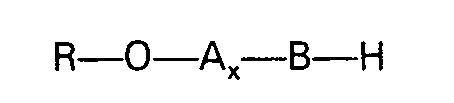
wherein R is a primary alkyl group having from 7 to 11 carbon atoms; A is oxypropylene groups; x is an integer of from 2 to 15 such that the sum of carbon atoms in said alkyl group and x is from 12 to 22; and B is a random mixture of oxyethylene and oxypropylene groups the molar ratio of oxyethylene to oxypropylene being from 1:1 to 5:1 such that the total molar ratio of oxyethylene to oxypropylene in A and B is from 0.2:1 to 1.5:1.
wherein R is a primary alkyl group having from 7 to 11 carbon atoms; A is oxypropylene groups; x is an integer of from 2 to 15 such that the sum of carbon atoms in said alkyl group and x is from 12 to 22; and B is a random mixture of oxyethylene and oxypropylene groups the molar ratio of oxyethylene to oxypropylene being from 1:1 to 5:1 such that the total molar ratio of oxyethylene to oxypropylene in A and B is from 0.2:1 to 1.5:1.
2. The liquid, nonionic surfactant of claim 1 wherein R is a straight- or branched-chain
alkyl group having from 8 to 10 carbon atoms.
3. The liquid, nonionic surfactant of claim 1 wherein the molar ratio of oxyethylene
to oxypropylene in the random mixture is from 2:1 to 5:1.
4. The liquid, nonionic surfactant of claim 1 wherein R is 2-ethylhexyl.
5. The liquid, nonionic surfactant of claim 1 wherein x is an integer up to 12.
6. The liquid, nonionic surfactant of claim 1 wherein the sum of the number of carbon
atoms in R and x is a value up to 20.
1. Flüssiges wenig schäumendes nicht-ionisches oberflächenaktives Mittel regelosser
Blockstruktur der allgemeinen Formel

worin R eine primäre Alkylgruppe mit 7 bis 11 Kohlenstoffatomen, A eine Oxypropylengruppe, x eine ganze Zahl von 2 bis 15 derart ist, daß die Summe der Kohlenstoffatome in der Alkylgruppe und x 12 bis 22 beträgt, und B ein statistisches Gemisch von Oxyethylen und Oxypropylengruppen in einem Molverhältnis 1:1 bis 5:1 derart darstellt, daß das gesamte Molverhältnis Oxyethylen:Oxypropylen in A und B 0,2:1 bis 1,5:1 beträgt.
worin R eine primäre Alkylgruppe mit 7 bis 11 Kohlenstoffatomen, A eine Oxypropylengruppe, x eine ganze Zahl von 2 bis 15 derart ist, daß die Summe der Kohlenstoffatome in der Alkylgruppe und x 12 bis 22 beträgt, und B ein statistisches Gemisch von Oxyethylen und Oxypropylengruppen in einem Molverhältnis 1:1 bis 5:1 derart darstellt, daß das gesamte Molverhältnis Oxyethylen:Oxypropylen in A und B 0,2:1 bis 1,5:1 beträgt.
2. Flüssiges nicht ionishes oberflächenaktives Mittel nach Anspruch 1, worin R eine
geradkettige oder verzweigte Alkylgruppe mit 8 bis 10 Kohlenstoffatomen ist.
3. Flüssiges nicht ionisches oberflächenaktives Mittel nach Anspruch 1, worin das
Molverhältnis Oxyethylen:Oxypropylen im statistischen Gemisch 2:1 bis 5:1 beträgt.
4. Flüssiges nicht-ionisches oberflächenaktives Mittel nach Anspruch 1, worin R 2-Ethylhexyl
ist.
5. Flüssiges nicht-ionishes oberflächenaktives Mittel nach Anspruch 1, worin x eine
ganze Zahl bis 12 ist.
6. Flüssiges nicht-ionisches oberflächenaktives Mittel nach Anspruch 1, worin die
Summe der Kohlenstoffatome in R und x bis 20 beträgt.
1. Surfactif non ionique liquide peu moussant, à structure statistique séquencée représentée
par la formule:

dans laquelle R est un groupe alkyle primaire ayant 7 à 11 atomes de carbon; A représente des groupes oxypropylène; x est un nombre entier de 2 à 15 choisi de manière que la somme des atomes de carbone dudit groupe alkyle et de x ait une valeur de 12 à 22; et B est un mélange statistique de groupes oxyéthylène et oxypropylène, le rapport molaire oxyéthylène:oxypropylène ayant une valeur de 1:1 à 5:1 de telle sorte que le rapport molaire total oxyéthylène:oxypropylène dans A et B ait une valeur de 0,2:1 à 1,5:1.
dans laquelle R est un groupe alkyle primaire ayant 7 à 11 atomes de carbon; A représente des groupes oxypropylène; x est un nombre entier de 2 à 15 choisi de manière que la somme des atomes de carbone dudit groupe alkyle et de x ait une valeur de 12 à 22; et B est un mélange statistique de groupes oxyéthylène et oxypropylène, le rapport molaire oxyéthylène:oxypropylène ayant une valeur de 1:1 à 5:1 de telle sorte que le rapport molaire total oxyéthylène:oxypropylène dans A et B ait une valeur de 0,2:1 à 1,5:1.
2. Surfactif non ionique liquide suivant la revendication 1, dans lequel R est un
groupe alkyle à chaîne droite ou à chaîne ramifiée ayant 8 à 10 atoms de carbone.
3. Surfactif non ionique liquide suivant la revendication 1, dans lequel le rapport
molaire oxyéthylène:oxypropylène dans le mélange statistique a une valeur de 2:1 à
5:1.
4. Surfactif non ionique liquide suivant la revendication 1, dans lequel R est le
groupe 2- éthylhexyle.
5. Surfactif non ionique liquide suivant la revendication 1, dans lequel x est un
nombre entier dont la valeur va jusqu'à 12.
6. Surfactif non ionique liquide suivant la revendication 1, dans lequel la somme
du nombre d'atomes de carbone dans R et de x a une valeur allant jusqu'à 20.