|
(11) | EP 0 051 997 B1 |

| (12) | EUROPEAN PATENT SPECIFICATION |
|
|
| (54) |
Layered compounds of mixed oxides and Lewis bases Verbindungen mit Schichtstruktur auf der Basis gemischter Oxide und Lewis-Basen Composés à structure stratifiée à base d'oxydes mixtes et de bases de Lewis |
|
|
|||||||||||||||||||||||||||||||
| Note: Within nine months from the publication of the mention of the grant of the European patent, any person may give notice to the European Patent Office of opposition to the European patent granted. Notice of opposition shall be filed in a written reasoned statement. It shall not be deemed to have been filed until the opposition fee has been paid. (Art. 99(1) European Patent Convention). |
[0001] This invention relates to unique layered compounds formed by reacting mixed oxides with a Lewis base. More particularly, the Lewis base is covalently bound to a metal atom within a layered oxide structure.
[0002] It is known from U.S. Patent No. 3,766,064 that heavy metal chalcogenides wherein the metal is titanium, vanadium, zirconium, niobium, hafnium, tantalum, palladium, platinum and gallium, and the chalcogenide is sulfur, selenium and tellurium can be intercalated with ammonia, hydrazine and organic nitrogen compounds. The general properties and methods of preparation are described therein. U.S. Patent No. 3,688,109 relates to similar intercalated compounds useful as X-ray diffraction grating crystals. Intercalation compounds including molybdenum and tungsten with isonitrile and metallocene guests are disclosed in U.S. Patent Nos. 4,094,893 and 3,980,684. U.S. Patent No. 4,049,887 relates to an improved cathode containing as active material a layered compound of the formula MAxBY where M is Fe, V, Ti, Cr or In, A is O, S, Se or Te and B is Cl, Br or I.
[0003] J. Bernard and M. Camelot, C. R. Acad. Sci., Paris, Ser. C., 263: 1068 (1966) report on the reaction of molybdenum trioxide, molybdenyl chloride and molybdenum dioxydichloride with pyridine. in a subsequent work, M. Camelot, Revue de Chimie Minerale, 6, 853 (1969), studied addition compounds of pyridine with some oxychlorides or trioxides of chromium, molybdenum and uranium. Based on an infrared spectroscopic investigation, Camelot concluded that these compounds were molecular coordination compounds.
[0004] G. Ladwig (Z. Anorg. Allg. Chem., 338, 266 (1965)) relates to a structural study of VPO5·nH2O. It is reported on pages 273 and 274 that anhydrous VP05 takes up ammonia and amines with a one-dimensional lattice expansion to give a VPO5·1.INH3 reaction product. Pyridine was stated to show no lattice expansion. Hydrogen bonding was asserted to be important in determining the type of molecule that can react with VPOs layers. Similar structural studies involving niobium phosphate are reported by Chernorukov et al., Russian J. lnorg. Chem., 23, 1627 (1978); 24, 987 (1979).
[0005] It has been discovered that certain mixed oxides form new compounds having a unique layered structure. The compositions of the invention comprise the reaction product of a mixed oxide having layers of corner linked octahedra and tetrahedra and a Lewis base, said reaction product forming a layered compound of the formula LxMOM'04 where MOM'04 is a mixed oxide selected from VOP04, VOS04 VOAsO4, VOMo04, NbOP04, NbOAsO4, TaOP04 and MoOP04, x is from 0.1 to 1 and L is a Lewis base containing nitrogen or oxygen electron donors and selected from 5-membered heterocyclic amines, 6-membered heterocyclic amines, amine oxides triorganophosphates, phosphine oxides and sulfoxides or a mixture thereof, the layered compound being characterized in that.L is covalently bound to a metal atom in the MOM'04 layer.
[0006] The present compositions contain a neutral Lewis base which is covalently bound to a metal (M) atom in the mixed oxide (MOM'04) layers. The bonding is therefore similar to that which might be expeected from a typical coordination complex. They are not, however, coordination complexes because of the layered structure which remains even after reaction with Lewis base.
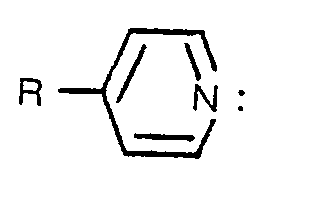
[0008] Lewis bases which form the layered compounds of the formula LxMOM'O4 are those which have heterocyclic nitrogen and oxygen donors, preferably 5- and 6-membered heterocyclic nitrogen donors, and x is preferably from 0.4 to 1.0. Preferred nitrogen donors are pyridines having the formula
where R is hydrogen; halogen; C1―C20, preferably C1―C10 aliphatic; C6―C10 aryl, preferably phenyl which may be substituted by halogen or C1―C6 alkyl; C7―C20 aralkyl, preferably benzyl or phenylethyl; OR' or SR' where R' is C1―C6 alkyl. Examples are
Other 5- and 6-membered heterocyclic amines which may form layered compounds include pyridazine, pyrimidine, pyrazine, triazine, N-substituted oxazine, N-substituted imidazole, oxazole, thiazole, 1,4-diazabicyclo[2,2,2]-octane and
where n is 0 or 1 and R2 is methylene; alkylene, alkene or alkyne of 2-6 carbon atoms; C6―C10 aryl, preferably paraphenylene, C7―C14 aralkylene; oxygen or sulfur. Oxygen donors may be amine oxides, triorganophosphates, phosphine oxides and sulfoxides.
[0009] Mixed oxides according to the invention are characterized in terms of layers of corner linked octahedra and tetrahedra, the layers being linked through the apical octahedron oxgens. The octahedra, however, are severely distorted with one very short and one very long metal- oxygen bond so that the resulting structure is actually layered rather than a three dimensional net. In the formula MOM'041 M is V, Nb, Ta or Mo and M' is P, As, S or Mo. Preferred mixed oxides are VOS04, VOP04, VOAs04 and VOMo04, especially VOAs04 and VOPO4.
[0010] The present mixed oxides of the formula MOM'04 are described in the literature, e.g., A. F. Wells, Structural Inorganic Chemistry, 4th ed., Oxford Press, London. Unlike the heavy metal chalcogenides employed in intercalation compounds such as those reported in U.S. Patent No. 3,766.,064, mixed oxides of the ,formula MOM'04 may be used without any special pretreatment. Thus, the mixed oxide is heated with an appropriate Lewis base in a sealed tube at temperatures of from 100 to 400°C, preferably 100 to 250°C for up to about 21 days, preferably from about 1 to 7 days. The amount of Lewis base is not critical and a stoichiometric amount or an excess may be used. It is preferred to evacuate the tube prior to sealing to minimize the possibility of oxidation of Lewis bases at elevated temperature. At higher temperatures such as 250°C., it is possible that the mixed oxide itself can lead to oxidation of Lewis base. It also is preferred to use substantially anhydrous Lewis bases. An alternative preparation is to reflux the hydrated mixed oxide with either the Lewis base or the Lewis base dissolved in suitable organic solvent.
[0011] The layered compounds of the present invention do' possess the covalent bonding characteristic of molecular coordination compounds. They are not, however, molecular coordination compounds since the layered structure of the mixed oxide is maintained even after reaction with Lewis base.
[0012] As noted previously, the octahedra in mixed oxides of the formula MOM'04 are very distorted with one very long and one very short metal oxygen bond. In the present invention, the very long metal oxygen bond is replaced by a strongly bound Lewis base which then produces a true layered compound by distrupting the weak interconnecting long metal oxygen bond. This is shown in Figure 1, which is a schematic diagram illustrating the structure of (pyridine)VOP04. In order for the Lewis base to form a strong L-metal bond, it should not be sterically hindered, i.e., larger than the available space in the metal oxide structure. Thus, bulky Lewis bases such as tri-t-butyl amine and triphenylphosphine will not form layered compounds according to the invention.
[0013] When a bidentate Lewis base is incorporated into the LNOM'04 structure, it is possible that separate mixed oxide layers may be bound together. For example, when 4,4'-bipyridine is employed, each separate pyridine ring may bind to metal atoms in adjacent mixed oxide layers. The resulting composition would have individual layers within the overall LxMOM'O4 crystal structures bound together by bridging 4,4'-bipyridine molecules.
[0014] An X-ray powder pattern analysis of the layered reaction products demonstrates that the interlayer distance has increased in a manner correlating with the incorporation of specific Lewis bases between the layers. Thermogravimetric analysis indicates the loss of Lewis base corresponding to an approximate composition wherein x in LxMOM'O4 ranges from 0.1 to 1. The fact that temperatures substantially in excess of the boiling point of the Lewis base are required to remove the Lewis base provides evidence of the covalent bonding present in the instant layered compounds.
[0015] The compounds of the invention have a 2- dimensionally bonded layered structure. They are semi-conductors or insulators, are transparent to electromagnetic radiation, and are useful in electrochromic devices and as battery cathodes.
Example 1
[0017] VOPO4·2H2O was refluxed in pyridine for 4 days. After this time the excess pyridine was replaced with fresh pyridine and reflux continued for a further 6 days. The final yellow product was separated by filtration and an x-ray powder pattern recorded. The lines in the x-ray pattern could all be indexed on a tetragonal unit cell (a=6.21 and c=9.62 A). No reflections due to starting VOP04'2H20 were observed. Thermogravimetric analysis of the compound in oxygen to VOP04 at 600°C gave an overall weight loss of 32.2% compared to a theoretical weight loss of 32.8% for a stoichiometric 1:1 pyridine:VOP04 composition. The infrared spectrum of the compound showed strong absorptions at 1446, 1489 and 1604 cm-1 characteristic of coordinated pyridine. Electron spin resonance indicated 2.5 mole% of V(IV).
Example 2
[0018] Anhydrous VOPO4 was heated with excess pyridine in a sealed pyrex ampoule for 4 days at 170°C. The yellow product was separated by filtration and analyzed by x-ray diffraction and thermogravimetric analysis. Thermogravimetric analysis in oxygen gave an overall weight loss of 29.4% compared with the theoretical of 32.8% for the 1:1 stoichiometry. An x-ray powder pattern could be completely indexed on the same tetragonal cell as in Example 1, but with slightly different lattice parameters (a = 6.20, c = 9.51 A). Electron spin resonance indicated 1.5 mole % of V(IV) in the final product. The infrared spectrum is similar to that obtained in Example 1 and shows strong absorptions at 1444, 1487 and 1602 cm-1.
Example 3
[0019] VOPO4·2H2O, excess pyridine and activated molecular sieves were heated at 150°C for 4 days in a sealed pyrex ampoule. The green product was separated from excess pyridine and the molecular sieves and characterized as described above. By thermogravimetric analysis the overall weight change of 32.7% is close to that for a stoichiometric pyridine VOP04 complex. The compound prepared by this technique, however, differs in color and in the extent of vanadium reduction indicated by the electron spin resonance (18 mole %). Moreover, the thermogravimetric analysis indicates that the major pyridine loss occurs at about 450°C compared to about 300°C for the compounds of Examples 1 and 2. The infrared spectrum is also characteristically different in showing a strong absorption at 1570 cm-1.
Example 4
[0020] Hydrated vanadyl sulfate was dried at 160°C for 20 h to give VOSO4·XH2O. Anhydrous VOS04 was obtained by further dehydrating VOSO4·H2O at 260°C in helium for 4 h and 350°C for 1/2 h. The anhydrous VOS04 was subsequently handled in a dry box to prevent rehydration. Anhydrous VOS04 and excess dry pyridine were heated in a sealed pyrex tube for 7d at 110°C. The X-ray powder pattern of the product gave a line at d = 8.98 A characteristic of the formation of a pyridine compound. A small amount of unreacted VOSO4 was also observed. Analysis by thermogravimetric oxidation to V2O5 gave a pyridine:VOS04 ratio of 0.94:1.
Example 5
[0021] Hydrated vanadium phosphate VOPO4·2H2O was heated with a solution of 4,4'-bipyridine in toluene in the presence of molecular sieves in a sealed pyrex tube for 1 day at 140°C and then 6.5 days at 170°C. X-ray diffraction of the product showed a well developed 001 series of reflections corresponding to a layer separation of 13.0 A. The layer separation is increased relative to that observed for the pyridine compound in Example 1 due to the larger size of the 4,4'-bipyridine molecule. Thermogravimetric oxidation to VOP04 indicated a composition close to 0.5 4,4'-bipyridine per VOPO4. Some unreacted VOP04 was, however, observed in the x-ray pattern.
Example 6
[0022] Anhydrous VOP04 was heated with a solution of 4-phenylpyridine in xylene in a sealed pyrex tube for 4 days at 150°C. After this period, the sample was removed, reground and resealed. The reaction was continued for a further eight days at 200°C. X-ray diffraction of the product revealed a series of 001 reflections corresponding to a layer separation of 14.3 A. The layer separation is increased relative to that observed for the pyridine compound in Example 1 due to the larger size of the 4-phenylpyridine. Thermogravimetric oxidation to VOP04 indicated an overall composition of 0.42 4-phenylpyridine per VOP04. Some unreated VOP04, however, was observed in the x-ray pattern.
Example 7
[0023] VOAsO4·2H2O was synthesized by a modification of the procedure described N. G. Chernorukov et al. in the Russian Journal of Inorganic Chemistry, 23, 1479, 1978. V2O5 (3g) and H3AsO4·1/2 H2O were refluxed in 75 ml of water for 3 days. The resulting yellow brown solution was filtered while hot and then reduced to one quarter of its original volume. Yellow VOAsO4·2H2O separated and was removed by filtration, washed and dried. Anhydrous VOAsO4 was prepared from the hydrated compound by heating at 200°C in flowing helium for two hours. The anhydrous VOAsO4 was subsequently handled in a dry box to prevent rehydration.
[0024] Anhydrous VOAsO4 was heated with excess dry pyridine at 150°C in a sealed pyrex tube for 10 days. The x-ray powder pattern could be indexed on a tetragonal unit cell with a=6.41 A and c=9.70 A together with lines due to a small amount of unreacted VOAs04. Thermogravimetric analysis of the compound in oxygen to VOAsO4 gave a weight loss of 26.9% compared with the theoretical weight loss of 27.8% for the stoichiometric 1:1 pyridine: VOAsO4 composition. The infrared spectrum showed strong absorptions at 1446, 1485 and 1602 cm-1 characteristic of coordinated pyridine.
1. A composition comprising the reaction product of a Lewis base and a mixed oxide
having layers of corner linked octahedra and tetrahedra, said reaction product forming
a layered compound of the formula LxMOM'O4 where MOM'04 is a mixed oxide selected from VOP04, VOSO4, VOAs04, VOMo04, NbOP04, NbOAs04, TaOP04 and MoOP04, x is from 0.1 to 1 and L is a Lewis base containing nitrogen or oxygen electron
donors and being a 5-membered heterocyclic amine, a 6- membered heterocyclic amine,
an amine oxide, a triorganophosphate, a phosphine oxide or a sulphoxide or a mixture
thereof, the layered compound being characterized in that L is covalently bound to
a metal atom in the MOM'O4 layer.
2. A composition according to claim 1 wherein L is a 6-membered heterocyclic amine.
3. A composition according to claim 1 wherein L is a pyridine of the formula
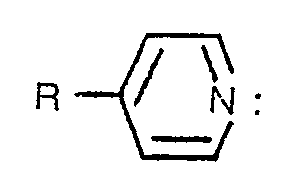
where R is hydrogen; halogen; C1―C20 aliphatic; C6―C10 aryl; C7―C20 aralkyl; OR' or SR' where R' is C1―C6 alkyl.
where R is hydrogen; halogen; C1―C20 aliphatic; C6―C10 aryl; C7―C20 aralkyl; OR' or SR' where R' is C1―C6 alkyl.
4. A composition according to claim 3 wherein R is hydrogen.
5. A composition according to any one of the preceding claims wherein MOM'04 is VOP04.
6. A composition according to any one of the claims 1 to 4 wherein MOM'O4 is VOS04.
7. A composition according to any one of claims 1 to 4 wherein MOM'O4 is VOAsO4.
8. A composition according to any one of claims 1 to 4 wherein MOM'04 is VOMo04.
9. A composition according to any one of the preceding claims wherein x is from 0.4
to 1.0.
10. A composition comprising the reaction product of a Lewis base and a mixed oxide
having layers of corner linked octahedra and tetrahedra, said reaction product forming
a layered compound of the formula LxMOM'O4 wherein L is
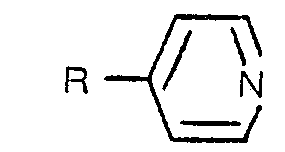
where R is C1―C10 aliphatic, phenyl which may be substituted by halogen or C1―C6 alkyl; benzyl or phenylethyl; or OR' or SR' where R' is C1―C6 alkyl, MOM'04 is VOP04, VOMo04, VOS04 or VOAsO4, x is from 0.1 to 1.0, the layered compound being characterized in that L is covalently bound to a metal atom in the MOM'04 layer.
where R is C1―C10 aliphatic, phenyl which may be substituted by halogen or C1―C6 alkyl; benzyl or phenylethyl; or OR' or SR' where R' is C1―C6 alkyl, MOM'04 is VOP04, VOMo04, VOS04 or VOAsO4, x is from 0.1 to 1.0, the layered compound being characterized in that L is covalently bound to a metal atom in the MOM'04 layer.
11. A composition according to claim 10 wherein R is hydrogen.
1. Une composition comprenant le produit de la reaction d'une de Lewis et d'un oxyde
mixte comportant des couches d'octaèdres et de tétraèdres reliés par leurs sommets,
ce produit de réaction formant un composé stratifié de formule LxMOM'O4, dans laquelle MOM'04 est un oxyde mixte choisi parmi VOP04, VOSO4, VOAsO4, VOMo04, NbOP04, NbOAsO4, TaOP04 et MoOP04, x vaut de 0,1 à 1 et L est une base de Lexis contenant de l'azote ou de l'oxygène
comme donneur d'électrons et étant une amine hétérocyclique pentagonale, une amine
hétérocyclique hexagonale, une oxyde d'amine, un triorganophosphate, un oxyde de phosphine
ou un sulfoxyde, ou un de leurs mélanges, le composé stratifié étant caractérisé en
ce que L est lié par covalence à un atome de métal dans la couche de MOM'04.
2. Une composition selon la revendication 1, dans laquelle L est une amine hétérocyclique
hexagonale.
3. Une composition selon la revendication 1, dans laquelle L est une pyridine de formule:
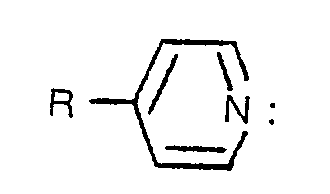
dans laquelle R représente de l'hydrogène, un halogène, un groupe aliphatique en C1 à C20, un groupe aryle en C6 à C10, un groupe aralkyle en C7 à C20, OR' ou SR', où R' est un groupe alkyle en C, à C6·
dans laquelle R représente de l'hydrogène, un halogène, un groupe aliphatique en C1 à C20, un groupe aryle en C6 à C10, un groupe aralkyle en C7 à C20, OR' ou SR', où R' est un groupe alkyle en C, à C6·
4. Une composition selon la revendication 3, dans laquelle R représente de l'hydrogène.
5. Une composition selon l'une quelconque des revendications précédentes, dans laquelle
MOM'C4 est VOP04.
6. Une composition selon l'une quelconque des revendications 1 à 4, dans laquelle.
MOM'04 est VOS04.
7. Une composition selon l'une quelconque des revendications 1 à 4, dans laquelle
MOM'O4 est VOAsO4
8. Une composition selon l'une quelconque des revendications 1 à 4, dans laquelle
MOM'04 est VOMo04.
9. Une composition selon l'une quelconque des revendications précédentes, dans laquelle
x vaut de 0,4 à 1,0.
10. Une composition comprenant le produit de la réaction d'une base de Lewis et d'un
oxyde mixte ayant des couches d'octaèdres et de tétradèdres reliés par leurs sommets,
ce produit de réaction formant un composé stratifié de formule LxMOM'O4, dans laquelle L représente:
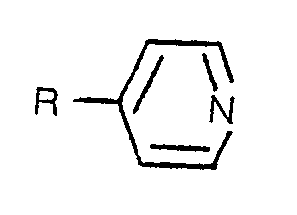
où R est un groupe aliphatique en C, à C10, phényle qui peut être substitué par de l'halogène ou par un groupe alkyle en C, à C6; un groupe benzyle ou phényléthyle, ou OR' ou SR', où R' est un groupe alkyle en C, à C6, MOM'O4 représente VOPO4, VOMo04, VOSO4 ou VOAs04, x vaut environ 0,1 à 1,0, le composé stratifié étant caractérisé ce que L est lié par covalence à un atome de métal de la couche de MOM'O4.
où R est un groupe aliphatique en C, à C10, phényle qui peut être substitué par de l'halogène ou par un groupe alkyle en C, à C6; un groupe benzyle ou phényléthyle, ou OR' ou SR', où R' est un groupe alkyle en C, à C6, MOM'O4 représente VOPO4, VOMo04, VOSO4 ou VOAs04, x vaut environ 0,1 à 1,0, le composé stratifié étant caractérisé ce que L est lié par covalence à un atome de métal de la couche de MOM'O4.
11. Une composition selon la revendication 10, dans laquelle R représente de l'hydrogène.
1. Zusammensetzung in Form des Reaktionsprodukts aus einer Lewis- Base und einem Mischoxid
mit Schichten aus an den Ecken verbundenen Oktaedern und Tetraedern, wobei das Reaktionsprodukt
eine schichtförmige Verbindung mit der Formel LxMOM'04 bildet, in der MOM'O4 ein Mischoxid ausgewählt aus VOPO4, VOSO4, VOAs04, VOMo04, NbOP04, NbOAs04, Ta0P04 und MoOP04, x 0,1 bis 1 ist und L eine Stickstoff- oder Sauerstoffelektronendonatoren enthaltende
Lewis-Base und zwar ein fünfgliedriges heterocyclisches Amin, ein sechsgliedriges
heterocyclisches Amin, ein Aminoxid, ein Triorganophosphat, ein Phosphinoxid oder
ein Sulfoxid oder eine Mischung derselben ist, und wobei die schichtförmige Verbindung
dadurch gekennzeichnet ist, daß L kovalent an ein Metallatom in der MOM'04- Schicht gebunden ist.
2. Zusammensetzung nach Anspruch 1, dadurch gekennzeichnet, daß L ein sechsgliedriges
heterocyclisches Amin ist.
3. Zusammensetzung nach Anspruch 1, dadurch gekennzeichnet, daß L ein Pyridin mit
der Formel
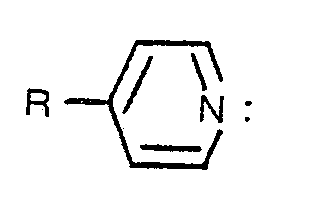
ist, in der R Wasserstoff, Halogen, ein aliphatischer C1―C20-Rest, ein C6―C10-Arylrest, ein C7―C20-Aralkylrest, OR' oder SR' ist, wobei R' ein C1―C6-Alkylrest ist.
ist, in der R Wasserstoff, Halogen, ein aliphatischer C1―C20-Rest, ein C6―C10-Arylrest, ein C7―C20-Aralkylrest, OR' oder SR' ist, wobei R' ein C1―C6-Alkylrest ist.
4. Zusammensetzung nach Anspruch 3, dadurch gekennzeichnet, daß R Wasserstoff ist.
5. Zusammensetzung nach einem der vorangehenden Ansprüche, dadurch gekennzeichnet,
daß MOM'04 VOP04 ist.
6. Zusammensetzung nach einem der Patentansprüche 1 bis 4, dadurch gekennzeichnet,
daß MOM'04 VOSOQ ist.
7. Zusammensetzung nach einem der Ansprüche 1 bis 4, dadurch gekennzeichnet, daß MOM'04 VOAs04 ist.
8. Zusammensetzung nach einem der Ansprüche 1 bis 4, dadurch gekennzeichnet, daß MOM'4 VOMoO4 ist.
9. Zusammensetzung nach einem der vorangehenden Ansprüche, dadurch gekennzeichnet,
daß x 0,4 bis 1,0 beträgt.
10. Zusammensetzung in Form des Reaktionsprodukts aus einer Lewis-Base und einem Mischoxid
mit Schichten aus an den Ecken verbundenen Oktaedern und Tetraedern, wobei das Reaktionsprodukt
eine schichtförmige Verbindung mit der Formel LxMOM'O4 bildet, in der L
ist, wobei R eine aliphatischer C1―C10-Rest, ein Phenylrest, der mit Halogen oder C1―C6-Alkyl substituiert sein kann, ein Benzyl- oder Phenylethylrest oder OR' oder SR' ist, wobei R' ein C1―C6-Alkylrest ist, MOM'04 VOP04, VOMo04, VOSO4 oder VOs04 ist und x etwa 0,1 bis 1,0 beträgt und wobei die schichtförmige Verbindung dadurch gekennzeichnet ist, daß L kovalent an ein Metallatom in der MOM'04-Schicht gebunden ist.
ist, wobei R eine aliphatischer C1―C10-Rest, ein Phenylrest, der mit Halogen oder C1―C6-Alkyl substituiert sein kann, ein Benzyl- oder Phenylethylrest oder OR' oder SR' ist, wobei R' ein C1―C6-Alkylrest ist, MOM'04 VOP04, VOMo04, VOSO4 oder VOs04 ist und x etwa 0,1 bis 1,0 beträgt und wobei die schichtförmige Verbindung dadurch gekennzeichnet ist, daß L kovalent an ein Metallatom in der MOM'04-Schicht gebunden ist.
11. Zusammensetzung nach Anspruch 10, dadurch gekennzeichnet, daß R Wasserstoff ist.