| (19) |
 |
|
(11) |
EP 0 052 068 B1 |
| (12) |
EUROPEAN PATENT SPECIFICATION |
| (45) |
Mention of the grant of the patent: |
|
05.12.1984 Bulletin 1984/49 |
| (22) |
Date of filing: 12.10.1981 |
|
| (51) |
International Patent Classification (IPC)3: A42B 3/00 |
|
| (54) |
Protective helmet
Schutzhelm
Casque de protection
|
| (84) |
Designated Contracting States: |
|
BE DE FR GB IT LU NL |
| (30) |
Priority: |
11.11.1980 CH 8344/80
|
| (43) |
Date of publication of application: |
|
19.05.1982 Bulletin 1982/20 |
| (71) |
Applicant: Kiwi S.A. |
|
CH-6537 Grono (CH) |
|
| (72) |
Inventor: |
|
- Bonalume, Enrico
CH-6535 Roveredo (GR) (CH)
|
| (74) |
Representative: Baggiolini, Raimondo
Patent Attorneys et al |
|
Fiammenghi-Fiammenghi
Via San Gottardo 15
CH-6900 Lugano
CH-6900 Lugano (CH) |
|
| |
|
| Note: Within nine months from the publication of the mention of the grant of the European
patent, any person may give notice to the European Patent Office of opposition to
the European patent
granted. Notice of opposition shall be filed in a written reasoned statement. It shall
not be deemed to
have been filed until the opposition fee has been paid. (Art. 99(1) European Patent
Convention).
|
[0001] This invention relates to protective helmets, which are used by, for example, motor
cyclists and pedal cyclists, scooter riders and moped riders, and which are of a type
provided with chin straps in order that the helmet may be held securely to the user's
head. The most commonly known protective helmet for motor cyclists have chin straps
which are secured by means of metallic pins or iron plates which plates in turn are
rivotted to the inside of the helmet shell.
[0002] There are known other fixing arrangements in protective helmets, but invariably these
arrangements include metallic connecting parts (CH-A-767591).
[0003] When metallic parts are used, it frequently happens that due to the action of inclement
weather or because of perspiration of the user, the metallic parts become oxidised,
and if made of iron or steel rusting, which on the one hand makes them unsightly,
and on the other hand and more seriously weakens them to such an extent that they
may fail in use when subject to stress which could be extremely dangerous in the case
of impacts and accidents.
[0004] The present invention seeks to provide a protective helmet, whereby the utilisation
of metallic parts for the fixing of the chin strap of the helmet is obviated thereby
avoiding the abovementioned drawbacks.
[0005] In accordance with the present invention, there is provided a protective helmet comprising
a head protecting shell of non-metallic material and a chin strap mountings at respective
sides thereof, said mountings including a support integral with the shell, and a locking
member which is also of non-metallic material and which co-operates with the support
thereby to lock the chin strap to the shell, characterised in that the support comprises
a bridge stamped out from, or moulded with the protective shell the bridge 12 being
supported and spaced inwardly of the inner surface of the shell by bridge legs at
the end of the bridge so as to define a bridge slot through which an end loop of the
chin strap passes; a complementary part of said bridge comprising a locking pin which
is greater in diameter than the width of said slot and which passes through the said
loop of the chin strap, said locking pin having resilient locking legs which respectively
resiliently lock to the bridge legs to prevent the locking pin in use from moving
upwardly relative to the bridge; an aperture being formed in the shell to allow the
stamping or moulding of said bridge, which aperture is closed by a cover of synthetic
plastics material by which is sprung into position by means of resilient projections
from the outside of the shell, so as to close said aperture; said bridge, legs and
locking pin being located on the inner surface of the shell and the cover being flush
with the outer surface of the shell so that said outer surface is smooth and can be
moulded in synthetic resin, in order to avoid the use of rivets screws, studs or other
metallic parts.
[0006] The said locking pin may be provided with two resilient locking legs provided with
projections which are adapted to spring into locking engagement with recesses or ledges
in the bridge legs, thereby to prevent the movement of the locking pin upwards relative
to the bridge.
[0007] With the formation of each bridge there may be formed an aperture in the outside
of the shell, and such aperture is preferably covered by means of a cover plate which
is provided with resilient projections which serve resiliently to lock the cover plate
in position covering said aperture.
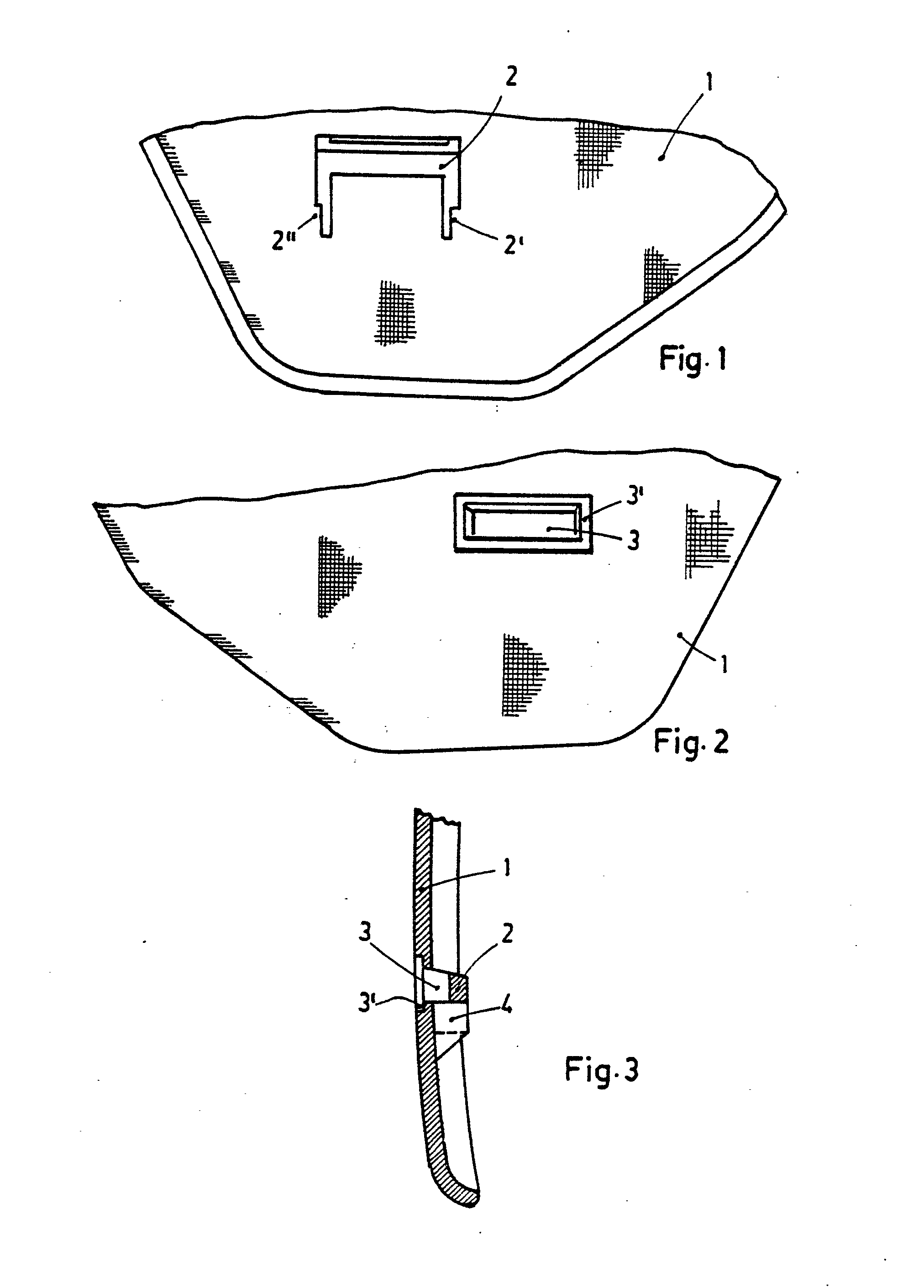
[0008] An embodiment of the present invention will now be described, by way of example,
with reference to the accompanying drawings, wherein:
Fig. 1 is a view of one side of the inside of the helmet shell, showing the integral
support at that side, a similar support being provided at the other side;
Fig. 2 shows the support shown in Fig. 1 when viewed from the outside of the helmet;
Fig. 3 is a cross-section taken through the support shown in Figs. 1 and 2;
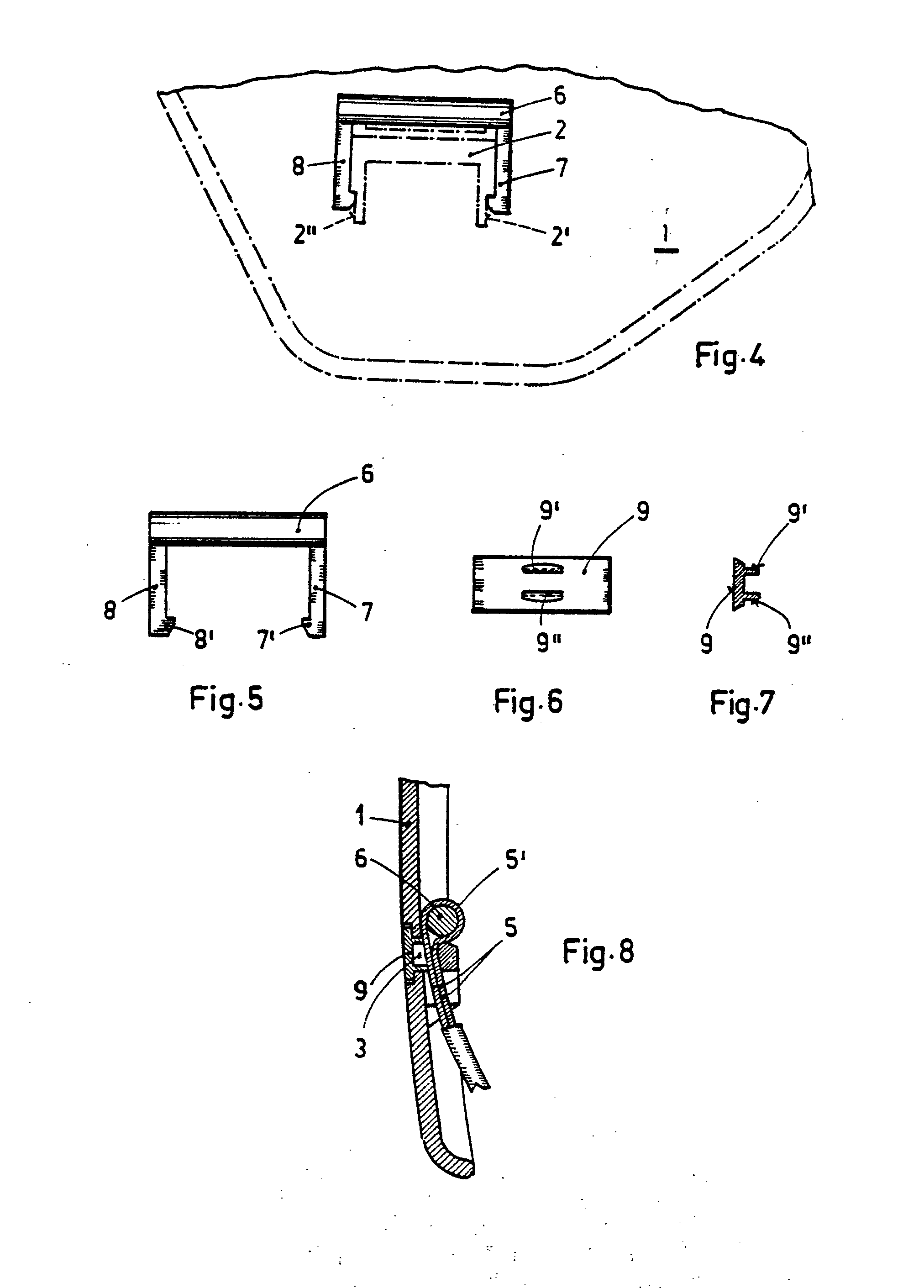
Fig. 4 is a view similar to Fig. 1, but showing the locking pin in operative position;
Fig. 5 is a side view of the locking pin shown in Fig. 4;
Fig. 6 is a plan view of an outer cover plate;
Fig. 7 is a cross-sectional view of a cover plate shown in Fig. 6; and
Fig. 8 is a cross-section similar to Fig. 3, but showing the complete assembly, and
the loop end of the chin strap held by'the assembly, and the cover plate applied.
[0009] Referring to the various figures, it is to be mentioned that the helmet shell 1 is
provided with two chin strap mountings, one at each side and one only of which is
described, and the said shell is made in this example of stampable elastic synthetic
resin (it may be of polyester resin reinforced with glass fibres), and has formed
by stamping or mechanical moulding on each side a locking bridge 2 which is spaced
from the inside of the helmet by means of bridge legs at the ends of bridge 2, so
as to define a slot or loop hole 3, 4 to receive the looped end of the chin strap
5. The looped end may be formed by folding the end of the strap and sewing the folded
end to the remainder. The looped end is indicated by numeral 5' in Fig. 8. Received
in the looped end 5' is a locking pin 6, which is also made of synthetic resinous
material and terminates in two resilient legs 7 and 8 as shown in Figs. 4 and 5, which
are provided with projections 7' and 8' which are resiliently received in the recesses
2 and 2" of the bridge 2, to prevent the movement of the pin 6, and therefore the
loop 5', upwards in use.
[0010] The diameter of the pin 6 is greater than the width of the slot 3 of the bridge,
to prevent the loop 5' from slipping through the slot 3, 4.
[0011] Each mounting is provided with a cover plate 9 which is also of synthetic plastics
material, and is provided with resilient projections 9 and 9", which serve to hold
the cover in the opening 3', as shown in Fig. 2, to cover said opening. The opening
3' occurs with the stamping out of the bridge 2.
[0012] It will be clear that in the arrangement described there are no metallic parts, and
therefore oxidation, corrosion and wear of parts due to oxidation and corrosion are
excluded absolutely, ensuring the long term efficiency of the strap attachments.
1. A protective helmet comprising a head protecting shell of non-metallic material
and a chin strap mountings at respective sides thereof, said mountings including a
support integral with the shell, and a locking member which is also of non-metallic
material and which co-operates with the support thereby to lock the chin strap to
the shell, characterised in that the support comprises a bridge (2) stamped out from,
or moulded with the protective shell (1) the bridge (12) being supported and spaced
inwardly of the inner surface of the shell by bridge legs (2', 2") at the end of the
bridge (2) so as to define a bridge slot (3) through which an end loop (5') of the
chin strap (5) passes; a complementary part (6) of said bridge (2) comprising a locking
pin (6) which is greater in diameter than the width of said slot (3, 4) and which
passes through the said loop (5.') of the chin strap, said locking pin (6) having
resilient locking legs (7, 8), which respectively resiliently lock to the bridge legs
to prevent the locking pin (6) in use from moving upwardly relative to the bridge
(2); an aperture (3') being formed in the shell (1) to allow the stamping or moulding
of said bridge (2), which aperture (3) is closed by a cover (9) of synthetic plastics
material which is sprung into position by means of resilient projections (9', 9"),
from the outside of the shell, so as to close said aperture (3'); said bridge (2),
legs (2, 2') and locking pin (6) being located on the inner surface of the shell (1)
and the cover (9) being flush with the outer surface of the shell so that said outer
surface is smooth and can be moulded in synthetic resin, in order to avoid the use
of rivets screws, studs or other metallic parts.
2. A helmet according to claim 1, characterised in that the shell (1) and all the
parts forming the chin strap mountings are of polyester resin reinforced with glass
fibre.
1. Schutzhelm mit einer Kopfschutzschale aus nichtmetallischem Material sowie einer
an jeder Seite ausgebildeten Kinnriemenbefestigung, die eine mit der Schutzschale
einstückige Halterung und ein ebenfalls aus nichtmetallischem Material bestehendes
Riegelglied umfaßt, das mit der Halterung zur Verriegelung des Kinnriemens an der
Schutzschale zusammenarbeitet, dadurch gekennzeichnet, daß die Halterung einen aus
der Schutzschale (1) herausgepresßten oder mit der Schutzschale geformten Steg (2)
umfaßt, der mit Abstand einwärts von der Innenoberfläche der Schutzschale an dieser
durch Stegschenkel (2', 2") an den Enden des Steges (2) abgestützt ist und einen Durchtritt
(3) bildet, der von einer endseitigen Schlaufe (5') des Kinnriemens durchsetzt ist,
daß ein Komplementärteil (6) des Steges (2) als Riegelbolzen (6) ausgebildet ist,
der einen gegenüber der Weite des Durchtritts (3, 4) größeren Durchmesser hat sowie
die Schlaufe (5') des Kinnriemens durchsetzt und mit federnden Riegelschenkeln (7,
8) versehen ist, welche sich jeweils federnd mit den Stegschenkeln zur Unterbindung
einer Aufwärtsbewegung des Riegelbolzens (6) im Gebrauch mit Bezug zum Steg (2) verriegeln,
daß in der Schutzschale (1) eine das Herauspressen oder Formen des Steges (2) zulassende
Öffnung (3') ausgestaltet wird, welche von einer aus synthetischem Kunstoffmaterial
bestehenden Abdeckung (9) verschlossen wird, die von der Außenseite der Schutzschale
mittels federnder Nasen (9', 9") zum Schließen der Öffnung (3') in ihre Lage eingeschnappt
wird, und daß der Steg. (2), die Schenkel (2', 2") sowie der Riegelbolzen (6) an der
Innenfläche der Schultzschale (1) angeordnet sind und die Abdeckung (9) bündig mit
der Außenfläche der Schutzschale ist, so daß diese Ausßenfläche glatt. und aus Kunstharz
formbar ist, um die Verwendung von Nieten, Schrauben, Stiften oder anderen Metallteilen
zu vermeiden.
2. Schutzhelm nach Anspruch 1, dadurch gekennzeichnet, daß die Schutzschale (1) sowie
alle die Kinnriemenbefestigung bildenden Teile aus einem mit Glasfasern verstärkten
Polyesterharz sind.
1. Casque de protection comprenant une paroi protégeant la tête en matière non-métallique
et des montures pour une mentonnière su les côtés respectifs du casque, lesdites montures
comprenant un support faisant corps avec la paroi et un organe de retenue qui est
aussi en matière non-métallique et qui coopère avec le support pour retenir ainsi
la mentionnière à la paroi, caractérisé en ce que le support comprend un point (2)
embouti ou moulé avec la paroi protectrice (1), le pont (2) étant supporté et écarté
intérieurement de la face intérieure de la paroi par des montants de pont (2', 2")
à l'extrémité du pont (2) de façon à ménager une fente de pont (3) à travers laquelle
passe une boucle d'extrémité (5') de la mentonnière (5); une partie complémentaire
(6) dudit pont (2) comprenant une broche de retenue (6) qui est d'un diamètre supérieur
à la largeur de ladite fente (3, 4) et qui passe à travers ladite boucle (5') de la
mentonnière, ladite broche de retenue (6) ayant des pattes élastiques de verrouillage
(7, 8) qui s'enclenchent respectivement de façon élastique aux branches de pont pour
empêcher la broche de retenue (6) en service de se déplacer vers le haut par rapport
au pont (2); une ouverture (3') étant formée dans la paroi (1 ) pour permettre l'emboutissage
ou le moulage dudit point (2), laquelle ouverture (3') est fermée par un couvercle
(9) en matière plastique synthétique qui est mis en position au moyen de saillies
élastiques (9', 9") par l'extérieur de la paroi de façon à fermer ladite ouverture
(3'); ledit pont (2), les branches (2', 2") et la broche de retenue (6) étant placés
sur la surface intérieure de la paroi (1) et le couvercle (9) étant à fleur de la
surface extérieure de la paroi de façon que ladite surface extérieure soit lisse et
puisse être moulée en résine synthétique afin d'éviter l'utilisation de rivets, vis,
goujons ou autres parties métalliques.
2. Casque selon la revendication 1, caractérisé en ce que la paroi (1) et toutes les
parties formant les montures de mentonnière sont en résine de polyester renforcée
par des fibres de verre.