|
(11) | EP 0 052 280 B1 |

| (12) | EUROPEAN PATENT SPECIFICATION |
|
|
| (54) |
Process for the production of 3-amino-4,6-diacetyl phenol or a derivative thereof Verfahren zur Herstellung von 3-Amino-4,6-diacetylphenol oder einem Derivat hiervon Procédé pour la préparation de l'amino-3 diacétyl-4,6 phénol ou d'un dérivé de ce composé |
|
|
|||||||||||||||||||||||||||||||
| Note: Within nine months from the publication of the mention of the grant of the European patent, any person may give notice to the European Patent Office of opposition to the European patent granted. Notice of opposition shall be filed in a written reasoned statement. It shall not be deemed to have been filed until the opposition fee has been paid. (Art. 99(1) European Patent Convention). |
[0002] Acetylation of already substituted benzene rings is a well known procedure, and is conventionally carried out by reaction of acetic acid, acetic anhydride or an acetyl halide with the appropriate substrate, see for example, Methoden der Organischen Chemie (Houben Weyl), Band VII/2a, page 16-21 (1973). It is also known that certain substituents deactivate the ring and thus make acetylation more difficult. Amongst these deactivating substituents is the acetyl group, and thus the production of diacetyl compounds from an appropriate substrate carrying no, or one, acetyl substituent, would be expected to be a difficult reaction. Now with difficult reactions it is conventional to use higher reaction temperatures in order to 'force' the reaction to go. In the acetylation reactions mentioned above it has been conventional to use a Lewis acid catalyst, e.g. ZnCl2, FeCl3, AICI3, TiCI4 etc. The reaction is normally carried out in a suitable solvent; one of the most common being carbon bisulphide. It has also been conventional to use an excess of the Lewis acid and of the acetylating agent, but clearly for reasons of economy the excess has normally not been more than a 1 or 2 fold excess. It is known from Methodicum Chimicum, Volume 5, Georg Thieme Verlag, Stuttgart, 1975 pages 350, 351 that under certain circumstances phenols and phenol ethers can be diacetylated. However, P. H. Gore in chapter XXXI of Friedel-Crafts and Related Reactions, Ed. G. Olah, Interscience Publishers, John Wiley & Sons Inc, New York, 1963-1965, discloses that 2,4-dihydroxy acetophenone acetylates principally in the 3- position with aluminium chloride and acetyl chloride.
[0003] In the production of an unsymmetrical diacetyl compound from a corresponding mono- acetyl substrate, e.g. in the production of 3-amino-4,6-diacetyl phenol from a mono acetyl amino phenol there are clearly two possible starting materials, i.e. of formulae I and II,
[0004] We have now surprisingly found that compounds of formula II cannot be acetylated to produce 3-amino-4,6-diacetyl phenol in any reasonable yield, and that compounds of formula I can only be acetylated to produce 3-amino-4,6-diacetyl phenol under very specific reaction conditions, i.e. using a particular acetylating agent, a narrow range of low temperatures, a particular solvent and a particular catalyst.
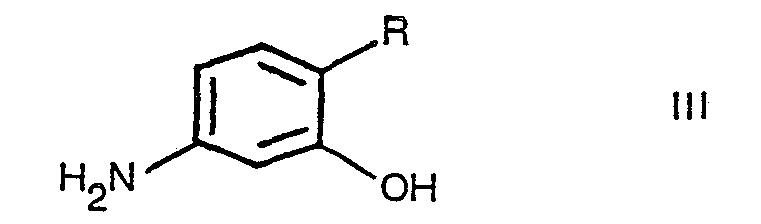
[0005] According to the invention we provide a process for the production of 3-amino-4,6- diacetyl phenol, or a derivative thereof, which comprises reacting a compound of formula III,
or a protected derivative thereof,
[0006] in which R is acetyl or hydrogen, with an excess of acetyl chloride or acetyl bromide and aluminium chloride or aluminium bromide at a temperature of from 30° to 50°C in an halogenated hydrocarbon solvent, and where desired or necessary hydrolysing the resulting compound to 3-amino-4,6-diacetylphenol.
[0007] We prefer the reaction to be carried out at a temperature of from 40 to 45°C. At temperatures below about 30°C the reaction proceeds too slowly for economic operation and at temperatures above about 50°C the proportion of unwanted biproducts tends to increase.
[0008] We prefer to use a large excess of aluminium halide and acetyl halide. Thus we prefer to use from 5 to 20 equivalents, and more preferably about 10 equivalents, of aluminium halide (and also preferably of acetyl halide) with respect to the compound of formula III.
[0009] We prefer to use an initial concentration of above 0.05, and preferably from 0.2 to 0.3, moles per litre of the compound of formula III in the reaction mixture.
[0010] We prefer the halogenated hydrocarbon solvent to be 1,2-dichloroethane or more preferably dichloromethane. Dichloromethane is particularly preferred as its use makes temperature control of the reaction more simple.
[0011] When acetyl bromide is used we prefer also to use aluminium bromide as catalyst to avoid exchange reactions between acetyl bromide and aluminium chloride. However we prefer to use acetyl chloride and aluminium chloride. We also prefer to use equimolar proportions of the acetylating agent and the aluminium halide. However a 2 to 3 times molar excess of the acetylating agent with respect to the aluminium halide may be used if desired.
[0012] The reaction is preferably carried out under substantially anhydrous conditions, but small quantities of water will be absorbed by the excess acetyl halide.
[0013] When a derivative of the compound of formula III is used it may be a derivative of the -OH group, for example an ester or an ether, and preferably a C 1 to 6 alkyl ether, e.g. a methyl or butyl ether. A derivative of the -NH2 group may also be used, e.g. an acyl derivative such as a C 1 to 6 alkanoyl (acetyl) derivative thereof. If desired both the ―OH and -NH2 groups may be in the form of a derivative. When a free -NH2 group is used this group will be acetylated under the reaction conditions. We thus prefer to use 4-acetamido-2-hydroxyacetophenone as the starting material.
[0014] The reaction, when operated on a batch basis, is preferably allowed to continue for a period of from 20 to 50, e.g. about 40, hours, before the reaction product is isolated, e.g. by addition to water. The product may be isolated from the reaction mixture as a derivative of the -NH2 or -OH group, e.g. as the -NH acetyl derivative. However the crude derivative of the -NH2 group is preferably hydrolysed in situ to the free amino compound, e.g. by reaction with hydrochloric acid in an alcoholic solvent, e.g. ethanol, at an elevated temperature, e.g. of from about 80 to 110°C.
[0015] The 3-amino-4,6-diacetyl phenol, or the derivative thereof, may be isolated from the reaction mixture using conventional techniques known per se, e.g. by crystallisation, washing, drying etc.
[0016] -Compounds of formula III are either known or may be made from known compounds using conventional techniques known per se.
[0017] 3-Amino-4,6-diacetyl phenol is useful as an intermediate in the production of pharmaceuticals, e.g. 4,6-dioxo-4H,6H-pyrano[3,2-g]-quinoline-2,8-dicarboxylic acids, which are of known utility as inter alia anti-allergic compounds. 3-Amino-4,6-diacetyi phenol is also useful as an intermediate in the production of other fine chemicals.
[0018] A further surprising feature of our invention is that no 3-amino-2,6-diacetyl phenol is found in the reaction product.
Example 1
[0020] To a preformed acylating mixture comprising equimolar aluminium chloride and acetyl chloride in dichloromethane (270 ml/mole of AICI3) at 10-15°C was added 4-acetamido-2-hydroxyacetophenone (0.1 mole/mole of AICI2) over 15 minutes. The temperature was kept at less than 25°C.
[0021] The mixture was heated under reflux and the reaction monitored regularly by gas liquid chromatography. After 40 hours the mixture was allowed to cool to ambient temperature and was added to water (1 L/mole of AICI3) at a rate such that the temperature was maintained at 30-35°C. The resulting slurry was stirred for 1 hour at 30°C and the solid removed by filtration. This residue was washed with water, sucked dry and recrystallised from ethanol to afford, after drying in vacuo at 50°C, pure 3-acetamido-4,6-diacetylphenol as confirmed by gas liquid chromatography and proton nmr. Yield, 56%.
[0022] As an alternative the crude, damp product obtained by filtration of the slurry was dissolved in ethanol (ca 13 litres per kg starting acetamide) at reflux and concentrated hydrochloric acid (0.7 litres/kg starting acetamide) was added. The reaction mixture was heated at reflux for 3t hours. The mixture was cooled to room temperature and the crystalline product isolated, washed with ethanol, and dried. The product identity (as 3-amino-4,6-diacetylphenol) was confirmed by gas liquid chromatography, and by infra-red and proton nmr. Yield 60% based on starting 4-acetamido-2-hydroxyacetophenone.
Example 2
Acetylation of 3-aminophenol
[0023] Finely pulverised 3-aminophenol was added over a few minutes to a solution of aluminium chloride and acetyl chloride (equimolar proportions of each, 10 equivalents per equivalent of 3-aminophenol) in dichloromethane (dried over CaCl2, 1.5 litre per kg AlCl3), at room temperature. The reaction mixture was heated to reflux point for 3 days. The reaction mixture was then cooled to room temperature and poured into water (2 litres per litre of reaction mixture) and extracted with dichloromethane.
[0024] The 3-acetamido-4,6-diacetyl phenol product was isolated from the organic phase by extraction with aqueous potassium carbonate and characterised by its glc properties and NMR spectrum.
Example 3
Diacetylation of 3-acetamidoanisole
[0025] To a preformed acylating mixture comprising equimolar aluminium chloride and acetyl chloride in dichloromethane (150 mg/mole AICI3) was added a solution of 3-acetamidoanisole (0.1 mole mole AICI3) in dichloromethane (125 ml/mole AICI3) over 40 minutes, maintaining the temperature of the reaction mixture at 0-5°C.
[0026] The mixture was heated under reflux and the reaction monitored by glc. After 70 hrs the mixture was allowed to cool and added to ice- water. 4-Acetamido-2-hydroxyacetophenone was removed by filtration. The aqueous layer was extracted with methylene chloride, the organic phase washed with water, dried and concentrated. Recrystallisation from ethanol afforded, after drying, pure 3-acetamido-4,6- diacetylphenol, confirmed by glc and NMR.
1. A process for the production of 3-amino-4,6-diacetyl phenol, or a derivative thereof,
which comprises reacting a compound of formula III,
or a protected derivative thereof,
in which R is acetyl or hydrogen, with an excess of acetyl chloride or acetyl bromide and aluminium chloride or aluminium bromide at a temperature of from 30°C to 50°C in an halogenated hydrocarbon solvent, and where desired or necessary hydrolysing the resulting compound to 3-amino-4,6-diacetylphenol.
or a protected derivative thereof,
in which R is acetyl or hydrogen, with an excess of acetyl chloride or acetyl bromide and aluminium chloride or aluminium bromide at a temperature of from 30°C to 50°C in an halogenated hydrocarbon solvent, and where desired or necessary hydrolysing the resulting compound to 3-amino-4,6-diacetylphenol.
2. A process according to Claim 1, wherein acetyl chloride and aluminium chloride
are used.
3. A process according to Claim 1 or 2, wherein the solvent is methylene chloride.
4. A process according to any one of the preceding claims, wherein there is used from
5 to 20 equivalents of aluminium chloride and acetyl chloride with respect to the
compound of formula III.
5. A process according to any one of the preceding claims, wherein an initial concentration
of from 0.2 to 0.3 moles per litres of the compound of formula III is used.
6. A process according to any one of the preceding claims, wherein the compound of
formula III is used in the form of an acyl derivative of the -NH2 group.
7. A process according to any one of the preceding claims, wherein the compound of
formula III is 4-acetamido-2-hydroxyacetophenone.
8. A process according to any one of the preceding claims, wherein equimolar proportions
of acetyl chloride and aluminium chloride are used.
9. A process according to any one of the preceding claims, wherein the reaction is
carried out at a temperature of from 40° to 45°C.
10. A process according to any one of the preceding claims, wherein the reaction product
is hydrolysed to free 3-amino-4,6-diacetyl phenol.
1. Verfahren zur Herstellung von 3-Amino-4,6-diacetylphenol oder eines Derivats hievon,
welches das Umsetzen einer Verbindung der Formel 111
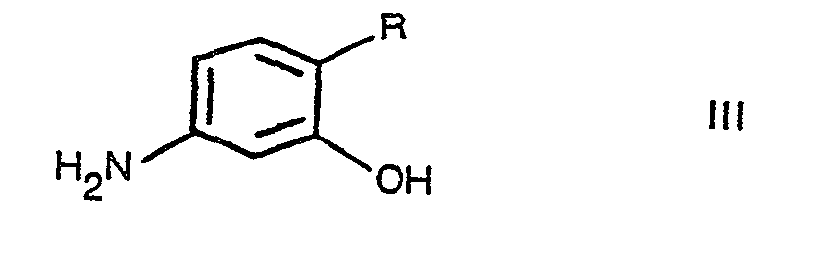
oder eines geschützten Derivats hievon, worin R Acetyl oder Wasserstoff bedeutet, mit einem Überschuß an Acetylchlorid oder Acetylbromid und Aluminiumchlorid oder Aluminiumbromid bei einer Temperatur von 30 bis 50°C in einem halogenierten Kohlenwasserstofflösungsmittel und, wenn gewünscht oder notwendig, Hydrolysieren der resultierenden Verbindung zu 3-Amino-4,6-diacetylphenol umfaßt.
oder eines geschützten Derivats hievon, worin R Acetyl oder Wasserstoff bedeutet, mit einem Überschuß an Acetylchlorid oder Acetylbromid und Aluminiumchlorid oder Aluminiumbromid bei einer Temperatur von 30 bis 50°C in einem halogenierten Kohlenwasserstofflösungsmittel und, wenn gewünscht oder notwendig, Hydrolysieren der resultierenden Verbindung zu 3-Amino-4,6-diacetylphenol umfaßt.
2. Verfahren nach Anspruch 1, worin Acetylchlorid und Aluminiumchlorid verwendet werden.
3. Verfahren nach Anspruch 1 oder 2, worin das Lösungsmittel Methylenchlorid ist.
4. Verfahren nach einem der vorhergehenden Ansprüche, worin 5 bis 20 Äquivalente Aluminiumchlorid
und Acetylchlorid mit bezug auf die Verbindung der Formel 111 verwendet werden.
5. Verfahren nach einem der vorhergehenden Ansprüche, worin eine Anfangskonzentration
von 0,2 bis 0,3 Mol pro I Verbindung der Formel 111 verwendet wird.
6. Verfahren nach einem der vorhergehenden Ansprüche, worin die Verbindung der Formel
III in Form eines Acylderivats der ―NH2-Gruppe verwendet wird.
7. Verfahren nach einem der vorhergehenden Ansprüche, worin die Verbindung der Formel
III 4-Acetamido-2-hydroxyacetophenon ist.
8. Verfahren nach einem der vorhergehenden Ansprüche, worin äquimolare Anteile an
Acetylchlorid und Aluminiumchlorid verwendet werden.
9. Verfahren nach einem der vorhergehenden Ansprüche, worin die Reaktion bei einer
Temperatur von 40 bis 45°C durchgeführt wird.
10. Verfahren nach einem der vorhergehenden Ansprüche, worin das Reaktionsprodukt
zum freien 3-Amino-4,6-diacetylphenol hydrolysiert wird.
1. Procédé de production du 3-amino-4,6- diacétylphénol ou d'un dérivé de celui-ci,
qui comprend la réaction d'un composé de formule III,
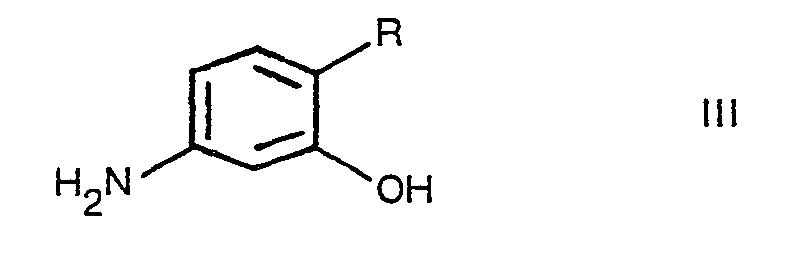
ou d'un dérivé protégé de celui-ci, dans laqùelle R représente un radical acétyle ou atome d'hydrogène, avec un excès de chlorure d'acétyle ou de bromure d'acétyle et de chlorure d'aluminium ou de bromure d'aluminium à une température de 30° à 50° dans un solvant hydrocarboné halogéné et, si souhaité ou nécessaire, l'hydrolyse du composé résultant en 3-amino-4,6-diacétylphénol.
ou d'un dérivé protégé de celui-ci, dans laqùelle R représente un radical acétyle ou atome d'hydrogène, avec un excès de chlorure d'acétyle ou de bromure d'acétyle et de chlorure d'aluminium ou de bromure d'aluminium à une température de 30° à 50° dans un solvant hydrocarboné halogéné et, si souhaité ou nécessaire, l'hydrolyse du composé résultant en 3-amino-4,6-diacétylphénol.
2. Procédé suivant la revendication 1, dans lequel on utilise le chlorure d'acétyle
et le chlorure d'aluminium.
3. Procédé suivant la revendication 1 ou 2, dans lequel le solvant est le chlorure
de méthylène.
4. Procédé suivant l'une quelconque des revendications précédentes, dans lequel on
utilise 5 à 20 équivalents de chlorure d'aluminium et de chlorure d'acétyle par rapport
au composé de formule III.
5. Procédé suivant l'une quelconque des revendications précédentes, dans lequel on
utilise une concentration initiale de 0,2 à 0,3 mole par litre du composé de formule
III.
6. Procédé suivant l'une quelconque des revendications précédentes, dans lequel on
utilise le composé de formule III sous la forme d'un dérivé acylé du radical -NH2.
7. Procédé suivant l'une quelconque des revendications précédentes, dans lequel le
composé de formule III est la 4-acétamido-2-hydroxyacétophénone.
8. Procédé suivant l'une quelconque des revendications précédentes, dans lequel on
utilise des proportions équimolaires de chlorure d'acétyle et de chlorure d'aluminium.
9. Procédé suivant l'une quelconque des revendications précédentes, dans lequel on
exécute la réaction à une température de 40 à 45°C.
10. Procédé suivant l'une quelconque des revendications précédentes, dans lequel le
produit de réaction est hydrolysé en 3-amino-4,6-diacétylphénol libre.