|
(11) | EP 0 053 499 B1 |

| (12) | EUROPEAN PATENT SPECIFICATION |
|
|
| (54) |
Process for producing crystalline aluminosilicates Verfahren zur Herstellung kristalliner Aluminiumsilikate Procédé pour la préparation d'aluminosilicates cristallins |
|
|
|||||||||||||||||||||||||||||||
| Note: Within nine months from the publication of the mention of the grant of the European patent, any person may give notice to the European Patent Office of opposition to the European patent granted. Notice of opposition shall be filed in a written reasoned statement. It shall not be deemed to have been filed until the opposition fee has been paid. (Art. 99(1) European Patent Convention). |
[0001] This invention relates to a process for producing a crystalline aluminosilicate comprising hydrothermally reacting a starting mixture composed of a silicon compound, an aluminum compound, an alkali metal compound, a compound capable of releasing an organic cation in water, and water, said starting mixture comprising at least two types of colloids. More specifically, it pertains to a process for producing crystalline aluminosilicates which exhibit very good properties as adsorbents or catalysts.
[0002] Known crystalline aluminosilicates include naturally occurring aluminosilicates and synthetic zeolites hydrothermally synthesized from an aqueous solution containing silicon and aluminum.
[0003] In recent years, synthetic zeolites having a different skeletal structure from naturally occurring zeolites, such as ZSM-5 (see Japanese Patent Publication No. 10064/1971) and ZSM-34 (Japanese Laid-Open Patent Publication No. 58499/1978), have been hydrothermally synthesized in the presence of quaternary ammonium compounds. Particularly, ZSM-5 crystallized in the presence of a tetrapropyl ammonium compound is a unique zeolite which gives a crystalline phase over a wide Si02/AI203 mole ratio in the skeleton. These crystalline aluminosilicates have found wide applications as adsorbents or catalysts of high performance because they are porous and show selectivity with regard to shapes of molecular units. For example, they are used as dehydrating agents for organic matter or as isomerization catalysts for hydrocarbons.
[0004] Crystalline aluminosilicate catalysts, like general solid catalysts, are required to have high activity, good selectivity and long active lifetimes. Not only the type of the crystalline aluminosilicate and the type of the skeletal structure, but also the particle size and shape of the crystals become factors which affect the activity, selectivity and life of the catalysts. Hence, for provision of catalysts which can fully withstand practical use, not a few factors should be controlled. For example, in an attempt to provide practical ZSM-5 catalysts, it has previously been proposed to (i) increasing the particle size of the ZSM-5 crystals by optimizing the crystallizing conditions; (ii) convert the surface of the crystals into a silanol; or (iii) grow a shell of a different composition on the exterior of the crystal grains. By these prior methods, defects attributed to imperfections in surface structure can be remedied to some extent, but this does not result in ZSM-5 catalysts having various satisfactory properties.
[0005] It is already known from US-A-3 433 589 to produce a crystalline aluminosilicate by reacting a starting mixture composed of a silicon compound, an aluminum compound, an alkali metal compound, a quaternary organic ammonium ion and water whereby the starting mixture comprises at least two colloids.
[0006] It is the object of this invention therefore to provide a process for producing a crystalline aluminosilicate which shows fully satisfactory performance, particularly high activity, good selectivity and a long active lifetime, as a solid catalyst. In this crystalline aluminosilicate each of the crystals should be constituted of an integrated mass of many small but distinguishable heterogeneous portions having different silicon aluminum atomic ratios.
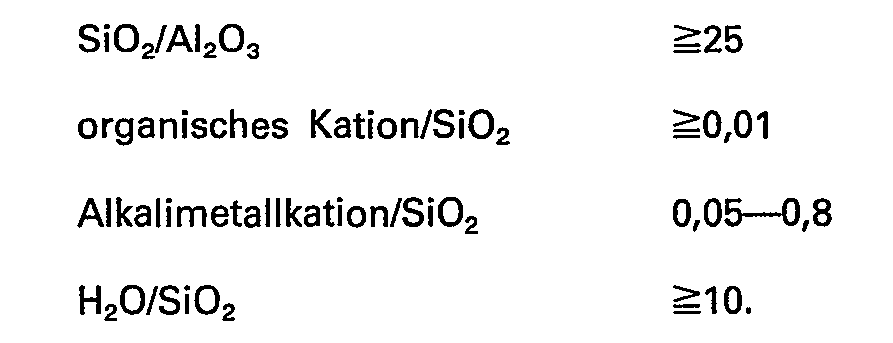
[0008] The inventive process is characterized by the fact that the two types of colloids have different silicon/aluminum atomic- ratios, said two types of colloids comprising a gel having the following composition in mole ratio:
and a sol having the following composition in mole ratio:
and the hydrothermal reaction optionally is carried out in the presence of a fluorine compound.
[0009] In contrast to the process as described in US-A-3 433 589, the process of the present invention involves the use of a sol as a starting material whereas the starting material of the prior art process is a gel.
[0010] The characteristic feature of the process of the invention is that a starting mixture comprising at least two colloids having different silicon/aluminum atomic ratios is hydrothermally reacted.
[0011] The raw materials used in the process of the invention may be any known materials which are normally used in the synthesis of zeolites.
[0012] Examples of the silicon compound are sodium silicate, solid silica, silica gel and silica sol. Silica sol is preferred. Silica sol is readily available under the trademarks of Ludox (Du Pont), Snowtex (Nissan Chemical Co., Ltd.) and Cataloid (Shokubai Kasei Co., Ltd.), Silica gel is available, for example, under the tradename of Syloid (Fuji-Davison Company).
[0013] A water-insoluble silicon compound such as solid silica or silica gel may be used as a solution in an alkaline aqueous solution. Many commercial grades of silica sol contain about 1000 ppm of alumina. If such silica sol is to be used, the alumina content should be considered in practicing the present invention.
[0014] The aluminum compound may, for example, be sodium aluminate or freshly prepared aluminum hydroxide. The alkali metal compound may be a sodium compound. In practice, sodium hydroxide is preferred as the sodium compound. The quality of sodium hydroxide may be of usual industrial grade. It should be noted that sodium aluminate acts both as the alkali metal compound and as the aluminum compound.
[0015] A preferred example of the compound capable of releasing an organic cation in water is a quaternary organic ammonium compound of the following general formula
wherein R is a lower alkyl group, and X is one equivalent of an anion.
[0016] The compound of formula (1) may, if desired, be formed in situ in the reaction system by using a combination of a tertiary amine of the following formula
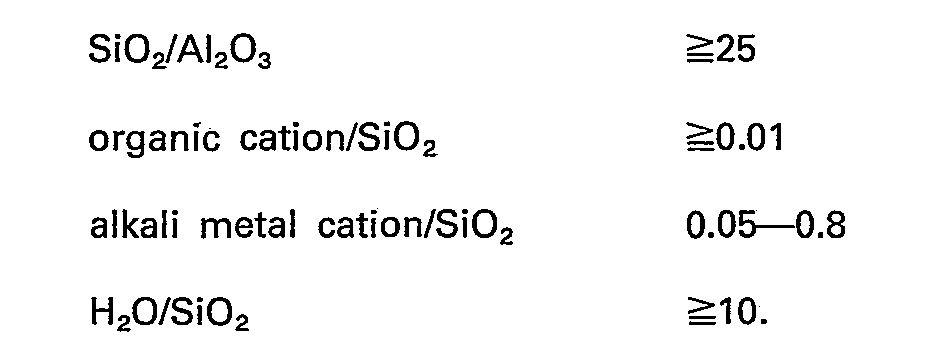
wherein R is as defined in formula (1), and a compound of the following general formula
wherein R and X are as defined.
[0017] In the above general formulae (1), (2) and (3), R is a lower alkyl group such as methyl, ethyl, n-propyl, iso-propyl, n-butyl, sec-butyl and tert-butyl.
[0018] In the general formulae (1) and (3), X is a monovalent halogen atom such as chlorine, bromine and iodine, a hydroxyl group, or one equivalent of an acid group such as a sulfuric acid group.
[0019] Examples of suitable quaternary organic ammonium compounds of general formula (1) include tetraalkyl ammonium halides such as tetrapropyl ammonium bromide, tetramethyl ammonium bromide, tetraethyl ammonium bromide, tetrapropyl ammonium chloride, tetrabutyl ammonium bromide and tetrabutyl ammonium chloride; and the hydroxides and sulfates of tetraalkyl ammoniums such as tetramethyl ammonium, tetraethyl ammonium, tetrapropyl ammonium and tetrabutyl ammonium.
[0020] Examples of suitable tertiary amines of general formula (2) include trimethylamine, triethylamine, tripropylamine and tributylamine.
[0021] Specific examples of the compound of general formula (3) are methyl bromide, ethyl bromide, propyl bromide, propyl chloride, butyl bromide, butyl chloride, methyl alcohol, ethyl alcohol, dimethyl sulfate and diethyl sulfate.
[0022] From these compounds, quaternary ammonium ions of the general formula R4N+ in which R is as defined are formed. Other organic cations may also be used.
[0023] The process of this invention is practiced by hydrothermally reacting a starting mixture prepared from the aforesaid starting compounds and water. The starting mixture is prepared from at least two colloids having different silicon/aluminum atomic ratios. The colloids may be gels or sols, preferably a combination of a gel and a sol.
[0024] Where the colloid is a gel, the gel should advantageously have the following composition in mole ratio. In the following composition, the silicon atom, the aluminum atom, the compound capable of releasing an organic cation in water, and the alkali metal compound are expressed respectively as Si02, A1203, R4N+, and Na+ (the same expression will apply hereinafter).
[0025] The SiOz/AI203 ratio in the starting mixture is determined depending upon the desired final Si02/AI203 ratio in the crystalline aluminosilicate. The increase of the R4N+ mole ratio and the decrease of the H20/Si02 mole ratio promotes gellation, and the increase of the Na+/Si02 mole ratio hampers gellation. Usually, gellation is performed preferably at room temperature to a temperature of 100°C, especially preferably at 100°C. The gel can be prepared in about 5 minutes to 2 hours at these temperatures.
[0026] Where the colloid is a sol, the sol should advantageously have the following composition (mol ratio).
[0027] The aforesaid commercially available silica sols may be used as sols having the above composition. The sol is usually prepared at ambient temperature, but if desired, heating or cooling may be carried out.
[0028] According to this invention, at least two colloids having different silicon/aluminum atomic ratios are preferably prepared by so-called "laminer flow mixing" or "streamline flow mixing" by which shearing is minimized.
[0029] Preferably, these at least two colloids are mixed so as to give a starting mixture having the following composition (mole ratio).
[0030] Furthermore, these colloids are mixed preferably in such a manner that the weight of one colloid in the starting mixture, calculated as Si02, is 0.1 to 20 times, particularly 3 to 10 times, that of at least one other colloid in the mixture. Accordingly, especially preferably, the starting material is prepared from at least one gel and at least one sol by mixing them such that the weight of at least one gel, calculated as Si02, is 0.1 to 20 times, particularly 3 to 10 times, that of at least one sol.
[0031] In order to prepare a crystalline aluminosilicate suitable as a catalyst, it is preferred to mix silica-alumina gel and silica sol and crystallize the mixture, or to mix silica gel and silica alumina sol and crystallize the mixture.
[0032] The adjustment of the quantitative ratios of the starting compounds in the starting mixture to the above ranges is important for performing sufficient crystallization by hydrothermal reaction thereby forming the desired crystals.
[0033] Surprisingly, it has been found in accordance with this invention that even if the amount of the quaternary ammonium compound is as small as described above, crystallization is not hampered but proceeds normally. This phenomenon is presumably because the quaternary ammonium compound is absorbed by the gel prepared in advance, and therefore, the subsequent crystallization proceeds around the gel.
[0034] The hydrothermal reaction in accordance with the process of this invention is carried out at a temperature of about 100°C to about 200°C, preferably about 130°C to about 170°C. Preferably, the hydrothermal reaction is carried out in a closed system under autogenous pressure.
[0035] The hydrothermal reaction time for crystallization varies depending upon the reaction temperature, the quantitative ratios of the compounds in the starting mixture, etc. Usually, it is about 4 to about 150 hours. For example, when the reaction temperature is 150°C, the hydrothermal reaction is usually carried out for 20 to 100 hours depending upon the starting mixture used, etc.
[0036] The hydrothermal reaction in accordance with the process of this invention may also be carried out in the presence of a fluorine compound. Investigations of the present inventors have shown that the presence of a fluorine ion in neutrality or alkalinity brings about the advantage of promoting gellation and growing crystals to a larger size.
[0037] Fluorine compounds which act as a fluorine ion source include, for example, compounds which dissociate in water to release a fluorine ion, such as sodium fluoride and ammonium fluoride; and compounds which undergo hydrolysis in water to release a fluorine ion, such as silicion fluoride, boron fluoride, and sulfur fluoride. The compounds which dissociate in water to release a fluorine ion, especially sodium fluoride and ammonium fluoride, are preferred.
[0038] The fluorine compound may be caused to be present during preparation of the respective colloids, or during preparation of the starting mixture by mixing two or more colloids.
[0039] The amount of the fluorine compound used is suitably at least 0.1 mole, preferably 0.1 to 1.0 moles, especially preferably 0.2 to 0.8 mole, per mole of Si02 in the starting mixture.
[0040] Catalysts prepared from the crystalline aluminosilicates produced by the process of this invention have high selectivity and a longer active lifetime than ordinary homogeneous ZSM-5 zeolites.
[0041] According to the process of this invention, a heterogeneous crystalline aluminosilicate in which the crystalline aluminosilicate portions and the crystalline silicate portions are distributed, for example, in a mosaic pattern can also be produced.
[0042] The crystalline aluminosilicates obtained by the process of this invention can be used suitably as catalysts for the isomerization, disproportionation or alkylation of hydrocarbons and the dehydration of oxygen-containing compounds. More specifically, these aluminosilicates can be used in the isomerization of xylenes, the methylation of toluene, the synthesis of olefins from methanol, and the synthesis of paraffins and aromatic compounds.
[0043] For use as catalysts, the crystalline aluminosilicates obtained by the process of this invention should be subjected to the following treatment. Crystalline aluminosilicates obtained by hydrothermal reaction in the absence of a fluorine ion are calcined, subjected to ion-exchange with ammonium chloride, and again calcined to convert them into "H+ form". Crystalline aluminosilicates obtained by performing hydrothermal reaction in the presence of a fluorine ion are calcined, and then treated with an acid such as hydrochloric acid. As a result of the above treatment, fluorine contained in the crystalline aluminosilicates will sometimes decrease in amount or disappear.
[0044] It is not entirely clear why the crystalline aluminosilicates having a heterogeneous structure obtained by the process of this invention have excellent catalytic activity. It is presumed however that the heterogeneous structure of the crystalline aluminosilicates affects heat transfer and material transfer within the crystals and the resulting effects are reflected on the catalytic properties of the aluminosilicates.
[0045] The crystalline aluminosilicates obtained by the process of this invention have a large particle size. As solid catalysts they have high activity and selectivity and a long active lifetime. They are also suitable as adsorbents.
Example 1
[0047] 50.7 g of silica sol (Si02 content 30% by weight and Na20 content 0.33% by weight) and 4.7 g of sodium aluminate solution (AI203 content 1.2% by weight; Na20 content 2.2% by weight) were mixed with 37.8 g of water, and 6.8 g of tetrapropylammonium bromide was dissolved in the mixture with stirring. The solution was heated on a boiling water bath. After the lapse of about 15 minutes, this solution gelled.
[0048] Separately, 7.0 g of silica sol (Si02 content 30% by weight and Na20 content 0.33% by weight), 1.5 g of sodium hydroxide and 2.0 g of tetrapropyl ammonium bromide were mixed with 192.0 g of water to form a sol.
[0049] With slow stirring to afford "stream line flow mixing", the above gel and sol were mixed to form a starting mixture. The mixture was charged into an autoclave. The autoclave was closed, and maintained at 150°C to perform hydrothermal reaction for 60 hours. After the lapse of a predetermined period of time, the crystals were withdrawn, washed and dried at 110°C for 5 hours to obtain 19.6 g of crystals. The crystals had an average particle size of about 9 µ (microns)x7 p and showed the X-ray diffraction pattern given in Figure 1.
[0050] The compositions in mole ratio of the gel, the sol and the starting mixture are shown in Table 1.
Example 2
[0051] 71.2 g of silica sol (Si02 content 30% by weight and Na20 content 0.33% by weight), 0.43 g of sodium aluminate (AI203 content 34.9% by weight; Na20 content 33.3% by weight), 1.9 g of sodium hydroxide and 24.6 g of tetrapropyl ammonium bromide were mixed with 348.2 g of water, and 4.3 g of ammonium fluoride was further added. The mixture was allowed to stand at room temperature for about 10 hours to form a gel.
[0052] Separately, 73.3 g of silica sol (SiOz content 30% by weight and Na20 content 0.33% by weight), 2.2 g of sodium hydroxide and 25.4 g of tetrapropyl ammonium bromide were mixed with 358.6 g of water to prepare a sol.
[0053] From the resulting gel and sol, 45.0 g of crystals were obtained by operating in the same way as in Example 1. The crystals had an average particle size of about 20 px5 µ and showed the X-ray diffraction pattern given in Figure 2.
[0054] The composition in mole ratio of the gel, the sol and the starting mixture are shown in Table 1.
Examples 3 and 4
[0055] Hydrothermal reaction was carried out in the same way as in Example 1 or 2 except that the compositions in mole ratio of the gel and the sol were changed as shown in Table 1. Specifically, Example 3 was operated in the same way as in Example 1, and Example 4, in the same way as in Example 2.
[0056] In Example 3, 30.2 g of crystalline aluminosilicate having an average particle size of about 14 px13 p and showing the X-ray diffraction pattern given in Figure 3 was obtained.
[0057] In Example 4, 33.5 g of crystalline aluminosilicate having an average particle size of about 56 µ×9 µ and showing the X-ray diffraction pattern given in Figure 4 was obtained.
Comparative Example 1
[0058] The same gel as used in Example 2 was hydrothermally reacted alone to form crystals. The resulting crystals had an average particle size of about 43 µx8 µ, and showed the X-ray diffraction pattern given in Figure 5.
Comparative Example 2
[0059] The same sol as used in Example 2 was hydrothermally reacted alone to form crystals. The resulting crystals had an average particle size of about 12 px6 µ and showed the X-ray diffraction pattern given in Figure 6.
Comparative Example 3
Comparative Example 4
[0061] The same sol as used in Example 3 was hydrothermally reacted alone to form crystals. The resulting crystals were mordenite crystals.
Referential Example
[0062] (1) The crystalline aluminosilicate obtained in Example 4 was calcined in the air at 550°C for 5 hours, and then contacted with an 18% by weight aqueous solution of hydrochloric acid at 90°C for 5 hours. The solid was separated by filtration, and washed with water until no chlorine ion was detected in the washing. It was finally dried at 110°C for 10 hours.
[0063] Silica sol and titanium dioxide powder were added to the dried crystals, and they were well kneaded. The mixture was molded into tablets by using a porous plate (1.5 mmφx2 mmH). After drying, the tablets were taken out from the porous plate, and calcined in the air at 550°C for 5 hours to form a catalyst. The resulting catalyst contained 67% by weight of crystalline aluminosilicate, 13% by weight of silica and 20% by weight of titanium dioxide.
[0064] 4.4 ml of the aforesaid catalyst was filled in a reaction tube having a sectional area of 7.3 cm2 to a height of 0.6 cm. The catalyst bed was maintained at 335°C, and methanol was passed through the catalyst bed at a feed rate (LHSV) of 1.2 hr-1 under atmospheric pressure without using a diluent.
[0065] The amount of methanol supplied was 1.6 g per m2 of cross-sectional area per second, and the linear velocity of the methanol vapour was 0.11 cm/sec. The results of the reaction are shown in Table 2.
[0066] (2) 0.28 g of sodium aluminate (AI2O3 content 34.9% by weight; Na20 content 33.3% by weight), 2.9 g of sodium hydroxide and 2.8 g of ammonium fluoride were dissolved in 471.3 g of water. Then, 31.7 g of tetrapropyl ammonium bromide prepared in advance was added to form a uniform aqueous solution. Furthermore, 71.2 g of silica sol (Si02 content 40% by weight) was added to the aqueous solution, and the mixture was put in a mixer and treated at a rotating speed of 10,000 rpm (the linear velocity of the blade tip 45 m/sec.) at room temperature for 3 minutes while imparting a shearing force. The composition of this starting mixture was the same (see Table 1) as that of the starting mixture used in Example 2.
[0067] The starting mixture was charged into an autoclave, and hydrothermally reacted in the same way as in Example 1 to form crystals. The crystals were calcined, treated with an acid, molded, calcined, and used as a catalyst in the same way as set forth in (1) above. The results are also shown in Table 2 in the parentheses.
1. A process for producing a crystalline aluminosilicate comprising hydrothermally
reacting a starting mixture composed of a silicon compound, an aluminum compound,
an alkali metal compound, a compound capable of releasing an organic cation in water,
and water, said starting mixture comprising at least two types of colloids, characterized
by the fact that the two types of colloids have different silicon/aluminum atomic
ratios, said two types of colloids comprising a gel having the following composition
in mole ratio:
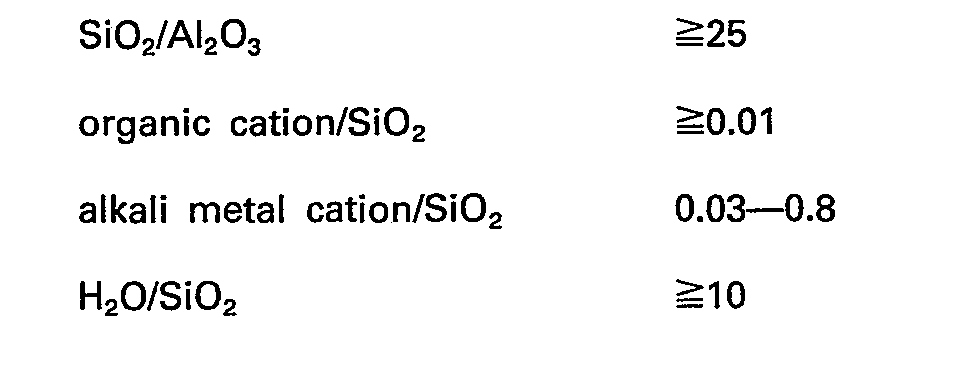
and a sol having the following composition in mole ratio:
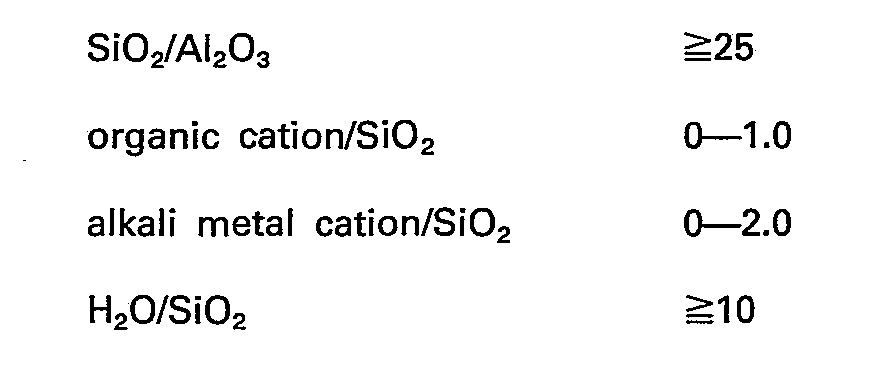
and the hydrothermal reaction optionally is carried out in the presence of a fluorine compound.
and a sol having the following composition in mole ratio:
and the hydrothermal reaction optionally is carried out in the presence of a fluorine compound.
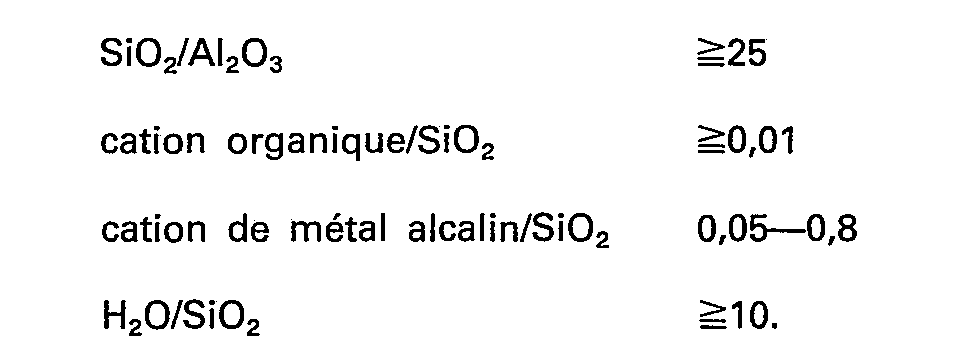
2. The process of claim 1 wherein said starting mixture has the following composition
in mole ratio:
3. The process of claim 1 or 2 wherein the organic cation is a quaternary organic
ammonium ion.
4. The process of claim 1 or 2 wherein the alkali metal cation is a sodium ion.
5. The process of claim 1 wherein one colloid in said starting mixture is present
in a weight, calculated as SiOz, 0.1 to 20 times the weight of other colloid in said mixture.
6. The process of any one of claim 1 or 2 wherein said starting mixture is composed
of said gel and said sol, and the weight of said gel calculated as Si02 is 0.1 to 20 times the weight of said sol.
7. The process of claim 1 wherein the hydrothermal reaction is carried out in the
presence of a fluorine compound, which promotes gellation and grows crystals to a
larger size, in an amount of at least 0.1 mole per mole of the starting mixture calculated
as Si02.
8. The process of claim 7 wherein said fluorine compound is a compound which dissociates
in water to release a fluorine ion.
9. The process of claim 7 or 8 wherein said fluorine compound is sodium fluoride or
ammonium fluoride.
10. The process of claim 7 wherein said fluorine compound is a compound which undergoes
hydrolysis in water to release a fluorine ion.
11. The process of claim 7 or 10 wherein said fluorine compound is silicon fluoride,
boron fluoride or sulfur fluoride.
12. The process of claim 1 wherein the hydrothermal reaction is carried out at a temperature
of about 100°C to about 200°C.
13. The process of claim 1 wherein said starting mixture is prepared by mixing said
at leasttwo types of colloids having different silicon/aluminum ratios by the so-called
"laminar flow mixing" by which shearing is minimized.
1. Verfahren zur Herstellung eines kristallinen Aluminosilikats, bei dem man ein Ausgangsgemisch,
bestehend aus einer Siliciumverbindung, einer Aluminiumverbindung, einer Alkalimetallverbindung,
einer Verbindung, die dazu imstande ist, ein organisches Kation in Wasser freizusetzen,
und Wasser hydrothermisch umsetzt, wobei das genannte Ausgangsgemisch mindestens zwei
Typen von Kolloiden enthält, dadurch gekennzeichnet, daß die zwei Typen von Kolloiden
unterschiedliche Silicium/Aluminium-Atomverhältnisse haben, daß die zwei Typen der
Kolloide ein Gel mit folgender Zusammensetzung im Molverhältnis:
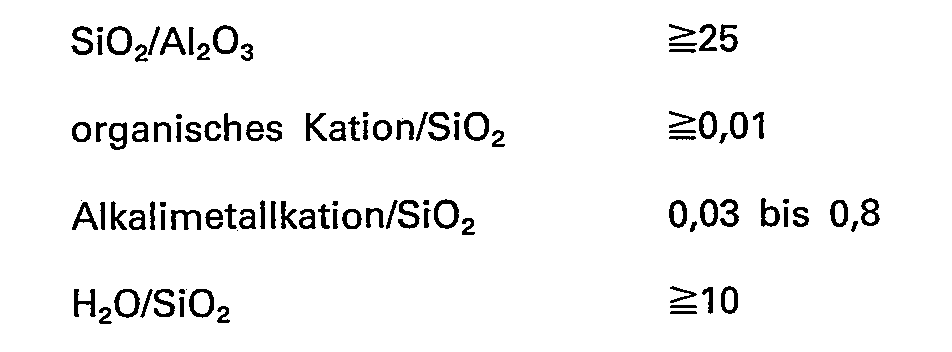
und ein Sol mit folgender Zusammensetzung im Molverhältnis:

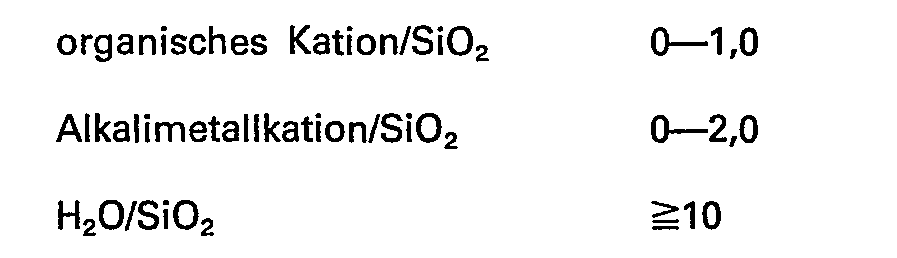
umfassen und daß man die hydrothermische Reaktion gegebenenfalls in Gegenwart einer Fluorverbindung durchführt.
und ein Sol mit folgender Zusammensetzung im Molverhältnis:
umfassen und daß man die hydrothermische Reaktion gegebenenfalls in Gegenwart einer Fluorverbindung durchführt.
2. Verfahren nach Anspruch 1, dadurch gekennzeichnet, daß das Ausgangsgemisch die
folgende Zusammensetzung im Molverhältnis aufweist:
3. Verfahren nach Anspruch 1 oder 2, dadurch gekennzeichnet, daß das organische Kation
ein quaternäres organisches Ammoniumion ist.
4. Verfahren nach Anspruch 1 oder 2, dadurch gekennzeichnet, daß das Alkalimetallkation
ein Natriumion ist.
5. Verfahren nach Anspruch 1, dadurch gekennzeichnet, daß ein Kolloid in dem genannten
Ausgangsgemisch in einer als Si02 berechneten Gewichtsmenge von dem 0,1- bis 20-fachen der Gewichtsmenge des anderen
Kolloids in dem genannten Gemisch vorhanden ist.
6. Verfahren nach Anspruch 1 oder 2, dadurch gekennzeichnet, daß das genannte Ausgangsgemisch
aus dem genannten Gel und dem genannten Sol zusammengesetzt ist und daß die als Si02 berechnete Gewichtsmenge des genannten Gels das 0,1- bis 20-fache der Gewichtsmenge
des genannten Sols ist.
7. Verfahren nach Anspruch 1, dadurch gekennzeichnet, daß man die hydrothermische
Reaktion in Gegenwart einer Fluorverbindung, die die Gelierung fördert und die Kristalle
zu einer größeren Größe wachsen läßt, in einer Menge von mindestens 0,1 mol pro mol
Ausgangsgemisch, berechnet als Si02, vornimmt.
8. Verfahren nach Anspruch 7, dadurch gekennzeichnet, daß die genannte Fluorverbindung
eine Verbindung ist, die in Wasser unter Freisetzung eines Fluorions dissoziiert.
9. Verfahren nach Anspruch 7 oder 8, dadurch gekennzeichnet, daß die genannte Fluorverbindung
Natriumfluorid oder Ammoniumfluorid ist.
10. Verfahren nach Anspruch 7, dadurch gekennzeichnet, daß die genannte Fluorverbindung
eine Verbindung ist, die in Wasser unter Freisetzung eines Fluorions hydrolysiert.
11. Verfahren nach Anspruch 7 oder 10, dadurch gekennzeichnet, daß die genannten Fluorverbindung
Siliciumfluorid, Borfluorid oder Schwefelfluorid ist.
12. Verfahren nach Anspruch 1, dadurch gekennzeichnet, daß man die hydrothermische
Reaktion bei einer Temperatur von etwa 100 bis etwa 200°C durchführt.
13. Verfahren nach Anspruch 1, dadurch gekennzeichnet, daß man das genannte Ausgangsgemisch
dadurch herstellt, daß man die mindestens zwei Typen von Kolloiden mit unterschiedlichen
Silicium/Aluminium-Verhältnissen durch das sogenannte "laminare Fließvermischen",
durch das eine Scherwirkung minimalisiert wird, herstellt.
1. Un procédé de production d'aluminosilicates cristallisés dans lequel on fait réagir
par voie hydrothermique un mélange formé d'un composé de silicium, d'un composé d'aluminium,
d'un composé de métal alcalin, d'un composé libérant un cation organique dans l'eau,
et d'eau, mélange qui comprend au moins deux sortes de colloïdes, procédé caractérisé
en ce que dans les deux sortes de colloïdes le rapport atomique silicium/aluminium
est différent, ces sortes de colloïdes comprenant un gel ayant la composition suivante
en proportions molaires:
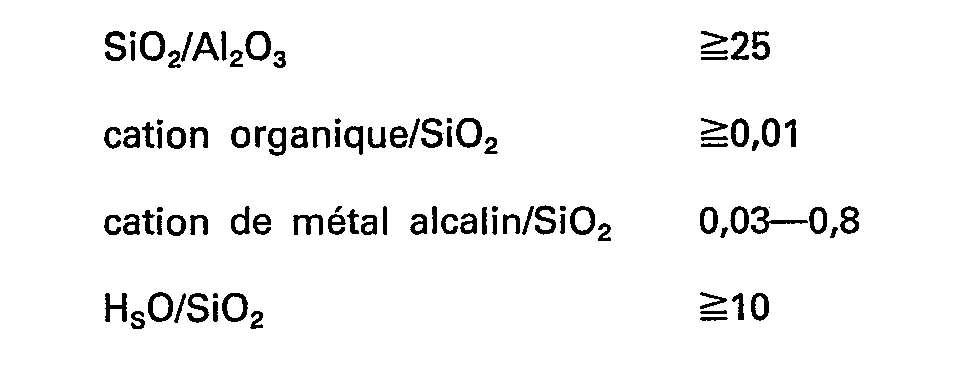
et un sol ayant la composition suivante en proportions molaires:
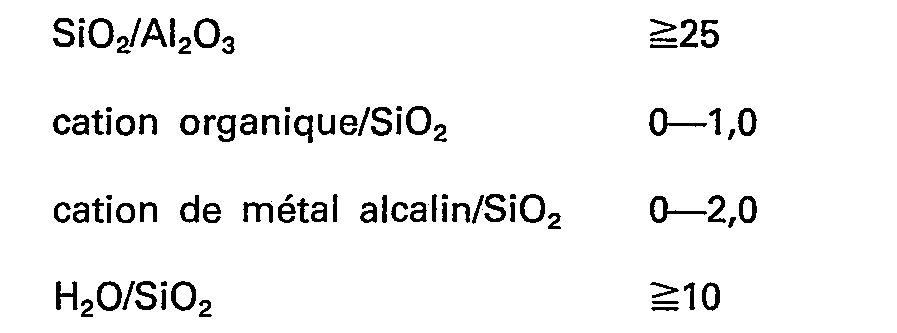
et la réaction hydrothermique est facultativement effectuée en présence d'un composé du fluor.
et un sol ayant la composition suivante en proportions molaires:
et la réaction hydrothermique est facultativement effectuée en présence d'un composé du fluor.
2. Procédé selon la revendication 1 dans lequel le mélange dont on part a la composition
suivante en proportions molaires:
3. Procédé selon la revendication 1 ou 2 dans lequel le cation organique est un ion
ammonium quaternaire organique.
4. Procédé selon la revendication 1 ou 2 dans lequel le cation de métal alcalin est
l'ion sodium.
5. Procédé selon la revendication 1 dans lequel le poids de l'un des colloïdes du
mélange, calculé en Si02, est de 0,1 à 20 fois le poids de l'autre colloïde.
6. Procédé selon la revendication 1 ou 2 dans lequel le mélange est formé du gel et
du sol, et le poids du gel, en Si02, est de 0,1 à 20 fois le poids du sol.
7. Procédé selon la revendication 1 dans lequel la réaction est effectuée en présence
d'un composé du fluor, ce qui favorise la gélification et fait croître la dimension
des cristaux, dans une proportion d'au moins 0,1 mole par mole de Si02 du mélange.
8. Procédé selon la revendication 7 dans lequel le composé fluoré est un composé qui
se dissocie dans l'eau en donnant l'ion fluor.
9. Procédé selon la revendication 7 ou 8 dans lequel le composé fluoré est le fluorure
de sodium ou d'ammonium.
10. Procédé selon la revendication 7 dans lequel le composé fluoré est un composé
qui s'hydrolyse dans l'eau en donnant l'ion fluor.
11. Procédé selon la revendication 7 ou 10 dans lequel le composé fluoré est le fluorure
de silicium, de bore ou de soufre.
12. Procédé selon la revendication 1 dans lequel la réaction est effectuée à une température
d'environ 100 à 200°C.
13. Procédé selon la revendication 1 dans lequel on prépare le mélange dont on part
en mélangeant les deux sortes au moins de colloïdes dans lesquels le rapport silicium/aluminium
est différent par mélange dit "à écoulement laminaire" pour réduire au minium les
forces de cisaillement.