| (19) |
 |
|
(11) |
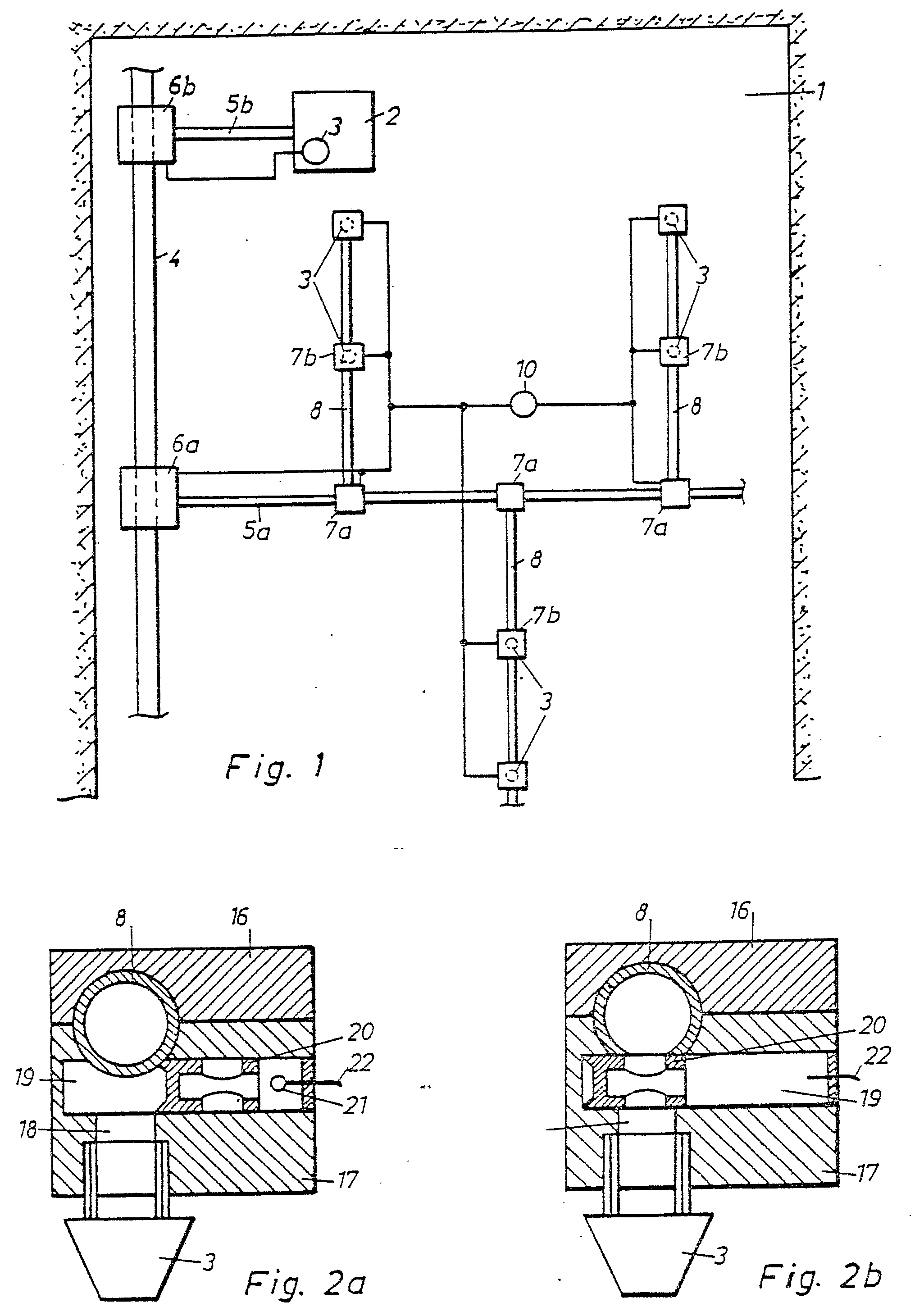
EP 0 053 617 B1 |
| (12) |
EUROPEAN PATENT SPECIFICATION |
| (45) |
Mention of the grant of the patent: |
|
02.01.1985 Bulletin 1985/01 |
| (22) |
Date of filing: 01.06.1981 |
|
| (86) |
International application number: |
|
PCT/SE8100/157 |
| (87) |
International publication number: |
|
WO 8103/620 (24.12.1981 Gazette 1981/30) |
|
| (54) |
PIPING SYSTEM WITH VARIABLE CONFIGURATION
ROHRSYSTEM MIT VERÄNDERLICHER ANORDNUNG
SYSTEME DE TUYAU AVEC CONFIGURATION VARIABLE
|
| (84) |
Designated Contracting States: |
|
DE FR GB |
| (30) |
Priority: |
18.06.1980 SE 8004509
|
| (43) |
Date of publication of application: |
|
16.06.1982 Bulletin 1982/24 |
| (71) |
Applicant: FLAMCO B.V. |
|
NL-2802 AC Gouda (NL) |
|
| (72) |
Inventors: |
|
- JORUP, Lars Johan Peder
S-611 45 Nyköping (SE)
- TOOMINGAS, Illar
S-122 48 Enskede (SE)
|
| (74) |
Representative: Jacobsson, Rune et al |
|
Axel Ehrners Patentbyra AB
Box 10316
100 55 Stockholm
100 55 Stockholm (SE) |
|
| |
|
| Note: Within nine months from the publication of the mention of the grant of the European
patent, any person may give notice to the European Patent Office of opposition to
the European patent
granted. Notice of opposition shall be filed in a written reasoned statement. It shall
not be deemed to
have been filed until the opposition fee has been paid. (Art. 99(1) European Patent
Convention).
|
Technical Field
[0001] The invention relates to a piping system with variable configuration for spreading
a fluid, suitably in extinguishing systems, emergency cooling systems and the like.
Background Art
[0002] In piping systems (e.g. CH-C-572 752) which branch out to form different configurations,
the connections between the different pipe sections and between the means fed thereby,
such as nozzles, must be made when the piping system is installed. Quite often, the
placing partition walls is scarcely decided when a piping system, e.g. for a sprinkler
installation, is installed. Consequently, when premises are re- disposed the piping
system must be dismantled and rebuilt at high cost.
Disclosure of Invention
[0003] The object of the invention is to provide a piping system where the connections between
the different pipe sections as well as between the pipes and the means fed via the
pipes are not made before the need of such connections arises. Alteration of the piping
system configuration without large costs and material loss is thus enabled for a desired
redisposition or conversion of the premises. The invention is based on the utilization
of removable branching means which first open the pipe walls when the need arises,
so that both pipes and branching means can be used for fitting into new configurations.
In this way great flexibility and low costs are achieved, while at the same time there
is greater operational reliability due to less risk of leakage.
Brief Description of Drawing
[0004] The invention will now be described in detail below with the aid of an embodiment
example, while referring to the appended drawing, where Figure 1 schematically illustrates
a piping system in accordance with the invention for a fire extinguishing installation,
and Figures 2a and 2b schematically illustrate a branching means suited to connecting
a pipe to another pipe or to a fluid spreading means.
Preferred Embodiment -
[0005] Figure 1 illustrates a part of a piping system intended for distributing fire extinguishing
fluid, e.g. water to the sprinkler heads 3, in a building 1. A main distribution pipe
is denoted by the numeral 4, and secondary pipes 5a, 5b are connectable to it via
pipe couplings 6a, 6b. The dimensions of pipe couplings 6a, 6b are suited to the respective
diameters of the main distribution pipe and the secondary pipe. These couplings are
of a type known per se, where an opening in a pipe on which the coupling is fixed
is provided by a cutting means displaced by a force. Couplings of this kind are described
in the Swedish Patent Specification 377 371 or the U.S. Patent Specification 3 394
727, for example. Pipe couplings denoted by 7a, 7b are of the same type as couplings
6a, 6b and so dimensioned that they can connect the secondary pipes 5a to the branch
pipe 8 as well as connecting the sprinkler heads 3 to the branch pipe 8. A closed
space 2, in which easily igniteable material is stored, obtains extinguishing medium
directly from the main distribution pipe 4 via a secondary pipe 5b so that the extinguishing
medium is fed to the space via a spreader nozzle or sprinkler, not shown in detail.
There are state indicating means 9, 10 which are actuated by an abnormal state, e.g.
the exceeding of a given temperature limit, smoke generation, explosion or ionising
etc. According to the example, the alarm means 9 is actuated by ionizing, while the
means 10 is actuated by exceeding a given temperature limit. The sprinkler heads can
naturally be triggered manually also.
[0006] Figures 2a and 2b illustrate the function of the pipe coupling known per se. The
latter includes an upper part 16 and a lower part 17, each provided with a semi-cylindrical
recess, and when these parts are assembled they sealingly enclose the pipe, e.g. pipe
8. The part 17 is provided with a channel 18 extending at right angles to the pipe
8, A branch pipe or a fluid spreader means, e.g. a sprinkler head 3, is connected
to the channel 18, which is not in communication with the bore of the pipe on being
fitted, since the pipe wall is not pierced (Figure 2a). The pipe coupling includes
a cutting means 20, displaceable in a transverse channel 19. An explosive charge 21
is arranged in the transverse channel and can be caused to explode with the aid of
an activating signal obtained on the wire 22. The cutting means 20 is displaced as
a result of the explosion, and communication is opened between the pipe 8 and the
sprinkler head 3, the latter only being schematically illustrated (Figure 2b).
[0007] If a fire occurs in the building 1 and the alarm means 10 generates an activating
signal, the explosive charges are triggered in the pipe couplings 6a, 7a and 7b, which
are connected to the alarm means 10 via the wire indicated by a dashed line. Communication
is thus opened in the pipe coupling 6a as well as 7a and 7b, so that the extinguishing
fluid, e.g. water, can flow from the main distribution pipe 4 to the secondary pipe
5a and from there to the sprinkler heads 3 via the pipe couplings 7a and 7b. The extinguishing
operation can start immediately in this mode. If the fire extinguishing installation
is not put to use, and redisposition of the premises be of interest, the piping system
can be taken apart and the pipes assembled in another configuration.
[0008] An indicator reacting for ionization is arranged in the closed space 2. If a fire
in this space should therefore cause ionization, an activating signal is sent on the
wire, indicated by a dashed line, to the pipe coupling 6b. Passage is opened from
the main distribution pipe 4 to the branch pipe 5b so that the closed room 2 is fed
with extinguishing medium.
[0009] It will thus be seen that a piping system is provided by the invention, and has a
configuration which can be freely changed while using the former parts, which enables
large savings and freedom in planning.
Piping system with variable configuration for spreading a fluid, for example in extinguishing
installations, emergency cooling installations and the like, the piping system being
provided with alarm means (9, 10) which sense the state in the space which is to be
monitored, and for an abnormal state in said space generate an . alarm signal, characterized
in that the pipes (4, 5, 8) incorporated in the piping system lack holes for branches
and are provided with pipe couplings (6, 7), of a type having piercing means (20)
enabling communication to be made between the pipes connected by the pipe coupling,
and in that the piercing means are provided with triggering means (21 ) adapted for
activating the piercing means on receiving an alarm signal, so that the piping system
functions as an ordinary fluid spreading system, but where the branches can be optionally
moved as long as the piping system has not been actuated by an alarm signal.
Système de canalisations à configuration variable pour répandre un fluide, par exemple
dans des installations d'extinction, des installations de refroidissement d'urgence
et autres, le système de canalisations étant équipé de moyens d'alarme (9, 10) qui
détectent l'état de l'espace qui doit être surveillé et qui, dans le cas d'un état
anormal dudit espace, produisent un signal d'alarme, caractérisé en ce que les canalisations
(4, 5, 8) incorporées dans le système de canalisations ne présentent pas de trous
pour des branchements et sont équipées de raccords (6, 7) de canalisation d'un type
comportant des moyens (20) de perçage permettant d'établir une communication entre
les canalisations reliées par le raccord de canalisations, et en ce que les moyens
de perçage sont équipés de moyens (21 ) de déclenchement conçus pour actionner les
moyens de perçage à la réception d'un signal d'alarme, afin que le système de canalisations
fonctionne comme un système normal de distribution de fluide, mais dans lequel les
branchements peuvent être déplacés facultativement tant que le système de canalisations
n'a pas été actionné par un signal d'alarme.
Rohrleitungssystem mit veränderlicher Konfiguration zum Spritzen einer Flüssigkeit,
z.B. in Löschbetriebsanlagen, Notkühlbetriebseinrichtungen und ähnlichen, wobei das
Rohrleitungssystem mit einer Alarmeinrichtung versehen ist, die den Zustand im zu
überwachenden Raum abtastet und die bei einem nicht normalen Zustand in diesem Raum
ein Alarmsignal erzeugt, dadurch gekennzeichnet, daß die in dem Rohrleitungssystem
verwendeten Rohre (4, 5, 8) keine Löcher für Abzweigungen aufweisen und mit Rohrkupplungen
(6, 7) versehen sind, die Schneideinrichtungen (20) zur Schaffung einer Verbindung
zwischen den durch die Rohrkupplung verbundenen Rohre besitzen, und daß die Schneideinrichtungen
jeweils mit einer Auslöse- oder Triggereinrichtung (21) versehen ist, um die Schneideinrichtungen
bei Empfang einer Alarmsignales zu betätigen, so daß das Rohrleitungssystem als normales
Flüssigkeitspritzsystem arbeitet, in dem aber die Abzweigungen so lange wahlfrei bewegt
werden können, wie das Rohrleitungssystem nicht durch ein Alarmsignal betätigt wird.