|
(11) | EP 0 053 733 B1 |

| (12) | EUROPEAN PATENT SPECIFICATION |
|
|
| (54) |
Polyquaternary flocculants Polyquaternäre Flockungsmittel Floculants polyquaternaires |
|
|
|||||||||||||||||||||||||||||||
| Note: Within nine months from the publication of the mention of the grant of the European patent, any person may give notice to the European Patent Office of opposition to the European patent granted. Notice of opposition shall be filed in a written reasoned statement. It shall not be deemed to have been filed until the opposition fee has been paid. (Art. 99(1) European Patent Convention). |
[0001] This invention relates to the preparation of polyquaternary polymeric flocculants from dialkylamines, epihalohydrins, and optionally polyfunctional polyamines, which contain a significantly reduced total amount of epihalohydrin and 1,3-dihalo-2-propanol and less than about 1000 ppm dialkylamine.
[0002] U.S. Patents Re 28,807 and Re 28,808 teach the basic preparation of the polyquaternary polymers which form the starting material of the present invention. Commercially, these products are prepared from dimethylamine (DMA), epichlorohydrin (EPI) and optionally ethylenediamine (EDA). When so prepared, the resultant polymers have low residual levels of epichlorohydrin, but large residues of dimethylamine. In view of the fact that epichlorohydrin is reported to be a mutagen and has produced cancer in animals, the very low level thereof in the final product was critical to the use of the polyquaternary polymer as a flocculant for potable water clarification.
[0003] Recently it has been discovered that part of the epichlorohydrin found in commercial polymers is converted into 1,3-dichloro-2-propanol (1,3-DCP), also reportedly a mutagen. Thus, there could be anywhere from 100 to 10,000 ppm of combined EPI and 1,3-DCP, and up to 2,000 ppm dimethylamine in a commercial polymer.
[0004] The use of these polyquaternary polymers containing amounts such as 3,000 ppm of combined EPI and 1,3-DCP as flocculants, at the maximum concentration of 20 milligrams per liter of water treated as allowed by the U.S. Environmental Protection Agency, means that the final clarified water would contain less than 100 parts per billion combined EPI and 1,3-DCP, well under the proposed standards for trihalomethanes set by the Environmental Protection Agency.
[0005] Nevertheless, in view of the public benefit to be gained by the use of chemical products which have reduced levels of chlorinated residues, there exists a need for further reducing the total residues of epichlorohydrin and 1,3-DCP in the flocculants, while at the same time limiting the residue of dimethylamine therein to less than 1000 ppm.
[0006] Accordingly, it is an object of the present invention to produce polyquaternary flocculants containing substantially reduced residues of epihalohydrin and 1,3-dihalo-2-propanol, and less than about 1000 ppm dialkylamine.
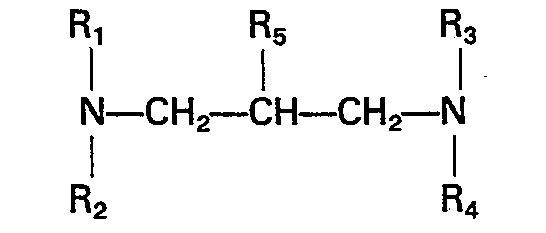
[0007] This is accomplished by post-treating a polyquaternary polymer prepared from dialkylamine, epihalohydrin, and optionally a polyfunctional amine. The post treatment is performed by reacting the polyquaternary polymer with a compound of the formula:
wherein R1, R2, R3, and R4 are alkyl (C1-3), and R5 is hydrogen or hydroxyl. The post-treatment is preferably carried out at a temperature from about 80°C to 90°C and more preferred from about 85°C to 90°C for a period of at least about 1 hour. Preferably, R1, R2, R3 and R4 are methyl groups, R5 is hydroxyl, and the reaction time is at least about two hours.
[0008] The molar ratio of the treatment compound to the residues is preferably about 10 to 20:1 and most desirably about 20:1. Preferably, the treatment compound is added to the polymer in two equal charges, preferably about thirty minutes apart.
[0009] A 1,3-bis(dialkylamino)-2-propanol, corresponding to the above formula when R5 is hydroxyl, may be readily prepared by reacting a dialkylamine, preferably dimethylamine, with an epihalohydrin, preferably epichlorohydrin, in about a 2:1 molar ratio, respectively at a temperature of from about 20°C to 50°C for about one to two hours.
[0010] A 1,3-bis(dialkylamino)propane compound, corresponding to the above formula when Rs is hydrogen, may be prepared by reacting a 1,3-dihalopropane, preferably 1,3-dibromopropane, with an alcoholic dialkylamine, preferably dimethylamine, in solution at a temperature of about 150°C for a prolonged period of time.
[0011] It is to be understood, however, that the particular method employed to prepare the compounds useful in the process of the instant invention does not constitute a feature of the invention.
[0012] The polyquaternary polymer which is treated by the present process may be prepared as disclosed and claimed in U.S. Reissue Patents 28,807 and 28,808.
[0013] Generally, this entails the reaction of a lower dialkylamine, preferably dimethylamine, with an epihalohydrin, preferably epichlorohydrin, and optionally a polyfunctional amine, preferably ethylenediamine, until a polyquaternary polymer is produced which, as a 37% aqueous solution, by weight, based on the total weight of the cationic portion of said polyquaternary polymer, has a viscosity at 25°C of at least about 100 mPas (100 centistokes).
[0014] The present post-treatment may be performed by simply adding a sufficient amount of the treating compound to the polymeric flocculant and allowing sufficient time for it to react with the residual epihalohydrin and 1,3-dihalo-2-propanol present in said flocculant.
[0015] The following examples are provided for illustrative purposes only and the present invention is not in any way deemed limited thereby, except as set forth in the appended claims. All parts and percentages are by weight unless otherwise indicated.
Example 1
[0016] A polyquaternary polymeric flocculant of the formula:
was prepared from epichlorohydrin and dimethylamine in accordance with the process disclosed and claimed in U.S. Reissue Patent 28,807 and was adjusted to give high residue levels of combined EPI and 1,3-DCP (1,865 ppm) and DMA (73 ppm).
[0017] 1,3-Bis(dimethylamino)-2-propanol was prepared by reacting a 2:1 molar ratio of DMA to EPI at a temperature of 60°C for 1 hour, and the residue levels were found to be as follows:
EPI-81 ppm;
1,3-DCP-less than 2 ppm;
DMA-58,000 ppm.
[0019] Table I demonstrates that, upon treatment of the polyquaternary polymer with the 1,3- bis(dimethylamino)-2-propanol at 90°C, the total residual EPI and 1,3-DCP content of the polymer was significantly reduced with time, while the DMA residue was maintained well below 1,000 ppm.
Example 2
[0020] The polyquaternary polymer of Example 1 was treated with 1,3-bis(dimethylamino)-2-propanol, -prepared as in Example 1 but containing 24 ppm EPI, less than 2 ppm 1,3-DCP and 57,000 ppm DMA, at 90°C.
[0021] Table II shows that the total residual level of EPI and 1,3-DCP in the polymer following treatment was again lowered, and the DMA residue remained less than 1,000 ppm.
Example 3
[0022] A flocculant was prepared from 100 parts epichlorohydrin, 99 parts dimethylamine and 1 part ethylenediamine in accordance with the process described in U.S. Reissue Patent 28,808 and the measured residue levels were 40 ppm, 52 ppm and 33 ppm for EPI, 1,3-DCP and DMA, respectively.
[0023] Adding 1,3-bis(dimethylamino)-2-propanol (residues of 81 ppm EPI; less than 2 ppm 1,3-DCP; 58,000 ppm DMA) at a 20 mole excess (assuming 500 ppm 1,3-DCP as the residue) in 2 charges of 10:1 each, spaced thirty minutes apart, coupled with heating at 90°C, yielded the residue results set forth in Table III.
Example 4
[0024] The polymer of Example 3 was treated with the 1,3-bis(dimethylamino)-2-propanol of Example 2 in the manner specified in Example 3. The results of that treatment are set out in Table IV.
Example 5
[0026] A polyquaternary polymer of the formula set forth in Example 3, but with residues as follows: combined EPI plus 1,3-DCP-64 ppm and DMA-853 ppm, was treated with the 1,3-bis(dimethylamino)-2-propanol of Example 2. The resulting polymer's residue levels are tabulated in Table V.
Example 6
1. A method for reducing the total combined epihalohydrin and 1,3-dihalo-2-propanol
residue content of a polyquaternary polymer prepared from an epihalohydrin, a dialkylamine,
and optionally a polyfunctional amine, while maintaining the dialkylamine residue
content of said polymer below about 1000 ppm, which comprises treating said polymer
with a residue reducing effective amount of a treatment compound of the formula:
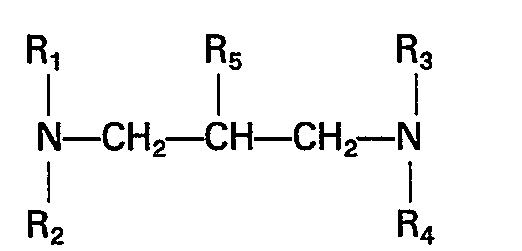
wherein R1, R2, R3 and R4 are alkyl (C1-C3), and R5 is hydrogen or hydroxyl.
wherein R1, R2, R3 and R4 are alkyl (C1-C3), and R5 is hydrogen or hydroxyl.
2. The method of Claim 1 wherein the epihalohydrin is epichlorohydrin, the dialkylamine
is dimethylamine and the optional polyfunctional amine is ethylenediamine.
3. The method of Claim 1 or Claim 2 wherein each R1, R2, R3 and R4 are each methyl, and Rs is hydroxyl.
4. The method of Claim 1 or Claim 2 wherein the molar ratio of the treatment compound
to the residues is from about 10 to 20:1.
5. The method of Claim 1 wherein the molar ratio of the treatment compound to the
residues is about 20:1.
6. The method of Claim 5 wherein the treatment compound is added to the polymer in
two essentially equal charges, spaced about thirty minutes apart.
7. The method of Claim 1 wherein the reaction time is at least about one hour.
8. The method of Claim 1 wherein the reaction temperature is from about 80°C to 90°C.
9. A polyquaternary polymer produced by post treating a polymer, prepared from an
epihalohydrin, a dialkylamine and optionally a polyfunctional amine, with a compound
of the formula:
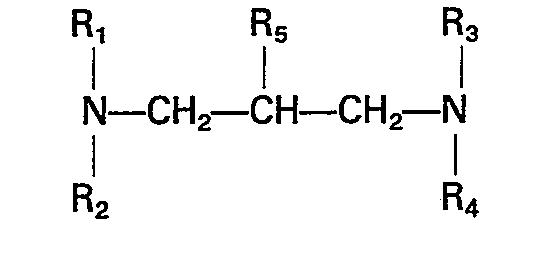
wherein R1, R2, R3 and R4 are alkyl (C1-C3), and R5 is hydrogen or hydroxyl, in an amount effective to reduce the residues of the epihalohydrin and 1,3-dihalo-2-propanol, while maintaining the dialkylamine residue content of said polymer below about 1000 ppm.
wherein R1, R2, R3 and R4 are alkyl (C1-C3), and R5 is hydrogen or hydroxyl, in an amount effective to reduce the residues of the epihalohydrin and 1,3-dihalo-2-propanol, while maintaining the dialkylamine residue content of said polymer below about 1000 ppm.
1. Verfahren zur Verringerung des gesamten kombinierten Epihalogenhydrin- und 1,3-Dihalogen-2-propanol-Rückstandgehalts
eines polyquaternären Polymeren, hergestellt aus einem Epihalogenhydrin, einem Dialkylamin
und gegebenenfalls einem polyfunktionellen Amin, wobei der Dialkylamin-Rückstandgehalt
des Polymeren unter etwa 1000 ppm gehalten wird, umfassend die Behandlung des Polymeren
mit einer zur Rückstandsverringerung wirksamen Menge eines Behandlungsmittels der
Formel:
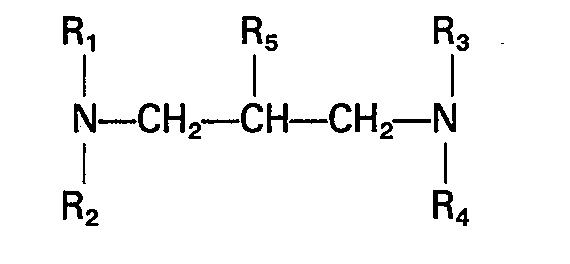
wobei R1, R2, R3 und R4 für Alkyl (C1-C3) stehen, und R5 für Wasserstoff oder Hydroxyl steht.
wobei R1, R2, R3 und R4 für Alkyl (C1-C3) stehen, und R5 für Wasserstoff oder Hydroxyl steht.
2. Verfahren nach Anspruch 1, wobei das Epihalogenhydrin Epichlorhydrin ist, das Dialkylamin
Dimethylamin ist und das fakultative polyfunktionelle Amin Ethylendiamin ist.
3. Verfahren nach Anspruch 1 oder Anspruch 2, wobei jeder der Reste R1, R2, R3 und R4 jeweils Methyl ist und R5 für Hydroxyl steht.
4. Verfahren nach Anspruch 1 oder Anspruch 2, wobei das Molverhältnis des Behandlungsmittels
zu den Rückständen von etwa 10 bis 20:1 beträgt.
5. Verfahren nach Anspruch 1, wobei das Molverhältnis des Behandlungsmittels zu den
Rückständen etwa 20:1 beträgt.
6. Verfahren nach Anspruch 5, wobei das Behandlungsmittel dem Polymeren in zwei wesentlich
gleichen Chargen zugesetzt wird, und zwar im Abstand von etwa 30 Minuten.
7. Verfahren nach Anspruch 1, wobei die Reaktionszeit mindestens etwa eine Stunde
beträgt.
8. Verfahren nach Anspruch 1, wobei die Reaktionstemperatur von etwa 80°C bis 90°C
beträgt.
9. Polyquaternäres Polymeres, das hergestellt wurde, indem man ein aus einem Epihalogenhydrin,
einem Dialkylamin und gegebenenfalls einem polyfunktionellen Amin hergestelltes Polymeres
nachbehandelt mit einer Verbindung der Formel:
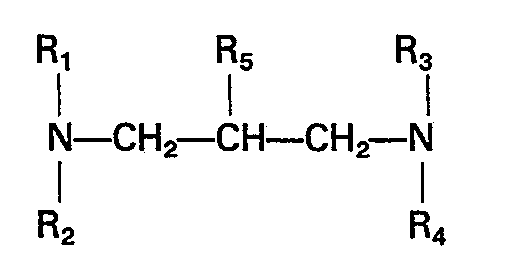
wobei R1, R2, R3 und R4 für Alkyl (C1-C3) stehen und R5 für Wasserstoff oder Hydroxyl steht, in einer wirksamen Menge zur Verringerung der Rückstände an Epihalogenhydrin und 1,3-Dihalogen-2-propanol, wobei man den Dialkylamin-Rückstandgehalt des Polymeren unter etwa 1000 ppm hält.
wobei R1, R2, R3 und R4 für Alkyl (C1-C3) stehen und R5 für Wasserstoff oder Hydroxyl steht, in einer wirksamen Menge zur Verringerung der Rückstände an Epihalogenhydrin und 1,3-Dihalogen-2-propanol, wobei man den Dialkylamin-Rückstandgehalt des Polymeren unter etwa 1000 ppm hält.
1. Procédé pour réduire la teneur résiduelle totale en épihalogénohydrine et en 1,3-dihalogéno-2-propanol
comninés d'un polymère polyquaternaire préparé à partir d'une épihalogénohydrine,
d'une dialkylamine et éventuellement d'une amine polyfonctionnelle tout en maintenant
la teneur résiduelle en dialkylamine dudit polymère en dessous d'environ 1 000 ppm,
qui comprend le traitement dudit polymère avec une quantité efficace pour réduire
les résidus d'un composé de traitement de formule:
dans laquelle R1, R2, R3 et R4 sont chacun un alkyle (C1―C3) et R5 est un hydrogène ou un hydroxyle.
dans laquelle R1, R2, R3 et R4 sont chacun un alkyle (C1―C3) et R5 est un hydrogène ou un hydroxyle.
2. Procédé selon la revendication 1 caractérisé en ce que l'épihalogénohydrine est
l'épichlorhydrine, la dialkylamine est la diméthylamine et l'amine polyfonctionnelle
éventuelle est l'éthylènediamine.
3. Procédé selon la revendication 1 ou la revendication 2, caractérisé en ce que R1, R2, R3 et R4 sont chacun un méthyle et R5 est un hydroxyle.
4. Procédé selon la revendication 1 ou la revendication 2, caractérisé en ce que le
rapport molaire du composé de traitement aux résidus est d'environ 10 à 20/1.
5. Procédé selon la revendication 1 caractérisé en ce que le rapport molaire du composé
de traitement aux résidus est d'environ 20/1.
6. Procédé selon la revendication 5 caractérisé en ce que le composé de traitement
est ajouté au polymère en deux charges essentiellement égales, espacées d'environ
30 minutes.
7. Procédé selon la revendication 1 caractérisé en ce que la durée de réaction est
d'au moins environ une heure.
8. Procédé selon la revendication 1 caractérisé en ce que la température de réaction
est d'environ 80°C à 90°C.
9. Polymère polyquaternaire produit par traitement ultérieur d'un polymère, préparé
à partir d'un épihalogénohydrine, d'une dialkylamine et éventuellement d'une amine
polyfonctionnelle, avec un composé de formule:
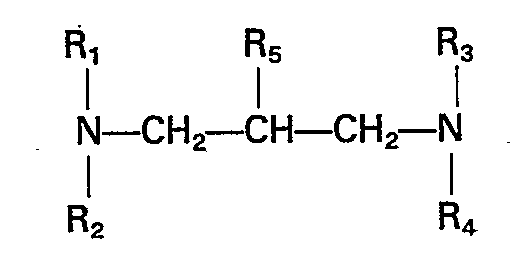
dans laquelle R1, R2, R3 et R4 sont chacun un alkyle (Cl-C3) et R5 est un hydrogène ou un hydroxyle, en une quantité efficace pour réduire les résidus de l'épihalogénohydrine et du 1,3-dihalogéno-2-propanol, tout en maintenant la teneur résiduelle en dialkylamine dudit polymère en dessous d'environ 1 000 ppm.
dans laquelle R1, R2, R3 et R4 sont chacun un alkyle (Cl-C3) et R5 est un hydrogène ou un hydroxyle, en une quantité efficace pour réduire les résidus de l'épihalogénohydrine et du 1,3-dihalogéno-2-propanol, tout en maintenant la teneur résiduelle en dialkylamine dudit polymère en dessous d'environ 1 000 ppm.