| (19) |
 |
|
(11) |
EP 0 053 783 B1 |
| (12) |
EUROPEAN PATENT SPECIFICATION |
| (45) |
Mention of the grant of the patent: |
|
11.07.1984 Bulletin 1984/28 |
| (22) |
Date of filing: 30.11.1981 |
|
|
| (54) |
A rear lamp construction of a hatchback type motor vehicle
Anordnung für Signalleuchten für Fahrzeuge mit einem hochschwenkbaren hinteren Karosserieabschluss
Aménagement de lampes de signalisation pour véhicule ayant un hayon arrière basculant
|
| (84) |
Designated Contracting States: |
|
DE FR GB IT SE |
| (30) |
Priority: |
09.12.1980 JP 177291/80 U
|
| (43) |
Date of publication of application: |
|
16.06.1982 Bulletin 1982/24 |
| (71) |
Applicant: NISSAN MOTOR CO., LTD. |
|
Yokohama-shi
Kanagawa-ken (JP) |
|
| (72) |
Inventor: |
|
- Tohata, Toru
Atsugi-City
Kanagawa pref. (JP)
|
| (74) |
Representative: TER MEER STEINMEISTER & PARTNER GbR |
|
Mauerkircherstrasse 45
81679 München
81679 München (DE) |
|
| |
|
| Note: Within nine months from the publication of the mention of the grant of the European
patent, any person may give notice to the European Patent Office of opposition to
the European patent
granted. Notice of opposition shall be filed in a written reasoned statement. It shall
not be deemed to
have been filed until the opposition fee has been paid. (Art. 99(1) European Patent
Convention).
|
[0001] The present invention relates in general to a rear lamp construction of a wheeled
motor vehicle, and more particularly to a rear lamp construction of a hatchback type
motor vehicle.
[0002] It is an object of the present invention to provide a rear lamp construction, for
a hatchback type motor vehicle, which offers sufficient illumination areas to improve
the recognition of the illumination on the back portion of the vehicle.
[0003] In conventional embodiments (Fig. 1, 2), there is provided a rear lamp construction
of a motor vehicle of a type having a hatchback door which is swingable relative to
the vehicle body to open and close a door opening defined in a rear panel construction
of the vehicle. According to the present invention, the rear lamp construction comprises
first means mounted in the rear panel construction for producing light which is directed
toward the door opening; and second means mounted in the hatchback door at a portion
where the light coming from the first means reaches when the door is in its closed
position, the second means reflecting the light coming from the first means towards
the back of the vehicle.
[0004] Other objects and advantages of the present invention will become clear from the
following description when taken in conjunction with the accompanying drawings, in
which:
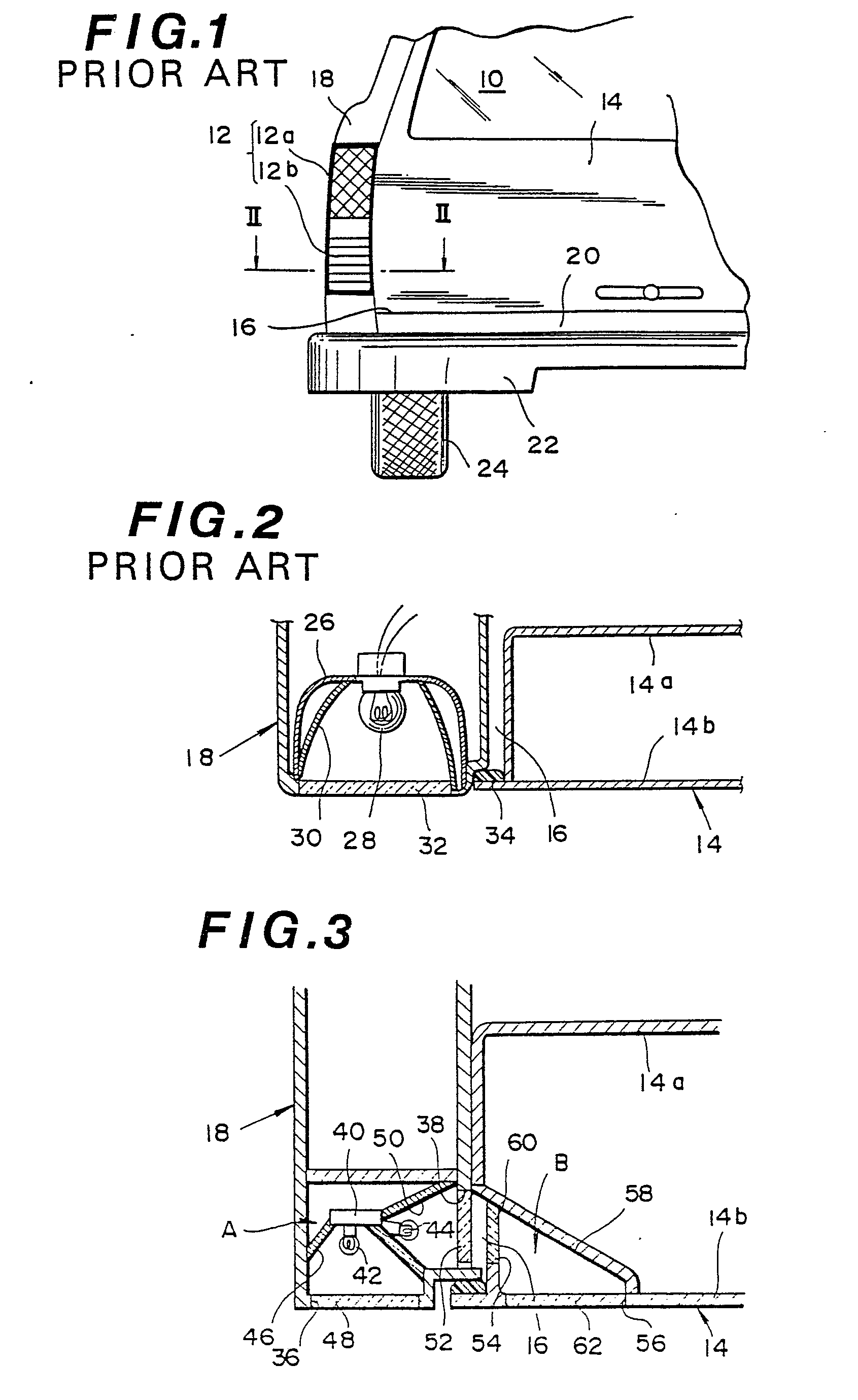
Fig. 1 is a partial rear view of a hatchback type motor vehicle which is equipped
with a conventional rear lamp construction;
Fig. 2 is a sectional, but enlarged, view taken along the line II-II of Fig. 1;
Fig. 3 is a view similar to Fig. 2, but showing a first embodiment of the present
invention;
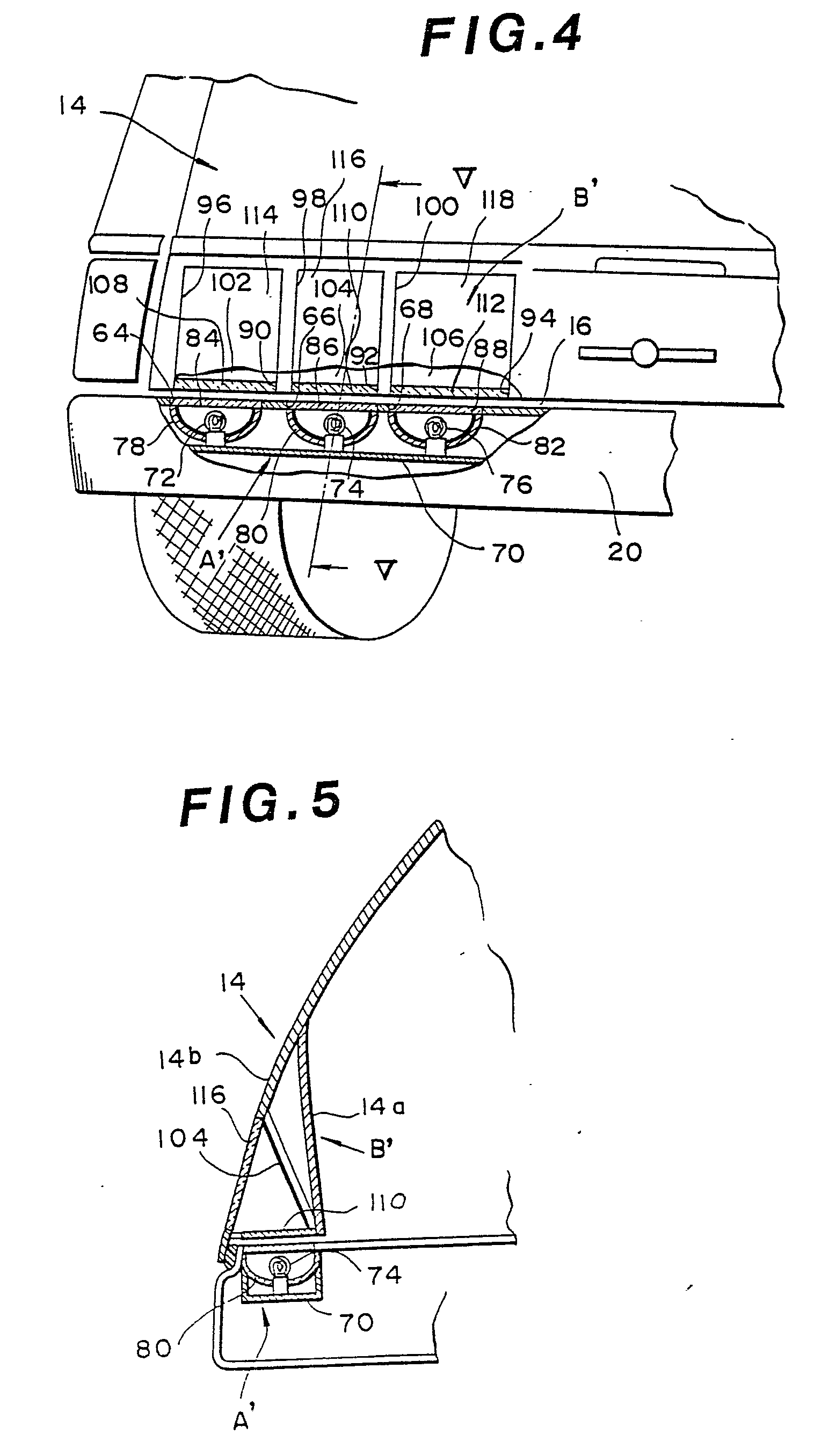
Fig. 4 is a partially broken rear view of a hatchback type motor vehicle to which
a second embodiment of the present invention is applied; and
Fig. 5 is a sectional view taken along the line V-V of Fig. 4.
[0005] Prior to describing the invention, one of the conventional rear lamp constructions
of a hatchback type motor vehicle will be explained with reference to Figs. 1 and
2 in order to clarify the invention.
[0006] In these drawings, particularly in Fig. 1, there is shown a hatchback type wheeled
motor vehicle 10 to which a conventional rear lamp construction 12 is mounted. The
motor vehicle 10 has a hatchback door 14 which is hinged at its upper portion to the
vehicle body so as to be upwardly and downwardly swingable about the hinged portion
to open and close a door opening 16 which is defined by rear side bodies 18 (only
one being shown), a roof panel (not shown) and a rear transverse lower panel 20. Designated
by numerals 22 and 24 are a rear bumper and a rear-left road wheel of the vehicle
10.
[0007] The rear lamp construction 12 hereinshown is a combination lamp unit consisting of
a stop lamp 12a and a tail lamp 12b. The lamp unit 12 is mounted on the back portion
of each rear side body 18 and comprises, as is understood from Fig. 2, a supporter
26 tightly received in the rear side body 18, electric bulbs 28 (only one being shown)
held on the supporter 26, frustoconical light reflecting mirrors 30 coaxially disposed
about the respective bulbs 28, and a light transmitting cover 32 or a lens covering
the larger open ends of the mirrors 30. The hatchback , door 14 is formed by an inner
panel 14a and an outer panel 14b. Designated by numeral 34 is an elastic packing which
is bonded to the peripheral portion of the door 14 to assure sealing between the door
14 and the vehicle body 10 upon closing of the door 14.
[0008] However, in the conventional rear lamp construction of the type mentioned above,
there is a limit to increase the size of the combination lamp unit or the area of
the light transmitting cover 32 because of the inherent narrowness of the place, viz.
the back portion of the rear side body 18, where the lamp unit 12 is to be mounted.
Thus, a sufficient recognition effect can not be expected from such construction especially
on cloudy or rainy days.
[0009] Hitherto, a measure has been proposed for eliminating such drawback, in which a lamp
unit is mounted on the hatchback door. Although, in this case, enlargement of the
unit or increase in illumination area can be easily made, there is a necessity of
a quite troublesome electric wiring owing to the pivotal arrangement of the door to
the vehicle body.
[0010] To eliminate the above-mentioned drawbacks is an essential object of the present
invention. In the following, the present invention will be described in detail.
[0011] Referring to Fig. 3, there is shown a first embodiment of the present invention.
In this drawing, the same parts as those in Fig. 2 are designated by the same numerals.
[0012] The rear lamp construction of the first embodiment comprises generally a first illumination
device A mounted on the rear side body 18 and a second illumination device B mounted
on the hatchback door 14. As will become apparent as the description proceeds, the
second illumination device B has no electric bulbs therein and functions only to reflect
the light, which comes thereto from the first illumination device A, toward the back
of the vehicle.
[0013] The first illumination device A is mounted on the back portion of the rear side body
18. For this mounting, the back portion of the body 18 is formed with both an opening
36 facing backward of the vehicle and another opening 38 facing towards the door opening
16. The device A comprises a lamp holder 40 tightly held in the body 18. Two spaced
electric bulbs 42 and 44 are mounted on the lamp holder 40 and have respective electric
lead wires (not shown) extending therefrom and lying in the body 18. A frusto-conical
light reflecting mirror 46 is coaxially disposed about the bulb 42 with its larger
open end facing the opening 36. A light transmitting cover 48 or a lens is mounted
in the opening 36 so as to cover the larger open end of the mirror 46. Another frusto-conical
light reflecting mirror 50 is coaxially disposed about the other electric bulb 44
with its larger open end facing toward the door opening 16. A light transmitting cover
52 is mounted in the opening 38 so as to cover the larger open end of the mirror 50.
With this arrangement, it will be appreciated that the light emitted from the bulb
42 is directed toward the back of the vehicle through the light transmitting cover
48, while, the light from the bulb 44 is directed toward the door opening 16 through
the light transmitting cover 52.
[0014] The second illumination device B is mounted on the hatchback door 14 at the portion
where the light from the bulb 44 reaches when the door 14 is in its closed position.
For facilitation of explanation, the following description will be made with respect
to a condition wherein the door 14 is in its closed position, that is, in the position
as shown in Fig. 3. For mounting thereon the second illumination device B, the door
14 is formed with both an opening 54 facing the light transmitting cover 52 of the
first illumination device A, and another opening 56 facing backward of the vheicle.
The second illumination device B comprises a flat light relfect- ing mirror 58 which
is received in the recep- table portion of the door 14 and secured to the door panels
14a and 14b in a manner to be inclined with respect to the advancing direction of
the light from the bulb 44. Preferably, the mirror 58 is inclined at 45 degrees with
respect to the light advancing direction. A light transmitting cover 60 is mounted
in the opening 54, and another light transmitting cover 62 or a lens is mounted in
the opening 56 of the door 14, as shown. With this arrangement, it will be appreciated
that the light from the electric bulb 44 of the first illumination device A enters
the second illumination device B and is reflected by the flat mirror 58 toward the
cover 62, that is, toward the back of the vehicle.
[0015] Referring to Figs. 4 and 5, especially Fig. 4 there is shown a second embodiment
of the present invention. As will become apparent as the description proceeds, the
rear lamp construction of this second embodiment is designed to illuminate only the
illumination device mounted on the hatchback door 14.
[0016] The rear lamp construction of the second embodiment comprises generally a lamp mounting
device A' mounted on the rear transverse lower panel 20, and an illumination device
B' mounted on the hatchback door 14.
[0017] For mounting thereon the lamp mounting device A', the panel 20 is formed with aligned
openings 64, 66 and 68 all of which face upwardly, that is, toward the door opening
16. The device A' comprises a lamp holder 70 tightly held in the panel 20. Three spaced
electric bulbs 72, 74 and 76 are held by the lamp holder 70 and have respective electric
lead wires (not shown) extending therefrom and lying in the panel 20. Frusto-conical
light reflecting mirrors 78, 80 and 82 are coaxially disposed about the bulbs 72,
74 and 76, respectively, with their larger open ends facing the corresponding openings
64, 66 and 68. Light transmitting covers 84, 86 and 88 are respectively mounted in
the openings 64, 66 and 68 so as to cover the larger open ends of the mirrors 78,
80 and 82. With this arrangement, it will be appreciated that the light emitted from
each of the bulbs 72, 74 and 76 is directed upward, that is, toward the door opening
16 of the vehicle.
[0018] The illumination device B' is mounted on the hatchback door 14 at the portion where
the light from the bulbs 72, 74 and 76 reaches when the door 14 is in its closed position.
Similar to the first embodiment, the following description will be made with respect
to a condition wherein the door 14 is in its closed position, that is, in the position
as shown in the drawings (Figs. 4 and 5). For mounting thereon the illumination device
B', the door 14 is formed with a first group of openings 90, 92 and 94 which face
the light transmitting covers 84, 86 and 88 of the lamp mounting device A' respectively,
and a second group of openings 96, 98 and 100 which face backward of the vehicle.
If desired, some of the openings 96, 98 and 100, for example, the openings 98 and
100, may be united to provide a larger opening in the rear transverse lower panel
20. The illumination device B' comprises flat light reflecting mirrors 102, 104 and
106 each of which is secured to the panels 14a and 14b of the door 14 in a manner
to be inclined with respect to the advancing direction of the light from the corresponding
bulb 72, 74 or 76. Light transmitting covers 108, 110 and 112 are mounted in the first
group of openings 90, 92 and 94 respectively, and light transmitting covers 114, 116
and 118 are mounted respectively in the second group of openings 96, 98 and 100. With
this arrangement, it will be appreciated that the light emitted from the bulbs 72,
74 and 76 of the light mounting device A' enter the illumination device B' and is
reflected by the corresponding flat mirrors 102, 104 and 106 toward the exteriorly
exposed light transmitting covers 114, 116 and 118, that is, toward the back of the
vehicle.
[0019] From the above description, it will be appreciated that when the hatchback door 14
is in its closed position under energization of the electric bulbs, a considerable
area of the hatchback door 14 participates in offering effective recognition of the
rear of the vehicle. In short, the rear lamp construction according to the present
invention can provide a larger illumination area on the rear portion of the vehicle
because of using the hatchback door as a promoting means for the illumination. When
the hatchback door 14 is in its open position, the light from each bulb will come
through the first illumination device A (in the first embodiment) or the lamp mounting
device A' (in the second embodiment). However, this light is usable for lighting up
the surrounding of the rear of the vehicle.
[0020] It is also to be noted that because the illumination device on the hatchback door
14 has no electric bulbs, the troublesome wiring on the door is not necessitated in
the present invention. This is quite advantageous in production of the vehicle.
1. A rear lamp construction of a motor vehicle of a type having a hatchback door which
is swingable relative to the vehicle body to open and close a door opening defined
in a rear panel construction of the vehicle, characterized in that said rear lamp
construction comprises first means (44, 50-52, 72-88) mounted in said rear panel construction
for producing light which is directed toward the door opening; and second means (58-62,
102-118) mounted in said hatchback door at a portion where the light coming from said
first means reaches when the door is in its closed position, said second means reflecting
the light coming from said first means toward the back of the vehicle.
2. A rear lamp construction as claimed in claim 1, characterized in that said first
means comprises an electric bulb (44, 72-76) for producing light when electrically
energized, and a first light reflecting mirror (50, 78-82) for enforcedly directing
the light coming from the bulb toward the door opening, and in which said second means
comprises a second light reflecting mirror (58, 102-106) for enforcedly directing
the light coming from the first mirror of the first means toward the back of the vehicle.
3. A rear lamp construction as claimed in claim 2, characterized in that said first
means further comprises a first light transmitting member (52, 84-88) mounted in an
opening (38, 64-68) which is formed in said rear panel construction at a position
to face the door opening, so that the light coming from said electric bulb transmits
through the first light transmitting member during its travelling toward the second
light reflecting mirror.
4. A rear lamp construction as claimed in claim 3, characterized in tha said second
means further comprises second and third light transmitting members (60-62, 108-118),
said second light transmitting member being mounted in an opening (54, 90-94) which
is formed in said hatchback door at a portion which faces said first light transmitting
member of said first means when the door is in its closed position, said third light
transmitting member being mounted in an opening (56, 96-100) which is formed in said
hatchback door at a position to face backward of the vehicle.
5. A rear lamp construction as claimed in claim 4, characterized in that said first
means further comprises another electric bulb (42) for producing light when electrically
energized, and a third light reflecting mirror (46) for enforcedly directing the light
coming from said other electric bulb toward the back of the vehicle.
6. A rear lamp construction as claimed in claim 5, characterized in that said first
means further comprises a fourth light transmitting member (48), said fourth light
transmitting member being mounted in an opening (36) which is formed in said rear
panel construction at a position to face backward of the vehicle.
7. A rear lamp construction as claimed in claim 4, characterized in that said first
light reflecting mirror is a frustoconical mirror (50, 78-82) which is coaxially disposed
about the electric bulb with its larger open end facing toward the door opening, and
in which said second light reflecting mirror is a flat mirror (58, 102-106) which
is secured to said door in a manner to be inclined with respect to the advancing direction
of the light coming from said electric bulb.
8. A rear lamp construction as claimed in claim 5, characterized in that said third
light reflecting mirror is a frustoconical mirror (46) which is coaxially disposed
about said other electric bulb (42) with its larger open end facing backward of said
vehicle.
9. A rear lamp construction as claimed in claim 4, characterized in that said third
light transmitting member (60, 108-112) is a lens.
10. A rear lamp construction as claimed in claim 6, characterized in that said fourth
light transmitting member (48) is a lens.
1. Rückleuchtenkonstruktion für ein Kraftfahrzeug mit einer Heckklappe, die in bezug
auf die Fahrzeugkarosserie zum Öffnen und Schließen einer Türöffnung in einer Rückwand
des Fahrzeugs schwenkbar ist, dadurch gekennzeichnet, daß die Rückleuchtenkonstruktion
eine erste Einrichtung (44, 50-52, 72-88), die in der Rückwand montiert ist zur Erzeugung
von Licht, das in Richtung der Türöffnung gerichtet ist, und eine zweite Einrichtung
(58-62, 102-118) umfaßt, die in der Heckklappe in einem Bereich montiert ist, in der
das Licht von der ersten Einrichtung bei geschlossener Heckklappe auftrifft, welche
zweite Einrichtung das von der ersten Einrichtung kommende Licht in Richtung der Rückseite
des Fahrzeugs reflektiert.
2. Rückleuchtenkonstruktion nach Anspruch 1, dadurch gekennzeichnet, daß die erste
Einrichtung eine elektrische Glühlampe (44, 72-76) zur Erzeugung von Licht bei elektrischer
Erregung und einem ersten Light reflektierenden Spiegel (50, 78-82) zur verstärkten
Lenkung des von der Glühlampe kommenden Lichts in Richtung der Türöffnung umfaßt,
und daß die zweite Einrichtung einen zweiten Licht reflektierenden Spiegel (58, 102-106)
zur verstärkten Lenkung des von dem ersten Spiegel der ersten Einrichtung kommenden
Lichts in Richtung der Rückseite des Fahrzeugs umfaßt.
3. Rückleuchtenkonstruktion nach Anspruch 2, dadurch gekennzeichnet, daß die erste
Einrichtung weiterhin ein erstes Licht durchlassendes Teil (52, 84-88) in einer Öffnung
(38, 64-68) in der Rückwand in einer Position gegenüber der Türöffnung umfaßt, so
daß das von der elektrischen Glühlampe abgegebene Licht durch das erste Licht durchlassende
Teil hindurch zu dem zweiten Licht reflektierenden Spiegel gelangt.
4. Rückleuchtenkonstruktion nach Anspruch 3, dadurch gekennzeichnet, daß die zweite
Einrichtung weiterhin zweite und dritte Licht durchlassende Teile (60-62, 108-118)
umfaßt, daß das zweite Licht durchlassende Teil in einer Öffnung (54, 90-94) in einer
Öffnung in der Heckklappe in einem Bereich gegenüber dem ersten Licht durchlassenden
Teil der ersten Einrichtung angeordnet ist, wenn die Heckklappe in der geschlossenen
Stellung steht, daß das dritte Licht durchlassende Teil in einer Öffnung (56, 96-100)
angeordnet ist, die in der Heckklappe in einer zur Rückseite des Fahrzeugs weisenden
Position vorgesehen ist.
5. Rückleuchtenkonstruktion nach Anspruch 4, dadurch gekennzeichnet daß die erste
Einrichtung weiterhin eine andere elektrische Glühlampe (42) zur Erzeugung von Licht
bei elektrischer Erregung und einen dritten Licht reflektierenden Spiegel (46) zur
verstärkten Lenkung des von der anderen Glühlampe kom-' menden Lichts in Richtung
der Rückseite des Fahrzeugs umfaßt.
6. Rückleuchtenkonstruktion nach Anspruch 5, dadurch gekennzeichnet, daß die erste
Einrichtung weiterhin ein viertes Licht durchlassendes Teil (48) umfaßt, das in einer
Öffnung (36) in der Rückwand in einer Position angeordnet ist, die zur Rückseite des
Fahrzeugs weist.
7. Rückleuchtenkonstruktion nach Anspruch 4, dadurch gekennzeichnet, daß der erste
Licht reflektierende Spiegel ein kegelstumpfförmiger Spiegel (50, 78-82) ist, der
koaxial um die elektrische Glühlampe herum derart angeordnet ist, daß das weitere
rückwärtige Ende der Türöffnung zugewandt ist, und daß der zweite Licht reflektierende
Spiegel ein flacher Spiegel (58, 102-106) ist, der an der Heckklappe geneigt zur Ausbreitungsrichtung
des von der elektrischen Glühlampe kommenden Lichts angeordnet ist.
8. Rückleuchtenkonstruktion nach Anspruch 5, dadurch gekennzeichnet, daß der dritte
Licht reflektierende Spiegel ein kegelstumpfförmiger Spiegel (46) ist, der koaxial
um die andere elektrische Glühlampe (42) herum derart angeordnet ist, daß sein weiteres
offenes Ende der Rückseite des Fahrzeugs zugewandt ist.
9. Rückleuchtenkonstruktion nach Anspruch 4, dadurch gekennzeichnet, daß das dritte
Licht durchlassende Teil (60, 108-112) eine Linse ist.
10. Rückleuchtenkonstruktion nach Anspruch 6, dadurch gekennzeichnet, daß das vierte
Licht durchlassende Teil (48) eine Linse ist.
1. Construction d'une lanterne arrière d'un véhicule automobile ayant une portière
à hayon arrière pouvant pivoter par rapport à la carrosserie du véhicule pour ouvrir
et fermer une ouverture définie dans la construction du panneau arrière du véhicule,
caractérisée en ce que ladite construction de lanterne arrière comprend des premiers
moyens (44, 50-52, 72-88) montés dans ladite construction de panneau arrière pour
produire de la lumière qui est dirigée vers l'ouverture de la portière et des seconds
moyens (58-62, 102-118) montés dans ladite portière du hayon arrière en une partie
que la lumière provenant desdits premiers moyens atteint quand la portière est à sa
position fermée, lesdits seconds moyens réfléchissant la lumière provenant desdits
premiers moyens vers l'arrière du véhicule.
2. Construction de lanterne arrière selon la revendication 1, caractérisée en ce que
lesdits premiers moyens comprennent une ampoule électrique (47, 72-76) pour produire
de la lumière lorsqu'elle est électriquement excitée, et un premier miroir réfléchissant
la lumière (50, 78-82) pour diriger, de force, la lumière provenant de l'ampoule vers
l'ouverture de la portière, et où lesdits seconds moyens comprennent un second miroir
réfléchissant la lumière (58, 102-106) pour diriger, de force, la lumière provenant
du premier miroir des premiers moyens vers l'arrière du véhicule.
3. Construction de lanterne arrière selon la revendication 2, caractérisée en ce que
lesdits premiers moyens comprennent de plus un premier organe transmettant la lumière
(52, 84-88) monté dans une ouverture (38, 64-68) qui est formée dans ladite construction
de panneau arrière en une position pour faire face à l'ouverture de la portière, de
façon que la lumière provenant de ladite ampoule électrique soit transmise à travers
ledit premier organe transmettant la lumière pendant son parcours vers le second miroir
réfléchissant la lumière.
4. Construction de lanterne arrière selon la revendication 3, caractérisée en ce que
les seconds moyens comprennent de plus des second et troisième organes transmettant
la lumière (60-62, 108-118), ledit second organe transmettant la lumière étant monté
dans une ouverture (54, 90-94) qui est formée dans ladite portière formant hayon arrière
en une partie qui fait face audit organe transmettant la lumière desdits premiers
moyens quand la portière est à sa position fermée, ledit troisième organe transmettant
la lumière étant monté dans une ouverture (56, 96-100) qui est formée dans ladite
portière formant hayon en une position pour être tournée vers l'arrière du véhicule.
5. Construction de lanterne arrière selon la revendication 4, caractérisée en ce que
les premiers moyens comprennent de plus une autre ampoule électrique (42) pour produire
de la lumière quand elle est électriquement excitée, et un troisième miroir réfléchissant
la lumière (46) pour diriger, de force, la lumière provenant de ladite autre ampoule
électrique vers l'arrière du véhicule.
6. Construction de lanterne arrière selon la revendication 5, caractérisée en ce que
les premiers, moyens comprennent de plus un quatrième organe transmettant la lumière
(48), ledit quatrième organe transmettant la lumière étant monté dans une ouverture
(36) qui est formée dans ladite construction de panneau arrière en une position pour
être tournée vers l'arrière du véhicule.
7. Construction de lanterne arrière selon la revendication 4, caractérisée en ce que
ledit premier miroir réfléchissant la lumière est un miroir tronconique (50, 78-82)
disposé coaxialement autour de l'ampoule électrique avec son extrémité ouverte plus
large tournée vers l'ouverture de la portière et en ce que ledit second miroir réfléchissant
la lumière est un miroir plan (58, 102-106) qui est fixé à ladite portière de façon
à être incliné par rapport à la direction d'avance de la lumière provenant de ladite
ampoule électrique.
8. Construction de lanterne arrière selon la revendication 5, caractérisée en ce que
ledit troisième miroir réfléchissant la lumière est un moroir tronconique (46) disposé
coaxialement autour de ladite autre ampoule électrique (42) avec son extrémité plus
large ouverte tournée vers l'arrière dudit véhicule.
9. Construction de lanterne arrière selon la revendication 4, caractérisée en ce que
ledit troisième organe transmettant la lumière (60, 108-112) est une lentille.
10. Construction de lanterne arrière selon la revendication 6, caractérisée en ce
que ledit quatrième organe transmettant la lumière (48) est une lentille.