|
(11) | EP 0 054 376 B1 |

| (12) | EUROPEAN PATENT SPECIFICATION |
|
|
| (54) |
Volatile oil compositions for metal working Flüchtige Ölzusammensetzungen zur Metallbearbeitung Compositions d'huile volatile pour le traitement de métal |
|
|
|||||||||||||||||||||||||||||||
|
||||||||||||||||||||||||||||||||
| Note: Within nine months from the publication of the mention of the grant of the European patent, any person may give notice to the European Patent Office of opposition to the European patent granted. Notice of opposition shall be filed in a written reasoned statement. It shall not be deemed to have been filed until the opposition fee has been paid. (Art. 99(1) European Patent Convention). |
[0001] This invention relates to volatile oil compositions for metal working and more particularly to volatile lubricant oil compositions for use in processing, machining or temporarily lubricating metal material.
[0002] Conventional lubricant oil compositions for metal working are all nonvolatile and thus, when used, will remain on the surface of the metal product after the completion of the mechanical treatment, consequently necessitating the removal of oil from the surface thereof by washing.
[0003] It has also been proposed to use certain halogenated hydrocarbons in lubricant oil compositions for metal working. Thus US-A-3,129,182 describes a cutting fluid consisting essentially of approximately 40 parts of the specific halogenated hydrocarbon trichlorotrifluoroethane and 1 part ethylene glycol monobutyl ether.
[0004] The principal object of the present invention is to provide volatile lubricant oil compositions for metal working (hereinafter referred to as "volatile metal working oil compositions").
[0005] Another object of the invention is to provide volatile metal working oil compositions which exhibit outstanding properties in use for the processing of metal materials.
[0006] A further object of the invention is to provide metal working oil compositions which are volatile and which have a cooling ability and lubricity and act as an extreme pressure lubricant.
[0007] A further object of the invention is to provide volatile metal working oil compositions having a lubricity and cooling ability sufficient to give reduced friction to metal materials, thereby providing the finished surface of metal product with improved smoothness and the prolongation of tool life.
[0008] The above and other objects of the invention will become more apparent from the following description of the invention.
[0009] These objects of the invention are achieved by providing a volatile oil composition for use in metal working comprising at least one halogenated hydrocarbon and a fluoro oil as a base oil component.
[0010] The volatile metal working oil compositions of this invention have the feature of being volatilized when left to stand at room temperature and normal pressure for 24 hours. The halogenated hydrocarbon component of the present oil composition are liquids having a boiling point of up to 125°C, preferably in the range of 35 to 125°C. Such halogenated hydrocarbon component acts mainly to cool the surface of metal products.
[0011] Typical of useful halogenated hydrocarbons are methylene chloride, perchloroethylene, tetrachlorodifluoroethane, trichlorotrifluoroethane, tetrachloromonofluoroethane, trichlorodifluoroethane, tetrachlorotetrafluoropropane or mixtures of these two or more hydrocarbons. Among such halogenated hydrocarbons, those having at least one fluorine atom are especially preferred because due to their low surface energy, they readily penetrate into the surface of metal products.
[0013] Useful fluoro oils are oil liquids having a boiling point of up to 250°C, preferably 130 to 250°C. Examples of useful fluoro oils are telomers containing, as a taxogen, fluoro olefins such as tetrafluoroethylene and trifluorochloroethylene. Particularly preferred fluoro oils are telomers containing chlorotrifluoroethylene havinq the formula
wherein n is an integer of 2 to 4.
[0014] With this invention, it is preferable to use such fluoro oil conjointly with at least one other base oil. Base oils useful in this invention as an additional component are those having a boiling point of up to 250°C. Examples of useful base oils are saturated or unsaturated aliphatic hydrocarbons, aromatic hydrocarbons, naphthene hydrocarbons, alkyl ethers of alkylene glycol and the like. Useful saturated or unsaturated aliphatic hydrocarbons include n-decane, dodecane, turpentine oil and pine oil. Exemplary of useful aromatic hydrocarbons is cymene. An example of a useful naphthene hydrocarbon is dicyclohexyl. The fluoro oil when mixed with any one of the other base oils can synergistically give reduced friction to the surface of the metal product, thus contributing to pronounced enhancement of workability.
[0015] The amounts of halogenated hydrocarbon and base oil to be used in the present invention are not particularly limited but are widely variable although the use of these materials are restricted to those having the boiling point in the ranges as specified above. Usually the base oil is used in an amount of 20 to 200 parts by weight per 100 parts by weight of the halogenated hydrocarbon. When conjointly used with the other base oils, the fluoro oil is preferably employed in an amount of about 5 to about 50 parts by weight per 100 parts by weight of the halogenated hydrocarbon.
[0016] The volatile metal working oil compositions of this invention may have incorporated therein conventional additives such as a load-resisting additive. Useful load-resisting additives are those having a boiling point of up to 250°C, such as phosphates, fatty acid esters and alkylene glycol esters. Typical of these esters are trimethylphosphate, triethylphosphate, tripropylphosphate and like triphosphates; dimethylhydrogenphosphite or like diphosphites; ethylcaproic acid ester, ethylcaprylic acid ester, ethylcapric acid ester and like fatty acid esters; and polyethyleneglycolmethylether acetate, ethyleneglycol- monoethylether acetate and like alkyleneglycol esters.
[0017] The oil compositions of the present invention are advantageously used as aerosols as well as liquids. They are useful, for example, in machining aluminium or stainless steel materials, making holes in printed circuits, reaming, tapping, thread chasing and being used as a lubricant in the assembling involving insertions or slidings, and in like metal working.
[0018] The present invention will be hereinafter described in more detail with reference to the examples and comparative examples given below.
Examples 1-3 and Comparative Examples 1-5
[0019] Samples of the present invention were prepared from the halogenated hydrocarbons, base oils and fluoro oils as another base oil in the proportions as listed in the table below.
[0020] On the other hand, comparative samples were prepared by using the halogenated hydrocarbons, base oils or fluoro oil each singly or in admixture.
[0021] These two groups of samples were tested by being each applied to metal test pins which then were fixed in a tester for checking FALEX lubricants. The tester were subsequently operated to rotate the test pins with use of a specific load over a specified period of time. Eventually the test pins were evaluated in terms of the amount of the metal material abraded away and coefficient of friction. The table below shows the results.
1: A volatile oil composition for use in metal working comprising at least one halogenated
hydrocarbon and a fluoro oil as a base oil component.
2. A composition as defined in Claim 1 in which the base oil component additionally
comprises at least one base oil other than a fluoro oil.
3. A composition as defined in Claim 1 or 2 in which the fluoro oil is a low polymer
of chlorotrifluoroethylene.
4. A composition as defined in Claim 1, 2 or 3 in which the fluoro oil is a low polymer
of chlorotrifluoroethylene having the formula:
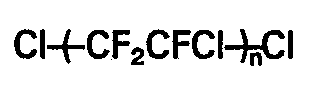
wherein n is an integer of 2 to 4.
wherein n is an integer of 2 to 4.
5. A composition as defined in any preceding claim, in which the base oil has a boiling
point in the range of 130 to 250°C.
6. A composition as defined in any preceding claim in which the halogenated hydrocarbon
has a boiling point of 35 to 125°C.
7. A composition as defined in any preceding claim in which the halogenated hydrocarbon
is a chlorofluoro hydrocarbon.
8. A composition as defined in Claim 7 in which the chlorofluorohydrocarbon is trichlorotrifluoroethane
or tetrachlorodifluoroethane.
9. A composition as defined in any preceding claim which contains a load-resisting
additive having a boiling point of up to 250°C.
10. A composition as defined in Claim 9 in which the load-resisting additive is selected
from the group consisting of phosphate, fatty acid ester and alkyleneglycol ester.
1. Flüchtige Ölzusammensetzung zur Verwendung bei der Metallbearbeitung, die wenigstens
einen halogenierten Kohlenwasserstoff und ein fluoriertes Öl als einen Grundölbestandteil
enthält.
2. Zusammensetzung nach Anspruch 1, in der der Grundölbestandteil zusätzlich wenigstens
ein anderes Grundöl als ein fluoriertes Öl umfaßt.
3. Zusammensetzung nach Anspruch 1 oder 2, in der das fluorierte Öl ein niedriges
Polymer von Chlortrifluoräthylen ist.
4. Zusammensetzung nach Anspruch 1, 2 oder 3, in der das fluorierte Öl ein niedriges
Polymer von Chlortrifluoräthylen mit der Formel
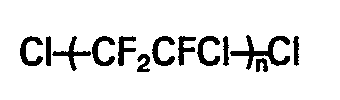
ist, worin, n eine ganze Zahl von 2 bis 4 ist.
ist, worin, n eine ganze Zahl von 2 bis 4 ist.
5. Zusammensetzung nach einem der vorhergehenden Ansprüche, in der das Grundöl einen
Siedepunkt im Bereich von 130 bis 250°C besitzt.
6. Zusammensetzung nach einem der vorhergehenden Ansprüche, in der der halogenierte
Kohlenwasserstoff einen Siedepunkt von 35 bis 125°C besitzt.
7. Zusammensetzung nach einem der vorhergehenden Ansprüche, in der der halogenierte
Kohlenwasserstoff ein Chlorfluorkohlenwasserstoff ist.
8. Zusammensetzung nach Anspruch 7, in der der Chlorfluorkohlenwasserstoff Trichlortrifluoräthen
oder Tetrachlordifluoräthen ist.
9. Zusammensetzung nach einem der vorhergehenden Ansprüche, die ein lastbeständiges
Additive oder einen Hochdruckzusatz mit einem Siedepunkt bis zu 250°C enthält.
10. Zusammensetzung nach Anspruch 9, in der das lastbeständige Additive aus der aus
Phosphat, Fettsäureester und Alkylenglycolester bestehenden Gruppe ausgewählt ist.
1. Composition d'huile volatile utilisable pour le travail des métaux, comprenant
au moins un hydrocarbure halogéné et une huile fluorée comme constituant de l'huile
de base.
2. Composition selon la revendication 1, caractérisée en ce que le constituant de
l'huile de base comprend, en outre, au moins une huile de base autre qu'une huile
fluorée.
3. Composition selon la revendication 1 ou 2, caractérisé en ce que l'huile fluorée
est un polymère inférieur de chlorotrifluoroéthylène.
4. Composition selon la revendication 1, 2 ou 3, caractérisée en ce que l'huile fluorée
est un polymèrè inférieur de chlorotrifluoroéthylène de formule:
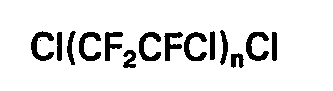
dans laquelle n est un nombre entier de 2 à 4.
dans laquelle n est un nombre entier de 2 à 4.
5. Composition selon l'une quelconque des revendications précédentes, caractérisée
en ce que l'huile de base possède un point d'ébullition compris entre 130 et 250°C.
6. Composition selon l'une quelconque des revendications précédentes, caractérisée
en ce que l'hydrocarbure halogénuré possède un point d'ébullition de 35 à 125°C.
7. Composition selon l'une quelconque des revendications précédentes, caractérisée
en ce que l'hydrocarbure halogéné est un chlorofluoro-hydrocarbure.
8. Composition selon la revendication 7, caractérisée en ce que le chlorofluoro-hydrocarbure
est le trichlorotrifluoroéthane ou le tétrachlorodifluoroéthane.
9. Composition selon l'une quelconque des revendications précédentes, caractérisée
en ce qu'elle contient un additif de résistance à la charge possédant un point d'ébullition
inférieur ou égal à 250°C.
10. Composition selon la revendication 9, caractérisée en ce que l'additif de résistance
à la charge est choisi dans le groupe constitué par un phosphate, un ester d'acide
gras et un ester d'alkylène-glycol.