| (19) |
 |
|
(11) |
EP 0 054 984 B1 |
| (12) |
EUROPEAN PATENT SPECIFICATION |
| (45) |
Mention of the grant of the patent: |
|
28.08.1985 Bulletin 1985/35 |
| (22) |
Date of filing: 30.10.1981 |
|
| (51) |
International Patent Classification (IPC)4: H01M 4/96 |
|
| (54) |
Fuel cell electrode and process for the production of a fuel cell electrode
Brennstoffzellenelektrode und Verfahren zur Herstellung einer Brennstoffzellenelektrode
Electrode pour pile à combustible et procédé de fabrication d'une électrode pour pile
à combustible
|
| (84) |
Designated Contracting States: |
|
AT BE CH DE FR GB IT LI LU NL SE |
| (30) |
Priority: |
13.12.1980 NL 8006774
|
| (43) |
Date of publication of application: |
|
30.06.1982 Bulletin 1982/26 |
| (71) |
Applicant: Electrochemische Energieconversie N.V. |
|
B-2400 Mol (BE) |
|
| (72) |
Inventor: |
|
- Blanchart, Alain Paul Octave
B-2490 Balen (BE)
|
| (74) |
Representative: van Golde, Lambertus Maria Gerardus T. et al |
|
OCTROOIBUREAU DSM
P.O. Box 9
6160 MA Geleen
6160 MA Geleen (NL) |
|
| |
|
| Note: Within nine months from the publication of the mention of the grant of the European
patent, any person may give notice to the European Patent Office of opposition to
the European patent
granted. Notice of opposition shall be filed in a written reasoned statement. It shall
not be deemed to
have been filed until the opposition fee has been paid. (Art. 99(1) European Patent
Convention).
|
[0001] The invention relates to a fuel cell electrode provided with a catalytic layer containing
a noble metal on carbon with a relatively low specific surface and a carbon with a
relatively high specific surface, in particular a gas diffusion electrode.
[0002] Such an electrode e.g. is known from the U.K. patent specification 1,007,490. According
to this patent specification a fuel cell electrode contains a catalytic layer consisting
of a hydrophobic binder and either noble metal on graphite only or noble metal on
a combination of graphite and activated carbon. The catalytic layer containing noble
metal on a combination of graphite and activated carbon is produced by providing an
intimate mixture of the graphite and the activated carbon with a desired quantity
of noble metal, for instance 2% silver. In such a process the noble metal will spread
evenly over the full surface of the two carbons, and after this treatment the activated
carbon (relatively high specific surface) will contain a substantially higher percentage
by weight of noble metal in respect of this activated carbon than the percentage by
weight of noble metal on the graphite (relatively low specific surface) in respect
of this graphite. Also from the German Offenlegungsschrift 2,208,632 an electrode
is known which in the catalytic layer in addition to hydrophobic binder contains graphite
and activated carbon provided with catalyst.
[0003] These known electrodes have great disadvantages. A fuel cell containing such an electrode
has a very poor cell performance and/or shows great instability.
[0004] The object of the invention is a fuel cell electrode combining the capacity of producing
good cell performance with good stability, i.e. an electrode capable of producing
high initial cell performance decreasing only very slowly in course of time. Such
an electrode according to the invention is characterized in that the catalytic layer
contains noble metal on carbon with a specific surface lower than 100 m
lg-
1, preferably lower than 30 m
2g-', and carbon with a specific surface higher than 150 m
2g-', preferably between 200 and 1200 m
2g-', on which carbon with a relatively high specific surface there is at most an equally
large percentage by weight of noble metal in respect of the carbon having a relatively
high specific surface as the percentage by weight of noble metal in respect of the
carbon having a relatively low specific surface on the carbon having a relatively
low specific surface. The carbon with a relatively high specific surface preferably
contains a percentage by weight of noble metal in respect of this carbon with a relatively
high specific surface that is lower than the percentage by weight of noble metal in
respect of the carbon with a relatively low specific surface on the carbon with a
relatively low specific surface or contains no noble metal. The last-mentioned preference
is supported by economic arguments, because the presence of noble metal on the carbon
with a relatively high specific surface has only little effect on the performance
of the electrode according to the invention, and thus noble metal can be saved.
[0005] The carbon for an electrode according to the invention can be suitably provided with
noble metal by depositing on this carbon, from a solution, one or more salts of the
desired noble metal and subsequently reducing these salts with hydrogen to pure metal.
In this process the carbon having a relatively low specific surface must be provided
with the noble metal separately in order to be able to obtain, on this carbon, a percentage
by weight of noble metal in respect of the carbon having a relatively low specific
surface at least as large as the percentage by weight of noble metal in respect of
the carbon having a relatively high specific surface on the rest of the carbon used
in the electrode.
[0006] Very suitable carbons having specific surfaces lower than 100 m
2g-' for electrodes according to the invention are graphite, graphitized carbon, low-surface
carbon black and in particular etched graphite. This last-mentioned carbon can be
suitably prepared by contacting graphite with substances such as peroxide, fluorine
or chlorine before applying noble metal to it.
[0007] A noble metal for electrodes according to the invention may be, for instance, ruthenium,
palladium, silver or platinum. A very suitable noble metal for electrodes according
to the invention is platinum. The noble metal preferably occurs in amounts of between
1 and 10% by weight in respect of the carbon having a relatively low specific surface
on the carbon having a relatively low specific surface and preferably in amounts of
between 0 and 10% by weight in respect of the carbon having a relatively high specific
surface on the carbon having a relatively high specific surface.
[0008] Suitable carbons having specific surfaces higher than 150 m
2g
-1 for electrodes according to the invention are high-surface carbon black and activated
carbon, especially carbon which has been thermally treated.
[0009] The weight ratio between the carbon having a relatively low specific surface and
the carbon having a relatively high specific surface in an electrode according to
the invention preferably ranges between 10:1 and 1:10.
[0010] A fuel cell electrode according to the invention preferably consists of a plane electrode
with a catalytic layer consisting of noble metal on carbon having a specific surface
lower than 100 m
2/g, carbon having a specific surface higher than 150 m
2/g and a binder such as polytetrafluoroethylene (PTFE), polytrifluoro- chloroethylene
(PTFCE), polyolefins, for instance polypropylene, low pressure polyethylene or polyisobutene,
or epoxy resins, of which PTFE is preferred, preferably in an amount of 3-30 parts
by weight per 100 parts by weight of carbon.
[0011] The fuel cell electrodes, according to the invention are particularly suitable as
cathodes, specifically as air or oxygen cathodes.
[0012] The invention also comprises a process for the production of a fuel cell electrode
characterized in that in this process a carbon with a relatively low specific surface,
which specific surface is lower than 100 m
2g
-1, preferably lower than 50 m
2g
-1, and with a percentage A by weight of noble metal in respect of this carbon with
a relatively low specific surface of 1-10 is mixed intimately with a carbon with a
relatively high specific surface, which specific surface is higher than 150 m
2g
-1, preferably between 200 and 1200 m
2g-', particularly between 250 and 500 m
2g
-1, and with a percentage B by weight of noble metal in respect of this carbon with
a relatively high specific surface of 0-10, B/A being at most equal to 1, and with
a binder, and the resulting mixture is formed into a catalytic layer of the desired
dimensions.
[0013] In the above process by preference 1-10 parts by weight of the said carbon with a
relatively low specific surface are mixed with 1-10 parts by weight of the said carbon
with a relatively high specific surface. In this process it is also preferred to use
as noble metal Pt and it is preferred to use as binder PTFE. Further it is preferred
in this process to use 3-30 parts by weight of binder per 100 parts by weight of carbon.
[0014] The invention will be further elucidated by means of the following experiments. In
these experiments the electrode performance has been measured in a H
2/KOH (concentration 6 moles per litre)/air-cell having an active surface of 289 cm
2 at an electrolyte temperature of 338 K and a constant voltage of 0.69 V with always
the same hydrogen anodes, in which experiments the air cathode is replaced each time
by those mentioned below.
[0015] In these experiments the following carbons were used:
1. Graphite having a specific surface of 12 m2g-1 provided with 5% by weight Pt.
2. Activated carbon the specific surface of which had been reduced by thermal treatment
from 850 to 300 m2g-1 without Pt.
3. Activated carbon having a specific surface of 850 m2g-1 without Pt.
4. Activated carbon having a specific surface of 850 m2g-1 provided with 5% by weight Pt.
5. Carbon black having a specific surface of 200 m2g-1 provided with 5% by weight Pt.
6. Carbon black having a specific surface of 1100 m2g-1 provided with 5% by weight Pt.
[0016] The results of these experiments are shown in the following table.
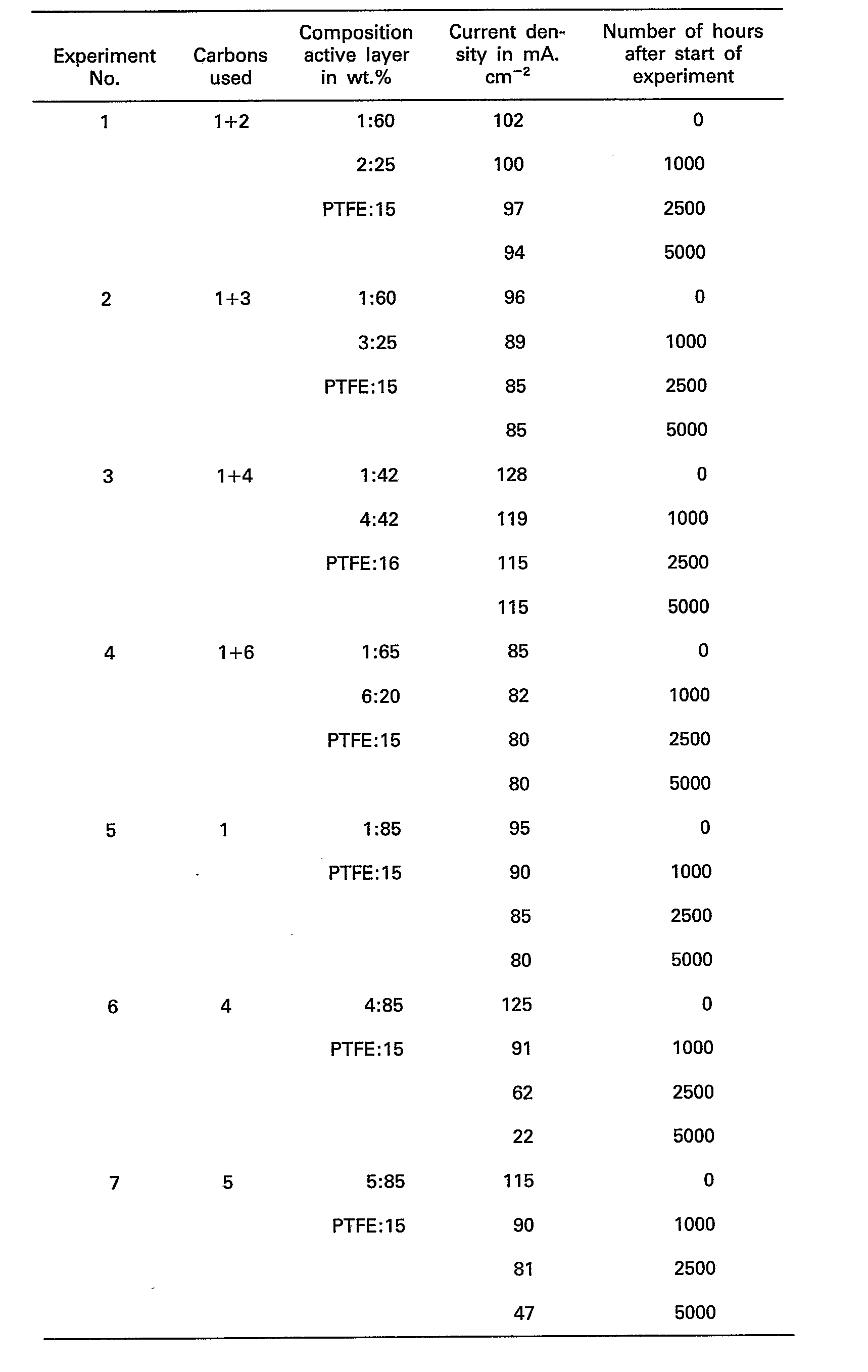
[0017] Of these experiments, experiments 1,2,3 and 4 are according to the invention, experiments
5, 6 and 7 are comparative.
[0018] As shown by the above experiments, the electrodes according to experiments 6 and
7 are highly unstable. During further measurements of an electrode according to experiment
5, it was found that with a slight increase in the current drain there would be very
strong decrease in voltage. Consequently, electrodes according to experiment 5 are
also unsuitable for practical use, where such high current drain is necessary. With
the electrodes according to experiments 1, 2, 3 and 4 this current densities had been
reached so that electrodes can be used satisfactorily in practice.
1. Fuel cell electrode provided with a catalytic layer containing a noble metal on
carbon with a relatively low specific surface and a carbon with a relatively high
specific surface, characterized in that the catalytic layer contains noble metal on
carbon with a specific surface lower than 100 m2g-1 and carbon with a specific surface higher than 150 m2g-' on which carbon with a relatively high specific surface there is at most an equally
large percentage by weight of noble metal in respect of the carbon having a relatively
high specific surface as the percentage by weight of noble metal in respect of the
carbon having a relatively low specific surface on the carbon having a relatively
low specific surface.
2. Fuel cell electrode according to claim 1, characterized in that the carbon having
a relatively low specific surface has a specific surface lower than 50 m2g-1.
3. Fuel cell electrode according to claim 1 or 2, characterized in that the carbon
having a relatively high specific surface has a specific surface of between 200 and
1200 m2g-'.
4. Fuel cell electrode according to any one of claims 1-3, characterized in that the
carbon having a relatively high specific surface has been subjected to thermal treatment.
5. Fuel cell electrode according to any one of claims 1-4, characterized in that as
carbon having a relatively low specific surface graphite is used.
6. Fuel cell electrode according to claim 5, characterized in that this graphite is
etched.
7. Fuel cell electrode according to any one of claims 1-6, characterized in that as
carbon having a relatively high specific surface activated carbon is used.
8. Fuel cell electrode according to any one of claims 1-7, characterized in that the
carbon with a relatively low specific surface is provided with 1-10% by weight of
noble metal in respect of the carbon having a relatively low specific surface, that
the carbon with a relatively high specific surface is provided with 0-10% by weight
of noble metal in respect of the carbon having a relatively high specific surface,
that the weight ratio between both kinds of carbon is between 10:1 and 1:10, and that
the catalytic layer in addition to the carbon contains a binder, preferably in a quantity
of 3-30 parts by weight per 100 parts by weight of carbon, using by preference PTFE
as binder.
9. Fuel cell electrode according to any one of claims 1-8, characterized in that as
noble metal Pt is used.
10. Process for the production of a fuel cell electrode, characterized in that in
this process a carbon with a relatively low specific surface, which specific surface
is lower than 100 m2g-', and with a percentage A by weight of noble metal in respect of this carbon with
a relatively low specific surface of 1-10 is mixed intimately with a carbon with a
relatively high specific surface, which specific surface is higher than 150 m2g-', and with a percentage B by weight of noble metal in respect of this carbon with
a relatively high specific surface of 0-10, B/A being at most equal to 1, and with
a binder, and the resulting mixture is formed into a catalytic layer of the desired
dimensions.
11. Process according to claim 10, characterized in that 1-10 parts by weight of the
said carbon with a relatively low specific surface are mixed with 1-10 parts by weight
of the said carbon with a relatively high specific surface.
12. Process according to claim 10 or 11, characterized in that the carbon having a
relatively low specific surface has a specific surface lower than 50 m2g-1.
13. Process according to any one of the claims 10-12, characterized in that the carbon
having a relatively high specific surface has a specific surface of between 200 and
1200 m2g-'.
14. Process according to any one of the claims 10-13, characterized in that Pt is
used as noble metal.
15. Process according to any one of the claims 10-14, characterized in that PTFE is
used as binder.
16. Process according to any one of the claims 10-15, characterized in that 3-30 parts
by weight of binder are used per 100 parts by weight of carbon.
1. Electrode pour pile à combustible comportant une couche catalytique contenant un
métal noble sur du charbon possédant une surface spécifique relativement faible et
le charbon possédant une surface spécifique relativement grande, caractérisée en ce
que la couche catalytique contient du métal noble sur du charbon possédant une surface
spécifique inférieure à 100 m2g-1 et du charbon possédant une surface spécifique supérieure à 150 m2g-' et que sur ce charbon possédant une surface spécifique relativement grande il
existe tout au plus un pourcentage en poids en métal noble par rapport au charbon
possédant une surface spécifique relativement grande, aussi important que le pourcentage
en poids de métal noble par rapport au charbon possédant une surface spécifique relativement
faible, sur ce charbon possédant une surface spécifique relativement faible.
2. Electrode pour pile à combustible selon la revendication 1, caractérisée en ce
que le charbon possédant une surface spécifique relativement faible possède une surface
spécifique inférieure à 50 m2g-'.
3. Electrode pour pile à combustible selon la revendication 1 ou 2, caractérisée en
ce que le charbon possédant une surface spécifique relativement grande possède une
surface spécifique comprise entre 200 et 1200 m2g-'.
4. Electrode pour pile à combustible selon l'une quelconque des revendications 1-3,
caractérisée en ce que le charbon possédant une surface spécifique relativement grande
a été soumis à un traitement thermique.
5. Electrode pour pile à combustible selon l'une quelconque des revendications 1-4,
caractérisée en ce que l'on utilise du graphite comme charbon possédant une surface
spécifique relativement faible.
6. Electrode pour pile à combustible suivant la revendication 5, caractérisée en ce
que ce graphite est corrodé.
7. Electrode pour pile à combustible selon l'une des revendications 1-6, caractérisée
en ce que l'on utilise du charbon activé en tant que charbon possédant une surface
spécifique relativement grande.
8. Electrode pour pile à combustible selon l'une quelconque des revendications 1-7,
caractérisée en ce que le charbon possédant une surface spécifique relativement faible
est garni de 1-10% en poids d'un métal noble par rapport au charbon possédant une
surface spécifique relativement faible, que le charbon possédant une surface spécifique
relativement grande est garni de 0-10% en poids d'un métal noble par rapport au charbon
possédant une surface spécifique relativement grande et que le rapport pondéral entre
les deux types de charbon est compris entre 10:1 et 1:10, et que la couche catalytique
prévue en plus du charbon contient un liant, de préférence en une quantité de 3-30
parts en poids pour 100 parts en poids de charbon, ce liant étant constitué de préférence
par du PTFE.
9. Electrode pour pile à combustible selon l'une quelconque des revendications 1-8,
caractérisée en ce que l'on utilise du Pt comme métal noble.
10. Procédé de fabrication d'une électrode pour pile à combustible, caractérisé en
ce que, selon ce processus, un charbon possédant une surface spécifique relativement
faible, qui est inférieure à 100 m'g-1, et un pourcentage A en poids d'un métal noble par rapport à ce charbon possédant
une surface spécifique relativement faible, d'une valeur égale à 1-10, est mélangé
de façon intime avec un charbon possédant une surface spécifique relativement grande,
qui est supérieure à 150 m2g-1, et possédant un pourcentage B en poids d'un métal
noble par rapport à ce charbon possédant une surface spécifique relativement grande,
égal à 0-10, B/A étant au maximum égal à 1, et avec un liant, et que le mélange résultant
est réalisé sous la forme d'une couche catalytique possédant les dimensions désirées.
11. Procédé selon la revendication 10, caractérisé en ce que 1-10 parts en poids dudit
charbon possédant une surface spécifique relativement faible sont mélangées à 1-10
parts en poids dudit charbon possédant une surface spécifique relativement grande.
12. Procédé selon la revendication 10 ou 11, caractérisé en ce que le charbon possédant
une surface spécifique relativement faible possède une surface spécifique inférieure
à 50 mlg-1.
13. Procédé selon l'une quelconque des revendications 10-12, caractérisé en ce que
le charbon possédant une surface spécifique relativement grande possède une surface
spécifique comprise entre 200 et 1200 m2g-1.
14. Procédé selon l'une quelconque des revendications 10-13, caractérisé en ce que
l'on utilise du Pt comme métal noble.
15. Procédé selon l'une quelconque des revendications 10-14, caractérisé en ce que
l'on utilise du PTFE comme liant.
16. Procédé selon l'une quelconque des revendications 10-15 caractérisé en ce que
l'on utilise 3-30 parts en poids de liant pour 100 parts en poids de charbon.
1. Brennstoffzellenelektrode, die mit einer katalytischen Schicht, enthaltend ein
Edelmetall auf Kohlenstoff mit verhältnismäßig niedriger spezifischer Oberfläche und
einen Kohlenstoff mit verhältnismäßig hoher spezifischer Oberfläche, versehen ist,
dadurch gekennzeichnet, daß die katalytische Schicht Edelmetall auf Kohlenstoff mit
einer spezifischen Oberfläche niedriger als 100 m2g-1 und Kohlenstoff mit einer spezifischen Oberfläche höher als 150 m2g-1 enthält, auf welchem Kohlenstoff mit verhältnismäßig hoher spezifischer Oberfläche
höchstens ein gleich großer Gewichtsprozentsatz an Edelmetall, bezogen auf den Kohlenstoff
mit verhältnismäßig hoher spezifischer Oberfläche, vorliegt wie der Gewichtsprozentsatz
an Edelmetall, bezogen auf den Kohlenstoff mit verhältnismäßig niedriger spezifischer
Oberfläche, auf dem Kohlenstoff mit verhältnismäßig niedriger spezifischer Oberfläche.
2. Brennstoffzellenelektrode nach Anspruch 1, dadurch gekennzeichnet, daß der Kohlenstoff
mit verhältnismäßig niedriger spezifischer Oberfläche eine spezifische Oberfläche
niedriger als 50 m2g-' hat.
3. Brennstoffzellenelektrode nach Anspruch 1 oder 2, dadurch gekennzeichnet, daß der
Kohlenstoff mit verhältnismäßig hoher spezifischer Oberfläche eine spezifische Oberfläche
zwischen 200 und 1200 m2g-1 hat.
4. Brennstoffzellenelektrode nach einem der Ansprüche 1-3, dadurch gekennzeichnet,
daß der Kohlenstoff mit verhältnismäßig hoher spezifischer Oberfläche einer Wärmebehandlung
unterzogen worden war.
5. Brennstoffzellenelektrode nach einem der Ansprüche 1-4, dadurch gekennzeichnet,
daß als Kohlenstoff mit verhältnismäßig niedriger spezifischer Oberfläche Graphit
verwendet wird.
6. Brennstoffzellenelektrode nach Anspruch 5, dadurch gekennzeichnet, daß dieser Graphit
geätzt ist.
7. Brennstoffzellenelektrode nach einem der Ansprüche 1-6, dadurch gekennzeichnet,
daß als Kohlenstoff mit verhältnismäßig hoher spezifischer Oberfläche aktivierter
Kohlenstoff verwendet wird.
8. Brennstoffzellenelektrode nach einem der Ansprüche 1-7, dadurch gekennzeichnet,
daß der Kohlenstoff mit verhältnismäßig niedriger spezifischer Oberfläche mit 1-10
Gew.-% Edelmetall, bezogen auf den Kohlenstoff mit verhältnismäßig niedriger spezifischer
Oberfläche, versehen ist, daß der Kohlenstoff mit verhältnismäßig hoher spezifischer
Oberfläche mit 0-10 Gew.-% Edelmetall, bezogen auf den Kohlenstoff mit verhältnismäßig
hoher spezifischer Oberfläche, versehen ist, daß das Gewichtsverhältnis zwischen den
beiden Kohlenstoffarten zwischen 10:1 und 1:10 liegt, und daß die katalytische Schicht
zusätzlich zum Kohlenstoff einen Binder, vorzugsweise in einer Menge von 3-30 Gewichtsteilen
je 100 Gewichtsteile Kohlenstoff, enthält, wobei als Binder vorzugsweise PTFE verwendet
wird.
9. Brennstoffzellenelektrode nach einem der Ansprüche 1-8, dadurch gekennzeichnet,
daß als Edelmetall Pt verwendet wird.
10. Verfahren zur Herstellung einer Brennstoffzellenelektrode, dadurch gekennzeichnet,
daß bei diesem Verfahren ein Kohlenstoff mit verhältnismäßig niedriger spezifischer
Oberfläche, welche spezifische Oberfläche niedriger als 100 m2g-1 ist, und mit einem Gewichtsprozentsatz A an Edelmetall, bezogen auf diesen Kohlenstoff
mit verhältnismäßig niedriger spezifischer Oberfläche, von 1-10 innig vermischt wird
mit einem Kohlenstoff mit verhältnismäßig hoher spezifischer Oberfläche, welche spezifische
Oberfläche höher als 150 m2g-1 ist, und mit einem Gewichtsprozentsatz B an Edelmetall, bezogen auf diesen Kohlenstoff
mit verhältnismäßig hoher spezifischer Oberfläche, von 0-10, wobei B/A höchstens gleich
1 ist, und mit einem Binder, und das resultierende Gemisch zu einer katalytischen
Schicht mit den gewünschten Abmessungen geformt wird.
11. Verfahren nach Anspruch 10, dadurch gekennzeichnet, daß 1-10 Gewichtsteile des
Kohlenstoffs mit verhältnismäßig niedriger spezifischer Oberfläche mit 1-10 Gewichtsteilen
des Kohlenstoffs mit verhältnismäßig hoher spezifischer Oberfläche vermischt werden.
12. Verfahren nach Anspruch 10 oder 11, dadurch gekennzeichnet, daß der Kohlenstoff
mit verhältnismäßig niedriger spezifischer Oberfläche eine spezifische Oberfläche
niedriger als 50 m2g-' hat.
13. Verfahren nach einem der Ansprüche 10-12, dadurch gekennzeichnet, daß der Kohlenstoff
mit verhältnismäßig hoher spezifischer Oberfläche eine spezifische Oberfläche zwischen
200 und 1200 m2g-1 hat.
14. Verfahren nach einem der Ansprüche 10-13, dadurch gekennzeichnet, daß Pt als Edelmetall
verwendet wird.
15. Verfahren nach einem der Ansprüche 10-14, dadurch gekennzeichnet, daß PTFE als
Binder verwendet wird.
16. Verfahren nach einem der Ansprüche 10-15, dadurch gekennzeichnet, daß 3-30 Gewichtsteile
Binder je 100 Gewichtsteile Kohlenstoff verwendet werden.