|
(11) | EP 0 058 203 B2 |

| (12) | NEW EUROPEAN PATENT SPECIFICATION |
|
|
| (54) |
NON-DUSTING AND FAST-WETTING IMPRESSION MATERIAL AND METHOD OF PREPARING SAME NICHT STAUBENDES UND SCHNELL VERNETZENDES DRUCKMATERIAL SOWIE VERFAHREN ZU DESSEN HERSTELLUNG MATERIAU D'IMPRESSION A MOUILLAGE RAPIDE ET NE PRODUISANT PAS DE POUSSIERE ET PROCEDE DE PREPARATION DE CELUI-CI |
|
|
|||||||||||||||||||||||||||||||
|
||||||||||||||||||||||||||||||||
[0001] This invention relates to a dental impression material composition in accordance with the preamble of claim 1, for use in dental applications, which are formed by mixing a powdered material with water, as for example alginate impression materials or alginate substitute materials, i.e., those in which the alginic acid salt component is replaced by a substitute polymer, for example, carboxymethyl cellulose, xanthan gum, and the like.
[0002] Alginate impression materials and alginate substitute materials are known and have been used successfully for many years in the dental arts. See, for example, U.S. 2,345,255 to Gross; U.S. 2,390,137 to Vallan- digham; U.S. 2,397,145 to vanBuren Joy; U.S. 2,422,497 to Noyes; U.S. 2,878,129 to Rabchuck; U.S. 3,246,998 to Higashi etal,; Reissue 23,700 to Lockridge; and U.S. 2,733,156 to Cornell; the disclosures of these patents relevant to the preparation of conventional alginate and alginate substitute impression materials being incorporated herein by reference.
[0003] The use of such impression materials generally involves the proper measuring and then mixing of certain powdered constituents or components of the impression material (referred to hereinafter as the powdered components), with water or substitute liquid, proper measuring of the powdered and liquid components being essential to obtaining satisfactory physical properties. Prior to mixing the powdered and liquid components, it is common practice for the user to shake the container to which the various powdered components of the impression material are stored to fluff them. This fluffing is done to facilitate the measuring or proportioning of the powdered components, using a scoop or ladle which usually is provided with the container. Under such circumstances, however, when the top of the container is opened, some of the fluffed powder tends toward dusting, i.e., becoming airborne and floating out of the container. Dusting also tends to occur when the powdered components are mixed with water or a water substitute due, at least in part, to the difficulty with which the powdered components are wet by the water. In practice, the powdered components are placed in a flexible mixing bowl and water is added to it. The powdered components do not wet immediately and the bulk of the powder floats for a period of time on the surface of the water during mixing, thus permitting some dusting to occur. The dusting problem is further exaggerated because the harder one stirs the powdered components/wa- ter mix, the greater is the opportunity for a portion of the powder to become airborne.
[0004] This dusting, which occurs primarily when a portion of the filler in the powdered components separates from the remaining powdered components and becomes airborne upon mixing or shaking, or upon stirring with the liquid component of the impression material has become the cause of concern because of its potential health hazard. (Woody, R. D. et al., JADA 94, 501, 1977).
[0005] From British patent 1 073 772 it is known to improve the flexibility and elasticity of dental impression material gels by adding a flip-forming water-soluble polymer. The polymer may be used in the form of a satchet, containing a certain amount of the dental impression material powder. Thus, shaking and measuring operations are avoided with the consequence of reduced amounts of airborne dust particles.
[0006] US-A-4 136 050 is concerned with a method of the removal of airborne particles from the air around large scale or industrial dust handling operations, such as dumping or dust into railroad cars or land fills. The airborne dust particles are deposited by spraying with water. For improving this water spray dust deposition a polymer may be added to the water.
[0007] It is a principal object of the present invention to reduce the dusting that occurs when the filler in the powdered components of a dental impression material separates and becomes airborne upon mixing or shaking.
[0008] In accordance with the present invention, the greater ease and speed with which the powdered components are wet by water during mixing, the elimination or airborne particles of powder, and other objects and advantages are achieved when the constituent powdered particles, or at least a portion thereof, are coated with a minor amount of a surfactant/dispersing agent or compound which is readily and rapidly wet, dispersed or dissolved by the water or substitute liquid component of the impression material. This coating of the powdered particles causes the individual particles to be attracted to one another so that they do not easily become airborne, and permits the powder particles to be easily wet by the water or substitute liquid. Examples of substances which may be used to coat the powdered particles, are, for example, natural polymer dispersing agents such as xanthan gum, sodium polyalginate or potassium polyalginate, cellulose esters or ethers having ester or ether groups containing free hydroxy or carboxyl groups such as hydroxyethyl or hydroxymethyl cellulose, carboxyl methyl cellulose, synthetic ionic polymeric surfactants such as those which contain substantial amounts of units derived from alkylene oxides such as polyethylene glycol or polypropylene or polybutylene glycol or copolymers of them, including polymeric surfactants of which the Tween and Brij series produced by ICI Americas are examples, and other including, for example, block copolymers of polysiloxanes and polyethylene glycols. The coating agent need not necessarily be limited to polymers but may include monomeric substances, for example, polyols such as ethylene glycol, propylene glycol, alkanolamines such as triethanolamine, and compounds such as lauryl sulfate, sucrose butyrate, glycerol esters, and the like. Mixtures of the above coating agents also may be used. It should be evident, then, that a wide variety of coating agents may be employed, in varying dusting reducing, powder wetting enhancing amounts, usually from about 1-10% by weight based on the total weight of the powdered components, so long as the respective agent that is used adequately coats the powdered components, and is readily and quickly wet, dispersed or dissolved by the liquid component of the impression material to provide a composition wherein dusting is significantly reduced and the powdered components are significantly more rapidly wet upon mixing as compared to the same composition absent the coating agent.
[0009] The preferred composition of the invention has a Dust Index of less than about 100 using a Gelman Air Analyzer (See Example 4).
[0010] The invention will be more fully understood in conjunction with the following examples thereof, which examples merely are illustrative and should not be considered to be limitive of the materials and procedures employed in practicing the invention.
Example 1
[0011] An alginate impression material was produced from the following components:
The diatomaceous earth filler was wet with the polypropylene glycol coating agent before being admixed with the other powdered components. The entire mixture was blended in a ribbon blender. A 14 gram sample of the resulting mixture was placed in a mixing bowl mounted on an "Alginator" produced by Cadco Products. An appropriate quantity of water was then added to the bowl and the "Alginator" was caused to turn. A spatula was held in a fixed position in the turning mixture and it was observed that after 5 seconds the alginate powder was wet. It was also observed that there were no dust particles released upon stirring.
Example 2
[0012] The procedures of Example 1 were repeated, except that potassium alginate was used in place of sodium alginate. A complete wetting of the alginate was noted within 5 seconds and no dusting was observed.
Example 3
[0013] The procedure of Example 1 was repeated except that the polypropylene glycol (coating agent) was eliminated from the alginate powder formulation. In contrast with the results of Example 1, it was observed that it took the same alginate formulation, except for the omission of the surface coating agent, 10 seconds to be wet by the water. It was also observed that there was a great deal of "dusting".
Example 4
[0014] In order to quantify the observation of dusting a standard container of alginate impression material powder was fluffed by turning and rotating the container for 20 seconds. Immediately the top was removed and the relative concentration of particles released from the surface were quantified using a Gelman Air Analyzer, a unit which is designed to measure particulate contaminates in industry. The air immediately above the container of the alginate formulation prepared in accordance with Example 1, i.e. having a coating agent present on the filler particles, was sampled and a particle content (Dust Index) of 6.5 micro grams per liter of air per minute was observed. This was much less than a particle content (Dust Index) of 215 micro grams per liter of air per minute measured for the same alginate impression material powder handled in the same manner, but not surface treated. Both the surface treated powder and that not treated, complied fully with the requirement of ADA Specification 18 for Alginate Impression Material.
[0015] Using the same procedure, additional dust-free alginate compositions were made using different coating agents. Successful coating agents, their "Dust Index", and chemical name are listed in the following Table:
These coating agents all are capable of providing useful alginate materials.
Example 5
[0016] The procedure of Example 1 was repeated, except that the alginate impression material was produced from the following components:
A complete wetting of the alginate impression material was noted within 5 seconds and no dusting was observed.
[0017] Although the present invention has been described in connection with preferred embodiments thereof, it is to be understood that modifications and variations may be resorted to, without departing from the spirit and scope thereof, as those skilled in the art will readily understand. Such modifications and variations are considered to be within the purview and scope of the appended claims.
1. A dry powdered dental impression material composition adapted upon mixing with
water to form a dental impression paste capable of setting to a solid, comprising
an alginic acid salt component and a filler component, characterized in that said
powdered composition or at least a portion thereof is coated with a coating agent
which is readily and rapidly wet, dispersed or dissolved by the water when the impression
composition is mixed for forming the settable paste, said dry powdered impression
material composition having reduced dusting characteristics as compared to the same
composition absent the coating agent.
2. The impression material of claim 1, wherein said coating agent is selected from
the group consisting of natural polymer dispersing agents, cellulose ester and ethers
having ester or ether groups containing free hydroxyl or carboxyl groups and synthetic
nonionic polymeric surfactants.
3. The impression material of claim 1, wherein said coating agent is selected from
the group consisting of xanthan gum, hydroxyethyl or hydroxymethyl cellulose, carboxy
methyl cellulose, sodium polyalginate or potassium polyalginate, polyethylene glycol
or polypropylene glycol or polybutylene glycol or copolymers thereof, ethylene glycol,
propylene glycol, triethanolamine,lauryl sulfate, sucrose butyrate, glycerol esters
and mixtures thereof.
4. The impression material of claim 1 consisting essentially of the following components
in admixture:
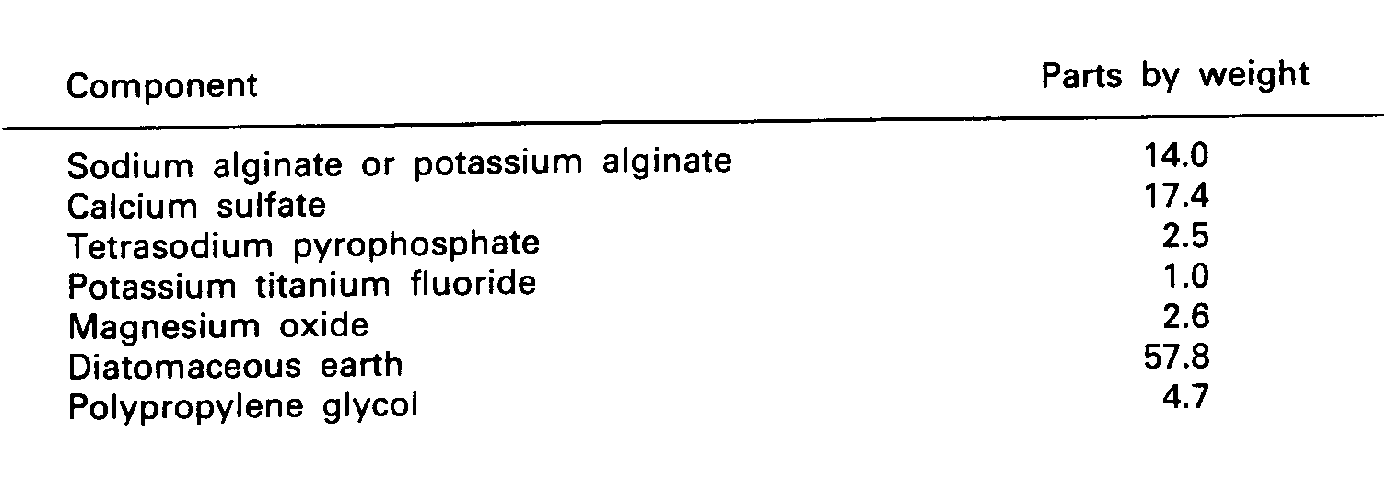
wherein said diatomaceous earth had been coated with said polypropylene glycol prior to having been mixed with the remaining components.
wherein said diatomaceous earth had been coated with said polypropylene glycol prior to having been mixed with the remaining components.
1. Trockene, pulverförmige dentale Abdruckmaterialzusammensetzung, die beim Vermischen
mit Wasereine dentale Abdruckpaste bildet, welche sich zu einem Feststoff verfestigen
kann, umfassend eine Algininsäuresalzkomponente und eine Füllstoffkomponente, dadurch
gekennzeichnet, daß die pulverförmige Zusammensetzung oder mindestens ein Teil derselben
mit einem Beschichtungsmittel beschichtet ist, welches leicht und rasch durch das
Wasser benetzt, dispergiert oder aufgelöst wird, wenn die Abdruckzusammensetzung zur
Bildung der härtbaren Paste angemischt wird, wobei die trockene, pulverförmige Abdruckzusammensetzung
verringerte Stäubungseigenschaften hat im Vergleich zu der gleichen Zusammensetzung
ohne das Beschichtungsmittel.
2. Das Abdruckmaterial von Anspruch 1, wobei das Beschichtungsmittel ausgewählt ist
aus der Gruppe bestehend aus natürliche Polymerdispersionsmittel, Celluloseester und
Äther mit Ester- oder Äthergruppen, enthaltend freie Hydroxyl- oder Carboxylgruppen,
und synthetische, nicht-ionische polymere Surfaktantien.
3. Das Abdruckmaterial nach Anspruch 1, wobei das Beschichtungsmittel ausgewählt ist
aus der Gruppe bestehend aus Xanthangummi, Hydroxyäthyl- oder Hydroxymethylcellulose,
Carboxymethylcellulose, Natriumpolyalginat oder Kaliumpolyalginat, Polyäthylenglycol
oder Polyproylenglycol oder Polybutylenglycol oder Copolymers derselben, Äthylenglycol,
Propylenglycol, Triäthanolaminlaurylsulfat, Laurylsulfat, Sucrosebutyrat, Glycerinester
und Mischungen derselben.
4. Das Abdruckmaterial nach Anspruch 1, bestehend im wesentlichen aus den folgenden
Komponenten als Gemisch:
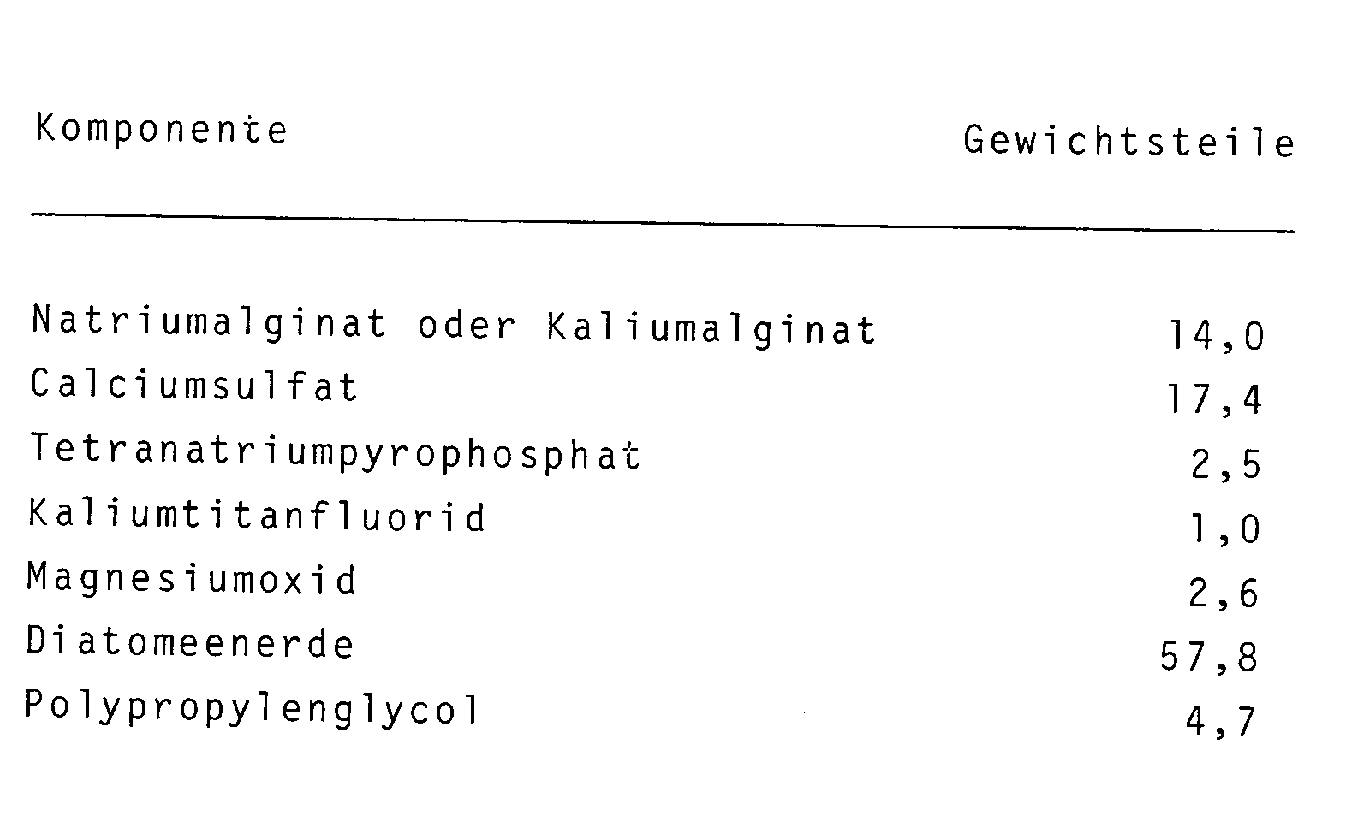
wobei die Diatomeenerde vor dem Vermischen mit den restlichen Komponenten mit dem Polypropylenglycol beschichtet wurde.
wobei die Diatomeenerde vor dem Vermischen mit den restlichen Komponenten mit dem Polypropylenglycol beschichtet wurde.
1. Composition pulvérulente sèche de matière pour empreinte dentaire, adaptée, après
gâchage à l'eau, de façon à former une pâte pour empreinte dentaire à même de durcir
pour donner un solide, comprenant un composant sel de l'acide alginique et un composant
charge, caractérisée en ce que ladite composition pulvérulente, ou au moins l'une
de ses parties, est enrobée d'un agent d'enrobage qui est facilement et rapidement
mouillé, dispersé ou dissous par l'eau, quand la composition pour empreinte est gâchée
pour former la pâte durcissable, ladite composition pulvérulente sèche de matière
pour empreinte présentant des caractéristiques réduites de formation de poussières
par rapport à la même composition en l'absence de l'agent d'enrobage.
2. Matière pour empreinte selon la revendication 1, dans laquelle ledit agent d'enrobage
est choisi dans le groupe comprenant les agents dispersants polymères naturels, les
esters et éthers cellulosiques possédant des groupes ester ou éther contenant des
groupes hydroxyle ou carboxyle libres, et les tensioactifs polymères synthétiques
non-ioniques.
3. Matière pour empreinte selon la revendication 1, dans laquelle ledit agent d'enrobage
est choisi dans le groupe comprenant la gomme xanthane, l'hydroxyéthyl- ou hydroxyméthyl-cellulose,
la carboxyméthyl- cellulose, le polyalginate de sodium ou le polyalginate de potassium,
le polyéthylèneglycol ou le polypropylèneglycol ou le polybutylèneglycol ou leurs
copolymères, l'éthylèneglycol, le propylèneglycol, la trié- thanolamine, le sulfate
de lauryle, le butyrate de saccharose, les esters du glycérol et leurs mélanges.
4. Matière pour empreinte selon la revendication 1, comprenant essentiellement, en
mélange, les constituants suivants :

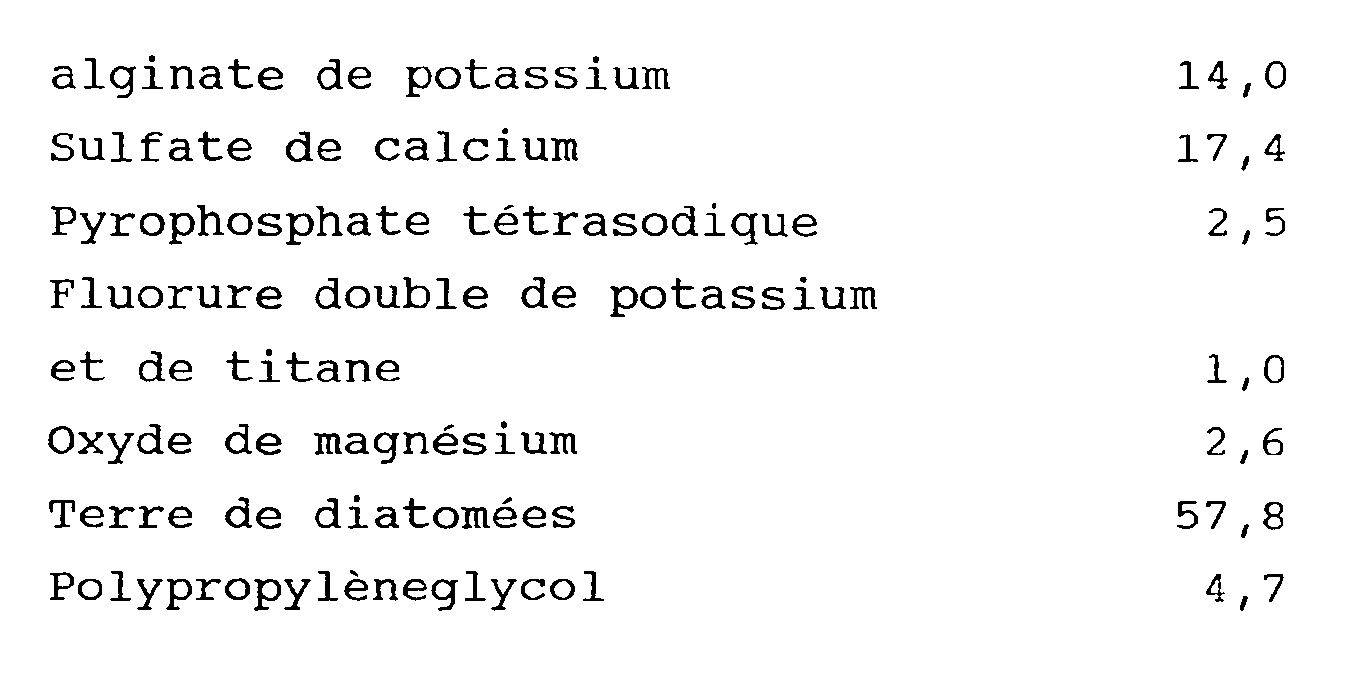
où ladite terre de diatomées a été enrobée dudit polypropylèneglycol avant d'être mélangée aux autres constituants.
où ladite terre de diatomées a été enrobée dudit polypropylèneglycol avant d'être mélangée aux autres constituants.