|
(11) | EP 0 059 059 B2 |

| (12) | NEW EUROPEAN PATENT SPECIFICATION |
|
|
| (54) |
Zeolites Zeolithe Zéolites |
|
|
|||||||||||||||||||||||||||||||
|
||||||||||||||||||||||||||||||||
[0002] Zeolite ZSM-12 and methods for its preparation have been described in United States Patents 3 832 449 and 4 104 294 and in published European Patent Applications 18089 and 13630. In all of the methods described, an essential feature of the synthesis of ZSM-12 is the use of an expensive tetra-alkylammonium compound.
[0003] It has now surprisingly been found that zeolites of the ZSM-12 type zeolite may be prepared using a much lower cost organic starting material than the tetra-alkylammonium compounds, namely piperazine or a derivative thereof.
[0004] Accordingly, the claimed method provides a synthetic zeolite material having a molar composition expressed by the formula:
wherein M is sodium, ammonium or hydrogen, Y is one or more of aluminium, gallium, boron, iron, chromium, vanadium, molybdenum, arsenic, antimony and manganese, X is silicon and/or germanium and H20 is water of hydration additional to water notionally present when M is hydrogen, and having an X-ray diffraction pattern (as determined by standard technique using copper Ka radiation) substantially as set out in Table 1.
[0005] For comparison, Table 1 also shows the X-ray data for zeolite ZSM-12 as given in Table 1 of US Patent No. 3 832 449.
[0006] The zeolite obtained by the claimed process appears to be most readily formed in a state of high purity when the number of moles of Y203 in the above formula is in the range 0.5 to 1.7.
[0007] The above definition includes both freshly prepared zeolite ("freshly prepared" means the product of synthesis and washing, with optional drying, as hereinafter described) and also forms of it resulting from dehydration and/or calcination and/or ion exchange.
[0008] Freshly prepared zeolite may contain a piperazine compound used in its synthesis. Since the product is a zeolite, the piperazine compound must be physically trapped within the crystal lattice, it can be removed by thermal or oxidative degradation or by displacement by suitable small molecules. This physically trapped material does not constitute part of the composition for the purposes of the definition.
[0009] The H20 content of freshly prepared zeolite depends on the conditions in which it has been dried after synthesis.
[0010] Calcined forms of the zeolite may contain any inorganic cation including hydrogen since the organic component is burnt out in the presence of air or otherwise displaced prior to calcination leaving hydrogen as the other balancing cation.
[0011] Among the ion-exchanged forms of the obtained zeolite, the ammonium (NHQ ) is of importance since it can be readily converted to the hydrogen form by calcination. The hydrogen form can also be prepared directly by exchange with an acid. The hydrogen form and forms containing metals introduced by ion exchange are described further below.
[0012] The invention provides a method of making a synthetic zeolite material having a molar composition expressed by the formula:
wherein M is sodium, ammonium or hydrogen, Y is one or more of aluminium, gallium, boron, iron, chromium, vanadium, molybdenum, arsenic, antimony and manganese, X is silicon and/or germanium and H20 is water of hydration additional to water notionally present when M is hydrogen and having the following X-ray diffraction pattern:
which comprises reacting an aqueous mixture comprising at least one oxide XO2, at least one oxide Y203 and at least one piperazine compound.
[0013] The reaction mixture preferably has the following molar composition:
wherein X and Y have the meanings given above, Q is a piperazine compound, M in MOH is sodium or ammonium, M in MZ is sodium, ammonium or hydrogen and Z is a strong acid radical present as a salt of M and may be added as a free acid to reduce the MOH level to a desired value.
[0014] The Examples show that by using reaction mixtures having compositions outside the preferred ranges, the desired product may be contaminated with other zeolites such as near ferrierites and/or ZSM-12 type zeolites.
[0015] The piperazine compound can be partially or fully alkylated e.g. methylated, but the preferred piperazine compound is piperazine itself.
[0016] The preferred alkali metal (M) is sodium. The preferred oxide X02 is silica (Si02), the preferred oxide Y103 is alumina (AI203) and the preferred acid radical is chloride.
[0017] The silica source can be any of those commonly considered for use in synthesising zeolites, for example powdered solid silica, silicic acid, colloidal silica or dissolved silica. Among the powdered silicas usable are precipitated silicas, especially those made by precipitation from an alkali metal silicate solution, such as the type known as "KS 300" made by AKZO, and similar products, aerosil silicas, fume silicas and silica gels suitably in grades for use in reinforcing pigments for rubber or silicone rubber. Colloidal silicas of various particle sizes may be used, for example 10-15 or 40-50 microns, as sold under the Registered Trade Marks "LUDOX" "NALCOAG" and "SYTON". The usable dissolved silicas include commercially available waterglass silicates containing 0.5 to 6.0 especially 2.0 to 4.0 mols of Si02 per mole of alkali metal oxide, "active" alkali metal silicates as defined in UK Patent 1193254, and silicates made by dissolving silica in an alkali metal hydroxide or a quaternary ammonium hydroxide or a mixture thereof.
[0018] The alumina source is most conveniently sodium aluminate, but can be or can include aluminium, an aluminium salt for example the chloride, nitrate or sulphate, an aluminium alkoxide or alumina itself, which should preferably be in a hydrated or hydratable form such as colloidal alumina, pseudoboehmite, boehmite, gamma alumina or the alpha or beta trihydrate.
[0019] The reaction mixture is reacted usually under autogenous pressure, optionally with added gas, e.g. nitrogen at a temperature between 85 and 250°C until crystals of ZSM-12 type zeolite form, which can be from one hour to many months depending on the reactant composition and the operating temperature. Agitation is optional, but is preferable since it reduces the reaction time.
[0020] At the end of the reaction, the solid phase is collected on a filter and washed and is then ready for further steps such as drying, dehydration and ion-exchange.
[0021] If the product of the reaction contains alkali metal ions, these have to be at least partly removed in order to prepare the hydrogen form of the zeolite and this can be done by ion exchange with an acid, especially a strong mineral acid such as hydrochloric acid or by way of the ammonium compound, made by ion exchange with a solution of an ammonium salt such as ammonium chloride. Such ion exchange can be carried out by slurrying once or several times with the solution.
[0022] In general, the cation(s) of the obtained zeolite can be replaced by any cation(s) of metals, and particularly those in Groups IA, IB, IIA, IIB, III (including rare earths) VIII (including noble metals) and by lead, tin and bismuth. (The Periodic Table is as in "Abridgements of Specifications" published by the UK Patent Office.) Exchange is carried out using any water soluble salts containing the appropriate cation.
[0023] In order to prepare a catalyst, the obtained zeolite may be used in association with an inorganic matrix, or with other materials which can be either inert or catalytically active. The matrix may be present simply as a binding agent to hold the small zeolite particles (0.005 to 10 microns) together, or it may be added as a diluent to control the amount of conversion in a process which may otherwise proceed at too high a rate, leading to catalyst fouling as a result of excessive coke formation.
[0024] Typical inorganic diluents include catalyst support materials such as alumina, silica, kaolinic clays, bentonites, montmorillonites, sepiolite, attapulgite, Fullers earth, synthetic porous materials such as Si02-AI203, Si02-Zr02, Si02-Th02, SDi02-BeO, Si02-Ti02 or any combination of these oxides. An effective way of mixing the obtained zeolite with such diluents is to mix appropriate aqueous slurries in a mixing nozzle and then to spray-dry the slurry. Other ways of mixing can be used.
[0025] If the obtained zeolite in any cationic form or as a catalytic composite is exchanged or impregnated with hydrogenation/dehydrogenation components, such as Ni, Co, Pt, Re, Rh, hydrocracking and reforming catalysts can be made, especially if the Na20 content is less than 0.1% w/w.
[0026] A wide range of hydrocarbon conversion catalysts can be prepared from the obtained zeolite by ion exchange or impregnation with cations, or oxides, selected from the following Cu, Ag, Mg, Ca, Sr, Zn, Cd, B, Al, Sn, Pb, V, P. Sb, Cr, Mo, W, Mn, Re, Fe, Co, Ni noble metals and lanthanides.
[0027] Usually the zeolite catalyst will be in acid form, thus stoichiometry is maintained by H+ or H20+ as an additional balancing cation, or as sole cation. Such catalysts may find application in the following processes; catalytic cracking, hydro- desulphurization, hydrodenitrification, catalytic dewaxing, alkylation of alkanes or aromatics, dealkyltion, disproportionation, isomerisation or alkanes and alkyl benzenes, dehydration reactions, oxidation, polymerisation and conversion of methanol to hydrocarbons.
Example 1
[0029] The synthesis mixture had the following molar composition: 2.32 Na20, 92.7 piperazine, A1203, 96.3 Si02, 3371 H20, 54.8 NaCI.
[0030] 57.2 g piperazine were dissolved in 200 g water and 142 g colloidal silica (Syton X-30, molar composition Na20, 0.0395 A1203, 85.6 Si02, 689 H20) were stirred in to give Solution A.
[0031] Next, 1.6 g sodium aluminate (of molar composition 1.26 Na20, A1203, 3 H20) were dissolved in 10 g water and stirred into Solution A.
[0032] Finally, 23 g sodium chloride were dissolved in 125 g water and stirred into the aluminate/silica slurry. The mixture was reacted at 177°C for 3 days in a stainless steel autoclave. After cooling to about 80°C, the slurry was filtered, and washed with two litres of distilled water at about 60°C, and dried overnight at 120°C. The product was sodium piperazine ZSM-12 type zeolite having the molar composition:
and X-ray data as shown in Table 1. This data is compared with data for ZSM-12 and it is evident that while the product of this invention shows broad similarities to ZSM-12 there are significant differences.
Example 2
[0033] A portion of the product of Example 1 was calcined in moist air at 550°C for 17 hours, and then twice exchanged with 5 ml per g of normal HCI for 1 hour at 60°C. The product was filtered and washed with 10 ml per g distilled water, dried for 17 hours at 120°C, and calcined in air at 450°C for 3 hours and had substantially the X-ray diffraction data shown in Table 2 and the following molar composition:
Example 3
[0034] The reaction mixture had the following molar composition:
71 g piperazine were dissolved in 150 g water and 312 g colloidal silica (Na20, 0.032 AI203, 76 Si02, 666 H20) to give a solution A. Next, 1.9 g sodium hydroxide and 0.5 g sodium aluminate (1.22 Na20, A1203, 1.2 H20) were dissolved in 10 g water, and then stirred into solution A. Finally, 45 g sodium chloride were dissolved in 267 g water and stirred into the mixture, which was then reacted at 180°C for 5 days in a stirred 1 litre stainless steel autoclave. The product contained about 40% ZSM-12 type zeolite with approximately equal amounts of a-quartz and a-cristobalite.
Example 4
[0035] The reaction mixture had the following molar composition:
35 g piperazine were dissolved in 330 g water and 233 g of colloidal silica (composition as Example 3) to give solution A. Next, 6.2 g sodium hydroxide and 3.7 g sodium aluminate were dissolved in 38 g water, and then stirred into solution A. Finally, 37.5 g sodium chloride in 200 g water was stirred in and the mixture was reacted for 2 dys at 180°C in a stirred stainless steel autoclave. The product contained about 36% ZSM-12 type zeolite about 35% near ferrierite and approximately equal amounts of a-quartz and a-cristobalite.
Example 5
[0036] The reaction mixture had the following molar composition:
73.6 p piperazine were dissolved in 240 g water and 192 g of Q-79 water glass (400 Na20, AI203, 1280 Si02, 9,720 H20) to give a solution A. Next, 2.5 g aluminium chloride (AICI3 6 H20) were dissolved in 240 ml of 2N hydrochloric acid. The acid solution was stirred into solution Ato give an homogeneous mixture, which was reacted for 3 days at 180°C in a stainless steel autoclave. The product was a ZSM-12 type zeolite containing approximately 10% near ferrierite.
Example 6
[0037] The reaction mixture had the following molar composition:
57.2 g piperazine were dissolved in 223 g water and 142 g colloidal silica (Na20, 0.032 A1203, 76 Si03, 666 H20) to give solution A.
[0038] Next, 1.6 g sodium aluminate (1.22 Na20, Al203, 1.2 H20) were dissolved in 10 g water and stirred into Solution A. Finally, 23 g sodium chloride were dissolved in 125 g water and stirred into the slurry. The mixture was reacted 3 days at 180°C. The product after 12 hours was ZSM-12 type zeolite with a trace of a-quartz but after 24 hours the Nu-13 was contaminated by about 30% a-quartz.
Example 7
[0039] This Example was a repeat of Example 8 except that 4.2 g sodium hydroxide was added to the sodium aluminate solution i.e. this example was run at OH-/Si02 = 0.22, whereas in Example 6, the OH-/Si02 was 0.057. The mixture was reacted at 180°C. Even after 8 hours, the product was 70% a-quartz and only 30% Nu-13. This Example demonstrates the fact that the OH/Si02 ratio is a critical factor in the synthesis of a ZSM-12 type zeolite Nu-13.
Example 8
[0040] This Example was a repeat of Example 1 except that 3 g of boric acid were dissolved in the sodium aluminate solution.
Example 9
1. A method of making a synthetic zeolite material having a molar composition expressed
by the formula:

wherein M is sodium, ammonium or hydrogen, Y is one or more of aluminium, gallium, boron, iron, chromium, vanadium, molybdenum, arsenic, antimony and manganese, X is silicon and/or germanium and H20 is water of hydration additional to water notionally present when M is hydrogen and having the following X-ray diffraction pattern:

which comprises reacting an aqueous mixture comprising at least one oxide X02, at least one oxide Y203 and at least one piperazine compound.
wherein M is sodium, ammonium or hydrogen, Y is one or more of aluminium, gallium, boron, iron, chromium, vanadium, molybdenum, arsenic, antimony and manganese, X is silicon and/or germanium and H20 is water of hydration additional to water notionally present when M is hydrogen and having the following X-ray diffraction pattern:
which comprises reacting an aqueous mixture comprising at least one oxide X02, at least one oxide Y203 and at least one piperazine compound.
2. A method according to claim 1 wherein the aqueous mixture has the molar composition:
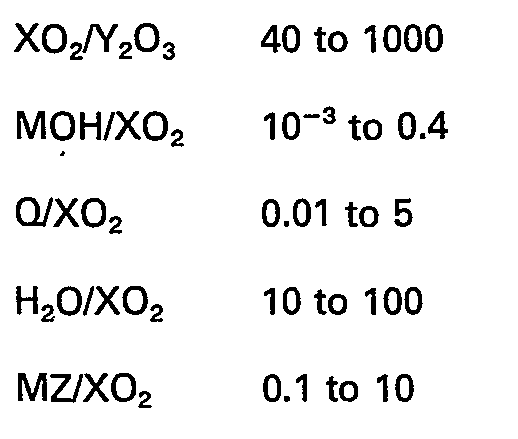
wherein X and Y have the meanings given in claim 1, Q is a piperazine compound, M in MOH is sodium or ammonium, M in MZ is sodium, ammonium or hydrogen and Z is a strong acid radical.
wherein X and Y have the meanings given in claim 1, Q is a piperazine compound, M in MOH is sodium or ammonium, M in MZ is sodium, ammonium or hydrogen and Z is a strong acid radical.
3. A method according to claim 2 wherein X02/ Y203 is in the range 70 to 200.
4. A method according to claim 2 or claim 3 wherein MOH/X02 is in the range 0.02 to 0.15.
5. A method according to any one of claims 2 to 4 wherein Q/X02 is in the range 0.05 to 2.
6. A method according to any one of claims 2 to 5 wherein H20/X02 is in the range 25 to 50.
7. A method according to any one of claims 2 to 6 wherein MZ/X02 is in the range 0.3 to 3.
8. A method according to any one of claims 2 to 7 wherein the piperazine compound
is piperazine.
1. Verfahren zur Herstellung eines synthetischen Zeolithmaterials, das eine molare
Zusammensetzung hat, die durch die Formel:

ausgedrückt wird, worin M Natrium, Ammonium oder Wasserstoff ist, Y ein oder mehr als ein Vertreter von Aluminium, Gallium, Bor, Eisen, Chrom, Vandadium, Molybän, Arsen, Antimon und Mangan ist, X Silicium und/oder Germanium aist und H20 Hydratwasser ist, das zu Wasser hinzukommt, das begrifflich vorhanden ist, wenn M Wasserstoff ist, wobei das synthetische Zeolithmaterial das folgende Röntgenbeugungsbild liefert:
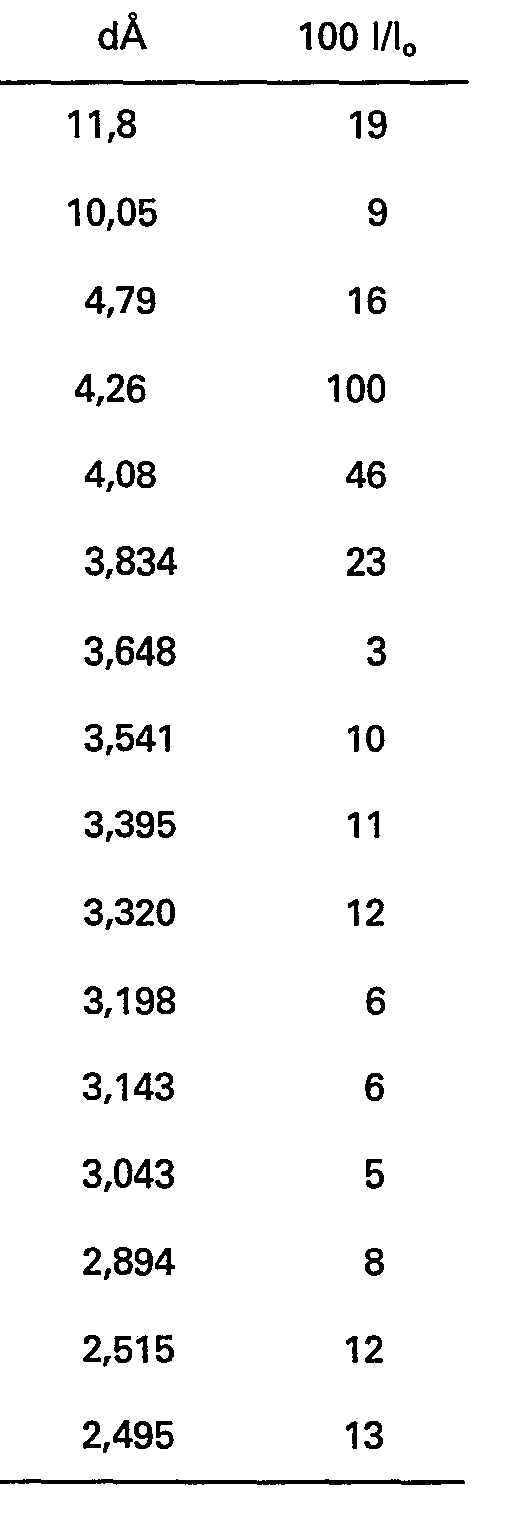
wobei in dem Verfahren eine wäßrige Mischung, die mindestens ein Oxid X02, mindestens ein Oxid Y203 und mindestens eine Piperazinverbindung enthält, zur Reaktion gebracht wird.
ausgedrückt wird, worin M Natrium, Ammonium oder Wasserstoff ist, Y ein oder mehr als ein Vertreter von Aluminium, Gallium, Bor, Eisen, Chrom, Vandadium, Molybän, Arsen, Antimon und Mangan ist, X Silicium und/oder Germanium aist und H20 Hydratwasser ist, das zu Wasser hinzukommt, das begrifflich vorhanden ist, wenn M Wasserstoff ist, wobei das synthetische Zeolithmaterial das folgende Röntgenbeugungsbild liefert:
wobei in dem Verfahren eine wäßrige Mischung, die mindestens ein Oxid X02, mindestens ein Oxid Y203 und mindestens eine Piperazinverbindung enthält, zur Reaktion gebracht wird.
2. Verfahren nach Anspruch 1, bei dem die wäßrige Mischung die molare Zusammensetzung:
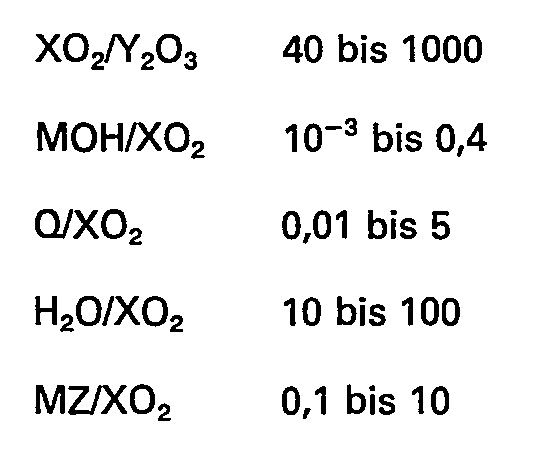
hat, worin X und Y die in Anspruch 1 angegebene Bedeutung haben, Q eine Piperazinverbindung ist, M in MOH Natrium oder Ammonium ist, M in MZ Natrium, Ammonium oder Wasserstoff ist und Z ein Rest einer starken Säure ist.
hat, worin X und Y die in Anspruch 1 angegebene Bedeutung haben, Q eine Piperazinverbindung ist, M in MOH Natrium oder Ammonium ist, M in MZ Natrium, Ammonium oder Wasserstoff ist und Z ein Rest einer starken Säure ist.
3. Verfahren nach Anspruch 2, bei dem X02/ Y203 in dem Bereich von 70 bis 200 liegt.
4. Verfahren nach 2 oder Anspruch 3, bei dem MOH/X02 in dem Bereich von 0,02 bis 0.15 liegt.
5. Verfahren nach einem der Ansprüche 2 bis 4, bei dem Q/X02 in dem Bereich von 0,05 bis 2 liegt.
6. Verfahren nach einem der Ansprüche 2 bis 5, bei dem H20/X02 in dem Bereich von 25 bis 50 liegt.
7. Verfahren nach einem der Ansprüche 2 bis 6, bei dem MZ/X02 in dem Bereich von 0,3 bis 3 liegt.
8. Verfahren nach einem der Ansprüche 2 bis 7, bei dem die Piperazinverbindung Piperazin
ist.
1. Procédé de préparation d'une zéolite de synthèse ayant une composition molaire
exprimée par la formule

dans laquelle M est du sodium, de l'ammonium ou de l'hydrogène, Y est un ou plusieurs éléments parmi l'aluminium, le gallium, le bore, le fer, le chrome, le vanadium, le molybdène, l'arsenic, l'antimoine et le manganèse, X est du silicium et/ ou du germanium et H20 est l'eau d'hydratation s'ajoutant à l'eau éventuellement présente lorsque M est del'hydrogène, et ayant le spectre de diffraction aux rayons X suivant:

caractérisé en ce qu'il comprend la réaction d'un mélange aqueux comprenant au moins un oxyde X02, au moins un oxyde Y203 et au moins un composé de pipérazine.
dans laquelle M est du sodium, de l'ammonium ou de l'hydrogène, Y est un ou plusieurs éléments parmi l'aluminium, le gallium, le bore, le fer, le chrome, le vanadium, le molybdène, l'arsenic, l'antimoine et le manganèse, X est du silicium et/ ou du germanium et H20 est l'eau d'hydratation s'ajoutant à l'eau éventuellement présente lorsque M est del'hydrogène, et ayant le spectre de diffraction aux rayons X suivant:
caractérisé en ce qu'il comprend la réaction d'un mélange aqueux comprenant au moins un oxyde X02, au moins un oxyde Y203 et au moins un composé de pipérazine.
2. Procédé suivant la revendication 1, caractérisé en ce que le mélange aqueux de
la composition molaire suivante
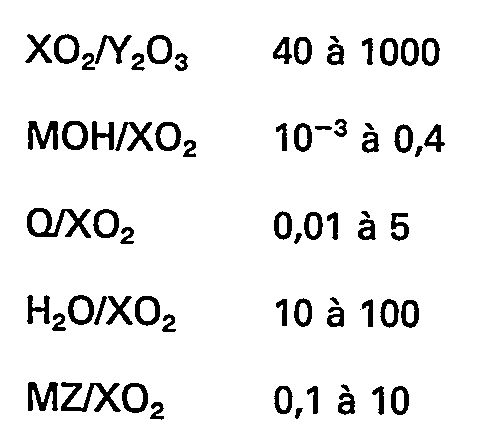
dans laquelle X et Y sont tels que définis dans la revendication 1, Q est un dérivé de pipérazine, M dans MOH est du sodium ou de l'ammonium, M dans MZ est du sodium de l'ammonium ou de l'hydrogène et Z est un radical d'acide fort.
dans laquelle X et Y sont tels que définis dans la revendication 1, Q est un dérivé de pipérazine, M dans MOH est du sodium ou de l'ammonium, M dans MZ est du sodium de l'ammonium ou de l'hydrogène et Z est un radical d'acide fort.
3. Procédé suivant la revendication 2, caractérisé en ce que le rapport XO2/Y203 est dans la gamme de 70 à 200.
4. Procédé suivant la revendication 2 ou la revendication 3, caractérisé en ce que
le rapport MOH/X02 est dans la gamme de 0,02 à 0,15.
5. Procédé suivant l'une quelconque des revendications 2 à 4, caractérisé en ce que
le rapport Q/XO2 est dans la gamme de 0,05 à 2.
6. Procédé suivant l'une quelconque des revendications 2 à 5, caractérisé en ce que
le rapport H20/X02 est dans la gamme de 25 à 50.
7. Procédé suivant l'une quelconque des revendications 2 à 6, caractérisé en ce que
le rapport MZ/XO2 est dans la gamme de 0,3 à 3.
8. Procédé suivant l'une quelconque des revendications 2 à 7, caractérisé en ce que
le dérivé de la pipérazine est la pipérazine.