| (19) |
 |
|
(11) |
EP 0 059 061 B2 |
| (12) |
NEW EUROPEAN PATENT SPECIFICATION |
| (45) |
Date of publication and mentionof the opposition decision: |
|
30.09.1992 Bulletin 1992/40 |
| (45) |
Mention of the grant of the patent: |
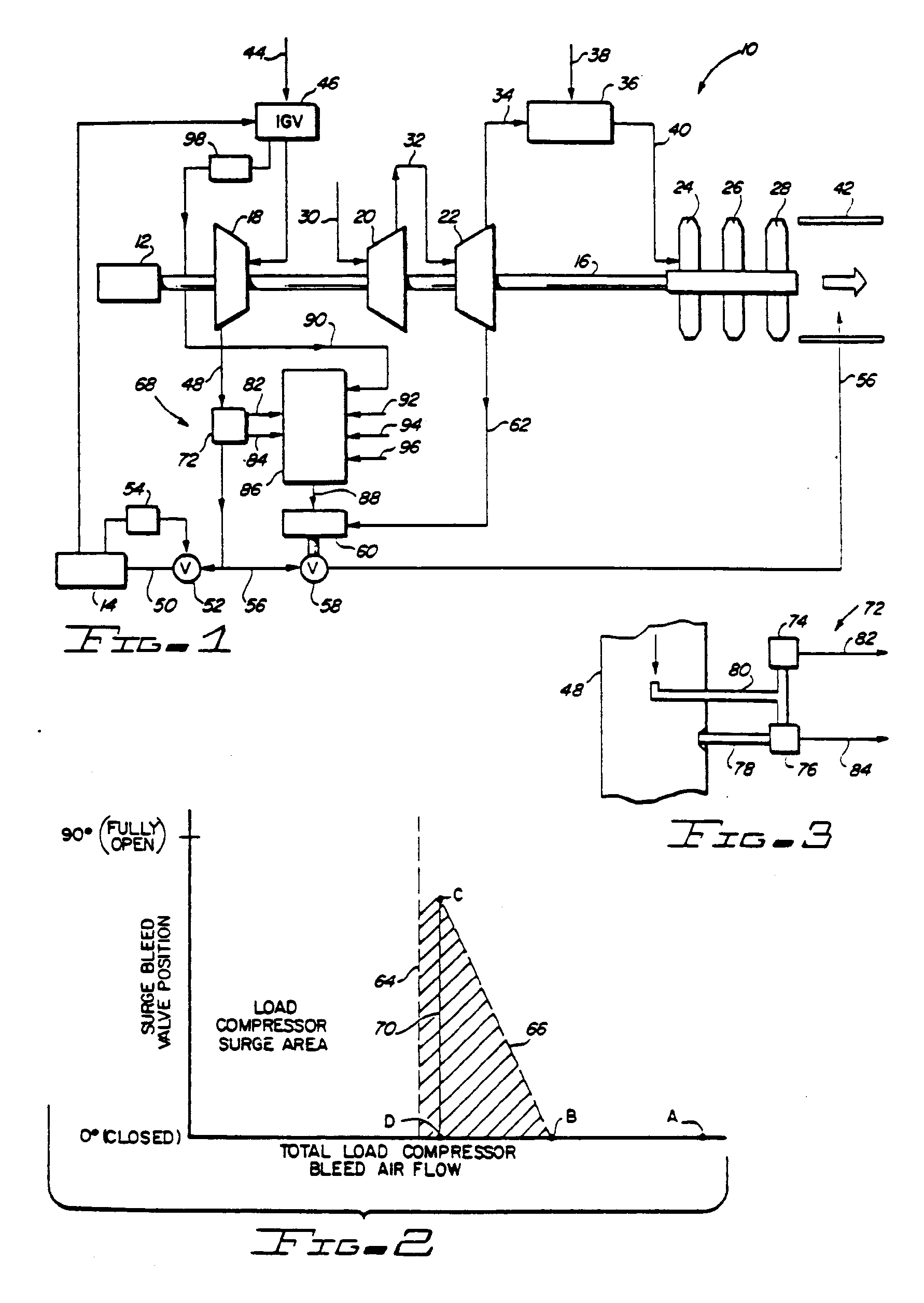
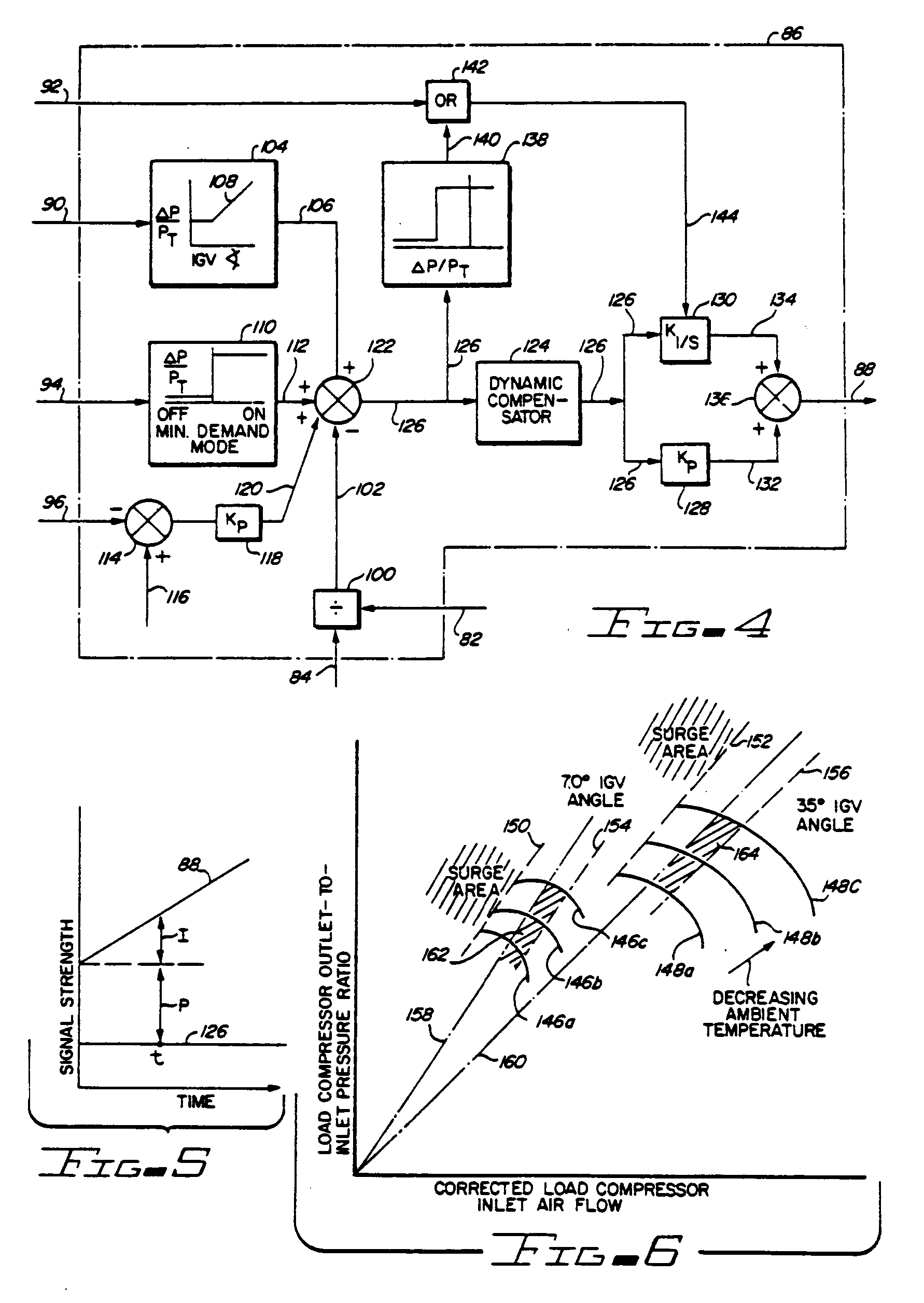
|
20.04.1988 Bulletin 1988/16 |
| (22) |
Date of filing: 16.02.1982 |
|
|
| (54) |
Compressor bleed air control apparatus and methods
Verfahren und Vorrichtung zur Steuerung der Nebenluft eines Kompressors
Procédé et dispositif de commande de l'air secondaire d'un compresseur
|
| (84) |
Designated Contracting States: |
|
DE FR GB IT |
| (30) |
Priority: |
19.02.1981 US 235794
|
| (43) |
Date of publication of application: |
|
01.09.1982 Bulletin 1982/35 |
| (73) |
Proprietor: THE GARRETT CORPORATION |
|
Los Angeles, California 90009 (US) |
|
| (72) |
Inventors: |
|
- Stokes, Richard F.
Phoenix
Arizona 85008 (US)
- Timm, James D.
Tempe
Arizona 85282 (US)
- LaCroix, Stephen R.
Scottsdale
Arizona 85253 (US)
- Adams, Milton R.
Tempe
Arizona 85282 (US)
|
| (74) |
Representative: Arthur, George Fitzgerald et al |
|
12, The Quadrangle
GB-Welwyn Garden City, Herts.
GB-Welwyn Garden City, Herts. (GB) |
| (56) |
References cited: :
DE-A- 2 818 977
FR-A- 2 115 342
FR-A- 2 429 913
GB-A- 1 021 797
GB-A- 2 036 177
US-A- 3 487 993
US-A- 3 909 152
|
DE-C- 2 735 246
FR-A- 2 368 623
GB-A- 994 592
GB-A- 2 024 944
US-A- 3 373 675
US-A- 3 744 925
US-A- 4 164 035
|
|
| |
|
|
|
|
| |
|
[0001] The present invention relates generally to apparatus and methods for regulating the
flow rate of gas discharge from a source of compressed gas which is liable to surging,
for example a compressor, and more particularly although not exclusively to a novel
bleed air control system adapted to ensure a constant minimum discharge flow rate
in a compressor used to power pneumatically-operated aircraft accessory systems and
the like.
[0002] US-A-3,487,993 and 3,909,152 both show examples of an aircraft gas turbine engine
with a compressed air bleed from the main engine compressor to power the aircraft
accessory system. Of these, US-A-3,487,993 shows an aircraft gas turbine engine with
a multi-stage compressor providing airfor combustion and subsequent combustion gas
expansion in the turbine section, the compressor having alternatively- operating bleeds
from an intermediate-pressure stage and a high-pressure stage. Means is provided for
switching the bleed from the intermediate-pressure stage to the high-pressure stage
by opening a normally-closed valve controlling the high-pressure stage bleed, when
a sensed pressure at e.g. the intermediate stage falls to a predetermined value. The
control valve when open may be modulated to regulate the pressure of the bleed air
supplied to the accessory system. US-A-3,909,152 provides only a simple accessory
bleed point from the gas turbine engine compressor, and provides this bleed through
a variable-area bleed port providing decreased port area when the bleed pressure is
high, and vice versa, to prevent overbleeding of the engine under high power conditions.
[0003] In addition to their traditional propulsion functions, gas turbine engines are often
used as accessory power units (APU's) to supply mechanical and/or pneumatic power
to a wide variety of aircraft accessory devices and systems. Accessory system pneumatic
power is typically provided by forcing bleed air from the APU compressor section through
a main bleed duct to the accessory system's supply inlet via a branch supply duct
connected to and defining a terminal portion of the main duct. In order to prevent
surge of the APU compressor used to power the pneumatic accessory system, it is necessary
to maintain a certain minimum flow rate through the main bleed duct.
[0004] However the APU-supplied accessory system normally has a widely fluctuating compressed
air requirement and is automatically controlled to correspondingly regulate the amount
of bleed air it receives from the compressor by modulation of an accessory valve positioned
in the branch supply duct.
[0005] To accommodate a decrease in accessory air demand, and maintain the compressor through
flow above its surge level, a further branch passage referred to as a surge bleed
duct is typically connected to the main bleed duct to provide an alternate outlet
flow path for the compressor bleed air as flow through the branch supply duct is diminished
by a closing of the accessory system valve. Flow through the surge bleed duct is regulated
by modulating a flow control valve, referred to as the surge bleed valve positioned
therein.
[0006] Conventional bleed air control systems employ mechanical devices, such as diaphragm
controllers, to proportionally operate the surge bleed valve in response to deviations
in main duct flow rate from a desired value thereof. More specifically, as the main
duct flow rate begins to deviate from a predetermined value, an error signal is generated
and the control system responsively modulates the surge bleed valve to a degree directly
proportional to the magnitude of the error signal.
[0007] Such conventional control of the surge bleed valve requires that the valve be initially
opened at a total compressor bleed air level substantially higher than the minimum
flow level (i.e. a flow level exceeding the surge level by a reasonable margin of
safety) required to prevent surge of the compressor. The early surge valve opening,
necessitated by the stead-state droop characteristics of proportional control which
cause the surge bleed valve operating characteristic line to be angled relative to
the compressor surge characteristic line, results in a sizable amount of excess surge
bleed air being dumped to atmosphere as the surge bleed valve is moved toward its
fully open position. This heretofore unavoidable excess surge bleed air causes increased
APU fuel consumption, results in increased surge bleed noise, decreases total power
available from the APU, and limits the maximum supply pressure available to the pneumatically-powered
accessory system.
[0008] GB-A-1021797 discloses an arrangement for preventing surging in a centrifugal compressor
comprising supply duct means for flowing to the gas-operated apparatus gas discharged
from the source; means defining an outlet passage from the supply duct means; means
for sensing the gas flow rate through the supply duct means and means for generating
an error signal having a magnitude indicative of the deviation between the sensed
flow rate and a desired value thereof; control means for utilising the error signal
in a manner to prevent surging despite fluctuations in the flow rate of gas received
by the gas-operated apparatus. A surge bleed duct control valve is controlled by a
signal which is dependent on AP
2/P
2, where A
P2 is the flow rate through the compressor and
P2 is the pressure level of the compressor. The control may have a proportional action
or both a proportional and an integral action.
[0009] Accordingly, one object of the present invention is to provide an improved compressor
system, and a bleed air control system and methods therefor, which eliminates or minimises
the above-mentioned excess surge bleed air flow as well as other problems and advantages.
[0010] US-A-4164035 discloses an apparatus for supplying gas discharged from a source of
compressed gas as well as a control apparatus for modulating a flow controlled valve
generally as set out in the precharacterising portion of claims 1 and 12. However,
in this case, the gas flow rate in the supply ducts is calculated using the gas pressure
before and after the compressor. This arrangement suffers a disadvantage that an accurate
reflection of the true flow rate cannot be guaranteed due to changes in the gas temperature,
velocity, leakage etc.
[0011] It is therefore an object of the present invention to provide an arrangement in which
the determination of the flow rate is not subject to these inaccuracies.
[0012] This object is achieved by the apparatus defined in Claims 1 and 12, and by the method
claimed in Claim 14.
[0013] The invention may be carried into practice in various ways, but one specific embodiment
thereof will now be described by way of example only, and with reference to the accompanying
drawings, in which:-
Figure 1 is a schematic diagram of a gas turbine engine accessory power unit in which
is incorporated a compressor bleed air control system embodying principles of the
present invention;
Figure 2 is a graph of surge bleed valve position plotted against total load compressor
bleed air flow which comparatively depicts the surge bleed valve control characteristics
of the control system of Figure 1 and those of a conventional, proportional control
system;
Figure 3 is an enlarged, schematic illustration of the flow sensor portion of the
control system of Figure 1;
Figure 4 is an enlarged schematic diagram showing the components of the electronic
controller portion of the control system of Figure 1;
Figure 5 is a graph of signal strength plotted against time depicting the relationship
between the electronic controller output signal and an error signal generated by the
control system of Figure 1; and
Figure 6 is a graph illustrating the relationship between the control system flow
parameter and the position of the load compressor inlet guide vanes of the accessory
power unit.
The Accessory Power Unit
[0014] Agas turbine engine accessory power unit (APU) 10 is schematically illustrated in
Figure 1 and constitutes a preferred embodiment of the present invention. Accessory
power units such as APU 10 are typically used to provide mechanical power to a driven
accessory such as a generator 12, and simultaneously to supply compressed air to an
accessory system such as an aircraft environmental control system 14 or to other pneumatically-operated
devices such as air turbine motors or the like.
[0015] APU 10 includes a power shaft 16 drivingly coupled at its left end in Figure 1 (through
a gearbox not shown in Figure 1) to the generator 12. Fixedly mounted on the shaft
16 for rotation therewith are, from left to right along its length, a centrifugal
load compressor 18, first and second stage centrifugal power compressors 20, 22, and
first, second, and third stage axial power turbines 24, 26 and 28 positioned at the
right end of the shaft 16.
[0016] During operation of the APU, ambient air 30 is drawn into the inlet of the first
stage power compressor 20, compressed, and then discharged through duct 32 into the
inlet of the second stage power compressor 22 where it is further compressed. Compressor
22 discharges the further compressed air through a duct 34 into a combustor 36. The
compressed air entering combustor 36 is mixed with fuel 38 also supplied to the combustor
to form a fuel-air mixture which is continuously burned therein. Expanded gas 40 from
the combustor is forced axially through the power turbines 24, 26, 28 to supply rotational
power to the shaft 16 and is exhausted from the APU to atmosphere through a discharge
passage 42 positioned immediately downstream of the power turbines.
[0017] The rotation of the shaft 16 drives the generator 12 (or other mechanically-driven
accessories) and also rotationally drives the load compressor 18 which is used to
supply compressed air to the pneumatically-operated accessory system 14. Ambient air
44 is drawn through a set of adjustable inlet guide vanes (IGV) 46 into the inlet
of the load compressor 18. Compressed air exiting (or "bled" from) compressor 18 is
fored through a main bleed air duct 48, and then through a branch bleed air supply
duct 50 connected to main duct 48, to supply compressed air to the accessory system
14. Branch bled duct 50 is sized to flow to the accessory system 14 the entire volume
of compressed air discharged from the load compressor 18.
[0018] The amount of compressor bleed air received by system 14 is conventionally regulated
by a valve or damper 52, positioned in the branch bleed duct 50, and controlled by
a volume controller 54 operatively connected between the system 14 and the valve 52.
Upon sensing an increase in system compressed air demand, the controller 54 modulates
valve 52 towards a fully open position. Conversely, upon sensing a decrease in system
compressed air demand, the controller 54 modulates valve 52 towards a fully closed
position.
[0019] The bleed air-producing load compressor 18 is conventionally designed for maximum
efficiency at rated load. Therefore, a certain minimum through flow of air is required
to prevent compressor surge (i.e., stall on the blades of compressor 18). Because
of the varying compressed air demand of accessory system 14, it is necessary to provide
an alternate outlet flow path (i.e., a path in addition to branch bleed air duct 50)
for the bleed air flowing through the main duct 48 in the event that the quantity
of bleed air flow through branch duct 50 falls below the minimum required to prevent
a surge condition in compressor 18. More specifically, when the valve 52 restricts
the flow of bleed air in branch duct 50 to below the minimum surge-prevention quantity,
an additional bleed air outlet passage must be provided from the main bleed duct 48.
[0020] To accomplish this relief function, a surge bleed duct 56 is connected to the main
bleed duct 48 and extended therefrom into the APU discharge passage 42. Like the branch
bleed duct 50, the surge bleed duct 56 is sized to accommodate the entire flow of
bleed air through the main duct 48 in the event that the control valve 52 closes completely,
in which case all of the bleed air dischargewd from the load compressor 18 is dumped
into the discharge passage 42 through the surge bleed duct 56.
[0021] Compressed air flow through the surge bleed duct 56 is regulated by variable surge
flow restriction means in the form of a surge bleed valve or damper 58 installed in
the surge bleed duct 56. Surge bleed valve 58 is positioned by a torque motor 60 which
is powered by bleed air 62 from the second stage power compressor 22.
[0022] It is to the control of the surge bleed valve 58, in response to the varying compressed
air demands of the accessory system 14, that the present invention is directed. The
conventional method of regulating the surge bleed valve 58 is to employ a mechanical
control system which senses the pressure within the main bleed duct 48 (or another
parameter related to the total air flow therethrough) and generates an error signal
indicative of the magnitude of the deviation of such parameterfrom a desired value
thereof. This error signal is used to proportionally control the surge bleed valve
to thereby maintain the bleed flow in duct 48 above the minimum required to prevent
compressor surge. More specifically, conventional control systems modulate the surge
bleed valve to a degree which is simply proportional to the strength of the mechanical
error signal. The limitations and disadvantages of proportional surge bleed valve
control are well known and are graphically depicted in Figure 2.
[0023] In Figure 2 point A represents, for a selected inlet guide vane position, the total
load compressor bleed air flow through main duct 48 with surge bleed valve 58 fully
closed and accesssory valve 52 fully open. The vertical dashed line 64 to the left
of point A is the surge line of the load compressor 18, a total compressor bleed flow
to the left of the surge line 64 causing compressor surge.
[0024] With conventional proportional control of surge bleed valve 58, its control line
(dashed line 66 in Fig. 2) is inclined leftwardly relative to the vertical because
of the droop characteristics inherent in proportional control. Thus, in order to ensure
that the total compressor bleed air flow in slightly above its surge flow level (by
a suitable safety margin of from 5 to 15 percent) when the surge valve is open to
an extent necessary to cause full bleed flow through duct 56 (i.e., at point C, at
which point the surge valve is somewhat less than fully open in accordance with customary
design practice), it is necessary to initially open the surge valve at point B - a
point well to the right of point C. This very early initial opening of the surge valve
causes a rather sizeable excess of surge bleed air to be dumped to atmosphere to accommodate
the proportional control droop. Such excess bleed air is graphically depicted in Figure
2 by the cross-hatched area between lines 64 and 66.
[0025] The large excess surge bleed air requirement of conventional proportional control
of the surge bleed valve results in increased fuel consumption of the APU, creates
additional bleed air noise, limits the bleed air pressure available to the pneumatically-operated
accessory system 14, and reduces the total usable power output of the APU.
[0026] The present invention provides a unique electronic control system, indicated generally
at 68 in Figure 1, which inexpensively solves these problems. In a novel manner described
below, control system 68 operates the surge bleed valve along a control line 70 (Figure
2) which is substantially parallel to the surge line 64 and extends through point
C just slightly to the right of the surge line. With the control line 70 thus shifted
relative to the conventional control line 66, an initial surge valve opening point'D'
is provided which, like point 'C' is positioned slightly to the right of the surge
line. Thus, as the accessory valve 52 begins to close off and the total compressor
bleed air flow begins to decrease (i.e. move leftwardly from point 'A') a much later
initial opening of the surge valve occurs. As can readily be seen in Figure 2, the
clockwise angular displacement of the surge valve control characteristic line 70 (relative
to the conventional control line 66) by the control system 68 eliminates all of the
excess surge bleed flow between lines 66 and 70. The only excess surge bleed airflow
remaining, represented by the cross-hatched area between lines 64 and 70, is that
necessary to maintain a predetermined margin of safety during operation of the APU.
The Electronic Surge Bleed Valve Control System
[0027] Referring now to Figures 1, and 4, the electronic control system 68 includes a flow
sensor 72, connected to the main bleed air duct 48, which comprises a total pressure
transducer 74 and a differential pressure transducer 76. A static pressure probe 78
extends into the main duct 48 and is coupled to the static pressure inlet of the differential
transducer 76. Additionally, a total pressure probe 80 extends into the duct 48 and
is coupled to the inlet of the total pressure transducer 74 and also to the total
pressure inlet of the differential transducer 76. The flow sensor 72 transmits an
output signal which comprises the combination of electric signals 82, 84 from the
transducers 74, 76 respectively. Signal 82 is indicative of the total pressure (PJ,
and signal 84 is indicative of the difference (P
t - P
s) between the total and static pressures within the main duct 48.
[0028] Transducer output signals 82, 84 are received by an electronic controller 86 which
responsively transmits an electric control signal 88 to the valve motor 60 to vary
the amount of power compressor bleed air 62 it receives, and thus vary the modulating
force on the normally open surge bleed valve 58 in a manner achieving the very desirable
surge valve control line 70 of Figure 2.
[0029] Also received by controller 86 are electric input signals 90, 92, 94 and 96, as indicated
in Figures 1 and 4, which function as subsequently described to reset the controller
86. Input signal 90 is transmitted to the controller 86 by an inlet guide vane position
sensor 98 and is indicative of the actual position (i.e., opening angle) of the inlet
guide vanes 46. input signal 92 is manually generated and resets controller 86 to
an accessory system zero demand (or "idle") mode in which, by means not shown, the
inlet guide vales are closed. input singal 94, also manually generated, resets controller
86 to an accessory system minimum demand mode and, also by means not shown, moves
the inlet guide vane to a predetermined minimum opening position. input signal 96
emanates from a pressure sensor (not shown) in the load compressor 18 and is indicative
of the pressure therein.
[0030] Referring now to Figure 4, the electronic controller 86 includes a divider 100 which
receives the pressure transducer output signals 82, 84 and responsively generates
an electric output signal 102 whose magnitude represents the value of the sensed control
paramater, (P
t - P
s)/P
t of the control system 68.
[0031] Reset signals 90, 94, 96 are used to combina- tively define a desired value, or set
point, of the main bleed flow-related control parameter (P
t - P,)/P
t. Signal 90, emanating from the guide vane position sensor 98, is used to adjust such
set point as a function of the angular position of the inlet guide vanes 46. This
guide vane-related adjustment is accomplished by a function generator 104 which receives
reset signal 90 and responsively generates an output signal 106 related to signal
90 according to a predetermined, generally linearly increasing reset schedule 108
as graphically illustrated in Figure 4.
[0032] As will be seen, the use of the control parameter (P
t - P,)/P
t, and the automatic adjustment of its set point value in response to changes in inlet
guide vane position, ensure that a constant minimum load compressor bleed flow rate,
between the compressor surge rate and the maximum accessory demand flow rate, is maintained
by the control system 68 despite wide variations in inlet guide vane position and
ambient temperatures.
[0033] Signal 94, generated when the accessory system minimum demand mode is manually selected,
is received by a signal generator 110 which transmits an output signal 112 whose magnitude
is constant.
[0034] The third control point reset signal, signal 96, which is indicative of the load
compressor inlet pressure, is received by a comparator 114 which also receives an
electric reference input signal 116 having a constant magnitude representative of
sea level atmospheric pressure. Comparator 114 generates, through a multiplier 118,
an output signal 120 which is proportional to the difference in magnitude between
signals 96 and 116, thus being indicative of the actual altitude of APU 10.
[0035] The three reset control signals, 106, 112, 120, and the signal 102 (which represents
the actual sensed value of the flow parameter (P
t - P
s)/P
t within the main bleed duct 48), are received by a comparator 122 which transmits,
through a dynamic compensator 124, an error signal 126 whose magnitude is indicative
of the difference between the actual value of the flow control parameter and the desired
value thereof -namely the sum of the magnitude of signals 106, 112 and 120. Dynamic
compensator 124 functions in a conventional manner to provide lead-lag dynamic compensation
to error signal 126, thereby improving its transient response characteristics without
affecting its steady state values.
[0036] It can be seen in Figure 4 that the set point value of the main bleed flow parameter
(P
t - P
s)/P
t is increased by the control system 68 in three manners - (1) an increased opening
of the inlet guide vanes, (2) a selection of the accessory system minimum demand made
and/or (3) an increase in the altitude of the APU. Conversely, the set point is decreased
by a reduction in the magnitude of any of the signals 106, 112, 120.
[0037] Error signal 126 is supplied in parallel to a proportional controller 128 and an
integral controller 130. Controller 128, 130, respectively, transmit electrical output
control signals 132, 134 which are received by a summer 136. The magnitude of output
signal 132 is a predetermined multiple of the magnitude of error signal 126, while
the magnitude of output signal 134 is the integral, as a function of time, of the
error signal 126.
[0038] The summer 136 combines, or superimposes, the proportional and integral control signals
132, 134 and outputs the combined control signal 88 which is used to regulate the
torque motor 60 (Figure 1), and thus modulate the surge bleed valve 58. As can be
seen in Figure 5, the output signal 88 from the electronic controller 86 has a magnitude
which increases linearly- relatively to the magnitude of the error signal 126 as a
function of the duration of such error signal, and has, at a given time t, both an
integral component I and a proportional component P. The flow rate of surge bleed
air exhausted through duct 56 is thus related to the magnitude of deviation of the
parameter (P
t - P,)/P
t, from its set point value, in both a proportional and time-integral manner.
[0039] It is this unique use of proportional and integral system control, afforded by the
parallel controllers 128, 130, which imparts the characteristics to the ultimate valve-controlling
signal 88 that substantially eliminate the excess surge bleed problems previously
described and long-associated with conventional proportional control of surge bleed
valve 58.
[0040] More specifically, it has been discovered that this addition to the valve-controlling
signal 88 of the integral component I (i.e., the integrated output signal 134) makes
possible the ideally positioned valve control line 70 (Figure 2), thereby eliminating
the previously unavoidable wastage of surge bleed air represented by the area between
lines 66 and 70 in Figure 2. The resulting control line 70, since it is essentially
parallel to surge line 64, greatly delays the required initial opening of the surge
valve (compared to conventional proportional valve control), as previously described,
when the total compressor bleed air flow rat begins to diminish.
[0041] In sum, the illustrated control system 68 provides a constant minimum total bleed
airflow rate (line 70) instead of the wasteful varying minimum flow rate (line 66)
of previous surge valve control systems. Under the greatly improved control of system
68, once the surge valve 58 is initially opened the flow through main duct 48 remains
essentially constant regardless of degree to which the surge valve is further opened.
[0042] Referring again to Figure 4, the error signal 126 received by the parallel controllers
128,130 is also transmitted to a "kicker" control 138. When error signal 126 reaches
a predetermined maximum level (indicating a predetermined maximum deviation between
the actual value of the flow parameter (P
t -P
s)/P
t and its set point), the kicker 138 transmits a constant value output signal 140 to
an OR gate 142 which also receives signal 92 (the manually selected accessory system
zero demand signal). If the OR gate 142 receives either of the signals 92, 140 it
immediately transmits to the integral controller 130 an electrical integrator shutoff
signal 144 which interrupts current flow therethrough, thereby allowing the surge
valve 58 to move, at its maximum slew rate, toward its normally open position.
[0043] Thus, for example, if the total bleed flow rate in main duct 48-experiences a very
rapid diminution, the kicker 138 acts as a safety mechanism to compenate for this
condition by snapping the surge valve to a more open position until the error signal
returns to below its predetermined maximum allowable level. Selection, via signal
92, of the zero accessory system demand mode, which closes the accessory valve 52
in a manner not shown, also de-energizes the integrator 130 and rapidly opens the
surge valve to prevent compressor stall which might otherwise result from a sudden
closing of the accessory valve.
[0044] As previously mentioned, the selection of the flow-related main bleed air control
parameter (P
t -P
s)/P
t affords the control system certain operational advantages. Such advantages will now
be described with reference to Figure 6.
[0045] In Figure 6 two sets of constant temperature load compressor operating lines, 146a,
146b and 146c, and 148a, 148b and 148c, are plotted against the coordinates of load
compressor outlet-to-inlet pressure ratio and corrected load compressor inlet air
flow for two representative inlet guide vane angles, 70° and 35°. For the 70° inlet
guide vane angle the load compressor surge line is represented by dashed line 150,
while the surge line of the load compressor for the 35° inlet guide vane angle is
represented by dashed line 152. To the right of, and substantially parallel to, the
surge lines 150, 152 are plotted representative maximum accessory system flow rate
demand lines 154, 156 which respectively correspond to the 700 and 350 wide vane angles.
[0046] Finally, there are plotted on the graph of Figure 6 two control parameter lines 158,
160, each of which represents a different constant value of the main bleed duct flow
parameter (P
f - P,)/P
t used in the preferred embodiment of the present invention.
[0047] Two important characteristics of the parameter lines 158, 160 should be noted. First,
each such line, as it passes through the compressor operating lines, has a constant
slope, indicating that the desired parameter (P
t - P
s)/P
t is insensitive to variations in compressor inlet (i.e., ambient) temperature. Secondly,
each of the parameter lines 158, 160 extends between and is essentially parallel to
a different one of the surge and demand line pairs 150,154 and 152,156. The lines
158, 160 thus respectively define ideal potential load compressor operating areas
162 (the cross-hatched area bounded by lines 146a, 156, 146c and 158) and 164 (the
cross-hatched area bounded by lines 148a, 156, 148c and 160), such potential operating
areas having substantially constant minimum flow rates paralleling their associated
surge lines.
[0048] The achievement of these optimum compressor operating areas, defined in part by the
flow parameter lines 158,160, is, of course, made possible by the previously described
novel integral and proportional surge valve control built into the control system
68.
[0049] Another reason why the use of this particular flow control parameter is operationally
advantageous is that the optimum value of such parameter for each guide vane angle
is essentially linearly related to the particular inlet guide vane angle. This generally
linear relationship permits the use of the relatively simple linearfunction generator
104 (Figure 4) to properly reset the desired value of the flow parameter as a function
of the inlet wide vane position.
[0050] The bleed air control principles of the present invention are applicable to a wide
variety of compressor bleed applications and are not limited to the APU load compressor
application described above. For example, the proportional-plus-integral surge valve
control method of the present invention is equally well adapted to the situation where
partial bleed-off of the compressed air discharged from a power compressor (as distinguished
from a load compressor) is used as the air source for a pneumatically-operated accessory
system.
[0051] Additionally, while the control parameter (P
t -P
s)/P
t is particularly well suited to the illustrated load compressor bleed application,
otherflow-related parameters (such as P
t - P
s) could be used if desired. Moreover, the signals used to adjust the control set point
(i.e., the illustrated altitude, minimum demand mode, and inlet guide vane adjustment
signals) could be varied to suit the particular bleed air application. One example
of such variation would be the deletion of the guide vane adjustment of the control
set point in the situation where the bled-from compressor does not have adjustable
guide vanes.
[0052] To summarize, the control system 68, with its integral-plus-proportional control
feature, provides apparatus and methods for eliminating the large amount of wasted
surge bleed air associated with previous surge valve control systems. This is accomplished
by using relatively standard, rugged and reliable electronic components. The greatly
improved control provided by this invention reduces fuel consumption and surge bleed
air usage and noise, yet at the same time increases the maximum air pressure available
to the pneumatic accessory system 14 and the maximum shaft power available to the
mechanically-driven accessory 12.
1. Apparatus for supplying gas discharged from a source (18) of compressed gas having
an inlet (46) of variable area to gas-operated apparatus (14) having a variable supply
gas flow rate demand, the source being subject to surging, said apparatus comprising;
(a) supply duct means (48) for flowing to the gas-operated apparatus (14) gas discharged
from the source (18); (b) means (56) defining an outlet passage from the supply duct
means; (c) flow regulating means (58, 60) operable to variably restrict gas flow from
the duct means (48) outwardly through the outlet passage (56) ; (d) means (72) for
sensing the gas flow rate through the supply duct means (48) located between the compressed
gas source (18) and the outlet passage (56) and means (100, 122) for generating an
error signal (126) having a magnitude indicative of the deviation between the sensed
flow rate and a desired value thereof; and (e) control means (128, 130, 136) for converting
the error signal (126) into a control signal (88) for operating the flow regulating
means (58, 60) in a manner to maintain sufficient gas flow through the supply duct
means (48) to prevent surging despite fluctuations in the flow rate of gas received
by the gas-operated apparatus, the magnitude of the control signal relative to the
magnitude of the error signal having both an integral component (134) and a proportional
component (132), characterised in that the means for sensing the gas flow rate through
the supply duct means (48) comprises a total pressure probe (80) extending into the
supply duct means (48), a static pressure robe (78) extending into the supply duct
means (48), a total pressure transducer (74) and a differential transducer (76), the
transducers (74, 76) being connected to the pressure probes (78, 80), and the desired
value of the flow rate being provided by a sensed value of a flow related parameter
which has been varied in response to variation in the area of the inlet (46), the
flow-related parameter being (Pf - P,)/Pt, Pt being the total pressure in the duct means (48) and Ps being the static pressure therein, and further characterised by a kicker device (138)
for automatically deleting the integral component from the control signal while the
error signal exceeds a predetermined magnitude; and means for generating a signal
(96) indicative of the pressure at the inlet (46), means for generating a reference
signal (116) having a constant value representing a reference pressure, such as sea
level atmostpheric pressure, and a comparator (114) which receives the inlet presssure
signal (96) and the reference signal (116) and which generates an output signal (120)
which is proportional to the difference in magnitude betwwen the signal (96,116),
the output signal being selectively employed to bias the flow related parameter in
dependance upon the altitude of the apparatus above the position represented by the
reference pressure.
2. Apparatus as claimed in Claim 1, in which the control means (128, 130, 136) for
utilising the error signal (126) comprises a first control means (128) for receiving
the error signal and transmitting a first output signal (132) having a magnitude proportional
to the magnitude of the error signal, and a second control means (130) for receiving
the error signal and transmitting a second output signal (134) having a magnitude
representing the integral, as a function of time, of the magnitude of the error signal,
and means (136) for simultaneously utilising the two output signals to modulate the
flow regulating means (58) in a manner ensuring that the minimum gas flow rate through
the supply duct (48) is of a substantially constant, predetermined magnitude regardless
of the supply gas demand of the gas-operated apparatus.
3. Apparatus as claimed in claim 2, wherein the error signal-generating means includes;
the differential pressure transducer (76) which senses the difference between the
transducer (76) which senses the difference between the total pressure and the static
pressure within the supply duct means (48) and transmits a third output signal (84)
indicative of the sensed pressure differential; the total pressure transducer (74)
which senses the total pressure within the supply duct means (48) and transmits a
fourth output signal (82) indicative of the sensed total pressure; means (100) for
generating a sensed parameter signal (102) having a magnitude equal to the magnitude
of said third output signal divided by the magnitude of said fourth output signal;
and comparator means (122) for receiving said second parameter signal (102) and at
least one reset signal (106, 112, or 120) indicative of said desired value of said
parameter, and for responsively generating the error signal (126).
4. The apparatus of Claim 3, for use with a compressor (18) of a type having adjustable
inlet guide vanes, the apparatus further comprising guide vane position sensor means
(98) for transmitting a reset signal (106) to the comparator means (122), the reset
signal (106) varying as a function of the position of the inlet guide vanes according
to a predetermined reset schedule.
5. The apparatus of Claim 4, wherein the reset schedule is substantially linear.
6. The apparatus of Claim 3 or Claim 4 or Claim 5, including means for transmitting
a reset signal (94) to the comparator means (122), the reset signal being generated
in response to the selection of a predetermined mode of operation of the gas-operated
apparatus (14).
7. Apparatus as claimed in any one of Claims 1 to 6, in combination with a source
comprising an air compressor (18) subject to surging, the supply duct (48) in use
delivering bleed air from the compressor to pneumatically-powered apparatus (14) having
a variable supply air demand, and in which the flow regulating means comprises a surge
bleed control valve (58) in a surge bleed passage constituting the outlet passage
(56), and the control means (128, 130, 136) is arranged to utilise the error signal
(126) to modulate the valve (58) in a manner such that, subsequent to an initial opening
of the valve, the flow rate through the supply duct (48) remains substantially constant
in use regardless of the degree to which the valve is further opened, whereby the
valve is controlled in use along an operating characteristic line (70) substantially
parallel to a surge line characteristic (64) of the compressor.
8. Apparatus as claimed in any of Claims 2 to 7 wherein the kicker device (138) has
inlet means for receiving the error signal (126) and means for deactivating the integral
controller (130) when the errorsignal reaches a predetermined magnitude.
9. Apparatus as claimed in any one of Claims 1 to 8, in combination with an accessory
powerunitfor supplying compressed air to pneumatically-powered apparatus having a
fluctuating compressed air supply demand, the unit comprising a power- driven compressor
(18) supplying compressed air through the supply duct (48) to the pneumatically-powered
apparatus, and the outlet passage (56) and its flow regulating means (58) being operable
to exhaust from the supply duct a selectively-variable quantity of air to ensure at
least a predetermined minimum flow rate through the supply duct sufficient to prevent
surge of the compressor, the apparatus maintaining the said minimum flow rate essentially
constant regardless of fluctuations in the air supply demand of the pneumatically-powered
apparatus.
10. Apparatus as claimed in claim 9, in which the accessory power unit comprises a
gas turbine engine driving a compressor which supplies the compressed air to drive
the pneumatically-powered apparatus.
11. Apparatus as claimed in any one of Claims 1 to 9, incorporated in a gas turbine
engine device comprising: (a) as the said source subject to surging, drivable compressor
means (18, 20, 22) for receiving, compressing and discharging air; (b) combustor means
(36) for receiving compressed air discharged by said compressor means, mixing the
received air with fuel (38), burning the fuel-air mixture, and discharging the resultant
expanded gas (40); (c) turbine means (24, 26, 28) positioned to be operated by the
expanded gas (40) discharged from said combustor means (36) for driving said compressor
means and creating a power output from said gas turbine device; and (d) a bleed air
system including: (1) main bleed duct means (48) constituting the said surplus duct
means, said main bleed duct means having a branch air supply portion (50) for flowing
compressed air received from said compressor means (18) to the said gas-operated apparatus
(14) to operate the latter, and further having a surge bleed outlet portion (56) constituting
the said outlet passage from the supply duct means (48).
12. Control apparatus for modulating a flow control valve (58) positioned in an outlet
passage (56) connected to a main air supply passage (48) adapted to receive air discharged
from a compressor subject to surging and to supply the air to pneumatically-operated
apparatus (14) having a variable supply air demand, a flow sensor (72) for sensing
the air flow rate through the supply passage (48) being located between the compressor
and the outlet passage (56), the control apparatus comprising (a) means (122) for
generating an error signal indicative of the difference between the actual magnitude
of a selected flow-related parameter within the main air supply passage (48) and a
desired value of the parameter; (b) first control means (128) for receiving the error
signal and transmitting an output signal (132) having a magnitude proportional to
the magnitude of the error signal; (c) second control means (130) for receiving the
error signal and transmitting an output signal (134) having a magnitude representing
the integral, as a function of time, of the magnitude of the error signal; (d) means
(136, 88) for simultaneously utilising said output signals (132, 134) from said first
and second control means to modulate the flow control valve (58) in a manner ensuring
that the minimum airflow rate through the main air supply passage (48) is of a substantially
constant, predetermined magnitude regardless of supply air demand of the pneumatically-operated
apparatus; and (e) means (90,104) for adjusting the desired value of the parameter
in response to the variation of the inlet guide vane setting of the compressor, characterised
in that the flow sensor (72) comprises a total pressure probe (80) extending into
the supply passage (48), a static pressure probe (78) extending into the supply passage
(48), a total pressure transducer (74) and a differential pressure transducer (76),
the transducers (76, 76) being connected to the pressure probes (78, 80), whereby
the flow-related parameter is (Pt - P,)/Pt, Pt being the total pressure in the duct means (48) and Ps being the static pressure therein, and further characterised by a kicker device (138)
for automatically deleting said integral component from the control signal while the
error signal exceeds a predetermined magnitude; and means for generating a signal
(96) indicative of the pressure at the inlet (46), means for generating a reference
signal (116) having a constant value representing a reference pressure, such as sea
level atmostpheric pressure, and a comparator (114) which receives the inlet pressure
signal (96) and the reference signal (116) and which generates an output signal (120)
which is proportional to the difference in magnitude between the signals (96, 116),
the output signal being selectively employed to bias the flow related parameter in
dependance upon the altitude of the apparatus above the position represented by the
reference pressure.
13. Control apparatus as claimed in Claim 12, in combination with a compressor (18)
subject to surging supplying compressed air through the main supply passage (48) to
the pneumatically-operated apparatus (14), the control apparatus serving to modulate
the flow control valve (58); the flow sensor being responsive to variations in the
flow rate of air received by the pneumatically-operated apparatus (14) and being arranged
togetherwith the generating means (122) to produce the said error signal (126) which
has a magnitude indicative of the degree of deviation, from a desired minimum flow
rate, of the actual flow rate through the main supply passage (48), the control apparatus
being arranged to utilise the error signal (126) to modulate the flow control valve
(58) in such a manner that, subsequent to an initial opening of the valve (58), the
flow rate through the main supply passage (48) remains substantially constant regardless
of the degree to which the valve (58) is further opened, whereby in use the apparatus
controls the valve along an operating character- tistic line (70) substantially parallel
to a surge characteristic line (64) of the compressor.
14. A method of controlling a flow control valve (58) positioned in an outlet branch
passage (56) of a compressed air supply duct (48) interconnected between the outlet
of a compressor (18) subject to surging and the inlet of pneumatically-powered apparatus
(14) having a variable supply air demand, in which to ensure a predetermined, essentially
constant minimum flow rate through the supply duct (48) despite fluctuations in the
supply air demand of the pneumatically-powered apparatus (14), said method comprises
the steps of: (a) generating an error signal indicative of the difference between
the actual magnitude of a selected flow-related parameter within the supply duct (48)
and a desired value of the parameter; (b) producing a first control signal (132) having
a magnitude related to the magnitude of the errorsignal; (c) producing a second control
signal (134) whose magnitude is the integral, as a function of time, of the error
signal; (d) simultaneously utilising said first and second control signal (132 and
134) to modulate the flow control valve; and (e) adjusting the desired value of the
parameter in response to variation of the area of the inlet to the compressor, the
said control signal producing steps being performed by providing a proportional controller
(128) and an integral controller (130) and transmitting said error signal to each
of said controllers to produce the respective control signals, characterised in that
the generating of said error signal (126) includes the steps of sensing within the
supply duct (48) the value of the parameter Pt - P,)/Pt, Pt being the total pressure within the supply duct and Ps being the static pressure therein, and transmitting a signal (102) indicative of
the sensed value of said parameter to an inlet of a comparator (122), and comparing
the signal (102) with a set point value of the comparator to provide the error signal
as the difference thereof, and further characterised by automatically deleting the
integral component from the control signal while the error signal exceeds a predetermined
magnitude by means of a kicker device (138) and generating a signal (8=96) indicative
of the pressure at the inlet (46), generating a reference signal (116) having a constant
value representing a reference pressure, such as sea level atmospheric pressure, and
generating an output signal (120) which is proportional to the difference in magnitude
between the signals (96, 116), the output signal being sele- tively employed to bias
the flow related parameter in dependance upon the altitude of the apparatus above
the position represented by the reference pressure.
15. The method of Claim 14, wherein the compressor (18) has adjustable inlet guide
vanes, said comparator (122) has an adjustable set point, and said method further
comprises the step of adjusting said set point value in response to variations in
the position of the inlet guide vanes.
16. The method of Claim 15, wherein said point adjusting step is performed by adjusting
said set point according to a schedule essentially linearly related to changes in
the position of the inlet guide vanes.
17. The method of any one of Claims 14 to 16, in which the compressed air supply duct
(48) interconnects the outlet of a compressor (18) of a gas turbine engine and the
pneumatically-powered apparatus (14) to drive the latter.
18. The method of any one of Claims 14 to 16, applied to the utilisation of a compressor
(18) of a gas turbine engine to power pneumatically-operated apparatus (14) having
a variable inlet air flow demand, said method comprising the steps of interconnecting
the said supply duct (48) between the compressor (18) and the pneumatically-operated
apparatus; said method ensuring the maintenance of an essentially constant minimum
supply duct flow rate, despite fluctuations in the flow rate of air received by the
pneumatically-operated apparatus (14), by exhausting air from said supply duct (48)
in response to variatons therein of the value of the said parameter, the flow rate
of air exhausted from said supply duct being related to the magnitude of said parameter
value variations in both a proportional and time-integral manner.
1. Einrichtung zum Einspeisen von aus einer Druckgasquelle (18) mit einem Einlaß (46)
veränderlicher Querschnittsfläche abgegebenem Gas in eine gasbetätigte Einrichtung
(14) mit veränderlichem Gasdurchflußgeschwindigkeitsbedarf, wobei die Druckgasquelle
einer Pumpwirkung ausgesetzt ist, mit
a) einer Speiseleitungsvorrichtung (48), durch die aus der Quelle (18) stammendes
Gas in die gasbetätigte Einrichtung (14) strömt,
b) einer Vorrichtung (56), die einen Auslaßkanal von der Speiseleitungsvorrichtung
festlegt,
c) einer Durchflußregelvorrichtung (58, 60), die so betätigbar ist, daß sie den Gasdurchfluß
von der Leitungsvorrichtung (48) nach außen durch den Auslaßkanal (56) variabel begrenzt,
d) einer Vorrichtung (72) zum Feststellen der Gasdurchflußgechwindigkeit durch die
Speiseleitungsvorrichtung (48), die zwischen der Druckgasquelle (18) und dem Auslaßkanal
(56) angeordnet ist, und einer Vorrichtung (100,122) zum Erzeugen eines Fehlersignals
(126) mit einer Größe, die die Abweichung zwischen der festgestellten Durchflußgeschwindigkeit
und einem gewünschten Wert hierfür anzeigt, und
e) einer Steuervorrichtung (128, 130, 136) zur Umwandlung des Fehlersignals (126)
in ein Steuersignal (88) zur Betätigung der Durchflußregelvorrichtung (58, 60) in
der Weise, daß ein ausreichend großer Gasdurchfluß durch die Speiseleitungsvorrichtung
(48) aufrecht erhalten wird, um ein Pumpen trotz vorhandener Schwankungen der Durchflußgeschwindgkeit
des Gases, das von der gasbetätigten Einrichtung aufgenommen wird, zu verhindern,
wobei die Größe des Steuersignals relativ zur Größe des Fehlersignals sowohl eine
integrale Komponente (134) als eine proportionale Komponente (132) aufweist,
dadurch gekennzeichnet, daß die Vorrichtung zur Feststellung der Gasdurchflußgeschwindigkeit
durch die Speiseleitungsvorrichtung (48) eine Gesamtdrucksonde (80), die sich in die
Speiseleitungsvorrichtung (48) erstreckt, eine Statikdrucksonde (78), die sich in
die Speiseleitungsvorrichtung (48) erstreckt, einen Gesamtdruckwandler (74) und einen
Differentialwandler (76) aufweist, wobei die Wandler (74, 76) mit den Drucksonden
(78, 80) verbunden sind, und der gewünschte Wert der Durchflußgeschwindigkeit durch
einen festgestellten Wert eines durchflußbezogenen Parameters erzeugt wird, der in
Abhängigkeit von der Änderung des Flächeninhalts des Einlasses (46) verändert worden
ist, und wobei der flußbezogene Parameter (P
t - P
s)/P
t ist, wobei P
t der Gesamtdruck in der Leitungsvorrichtung (48) und Ps der darin herrschende statische
Druck ist, und
ferner gekennzeichnet durch eine Kickervorrichtung (138) zum selbsttätigen Aufheben
der integralen Komponente aus dem Steuersignal, während das Fehlersignal einen vorbestimmten
Wert übersteigt, sowie
eine Vorrichtung zur Erzeugung eines Signals (96), das den Druck am Einlaß (46) anzeigt,
eine Vorrichtung zur Erzeugung eines Bezugssignals (116) mit einem konstanten Wert,
der einen Bezugsdruck, z.B. den Atmosphärendruck auf Meereshöhe darstellt, und eine
Vergleichsvorrichtung (114), die das Einlaßdrucksignal (96) und das Bezugssignal (116)
aufnimmt und das ein Ausgangssignal (120) erzeugt, das proportional der Differenz
der Größe zwischen den Signalen (96, 116) ist, wobei das Ausgangssignal selektiv verwendet
wird, um den flußbezogenen Parameter in Abhängigkeit von der Höhe der Einrichtung
über der durch den Bezugsdruck repräsentierten Position vorzuspannen.
2. Einrichtung nach Anspruch 1, bei der die Steuervorrichtung (128, 130, 136) zur
Verwendung des Fehlersignales (126) aufweist: eine erste Steuervorrichtung (128) zum
Aufnehmen des Fehlersignais und zum Übertragen eines ersten Ausgangssignals (132)
mit einer Größe proportional der Größe des Fehlersignals, eine zweite Steuervorrichtung
(130) zum Aufnehmen des Fehlersignals und zum Übertragen eines zweiten Ausgangssignals
(134) mit einer Größe entsprechend dem Integral der Größe des Fehlersignals als Funktion
der Zeit, sowie eine Vorrichtung (136) zum gleichzeitigen Verwenden der beiden Ausgangssignale
für das Modulieren der Durchflußregelvorrichtung (58) in einer Weise, die sicherstellt,
daß die minimale Gadurchflußgeschwindigkeit durch die Speiseleitung (48) eine im wesentlichen
konstante, vorbestimmte Größe unabhängig von dem Speisegasbedarf der gasbetätigten
Einrichtung ist.
3. Einrichtung nach Anspruch 2, bei der die Fehlersignalerzeugungsvorrichtung aufweist:
den Differentialdruckwandler (76), der die Differenz zwischen dem Gesamtdruck und
dem statischen Druck innerhalb der Speiseleitungsvorrichtung (48) feststellt und ein
drittes Ausgangssignal (84), das das festgestellte Druckdifferential anzeigt, überträgt,
den Gesamtdruckwandler (74), der den Gesamtdruck innerhalb der Speiseleitungsvorrichtung
(48) feststellt und ein viertes Ausgangssignal (82), das den festgestellten Gesamtdruck
anzeigt, überträgt,
eine Vorrichtung (100) zum Erzeugen eines festgestellten Parametersignals (102) mit
einer Größe gleich der Größe des dritten Ausgangssignals dividiert durch die Größe
des vierten Ausgangssignals, und
eine Vergleichsvorrichtung (122) zum Aufnehmen des festgestellten Parametersignals
(102) und mindesten eines Rücksetzsignals (106, 112 oder 120), das den gewünschten
Wert des Parameters anzeigt, und zum Erzeugen des Fehlersignals (126) durch Ansprechen.
4. Einrichtung nach Anspruch 3 zurVerwendung mit einem Kompressor (18) mit einstellbaren
Einlaßleischaufeln, wobei die Einrichtung ferner eine Leitschaufelpositionsfeststellvorrichtung
(98) zum Übertragen eines Rücksetzsignals (106) in die Vergleichsvorrichtung (122)
aufweist, und wobei das Rücksetzsignal (106) sich als Funktion der Position der Einlaßleitschaufeln
entsprechend einem vorbestimmten Rücksetzschema ändert.
5. Einrichtung nach Anspruch 4, bei der das Rücksetzschema im wesentlichen linear
ist.
6. Einrichtung nach Anspruch 3, 4 oder 5, mit einer Einrichtung zum Übertragen eines
Rücksetzsignals (94) auf die Vergleichsvorrichtung (122), wobei das Rücksetzsignal
in Abhängigkeit von der Auswahl einer vorbestimmten Betriebsart der gasbetätigten
Einrichtung (14) erzeugt wird.
7. Einrichtung nach einem der Ansprüche 1 - 6 in Verbindung mit einer Quelle, die
einen Luftkompressor (18) aufweist, der einem Pumpen ausgesetzt ist, wobei die Speiseleitung
(48) im Betrieb Anzapfluft von dem Kompressor in eine pneumatisch angetriebene Einrichtung
(14) liefert, die einen variablen Speiseluftbedarf hat, bei der die Durchflußregelvorrichtung
ein Pump-Nebenluft-Steuerventil (58) in einem den Auslaßkanal (56) darstellenden Pump-Nebenluft-Kanal
aufweist, und bei der die Steuereinrichtung (128,130,136) so ausgebildet ist, daß
sie das Fehlersignal (126) zum Modulieren des Ventils (58) in solcher Weie verwendet,
daß im Anschluß an ein beginnendes Öffnen des Ventils die Durchflußgeschwindigkeit
durch die Speiseleitung (48) im Betrieb im wesentlichen konstant bleibt, unabhängig
von dem Ausmaß, um das das Ventil weiter geöffnet wird, wobei das Ventil im Betrieb
nach einer Betriebscharakteristiklinie (70) gesteuert wird, die im wesentlichen parallel
zu einer Pump-Liniencharakteristik (64) des Kompressors verläuft.
8. Einrichtung nach einem der Ansprüche 1 - 7, bei der die Kickervorrichtung (138)
eine Einlaßvorrichtung zum Aufnehmen des Fehlersignals (126) und eine Vorrichtung
zum Unwirksammachen des integralen Steuergerätes (130), wenn das Fehlersignal eine
vorbestimmte Größe erreicht, aufweist.
9. Einrichtung nach einem der Ansprüche 1 - 8, in Verbindung mit einer zusätzlichen
Leistungseinheit zum Einspeisen von Druckluft in die pneumatisch betriebene Einrichtung
mit fluktuierendem Druckluft-Speisebedarf, bei der die zusätzliche Leistungseinheit
einen kraftgetriebenen Kompressor (18) aufweist, der Druckluft durch die Speiseleitung
(48) in die pneumatich betriebene Einrichtung einspeist und der Auslaßkanal (56) sowie
die Durchflußregelvorrichtung (58) so betätigbar sind, daß sie aus der Speiseleitung
eine selektiv veränderbare Luftmenge abführen, um zumindest eine vorbestimmte minimale
Durchflußgeschwindigkeit durch die Speiseleitung sicherzustellen, die aureicht, um
ein Pumpen des Kompressors zu verhindern, wobei die Einrichtung die minimale Durchflußgeschwindigkeit
unabhängig von Schwankungen im Speiseluftbedarf der pneumatisch betriebenen Einrichtung
im wesentlichen konstant hält.
10. Einrichtung nach Anspruch 9, bei der die zusätzliche Leistungseinheit ein Gasturbinentriebwerk
aufweist, das einen Kompressor antreibt, welcher die komprimierte Luft zum Antrieb
der pneumatisch betriebenen Einrichtung einspeist.
11. Einrichtung nach einem der Ansprüche 1 - 9 in Verbindung mit einem Gasturbinentriebwerk,
gekennzeichnet durch
a) als der Pumpwirkung ausgesetzte Quelle einer antreibbaren Kompressorvorrichtung
(18, 20, 22) zum Aufnehmen, Komprimieren und Abgeben von Luft,
b) eine Verbrennungsvorrichtung (36) zum Aufnehmen komprimierter Luft, die von der
Kompressorvorrichtung abgegeben wird, zum Mischen der aufgenommenen Luft mit Brennstoff
(38), zum Verbrennen des Brennstoff-Luftgemisches und zum Abgeben des resultierenden
expandierten Gases (40),
c) eine Turbinenvorrichtung (24, 26, 28), die so ausgelegt ist, daß sie durch das
expandierte Gas (40) beaufschlagt wird, das von der Verbrennungsvorrichtung (36) abgegeben
wird, um die Kompressorvorrichtung anzutreiben und eine Leistungsabgabe aus der Gasturbinenvorrichtung
zu erzielen, und
d) ein Nebenluftsystem mit einer Hauptanzapfleitung (48), die die überschüssige Leitung
darstellt und die einen Zweigluftspeiseteil (50) besitzt, um von der Kompressorvorrichtung
(18) aufgenommene komprimierte Luft in die gasbetriebene Vorrichtung (14) überzuführen
und letztere zu betätigen, und ferner mit einem Pump-Nebenluft-Auslaßteil (56), der
den Auslaßkanal aus der Speiseleitungsvorrichtung (48) darstellt.
12. Steuereinrichtung zum Modulieren eines Durchfluß-Steuerventils (58), das in einem
Auslaßkanal (56) angeordnet ist, der mit einem Hauptluft-Speisekanal (48) verbunden
ist, welcher Luft aufnehmen kann, die von einem einem Pumpen ausgesetzten Kompressor
abgegeben wird, und die Luft in die pneumatisch betätigte Vorrichtung (14) mit variablem
Speiseluftbedarf einspeist, und einem Durchflußsensor (72) zum Feststellen der Luftdurchflußgeschwindigkeit
durch den Speisekanal (48), der zwischen Kompressor und Auslaßkanal (56) angeordnet
ist, mit
a) einer Vorrichtung (122) zum Erzeugen eines Fehlersignals, das die Differenz zwischen
der tatsächlichen Größe eines ausgewählten, durchflußbezogenen Parameters innerhalb
des Hauptluft-Speisekanals (48) und eines Sollwerts des Parameters anzeigt,
b) einer ersten Steuervorrichtung (128) zum Aufnehmen des Fehlersignals und zum Übertragen
eines Ausgangssignals (132) mit einer Größe proportional der Größe des Fehlersignals,
c) einer zweiten Steuervorrichtung (130) zum Aufnehmen des Fehlersignals und zum Übertragen
eines Ausgangssignals (134) mit einer Größe, die das Integral der Größe des Fehlersignals
abhängig von der Zeit repräsentiert,
d) einer Vorrichtung (136, 88) zum gleichzeitigen Auswerten der Ausgangssignale (132,
134) aus der ersten und der zweiten Steuervorrichtung, um das Durchflußsteuerventil
(58) so zu modulieren, daß sichergestellt ist, daß die minimale Luftdurchströmgeschwindigkeit
durch den Hauptluft-Speisekanal (48) eine im wesentlichen konstante, vorbestimmte
Größe unabhängig von dem Speiseluftbedarf der pneumatisch betätigten Vorrichtung ist,
und
e) einer Vorrichtung (90, 104) zum Einstellen des Sollwertes,des Parameters in Abhängigkeit
von der Änderung der Einlaß-Leitschaufeleinstellung des Kompressors,
dadurch gekennzeichnet, daß der Durchflußsensor (72) eine sich in den Speisekanal
(48) erstreckende Gesamtdrucksonde (80), eine sich in den Speisekanal (48) erstreckende
Statikdrucksonde (78), einen Gesamtdruckwandler (74) und einen Differentialdruckwandler
(76) aufweist, wobei die Wandler (74, 76) mit den Drucksonden (78, 80) verbunden sind,
wobei der durchflußbezogene Parameter (P
t - P
s)/P
t ist, dessen P
t der Gesamtdruck in der Speiseleitung (48) und dessen Ps der statische Druck darin
ist, und ferner gekennzeichnet durch eine Kickervorrichtung (138) zum automatischen
Aufheben der integralen Komponente aus dem Steuersignal, während das Fehlersignal
eine vorbestimmte Größe übersteigt, und durch eine Vorrichtung zur Erzeugung eines
Signals (96), das den Druck am Einlaß (46) anzeigt, eine Vorrichtung zum Erzeugen
eines Bezugssignals (116) mit einem konstanten Wert, das einen Bezugsdruck repräsentiert,
z.B. den Atmosphärendruck bei Meeresspiegel, und eine Vergleichsvorrichtung (114),
die das Einlaßdrucksignal (96) und das Bezugssignal (116) aufnimmt und ein Ausgangssignal
(120) erzeugt, das proportional der Differenz in der Größe zwischen den Signalen (96,116)
ist, wobei das Ausgangssignal selektiv zum Vorspannen des durchflußbezogenen Parameters
in Abhängigkeit von der Höhe der Einrichtung über der durch den Bezugsdruck repräsentierten
Position verwendet wird.
13. Steuereinrichtung nach Anspruch 12, in Verbindung mit einem Kompressor (18), der
einem Pumpen ausgesetzt ist und komprimierte Luft durch den Hauptspeisekanal (48)
in die pneumatisch betätigte Vorrichtung (14) einspeist, wobei die Steuereinrichtung
zum Modulieren des Durchfluß-Steuerventils (58) dient, der Durchflußsensor auf Änderungen
in der Durchflußgeschwindigkeit der durch die pneumatisch betätigte Vorrichtung (14)
aufgenommenen Luft dient und zusammen mit der Erzeugungsvorrichtung (122) so ausgebildet
ist, daß das Fehlersignal (126), das eine Größe hat, die das Maß der Abweichung der
tatsächlichen Durchflußgeschwindigkeit durch den Hauptspeisekanal (48) von einer gewünschten
minimalen Durchflußgeschwindigkeit hat, die Steuereinrichtung so ausgelegt ist, daß
das Fehlersignal (126) verwendet wird, um das Durchfluß-Steuerventil (58) so zu modulieren,
daß im Anschluß an ein beginnendes Öffnen des Ventils (58) die Durchflußgeschwndigkeit
durch den Hauptspeisekanal (48) im wesentlichen unabhängig davon, wie weit das Ventil
(58) geöffnet ist, konstant bleibt, und im Betrieb die Einrichtung das Ventil nach
einer Betriebscharakteristiklinie (70) steuert, die im wesentlichen parallel zu einer
Pump-Charakteristiklinie (64) des Kompressors verläuft.
14. Verfahren zur Steuerung eines Durchfluß-Steuerventils (58), das in einem Auslaß-Zweigkanal
(56) einer Druckluft-Speiseleitung (48) angeordnet ist, die zwischen den Auslaß eines
einem Pumpen ausgesetzten Kompressors (18) und den Einlaß der pneumatisch betriebenen
Vorrichtung (14) mit einem veränderlichen Speiseluftbedarf ist, bei dem zur Erzielung
einer im wesentlichen konstanten minimalen Durchflußgeschwindigkeit durch die Speiseleitung
(48) trotz auftretender Schwankungen im Speiseluftbedarf der pneumatisch betriebenen
Vorrichtung (14) folgende Schritte durchgeführt werden:
a) es wird ein Fehlersignal erzeugt, das die Differenz zwischen dem Istwert eines
ausgewählten, durchflußbezogenen Parameters innerhalb der Speieleitung (48) und eines
Sollwertes des Parameters anzeigt,
b) es wird ein erstes Steuersignal (132) mit einer auf die Größe des Fehlersignals
bezogenen Größe erzeugt,
c) es wird ein zweites Steuersignal (134) erzeugt, dessen Größe das Integral des Fehlersignals
als Funktion der Zeit ist,
d) es werden gleichzeitig das erte und das zweite Steuersignal (132,134) verwendet,
um das Durchfluß-Steuerventil zu modulieren, und
e) es wird der Sollwert des Parameters in Abhängigkeit von der Änderung der Einlaßfläche
in dem Kompressor eingestellt,
wobei die Schritte zur Erzeugung des Steuersignals so durchgeführt werden, daß ein
proportional wirkendes Steuergerät (128) und ein integral wirkendes Steuergerät (130)
vorgesehen werden und das Fehlersignal an jedes der Steuergeräte übertragen wird,
um die entsprechenden Steuersignale zu erzeugen,
dadurch gekennzeichnet, daß das Erzeugen des Fehlersignals (126) das Feststellen des
Wertes des Parameters (Pt - Ps)/Pt in der Speiseleitung (48), wobei Pt der Gesamtdruck
in der Speiseleitung und Ps der statische Druk darin ist, das übertragen eines Signals
(102), das den festgestellten Wert des Parameters in einen Einlaß einer Vergleichsvorrichtung
(122) anzeigt, und das Vergleichen des Signals (102) mit einem Sollwert der vergleichsvorrichtung
zur Erzielung des Fehlersignals als Differenz daraus einschließt, und ferner
gekennzeichnet durch ein automatisches Aufheben der integralen Komponente aus dem
Steuersignal mit Hilfe einer Kickervorrichtung (138), während das Fehlersignal eine
vorbestimmte Größe übersteigt, und das Erzeugen eines Signals (8=96), das den Druck
am Einlaß (46) anzeigt, das Erzeugen einesbezugssignals (116) mit einem einen Bezugsdruck
repräsentierenden Konstantwert, z.B. Atmosphärendruck bei Meeresspiegel, und das Erzeugen
eines Ausgangssignales (120), das proportional der Differenz in der Größe zwischen
den Signalen (96, 116) ist, wobei das Ausgangssignal selektiv verwendet wird, um den
durchflußbezogenen Parameter in Abhängigkeit von der Höhenlage der Einrichtung über
der durch den Bezugsdruck repräsentierten Position vorzuspannen.
15. Verfahren nach Anspruch 14, bei dem der Kompressor (18) einstellbare Einlaß-Leitschaufeln
aufweist, die Vergleichsvorrichtung (122) einen einstellbaren Sollwert hat, und die
Einstellung des Sollwertes in Abhängigkeit von Änderungen in der Position der Einlaß-Leitschaufeln
vorgenommen wird.
16. Verfahren nach Anspruch 15, bei dem das Einstellen des Sollwerts so vorgenommen
wird, daß der Sollwert nach einem Schema eingeteilt wird, das weitgehend linear bezogen
auf Änderungen in der Position der Einlaß-Leitschaufeln verläuft.
17. Verfahren nach einem derAnsprüche 14 -16, bei dem die Speiseleitung (48) für Druckluft
den Auslaß eines Kompressors (18) eines Gasturbinentriebwerks und die pneumatisch
angetriebene Vorrichtung (14) zu deren Antrieb miteinander verbindet.
18. Verfahren nach einem der Ansprüche 14 -16, zur Anwendung bei einem Kompressor
(18) eines Gasturbinentriebwerks, um die pneumatisch betriebene Vorrichtung (14) mit
einem variablen Einlaß-Luftdurchflußbedarf anzutreiben, bei dem die Speiseleitung
(48) zwischen Kompressor (18) und pneumatisch betätigter Vorrichtung (14) eingeschaltet
ist, wobei das Verfahren die Aufrechterhaltung einer im wesentlichen konstanten minimalen
Speiseleitungs-Durchflußgeschwindigkeit unabhängig von Schwankungen in der Durchflußgeschwindigkeit
der von der pneumatisch betätigten Vorrichtung (14) aufgenommenen Luft dadurch gewährleistet,
daß Luft aus der Speiseleitung (48) in Abhängigkeit von darin auftretenden Änderungen
des Wertes des Parameters abgezogen wird, wobei die Durchflußgeschwindigkeit der von
der Speiseleitung abgezogenen Luft auf die Größe der Änderungen des Parameterwertes
sowohl in proportionaler als in zeitintegraler Weise bezogen ist.
1.- Dispositif pour la fourniture de gaz, refoulé par une source (18) de gaz comprimé
ayant une entrée (46) de section variable, à un appareil (14) actionné par le gaz
et ayant une demande variable de débit d'alimentation en gaz,la source étant sujette
à un décrochage ou une instabilité, ledit dispositif comprenant :(a) un conduit d'alimentation
(48) pour amener le gaz refoulé par la source (18) à l'appareil actionné par le gaz
(14) ; (b) des moyens (56) définissant un passage de sortie du conduit d'alimentation
; (c) des moyens de régulation de débit (58,60) qui agissent pour limiter de façon
variable, la sortie de gaz du conduit (48) par le passage de sortie (56) ; (d) des
moyens (72) pour mesurer le débit de gaz dans le conduit d'alimentation (48), situés
entre la source de gaz comprimé (18) et le passage de sortie (56), et des moyens (100,122)
pour engendrer un signal d'erreur (126) ayant une amplitude indicative de l'écart
entre le débit mesuré et une valeur désirée de ce débit ; et (e) des moyens de commande
(128,130,136) pour convertir le signal d'erreur (126) en un signal de commande (88)
actionnant les moyens de régulation de débit (58,60) de manière à maintenir dans le
conduit d'alimentation (48) un débit de gaz suffisant pour éviter le décrochage malgré
les fluctuations du débit de gaz reçu par l'appareil actionné par le gaz, l'amplitude
du signal de commande par rapport à l'amplitude du signal d'erreur ayant à la fois
une composante intégrale (134) et une composante proportionnelle (132), caractérisé
en ce que les moyens de mesure du débit de gaz dans le conduit d'alimentation (48)
comprennent une sonde de pression totale (80) s'étendant dans le conduit d'alimentation
(48), une sonde de pression statique (78) s'étendant dans le conduit d'alimentation
(48), un transducteur de pression totale (74) et un transducteur différentiel (76),
les transducteurs (74,76) étant connectés aux sondes de pression (78,80), et la valeur
désirée du débit étant fournie par une valeur mesurée d'un paramètre lié au débit
qui a varié en réponse à une variation dans la région de l'entrée (46), le paramètre
lié au débit étant (Pt -Ps)/Pt. Pt étant la pression totale dans le conduit (48) et Ps étant la pression statique dans ce conduit, et caractérisé en outre par un dispositif
à impulsion ou basculeur (138) pour annuler automatiquement la composante intégrale
du signal de commande lorsque le signal d'erreur dépasse une amplitude prédéterminée
et des moyens pour engendrer un signal (96) indicatif de la pression à l'entrée (46),
des moyens pour engendrer un signal de référence (116) ayant une valeur constante
qui représente une pression de référence, telle que la pression atmosphérique au niveau
de la mer, et un comparateur (114) qui reçoit le signal de pression d'entrée (96)
et le signal de référence (116) et qui engendre un signal de sortie (120), qui est
proportionnel à la différence d'amplitude entre les signaux (96,116), le signal de
sortie étant employé sélectivement pour modifier le paramètre lié au débit en fonction
de l'altitude'du dispositif au-dessus de la position représentée par la pression de
référence.
2.- Dispositif suivant la revendication 1, dans lequel les moyens de commande (128,130,136)
pour utiliser le signal d'erreur (126) comprennent un premier élément de commande
(128) pour recevoir le signal d'erreur et transmettre un premier signal de sortie
(132) ayant une amplitude proportionnelle à l'amplitude du signal d'erreur, et un
deuxième élément de commande (130) qui reçoit le signal d'erreur et fournit un deuxième
signal de sortie (134) ayant une amplitude représentant l'intégrale, en fonction du
temps, de l'amplitude du signal d'erreur, et des moyens (136) pour utiliser simultanément
les deux signaux de sortie afin de moduler les moyens de régulation de débit (58)
d'une manière assurant que le débit minimal de gaz dans le conduit d'alimentation
(48) est d'une grandeur prédéterminée sensiblement constante , quelle que soit la
demande de gaz d' alimentation de l'appareil actionné par le gaz.
3.- Dispositif suivant la revendication 2, dans lequel les moyens de génération de
signal d'erreur comprennent : le transducteur de pression différentielle (76) qui
mesure la différence entre le transducteur (76) qui détecte la différence entre la
pression totale et la pression statique dans le conduit d'alimentation (48) et fournit
un troisième signal de sortie (84) indicatif de la différence de pression mesurée
; le transducteur de pression totale (74) qui mesure la pression totale dans le conduit
d'alimentation (48) et fournit un quatrième signal de sortie (82) indicatif de la
pression totale mesurée des moyens (100) pour engendrer un signal de paramètre mesuré
(102) ayant une amplitude égale à l'amplitude. dudit troisième signal de sortie divisée
par l'amplitude dudit quatrième signal de sortie ; et des moyens de comparaison (122)
pour recevoir ledit deuxième signal de paramètre (102) et au moins un signal de modification
de réglage (106,112 ou 120),indicatif de ladite valeur désirée dudit paramètre, et
qui génère en réponse le signal d'erreur (126).
4.- Dispositif suivant la revendication 3, utilisable avec un compresseur (18) d'un
type comportant des aubages réglables de guidage d'entrée, le dispositif comprenant
en outre des moyens (98) de détection de la position des aubages de guidage pour transmettre
un signal de changement de réglage (106) aux moyens de comparaison (122), le signal
de changement de réglage (106) variant en fonction de la position des aubages de guidage
d'entrée conformément à un programme prédéterminé de changement de réglage.
5.- Dispositif suivant la revendication 4, dans lequel le programme de changement
de réglage est sensiblement linéaire.
6.- Dispositif suivant la revendication 3 ou la revendication 4 ou la revendication
5, comprenant des moyens de transmission d'un signal de changement de réglage (94)
aux moyens de comparaison (122), le signal de changement de réglage étant engendré
en réponse à la sélection d'un mode prédéterminé de fonctionnement de l'appareil actionné
par le gaz (14).
7.- Dispositif suivant l'une quelconque des revendications 1 à 6, en combinaison avec
une source comprenant un compresseur d'air (18) susceptible de décrochage, le conduit
d'alimentation (48) dirigeant en utilisation de l'air de soutirage du compresseur
vers un appareil actionné pneumatique (14) ayant une demande variable en air d'alimentation,
et dans lequel les moyens de régulation de débit comprennent une vanne (58) de commande
de soutirage de décrochage ou critique placée dans un passage de soutirage critique
constituant le passage de sortie (56), et les moyens de commande (128,130,136) sont
prévus pour utiliser le signal d'erreur (126) afin de moduler la vanne (58) d'une
manière telle que, après une ouverture initiale de la vanne, le débit dans le conduit
d'alimentation (48) reste sensiblement constant en utilisation, quel que soit le degré
auquel la vanne est ensuite ouverte, de sorte que la vanne est commandée en utilisation
le long d'une ligne de fonctionnement caractéristique (70) sensiblement parallèle
à une ligne caractéristique de décrochage (64) du compresseur.
8.- Dispositif suivant l'une quelconque des revendications 2 à 7, dans lequel le dispositif
basculeur (58) comporte des moyens d'entrée pour recevoir le signal d'erreur (126)
et des moyens pour désactiver l'élément de commande intégrale (130) lorsque le signal
d'erreur atteint une amplitude prédéterminée.
9.- Dispositif suivant l'une quelconque des revendications 1 à 8, en combinaison avec
un groupe de puissance auxiliaire pour la fourniture d'air comprimé à un appareil
actionné pneumatiquement et ayant une demande variable d'alimentation en air comprimé,
le groupe comprenant un compresseur entraîné (18) qui fournit de l'air comprimé à
l'appareil actionné pneuna- tiquement, par l'intermédiaire du conduit d'alimentation
(48), et le passage de sortie (56) et ses moyens de régulation de débit (58) permettant
d'évacuer du conduit d'alimentation une quantité d'air sélectivement variable afin
d'assurer dans le conduit d'alimentation un débit minimal prédéterminé suffisant pour
éviter le décrochage du compresseur, le dispositif maintenant ledit débit minimal
sensiblement constant quelles que soient les fluctuations de la demande d'alimentation
en air de l'appareil actionné pneumatiquement.
10.- Dispositif suivant la revendication 9, dans lequel le groupe auxiliaire comprend
un moteur à turbine à gaz entraînant un compresseur qui fournit l'air comprimé d'entraînement
de l'appareil actionné pneumatiquement.
11.- Dispositif suivant l'une quelconque des revendications 1 à 9, incorporée dans
un moteur à turbine à gaz comprenant : (a) comme dite source sujette au décrochage,
des moyens de compression (18,20,22) qui peuvent être entraînés pour recevoir, comprimer
et refouler de l'air ; (b) des moyens de combustion (36), pour recevoir l'air comprimé
refoulé par lesdits moyens de compression, mélanger l'air reçu avec un combustible
(38), brûler le mélange combustible-air et rejeter le gaz dilaté résultant (40) ;
(c) des moyens à turbine (24,26,28) disposés pour être actionnés par le gaz dilaté
(40) sortant des dits moyens de combustion (36), afin d'entraîner les dits moyens
de compression et d'engendrer une sortie de puissance de ladite turbine à gaz ; et
(d) un système d'air de soutirage comprenant: 1) un conduit de soutirage principal
(48) constituant ledit conduit d'alimentation, ledit conduit de soutirage principal
comportant une partie (50) d'alimentation d'air en dérivation, pour diriger l'air
comprimé fourni par lesdits moyens de compression (18) vers ledit appareil actionné
par le gaz (14) afin d'actionner ce dernier, et comportant en outre une partie de
sortie de soutirage critique (56) constituant ledit passage de sortie du conduit d'alimentation
(48).
12.- Dispositif de commande pour moduler une vanne de régulation de débit (58) placée
dans un passage de sortie (56) raccordé à un passage principal d'alimentation en air
(48) prévu pour recevoir l'air refoulé par un compresseur sujet au décrochage et pour
amener l'air à un appareil actionné pneumatiquement (14) ayant une demande variable
en air d'alimentation, un capteur de débit pour mesurer le débit d'air dans le Passage
d'alimentation (48), placé entre le compresseur et le passage de sortie (56), le dispositif
de commande comprenant (a) des moyens (122) pour engendrer un signal d'erreur indicatif
de la différence entre l'amplitude effective d'un paramètre choisi lié à l'écoulement
dans le passage principal d'alimentation en air (48) et une valeur désirée du paramètre
; (b) un premier élément de commande (128) qui reçoit le signal d'erreur et fournit
un signal de sortie (132) ayant une amplitude proportionnelle à l'amplitude du signal
d'erreur ; (c) un deuxième élément de commande (130) qui reçoit le signal d'erreur
et fournit un signal de sortie (134) ayant une amplitude représentant l'intégrale,
en fonction du temps, de l'amplitude du signal d'erreur ; (d) des moyens (136,88)
pour utiliser simultanément lesdits signaux de sortie (132,134) desdits premier et
deuxième éléments de commande afin de moduler la vanne de régulation de débit (58)
d'une manière assurant que le débit minimal d'air dans le passage principal d'alimentation
en air (48) est d'une valeur prédéterminée sensiblement constante, quelle que soit
la demande d'air d'alimentation de l'appareil actionné pneumatiquement et (e) des
moyens (90,104) pour ajuster la valeur désirée du paramètre en réponse à la variation
de la position des aubages de guidage d'entrée du compresseur, caractérisé en ce que
le capteur de débit (72) comprend une sonde de pression totale (80) s'étendant dans
le passage d'alimentation (48), une sonde de pression statique (78) s'étendant dans
le passage d'alimentation (48), un transducteur de pression totale (74) et un transducteur
de pression différentielle (76), les transducteurs (74,76) étant raccordés aux sondes
de pression (78,80), de sorte que le paramètre lié au débit est (Pt - P,)/Pt, Pt étant la pression totale dans le conduit (48) et Ps étant la pression statique dans ce dernier, et caractérisé en outre par un dispositif
de basculement (138) pour annuler automatiquement ladite composante intégrale du signal
de commande lorsque le signal d'erreur dépasse une amplitude prédéterminée ; et des
moyens pour engendrer un signal (96) indicatif de la pression à l'entrée (46), des
moyens pour engendrer un signal de référence (116) ayant une valeur constante représentant
une pression de référence, telle que la pression atmosphérique au niveau de la mer,
et un comparateur (114) qui reçoit le signal de pression d'entrée (96) et le signal
de référence (116) et qui engendre un signal de sortie (120) qui est proportionnel
à la différence d'amplitude entre les signaux (96,116), le signal de sortie étant
sélectivement employé pour faire varier le paramètre lié au débit, en fonction de
l'altitude de l'appareil au-dessus de la position représentée par la pression de référence.
13.- Dispositif de commande suivant la revendication 12, en combinaison avec un compresseur
(18) sujet au décrochage et fournissant de l'air comprimé à l'appareil actionné pneumatiquement
(14), par l'intermédiaire du passage principal d'alimentation (48), le dispositif
de commande servant à moduler la vanne de régulation de débit (58) ; le capteur de
débit étant sensible aux variations du débit d'air reçu par l'appareil actionné pneumatiquement
(14) et étant agencé en combinaison avec les moyens de génération (122) de manière
à produire ledit signal d'erreur (126) qui a une amplitude indicative du degré de
déviation, par rapport à un débit minimal désiré, du débit réel dans le passage principal
d'alimentation (48), le dispositif de commande étant prévu pour utiliser le signal
d'erreur (126) afin de moduler la vanne de régulation de débit (58) d'une manière
telle que, après une ouverture initiale de la vanne (58) , le débit dans le passage
principal d'alimentation (48) reste sensiblement constant quel que soit le degré auquel
la vanne (58) est ensuite ouverte, de sorte que, en utilisation, le dispositif commande
la vanne le long d'une ligne caractéristique de fonctionnement (70) sensiblement parallèle
à une ligne caractéristique (64) de décrochage du compresseur.
14.- Procédé de commande d'une vanne de régulation de débit (58) placée dans un passage
de dérivation de sortie (56) d'un conduit d'alimentation en air comprimé(48) interconnecté
entre la sortie d'un compresseur (18) sujet au décrochage et l'entrée d'un appareil
actionné pneumatiquement (14) ayant une demande variable en air d'alimentation, dans
lequel, pour assurer un débit minimal prédéterminé sensiblement constant dans le conduit.
d'alimentation (48). malgré les fluctuations de la demande en aird'alimentation de
l'appareil actionné pneumatiquement (14), ledit procédé comprend les opérations de
: (a) génération d'un signal d'erreur indicatif de la différence entre l'amplitude
effective d'un paramètre choisi lié au débit dans le conduit d'alimentation (48) et
une valeur désirée du paramètre ; (b) production d'un premier signal de commande (132)
ayant une amplitude liée à l'amplitude du signal d'erreur ; (c) production d'un deuxième
signal de commande (134) dont l'amplitude est l'intégrale, en fonction du temps, du
signal d'erreur ; (d) utilisation simultanée desdits premier et deuxième signaux de
commande (132 et 134) pour moduler la vanne de régulation de débit;et (e) correction
de la valeur désirée du paramètre, en réponse à une variation de la section de l'entrée
du compresseur, les dites opérations de production de signal de commande étant effectuées
par utilisation d'un élément de commande proportionnelle (128) et d'un élément de
commande intégrale (130) et par envoi dudit signal d'erreur à chacun desdits éléments
de commande pour produire les signaux de commande respectifs, caractérisé en ce que
la génération dudit signal d'erreur (126) comprend les opérations de mesure de la
valeur du paramètre (Pt - Ps)/ Pt dans le conduit d'alimentation (48), Pt étant la pression totale dans le conduit d'alimentation et Ps étant la pression statique dans ce conduit, et de transmission d'un signal (102)
indicatif de la valeur mesurée dudit paramètre à une entrée d'un comparateur (122)
et de comparaison du signal (102) avec une valeur de consigne du comparateur de manière
à fournir le signal d'erreur comme différence de ces valeurs, et caractérisé en outre
par l'annulation automatique de la composante intégrale du signal de commande lorsque
le signal d'erreur dépasse une amplitude prédéterminée, au moyen d'un dispositif basculeur
(138) ; et la génération d'un signal (96) indicatif de la pression à l'entrée (46),
la génération d'un signal de référence (116) ayant une valeur constante qui représente
une pression de référence, telle que la pression atmosphérique au niveau de la mer,
et la génération d'un signal de sortie (120) qui est proportionnel à la différence
d'amplitude entre les signaux (96,116), le signal de sortie étant sélectivement employé
pour faire varier le paramètre lié au début, en fonction de l'altitude de l'appareil
au-dessus de la position représentée par la pression de référence.
15.- Procédé suivant la revendication 14, dans lequel le compresseur (18) comporte
des aubages réglables de guidage d'entrée, ledit comparateur (122) comporte un point
de consigne réglable, et ledit procédé comprend en outre l'opération de réglage de
ladite valeur de consigne en réponse aux variations de la position des aubages de
guidage d'entrée.
16.- Procédé suivant la revendication 15, dans lequel ladite opération de réglage
du point de consigne est effectuée par réglage dudit point de consigne conformément
à un programme sensiblement en relation linéaire avec les variations de la position
des aubages des guidage d'entrée.
17.- Procédé suivant l'une quelconque des revendications 14 à 16, dans laquelle le
conduit d'alimentation en air comprimé (48) interconnecte la sortie d'un compresseur
(18) d'un moteur à turbine à gaz et l'appareil actionné pneumatiquement (14),pour
entraîner ce dernier.
18.- Procédé suivant l'une quelconque des revendications 14 à 16, appliqué à l'utlisation
d'un compresseur(18) d'un moteur à turbine à gaz pourali- menter un appareil actionné
pneumatiquement (14) ayant une demande variable de débit d'air d'entrée, ledit procédé
comprenant les opérations d'interconnexion dudit conduit d'alimentation (48) entre
le compresseur (18) et l'appareil actionné pneumatiquement (14); ledit procédé assurant
le maintien d'un débit minimal sensiblement constant dans le conduit d'alimentation,
malgré les fluctuations du débit d'air reçu par l'appareil actionné pneumatiquement
(14), par évacuation d'air dudit conduit d'alimentation (48) en réponse aux variations
de la valeur dudit paramètre, le débit d'air évacué dudit conduit d'alimentation étant
lié à l'amplitude desdites variations de la valeur du paramètre à la fois d'une manière
proportionnelle et d'une manière intégrale en fonction du temps.