|
(11) | EP 0 059 165 A1 |

| (12) | EUROPEAN PATENT APPLICATION |
|
|
|
|
|||||||||||||||||||||||
| (54) | Method and dyestuffs for dyeing cellulosics and blends thereof without afterwash |
| (57) The present invention relates to a method of dyeing cellulosics and blends of cellulosics
with hydrophobic synthetic fibers without afterwash. A novel series of dyes which
contain at least one substituent subject to thermal decarboxylation are disclosed. |
[0001] Many methods and dyes are known which have been used in the dyeing of cellulosic fibers and blends of these fibers with hydrophobic synthetics such as polyesters. A common drawback of these methods, however, is the need for an afterwash treatment following, for example, padding of the fiber materials. The generally required rinsing and finishing treatments lead to substantial additional costs for the overall dyeing procedure. The afterwash is needed in order to remove unfixed dyestuff.
[0002] When an attempt is made to dye materials consisting of cellulosic/ synthetic blends, the difficulties encountered are even greater. A number of different methods have been applied, with varying degrees of success. One conventional method is to use a mixture of reactive and disperse dyes to treat the cellulosic and synthetic fibers, respectively. This process requires at least one soaping and rinsing.
[0003] An alternative method involves the use of vat dyes or disperse-vat dye mixtures. After a conventional thermosol treatment, the fiber materials are contacted with a chemical bath containing hydrosulfite and alkali to fix the dye onto the cellulosic fibers, with optional steam or dry heat treatment.
[0005] Another proposed method calls for the use of selected disperse dyes in the presence of water and water-miscible solvents such as glycol or polyglycolethers which boil above about 150° C. After padding or printing of the fabric, the goods are dried, whereby the water evaporates and leaves the solvents behind on the fibers; the dyes dissolve in the solvent and then diffuse into the cellulosic fibers. The fiber material is subsequently thermosoled, evaporating the solvent and causing a diffusion of some of the dyestuff into the polyester fibers. The remaining dyestuff is left behind in the cellulosic fibers after evaporation of the solvent.
[0006] Still another alternative calls for the use of pigments in conjunction with a binder and an emulsion thickener. No afterwash is needed, but the materials must be cured after printing or padding. They often have a stiff hand and an inferior crock fastness. Some emulsion thickeners are fire hazards and air pollutants.
[0007] All of the above methods, and other similar ones which have been proposed, have substantial disadvantages. Most of the known methods for treatment of both cellulosics and blends require either the use of mixtures of dyes, afterwash treatments, or both. These processes, moreover, often require a number of discrete steps, each of which results in additional process and materials costs. Some of the other known one-step methods require the use of additional compositions, with the associated technical complications and additional costs. Other defects common in the art include difficulty in tone-in-tone adjustment, inability to achieve a broad spectrum of colors, inferior color fastness, poor hand and ineconomic fixation.
[0008] It is therefore an object of this invention to provide a method for the dyeing of cellulosics and cellulosic-synthetic blends which can be carried out without the need for conventional afterwash treatments. It is also an object of the invention to provide a method for dyeing of cellulosic-synthetic blends without the need for multiple steps or mixtures of different classes of dyes. It is still another object of the invention to provide an economically attractive method for application and fixation of dyestuff to cellulosics and blends. It is an additional object of the invention to provide novel dyes suitable for carrying out the inventive process.
[0009] These and other objects are achieved through a process in which cellulosic or cellulosic-synthetic blend fiber material is padded or printed with an alkaline composition containing at least one dyestuff of the formula
wherein A is an organic dyestuff residue; R1 and R21 each independently of the other, are H or C1-C4 alkyl; m is 0 or 1; n is 0, 1 or 2; p is 1, 2, or 3; B is a glycidic acid
group or a group -Y-(CR3R4)-COO Z in which Y is CO or S02, R3 is H, C1-C4 alkyl or a carboxylate group, R4 is H or lower alkyl, and Z is an ammonium or alkali metal cation; and
subsequently subjecting the padded or printed material to a conventional thermosol treatment, i.e., dry heating at a temperature between 320-425° F over a period of 5-120 seconds. A preferred temperature range for thermosol treatment is between 395-425° F.
[0010] In general, A represents an organic colorant radical which can be used in pigments or dyestuffs. These include azo, triphenylmethane, anthraquinone, stilbene, indigoid, thioindigoid and phthalocyanine residues. For the dyeing or printing of cellulosic fibers alone, the core of the dyestuff is generally a water-insoluble dye. When in addition synthetic fibers in a blend are to be dyed, the colorant radical after decarboxylation should have the properties of a disperse dye molecule.
[0011] A further object of this invention are novel dyes of the formula
wherein A is an organic dyestuff residue; R and R2, each independently of the other, are H or C1-C4 alkyl; m is 0 or 1; n is 0, 1 or 2; p is 1, 2, or 3; B is a glycidic acid
group or a group -SO2-(CR3R4)-COO-Z+ in which R3 is H, C1-C4 alkyl or a carboxylate group, R4 is H or lower alkyl, and Z is an ammonium or alkali metal cation.
[0012] Of particular interest are those novel dyes in which A represents an azo dyestuff radical. Especially suitable for use in the novel dyeing process are those dyestuffs of the general formula
wherein R is an optionally substituted aryl radical free of permanently solubilizing groups and containing at least one -OH or -NH2 group; R and R22 each independently of the other, are hydrogen or C1-C4 alkyl; Z is an alkali metal or ammonium cation; B is a glycidic acid
group or -SO2-(CR3R4)-COO-z+ wherein R3 is H, C1-C4 alkyl or a carboxylate group and R4 is H or C1-C4 alkyl; m is 0 or 1; n is 0, 1 or 2 and p is 1, 2 or 3. As R, phenyl and naphthyl are the preferred aryl radicals.
[0013] The radical R may bear a wide variety of substituents, provided that the radical is free of permanently solubilizing groups, such as sulfonic acid groups. Suitable substituents include amino, hydroxy, alkyl and alkoxy, each of 1-4 carbon atoms, carboxy, nitro, Cl-C3- alkylcarbonyl, and benzamido optionally substituted in the aryl residue by one or more lower alkyl and/or lower alkoxy groups.
[0014] The dyestuffs used in the inventive process are characterized by a CO or S02 group in the beta-position to a terminal carboxyl group. The inductive effects of these electron-withdrawing groups facilitate a pyrrolytic decarboxylation at elevated temperatures. The same properties are also attributed to the glycidic acid group
which is a tautomer to -CO-CH2-C00 Z
[0015] It is this propensity to decarboxylate which leads to the significant advances in the dyeing art achieved through the novel process. In general, the dyeing process is begun by printing or padding the material with the water-soluble form of the novel dyes, i.e. the ammonium or alkali metal salts. After the dyes are applied to the material, they are transformed into the water-insoluble form through thermal decarboxylation. The chemical constitution of these dyes allows for a change of solubility properties through a simple heating of the treated material, e.g. thermosol treatment.
[0016] This change in solubility properties allows for technically simple dyeing of cellulosic fiber materials without the need for an afterwash treatment. Moreover, the said dyes make it possible to dye mixtures of cellulosic and synthetic fibers with a single class of dyestuff molecule. In general, the dissolved dye first permeates the cellulosic fibers during the padding or printing process. Upon subjection to the thermosol treatment, the molecule decarboxylates, rendering the dye insoluble and physically trapped in the cellulosic fibers. The decarboxylated dye on or near the polyester fiber behaves as a disperse dye, and sublimes and diffuses into the polyester. At this point, both fiber types are dyed with the same type of molecule.
[0017] The inventive method and the inventive dyestuffs are suitable for use with a broad range of fiber types. Cellulosics include cotton and viscose. Synthetics, such as polyesters, polyamides and polypropylenes, particularly in blends with cellulosics, are also suitable for treatment with the said dyes according to the novel method.
[0018] The thermosol treatment is carried out according to the conventional method. In general, the padded or printed goods are submitted to dry heat at a temperature between 320-425° F over a period of 5-120 seconds. Application of the dyestuff to the fiber materials is effected either by padding from a dyebase to which a conventional antimigrant is added, or printing with printing paste consisting of dyestuff and a thickener as commonly used for printing. Thickeners of very low solid content as described in USP 4,095,942 are preferred. Materials suitable for treatment according to the inventive method include a wide range of textile products, including e.g. shaped articles such as fibers, yarns and piece goods thereof, as well as fabrics.
[0019] The inventive compounds may be prepared through a wide variety of known methods. The introduction of a sulfonacetic group may be carried out via sulfonylchloride-sulfinic acid followed by reaction with a monochloroacetate (R. Otto, Chem. Berichte 18: 154-162 (1885); Alan A. Goldberg and Donald M. Besley, J. Chem. Soc. (1945) 566-570).
[0020] The introduction of a carbonylacetic group may be effected through the use of malonic acid (Landsteiner, van der Scheer, J. exp. Med. 56: 399 (1932)) or ethylmalonylchloride. Alternatively, ethyl p-nitrobenzoylacetate can be used as an intermediate for the formation of the novel azo dyes (W.H. Perkin, and Gustav Belenot, J. Chem. Soc., 49: 440-453 1886)). After reduction of the nitro group, for example by using a Parr hydrogenator and a palladium catalyst, the amine is capable of diazotization and coupling. The same reduction process is applicable to p-nitrophenylglycidic acid ester (A. Lipp, Chem. Ber. 19: 2643-2650 (1886); L. Claisen, Chem. Ber. 38: 693-719 (1905)). Hydrolysis of the esters is carried out in a conventional manner.
Example 1
Dye Syntheses through Ethyl Malonyl Chloride
[0021] 13.8 g of p-nitroaniline and 10.1 g triethanolamine are dissolved in 200 ml anhydrous ether. Within 15 min., 16.7 g of ethylmalonylchloride diluted in 50 ml ether is added with stirring. The malonyl nitro- anilide separates as an amber oily substance, turning into a powdery yellow-orange precipitate. The precipitate is filtered and washed with enough HC1 conc. to clear it from p-nitroaniline.
[0022] A solution containing 2.08 g of palladium chloride, PdCl2, and 2.60 ml of concentrated hydrochloric acid dissolved in 20 ml of water is heated to near the boil in a 500-ml beaker on a steam bath. This mixture is then poured into a solution of 67.5 g of sodium acetate trihydrate dissolved in 250 ml of water contained in a half-liter reduction bottle. To this solution is added 22.5 g of carbon (Norit) which had been previously washed in nitric acid. The preparation of the catalyst is carried out in a Parr shaker type hydrogenator at room temperature.
[0023] Upon completion of the reduction, as indicated by cessation of hydrogen absorption, the material is collected on a Buchner funnel. The wet catalyst is immediately washed with five 200-ml portions of water. The wet catalyst is placed in a porcelain plate and allowed to air-dry. The plate is then placed in a vacuum desiccator over calcium chloride. The dried powder catalyst is stored in a tightly closed bottle.
[0024] Into a 500-ml reduction bottle are placed 2.0 g of the intermediate and 250-ml of alcohol. Ten percent of the prepared catalyst (0.2 g) is added to the reduction bottle, and the intermediate is hydrogenated over a twenty-minute period. After removal of the catalyst, 250 ml of alcohol is added.
[0025] The solution of the amine intermediate is diluted with 150 ml water. To this solution is added 10. ml of HC1 conc. The temperature is brought to 3° C with addition of ice to the reaction mixture. Then 0.7 g sodium nitrite is added as a 30 % solution. Meanwhile, 1.5 g 2-naphthol is dissolved in 250 ml water with 10 g of soda ash. To this solution the diazo solution is added with stirring. When coupling is completed, the product is filtered and washed to neutrality, and then dried under vacuum.
[0026] Additional dyes are synthesized used a similar synthetic scheme; however, the malonamic intermediate is hydrolysed in alcoholic KOH to form the free acid intermediate, prior to diazotization and coupling. By doing so, dyes can be synthesized without having to hydrolize each individual dye to convert the dye ester into the dye acid.
Example 2
[0029] By reducing the nitro group on this compound, the resulting amine
is capable of diazotization and coupling to form new dyes. The nitro compound was reduced in the Parr hydrogenator as previously described.
[0030] Normal diazotization and coupling reactions followed by ester hydrolysis were performed to synthesize the following new dye compounds.
[0031] Example 3 : A 50:50 blend of polyester 54/cotton is screen printed with a print paste containing 1 % of the following dyestuff
and a 0.3 % print paste made from the sodium salt of polyacrylic acid with a molecular weight of 4 million.
[0032] The print is dried at 100° C with hot air and submitted to contact heat at 225° C. A full yellow shade with good fastness properties is obtained. Both fibers are colored in the same shade.
[0033] Example 4: The same as Example 3 but with a 1.5 % dyestuff paste of the following constitution
[0034] Fixation is accomplished by 2 minute hot air framing at 225° C instead of contact heating. A vivid orange is obtained with very good fastness properties on both fibers.
[0035] Example 5: A 65:35 polyester 54/cotton blend is roller printed with a 1 % paste of a dyestuff of the following formula
and fixed according to Example 3. A blue shade with overall good fastness properties is obtained.
[0038] Example 7: Mercerized cotton is padded with a dye liquor containing 15 g/1 of the following dyestuff
and 0.5 g wetting agent. After drying and curing for 2 minutes at 225° C, the dye is completely fixed without afterwash.
1. A process for dyeing cellulosic and cellulosic-synthetic fiber blend material without
afterwash comprising padding or printing the material with an alkaline composition
containing at least one dyestuff of the formula

wherein A is an organic dyestuff residue; R and R2; each independently of the other, is H or C1-C4 alkyl; B is a glycidic acid group
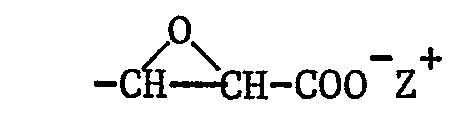
or a group -Y-(CR3R4)-COO-Z+ in which Y is CO or SO2, R3 is H, C1-C4 alkyl or -C00-, R4 is H or C1-C4 alkyl, and Z is an ammonium or alkali metal cation; m is 0 or 1, n is 0, 1 or 2; and p is 1, 2 or 3; and heating the material at a temperature between about 320-425° F over a period of 5-120 seconds.
wherein A is an organic dyestuff residue; R and R2; each independently of the other, is H or C1-C4 alkyl; B is a glycidic acid group
or a group -Y-(CR3R4)-COO-Z+ in which Y is CO or SO2, R3 is H, C1-C4 alkyl or -C00-, R4 is H or C1-C4 alkyl, and Z is an ammonium or alkali metal cation; m is 0 or 1, n is 0, 1 or 2; and p is 1, 2 or 3; and heating the material at a temperature between about 320-425° F over a period of 5-120 seconds.
2. A process as defined in claim 1, wherein said fiber material is a cellulosic.
3. A process as defined in claim 1, wherein said fiber material is a cellulosic-polyester
blend.
4. A process as defined in claim 1, wherein said temperature is between 395-425° F.
5. A dyestuff of the formula

wherein A is an organic dyestuff residue; R1 and R2, each independently of the other, is H or Cl-C4 alkyl; B is a glycidic acid group
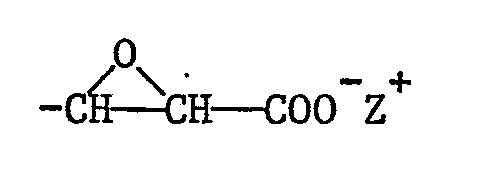
or a group -SO2-(CR3R4)―COO-Z+ in which R3 is H, Cl-C4 alkyl or C00 , R4 is H or Cl-C4 alkyl and Z+ is an ammonium or alkali metal cation; m is 0 or 1; n is 0, 1 or 2; and p is 1, 2 or 3.
wherein A is an organic dyestuff residue; R1 and R2, each independently of the other, is H or Cl-C4 alkyl; B is a glycidic acid group
or a group -SO2-(CR3R4)―COO-Z+ in which R3 is H, Cl-C4 alkyl or C00 , R4 is H or Cl-C4 alkyl and Z+ is an ammonium or alkali metal cation; m is 0 or 1; n is 0, 1 or 2; and p is 1, 2 or 3.
6. A dyestuff as defined in claim 5, of the formula

wherein R is an optionally substituted aryl radical containing at. least one -OH or -NH2 group.
wherein R is an optionally substituted aryl radical containing at. least one -OH or -NH2 group.
7. A dyestuff as defined in claim 5, wherein B is a glycidic acid group.
8. A dyestuff as defined in claim 5, wherein B is a group of the formula

9. A dyestuff as defined in claim 7, wherein m is 0 and n is 0.
10. A dyestuff as defined in claim 8, wherein R3 is H and R4 is H.